💥Join UPSC 2027,2028 Mentorship (July Batch) + XFactor Notes & Microthemes PDF

GS Paper: Indigenization Of Technology

  • Diagnostic sector requires Regulations

    Why in the News?

    India has around 3,00,000 diagnostic labs, and the number is increasing. However, the sector is largely unregulated, scattered, and concentrated in urban areas.

    What is the significance of India’s Diagnostics Sector?

    • Market Size and Growth: The Indian diagnostics market was valued at approximately US$13 billion in 2023 and is projected to reach US$25 billion by FY28. It is expected to grow at a CAGR of around 14%. Some projections estimate the market could reach US$40 billion by 2034.
    • Essential Component of Healthcare: Diagnostics play a crucial role in disease prevention, early detection, and effective management, making them an essential part of modern healthcare. Doctor recommendations drive a major part of the diagnostic business, with tests being conducted for most patients before prescribing medication.
    • Key Market Segments: The sector is primarily divided into pathology (60%) and radiology (40%). Pathology is further broken down into illness (acute and chronic) and wellness segments.
    • Drivers of Growth: Several factors contribute to the sector’s growth, including increasing life expectancy, a growing middle class, higher penetration of government insurance schemes, rising income levels, and increasing awareness of preventive testing. An aging population and the rise in chronic diseases also fuel the demand for diagnostic services.

    What are the challenges faced by the Diagnostics Sector?

    • Urban-Rural Divide: A significant portion of diagnostics revenue (76%) comes from urban areas, even though 70% of India’s population resides in rural areas.
    • Disparities in Infrastructure: Rural areas have fewer healthcare facilities, with only about 36.5% of the total hospital beds, leading to delayed treatments and poorer health outcomes
    • Regulatory Issues: The Kerala State Clinical Establishments Act faces resistance due to stringent space (300 sq. ft. in rural areas, 500-700 sq. ft. in urban areas) and educational requirements, making compliance unviable for many small labs.
    • Standardization Needs: Lack of uniform testing protocols leads to errors. Example: A government lab in Karnataka reported a platelet count of 0.47 lakh/cmm, but a private lab retest showed 2.2 lakh/cmm, highlighting the need for mandatory NABL accreditation and standard SOPs to ensure diagnostic accuracy.
    • Infrastructure Gaps in Public Sector: Lack of essential upgrades in government labs (e.g., Osmania and Gandhi Hospitals in Hyderabad). Limited operational hours and unavailability of specialists in government hospitals force patients to private facilities.

    What are the present Regulations implemented by the govt for this Sector?

    • Clinical Establishments Act, 2010: This act aims to regulate diagnostic centers but has been adopted by only 12 states and Union Territories, leading to inconsistent regulations across the country.  
    • Medical Devices Rules, 2017: These rules govern medical devices, an integral part of the diagnostics framework, focusing on manufacturing, import, sale, distribution, and quality and safety control. They provide risk-based categorization, establish product standards, and set timelines for obtaining licenses.
    • State-Specific Regulations: Some states like Karnataka and Kerala have separate regulatory frameworks, but enforcement remains inconsistent. Tamil Nadu’s Clinical Establishments (Regulations) Rules, 2018, mandate minimum space requirements for labs.
    • Pricing Regulations for Government-Led Diagnostic Schemes: Limits test costs to reduce out-of-pocket expenses for patients. Example: Telangana’s T-Diagnostics Programme has conducted 18.10 crore tests at subsidized rates, saving ₹1,100 crore for patients.
    • Mandatory Quality Control & External Audits: Enforces periodic inspections to maintain test accuracy. Example: Karnataka’s KPME Act mandates SOPs for sample collection, testing, and reporting, with penalties for non-compliance.


    Way forward: 

    • Expand Rural Diagnostic Infrastructure: Strengthen public-private partnerships (PPPs) to enhance diagnostic services in rural areas, improve affordability, and ensure equitable access through mobile labs and telemedicine integration.
    • Enforce Uniform Regulatory Standards: Implement a nationwide mandatory NABL accreditation and standard operating procedures (SOPs) for all diagnostic centers to ensure quality, accuracy, and compliance across states.

    Mains PYQ:

    Q What do you understand by nanotechnology and how is it helping in health sector? (UPSC IAS/2020)
  • India needs to be a global champion in sunrise sectors

    Why in the News?

    India must lead in emerging industries to become a developed nation and a USD 32 trillion economy by 2047. Niti Ayoge CEO stressed the need to produce solar panels and electric vehicles.

    What are the Sunrise sectors?

    • Sunrise sectors refer to rapidly growing industries that are in their early stages but have high potential for expansion. These sectors attract significant venture capital and are appealing for long-term growth prospects.
    • Niti Aayog CEO believes that excelling in these sectors is crucial for India to meet its ambitious economic targets by 2047.

    Key Sunrise Sectors: 

    • Electric Vehicles (EVs): With initiatives like FAME II, India aims to boost EV manufacturing and infrastructure. The sector is expected to grow significantly, contributing to sustainability and reducing dependence on fossil fuels.
    • Electronics and Semiconductors: The semiconductor market in India is projected to triple by 2026, driven by government incentives and initiatives like the PLI Scheme. This sector is vital for establishing India as a global manufacturing hub.
    • Renewable Energy: India is focusing on renewable energy sources, particularly solar power, where it currently lags behind globally by 5-7 years in manufacturing capabilities.
    • Artificial Intelligence (AI) and advanced tech: It will drive innovation, economic growth, and global competitiveness.

    What are the potential impacts?

    • Economic Growth: By investing in sunrise sectors, India can drive economic growth through innovation, job creation, and industrial development. This can help bridge the gap to becoming a global economic power.
    • Sustainability: These sectors align with global sustainability goals, helping India reduce dependency on fossil fuels and transition to cleaner, more renewable energy sources, ultimately aiding in climate change mitigation.
    • Global Competitiveness: Being a leader in sunrise sectors, such as electric vehicles or solar panel manufacturing, can position India as a global hub for cutting-edge technology and innovation.

    What are the challenges faced by the Sunrise Sectors in India?

    • Technological Gap: Indian industries are lagging in areas like solar panel manufacturing and electric vehicles, often 5-7 years behind global leaders. This technological gap hinders competitiveness and innovation. Example: India has not fully capitalized on the growing electric vehicle market, which is dominated by countries like China.
    • Infrastructure and Investment Deficits: India’s current infrastructure does not fully support the rapid scaling of sunrise sectors. Additionally, private credit to GDP in India is lower compared to global giants like the US and China, affecting the ability of industries to scale up. Example: Limited investments in research, development, and infrastructure for clean technology and manufacturing.
    • Policy and Regulatory Bottlenecks: India’s policy frameworks for clean technology and green industries often lack the depth and support required for aggressive global competition. There is a need for more incentives, clear regulatory guidelines, and quicker approvals for new technologies.

    Way forward: 

    • Increased Investment in Research and Development: India must invest heavily in R&D for sunrise sectors, particularly in clean technologies and electric vehicle manufacturing. Government-backed initiatives and partnerships with global players can help bridge technological gaps.
    • Policy Support and Incentives: India should provide stronger policy frameworks, such as tax incentives, subsidies for clean tech investments, and faster clearances for new ventures in sunrise sectors. More investment in infrastructure, particularly for electric vehicle charging stations and renewable energy grids, is crucial.

    Mains PYQ:

    Q How is efficient and affordable urban mass transport key to the rapid economic development in India? (UPSC IAS/2019)

  • Long Range Glide Bomb (LRGB) ‘GAURAV’

    Why in the News?

    • The Defence Research and Development Organisation (DRDO) has successfully conducted the maiden flight test of the long-range glide bomb (LRGB) Gaurav’.
      • The test was carried out from a Su-30 MK-I fighter jet of IAF.

    About LRGB GAURAV

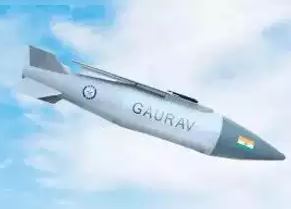
    • LRGB Gaurav is a 1,000 kg class long-range glide bomb developed by the DRDO.
    • It is air-launched from a Su-30 MK-I fighter jet of the Indian Air Force.
    • The bomb is designed and developed indigenously by the Research Centre Imarat (RCI), Hyderabad.
    • Adani Defence and Bharat Forge participated as Development cum Production Partners in the Gaurav project.
    • Key Features:
      • It uses a hybrid navigation system that combines Inertial Navigation System (INS) with Global Positioning System (GPS) data for highly accurate targeting.
      • The glide bomb is capable of hitting targets at long distances, although the exact range is not publicly disclosed.
      • Gaurav enhances India’s precision strike capabilities, allowing for significant impact on various target types with reduced risk to aircraft.

    PYQ:

    [2014] Which reference to Agni-IV Missile, which of the following statements is/are correct?

    1. It is a surface-to-surface missile.

    2. It is fuelled by liquid propellant only.

    3. It can deliver one-tonne nuclear warheads about 7500 km away.

    Select the correct answer using the code given below.

    (a) 1 only

    (b) 2 and 3 only

    (c) 1 and 3 only

    (d) 1, 2 and 3

  • DAC approves amendment to MQ-9B UAV deal with US

    Why in the News?

    • The Defence Acquisition Council (DAC) has reviewed and approved amendments to the deal for 31 MQ-9B High Altitude Long Endurance (HALE) Unmanned Aerial Vehicles (UAVs) from General Atomics of the US.
      • The DAC also approved a proposal for the scheduled refit of aircraft carrier INS Vikramaditya later this year.

    About MQ-9B HALE UAV

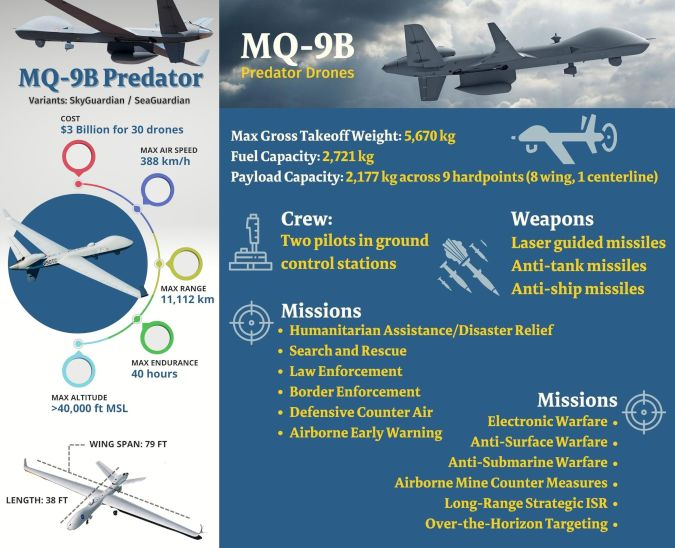
    • The MQ-9B drone is a version of the MQ-9 “Reaper” and has two models: Sky Guardian and Sea Guardian.
    • It is built by the General Atomics.
    • This drone can fly over 40,000 feet high, making it useful for watching the Himalayan border areas.
    • It can stay in the air for up to 40 hours, perfect for long surveillance missions.
    • The MQ-9B has advanced features like automatic take-off and landing, a system to avoid other objects, secure GPS, and encrypted communications.
    • It can offer 80% of a manned aircraft’s capabilities at 20% of the cost per hour.
    • Deployment:
      • The MQ-9B drones are planned to be deployed at four places, including INS Rajaji near Chennai and Porbandar in Gujarat, by the Indian Navy.
      • The other two services will keep them jointly at two bases in Sarsawa and Gorakhpur in Uttar Pradesh at Air Force bases due to long runway requirements.

    Specifications of the Procurement:

    • India is looking to procure 31 MQ-9B UAVs, including 15 Sea Guardians for the Indian Navy and 16 Sky Guardians (eight each for the Indian Army and Air Force).
    • The Indian Navy has leased two MQ-9As with the maiden flight taking place on November 21, 2020.
    • The estimated cost is $3.99 billion.
    • As part of the deal, General Atomics will establish a Global Maintenance, Repair, and Overhaul (MRO) facility in India, contributing to offset obligations.

    Significance of the deal

    • The SeaGuardian model can help the Navy patrol large areas more economically than manned aircraft.
    • For the Army and Air Force, these drones will help monitor movements along the borders, especially with China.

    Back2Basics: Defence Acquisition Council (DAC)

    Details
    Constitution Established under the Defence Ministry for guiding defence procurement planning.
    Role Highest decision-making body in the Defence Ministry for new policies and capital acquisitions for the Army, Navy, Air Force, and Indian Coast Guard.
    Formation Created in 2001 following recommendations on reforming the National Security System after the Kargil War.
    Chairman Minister of Defence.
    Members Chief of Defence Staff (CDS), Minister of State for Defence, Three Service Chiefs (Army, Navy, Air Force), Chief of Integrated Staff Committees, Defence Secretary, Secretary Defence Research & Development.
    Functions
    • In-principle approval of the 15 Year Long-Term Integrated Perspective Plan for Defence Forces.
    • Accord of Acceptance of Necessity for acquisition proposals.
    • Categorize acquisition proposals into ‘Buy’, ‘Buy & Make’, and ‘Make’.
    • Decisions on offset provisions for acquisitions above Rs. 300 crores.
    • Decisions regarding the transfer of technology under the ‘Buy & Make’ category.


    PYQ:

    [2018] What is “Terminal High Altitude Area Defense (THAAD)”, sometimes seen in the news?

    (a) An Israeli radar system

    (b) India’s indigenous anti-missile programme

    (c) An American anti-missile system

    (d) A defence collaboration between Japan and South Korea

  • [pib] Launching of LSAM 20 (Yard 130)  

    Why in the News?

    The Indian Navy has inducted the ‘Ammunition Cum Torpedo Cum Missile Barge, LSAM 20 (Yard 130) into its fleet.

    What is LSAM 20?

    • LSAM 20 (Yard 130) is the Ammunition Cum Torpedo Cum Missile Barge (Storage) inducted by the Indian Navy.  (built by MSME Shipyard, M/s Suryadipta Projects Pvt Ltd, Thane).
    • LSAM 20 facilitates transportation, embarkation, and disembarkation of articles/ammunition to IN Ships.
    • These Barges are indigenously designed and built under relevant Naval Rules and Regulations of the Indian Register of Shipping.

    Objective 

    • A Torpedo Cum Missile Barge is a specialized vessel used by the Indian Navy to transport various types of ammunition, torpedoes, and missiles to operational areas. 
    • These barges play a crucial role in providing logistical support to naval vessels by ensuring the uninterrupted transportation of essential military supplies. 

    PYQ:

    [2016] Which one of the following is the best description of ‘INS Astradharini’, that was in the news recently?

    (a) Amphibious warfare ship

    (b) Nuclear-powered submarine

    (c) Torpedo launch and recovery vessel

    (d) Nuclear-powered aircraft carrier

    Practice MCQ:

    What is the primary function of LSAM 20 (Yard 130) recently inducted by the Indian Navy?

    a) Transportation of personnel

    b) Transporting ammunition, torpedoes, and missiles

    c) Search and rescue operations

    d) Underwater surveillance


  • K-9 Vajra Howitzers and Su-30 MKI Fighter Aircraft Engines                                  

    Why in the news?

    Several critical ‘Make in India’ defence projects, including acquisitions of K-9 Vajra self-propelled howitzers and Su-30 MKI fighter aircraft engines, are pending final approval from the Centre post-elections.

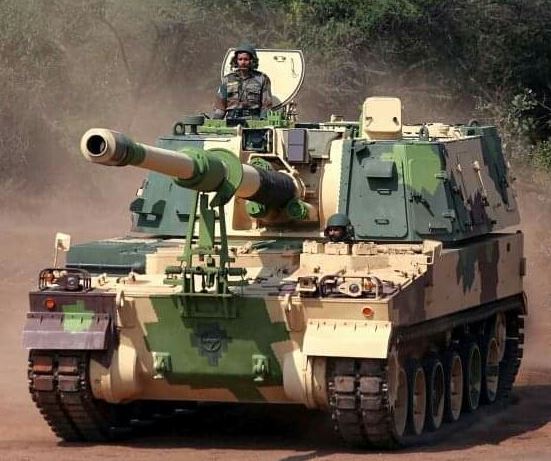
    About K-9 Vajra Self-Propelled Howitzers:

    • It is a self-propelled howitzer.
    • Technology: It incorporates technology transferred from South Korean defence major Hanwha Defense based on its K9 Thunder.
    • Development: The K9 gun has been developed under the ‘Buy Global’ programme of the Defence Procurement Procedure (DPP) where foreign companies are allowed to participate.
    • Features: The platform boasts all-welded steel armour protection. Initially intended for desert use, it has been deployed in mountainous regions due to the India-China standoff.
    • Winterisation: To ensure optimal performance in extreme cold conditions, the Army procured winterisation kits for the regiment deployed in mountainous areas.

    About Su-30MKI:

      • The Sukhoi Su-30MKI is a two-seater, twinjet multirole air superiority fighter. It is built under license by India’s Hindustan Aeronautics Limited (HAL).
    • Design: 
      • It was designed by Russia’s Sukhoi Corporation beginning in 1995 and built under licence by India’s Hindustan Aeronautics Limited (HAL).
      • The first squadron was inducted into the Indian Air Force (IAF) in 2002.
    • Characteristics:
      • It is a heavy, all-weather, long-range fighter with a highly integrated twin-finned airframe.
      • The construction materials include titanium and high-strength Aluminium alloy.

    Engine Upgrade:

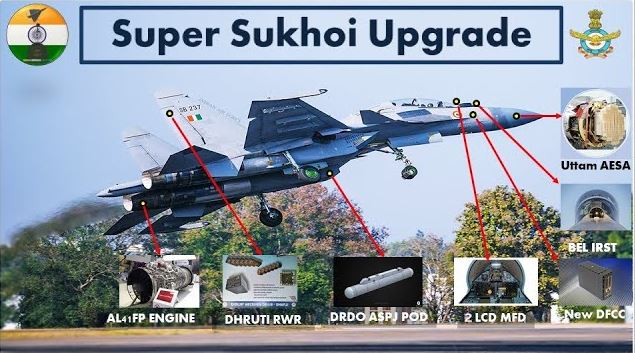
    India’s “Super Sukhoi” Program aims to enhance the performance and longevity of AL-31F engines, addressing long-standing engine failure issues and deficiencies.


    PYQ:

    [2016] Which one of the following is the best description of ‘INS Astradharini’, that was in the news recently?

    (a) Amphibious warfare ship
    (b) Nuclear-powered submarine
    (c) Torpedo launch and recovery vessel
    (d) Nuclear-powered aircraft carrier

  • How is India planning to boost EV production?

    Why in the News? 

    The Union government approved a policy to promote India as a manufacturing hub for Electric Vehicles (EVs).

    Features of the Electric Vehicles policy:

    • Reduction of Import Duty: Import duty on electric vehicles (EVs) imported as Completely Built Units (CBUs) with a minimum CIF value of $35,000 is reduced from 70%-100% to 15% for five years.  
    • Waiver of Duty: A maximum of 40,000 EV imports in five years, with a duty waiver of ₹6,484 crore or proportional to investment (whichever is lower), requires a minimum $800 million investment.
    • Localization Targets: Manufacturers are required to set up manufacturing facilities in India within three years. They must achieve 25% localization by the third year and 50% localization by the fifth year of incentivized operation.
    • Incentives for Setting Up Manufacturing Facilities: The policy incentivizes manufacturers to establish manufacturing facilities in India by offering reduced import duties and waivers, provided they meet certain investment and localization targets.
    • Encouragement of Global EV Makers: The policy aims to encourage global EV makers like Tesla and Chinese EV maker BYD to enter the Indian market by providing favorable conditions for setting up manufacturing facilities and importing EVs.

    Present concerns raised by Private Players in the Market:

    • Impact on Domestic Industry: Tata Motors opposed the reduction of import duties, fearing it would negatively affect the domestic industry. They argued that lowering duties could harm the investment climate.
    • Competitive Disadvantage: Domestic players are concerned that the policy benefits mainly higher-end Original Equipment Manufacturers (OEMs), potentially placing them at a competitive disadvantage in segments below ₹29 lakh.
    • Favoring Global Players: The policy appears to favor global EV players and Indian joint ventures with such players, potentially making it more challenging for purely domestic players to compete effectively.

    Conclusion: The government should engage in dialogue with stakeholders, including domestic players like Tata Motors, to address their concerns and seek their input in shaping the policy framework. Need to implement measures to support domestic players, including providing incentives and support for technology development, innovation, and capacity building.


    Mains question for practice 

    Q Indian Government has recently approved a policy aimed at promoting the country as a manufacturing hub for Electric Vehicles (EVs). Discuss the key features of this policy. Highlight the concerns raised by private players.

    Mains PYQ 

    Q How is efficient and affordable urban mass transport key to the rapid economic development in India? (UPSC IAS/2019)

  • AgniKul ‘Agnibaan SOrTeD’ Mission

    Why in the news?

    • For the second time, the launch of AgniKul ‘Agnibaan SOrTeD’ has been postponed.
    • The IIT Madras-based Agnikul Cosmos was to test-fire an Agnibaan rocket with 3D-printed engine, aiming for suborbital flight trajectory control.

    What is Agnibaan SOrTeD (Suborbital Tech Demonstrator)?

    • Agnibaan SOrTeD is a single-stage launch vehicle powered by Agnikul’s patented Agnilet semi-cryogenic engine.
    • In contrast to traditional sounding rockets, Agnibaan SOrTeD’s vertical take-off and precise trajectory enable orchestrated maneuvers during flight.

    Distinct Features of Agnibaan:

    • Customizability: The rocket offers custom launch configurations, either single or two-stage launches.
    • Dimensions: Standing at 18 meters and weighing 14,000 kg, Agnibaan SOrTeD is a powerful presence.
    • Payload Capacity: With a capacity for payloads of up to 100 kg, it can reach altitudes of 700 km in five different Lower Earth Orbits (LEOs).
    • Engine Configuration: The first stage can house up to seven Agnilet engines, powered by Liquid Oxygen and Kerosene, dependent on the mission’s requirements.
    • Launch Pedestal ‘Dhanush’: AgniKul’s built ‘Dhanush’ supports the rocket’s mobility across configurations, ensuring compatibility with multiple launch ports.
    • Agnilet Engine: Agnilet engine, a 3D-printed, single-piece, 6 kN semi-cryogenic marvel, drives Agnibaan’s propulsion. The engine employs a novel blend of liquid kerosene and supercold liquid oxygen as propellants.

    PYQ:

    [2011] Satellites used for telecommunication relay are kept in a geostationary orbit. A satellite is said to be in such an orbit when:

    1.    The orbit is geosynchronous.

    2.    The orbit is circular.

    3.    The orbit lies in the plane of the Earth’s equator.

    4.    The orbit is at an altitude of 22,236 km

    Select the correct answer using the codes given below:

    (a) 1, 2 and 3 only

    (b) 1, 3 and 4 only

    (c) 2 and 4 Only

    (d) 1, 2, 3 and 4

  • What is Project Akashteer?

    Why in the news?

    • The Indian Army’s Corps of Army Air Defense has initiated the induction of control and reporting systems under ‘Project Akashteer’ to bolster its air defense capabilities.

    About Project Akashteer

    • The Akashteer Project is an initiative designed to automate air defence control and reporting processes by digitising the entire process.
    • It is developed by Bharat Electronics Limited (BEL) as part of the ‘Atmanirbhar Bharat’ initiative.
    • It seeks to induct Akashteer Command and Control Systems
    • By integrating radar and communication systems at all levels into a unified network, ‘Akashteer’ aims to deliver an unprecedented level of situational awareness and control.
    • This will enable swift engagement of hostile targets, significantly reduce the risk of fratricide, and ensure the safety of friendly aircraft in contested airspace.

    How it will help India’s air defence system?

    The ‘Akashteer Command and Control Systems’ will significantly enhance India’s air defense capabilities in several ways:

    1. Efficiency and Integration: Digitizing Air Defence Control and Reporting processes with ‘Akashteer’ will improve efficiency and integration. This enables the Indian Army to respond swiftly to hostile threats while reducing the risk of friendly fire incidents.
    2. Situational Awareness: ‘Akashteer’ integrates radar and communication systems into a unified network, providing the Indian Army with better situational awareness. This enables them to detect and engage hostile targets more effectively, ensuring the safety of friendly aircraft in contested airspace.
    3. Mobility and Resilience: The system’s vehicle-based and mobile Control Centers are designed for operational capabilities even in challenging communication environments. This ensures that the Indian Army can operate effectively in diverse terrain and adverse conditions.
    4. Automation: Deployment of ‘Akashteer’ represents a move towards complete automation of air defense operations. This enhances the Indian Army’s ability to defend its airspace, ensuring a safer and more secure future for the country.

    PYQ:

    [2018] What is “Terminal High Altitude Area Defense (THAAD)”, sometimes seen in the news?

    (a) An Israeli radar system

    (b) India’s indigenous anti-missile programme

    (c) An American anti-missile system

    (d) A defence collaboration between Japan and South Korea

  • NexCAR19: India’s First Indigenous CAR T- Cell Therapy for Cancer

    Why in the news?

    • President Droupadi Murmu has unveiled ‘NexCAR19’ India’s first indigenously-developed CAR T-cell therapy for cancer treatment.

    What is CAR-T Cell Therapy?

    What is it?
    • CAR-T cell therapy stands for Chimeric Antigen Receptor T cell therapy.
    • It is a type of cancer immunotherapy that uses the patient’s own T cells, genetically modified in a laboratory to enhance their ability to locate and destroy cancer cells.
    How does it work?
    • T cells are white blood cells responsible for identifying and fighting illness and infection.
    • Each T cell has a receptor that can recognize antigens (proteins or molecules recognized by the immune system).
    • Cancer cells may have antigens that the immune system does not recognize as abnormal, allowing cancer to evade the immune response.
    • CAR-T cells are genetically engineered in the lab to express a new receptor that can bind to cancer cells and effectively kill them.
    Therapy Process The process involves several steps, including:

    1. Collecting T Cells: Blood is drawn from the patient’s arm, and T cells are separated from the blood using an apheresis machine.

    2. Engineering T Cells: In a laboratory, the T cells are modified by adding a manufactured CAR, and they are allowed to multiply and grow.

    3. Infusing CAR-T Cells: Once enough CAR-T cells are prepared, they are injected back into the patient’s arm.

    • Chemotherapy may be recommended before CAR-T cell infusion to enhance treatment effectiveness.
    • The process can take place in an outpatient infusion center or a hospital setting.
    Cancers Treated
    • CAR-T cell therapy is effective against certain types of cancer, especially when other treatments are ineffective.
    • It is currently FDA-approved for treating haematological malignancies, including leukemia, lymphoma, and multiple myeloma.


    NexCAR19: India’s Indigenously Developed CAR-T Therapy

    • NexCAR19 is designed to target cancer cells carrying the CD19 protein, a marker on cancer cells, enhancing precision in treatment.
    • It has been developed jointly by IIT Bombay and the Tata Memorial Centre.
    • Initially approved for patients aged 15 and above with B-cell lymphomas who did not respond to standard treatments, leading to relapse or recurrence.

    Effectiveness and Unique Features

    • Approximately 70% of patients respond to NexCAR19 treatment, with some achieving complete remission.
    • Lab and animal studies indicate lower drug-related toxicities, including reduced neurotoxicity and Cytokine Release Syndrome (CRS).
    • Trials for paediatric patients are underway at Tata Memorial Hospital, ensuring broader applicability.

    Availability and Affordability

    • ImmunoACT is in the process of securing licenses and partnering with hospitals, including Tata Memorial, Nanavati, Fortis, and Jaslok, across multiple cities.
    • Initially priced at Rs 30-40 lakh, ImmunoACT aims to eventually reduce the cost to Rs 10-20 lakh, making the therapy more accessible.

    PYQ:

    2017:

    Stem cell therapy is gaining popularity in India to treat a wide variety of medical conditions including leukaemia, Thalassemia, damaged cornea and several burns. Describe briefly what stem cell therapy is and what advantages it has over other treatments?


    Practice MCQ:

    With reference to the CAR-T Cell Therapy, consider the following statements:

    1.    T cells are Red Blood Cells responsible for identifying and fighting illness and infection.

    2.    Each T cell has a receptor that can recognize antigens (proteins or molecules recognized by the immune system).

    Which of the given statements is/are correct?

    (a) Only 1

    (b) Only 2

    (c) Both 1 and 2

    (d) Neither 1 nor 2