Mains Ready By December. Smash Mains & Smash PYQ Admissions Open

GS Paper: GS2

  • India-Pakistan Trade

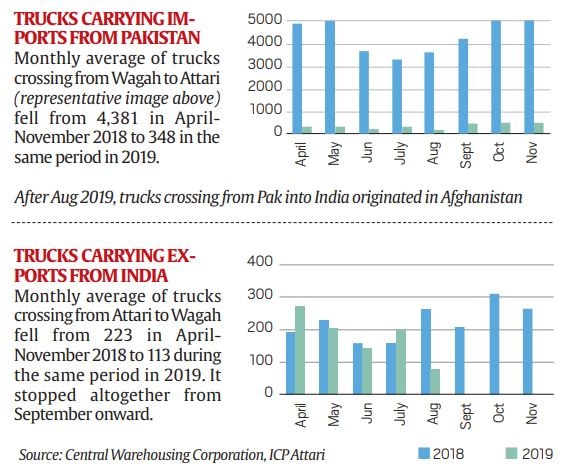
    Tensions between India and Pakistan in 2019 have reduced the already low volumes of trade between the two countries to near zero.

    India-Pakistan trade, in the beginning

    • In 1948-49, about 56% of Pakistan’s exports were to India, and 32% of its imports came from India.
    • From 1948-65, India and Pakistan used a number of land routes for bilateral trade; there were eight customs stations in Pakistan’s Punjab province and three customs checkpoints in Sindh.
    • India remained Pakistan’s largest trading partner until 1955-56. Between 1947 and 1965, the countries signed 14 bilateral agreements on trade, covering avoidance of double taxation, air services, and banking, etc.
    • In 1965, nine branches of six Indian banks were operating in Pakistan.

    Close to vanishing

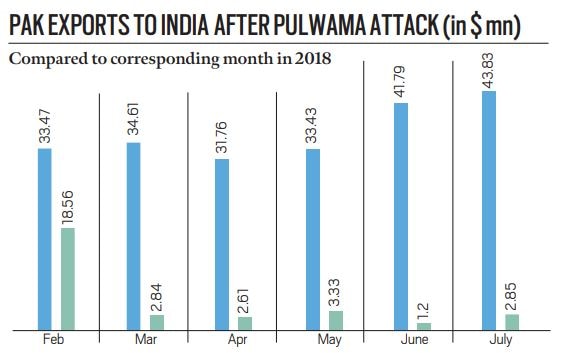
    • Following the terrorist attack on the CRPF convoy in Pulwama in February, India withdrew Most Favoured Nation (MFN) status for Pakistan and raised customs duty on Pakistani imports to 200% .
    • In April, India suspended cross-LoC trade to stop the misuse of this route by Pakistan-based elements.
    • Pakistan on its part closed its airspace to India for a prolonged period.
    • The decisions by both countries, while targeted at hurting the neighbour, have severely impacted the livelihoods of individuals and families involved in cross-border trading activities.
  • Pulse Polio Programme

    The beginning of this year’s Pulse Polio Programme was inaugurated from the Rashtrapati Bhavan itself.  To prevent the virus from coming to India, the government has since March 2014 made the Oral Polio Vaccination (OPV) mandatory for those travelling between India and polio-affected countries.

    The Pulse Polio Programme

    • India launched the Pulse Polio immunisation programme in 1995, after a resolution for a global initiative of polio eradication was adopted by the World Health Assembly (WHA) in 1988.
    • Children in the age group of 0-5 years are administered polio drops during national and sub-national immunisation rounds (in high-risk areas) every year.

    India is polio-free

    • According to the Ministry of Health, the last polio case in the country was reported from Howrah district of West Bengal in January 2011.
    • The WHO on February 24, 2012, removed India from the list of countries with active endemic wild polio virus transmission.
    • Two years later, the South-East Asia Region of the WHO, of which India is a part, was certified as polio-free.

    Back2Basics

    What is Polio?

    • The WHO defines polio or poliomyelitis as a highly infectious viral disease, which mainly affects young children.
    • The virus is transmitted by person-to-person, spread mainly through the faecal-oral route or, less frequently, by a common vehicle (e.g. contaminated water or food) and multiplies in the intestine, from where it can invade the nervous system and can cause paralysis.
    • Initial symptoms of polio include fever, fatigue, headache, vomiting, stiffness in the neck, and pain in the limbs. In a small proportion of cases, the disease causes paralysis, which is often permanent.
    • There is no cure for polio, it can only be prevented by immunization.
  • Cabinet Committee on Investment and Growth (CCIG)

    • In an austerity move, the Union government has decided to reduce wasteful expenditure on items such as travel and food by 20 percent, it is learnt.
    • A decision of this effect was taken at a recent meeting of the Cabinet Committee on Investment and Growth (CCIG) chaired by Prime Minister Narendra Modi.
    • All ministries have been directed to reduce wasteful expenditure on travel, food and conferences by 20 percent.
    • Note: The CCIG was recently created in June 2019.
  • [op-ed snap] Seize the summit

    Context

    India announced that it will invite all heads of government of Shanghai Co-operation Organisation member countries, including Pakistan.

    Significance of the invitation

    • First since 2014: The summit will assume significance should Pakistan Prime Minister accept the invitation.
      • As it will be the first by a head of government or state of that country to India since former Prime Minister Nawaz Sharif attended the swearing-in ceremony of Prime Minister in 2014.
    • Hopes belied: Nothing came from that meeting and hopes created by the invitation were belied.
    • Failed attempts to engage: Attempts to engage after that failed, including at a previous SCO summit at Ufa in 2015.

    Latest events that further reduced the engagement

    • Pulwama attack: First, there was the February 2019 Pulwama attack, India’s Balakot response, and Pakistan’s counter-response.
    • Article 370: After India did away with Jammu & Kashmir’s special status, India and Pakistan have downgraded even their diplomatic presence in each other’s countries.
    • Both the countries withdrew their high commissioners after the Article 370 issue.
    • Trade stopped completely: Bilateral trade, which had managed to survive earlier shocks to relations, has stopped completely.

    Opportunities presented by SCO summit

    • “Inputs of all stakeholders”: In deciding whether to accept the invitation, the Pakistan PM will have to take into consideration “inputs of all stakeholders”.
    • A polite way of saying that the final yes or no will rest with the Pakistan Army.
    • A chance for a high-level meeting: Even if Imran Khan stays away and sends a minister instead, it would still be a chance for a high-level bilateral meeting.
    • The world wants India and Pakistan to engage: The world wants India and Pakistan to engage, and this was evident in the way the UNSC refused to take up the Kashmir issue, saying it was not the forum for it.
    • Opportunity for India to make a start: India has declared several times recently that it wants to peel away from historical foreign policy baggage.
      • India should make a start with Pakistan by making it possible for such a meeting to take place.
    • Making acceptance of invitation easier: India can make it easier for the Pakistan Prime Minister to accept the invitation.
    • Resuming trade: A start could be made by resuming trade, which has ground to a dead halt
    • Sending High Commissioner back: India can start by sending India’s High Commissioner back to his office in Islamabad.

     Conclusion

    The SCO summit presents an opportunity for both the countries to end the long hiatus in the relations which is essential for both the countries to resolve the long-standing issues and progress of both the countries.


  • Death Penalty in India (Annual Statistics Report 2019)

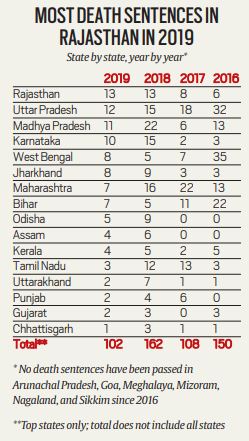
    Trial courts in India delivered 102 death sentences in 2019, over 60% fewer than the 162 death sentences passed in 2018.

    Highlights of the Report

    • In 2019, fewer death sentences overall were delivered.
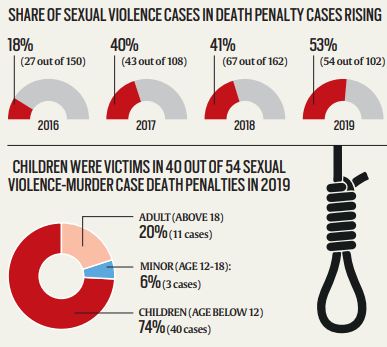
    • 1 out of 2 sentences for sexual violence-murder; in 3 out of 4 sexual violence-murder death sentences, children were the killer’s victims.
    • The courts were, however, especially unforgiving of murders that involved sexual violence — the proportion of death sentences imposed for murders involving sexual offences was at a four-year high in 2019 at 52.94%.
    • 2019 also saw the highest number of confirmations by High Courts in four years; 17 out of the 26 confirmations (65.38%) were in offences of murder involving sexual violence.
    • The Supreme Court, primarily during the tenure of the previous CJI Gogoi, listed and heard 27 capital cases, the most in a year since 2001.

    Project 39A

    • These are the headline findings in the fourth edition of The Death Penalty in India: Annual Statistics, published by Project 39A at the National Law University (NLU), Delhi.
    • Project 39A is a research and litigation initiative focussed on the criminal justice system, and especially issues of legal aid, torture, death penalty, and mental health in prisons.
    • The report tracked news of death sentences awarded by trial courts published online by news organisations in English and Hindi.
    • It checked these numbers against judgments uploaded to websites of High Court and district courts.
  • Yada Yada Virus

    A new virus detected in Australian mosquitoes has been provisionally named the Yada Yada virus (YYV).

    Yada Yada

    • It is an alphavirus, a group of viruses that the researchers described as small, single-stranded positive-sense RNA viruses.
    • It includes species important to human and animal health, such as Chikungunya virus and Eastern equine encephalitis virus.
    • They are transmitted primarily by mosquitoes and (are) pathogenic in their vertebrate hosts.
    • Unlike some other alphaviruses, Yada Yada does not pose a threat to human beings.
  • [op-ed of the day] Preventing mob lynching

    Context

    The spate of incidents of lynching over the past few years has led to a heightened sense of insecurity among the marginalised communities. The Centre should specify penal action against officials and doctors accused of dereliction of duty.

    2018 Supreme Court Judgement

    • In 2018, the Supreme Court described lynching as a “horrendous act of mobocracy”.
    • The Court exhorted the Centre and State governments to frame laws specifically to deal with the crime of lynching.
    • The SC laid down certain guidelines to be incorporated in these laws including
      • Fast-track trials.
      • Compensation to victims, and
      • Disciplinary action against lax law-enforcers.

    The State laws

    • Manipur bill for the law against lynching:  The Manipur government came up first with its Bill against lynching in 2018, incorporating some logical and relevant clauses.
      • Provision of nodal officer: The Bill specified that there would be nodal officers in each district to control such crimes.
      • Compensation to the victim: The law provides for adequate monetary compensation to the victims or their immediate kin.
      • Punishment for failure to enforce the law: Police officers who fail to prevent the crime of lynching in their jurisdiction are liable to be imprisoned for a term that may extend from one to three years with a fine limit of ₹50,000.
      • No concurrence of state for the prosecution of the police: No concurrence of the State government is required to prosecute them for dereliction of duty.
    • Rajasthan bill: The government has accepted only a few guidelines issued by the apex court.
      • No action against police officers: The bill is also silent on any action to be initiated against police officers who may be accused of dereliction of duty.
    • West Bengal bill: Most other guidelines of the Supreme Court have been adopted by the State.
      • Stringent punishment: Punishment for lynching to death is punishable with the death penalty or life imprisonment and a fine of up to ₹5 lakh.

    What the Centre can do

    • Adoption of the SC guidelines: The Centre should adopt the guidelines provided by the SC to deal with the crime.
    • Action against doctors: Centre would do well to incorporate sections in the law for penal action against doctors who stand accused of-
      • Dereliction of duty.
      • For delay in attending to victims of lynching.
      • For submitting false reports without carrying out a proper and thorough medical examination of the victims.
    • The compensation scheme for victims: Under the compensation scheme for the victims, the amount to be paid to the victims should be recovered from the perpetrators of the crime.
      • Collective fines: Collective fines should be imposed on the villagers where the lynching takes place.
    • Punishment for a political leader for inciting the mob: Centre could even provide for punitive action against political leaders found guilty of inciting mobs.
    • Punitive action against police: Punitive action to be taken against police officers accused of dereliction of duty, as incorporated in the law enacted by Manipur government, could be replicated in the Central law too.
      • Punitive action as a deterrent: It would deter police officials acting in a partisan manner in favour of the lynch mob.

    Conclusion

    Until a zero-tolerance attitude is adopted in dealing with mob lynching, this crime will continue to show a rising trend.