đŸ’„Join UPSC 2027,2028 Mentorship (July Batch) + XFactor Notes & Microthemes PDF

GS Paper: Population & Associated Issues

  • Who are the Bru Tribals?

    Non-Brus of Tripura has proposed six places for settling the displaced Brus from Mizoram and set a limit for the number of families to be accommodated in two subdivisions that have borne the brunt of the 23-year-old refugee crisis.

    Try this PYQ:

    Q. With reference to ‘Changpa’ community of India, consider the following statement:

    1. They live mainly in the State of Uttarakhand.
    2. They rear the Pashmina goats that yield fine wool.
    3. They are kept in the category of Scheduled Tribes.

    Which of the statements given above is/are correct? (CSP 2014)

    (a) 1 only

    (b) 2 and 3 only

    (c) 3 only

    (d) 1, 2 and 3

    Who are the Brus?

    • Reangs or Brus are the second largest ethnic group in Mizoram.
    • Their exodus in 1997 was spurred by violent clashes in Mamith subdivision, a Reang-dominated area when they demanded the creation of an autonomous council that was vehemently opposed by Mizo groups.
    • Around 34,000 people were forced to live in sub-human conditions in tents in Tripura. No solution could be reached all these years.
    • These people were housed in temporary camps at Kanchanpur, in North Tripura.

    Read the complete thread here:

    [Burning Issue] Bru– Reang Repatriation Agreement

  • Tribe in news: Siddi Community

    The Siddi community gets its first lawmaker in Karnataka. They are included as the Scheduled Tribes in Karnataka.

    Try this question from CSP 2019:

    Q.Consider the following statements about Particularly Vulnerable Tribal Groups (PVTGs) in India:

    1. PVTGs reside in 18 States and one Union Territory.
    2. A stagnant or declining population is one of the criteria for determining PVTG status.
    3. There are 95 PVTGs officially notified in the country so far.
    4. Irular and Konda Reddi tribes are included in the list of PVTGs.

    Which of the statements given above are correct?

    (a) 1, 2 and 3

    (b) 2, 3 and 4

    (c) 1, 2 and 4

    (d) 1, 3 and 4

    Siddi Tribe

    • The Siddi also known as Sidi, Siddhi, Sheedi or Habshi, are an ethnic group inhabiting India and Pakistan.
    • They are sometimes referred to as Afro-Indians. They are descended from the Bantu peoples of the East African region.
    • Similarly, another term for Siddis, habshi, is held to be derived from the common name for the captains of the Abyssinian ships that also first delivered Siddi slaves to the subcontinent.
    • They are primarily Muslims, although some are Hindus and others belong to the Catholic Church.

    How they came to India?

    • The first Siddis are thought to have arrived in India in 628 AD at the Bharuch port. Several others followed with the first Arab conquest of the subcontinent in 712 AD.
    • The latter groups are believed to have been soldiers with Muhammad bin Qasim’s Arab army and were called Zanjis.
    • In the Delhi Sultanate period prior to the rise of the Mughals in India, Jamal-ud-Din Yaqut was a prominent Siddi slave-turned-nobleman who was a close confidant of Razia Sultana.
    • Siddis were also brought as slaves by the Deccan Sultanates. They also served in the Navy of Shivaji Maharaj.
    • Several former slaves rose to high ranks in the military and administration, the most prominent of which was Malik Ambar.
    • Later the Siddi population was added to via Bantu peoples from Southeast Africa that had been brought to the Indian subcontinent as slaves by the Portuguese.
  • Lancet’s analysis of population trends for 2017-2100

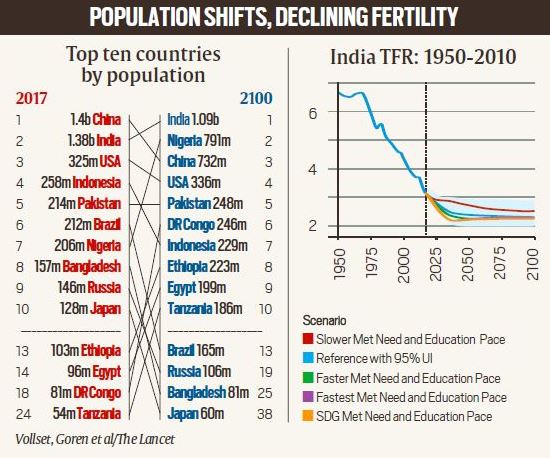
    When this century ends, India may no longer be a country of a billion, says a projection that appears in the online edition of the Lancet. The reference forecasts for China and India peaked before 2050 and both countries thereafter had steep declining trajectories.

    Try this question from CSP 2011:

    Q.India is regarded as a country with ‘Demographic Dividend’. This is due to

    (a) Its high population in the age group below 15 years

    (b) Its high population in the age group of 15-64 years

    (c) Its high population in the age group above 65 years

    (d) Its high total population

    World to see the peak

    • A new analysis published in The Lancet has projected that the world population will peak much earlier than previously estimated.
    • It projects the peak at 9.73 billion in 2064, which is 36 years earlier than the 11 billion peaks projected for 2100 by last year’s UN report World Population Prospects.
    • For 2100, the new report projects a decline to 8.79 billion from the 2064 peak.

    5 most populated countries

    • The five largest countries in 2100 are projected to be India, Nigeria, China, the U.S. and Pakistan.
    • However, these forecasts showed different future trajectories between countries.
    • Nigeria is forecast to have continued population growth through 2100 and was expected to be the second-most populous country by then.

    Predictions on India’s population

    • For India, the report projects a peak population of 1.6 billion in 2048, up from 1.38 billion in 2017.
    • By 2100, the population is projected to decline by 32% to 1.09 billion.
    • However, meeting UN Sustainable Goal Development targets, the peak would be earlier and see a population decline to 929 million.
    • Conventional wisdom is that though a decline in population is expected, it is expected to begin only around 2046.
    • The fall according to the latest 2019 assessment by the UNDP calculation, is expected to see India’s population settle at a little over 1.4 billion.

    Reasons for fall

    • The sharper fall is due to the assumption that all women globally will have much higher access to contraception and education.
    • This scenario will lead to a sharper reduction in the Total Fertility Rate, a metric that shows on average how many children a woman must have to keep replenishing the population.
    • A TFR is lower than 2.1leads to a decline in a country’s population.
  • Who are the Tangams?

    Last week Arunachal CM released a book titled “Tangams: An Ethnolinguistic Study Of The Critically Endangered Group of Arunachal Pradesh”.

    Try this question from CSP 2019:

    Q.Consider the following statements about Particularly Vulnerable Tribal Groups (PVTGs) in India:

    1. PVTGs reside in 18 States and one Union Territory.
    2. A stagnant or declining population is one of the criteria for determining PVTG status.
    3. There are 95 PVTGs officially notified in the country so far.
    4. Irular and Konda Reddi tribes are included in the list of PVTGs.

    Which of the statements given above are correct?

    (a) 1, 2 and 3

    (b) 2, 3 and 4

    (c) 1, 2 and 4

    (d) 1, 3 and 4

    Who are the Tangams?

    • The Tangams is a little-known community within the larger Adi tribe of Arunachal Pradesh and resides in the hamlet of Kugging in Upper Siang district’s Paindem circle.
    • In 1975, the community’s population was pegged at 2,000 spread across 25 villages.
    • From 2016 to 2020, a team from the Centre for Endangered Languages (CFEL) of Rajiv Gandhi University (RGU), carried out extensive field research and documented the community.
    • Their survey revealed that Tangams were now concentrated in only one village (Kugging), with only 253 reported speakers.
    • As per the UNESCO World Atlas of Endangered Languages (2009), Tangam — an oral language that belongs to the Tani group, under the greater Tibeto-Burman language family — is marked ‘critically endangered’.

    Why are there only a few speakers?

    • Kugging is surrounded by a number of villages inhabited by Adi subgroups such as Shimong, Minyongs, as well as the Buddhist tribal community of Khambas, among others.
    • To communicate with their neighbours over the years, the Tangams have become multilingual, speaking not just Tangam, but other tongues such as Shimong, Khamba and Hindi.
    • They rarely speak their own language now since their population is restricted to a single village. Moreover, the Tangams are relatively unknown — even within their state.
    • The village lacks proper infrastructure in all basic sectors of education, health, drinking water facilities, road and electricity. Roads have reached Kugging only in 2018.
    • Not a single person from the community has gone to university.

    Why are the languages at risk?

    • The diversity of languages has led various communities to depend on English, Assamese and colloquial variety of Hindi called Arunachalee Hindi as the link languages.
    • Many believe this shift has led to the loss of native languages of the tribal communities.
    • Even the numerically larger tribes like Nyishi, Galo, Mishmi, Tangsa etc. whose population exceed the ten thousand mark are also not safe from endangerment, hence marked unsafe.
    • The younger generation of these tribes especially in the urban areas has mostly discarded the use of their mother tongue.
  • Rabari, Bharvad and Charan Tribes of Gujarat

    The Gujarat government will constitute a commission to identify the members of Rabari, Bharvad and Charan communities who are eligible to get the benefits of Schedule Tribe (ST) status.

    Try this question from CSP 2017:

    Q.Every year, a monthlong ecologically important campaign/festival is held during which certain communities/ tribes plant saplings of fruit-bearing trees. Which of the following are such communities/ tribes?

    (a) Bhutia and Lepcha

    (b) Gond and Korku

    (c) lrula and Toda

    (d) Sahariya and Agariya

    About the Tribes

    (1) Rabari

    • The Rabari, also called the Rewari are an indigenous tribal caste of nomadic cattle and camel herders and shepherds that live throughout northwest India, primarily in the states of Gujarat, Punjab and Rajasthan.
    • The word “Rabari” translates as “outsiders”, a fair description of their primary occupation and status within Indian society.
    • They speak ‘Bhopa’ which is a mixture of Gujarati, Kachchi, Marwari words and Pharasi (Persian) and use Gujarati script.
    • The Rabari are known for their distinctive art, particularly the mirrored and whitewashed mud sculpture-work that adorns their homes and villages.
    • Rabari women are responsible for this artwork and also traditionally spin the wool from their sheep and goats, and give it to local weavers to make their woollen skirts, veils, blankets and turbans.

    (2) Bharvad

    • The Bharwad are tribals primarily engaged in herding livestock.
    • The Bharwad name may derive from the Gujarati word badawad, constructed from bada (sheep) and wada (a compound or enclosure).
    • The Bharwads have numerous subgroups known as ataks or guls (clans) whose main purpose is to determine eligibility for marriage.
    • Constrained exogamy is practised between clans.

    (3) Charan

    • The Charan, also called Gadhvi, is a small tribe in Gujarat and the name Charan is derived from the word ‘Char’ which means grazing.
    • Members of the caste are considered to be divine by a large section of society.
    • Women of the caste are adored as mother goddesses by other major communities of this region.
  • Migrants and COVID

    In this Article, we highlight some facts about migration in India, summarize key relief measures announced by the government and directives issued by the Supreme Court for the migrant population in relation to the lockdown.
    ———————————————————————————
    Reference source: https://www.prsindia.org/theprsblog/migration-india-and-impact-lockdown-migrants
  • What is the Sample Registration System (SRS)?

    The Registrar General of India released its Sample Registration System (SRS) bulletin based on data collected for 2018.

    Since we are talking about birth rates and death rates, how about revising Demographic Transition Model. Can you recall 4 distinctive stages of Indian Demographic history?

    Sample Registration System (SRS)

    • The SRS is a demographic survey for providing reliable annual estimates of infant mortality rate, birth rate, death rate and other fertility and mortality indicators at the national and sub-national levels.
    • Initiated on a pilot basis by the Registrar General of India in a few states in 1964-65, it became fully operational during 1969-70.
    • The field investigation consists of a continuous enumeration of births and deaths in selected sample units by resident part-time enumerators, generally Anganwadi workers and teachers; and an independent retrospective survey every six months by SRS supervisors.
    • The data obtained by these two independent functionaries are matched.

    Highlights of the data

    Birth and death rates

    • According to the data released the national birth rate in 2018 stood at 20, and death and infant mortality rates stood at 6.2 and 32, respectively.
    • The rates are calculated per one thousand of the population.
    • Madhya Pradesh has the worst infant mortality rate in the country while Nagaland has the best.
    • Chhattisgarh has the highest death rate, while Delhi has the lowest.
    • Bihar continues to remain at the top of the list in the birth rate while Andaman and Nicobar are at the bottom.

    Infant mortality

    • The data shows that against the national infant mortality rate (IMR) of 32, Madhya Pradesh has an IMR of 48 and Nagaland 4.
    • Bihar has the highest birth rate at 26.2 and Andaman and Nicobar Islands has a birth rate of 11.2.
    • Chhattisgarh has the highest death rate at 8 and Delhi, an almost entirely urban state, has a rate of 3.3, indicating better healthcare facilities.
    • As far as IMR is concerned, the present figure of 32 is about one-fourth as compared to 1971 (129).
    • In the last 10 years, IMR has witnessed a decline of about 35 per cent in rural areas and about 32 per cent in urban areas. T

    Birth rate

    • The birth rate is a crude measure of fertility of a population and a crucial determinant of population growth.
    • India’s birth rate has declined drastically over the last four decades from 36.9 in 1971 to 20.0 in 2018.
    • The rural-urban differential has also narrowed. However, the birth rate has continued to be higher in rural areas compared to urban areas in the last four decades.
    • There has been about an 11 per cent decline in the birth rate in the last decade, from 22.5 in 2009 to 20.0 in 2018. The corresponding decline in rural areas is 24.1 to 21.6, and in urban areas, it is 18.3 to 16.7.
  • In news: Two-child Norm

    A Rajya Sabha MP has introduced a Private Member’s Bill on two-child norms.

    Key propositions of the Bill

    • Essentially, the Bill aims to amend the Constitution in order to incentivise limiting families to two children by offering tax concessions, priority in social benefit schemes and school admissions, among other things.
    • It proposes incentives in taxation, education and employment for people who limit their family size to two children.

    Article 47A

    • The Bill has sought the incorporation of a new provision, Article 47A in Part IV of the Constitution, to withdraw all concessions from people who fail to adhere to the “small-family” norm.
    • Article 47A says the following:

     “47A. The State shall promote small family norms by offering incentives in taxes, employment, education etc. to its people who keep their family limited to two children and shall withdraw every concession from and deprive such incentives to those not adhering to small family norm, to keep the growing population under control.”

    Note: Article 47 of the Indian Constitution is one of the DPSP  which directs the State to raise the level of nutrition and the standard of living and to improve public health as among its primary duties and, in particular, the State shall endeavour to bring about prohibition of intoxicating drinks and drugs which are injurious to health.

    Why such Bill?

    • The Bill’s Statement of Object and Reasons states that the fact that India’s population has already crossed 125 crore is “really frightening”.
    • It goes on to say that India’s population has doubled in the last 40 years and that it is expected to unseat China as the world’s most populous nation in the next couple of decades.
    • Despite the fact that we have framed a National Population Control Policy, we are the second most populous country in the world.
    • Further, the population explosion will cause “many problems” for our future generations.
    • The Bill also makes a reference to “overburdened” natural resources that are overexploited because of overpopulation.

    Statewide policies relating to two-child norms

    Assam Cabinet has recently decided that those with more than two children will be ineligible for government jobs from 2021. Other states with similar norms:

    Rajasthan: For government jobs, candidates who have more than two children are not eligible for appointment.

    Madhya Pradesh: The state follows the two-child norm since 2001. Under Madhya Pradesh Civil Services (General Condition of Services) Rules, if the third child was born on or after January 26, 2001, one becomes ineligible for government service. The rule also applies to higher judicial services.

    Telangana: Under Section 19 (3) read with Sections 156 (2) and 184 (2) of Telangana Panchayat Raj Act, 1994, a person with more than two children shall be disqualified from contesting election. However, if a person had more than two children before May 30, 1994, he or she will not be disqualified.  The same sections in the Andhra Pradesh: AP Panchayat Raj Act, 1994, apply to Andhra Pradesh, where a person having more than two children shall be disqualified from contesting election.

    Gujarat: In 2005, the government amended the Gujarat Local Authorities Act. The amendment disqualifies anyone with more than two children from contesting elections for bodies of local self-governance — panchayats, municipalities and municipal corporations.

    Maharashtra: The Maharashtra Zilla Parishads And Panchayat Samitis Act disqualifies people who have more than two children from contesting local body elections (gram panchayats to municipal corporations). The Maharashtra Civil Services Rules, 2005 states that a person having more than two children is disqualified from holding a post in the state government. Women with more than two children are also not allowed to benefit from the Public Distribution System.

    Karnataka: The Karnataka (Gram Swaraj and Panchayat Raj) Act, 1993 does not bar individuals with more than two children from contesting elections to local bodies like the gram panchayat. The law, however, says that a person is ineligible to contest “if he does not have a sanitary latrine for the use of the members of his family”.

    Odisha: The Odisha Zilla Parishad Act bars those individuals with more than two children from contesting.

  • Explained: The Kashmir Pandit tragedy


    It is 30 years since the “exodus” from the Valley of its minority Hindu Kashmiri Pandit community.

    The run-up: 1980s to 1990

    • Sheikh Abdullah had died in 1982, and the leadership of the National Conference passed on to his son Farooq Abdullah, who won the 1983 election.
    • But within two years, the Centre broke up the NC, and installed dissident Ghulam Mohammed Shah as Chief Minister. This led to huge disaffection and political instability.
    • The Jammu & Kashmir Liberation Front (JKLF) stepped up its activities, and the hanging of the militant leader Maqbool Bhat in 1984 added to the sense of foreboding.
    • In 1986, after the Rajiv Gandhi government opened the Babri Masjid locks to enable Hindus to offer prayers there, ripples were felt in Kashmir too.
    • In Anantnag, the constituency of then Congress leader Mufti Mohammad Sayeed, there was a series of attacks on Hindu temples, and shops and properties of Kashmiri Pandits, blamed on separatist and secessionists.
    • Pandits had begun to be targeted. Eminent persons of the community were being shot dead.

    The night of January 19, 1990

    • Matters came to a head on January 19. By then, the Farooq Abdullah government had been dismissed and Governor’s Rule imposed.
    • According to accounts published by many eminent Kashmiri Pandits, there were threatening slogans over loudspeakers from mosques, and on the streets.
    • Speeches were made extolling Pakistan and the supremacy of Islam, and against Hinduism. Finally, the Kashmiri Pandit community decided to leave.

    The Gawkadal Massacre

    • On January 20, the first stream began leaving the Valley with hastily packed belongings in whatever transport they could find. A second, larger wave left in March and April, after more Pandits were killed.
    • On January 21, the CRPF gunned down 160 Kashmiri Muslim protesters at the Gawkadal Bridge, which has come to be known as the worst massacre in the long history of the conflict in Kashmir.
    • The two events — the flight of the Pandits and the Gawkadal massacre — took place within 48 hours.

    How many Pandits left?

    • According to some estimates, notably by the Kashmiri Pandit Sangharsh Samiti (KPSS), of 75,343 Kashmiri Pandit families in January 1990, more than 70,000 fled between 1990 and 1992 and continued until 2000.
    • The KPSS has placed the number of Kashmiri Pandits killed by militants from 1990 to 2011 at 399, the majority during 1989-90.
    • Some 800 families have remained in the Valley through these three decades.

    Role of the administration

    • The other contentious question about the exodus is the role played by the administration, and more specifically that of the J&K Governor, Jagmohan.
    • Newly appointed, he had arrived in Srinagar on January 19.
    • The Kashmiri Muslim view of the exodus is that he encouraged the Pandits to leave the Valley and thus gave a communal colour to what was until then a non-religious Kashmiri cause.
    • The Kashmiri Hindu view is that this is a disingenuous interpretation.
    • They believe that Kashmiri Muslims, with whom they had lived amicably for centuries, drove them out with a vengeance in a frenzy of Islamism that they could not have imagined even months earlier.
    • The truth, many commentators have concluded, may have been somewhere in the middle.

    The question of return

    • Those who had means rebuilt their lives elsewhere in the country — Delhi, Pune, Mumbai and Ahmedabad have Pandit populations, also Jaipur and Lucknow — or went abroad.
    • The fleeing Pandits did not think they would never return to the Valley. But as the situation in Kashmir spiraled into a full-blown militancy, return began to look remote if not impossible.
    • The longing to return to the Valley did not diminish over the years, though it may have become more an idea than a real ambition.
    • Successive governments have promised that they will help this process, but the situation on the ground in Kashmir has meant this remains only an intention.
    • There is an acute realization in the community that the Valley is no longer the same that they left behind in 1990.
    • In many cases, their properties were either immediately vandalised or sold quickly by the owners to Kashmiri Muslims. Many fell into disrepair.
  • Population and Associated Issues

    Introduction

    In demographics, the world population is the total number of humans currently living. The World is facing major challenge of rapid increase in human population since last many decades, (UNFPA, 2011). The world population was estimated to have reached 7.5 billion in April 2017. In various parts of globe, there is unparalleled rapid demographic change and the most noticeable example of this change is the vast expansion of human.

    It is expected that in near future, it will increase rapidly and give birth to numerous issues in the least developed regions. It is recommended that there is a desperate need to take urgent steps to control population otherwise serious problems can arise such as environment damage and restricted availability of food resources.

    Constant growth of population is a major issue and therefore it is significant to understand how policy makers can manage population growth for the benefit of society.

    Increase in population in India:

    Causes of Over Population:

    The two main common causes leading to over population in India are:

    • The birth rate is still higher than the death rate. We have been successful in declining the death rates but the same cannot be said for birth rates.
    • The fertility rate due to the population policies and other measures has been falling but even then it is much higher compared to other countries.

    The above two causes are interrelated to the various social issues in our country which are leading to over population.

    • Early Marriage and Universal Marriage System: Even though the marriageable age of a girl is legally 18 years, the concept of early marriage still prevails. Getting married at a young age prolongs the child bearing age. Also, in India, marriage is a sacred obligation and a universal practice, where almost every woman is married at the reproductive age.
    • Poverty and Illiteracy: Another factor for the rapid growth of population is poverty. Impoverished families have this notion that more the number of members in the family, more will be the numbers to earn income. Some feel that more children are needed to look after them in their old age. Also hunger can be cause of death of their children and hence the need for more children. Strange but true, Indian still lags behind the use of contraceptives and birth control methods. Many of them are not willing to discuss or are totally unaware about them. Illiteracy is thus another cause of over population.
    • Age old cultural norm: Sons are the bread earners of the families in India. This age old thought puts considerable pressure on the parents to produce children till a male child is born.
    • Illegal migration: Last but not the least, we cannot ignore the fact that illegal migration is continuously taking place from Bangladesh and Nepal is leading to increased population density.

    Effects of Over Population:

    Even after 67 years of independence, the scenario of our country is not good, due to over population. Some major impacts of high population are as follows:

    • Unemployment: Generating employment for a huge population in a country like India is very difficult. The number of illiterate persons increases every year. Unemployment rate is thus showing an increasing trend.
    • Manpower utilisation: The number of jobless people is on the rise in India due to economic depression and slow business development and expansion activities.
    • Pressure on infrastructure: Development of infrastructural facilities is unfortunately not keeping pace with the growth of population. The result is lack of transportation, communication, housing, education, healthcare etc. There has been an increase in the number of slums, overcrowded houses, traffic congestion etc.
    • Resource utilisation: Land areas, water resources, forests are over exploited. There is also scarcity of resources.
    • Decreased production and increased costs: Food production and distribution have not been able to catch up with the increasing population and hence the costs of production have increased. Inflation is the major consequence of over population.
    • Inequitable income distribution: In the face of an increasing population, an unequal distribution of income and inequalities within the country widen.

    Steps to Control Population in India

    Increasing the welfare and status of women and girls, spread of education, increasing awareness for the use of contraceptives and family planning methods, sex education, encouraging male sterilisation and spacing births, free distribution of contraceptives and condoms among the poor, encouraging female empowerment, more health care centres for the poor, to name a few, can play a major role in controlling population.

    India’s strengths in the global world in various fields cannot be ignored, whether in science & technology, medicine and health care, business and industry, military, communication, entertainment, literature and many more. Experts are hopeful that by increasing public awareness and enlisting strict population control norms by the Government will definitely lead the way for the country’s economic prosperity and control of population.

    • Social Measure: Population outburst is considered to be a social problem and it is intensely rooted in the civilization. It is therefore necessary to make efforts to eliminate the social iniquities in the country. Minimum age of Marriage: As fertility depends on the age of marriage therefore the minimum age of marriage should be raised. In India minimum age for marriage is 21 years for men and 18 years for women fixed by law. This law should be strongly implemented and people should also be made aware of this through promotion.
    • Raising the Status of Women: There are prevalent biases to women. They are restricted to house. They are still confined to rearing and bearing of children. So women should be given opportunities to develop socially and economically. Free education should be given to them.
    • Spread education: The spread of education changes the views of people. The educated men take mature decisions and prefer to delay marriage and adopt small family custom. Educated women are health mindful and avoid frequent pregnancies and thus help in lowering birth rate.
    • Adoption: is also effective way to curb population. Some parents do not have any child, despite expensive medical treatment. It is recommended that they should adopt orphan children. It will be helpful to orphan children and children to couples.
    • Social Security: is necessary for people. It is responsibility of government to include more and more people under-social security schemes. So that they do not depend upon others in the event of old age, sickness, unemployment with these facilities they will have no desire for more children.
    • Economic Measures: There has to be numerous economic measures taken as a preventive measure for population explosion. Government must devise policies for more employment opportunities. It is necessary is to raise the employment opportunities in rural as well as urban areas. Generally in rural areas there is disguised joblessness. Another economic measure for population control is the development of Agriculture and Industry. If agriculture and industry are correctly developed, huge number of people will get employment. When their income is increased they would enhance their standard of living and accept small family norms. Good standard of living is a deterrent to large family norm. In order to maintain their enhanced standard of living, people prefer to have a small family.
    • Urbanisation: process can reduce population increase. It is reported that people in urban areas have low birth rate than those living in rural areas. Urbanisation should be encouraged.
    • There is a need to follow strict birth control measures such as China has adopted the strategy to decrease the birth rate. But it is not possible to reduce technological advancements to decrease the death rate in India. In order to reduce the birth rate, several government-funded agencies like the Family Planning Association of India spend excessive funds to promote on family planning as a basic human right and the norm of a two-child family on a voluntary basis.
    • It is done to achieve a balance between the population size and resources, to get ready young people for responsible attitudes in human sexuality, and to provide education and services to all. The family planning methods provided by the family planning program are vasectomy, tubectomy, IUD, conventional contraceptives (that is condoms, diaphragms, jelly/cream tubes, foam tables) and oral pills.
    • Additionally, induced abortion is available, free of charge, in institutions recognized by the government to control population increase. However, the success of the family planning program in India depends on many factors such as literacy, religion and the region where the people live.

    Population policy followed in India since Independence

    After independence, a Population Policy Committee was created in 1952 which suggested for the appointment of a Family Planning Research and Programmes Committee in 1953.

    A Central Family Planning Board was created in 1956 which emphasized sterilization. Up till 1960s a rigid policy was not adopted to arrest the fast growth of population. The policy framed in 1951-52 was ad hoc in nature, flexible, and based on a trial and error approach.

    When the First Five-Year Plan was formulated, it was enumerated in the plan that the programme for family limitation and population control should:

    (a) present an accurate picture of the factors contributing to the rapid increase of population;

    (b) discover suitable techniques of family planning and devise methods by which knowledge of these techniques could be widely disseminated; and

    (c) give advice on family planning as an integral part of the service of government hospitals and public agencies.

    Until the Fifth Plan, family planning programme concerned itself primarily with birth control but in this plan ‘maternal and child health and nutrition services’ were also included as an integral part of family planning programme. Despite all the Five-Year Plans (from First to Tenth) and policies, the population of India is growing at a faster pace and taking the shape of ‘population explosion’.

    The striking growth rate of population compelled the government to adopt a relatively more clear and less flexible policy of population which can stabilize the growth rate. In 1961-71, the population growth rate was 2.25% which was highest in any decade after independence. At present (2001-2011), the population growth rate has declined to 1.50%.

    In April 1976, the First National Population Policy was framed by the Union Ministry of Health and Family Planning which suggested a wide spectrum of programmes including raising the statutory age of marriage, introducing monetary incentives, paying special attention to improving female literacy, etc.

    Though this policy was endorsed by the parliament, it was planned at a time when the Emergency was clamped all over India. Sanjay Gandhi, the then President of Indian Youth Congress, took the programme of sterilization overzealously which made the masses hostile towards the government led by Indira Gandhi as well as the programme. One of the reasons for this was said to be the excesses committed in the programme.

    There was an overall resentment among the people (as a result of which the Congress was voted out of power in elections held in March 1977). This incident defeated the whole purpose of the family planning programme. The enthusiasm of the people about birth control was also to some extent slackened. The later governments became extremely cautious about the implementation of programmes of family planning.

    The term ‘family planning’ was replaced by ‘family welfare’. While delivering a talk on ‘Indian Population in the 1990s,’ on February 8, 1991, the noted demographer Ashish Bose said that ‘family planning programme has completely failed in the country and entirely a new approach is needed for its success’.

    The progress to arrest population growth has been extremely slow as is evident when we compare it with China. Through vigorous family planning programme since 1970 and a more rigid policy of having only one child per family in 1980, China has avoided the birth of more than 200 million children and brought the fertility rate down to 2.5 from 5.82 among eligible mothers. This is a classic example of the role of government policy in affecting birth rate.

    To check the alarming population growth, an attempt has been made to rejuvenate the National Family Welfare Programme. The Ministry of Health and Family Welfare revised the strategy in the last decade of the 20th century seeking to broaden the area of family planning.

    It was emphasized that the population control programme would continue purely on voluntary basis as an integral part of a comprehensive policy package covering education, health, maternity and childcare, and women’s rights and nutrition, including anti-poverty programme. It was made people’s programme based on welfare approach.

    This revised strategy particularly focused on the provision of family planning strives at the doorsteps of the people. It is with this objective that the age of marriage is proposed to be raised for women from 18 to 20 years as envisaged in National Population Policy document, 2000, discussed later on.

    For raising the status of women, much emphasis on female education is also being given. Efforts are also being made to involve the voluntary organizations to promote family planning. As a part of family welfare and population control, the government has revised the PNDT Act in 2003, which was enacted in 1994. The main aim of the Act is to check female (embryo) infanticide.

    The 1990s, however, witnessed a marked shift in the approach of family planning programme in the country. The early years of the decade had seen intensification of women’s movement, both within and outside the country, in reaction to the overwhelming responsibilities imposed on women in family planning programme for achieving fertility reduction.

    The proponents of the movement were very critical of the approach and regarded the prevalent methods of birth control as an infringement on women’s fundamental rights. It was against this background that an expert group under the chairmanship of Dr. M.S. Swaminathan was appointed in August 1993 to prepare a draft on new population policy.

    The New Population Policy:

    Government of India introduced first National Population Policy in 1976, which focussed on reducing birth rate, lowering infant mortality rate and improving standard of life. The policy was revised in 1977 which focussed on:

    • No coercion for family planning
    • Minimum marriage age 18 years for females and 21 years for males.
    • Emphasis on awareness through education and media
    • Mandatory registration of marriages
    • Use of media for spreading the awareness about family planning among the rural masses.
    • Monetary compensation to those who opt for permanent measures of birth control (sterilisation and tubectomy).

    The National Population Policy 2000 provided a comprehensive framework to provide the reproductive and health needs of the people of India for the next ten years. It has fixed short term, medium term and long term goals as follows:

    • Short term goal: Addressing the unfulfilled needs of contraception and health care infrastructure. Provision of integrated service for basic reproductive and child health care.
    • Medium term goal: Bring down the Total Fertility rate.
    • Long term goal: To achieve a stable population by 2045.

    The government implemented the policy with involvement of local level bodies and voluntary sector with funds from central government.

    Critical Assessment of India’s Population Policy

    India’s national population policies have failed to achieve their objectives as we remain world’s second largest populated country. The population of India in 1951 was 35 crore, but by 2011, it had increased to 121 crore. There have been few shortcomings.

    • Firstly, the NPP have a narrow perspective, give much importance to contraception and sterilisation. The basic prerequisite of controlling population include poverty alleviation, improving the standards of living and the spread of education.
    • Secondly, on national scale the policy was not publicised and failed to generate mass support in favour of population control.
    • Thirdly, we have insufficient infrastructure owing to the lack of trained staff, lack of adequate aptitude among the staff and limited use or misuse of the equipment for population control resulted in failure of the policy.
    • Lastly, the use of coercion during the Emergency (1976-77) caused a serious resentment among the masses. This made the very NPP itself very unpopular.

    Conclusion

    To summarize, population escalation is a major issue around the world which has adverse impact on numerous environmental and human health problems. Population growth continue to increase in the world at a fast pace. As the population enlarges, many experts are concerned about its dangerous results.

    The growth rate of population is a function of migration, birth rate and death rate in a country. The change in population caused by net migration as a proportion of total population of the country is almost insignificant and, therefore, can be easily ignored. That leaves us with birth rate and death rate.

    The difference between the birth rate and the death rate measures the growth rate of population. Over populated regions need more resources. Population explosion causes deforestation for food production, urban overcrowding and the spread of horrible diseases.

    The effectual way to stop population growth is to implement family planning policies but the exact way to achieve that has created a great deal of disagreement. Several feasible solutions have been proposed by the government to curb population.