Why in the News
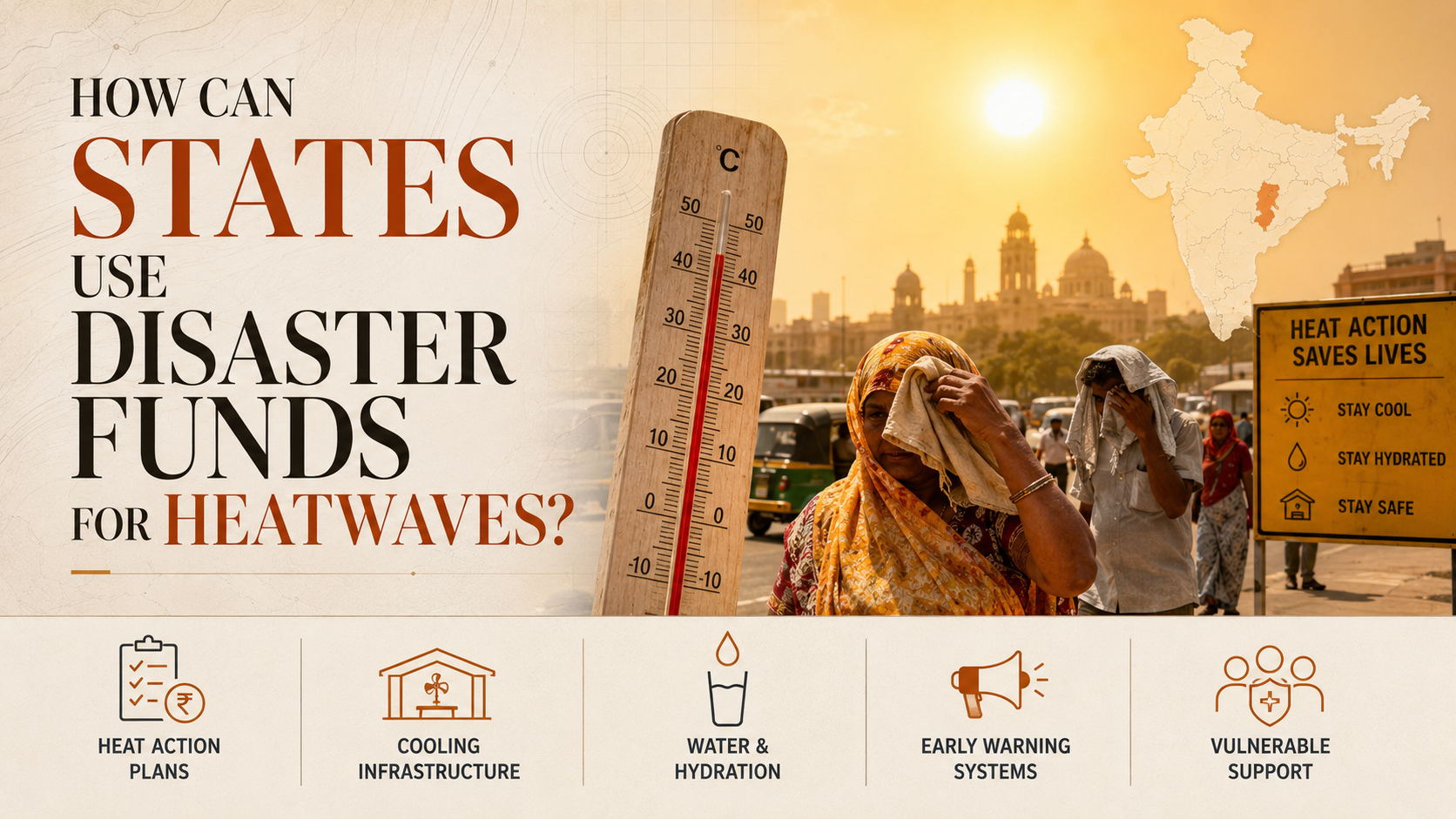
The Ministry of Home Affairs told the Lok Sabha on 4 August 2026 that heatwaves and lightning have been added to India’s list of notified natural calamities, taking the list to 14 items. The change follows a recommendation of the Sixteenth Finance Commission (FC-XVI), the constitutional body under Article 280 that recommends the distribution of resources including disaster funds between the Centre and the states, and operational guidelines issued on 30 June 2026. Heatwaves are now eligible for the full State Disaster Risk Management Fund pool rather than the capped local-disaster route states previously had to use.
What changes for states?
- Removal of the funding ceiling: A state could previously notify a heatwave only as a “local disaster” and draw on the State Disaster Response Fund (SDRF) up to a 10% annual cap, after setting its own compensation norms. Other notified disasters such as floods and cyclones faced no such ceiling. The new notification removes this asymmetry.
- Two distinct funding routes now available: Under the SDRF, states can fund relief and compensation for heat-related losses. Under the State Disaster Mitigation Fund (SDMF), a fund meant for longer-term risk reduction rather than immediate response, states can finance cooling shelters and early-warning systems.
- Scale of the fund pool: FC-XVI recommended Rs 2.04 lakh crore for state disaster funds over 2026-27 to 2030-31, about 28% more than the previous Commission’s allocation, split Rs 1.6 lakh crore to the SDRF and the rest to the SDMF. It separately recommended Rs 79,406 crore for national disaster funds that states can draw on when a disaster exceeds their own resources.
What challenges are in the way of using the funds effectively?
- Uneven heat action planning: Twelve states have notified heatwaves locally, but only around 300 cities and districts across 23 heatwave-prone states have Heat Action Plans (HAPs), leaving roughly 4,800 urban local bodies and 800 districts without one. Fix. Heat-specific SDMF guidelines, still awaited, will need to be paired with the risk and vulnerability assessments already required before any project proposal.
- Limited technical capacity to convert plans into proposals: A 2023 review found 79% of existing HAPs asked city departments to self-fund interventions rather than costing a proposal against the new fund. Fix. States need model mitigation proposals suited to local climate and geography, since many local bodies lack the capacity to prepare fundable projects on their own.
- Weak loss-and-damage data: Relief payouts under the new notification will depend on accurate heat mortality and morbidity data. The Health Ministry’s surveillance system, covering over 51,000 reporting units, recorded 4,853 heatstroke cases and 20 confirmed heatstroke deaths between 1 March and 26 July, but it does not capture the wider toll from heart, lung and kidney conditions worsened by heat.
Conclusion
The notification closes a genuine funding gap between heat and other disasters, but the benefit depends on state capacity to plan, cost and document heat interventions. Parametric insurance, which pays out automatically once a set temperature threshold is crossed, similar to Nagaland’s existing rainfall insurance, is one fast-disbursing tool states can pair with the new fund access.
Back2Basics: State Disaster Risk Management Fund
- It is the combined pool of the State Disaster Response Fund (SDRF), for immediate relief and reconstruction after a disaster, and the State Disaster Mitigation Fund (SDMF), for interventions that reduce the risk of a hazard becoming a disaster.
- The Finance Commission fixes the inter-state distribution using a disaster risk index built from hazard frequency and intensity, exposure, vulnerability, and a state’s expenditure record in the previous Commission’s period.
“[2024, GS3, 15 marks] What is disaster resilience? How is it determined? Describe various elements of a resilience framework. Also mention the global targets of the Sendai Framework for Disaster Risk Reduction (2015-2030).”