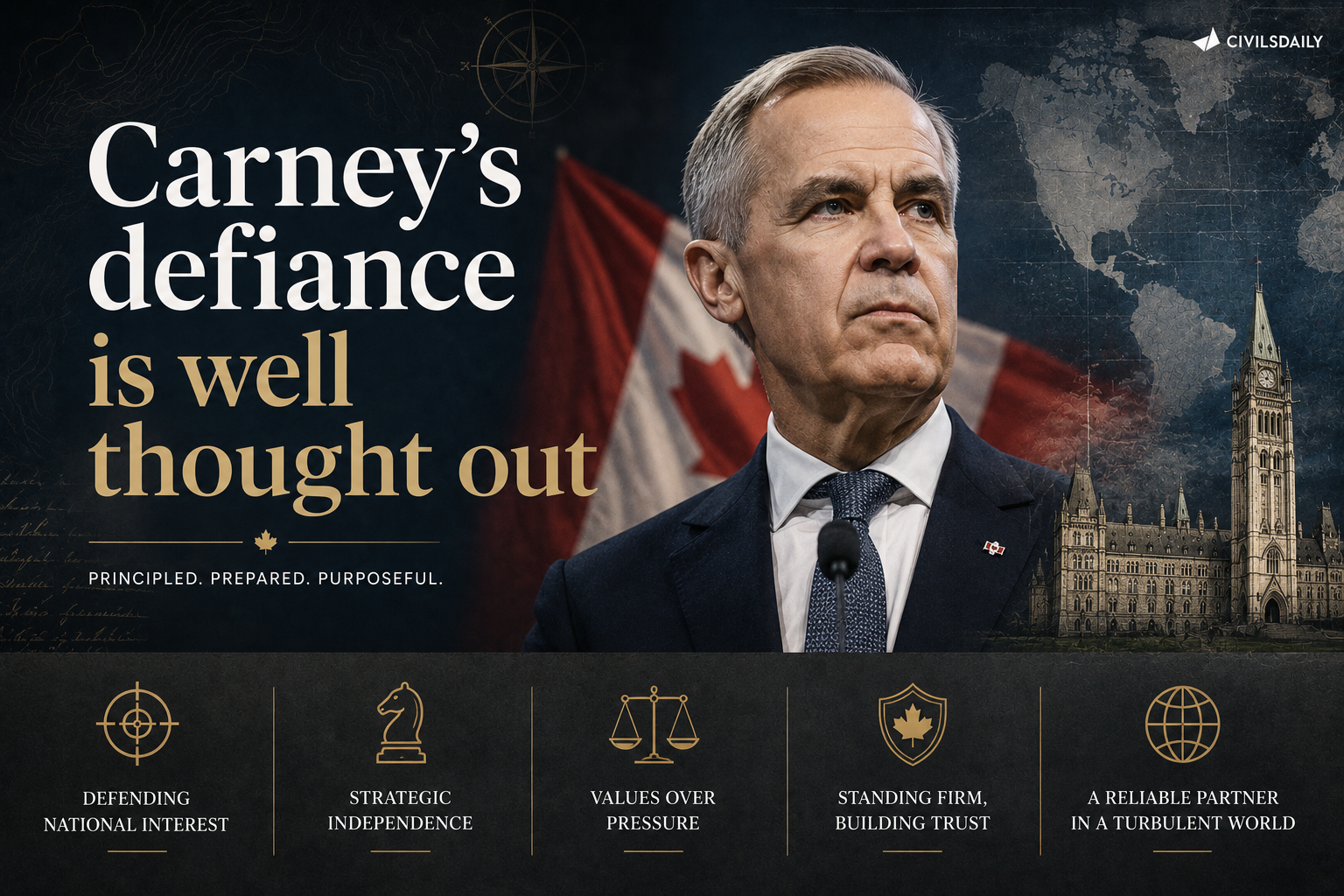
Why in the News
Canada’s Prime Minister has walked away from trade negotiations with the United States after Washington put forward terms that would have cost Canada its sovereignty, key industries, French language protections and its freedom to negotiate with other countries. He has also announced retaliatory tariffs matching the new United States tariffs dollar for dollar, stating that the Americans “asked too much and offered too little.” The move tests whether a middle power, an economy that sends roughly three quarters of its exports into a market ten times its size, can resist pressure from a dominant trading partner without folding, and it carries lessons for other countries, including India, that are negotiating their own terms with Washington.
What calculations underlie the decision to walk away?
- Broad domestic backing: The stance draws support even from the opposition Conservative party, amid public frustration with the United States President’s repeated talk of making Canada the fifty first state.
- A contained tariff footprint: The new tariffs apply to only about 5 percent of Canada’s overall exports to the United States, worth roughly 20 billion dollars, limiting the immediate domestic cost of retaliation.
- A calculated bet on mutual damage: A breakdown in trade relations is expected to hurt the United States as well, so Canada does not need to win the confrontation outright, only to make the arithmetic politically painful in Washington.
How exposed is the United States to a breakdown with Canada?
- A leading export destination: Canada is the largest export market for 26 American states and among the top three trading partners for 45 of the 50 states.
- Energy dependence: Canada supplies roughly 60 percent of America’s crude oil imports, and Canadian electricity helps power grids in New England and the upper Midwest.
- Critical inputs: Canadian potash is vital to American agriculture, while Canadian critical minerals feed strategically important American supply chains.
Why is the timing unfavourable for Washington?
- Domestic economic strain: A stalemate with Iran has pushed United States gasoline prices above 4 dollars a gallon, while the 30 year Treasury yield has climbed above 5.3 percent, its highest level since 2007.
- Fiscal and political weakness: Federal debt has crossed 40 trillion dollars, and the United States President’s net approval rating has fallen to minus 26 percent, narrowing his room to absorb a prolonged trade standoff.
What broader pattern does this defiance respond to?
- A repeated negotiating playbook: Governments from Mexico City to Brussels to Tokyo have spent the past year confronting an American administration that treats a signed trade agreement as an opening bid that can be revisited whenever it suits it, coercing partners with escalating tariff threats and demanding unilateral concessions.
- Prior diversification, not improvisation: The Canadian Prime Minister had earlier warned that middle powers must stand up or risk ending up “on the menu,” and spent close to a year building trade ties with China, the Gulf and Asia, including India, so that a closed door in Washington did not mean a locked room globally.
Challenges to Canada’s defiance strategy
- Economic exposure to a sustained standoff: Canada still sends roughly three quarters of its exports to an economy ten times its own size, so a prolonged confrontation could cost jobs and growth even if it wins the political argument. Eg. Estimates cited alongside the retaliatory tariffs put up to 90,000 Canadian jobs at risk from a sustained trade confrontation. Fix. Continue diversifying export markets by deepening the trade ties already being built with China, the Gulf and Asia.
- A narrow tariff footprint limits leverage: The new tariffs cover only about 5 percent of Canada’s exports to the United States, so retaliation alone may be too small to force a reversal in Washington. Eg. Even a full breakdown leaves most of Canada’s three quarter dependence on the United States market untouched. Fix. Extend retaliation toward strategically sensitive sectors such as crude oil, electricity and critical minerals, where Canada supplies a large share of United States demand.
- Domestic political risk if pain outlasts patience: Sustained economic pain could erode the broad backing that currently underwrites the stance, including support from the opposition. Eg. Higher fuel and consumer prices from a prolonged standoff could shift Canadian public opinion before comparable pressure is felt in Washington. Fix. Time targeted relief for the sectors affected by the new tariffs so public patience holds through the standoff.
Conclusion
The decision to reject an unfavourable trade deal, backed by calculated retaliation and prior diversification of trade ties, is being read as proof that a middle power can resist pressure from a much larger economy without folding. Whether the strategy succeeds depends on whether Canada’s own economic pain stays contained and whether Washington’s vulnerabilities, from energy prices to approval ratings, bite hard enough to force a reversal. For India, still negotiating its own trade deal with Washington, the lesson is not to reject a deal outright but to know precisely which concessions it can never afford to make.
[2025] What are the challenges before the Indian economy when the world is moving away from free trade and multilateralism to protectionism and bilateralism? How can these challenges be met?”