
Mains Ready By December. Smash Mains & Smash PYQ Admissions Open

Type: Bills/Act/Laws

  • All animals need equal consideration

    All animals need equal consideration

    Why in the News

    A division Bench of the Supreme Court has ordered the Keralam government to take custody of Raman, Keralam’s tallest elephant, in Jayakrishna Menon vs. Krishnankutty & Ors. The Bench observed that the court cannot remain a mute spectator in matters concerning animals and that their wellbeing is of “paramount importance”. It held that it would fail in its duty towards “voiceless animals” if it ignored the elephant’s continued use for temple activities after its own prohibition. The order stands in contrast with Re: City Hounded by Strays, Kids Pay Price (2026). There a three judge Bench adopted a much narrower interpretation of the law. That reading led to the removal of large numbers of dogs from public institutions. The divergence raises the question whether Indian animal law grades animals by their value to humans rather than by their capacity to suffer.

    What is equal consideration?

    1. The principle: Framed by moral philosopher Peter Singer, equal consideration holds that the basic principle of equality does not require equal or identical treatment; it requires that the interests of each being be weighed equally.
    2. Who qualifies: Every being that has interests, some subjective awareness, or the capacity to feel pleasure or pain.
    3. Different treatment can follow: Equal consideration for different beings can lead to different treatment and different rights, because their needs differ.

    What questions does the differential treatment of two animals raise?

    1. The court’s own premise: The elephant order implicitly acknowledges an animal’s propensity to suffer and the need to ensure its wellbeing.
    2. One elephant against lakhs of dogs: Why one elephant’s wellbeing is of paramount importance and the welfare of lakhs of street dogs is disregarded.
    3. One institution, two approaches: How the same institution adopts two contrasting, if not contradictory, approaches to issues involving similar moral considerations.
    4. Whether courts should decide at all: Whether the judiciary is the best positioned institution to decide cases that seal the fate of animals, for better or for worse.

    Do the differences between the two animals justify different consideration?

    1. The elephant’s legal standing: The Indian elephant is a charismatic animal, listed as Endangered on the International Union for Conservation of Nature (IUCN) Red List, and explicitly protected under the Wild Life (Protection) Act, 1972.
    2. The street dog’s legal standing: The street dog is legally perceived as a problem that needs to be tackled.
    3. Different relationships with humans: One is expected to live in the wild away from human habitation. The other shares public spaces, requiring humans to learn to coexist in shared spaces.
    4. The test: Whether these differences are significant enough to attract completely different moral and legal considerations.
    5. What is actually missing: In the two judgments the absence of equal consideration itself drives the differential treatment. Equal consideration would require an assessment of the needs of each animal and then the determination of a course of action.

    Why does the remedy lie with Parliament rather than the courts?

    1. Anthropocentric bias in both statutes: The Wild Life (Protection) Act, 1972 for elephants and the Prevention of Cruelty to Animals Act, 1960 for street dogs evaluate the worth of animals by their value to humans. That valuation determines the nature and level of protection each animal receives.
    2. A gap in legislative guidance: Two cases involving different animals produced contrasting approaches from the same court. That exposes the absence of a legislative standard for animal well-being across legal categories.
    3. The Swiss model, cited in passing: The Swiss Constitution ensures the well-being of animals and also protects animal dignity, granting animals an inherent worth.
    4. Parliament’s responsibility: Parliament should extend protection to every being worthy of moral consideration, through a legislative foundation that provides moral consideration to all animals and pathways for ethical coexistence.

    Challenges to an equal consideration standard in Indian animal law

    1. Fragmented statutes: The same act of harm is governed by different laws depending on the animal’s legal category, so no single test of suffering applies. Eg. Street dogs fall under the Animal Birth Control Rules, 2023 made under the cruelty law, and elephants fall under Schedule I of the wildlife law.
      The Fix: Enact a single animal welfare code with a sentience-based standard that applies across categories, with the wildlife schedules layered on top for conservation purposes.
    2. Nominal penalties: Section 11 of the Prevention of Cruelty to Animals Act, 1960 punishes a first cruelty offence with a fine of Rs 10 to Rs 50, unchanged since enactment. Eg. The draft Prevention of Cruelty to Animals (Amendment) Bill, 2022 proposed fines up to Rs 75,000 and imprisonment for gruesome cruelty and has not been introduced in Parliament.
      The Fix: Introduce the amendment Bill with graded penalties and a statutory definition of sentience.
    3. Unsettled legal status of animals: High Courts and the Supreme Court have taken different positions on whether animals are legal persons, so lower courts have no stable rule. Eg. The Uttarakhand High Court in Narayan Dutt Bhatt v. Union of India (2018) and the Punjab and Haryana High Court in Karnail Singh v. State of Haryana (2019) declared animals legal persons, a status no Supreme Court ruling has endorsed.
      The Fix: Settle the legal status of animals in statute rather than leaving it to divergent judicial declarations.
    4. No enforcement arm: The Animal Welfare Board of India is advisory, and district level societies exist on paper. Eg. The Prevention of Cruelty to Animals (Establishment and Regulation of Societies for Prevention of Cruelty to Animals) Rules, 2001 require a society in every district, and many districts have none.
      The Fix: Fund district societies from State budgets with mandated veterinary and inspector staffing and a reporting line to the State Animal Welfare Board.

    Conclusion

    The two rulings leave a tension unresolved. Indian animal law protects by category, endangered species on one side and nuisance animals on the other, and the capacity to suffer sits on neither side of that line. A court can decide the case before it; it cannot write a standard that applies to every animal. The thing to watch is whether Parliament takes up the pending amendment to the cruelty law and whether it writes sentience, rather than human utility, into the test.

    Animal Welfare Law in India

    1. What it covers: Statutory protection of animals from cruelty and of wild species from harm, spread across a cruelty statute, a wildlife statute and subordinate rules for specific uses such as transport, slaughter, performance and experiments.
    2. Two regimes: The cruelty law applies to any animal, domestic, captive or stray. The wildlife law protects species by schedule, and the Wild Life (Protection) Amendment Act, 2022 reduced the schedules from six to four.
    3. Institutions: The Animal Welfare Board of India (statutory since 1962), the Committee for Control and Supervision of Experiments on Animals for laboratory use, and the National Board for Wildlife for protected species.
    4. Scale: India holds about 60 percent of the world’s Asian elephants, with 29,964 counted in the 2017 synchronised census, and the 20th Livestock Census (2019) counted 1.53 crore stray dogs.

    Challenges in Animal Welfare

    1. Rabies from an unmanaged stray population: Sterilisation and vaccination have not reached the coverage that stops transmission. Eg. India accounts for about 36 percent of global rabies deaths as per the World Health Organization.
      The Fix: Fund local bodies to reach 70 percent vaccination coverage of the dog population in each ward, since transmission breaks at that threshold.
    2. Captive elephants at festivals: Parading in heat, crowds and noise causes injury and deaths of animals and people. Eg. The Kerala High Court’s 2024 guidelines on distance and rest norms for parading elephants were contested before the Supreme Court by festival organisers.
      The Fix: Enforce microchip registration and the 2024 transfer rules so that every captive elephant has a traceable owner accountable for its welfare.
    3. Culture against welfare: Traditional events with animals are permitted by State amendments to the cruelty law. Eg. A five judge Bench in Animal Welfare Board of India v. Union of India (2023) upheld Tamil Nadu’s Jallikattu amendment.
      The Fix: Codify measurable welfare conditions for each permitted event under the Performing Animals rules, with veterinary supervision as a licence condition.
    4. Regulation of livestock trade: Welfare rules for animal markets have collapsed under political contest. Eg. The Prevention of Cruelty to Animals (Regulation of Livestock Markets) Rules, 2017 were stayed by the Supreme Court and withdrawn in 2018.
      The Fix: Re-notify market rules confined to welfare conditions such as water, shade and transport limits, without conditions on the purpose of sale.

    “[2022] Which one of the following has been constituted under the Environment (Protection) Act, 1986 ?

    (a) Central Water Commission

    (b) Central Ground Water Board

    (c) Central Ground Water Authority

    (d) National Water Development Agency
  • Statistical Institute Bill referred to standing committee

    Why in the News

    The Lok Sabha Speaker has referred the Indian Statistical Institute Bill, 2026 to the Department-Related Standing Committee on Finance for examination. The Bill was introduced in the Lok Sabha during the Monsoon Session. It seeks to repeal the Indian Statistical Institute Act, 1959 and to incorporate the institute as a “body corporate” with a Board of Governors accountable to the Central government. The referral follows protests by the institute’s faculty and an Opposition demand that the Bill go to a standing committee. The tension is between a governance overhaul the government says the 1959 Act cannot deliver and a faculty that protested the Bill before it reached a committee.

    What does the Bill propose for the institute?

    1. Incorporation as a body corporate: The institute is to be incorporated to strengthen governance, promote academic excellence and research, and serve emerging needs in statistics and allied fields.
    2. The President as Visitor: The Bill makes the President the Visitor of the institute.
    3. A Board of Governors answerable to the Centre: The board is the principal policy executive body, headed by a chairperson drawn from academia, industry, education, public policy or statistical sciences. The Bill makes the board accountable to the Central government.
    4. An Academic Council under the director: The council is the principal academic body, headed by the institute’s director, with every full time professor and full time faculty member on it.
    5. A talent pipeline as the stated purpose: The Bill says the reform will build an ecosystem to train a new generation of high quality data scientists and statisticians and close the talent gap in India’s technology and financial sectors.

    Why does the government say the 1959 Act must go?

    1. The 1959 Act fixed status and one degree power: The Indian Statistical Institute Act, 1959 declared the institute an institution of national importance and let it grant degrees and diplomas in statistics.
    2. The 1995 amendment widened degrees, not governance: It added mathematics, quantitative economics, computer science and other subjects related to statistics as the institute determines from time to time.
    3. Five areas are called inadequate: The Bill says the Act has limited provisions on governance, administration, finance, accountability and functioning, and cannot respond to an evolving academic and research environment.
    4. Repeal rather than a second amendment: The government chose to repeal the 1959 Act and replace it with a comprehensive incorporation law.

    Challenges to the Indian Statistical Institute Bill, 2026

    1. A Centre accountable board reverses the founding design: The institute has run since 1932 as a registered society governed by its own council, and a statutory board answerable to the Central government moves the final say outside the institute. Eg. The Indian Institutes of Management (Amendment) Act, 2023 made the President the Visitor of the IIMs with power to appoint and remove directors, six years after the 2017 Act had handed those powers to their boards.
      The Fix: Write the board’s autonomy in academic and appointment matters into the Bill as a statutory guarantee, with the Centre’s role limited to audit and financial accountability.
    2. Statistical credibility rests on perceived independence: The institute’s faculty design methods used in national statistics, and executive control over its board invites doubt about the numbers at a time of live disputes over GDP methodology. Eg. In January 2019 two members of the National Statistical Commission, including its acting chairman, resigned after release of the Periodic Labour Force Survey for 2017-18 was withheld.
      The Fix: Fix the institute’s faculty and external statisticians as a majority on the board so the Centre’s nominees cannot outvote them.
    3. Faculty consent was not built into the process: The Bill reached introduction over faculty protest, and a governance law imposed on an academic community produces sustained non-cooperation. Eg. Delhi University’s Four Year Undergraduate Programme, introduced in 2013 without faculty consensus, was rolled back in 2014 on the University Grants Commission’s direction after sustained teacher opposition.
      The Fix: Have the standing committee take evidence from the faculty and the institute’s council before the Bill returns to the House.

    Conclusion

    The Bill’s stage is referral to the Department-Related Standing Committee on Finance after introduction in the Lok Sabha. The committee’s report is due within three months, and the Bill waits in the House until it comes. The committee’s treatment of the board’s accountability clause is what decides whether the faculty’s objection is answered or overridden.

    Back2Basics: Department-Related Standing Committees

    1. Origin: Parliament set up 17 Department-Related Standing Committees in 1993 and expanded them to 24 in 2004, each covering a set of ministries.
    2. Composition: Each has 31 members, 21 from the Lok Sabha and 10 from the Rajya Sabha, nominated by the Speaker and the Chairman, and a minister cannot be a member.
    3. Control: Sixteen committees, including Finance, work under the Lok Sabha Speaker and eight under the Rajya Sabha Chairman.
    4. Output: Their reports on Bills, demands for grants and policy are recommendatory, and the government tables an action taken report on them.

    “[2026] Consider the following statements about the Committee on the Welfare of Scheduled Castes and Scheduled Tribes of the Parliament of India:

    1. Although members of this Committee are elected from both Houses of Parliament, the Chairperson of this Committee is appointed by the Chairman of the Rajya Sabha.

    2. Twenty members are elected by the Rajya Sabha and ten members by the Lok Sabha.

    3. No Minister, except for the Union Minister of Social Justice and Empowerment, is eligible to be a member of this Committee.

    4. Members are elected for a fixed term of two years from the date they enter their office.

    Which one of the following conclusions based on the above statements is correct?

    (a) There are four correct statements

    (b) There is only one correct statement, that is statement 2

    (c) There are two correct statements, that include statement 1

    (d) There is no correct statement

  • Jharkhand SIR faceoff: BJP agents seek to delete voters, BLOs raise red flag

    Why in the News

    Booth Level Officers (BLOs) in at least four booths of Jharkhand’s Godda district have refused stacks of Form 7 applications seeking deletion of voters from the draft electoral roll, flagging them as not genuine or not procedurally sound. The applications were brought by Booth Level Agents (BLAs) of the Bharatiya Janata Party (BJP), and most of the names on them are from the minority community. The draft roll was published under the State’s Special Intensive Revision (SIR), and the claims and objections round on it is still open. The BJP has complained that the BLOs are at fault for refusing the forms. BLOs are State government employees, and the State is governed by a Jharkhand Mukti Morcha (JMM)-Congress alliance, so the standoff has acquired a party colour and has reached the Chief Electoral Officer (CEO). The tension is that Form 7 requires no evidence and has no filing cap, so the only safeguard against targeted bulk deletion is the inquiry after intake, and the CEO and the local Electoral Registration Officer (ERO) disagree on whether a BLO may refuse a form at all.

    How is a Form 7 deletion supposed to work?

    1. The statutory power sits with the ERO: Section 22 of the Representation of the People Act, 1950 lets the ERO correct or delete an entry on its own motion or on an application. In each case the ERO must hold an inquiry, give the elector time to respond and then pass an order.
    2. Only three grounds justify deletion: The ERO can remove an entry where the person has died, is no longer ordinarily resident in the constituency, or is ineligible because they are not a citizen or are under 18.
    3. Form 7 is the objection instrument: Under the Registration of Electors Rules, 1960, Form 7 carries an objection to a proposed inclusion or a deletion of a name in an existing roll. Any elector may use it to delete their own name or to object to another elector in the same constituency.
    4. The applicant proves nothing but signs a declaration: The form asks for one of five reasons, death, under age, absent or permanently shifted, already enrolled, or not Indian citizen, and needs no evidence. The applicant signs a declaration that a statement known to be false is punishable.

    Where does the online filing system leave the safeguard?

    1. Filing has moved online: The form can be downloaded from the voters’ portal and handed to the BLO, or filed on the portal or the ECINet app after the applicant links a phone number to their Electors Photo Identity Card (EPIC) number. Only a person registered in the same constituency can object to a name in it.
    2. The form identifies both parties: It carries the applicant’s name, EPIC number and phone number, and the name, EPIC number if available and address of the person objected to.
    3. Processing was centralised in 2018 but decisions were not: ERONet replaced the States’ own applications with one portal for EROs, and in 2025 the Election Commission of India (ECI) folded about 40 apps and portals into ECINet. Each form is still decided by the ERO concerned, not centrally.
    4. The portal verifies nothing at filing: No proof is required, and the system does not check that the EPIC number and phone number belong to the applicant.
    5. The inquiry is the safeguard, per the ECI: The ERO must issue a notice to the elector, allow seven days to respond, hold a hearing and pass an order, and the BLO must verify by a field visit. ECI officials say a deletion happens only after this ground inquiry.

    What did the investigation find in Godda’s booths?

    1. One BLA, 25 forms in one booth: At Booth No. 9 of Maheshtikri village a single BJP BLA filed Form 7s against 25 voters.
    2. The forms were not the official ones: The Maheshtikri BLO said the BLA brought forms that were not original, described them as covering voters absent from the village, and promised 50 more. Every form named a Muslim voter.
    3. She accepted the first batch and refused the rest: The BLO took the 25 forms, then declined further forms after the Block Development Officer (BDO) instructed BLOs that such documents were not official forms.
    4. A neighbouring BLA burned 75 forms: At Pachua Kita the BLO was handed around 75 Form 7s that differed from the forms the block office had issued. The BLA said he had been told they were for adding names, and he burned all of them when questioned.
    5. Almost every objected name was Muslim: At Pachua Kita almost all the names on the 75 forms were of Muslims, and at Maheshtikri all the forms carried Muslim voters.
    6. Complaints reached the ERO from four booths: The Basantrai BDO, acting as ERO, received complaints from Maheshtikri, Pachua Kita, Lochni and Baghakol. Villagers of Maheshtikri filed their own complaint against the mass objections in Booth No. 9.

    Why do the targeted voters say the objections cannot stand?

    1. The 2003 roll should protect them: Many of the targeted voters are verified in the 2003 intensive revision, and under the ECI’s own rules this eases their inclusion in the ongoing SIR. The BLOs said every objected voter at Maheshtikri and most at Pachua Kita were mapped to the 2003 roll.
    2. Residence runs back generations: The voters trace their families in the village across generations and hold the khatian, the land record used as proof of being Jharkhandi, along with Aadhaar cards and addresses in the State.
    3. Migration for work is the likely trigger: Several are labourers who work in Delhi, Ghaziabad or outside the State and return to vote in Jharkhand. One learned of the objection against him only from an anganwadi worker.
    4. The fear is benefits and citizenship, not only the vote: Eight voters spoken to feared disenfranchisement, loss of government scheme entitlements or being treated as non-citizens, and several said they were not educated enough to understand the consequences.
    5. Preliminary checks support them: The ERO said preliminary information shows some voters sought to be deleted are living at their registered addresses, and every deletion request will be field verified.

    How does the BJP defend the bulk filings?

    1. Objections are the BLA’s job: The former BJP MLA for Godda said filing objections is part of a BLA’s responsibility. BLAs are trained in Form 6 for new voters, Form 7 for objections and Form 8 for shifting or correction of entries.
    2. Duplicate registration is the stated ground: The party’s position is that a BLA can seek deletion where a name appears at two places, and that verifying the objection is the election authorities’ job.
    3. No cap exists on filings: There is no prescribed limit on the number of applications a BLA can submit, so a single BLA filing dozens breaks no rule.
    4. The BLO breached confidentiality, per the party: A BLO must keep the details of the objected person and of the BLA confidential, and disclosure can amount to a violation of the Representation of the People Act. The BJP says the Booth No. 9 BLO’s disclosure of its BLA’s identity caused pressure and threats against him.
    5. The complaint went to the Additional CEO: The BJP’s Jharkhand SIR convenor submitted a memorandum on discrepancies in the SIR, particularly in Sahibganj and Godda districts, accusing BLOs of two booths of refusing Form 7s from its BLAs.
    6. The BLAs describe a top down supply of forms: The Maheshtikri BLA said the former MLA gave him around 25 forms with the instruction to bring them back if the BLO refused, and some came back. The Pachua Kita BLA said he got the forms from party cadres, barely knew what they were, and thought they added names.

    Why have the ERO and the CEO split on what a BLO may do?

    1. The ERO told BLOs not to act: The BDO said BLOs were instructed not to act on the forms because the source of the forms was unknown, and that an inquiry report will follow field verification.
    2. The ERO wants a complaint route instead: In his view the BLAs should first have filed a written complaint with the Sub Divisional Officer (SDO) or the ERO asking for an investigation. Any objection should come from the family concerned or carry solid evidence.
    3. The CEO found no illegality: After speaking to the Godda Assistant ERO and the Deputy Commissioner, the Jharkhand CEO said objections were filed through Form 7 and can be submitted in bulk.
    4. The CEO holds that filing itself is legitimate: A BLA who believes a voter is registered in multiple States can object, and there is nothing wrong in filing objections.
    5. The CEO says BLOs cannot reject: The BLO must first inform the Assistant ERO (AERO), who decides what is to be done, and the BLO then records a recommendation in the observation report.

    Why has a roll revision become a party contest?

    1. The revision is large and the window is short: The SIR began in Jharkhand on June 30, and the draft roll published on August 5 removed 16.48 percent of voters, around 43 lakh. The claims and objections round closes on September 4.
    2. BLOs answer to a State government of the other side: The BJP frames the refusals as partisan because the BLOs are employees of a State run by its rivals.
    3. Godda is a marginal seat: The BJP candidate lost Godda in the 2024 Assembly election to the Rashtriya Janata Dal (RJD) by more than 20,000 votes after winning it in 2020 by around 4,500.
    4. The ruling alliance calls it targeted deletion: The JMM’s local block president called the forms a BJP conspiracy to remove Muslim voters, and the Congress general secretary said the party is monitoring Form 7 deletions across the State. The RJD MLA for Godda said the BDO told him action is being taken.

    Challenges to the Form 7 objection mechanism

    1. The burden shifts to the objected elector: A voter must answer a notice within a week and attend a hearing, and a migrant worker away from home routinely misses both. Eg. In Lal Babu Hussein v Electoral Registration Officer (1995) the Supreme Court set aside deletions in Bombay where names had been struck off on suspicion of foreign nationality without a proper opportunity to be heard.
      The Fix: Serve the notice on the phone number linked to the elector’s EPIC and allow a response through the portal or a family member at the hearing.
    2. The objector’s identity is unverified: An objection can be filed under someone else’s EPIC number and phone number since nothing checks that they belong to the applicant. Eg. In Bengaluru in 2022, staff of a private firm, Chilume Enterprises, posed as Booth Level Officers and collected voter data door to door, showing how easily the intake layer is impersonated.
      The Fix: Require a one time password on the phone registered against the objector’s EPIC before the portal accepts a Form 7.
    3. False declarations carry no practical cost: Section 31 of the Representation of the People Act, 1950 makes a false declaration punishable with imprisonment of up to one year, but prosecutions of objectors are rare, so bulk filing is free. Eg. In the Bihar SIR of 2025 the Supreme Court had to direct the ECI to publish booth wise lists of the about 65 lakh excluded names with reasons before any individual could contest an exclusion.
      The Fix: Track every rejected objection to its filer and prosecute repeat filers under Section 31.
    4. Party appointed agents drive the objection pipeline: BLAs are nominated by political parties, so the volume and targeting of objections follow party incentive rather than roll accuracy. Eg. The Bihar SIR of 2025 let each BLA submit up to 50 certified enumeration forms a day, formally placing party agents inside the roll’s verification chain.
      The Fix: Require the ERO to publish booth wise counts of objections by filer during the claims window so bulk targeting is visible before the roll is finalised.

    Conclusion

    The Godda dispute is about where the safeguard against targeted deletion sits, at the BLO’s counter or in the ERO’s inquiry. The CEO has ruled that intake cannot be refused, so every objection now goes to field verification. The marker to watch is the Basantrai ERO’s inquiry report and how many of the objections it upholds once the claims window closes.

    Back2Basics: Special Intensive Revision (SIR)

    1. Legal basis: Section 21 of the Representation of the People Act, 1950 lets the Election Commission of India direct a special revision of the electoral roll for any constituency, in addition to the annual summary revision.
    2. What makes it intensive: BLOs visit every household with enumeration forms and the roll is rebuilt from those forms, rather than corrected entry by entry as in a summary revision.
    3. The current cycle: The nationwide exercise began with Bihar in June 2025 and has proceeded State by State in phases since.

    Matching Previous Year Question

    “[2026, GS2, 10 marks] Is the right to vote a fundamental right? Discuss the position of the Election Commission of India while undertaking the revision of electoral rolls. Can it also examine the question of citizenship of voters?”

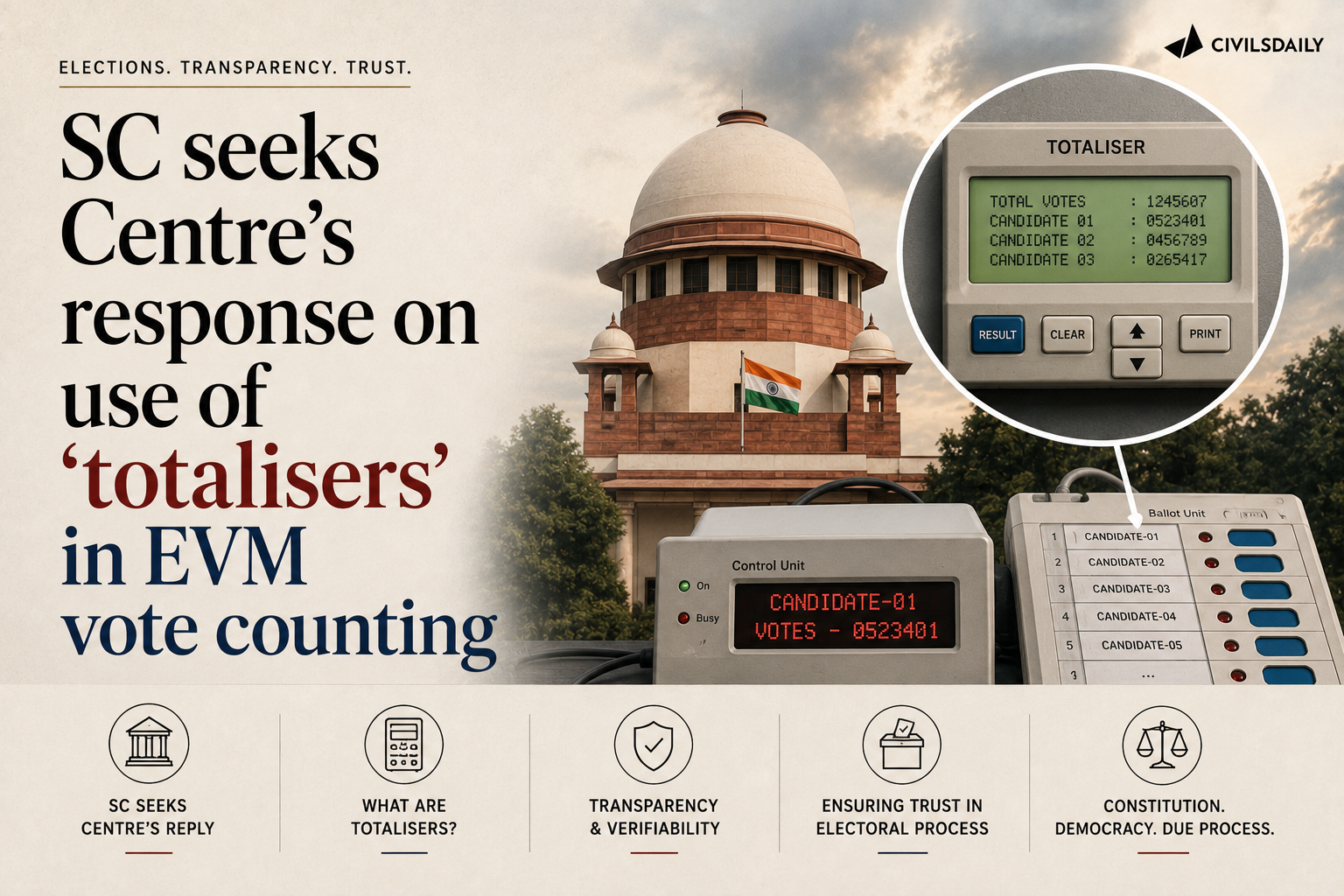
  • SC seeks Centre’s response on use of ‘totalisers’ in EVM vote counting

    SC seeks Centre’s response on use of ‘totalisers’ in EVM vote counting

    Why in the News

    The Supreme Court has sought the Centre’s response on the use of “totalisers”, machines that consolidate and count votes from multiple electronic voting machine (EVM) control units at once without revealing booth-wise voting trends, as a “fall-back option”. The order came on a petition arguing that totalisers would protect voters’ privacy by concealing booth-wise voting patterns and shield them from reprisals. The Election Commission (EC) had warned the Court against the move, saying that introducing a new and unregulated mechanism at a time when the integrity of EVMs is itself under frequent public questioning could give rise to fresh allegations and controversy. The tension is between the voter’s privacy at the booth level and the booth-wise, machine-wise trail that the EC calls the backbone of a self-verifying count.

    What is a totaliser?

    1. What it does: A totaliser consolidates and counts votes from multiple EVM control units simultaneously, so the result is declared for the group rather than for each booth.
    2. How it connects: It links a cluster of 14 control units, from 14 polling stations, via a cable.
    3. What it outputs: It provides a consolidated result for each candidate across that group of EVMs, with no booth-wise breakdown.

    Why does the petitioner want totalisers?

    1. Privacy of the individual voter: Booth-wise results reveal how a locality voted, and the petitioner argued that totalisers would safeguard the privacy of individual voters.
    2. Protection from reprisals: Political parties victimise voters at the local level after identifying voting patterns in particular polling booths, and concealing the pattern removes the target.
    3. A fall-back, not a replacement: The Court framed the question to the Centre as one of a “fall-back option”, not a wholesale change in counting.

    On what legal and political grounds does the Election Commission object?

    1. The climate is wrong: The EC told the Court that the functioning and integrity of EVMs are still a subject of frequent public questioning, and that a new and as yet unregulated mechanism would further complicate public confidence in an already sensitive area.
    2. There is no law for it: Neither the Representation of the People Act, 1951 nor the Conduct of Election Rules, 1961 nor any allied enactment contains a provision recognising, regulating or governing the use of a totaliser in counting.
    3. Amendments would be needed: Substantive amendments and a revision of the statutory procedure governing the counting of votes would have to be made to include totalisers.
    4. Parties have said no: Three of six national parties and 18 of 29 State parties opposed the idea, and only the Law Commission of India, in its 255th report, suggested their selective use.

    Why does the Election Commission say totalisers would reduce transparency?

    1. Counting is witnessed booth by booth: Polling and counting are conducted in the presence of candidates and their agents.
    2. Form 17C is the reconciliation tool: Candidates and agents use Form 17C to match the vote count at the end of polling and again after counting at every polling station, and those comparisons are used in adjudications before election tribunals and courts.
    3. The trail is the backbone: The one-to-one, booth-wise and EVM-wise correspondence under Form 17C is what the EC calls the backbone of the self-verifying and transparent character of counting, and that transparency gives credence to the outcome.
    4. Parties use the pattern legitimately: Knowledge of booth-level voting lets parties improve outreach in booths where they underperformed and make corrective organisational decisions.
    5. Aggregation hides faults: Totalisers would mask technical malfunction and human error in individual EVMs, since clubbed machines stand concealed within the aggregate figure and cannot be identified or independently verified by any party.
    6. The main worry: The EC’s chief concern is that totalisers would become fodder for further misapprehension about EVMs.

    Challenges to introducing totalisers

    1. Machine-level verification would lose its anchor: The Court-ordered paper trail check works per machine, and an aggregated result has no machine to check against. Eg. Association for Democratic Reforms v. Election Commission of India (2024) required Voter Verifiable Paper Audit Trail (VVPAT) slips to be counted for five randomly selected EVMs per Assembly segment.
      The Fix: Keep the machine-wise VVPAT count and Form 17C reconciliation internal to the counting hall, and publish only the aggregated result.
    2. Small clusters still reveal patterns: In sparsely populated segments a cluster of 14 booths can map onto one or two villages, so aggregation does not conceal the locality’s vote. Eg. Hill and tribal constituencies routinely have polling stations serving a few hundred electors each.
      The Fix: Set the cluster size by elector count rather than by a fixed number of machines.
    3. The EC’s own position has moved: The Commission proposed totalisers to the Law Ministry in 2008 and the Law Commission endorsed selective use in 2015, so its present opposition invites the charge of inconsistency. Eg. The 255th report on electoral reforms cited the EC’s proposal when recommending the change.
      The Fix: Publish a reasoned position paper setting out what changed between the 2008 proposal and the present affidavit.

    Conclusion

    The Court has kept the question open and asked the Centre rather than deciding it. The next step is the Centre’s reply, and the source gives no date for it. The marker to watch is whether the Centre is willing to amend the election rules, since without that amendment the EC’s legal objection stands whatever the Court thinks of the privacy claim.

    Back2Basics: Form 17C

    1. What it is: The “Account of Votes Recorded” prepared by the presiding officer of each polling station under the Conduct of Election Rules, 1961.
    2. Part I: Records the identification numbers of the EVMs used, the total electors, the votes recorded in the machine and the number of tendered votes, and a copy goes to each polling agent at the close of poll.
    3. Part II: Records the result of counting for that machine, filled in at the counting centre and signed by the counting supervisor and candidates’ agents.
    4. Why it matters: It is the only document that lets a candidate compare votes polled at a booth with votes counted from that booth.

    [2026, GS2, 10 marks] Is the right to vote a fundamental right? Discuss the position of the Election Commission of India while undertaking the revision of electoral rolls. Can it also examine the question of citizenship of voters?”

  • National Biodiversity Authority disburses Rs. 5.68 Crore in Access and Benefit Sharing funds

    National Biodiversity Authority disburses Rs. 5.68 Crore in Access and Benefit Sharing funds

    Why in the News

    The National Biodiversity Authority (NBA) disbursed Rs. 5.68 crore in Access and Benefit Sharing (ABS) funds.

    Core facts

    1. Disbursing body: The National Biodiversity Authority (NBA) released the funds.
    2. Amount: The verified headline figure is Rs. 5.68 crore, drawn from the release title.
    3. Mechanism: ABS returns a share of the commercial gains from biological resources to the communities and institutions that conserve them.
    4. Unverified detail: The recipient states, institutions and the per beneficiary split stated in the release body could not be verified this run. PRID 2304759.

    Static Context

    1. Biological Diversity Act, 2002: It gives effect to the Convention on Biological Diversity (CBD). It created a three tier structure.
    2. Three tier structure: The National Biodiversity Authority (NBA) sits at the national level. State Biodiversity Boards (SBBs) sit at the state level. Biodiversity Management Committees (BMCs) sit at the local body level.
    3. Access and Benefit Sharing: The principle flows from the Nagoya Protocol of 2010, a supplementary agreement to the CBD on fair and equitable sharing of benefits from genetic resources.
    4. Biopiracy check: The NBA regulates access to Indian biological resources by foreign entities. It clears Intellectual Property Rights (IPR) applications based on Indian biological material.
    5. 2023 amendment: The Biological Diversity (Amendment) Act, 2023 eased compliance for codified traditional knowledge and registered practitioners of Indian systems of medicine.

    Prelims angle

    The three tier NBA, SBB and BMC structure, the BMC role in ABS and the levy of collection fees, the Nagoya Protocol link, and the NBA gatekeeping of IPR applications are the testable static hooks.

    Mains angle

    GS Paper 3 (conservation, biodiversity governance). A question can assess whether the ABS mechanism delivers real incentives for community level conservation.

    “[2023] Consider the following statements:

    1. In India, the Biodiversity Management Committees are key to the realization of the objectives of the Nagoya Protocol.

    2. The Biodiversity Management Committees have important functions in determining access and benefit sharing, including the power to levy collection fees on the access of biological resources within its jurisdiction.

    Which of the statements given above is/are correct?

    (a) 1 only

    (b) 2 only

    (c) Both 1 and 2

    (d) Neither 1 nor 2

    “[2012] How does the National Biodiversity Authority (NBA) help in protecting the Indian agriculture?

    1. NBA checks the biopiracy and protects the indigenous and traditional genetic resources.

    2. NBA directly monitors and supervises the scientific research on genetic modification of crop plants.

    3. Application for Intellectual Property Rights related to genetic/biological resources cannot be made without approval of NBA.

    Which of the statements given above is/are correct?

    (a) 1 Only

    (b) 2 and 3 only

    (c) 1 and 3 only

    (d) 1, 2 and 3

  • Consumer Affairs notifies Legal Metrology (Indian Standard Time) Rules, 2026

    Consumer Affairs notifies Legal Metrology (Indian Standard Time) Rules, 2026

    Why in the News

    The Department of Consumer Affairs notified the Legal Metrology (Indian Standard Time) Rules, 2026.

    Core facts

    1. Notifying body: The Department of Consumer Affairs, under the Ministry of Consumer Affairs, Food and Public Distribution, issued the notification.
    2. Instrument: The rules are framed under the Legal Metrology Act, 2009, the parent law governing weights, measures and units of measurement.
    3. Purpose: The rules set Indian Standard Time (IST) as the single reference time for official, legal, commercial and administrative use.
    4. Unverified detail: The compliance timeline, exempted sectors and penalty provisions stated in the release body could not be verified this run. PRID 2304613.

    Static Context

    1. Legal Metrology Act, 2009: It replaced the Standards of Weights and Measures Act, 1976 and the enforcement Act of 1985. It standardises units, mandates verification of weighing and measuring instruments, and regulates packaged commodity declarations.
    2. Indian Standard Time: IST is fixed at the 82 degrees 30 minutes East standard meridian passing near Mirzapur, Uttar Pradesh. It runs 5 hours 30 minutes ahead of Coordinated Universal Time.
    3. Time keeping authority: The National Physical Laboratory (NPL), under the Council of Scientific and Industrial Research (CSIR), maintains and disseminates IST.
    4. Bureau of Indian Standards (BIS): BIS is the national standards body under the BIS Act, 2016. Standardisation of time complements product and quality standardisation functions.

    Prelims angle

    The parent Act (Legal Metrology Act, 2009), the standard meridian (82 degrees 30 minutes East), the IST offset (UTC plus 5:30), and the custodian of IST (NPL under CSIR) are the testable static hooks.

    Mains angle

    GS Paper 2 (Governance, regulation of standards) and GS Paper 3 (standardisation and the economy). A question can frame the costs and benefits of a single legal time reference for a country of India’s longitudinal span.

    [2017] Consider the following statements:

    1. The Standard Mark of Bureau of Indian Standards (BIS) is mandatory for automotive tyres and tubes.

    2. AGMARK is a quality Certification Mark issued by the Food and Agriculture Organization of the United Nations (FAO).

    Which of the above statements is/are correct?

    (a) 1 only

    (b) 2 only

    (c) Both 1 and 2

    (d) Neither 1 nor 2

  • The broken promise of right to work

    Why in the News

    Employment under India’s rural work guarantee fell 68 per cent in July and August against the average of the preceding five years. The Viksit Bharat Guarantee for Rozgar and Ajeevika Mission (Gramin) Act, enacted by the Union government in December 2025 to replace the Mahatma Gandhi National Rural Employment Guarantee Act, 2005 (MGNREGA), came into implementation on 1 July. A three judge Supreme Court Bench led by the Chief Justice of India dismissed a petition on minimum wages in rural employment guarantee programmes on 21 August and sought a fresh one. The same Bench asked whether the right to work should be treated on par with Article 21, the fundamental right to life. The tension is that the right to work sits in the unenforceable Directive Principles, and the one statute that had converted it into a demand driven entitlement has been replaced by a law that caps funds and shifts cost onto the States.

    What is the VB-GRAM G Act?

    1. It replaced the 2005 employment guarantee law: The Viksit Bharat Guarantee for Rozgar and Ajeevika Mission (Gramin) (VB-GRAM G) Act took over from MGNREGA with effect from 1 July.
    2. Funding is capped rather than demand driven: The Act places an arbitrary cap on funds instead of releasing money against work actually demanded.
    3. The wage is not tied to a minimum wage: The Act does not link its wage rate to any statutory minimum wage.
    4. Areas can be denotified: It carries provisions to denotify specified areas and exclude them from the scheme, which ends the universality MGNREGA carried.

    What has happened to rural employment since 1 July?

    1. Employment fell 68 per cent in July and August: The comparison is with the average for those two months over the preceding five years.
    2. The five year average was 3.44 crore households: They generated about 44 crore person days of work in July and August.
    3. This year the figures are 1.39 crore households and 14.94 crore person days: The data are as on 31 August 2026 for 2026-27.
    4. The decline predates the new law: Households employed in those months fell steadily from 4.79 crore in 2021-22 to 2.44 crore in 2025-26 under MGNREGA itself.
    5. Household earnings have halved: Estimated total earnings of households in July and August fell to about half of the same months last year.

    Why does the Constituent Assembly debate matter to the present dispute?

    1. The disagreement was about placement, not value: Most members agreed that a right to work was vital, and the argument was whether it belonged among the fundamental rights or in the Directive Principles of State Policy (DPSP), which are precepts for framing law rather than enforceable rights.
    2. K.T. Shah argued for a fundamental right: He held that the State needed a constitutional and positive legal mandate to guarantee socio-economic security to its citizens.
    3. B.R. Ambedkar held it was not yet enforceable: He treated the right to work as an essential goal whose immediate universal enforcement was not fiscally or institutionally viable in a newly independent India hollowed out of its resources.
    4. The placement was aspiration, not abandonment: Locating the right among the Directive Principles reflected a deliberate constitutionalism of aspiration rather than a rejection of the welfare ideal.

    Which constitutional provisions carry the right to work?

    1. Article 41 states the obligation: The State shall, within the limits of its economic capacity and development, make effective provision for securing the right to work.
    2. Article 39 covers livelihood and equal pay: It directs the State towards an adequate means of livelihood and equal pay for equal work for both men and women.
    3. Articles 42 and 43 cover conditions and wages: They require just and humane conditions of work, and a living wage with a decent standard of life for all workers.

    How did the aspiration become a statutory right?

    1. Olga Tellis established the link to life: In Olga Tellis vs Bombay Municipal Corporation (1985) the Supreme Court ruled that the right to livelihood was a necessary condition for the fundamental right to life.
    2. Activists and rural workers drove the legislation: The National Rural Employment Guarantee Act was passed in 2005 following their collective effort.
    3. It made a pan-India right to work real for the first time: The State carried a statutory obligation to provide employment at minimum wages.
    4. The scope was always narrow: The guarantee covered 100 days of work per rural household, and the programme was chronically underfunded.

    What is wrong with the Bench’s own remark on minimum wages?

    1. The remark links a wage floor to fewer workers: The Bench observed that if financial resources remained the same, a minimum wage threshold could reduce the number of workers who could be given employment.
    2. It cuts against Sanjit Roy: In Sanjit Roy vs State of Rajasthan (1983) the Supreme Court held that payment below minimum wages violates Article 23 of the Constitution and is akin to forced labour.
    3. It assumes a fixed budget: The reasoning rests on the resources for a welfare programme remaining unchanged and constrained.
    4. Higher wages raise demand, not only cost: Higher rural wages increase purchasing power and effective demand for goods and services, producing a multiplier effect on productivity.

    How did the wage fall behind in the first place?

    1. Wages were delinked from the wage law in 2009: MGNREGA wages ceased to be tied to the Minimum Wages Act, 1948.
    2. They barely kept pace with inflation: The daily wage in July and August rose from Rs 210 in 2021-22 to Rs 282.5 this year while person days collapsed.
    3. They stayed below agricultural minimum wages: The MGNREGA rate remained lower than the minimum agricultural wage in most States.
    4. Women are increasingly unpaid family workers: Rural wages have been stagnant for a decade, and women are recorded in growing numbers as working without pay within the household.

    Why does the new Act face a constitutional objection?

    1. Non-retrogression bars rolling a realised right back: Once the State has reached a level of progressive legislation and enforceability of a right, it cannot adopt measures that deliberately undo it.
    2. The Supreme Court affirmed the doctrine in Navtej Singh Johar vs Union of India: It operates as a check on State power, ensuring that rights once realised are not diluted later.
    3. The replacement appears to breach it: Substituting a demand driven statutory entitlement with a fund limited mission dilutes a right that had already been realised in law.
    4. The fiscal shift compounds the problem: States already face curtailed borrowing limits under the Fiscal Responsibility and Budget Management (FRBM) framework, and the new Act adds to what they must fund.

    Challenges to the rural employment guarantee

    1. A capped budget converts a guarantee into a scheme: Work can be refused once the allocation is exhausted, so the entitlement lapses at the point demand peaks. Eg. MGNREGA allocations were routinely spent before the fourth quarter, leaving States carrying negative opening balances into the next year.
      The Fix: Treat the allocation as a first charge revised at the supplementary budget stage against verified work demand.
    2. Wage payment delay destroys the incentive to seek work: A worker who waits months for payment stops applying, and the falling application count is then read as falling need. Eg. Delayed wage payments under MGNREGA drew repeated censure from the Supreme Court and from parliamentary committees.
      The Fix: Release the statutory delay compensation automatically from the central account rather than on an individual worker’s complaint.
    3. Work demand is registered by the body that must then supply it: A gram panchayat under budget pressure has an incentive not to record demand, so the shortfall never appears in the data. Eg. Dated receipts against work applications are prescribed by law and are rarely issued in practice.
      The Fix: Allow demand to be registered through an independent time stamped channel outside the implementing agency.
    4. Social audit units depend on the governments they audit: Their staff and budgets come from the State administration, which limits what they are able to report. Eg. Social audit units in several States operate well below their sanctioned staff strength.
      The Fix: Fund social audit units through a ring fenced central allocation and place their findings before the State legislature.
    5. Asset creation is measured by expenditure rather than durability: A work is closed on payment rather than on verified usefulness, so the durable asset the programme exists to create goes unchecked. Eg. Comptroller and Auditor General audits of MGNREGA have repeatedly reported incomplete and unusable works.
      The Fix: Make geo-tagged completion and a one year durability check the condition for closing a work in the management information system.

    Conclusion

    An unenforceable directive principle survives only through the statute that implements it. India now has a rural work law that no longer carries the features which made the earlier one a right, and the collapse in employment is the first measurable consequence of that. What must change is that the wage be linked to a living wage standard, that payment be made on time, and that social audits be run by panchayati raj institutions holding real powers. These are the minimum conditions under which a work guarantee functions as a guarantee at all.

    Back2Basics: Minimum Wages Act, 1948

    1. Purpose: It empowers the appropriate government to fix and revise minimum rates of wages payable in scheduled employments.
    2. Dual authority: Both the Centre and the States act as appropriate governments, each notifying rates for the employments within its own sphere.
    3. Components of the wage: A minimum wage may combine a basic rate with a cost of living allowance, so it moves as prices move.
    4. Current status: It has been subsumed into the Code on Wages, 2019, which extends a statutory floor wage across all employments rather than scheduled ones alone.

    Matching Previous Year Question

    “[2011] Among the following who are eligible to benefit from the “Mahatma Gandhi National Rural Employment Guarantee Act”? (a) Adult members of only the scheduled caste and scheduled tribe households (b) Adult members of below poverty line (BPL) households (c) Adult members of households of all backward communities (d) Adult members of any household ANSWER: (d)”

  • Subhash Chandra case: why are creditors set to recover only ₹6.5 cr. against ₹22,006 cr. claims?

    Why in the News

    The NCLT approved Subhash Chandra’s personal insolvency repayment plan, allowing creditors with ₹22,006.57 crore in admitted claims to recover just ₹6.25 crore, a 99.97% haircut.

    Core issue: The case highlights how personal insolvency under the IBC, 2016 works when a guarantor’s admitted liability is much larger than the assets available in their personal estate. Dissenting creditors, including HDFC Bank, are considering an appeal.

    How does personal guarantor insolvency work under the Insolvency and Bankruptcy Code, 2016?

    1. A personal guarantee is a promise to pay another’s debt: An individual undertakes to repay a borrower’s debt if the borrower defaults.
    2. The firm and the guarantor are separate legal persons: Proceedings against a company and against its personal guarantor are separate proceedings even when they arise from the same borrowing.
    3. The guarantor proposes, the creditors vote: In personal insolvency the first step is for the borrower to propose a repayment plan, which the creditors then vote on.
    4. Approval triggers a statutory discharge: Once the creditors and the NCLT approve the plan, Section 119 of the Code passes a discharge order giving the guarantor a fresh start.

    Why do the corporate and personal proceedings run in parallel?

    1. Section 60 sends the guarantor to the same tribunal: The IBC provides for insolvency of a personal guarantor of a corporate debtor to be dealt with by the NCLT where proceedings against the corporate debtor are pending.
    2. A guarantor’s liability is coextensive and independent: Contract law treats that liability as running alongside the principal borrower’s rather than only after it.
    3. A corporate process seeks a buyer, a personal process seeks a plan: Corporate insolvency resolves a firm’s debt by taking over its management and finding a buyer or revival plan, and failing that leads to liquidation.
    4. The personal order settles nothing for the firms: The founder’s personal insolvency does not extinguish the liabilities of the Essel linked firms that borrowed the money.

    Why does the 99.97 per cent haircut overstate what was lost?

    1. The comparison is against admitted claims, not realisable assets: The haircut measures the gap between claims admitted in the proceedings and the amount proposed for distribution.
    2. The disclosed estate was Rs 31.79 crore: The resolution professional assessed the guarantor’s disclosed personal assets at that figure.
    3. The tribunal applied a better off test: The NCLT considered whether creditors would recover more under the repayment plan than if the guarantor were pushed into bankruptcy.
    4. The guarantor disputes the claim base: His office has stated that he borrowed no money, and that the claim against him by the objectors to the plan is Rs 3,992 crore.

    How did the plan clear the creditors despite objections?

    1. The plan carried 80.814 per cent of voting share: The statutory threshold is more than three-fourths, so the requirement was met.
    2. No individual creditor holds a veto: A plan sanctioned by the tribunal binds every creditor covered by it, including those who voted against it.
    3. Five entities were alleged to be associates: Dissenting creditors argued those entities were connected to the founder and should not have been permitted to vote. The NCLT did not accept the objection.
    4. The Bench itself was divided: The original NCLT Bench differed over the plan, and a third judicial member decided the matter.

    What did the tribunal do with the net worth discrepancy?

    1. Earlier certificates showed a far larger figure: A 2017 net worth certificate furnished to RBL Bank put his net worth at about Rs 45,888 crore, and a 2018 certificate at about Rs 40,562 crore.
    2. Creditors sought a forensic audit: They asked for an examination of the gap between those certificates and the assets disclosed in the present proceedings.
    3. Suspicion was held not to be proof: The NCLT held that the creditors had not shown with evidence that specific assets were transferred, concealed or diverted to defraud them.
    4. A forensic audit is not a precondition: The tribunal held that such an audit is not mandatory before a repayment plan can be approved.

    What grounds remain if the creditors appeal?

    1. The appeal lies to the appellate tribunal: Creditors can challenge the order before the National Company Law Appellate Tribunal (NCLAT).
    2. The challenge must be legal or procedural: Available grounds include ineligible creditors being allowed to vote, the statutory majority being wrongly calculated, or the law being wrongly applied.
    3. A low recovery is not itself a ground: A creditor cannot overturn a plan merely because it considers the amount recovered too small.
    4. The associate votes are the strongest ground: If the appellate tribunal finds those votes were wrongly counted and the required majority was consequently not reached, it can interfere with the approval.
    5. The corporate borrowers stay exposed: Creditors can continue to pursue the principal borrowers through separate legal or insolvency proceedings.

    Is this outcome exceptional or the norm?

    1. 5,186 cases have produced 64 repayment plans: Since the personal guarantor provisions came into force, creditors have filed about that many cases and only 64 ended in a repayment plan.
    2. Recovery across those plans is about 1 per cent: Creditors recovered roughly that share of what they were owed in the cases that did reach a plan.
    3. The case is therefore representative: A near total haircut is the ordinary result of this regime rather than an outlier produced by one guarantor’s circumstances.

    Challenges to the personal guarantor insolvency regime

    1. Admitted claims bear no relation to the estate: A guarantor is admitted for the whole defaulted corporate debt, and the recovery pool is one individual’s property, so the ratio is guaranteed to look catastrophic. Eg. Guarantees securing multi-thousand crore project loans are routinely taken from promoters whose personal balance sheets are a fraction of that size.
      The Fix: Require lenders to record and periodically revalue the guarantor’s net worth against the guaranteed exposure, so the guarantee is priced as security rather than counted at face value.
    2. Voting power can sit with connected parties: The Code sets a voting threshold without a tested standard for excluding creditors related to the guarantor, so a majority can be assembled from within the group. Eg. Related party voting was the reason corporate insolvency law had to bar connected persons from the committee of creditors through Section 29A.
      The Fix: Extend a Section 29A style disqualification expressly to voting in personal guarantor repayment plans, with the burden of disclosure on the guarantor.
    3. Asset disclosure is self reported: The estate rests on what the individual declares to the resolution professional, who has limited power to trace assets held through family members or offshore structures. Eg. Benami holdings and trust structures sit outside the disclosure a resolution professional can compel.
      The Fix: Give the resolution professional statutory access to income tax, benami property and foreign asset reporting records for the guarantor and immediate family.
    4. The process is slow relative to the value at stake: A guarantor’s estate does not appreciate during the proceedings, and delay erodes the small recovery that exists. Eg. Corporate insolvency resolution has routinely overrun the 330 day outer limit the Code prescribes.
      The Fix: Set a hard outer timeline for personal guarantor cases with automatic escalation to the appellate tribunal on breach.
    5. Discharge closes the file without closing the debt: A discharge order releases the guarantor while the borrowing companies remain in default, so lenders keep the exposure and lose the security. Eg. Group structures allow the operating company, the borrower and the guarantor to fail in three separate forums on different timelines.
      The Fix: Require the corporate and personal proceedings arising from the same borrowing to be heard by a single Bench, so the two outcomes are decided against one record.

    Conclusion

    The regime was built to do two things at once. It gives an honest guarantor a fresh start, and it gives a lender a second claim on a defaulted loan. It cannot do both when the claim admitted is the whole debt and the estate is one person’s property. The marker to watch is whether the appellate tribunal treats disqualification of connected voters as a live standard, since that is the only part of this process a dissenting creditor can still reach.

    Back2Basics: Insolvency and Bankruptcy Board of India

    1. Establishment: Set up in 2016 as the regulator created by the Insolvency and Bankruptcy Code, 2016.
    2. Regulated entities: It regulates insolvency professionals, insolvency professional agencies and information utilities.
    3. Powers: It carries legislative, executive and quasi-judicial functions, framing regulations under the Code and enforcing them.
    4. Data role: It publishes case level outcomes of the insolvency process through periodic newsletters.

    [2017] Which of the following statements best describes the- term ‘Scheme for Sustainable Structuring of Stressed Assets (S4A)’, recently seen in the news?

    (a) It is a procedure for considering ecological costs of developmental schemes formulated by the Government.

    (b) It is a scheme of RBI for reworking the financial structure of big corporate entities facing genuine difficulties.

    (c) It is a disinvestment plan of the Government regarding Central Public Sector Undertakings.

    (d) It is an important provision in ‘The Insolvency and Bankruptcy Code’ recently implemented by the Government.

  • Govt. notifies IST as common time reference across India; gives 180 days for compliance

    Why in the News

    The Union Ministry of Consumer Affairs, Food and Public Distribution has notified the Legal Metrology (Indian Standard Time) Rules, 2026, making Indian Standard Time (IST) the single reference for legal, administrative, commercial and other official purposes across the country. The Rules come into force 180 days after their publication in the Official Gazette, which gives government departments, businesses and institutions a compliance window to align their systems. The step follows the spread of digital and technology based systems whose records depend on accurate and synchronised time stamps, from banking and payments to telecommunications, railways, power grids and computer networks. A stated feature of the Rules is the reduction of dependence on foreign satellite based time sources that several critical systems currently rely on. The tension is that a legal mandate can fix which clock is authoritative and cannot by itself supply a domestic time signal accurate and reachable enough for the systems being asked to switch.

    What are the Legal Metrology (Indian Standard Time) Rules, 2026?

    1. A single legal reference: The Rules make IST the sole time reference for legal, administrative, commercial and other official purposes across India.
    2. Regulated as a measurement: The nodal authority is the Department of Consumer Affairs, so time is governed as a unit of measurement under legal metrology rather than as a scientific standard alone.
    3. Deferred commencement: Enforcement begins only after the compliance window closes, so existing systems are given time to re-synchronise instead of being placed in immediate default.

    Why does a single time reference matter for the systems that use it?

    1. Financial records: A common reference supports accurate time stamping of banking and digital payment transactions, which is what establishes the order of two competing entries.
    2. Transport coordination: It underpins coordination among railways, airports and other transport systems that run on shared schedules.
    3. Communication networks: Reliable functioning of telecommunication and internet networks depends on synchronised clocks across switching and routing equipment.
    4. Power systems: Precise timekeeping in power systems is what allows a grid disturbance to be sequenced and attributed after the event.
    5. Legal and government records: The upkeep of government and legal records rests on a timestamp that can be relied on as evidence.
    6. Emergency services: Coordination of emergency and other time critical services requires every responding agency to work off the same reference.

    Why are foreign satellite based time sources the actual target?

    1. The current dependence: Several critical systems draw their time signal from foreign satellite constellations rather than from a domestic source.
    2. Divergent sources produce divergent records: Inconsistencies between different time sources affect the coordination and the recording of transactions and operations.
    3. Sovereignty over the signal: A time signal controlled outside the country can be degraded or withdrawn, which places the legal record of a domestic transaction outside national control.
    4. Dissemination is being built: Infrastructure is being created to disseminate accurate IST through Indian institutions and legal metrology laboratories.

    Challenges to enforcing a single legal time reference

    1. Legacy equipment cannot be re-synchronised by notification: Older industrial and utility controllers carry their own internal clocks and no interface to accept an external time input. Eg. Supervisory control equipment in several State distribution utilities still runs on locally set device clocks. Fix. Make an external time input a condition of equipment certification, so replacement cycles carry the requirement instead of a one time drive.
    2. Millisecond accuracy needs a physical network, not a rule: A mandate names the reference and does not deliver the signal at the precision that payment switches and grid protection equipment need. Eg. India’s national time reaches most users through public internet time servers rather than through dedicated links. Fix. Extend optical fibre and radio based time dissemination to regional laboratories before the compliance window closes.
    3. Enforcement capacity sits with State departments: State legal metrology staff who inspect weights and measures are being asked to verify a technical time standard they hold no instruments for. Eg. State legal metrology departments already report inspector shortfalls for routine verification of weighing and measuring instruments. Fix. Fund a reference clock and calibration equipment at each State laboratory as part of the rollout rather than after it.
    4. One legal time does not answer the longitudinal spread: A single reference across a country spanning nearly 30 degrees of longitude leaves the northeast with early sunrise and working hours misaligned with daylight. Eg. Assam has repeatedly sought a separate tea garden time an hour ahead of IST for its plantation working hours. Fix. Meet the demand through statutory flexibility in working hours, since the Rules foreclose a second legal time.

    Conclusion

    What to watch through the compliance window is whether the domestic dissemination network is live before enforcement begins, since a mandate that outruns its infrastructure converts every unsynchronised system into a default. The wider question is whether a legal standard alone can displace a foreign signal that critical systems adopted because it was cheaper and easier to reach.

    Back2Basics

    1. Reference meridian: IST is set to the 82.5 degrees East longitude, which passes near Mirzapur in Uttar Pradesh.
    2. Offset: It runs 5 hours 30 minutes ahead of Coordinated Universal Time (UTC), the global time scale maintained by atomic clocks.
    3. Custodian: The Council of Scientific and Industrial Research (CSIR) National Physical Laboratory, New Delhi, maintains and disseminates India’s national time using caesium atomic clocks.
    4. Single zone: India uses one time zone for the entire country, unlike several states of comparable longitudinal span that use more than one.

    Matching Previous Year Question

    “[2017] Consider the following statements: 1. The Standard Mark of Bureau of Indian Standards (BIS) is mandatory for automotive tyres and tubes. 2. AGMARK is a quality Certification Mark issued by the Food and Agriculture Organisation (FAO). Which of the statements given above is/are correct? (a) 1 only (b) 2 only (c) Both 1 and 2 (d) Neither 1 nor 2 ANSWER: (a)”

  • Indian Standard Time made the single legal time reference through new Legal Metrology rules

    Why in the News

    The Department of Consumer Affairs has notified the Legal Metrology (Indian Standard Time) Rules, 2026. The rules make Indian Standard Time (IST) the single legal time reference for use across sectors.

    Core facts

    1. Notifying body: The rules were notified by the Department of Consumer Affairs, under the Ministry of Consumer Affairs, Food and Public Distribution.
    2. Parent law: The rules are framed under the Legal Metrology Act, 2009. This Act governs weights, measures and standards of measurement in India.
    3. Mandate: The rules mandate use of IST for legal, administrative, commercial and official purposes. Use of any alternative time reference is barred unless expressly permitted.
    4. Synchronisation method: Government offices and public institutions must synchronise clocks using Network Time Protocol (NTP) and Precision Time Protocol (PTP). These are internet protocols that distribute a common reference time to connected devices.
    5. Source of time: IST is maintained by the CSIR National Physical Laboratory (NPL). It is set at Coordinated Universal Time (UTC) plus 5 hours 30 minutes.
    6. Exemptions: Scientific, astronomical and navigational uses are exempt with prior government approval.
    7. Enforcement: Compliance is checked through periodic audits. Penalties apply for violations.

    Static Context

    1. One Nation, One Time: The reform is the operational form of the One Nation, One Time idea. A draft version was first issued for public comment in early 2025.
    2. Legal Metrology institutions: The Legal Metrology wing sits under the Department of Consumer Affairs. It enforces uniform weights, measures and now uniform time.
    3. CSIR National Physical Laboratory: NPL is the national measurement standards laboratory. It keeps India’s atomic time scale and disseminates IST.
    4. Why uniform time matters: Power grid synchronisation, telecom, banking, digital governance and defence need one accurate time base. Many networks earlier drew time from foreign satellite sources such as the Global Positioning System (GPS).

    Prelims angle

    1. Custodian fact: IST is maintained by CSIR NPL, not by the India Meteorological Department or ISRO.
    2. Offset fact: IST equals UTC plus 5:30, based on the 82.5 degree East longitude reference.
    3. Legal base fact: The rules flow from the Legal Metrology Act, 2009, a consumer affairs law, not from a science ministry statute.
    4. Protocol fact: NTP and PTP are the mandated synchronisation protocols.

    Mains angle

    GS3 (Science and Technology in everyday life) and GS2 (government regulation and standardisation). A question can ask how a single national time standard strengthens critical infrastructure security and consumer fairness.

    Matching Previous Year Question

    “No direct PYQ traced in the provided files for legal metrology or Indian Standard Time. Closest tracked Microtheme is Certification/Promotional Bodies (Governance), covering national standards and certification bodies.”