💥UPSC 2027,2028 Mentorship (June Batch) + Access XFactor Notes & Microthemes PDF

Type: World Mapping

  • The Crisis In The Middle East

    Places in news: Kurdistan Region

    Note4Students

    From UPSC perspective, the following things are important:

    Prelims level: Kurdistan Region

    Why in the News?

    India has dispatched a humanitarian aid consignment to the Kurdistan region of Iraq.

    Kurdistan Region

    What is the Kurdistan Region?

    • The Kurdistan Region refers to areas inhabited by ethnic Kurds, primarily in Iraq, Iran, Syria, and Turkey.
    • The Kurdistan Regional Government (KRG) administers Iraqi Kurdistan, an autonomous region in northern Iraq.
    • The Kurds, a distinct ethnic and linguistic group, have long sought independence and greater autonomy.
    • Geographical Significance:
      • Spans across Turkey, Iraq, Iran, and Syria, covering the Zagros Mountains and fertile plains.
      • Rich in oil and natural gas, particularly in Iraqi Kurdistan, making it geopolitically significant.
      • Controls key border regions and trade routes, influencing regional stability.
    • Political Implications:
      • The Kurdish struggle for autonomy has led to tensions with central governments, particularly in Iraq and Turkey.
      • Kurdish forces (Peshmerga) have played a key role in fighting ISIS and maintaining security in northern Iraq.
      • The KRG has diplomatic ties with Western countries but lacks full sovereignty.

    Ongoing Dispute:

    • The Kurdish independence movement faces opposition from Iraq, Turkey, Iran, and Syria, fearing territorial fragmentation.
    • Iraq rejected the 2017 Kurdistan independence referendum, leading to military and economic retaliation.
    • Turkey continues military operations against Kurdish groups, considering them a security threat.
    • The Turkey-ISIS-Kurd relationship remains controversial, with allegations that Turkey indirectly enabled ISIS against the Kurds.


    PYQ:

    [2018] The term “two-state solution” is sometimes mentioned in the news in the context of the affairs of:

    (a) China

    (b) Israel

    (c) Iraq

    (d) Yemen

  • Places in News: Sudan’s Darfur Region

    Note4Students

    From UPSC perspective, the following things are important:

    Prelims level: Darfur Region

    Why in the News?

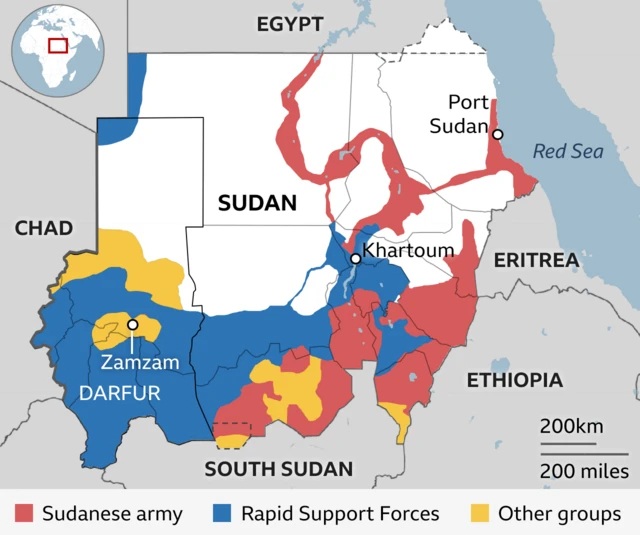
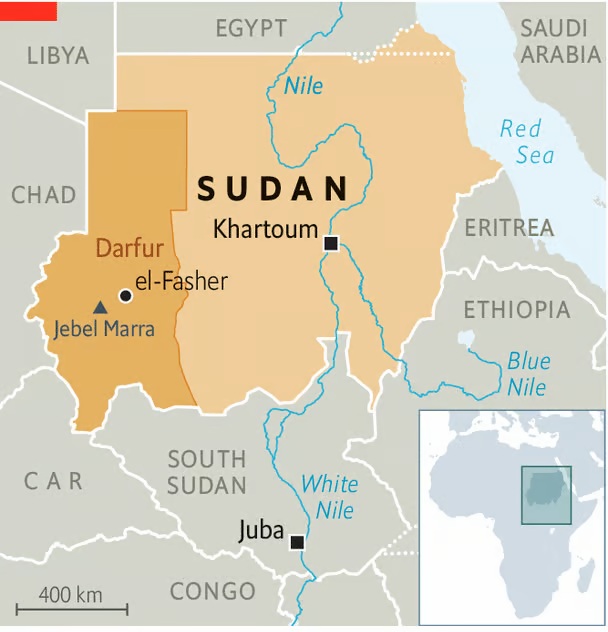
    At least 70 people were killed in a drone strike on the last working hospital in Sudan’s North Darfur capital.

    About the Darfur Region

    Details
    • Conflict-prone region in western Sudan, affected by ethnic violence and resource conflicts since 2003.
    • Site of one of the world’s worst humanitarian crises, with mass killings and displacement.
    • Home to multiple ethnic groups, with tensions between Arab pastoralists and non-Arab farming communities.
    • Janjaweed militias, backed by the Sudanese government, accused of genocide and mass atrocities.
    • Rapid Support Forces (RSF), formerly Janjaweed, play a key role in ongoing instability.
    • Renewed violence in 2023, worsening the humanitarian situation.
    Geographical Location
    • Located in western Sudan, bordering Chad, Libya, and the Central African Republic.
    • Covers an area of about 493,180 sq. km, nearly the size of France.
    • Predominantly arid and semi-arid, with desert in the north and more fertile land in the south.
    • Climate-driven water and grazing conflicts, worsened by desertification and climate change.
    • Composed of five states: North, South, West, Central, and East Darfur.
    • El Fasher is the capital and largest city, serving as an administrative and humanitarian hub.
    Impact of Conflict
    • Politically marginalized for decades, leading to armed uprisings against Sudan’s government.
    • Conflict escalated in 2003 with rebel groups like the Sudan Liberation Movement (SLM) and Justice and Equality Movement (JEM) demanding greater autonomy.
    • Remains a stronghold of rebel activity, contributing to Sudan’s broader instability.
    • Ongoing violence impacts regional security, affecting neighboring countries like Chad and the Central African Republic.


    PYQ:

    [2024] Consider the following statements :

    Statement-I: There is instability and worsening security situation in the Sahel region.

    Statement-II: There have been military takeovers/coups d’état in several countries of the Sahel region in the recent past.

    Which one of the following is correct in respect of the above statement?

    a) Both Statement-I and Statement-II are correct and Statement-II explains Statement-I

    b) Bothe Statement-I and Statement-II are correct, but Statement-II does not explain Statement-I

    c) Statement-I is correct, but Statement-II is incorrect

    d) Statement-I is incorrect, but Statement-II is correct

  • Foreign Policy Watch: India-ASEAN

    Mapping: Lao PDR

    Note4Students

    From UPSC perspective, the following things are important:

    Prelims level: Lao PDR

    Why in the News?

    The Indian Embassy in Lao PDR has successfully rescued 67 Indian nationals who were trafficked and forced to work in cyber scam centres in the Golden Triangle Special Economic Zone (GTSEZ).

    Golden Triangle Special Economic Zone (GTSEZ)

    • It is a semi-autonomous economic zone located in Bokeo Province, Lao PDR (Laos), near the borders of Thailand and Myanmar.
    • It is situated within the infamous Golden Triangle region, historically known for opium production and drug trafficking.
    • It was established to promote tourism, trade, and investment but has been widely criticized for illegal activities, including human trafficking, cyber fraud, and illicit gambling.

    About Lao PDR (Laos)

    Details
    • Officially known as the Lao People’s Democratic Republic (Lao PDR).
    • Gained independence from France in 1953.
    • Experienced a civil war (1959–1975), leading to the communist Pathet Lao taking control and abolishing the monarchy in 1975.
    • One-party communist state under the Lao People’s Revolutionary Party (LPRP).
    • Economic growth driven by hydropower, mining, and agriculture, but remains one of ASEAN’s least developed nations.
    • 2023 economic distress due to high debt and inflation, linked to China-backed infrastructure projects like the China-Laos Railway.
    Geographical Location
    • Landlocked country in Southeast Asia, bordered by China (north), Vietnam (east), Cambodia (south), Thailand (west), and Myanmar (northwest).
    • Capital city: Vientiane, located along the Mekong River near Thailand.
    • Total area: 236,800 sq. km, with a mountainous landscape and dense forests.
    • The Mekong River flows through Laos, supporting trade, agriculture, and hydropower projects.
    • Tropical monsoon climate with a wet season (May-Oct) and a dry season (Nov-Apr).
    Political Aspects
    • One-party communist state, ruled by the Lao People’s Revolutionary Party (LPRP) since 1975.
    • The most heavily bombed country per capita in history due to the US Secret War (1964–1973).
    • Acts as a buffer state between China, Vietnam, and Thailand, playing a role in Mekong River trade and energy exports.
    • ASEAN Membership: Joined ASEAN in 1997, contributing to regional diplomacy and economic cooperation.

    Challenges:

    • Major recipient of Chinese investment under the Belt and Road Initiative (BRI), with concerns over debt sustainability.
  • Climate Change Impact on India and World – International Reports, Key Observations, etc.

    In news: Yala Glacier

    Note4Students

    From UPSC perspective, the following things are important:

    Prelims level: Yala Glacier

    Why in the News?

    Yala Glacier in Nepal is predicted to disappear by the 2040s due to rapid retreat and mass loss. It is the only glacier in the Himalayas listed on the Global Glacier Casualty List, an initiative launched in 2024 to document endangered or vanished glaciers worldwide.

    Note:  The UN has designated 2025 as the International Year of Glacier Preservation, with March 21st to be observed annually as World Glacier Day starting from 2025.

    About the Yala Glacier 

    • Yala Glacier is located in the Langtang Valley, central Nepal, and is influenced by the Indian summer monsoon.
    • It is one of the most studied glaciers in Nepal and represents the Hindu Kush Himalayan region in the World Glacier Monitoring Service (WGMS) database.
    • The glacier has been monitored for over a decade using stakes, snow pits, and satellite images, providing crucial data on the state of Himalayan glaciers.
    • It is the only glacier in the Himalayas included in the Global Glacier Casualty List, a recognition of its critical status.
    • It plays a vital role in studying the cryosphere, a critical water resource supporting 240 million people in the Himalayan region.

    Retreat of Yala Glacier

    • Yala Glacier is projected to disappear by the 2040s, reflecting the growing threat to Himalayan glaciers.
    • It has retreated by 680 meters between 1974 and 2021, with a 36% reduction in area during this period.
    • Its elevation, which ranged between 5,170m and 5,750m in 2011, has significantly declined.
    • The glacier has lost so much mass that it no longer meets scientific standards for effective observation.
    • The Hindu Kush Himalayan cryosphere is warming twice as fast as the global average, leading to rapid glacial retreat.

    About the Global Glacier Casualty List

    • It was launched in 2024 by a consortium of institutions including Rice University, World Glacier Monitoring Service (WGMS), World Meteorological Organization (WMO), and UNESCO.
    • It documents endangered or vanished glaciers.
    • Glaciers Listed: Includes 15 glaciers, such as:
      • Pico Humboldt Glacier (Venezuela): Disappeared in 2024.
      • Sarenne Glacier (France): Vanished in 2023.
      • Dagu Glacier (China): Categorized as “critically endangered,” expected to vanish by 2030.
    • Significance:
      • Highlights the urgency of glacier preservation, as these ice masses store 70% of global freshwater and influence water security for billions of people worldwide.
      • Reinforces the need for global cooperation to address the accelerating loss of glaciers due to climate change


    PYQ:

    [2019] Consider the following Pairs :

    Glacier: River

    1. Bandarpunch : Yamuna
    2. Bara Shigri : Chenab
    3. Milam : Mandakini
    4. Siachen : Nubra
    5. Zemu : Manas

    Which of the following pairs given above are correctly matched?

    (a) 1,2 and 4

    (b) 1,3 and 4

    (c) 2 and 5

    (d) 3 and 5

  • Russian Invasion of Ukraine: Global Implications

    Places in news: Kerch Strait

    Note4Students

    From UPSC perspective, the following things are important:

    Prelims level: Kerch Strait

    Why in the News?

    Two Russian ships spilled 3,350 tonnes of low-grade fuel into the Kerch Strait in Crimea, posing an environmental threat to the biodiversity hotspot.

    About the Kerch Strait

    • The Kerch Strait is a narrow, strategically crucial waterway connecting the Black Sea and the Sea of Azov.
    • It serves as a natural maritime corridor between the Crimean Peninsula and the Russian mainland.
    • It stretches approximately 41 kilometers in length and varying between 4-15 kilometers in width.
    • The strait features the Kerch-Yenikalsky canal, a critical maritime passage enabling larger vessels to traverse between the Black and Azov Seas.
    •  Port facilities at Kavkaz and Kerch serve as essential transportation hubs, facilitating significant cargo and passenger movements.
    • Geopolitical Significance
      • Since Russia’s annexation of Crimea in 2014, the Kerch Strait has become a focal point of international tension.
      • The construction of the Crimean Bridge in 2018 provides a direct land connection between Russian territory and the Crimean Peninsula.

    PYQ:

    [2008] Which one of the following straits is nearest to the International Date Line?

    (a) Malacca Strait

    (b) Bering Strait

    (c) Strait of Florida

    (d) Strait of Gibraltar

  • In news: Diego Garcia Island

    Note4Students

    From UPSC perspective, the following things are important:

    Prelims level: Diego Garcia Island

    In news: Diego Garcia Island

    Why in the news?

    Indian fishermen from Tamil Nadu, were detained near Diego Garcia in the British Indian Ocean Territory for crossing the maritime boundary.

    About the Diego Garcia Island

    • The Diego Garcia Island is a part of the British Indian Ocean Territory (BIOT).
    • It is situated in the Indian Ocean, south of the equator.
    • It is located approximately 1,796 km south of India and 4,723 km east of Africa.
    • It was originally inhabited by the Chagossians (Ilois), descendants of African and Indian laborers brought by French colonists.
    • It became a British colony in 1814 following the Napoleonic Wars.

    Political Significance:

    • It houses a significant US military base, established under a 1966 UK-US agreement.
    • It plays a critical role in global military operations, particularly in the Middle East and Asia-Pacific.
    • It serves as a base for long-range bombers, intelligence-gathering operations, and logistical support.
    • The sovereignty of Diego Garcia is disputed by Mauritius, which claims it as part of its territory.
    • In 2019, the International Court of Justice (ICJ) advised the UK to return the Chagos Archipelago, including Diego Garcia, to Mauritius.
      • The United Nations General Assembly endorsed this ruling.
  • Mapping: Gulf of Mexico

    Note4Students

    From UPSC perspective, the following things are important:

    Prelims level: Gulf of Mexico

    Mapping: Gulf of Mexico

    Why in the News?

    Donald Trump has proposed to change the name of the Gulf of Mexico to the “Gulf of America” after his plans for purchasing Greenland.

    About the Gulf of Mexico

    • The Gulf of Mexico is a marginal sea of the Atlantic Ocean.
    • It is bordered by:
      • United States: States of Florida, Alabama, Mississippi, Louisiana, and Texas.
      • Mexico: Eastern coast, including the Yucatán Peninsula.
      • Cuba: Southeastern boundary.
    • It is believed to have formed around 300 million years ago during the late Paleozoic era.
    • Its formation is linked to the breakup of the supercontinent Pangaea.
    • The Gulf has a subtropical to tropical climate.
    • It is prone to hurricanes and tropical storms
    • The Gulf is one of the world’s most significant oil-producing regions. It contains over 17% of global proven petroleum reserves.

    Strategic Location:

    • The Gulf is a crucial artery for international shipping, particularly between the Americas and Europe.
    • It connects to the Caribbean Sea and Atlantic Ocean through the Straits of Florida and to the Pacific Ocean via the Panama Canal.
    • The Gulf serves as a key area for U.S. naval operations.
  • In news: Trinidad and Tobago

    Note4Students

    From UPSC perspective, the following things are important:

    Prelims level: Trinidad and Tobago

    In news: Trinidad and Tobago

    Why in the News?

    The government of Trinidad and Tobago declared a state of emergency on December 30, 2024, in response to escalating violence in the Caribbean nation.

    About Trinidad and Tobago

    • Geography:
      • Located in the southern Caribbean, near Venezuela.
      • A dual-island nation consisting of Trinidad (4,768 sq. km) and Tobago (300 sq. km).
      • Total land area: 5,128 sq. km.
      • Climate: Tropical, with a dry season from January to May and a rainy season from June to December.
    • Population:
      • Approximately 1.5 million people.
      • Ethnic Composition: African (36.3%), Indian (35.4%), Mixed (22.8%), European, Chinese, and others.
      • Religions: Christianity (64%), Hinduism (18%), Islam (5%), and others.
    • Capital and Cities:
      • Capital: Port of Spain (Trinidad).
      • Other key cities: San Fernando, Chaguanas, and Scarborough (Tobago).
    • Political System:
      • Government Type: Parliamentary democracy under a constitutional republic.
      • Member of the Commonwealth of Nations.
      • Gained independence from the UK on August 31, 1962, and became a republic in 1976.
    • Infrastructure:
      • Ports: Port of Spain, Point Lisas, and Scarborough are critical for trade.
      • Airports: Piarco International Airport (Trinidad) and A.N.R. Robinson International Airport (Tobago).
    • Culture and Heritage:
      • Known for the Carnival, one of the world’s largest pre-Lenten celebrations.
      • Birthplace of Calypso music, Soca, and the Steelpan (the only acoustic musical instrument invented in the 20th century).

    Geo-Political Significance

    • T&T is a major exporter of liquefied natural gas (LNG) and petrochemicals (methanol and ammonia), supplying markets in the U.S., Europe, and Latin America.
    • It is positioned at the crossroads of the Caribbean Sea and Atlantic Ocean, serving as a gateway between North and South America.
    • It is a founding member of the Caribbean Community (CARICOM) advocating for regional economic integration, disaster response, and collective security.
    • It is a active member of the Commonwealth and the United Nations, pushing for climate change resilience and sustainable development initiatives.
  • Russian Invasion of Ukraine: Global Implications

    Ukraine ends supply of Russian gas to Europe

    Note4Students

    From UPSC perspective, the following things are important:

    Prelims level: Urengoy-Pomary-Uzhgorod pipeline;

    Mains level: Geopolitical tension in Europe;

    Why in the News?

    For over 40 years, Russian gas has been transported to Europe through Ukraine, but these supplies are set to cease on January 1, following Ukraine’s Naftogaz decision not to renew its most recent five-year transit agreement with Russia’s Gazprom.

    Note: Student you can use this content in Prelims for facts related to map and mains exam for substantiate the argument related to geopolitical tension in Europe.

    Do you know about the Urengoy-Pomary-Uzhgorod pipeline?

    • The Urengoy-Pomary-Uzhgorod pipeline, also known as the Brotherhood pipeline, is a significant natural gas export route from Russia to Europe, primarily traversing Ukraine. The pipeline starts at the Urengoy gas field in northwest Siberia and extends southwest to Uzhhorod, Ukraine, near the Slovakian border.
    • It spans approximately 4,500 kilometers (2,800 miles), with about 1,160 kilometers (720 miles) located in Ukraine.
    • The pipeline was commissioned in 1984 and has been a crucial part of Russia’s gas export strategy to Europe.

    What is the volume of gas supplied through Ukraine?

    • Historical Context: At its peak, the pipeline system, including the Urengoy-Pomary-Uzhgorod pipeline, delivered approximately 201 billion cubic meters (bcm) of gas to Europe in 2018. However, this volume has drastically decreased over the years due to geopolitical tensions and the ongoing conflict in Ukraine.
    • Recent Figures: In 2023, only about 15 bcm of gas was shipped through Ukraine, a significant drop from 65 bcm when the last five-year contract began in 2020.

    What are the Possible Impacts?

    • Economic Consequences for Ukraine: Ukraine is expected to lose up to $1 billion annually in transit fees due to the cessation of gas flows. To mitigate this loss, it plans to quadruple gas transmission tariffs for domestic consumers, which could burden its industry with additional costs exceeding $38.2 million per year.
    • Impact on Gazprom: Russia’s Gazprom is projected to lose around $5 billion in gas sales as a result of this halted transit.
    • European Energy Security: The European Union has prepared for this transition and does not anticipate immediate impacts on consumer prices.
      • Countries like Slovakia and Austria have secured alternative gas supplies from sources such as Norway and LNG imports from the U.S. and Qatar.
    • Hungary will continue receiving Russian gas through the TurkStream pipeline under the Black Sea.

    TurkStream pipeline

    • Energy Crisis in Moldova: The cessation has led to an energy emergency in Transdniestria, a breakaway region of Moldova that relies on these transit flows, resulting in cutoffs of heating and hot water supplies for residents

    Way forward: 

    • Enhanced Energy Diversification: Europe and Ukraine should continue to strengthen alternative energy supply routes, including LNG imports and renewable energy projects, to reduce reliance on Russian gas and ensure long-term energy security.
    • Support for Affected Regions: Provide immediate humanitarian and financial assistance to regions like Transdniestria and Moldova for energy infrastructure upgrades, while encouraging energy-efficient solutions to mitigate the crisis.

    Mains PYQ:

    Q What is the significance of Indo-US defence deals over Indo-Russian defence deals? Discuss with reference to stability in the Indo-Pacific region. (UPSC IAS/2020)

  • In news: Greenland

    Note4Students

    From UPSC perspective, the following things are important:

    Prelims level: Greenland

    Why in the News?

    US President-elect Donald Trump has once again expressed interest in buying Greenland, and Greenland has again stated it is not for sale.

    In news: Greenland

    Why is the US so much interested in Greenland?

    • Greenland is strategically located in the North Atlantic Ocean, between Europe and North America, and across the Baffin Bay from Canada.
      • The US maintains a large air base in Greenland, the Pituffik Space Base (formerly Thule Air Base).
    • From here, the US can monitor and counter missile threats from Russia, China, and North Korea.
    • Greenland is abundant in rare earth minerals, critical for manufacturing electronics, electric vehicles, and weapons.
    • Melting ice caps due to global warming are opening new shipping routes in the Arctic.
      • Greenland’s position is crucial for controlling these waterways, with the US seeking to limit Russian and Chinese influence in the region.

    Greenland: Everything you need to know

    Details
    About 
    • World’s largest island, located in the North Atlantic Ocean between Europe and North America; part of the Kingdom of Denmark.
    • An autonomous territory within Denmark, managing domestic affairs, while Denmark oversees defense, foreign policy, and some economic matters.
    • Population: ~57,000, primarily Inuit communities, concentrated along the coast.
    • Transitioned from a Danish colony to self-rule in 1979, gaining further autonomy in 2009.
    Geographical Features
    • Covers 2.16 million square kilometers, with ~80% under the Greenland Ice Sheet, a critical focus for studying climate change and sea-level rise.
    • Predominantly Arctic climate, with freezing temperatures most of the year; milder summers in the southern coastal areas.
    • Rich in rare earth minerals, iron ore, zinc, lead, and uranium, making it geopolitically significant.
    • Banned uranium mining in 2021 for environmental reasons.
    Political Features
    • Has its own parliament (Inatsisartut) and prime minister overseeing domestic policies; Denmark controls foreign relations and defense.
    • Closely tied to Denmark, with Danish subsidies accounting for ~60% of Greenland’s budget.
    • Some political groups advocate for full independence, though economic dependence complicates this goal.


    PYQ:

    [2014] Consider the following countries :

    1. Denmark
    2. Japan
    3. Russian Federation
    4. United Kingdom
    5. United States of America

    Which of the above are the members of the ‘Arctic Council ‘?

    (a) 1, 2 and 3

    (b) 2, 3 and 4

    (c) 1, 4 and 5

    (d) 1, 3 and 5