Why in the news?
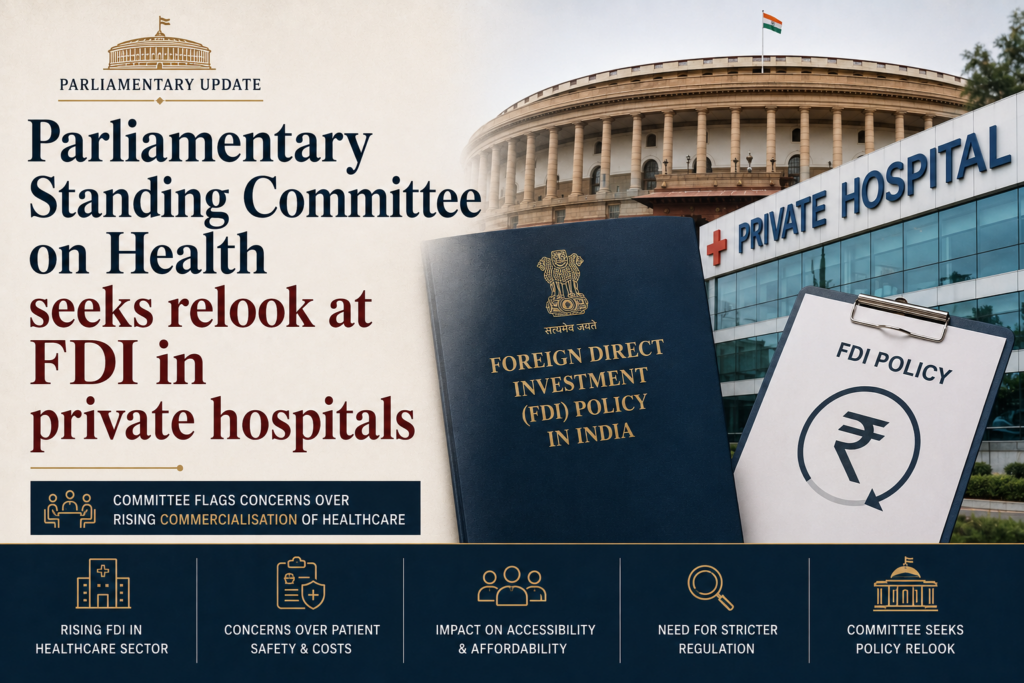
A Parliamentary Standing Committee has recommended a review and rationalisation of Foreign Direct Investment (FDI) limits governing the operation and acquisition of existing private hospitals, warning that aggressive corporatisation and an influx of foreign capital could push up healthcare costs. The recommendation exposes a tension between attracting capital to expand hospital capacity and protecting the affordability of medical care from a shift of healthcare from a public service into a purely capitalistic enterprise.
What is Foreign Direct Investment (FDI) in hospitals?
- Definition: FDI is a non-debt-creating capital flow in which a foreign entity takes a lasting stake in an Indian enterprise, here in the ownership, operation or acquisition of hospitals.
- Current position: Hospitals in India permit 100% FDI under the automatic route, which the Committee flags for the acquisition and operation of existing facilities.
Who examined the issue and in which report?
- Committee: The Department-related Parliamentary Standing Committee on Health and Family Welfare.
- Report: Its 176th report on the Affordability and Accessibility of Healthcare Facilities in the Public and Private Sector.
Why does the Committee want FDI limits reviewed?
- Consolidation risk: Foreign capital is facilitating the acquisition of cost-effective, mid-sized hospitals by larger corporate entities.
- Corporatisation: Such aggressive corporatisation is transforming healthcare from a public service into a purely capitalistic enterprise.
- Cost inflation: This has the potential to inflate the cost of medical procedures and trigger price increases across the healthcare ecosystem.
- Selective openness: Foreign capital should be encouraged in medical devices, consumables and specialised medicines for rare diseases, while its use in direct operation and acquisition of hospitals needs greater scrutiny.
What is the evidence of a public-private cost gap?
- Cost divergence: Citing the 80th round of the National Sample Survey, the panel put the average cost of hospitalisation at Rs 50,508 in private hospitals against Rs 6,631 in government hospitals.
- Regulator role: A strong public healthcare system could act as a market regulator by offering an affordable alternative and exerting competitive pressure on private providers.
- Price standardisation: It called for mechanisms to standardise and cap the cost of essential treatments, diagnostics and routine procedures in private hospitals.
What structural measures did the Committee recommend?
- Public multispeciality hospitals: Autonomous, efficiently managed public multispeciality hospitals in every revenue division to cut dependence on major cities for tertiary care.
- Redirected capital: Incentives to steer foreign investment toward local manufacturing of medical technologies and pharmaceuticals.
- Tier-2 and tier-3 push: Tax holidays and other incentives to attract private multispeciality hospitals in smaller cities and rural areas, with public-private partnerships for underserved regions.
- Cross-subsidisation: Private hospitals receiving government support to use revenue from higher-paying patients to help poorer patients.
- Reserved beds: Raising mandatory bed reservation for Below Poverty Line, Economically Weaker Section and AB-PMJAY beneficiaries from 10% to 20%.
- Fee scrutiny: Hospital-level ethics committees to examine professional fees.
Why is aggressive corporatisation a two-sided problem?
- The capital case: Foreign investment can expand hospital capacity, technology and specialised care that public systems struggle to fund.
- The affordability case: Consolidation of mid-sized hospitals by large corporates can raise prices and weaken affordable options.
- The unresolved gap: Without a strong public alternative and price caps, foreign capital risks entrenching a high-cost private tier.
Challenges to affordable healthcare in India
- Out-of-pocket burden: A large share of health spending is paid directly by households, pushing many into distress.
- Public-private divide: A wide cost gap between government and private care.
- Regional maldistribution: Concentration of tertiary hospitals in metros and large cities.
- Regulatory weakness: Limited standardisation and capping of procedure costs.
- Human resource shortage: Deficits of doctors, nurses and specialists in rural areas.
- Low public spending: Government health expenditure remains a small share of GDP.
Conclusion
The Committee has urged the government to review and rationalise FDI in the operation and acquisition of existing private hospitals while redirecting foreign capital toward medical manufacturing. The current status is a tabled recommendation; the next milestone is the government’s response on FDI norms, price standardisation and expanded public hospital capacity.
Healthcare Financing in India (Foundational Context)
- About: Healthcare in India is delivered through a mix of public facilities, private hospitals and insurance-funded care.
- Scale: Private hospitals dominate tertiary care, with hospitalisation costs several times higher than in government facilities.
- Structural fact: High out-of-pocket expenditure remains a defining feature of Indian health financing.
Government Initiatives for Healthcare
- Ayushman Bharat PM-JAY: Health cover of up to Rs 5 lakh per family per year for eligible beneficiaries.
- Ayushman Arogya Mandirs: Primary health and wellness centres for screening and preventive care.
- National Health Mission: Support for public health infrastructure and human resources.
- Production Linked Incentive for pharma and medical devices: Boosts domestic manufacturing of medicines and equipment.
Challenges in Health Financing
- High out-of-pocket spending, pushing households into poverty.
- Thin insurance penetration beyond publicly funded schemes.
- Cost opacity in private procedures and diagnostics.
- Weak public capacity in tertiary care outside metros.
- Skewed FDI use, favouring acquisition over greenfield capacity.
Way Forward
- Calibrated FDI: Distinguish greenfield capacity from acquisition of existing hospitals.
- Price regulation: Standardise and cap essential procedure costs.
- Public capacity: Build autonomous public multispeciality hospitals in every revenue division.
- Manufacturing incentives: Redirect foreign capital to devices and pharmaceuticals.
“[2020] With reference to Foreign Direct Investment in India, which one of the following is considered its major characteristic?
(a) It is the investment through capital instruments essentially in a listed company.
(b) It is a largely non-debt creating capital flow.
(c) It is the investment which involves debt-servicing.
(d) It is the investment made by foreign institutional investors in the Government securities.
