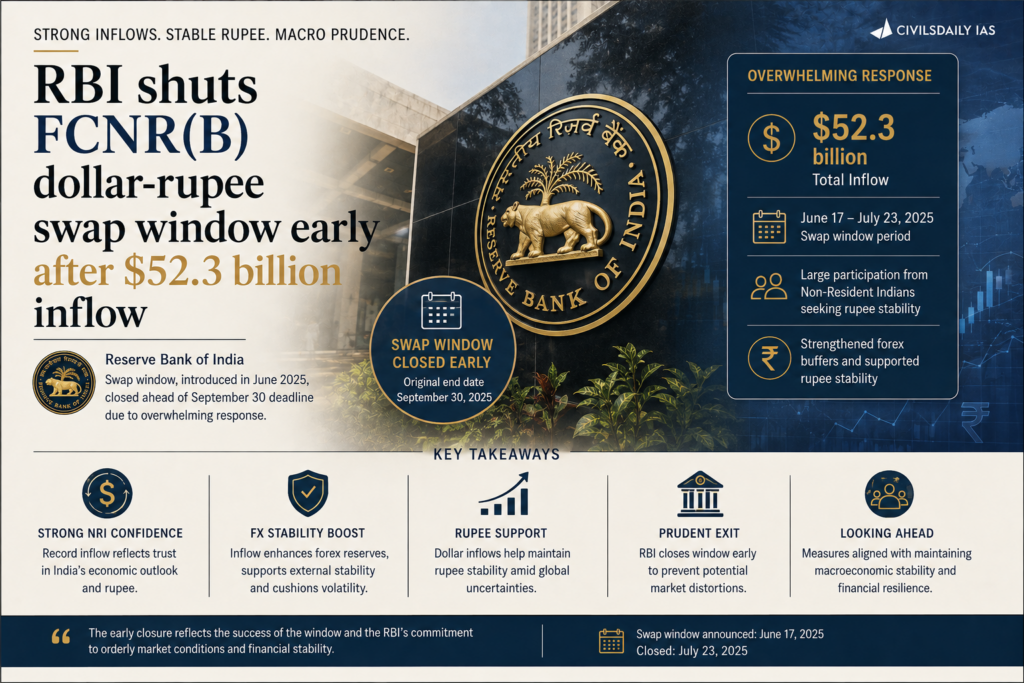
Why in the News
The Reserve Bank of India (RBI) will close its special US dollar-rupee swap window for fresh Foreign Currency Non-Resident (Bank) [FCNR(B)] deposits on 31 August 2026, after attracting $52.3 billion.
What is the FCNR(B) Swap Window?
- Banks mobilise fresh 3 to 5 year FCNR(B) deposits in foreign currency.
- Banks swap the dollars with the RBI for rupees at a concessional rate.
- The RBI returns the dollars when the swap matures.
- The concessional rate covers the bank’s hedging cost.
Key Definitions
- FCNR(B): Foreign Currency Non-Resident (Bank) term deposit held by NRIs or Persons of Indian Origin in foreign currency.
- Hedging Cost: Cost incurred to protect against exchange-rate fluctuations.
- ECB: External Commercial Borrowing, or loans raised by eligible Indian entities from non-resident lenders.
- OFCB: Overseas Foreign Currency Borrowing, or foreign currency funds borrowed by Indian banks from overseas markets.
- Balance of Payments (BoP): Record of all economic transactions between residents of a country and the rest of the world during a period.
Why was the window closed early?
- FCNR(B) route attracted $52.3 billion.
- Total inflows through the three components reached $56.846 billion by 13 August.
- High mobilisation indicated strong response.
- Swaps against already mobilised deposits remain possible until 11 September.
Impact on Forex Reserves
- India’s foreign exchange reserves reached around $707 billion as of 7 August, with foreign currency assets driving much of the increase.
- However, FCNR(B) inflows are debt creating and will eventually require repayment in foreign currency.
“[2021] Consider the following:
1. Foreign currency convertible bonds
2. Foreign institutional investment with certain conditions
3. Global depository receipts
4. Non-resident external deposits.
Which of the above can be included in Foreign Direct Investments?
(a) 1, 2 and 3
(b) 3 only
(c) 2 and 4
(d) 1 and 4.
