💥Mains Ready By December. Smash Mains & Smash PYQ Admissions Open

GS Paper: GS1-01.Indian Culture- Salient aspects of Art Forms, Literature and Architecture from ancient to modern times.

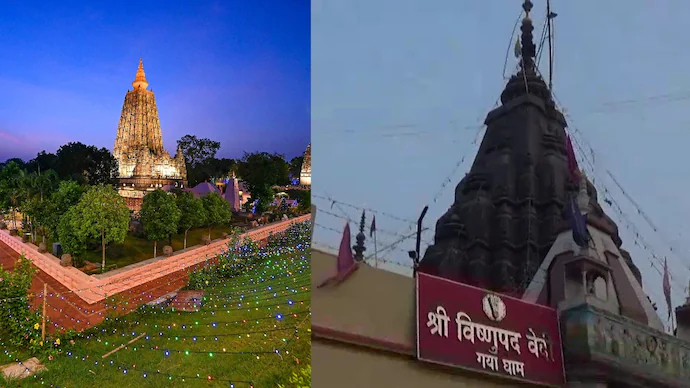
  • Bihar’s Vishnupad and Mahabodhi Temples

    Why in the News?

    • Finance Minister announced during her Union Budget speech that corridor projects will be built for the Vishnupad Temple at Gaya and the Mahabodhi Temple at Bodh Gaya in Bihar.

    About the Vishnupad Temple at Gaya

    Details
    Dedicated to Lord Vishnu
    Significance Contains a 40 cm long footprint of Lord Vishnu; considered sacred in Hinduism; attracts pilgrims for “Pind Daan” rituals.
    Historical Importance Believed to be over 1000 years old; associated with various legends and historical references in Hindu texts.
    Architecture
    • Built in Shikhara style;
    • Features intricate carvings and silver-plated flagposts;
    • Constructed of grey granite blocks.
    Built by Queen Ahilyabai Holkar of Indore in 1787.
    Festivals and Rituals
    • Major site for “Pind Daan” rituals during Pitru Paksha;
    • Attracts thousands of pilgrims during this period.
    Mythology The footprint is believed to be where Lord Vishnu placed his foot to subdue the demon Gayasur.
    Associated River Located on the banks of the Phalgu River, considered sacred for ritual offerings.
    Access and Visitation Accessible year-round; major pilgrimage site with facilities for devotees.
    Recent Developments Ongoing efforts for preservation and restoration; improved infrastructure for pilgrims.


    About the Mahabodhi Temple Complex:

    Details
    Location Bodh Gaya, Bihar;
    Significance Marks the location where Buddha attained enlightenment
    UNESCO Status World Heritage Site since 2002
    Historical Importance
    • One of the four holy sites related to Buddha’s life (Enlightenment).
    • Other holy sites: Lumbini (Birth) in Nepal, Sarnath (First Sermon) in Uttar Pradesh, Kushinagar (Death) in Uttar Pradesh
    Original Construction Built by Mauryan Emperor Ashoka around 260 BCE
    Reconstruction Reconstructed in brick during the late Gupta period (5th or 6th centuries)
    Archaeological Finds
    • Indicates site of veneration since the Mauryan period.
    • Vajrasana (Diamond Throne): Located within the temple, dated to the third century BCE
    Main Temple Structure Dates from the 6th century CE, incorporates parts from 2nd or 3rd century CE
    Architectural Features
    • Two large shikhara towers, the largest over 55 meters high
    • Influenced Jain, Hindu, and Buddhist architecture globally
    Materials Made mostly of brick covered with stucco
    Bodhi Tree Direct descendant of the original tree under which Buddha attained enlightenment
    Traditional Accounts Describes 7 weeks Buddha spent meditating after enlightenment at various spots within the complex
    Decline and Revival
    • Declined after Huna invasions and early Islamic invasions.
    • Revived under the Pala Empire (8th-12th century).
    • Declined again after 12th century CE invasions by Turk armies.
  • [pib] World Heritage Young Professionals Forum, 2024

    Why in the News?

    • India is hosting the UNESCO’s World Heritage Committee meeting for the first time in New Delhi.
      • Theme: “World Heritage in the 21st Century: Building Capacities and Exploring Opportunities for Youth.”

    About the World Heritage Young Professional Forum

    • The World Heritage Young Professionals Forum is an initiative by UNESCO to engage young professionals in the field of heritage conservation.
    • The first World Heritage Young Professionals Forum was organized in 1995.
    • The primary aim is to engage young professionals in heritage conservation and management through capacity building, networking, and awareness-raising.

    Back2Basics: UNESCO World Heritage Sites

    Description
    UNESCO World Heritage Sites Landmarks or areas selected by UNESCO for their cultural, historical, scientific, or other significant value, legally protected by international treaties.
    Importance World Heritage Sites represent collective and preservative interests of humanity, signifying remarkable accomplishments and intellectual history.
    Selection Criteria Sites must be already-classified landmarks, unique and significant culturally or physically, such as ancient ruins, historical structures, cities, monuments, etc.
    Conservation World Heritage Sites require practical conservation to protect them from risks like trespassing, uncontrolled access, or administrative negligence.
    World Heritage Committee Selects and monitors World Heritage Sites, manages the World Heritage Fund, and provides financial assistance. Composed of 21 states parties elected for a four-year term.
    Membership India is not a member of the World Heritage Committee.


    PYQ:

    [2014] Consider the following international agreements:

    1. The International Treaty on Plant Genetic Resources for Food and Agriculture
    2. The United Nations Convention to Combat Desertification
    3. The World Heritage Convention

    Which of the above has / have a bearing on the biodiversity?

    (a) 1 and 2 only

    (b) 3 only

    (c) 1 and 3 only

    (d) 1, 2 and 3

  • Ratna Bhandar of Puri Jagannath Temple, opened after 46 years

    Why in the News?

    After 46 years, the sacred treasury of Shree Jagannath Temple, Puri, known as Ratna Bhandar, was reopened amid years of legal battles, controversies, and debates.

    About the Ratna Bhandar

    • The Ratna Bhandar stores the gold and jewels offered by devotees to the deities Lord Jagannath, Lord Balabhadra, and Goddess Subhadra.
    • It is located adjacent to the prayer hall on the north side of the temple.
    • It consists of two sections: the ‘Bhitar Bhandar’ (Inner Treasury) and the ‘Bahar Bhandar’ (Outer Treasury), with the last inventory in 1978 noting significant amounts of gold and silver items in both chambers.
    • Legend says, Odisha’s King Anangabhima Dev (1211 to 1238) donated 2.5 lakh madhas of gold to prepare jewellery for the almighty.
    • The Odisha government passed the Jagannath Temple Act, 1952 to have a greater role in the temple’s management, which included maintaining an inventory of the offerings in the Puri collectorate’s Record Room.

    Recent Developments:

    • The safety of the Ratna Bhandar is managed by the Temple’s Committee, chaired by the titular ‘King of Puri’ and includes IAS officers and other state-appointed members.
    • Originally, keys to the Ratna Bhandar were held by the Puri royal family, temple committee, and collectorate, with significant changes in ownership and access protocols over the years due to legal rulings.
    • The recent reopening involved breaking the locks of the inner chamber as they could not be opened traditionally, following strict procedures.

    About Jagannath Puri Temple

    • The Jagannath Temple is an important Vaishnavite temple dedicated to Jagannath, a form of Sri Krishna in Puri in Odisha.
    • The present temple was rebuilt from the 10th century onwards, on the site of an earlier temple, and begun by Anantavarman Chodaganga Deva, the first king of the Eastern Ganga dynasty.
    • The Puri temple is famous for its annual Ratha Yatra, or chariot festival, in which the three principal deities are pulled on huge and elaborately decorated temple cars.
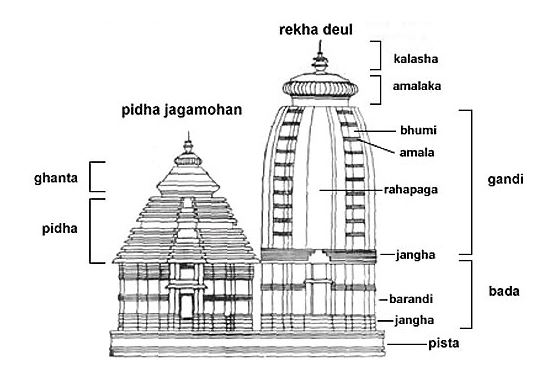
    Its Architecture:

    • With its sculptural richness and fluidity of the Oriya style of temple architecture, it is one of the most magnificent monuments of India.
    • The huge temple complex covers an area of over 400,000 square feet and is surrounded by a high fortified wall.
    • This 20 feet high wall is known as Meghanada Pacheri.
    • Another wall known as kurma bedha surrounds the main temple.

    The temple has four distinct sectional structures, namely:

    1. Deula, Vimana or Garba griha (Sanctum sanctorum) where the triad deities are lodged on the ratnavedi (Throne of Pearls). In Rekha Deula style;
    2. Mukhashala (Frontal porch);
    3. Nata mandir/Natamandapa, which is also known as the Jagamohan (Audience Hall/Dancing Hall), and
    4. Bhoga Mandapa (Offerings Hall)


    PYQ:

    [2012] The Nagara, the Dravida and the Vesara are the:

    (a) Three main racial groups of the Indian subcontinent

    (b) Three main linguistic divisions into which the languages of India can be classified

    (c) Three main styles of Indian temple architecture

    (d) Three main musical Gharanas prevalent in India

  • Temples in News: Mahabodhi Temple, Puri Jagannath Temple

    Description

    Mahabodhi Temple Complex

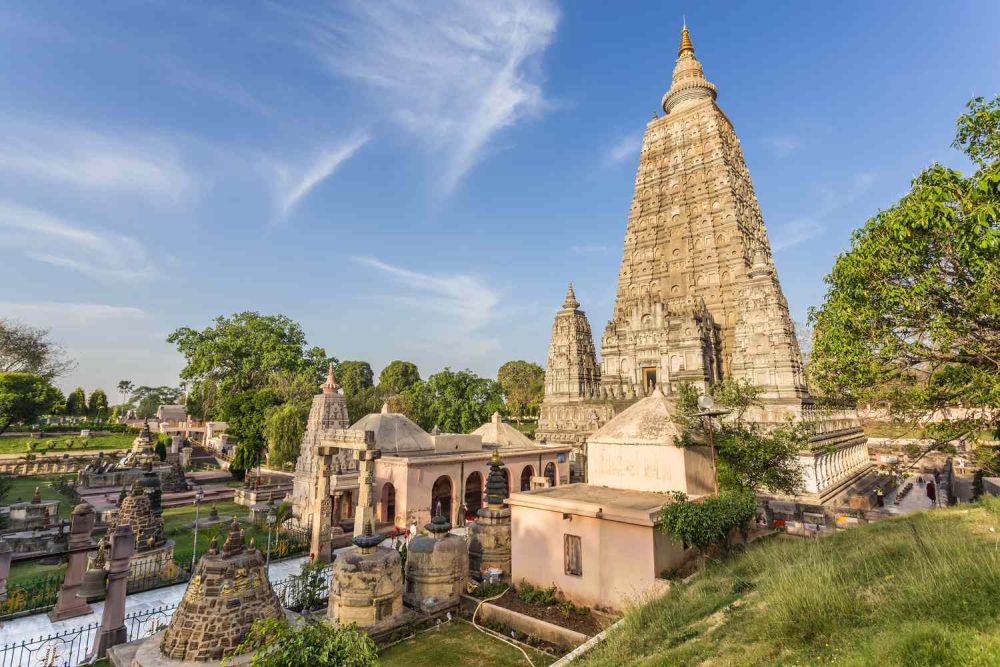
    Mahabodhi Temple Tourism (Bodh Gaya) (2024) - A Complete Travel Guide

    • Location: Bodh Gaya, Bihar
    • Significance: Marks the location where Buddha attained enlightenment.
    • UNESCO Status: World Heritage Site since 2002.
    • Historical Importance: One of the four holy sites related to Buddha’s life (Enlightenment).
    • Original Construction: Built by Mauryan Emperor Ashoka around 260 BCE.
    • Reconstruction: Reconstructed in brick during the late Gupta period (5th or 6th centuries).
    • Archaeological Finds: Indicates a site of veneration since the Mauryan period; Vajrasana (Diamond Throne) dated to the third century BCE.
    • Main Temple Structure: Dates from the 6th century CE, incorporates parts from 2nd or 3rd century CE.
    • Architectural Features: Two large shikhara towers, the largest over 55 meters high; influenced Jain, Hindu, and Buddhist architecture globally.
    • Materials: Made mostly of brick covered with stucco.
    • Bodhi Tree: A direct descendant of the original tree under which Buddha attained enlightenment.
    • Traditional Accounts: Describes 7 weeks Buddha spent meditating after enlightenment at various spots within the complex.
    • Decline and Revival: Declined after the Huna and early Islamic invasions; revived under the Pala Empire (8th-12th century); declined again after 12th century CE invasions by Turk armies.

    Ratna Bhandar of Jagannath Puri Temple

    • Location: Puri, Odisha
    • Significance: Important Vaishnavite temple dedicated to Jagannath, a form of Sri Krishna
    • History: Rebuilt from the 10th century onwards, begun by Anantavarman Chodaganga Deva, first king of the Eastern Ganga dynasty
    • Annual Event: Famous for its annual Ratha Yatra (chariot festival) where three principal deities are pulled on huge, elaborately decorated temple cars
    • Architecture: Oriya style of temple architecture; complex covers over 400,000 square feet, surrounded by a high fortified wall (Meghanada Pacheri); main structures include Deula (Sanctum sanctorum), Mukhashala (Frontal porch), Nata mandir/Natamandapa (Audience Hall/Dancing Hall), Bhoga Mandapa (Offerings Hall)

    Ratna Bhandar:

    • Context: The sacred treasury of Shree Jagannath Temple, Puri, known as Ratna Bhandar, was reopened after 46 years amid legal battles and controversies
    • Contents: Stores gold and jewels offered by devotees to the deities Lord Jagannath, Lord Balabhadra, and Goddess Subhadra
    • Location: Adjacent to the prayer hall on the north side of the temple.
    • Sections: Consists of two sections: the ‘Bhitar Bhandar’ (Inner Treasury) and the ‘Bahar Bhandar’ (Outer Treasury)
    • Historical Significance: Legend says Odisha’s King Anangabhima Dev (1211 to 1238) donated 2.5 lakh madhas of gold to prepare jewelry for the deities
    • Management: Safety managed by the Temple’s Committee chaired by the titular ‘King of Puri’; keys held by the Puri royal family, temple committee, and collectorate with changes over the years
    • Recent Developments: Reopened by breaking the locks of the inner chamber due to inability to open traditionally, following strict procedures


    Also in news: World Heritage Young Professional Forum

    • India is hosting the UNESCO’s World Heritage Committee meeting for the first time in New Delhi.
      • Theme: “World Heritage in the 21st Century: Building Capacities and Exploring Opportunities for Youth.”
    • The World Heritage Young Professionals Forum is an initiative by UNESCO to engage young professionals in the field of heritage conservation.
    • The first World Heritage Young Professionals Forum was organized in 1995.
    • The primary aim is to engage young professionals in heritage conservation and management through capacity building, networking, and awareness-raising.

    PYQ:

    [2012] The Nagara, the Dravida and the Vesara are the:

    (a) Three main racial groups of the Indian subcontinent

    (b) Three main linguistic divisions into which the languages of India can be classified

    (c) Three main styles of Indian temple architecture

    (d) Three main musical Gharanas prevalent in India

  • News in Frames: Chandravalli Caves

    Why in the News?

    Observations made by previous historians who had found painted pottery and coins from the Shatavahana empire and the pre-historic period were once again in the news.

    About Chandravalli Caves (also known as Ankali Math)

      • Chandravalli, a cave temple near Chitradurga, is also a pre-historic site.
      • Observations at the Site:
        • Previous excavations were carried out by Mortimer Wheeler under the guidance of the Archaeological Survey of India in 1947.
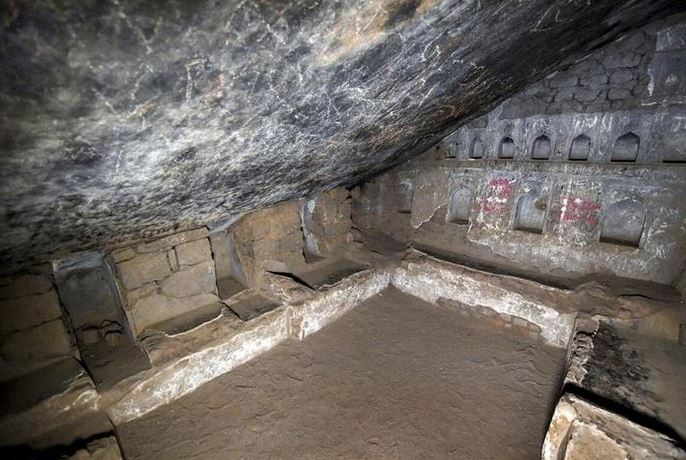
        • The cave features multiple chambers including a puja place with a shivlinga, a drawing room, a bedroom, and a water outlet connected to an internal tank.
        • The caves are accessible only through a narrow entrance, with interiors visible only with the help of a powerful torch hence they are also called as “Dark Caves”.
          • Presently, Excavations have revealed artifacts such as coins, painted bowls, and earthen pots from various dynasties such as the Hoysala, the Satavahana, and the Vijayanagara.
          • Excavation reports show that human habitation existed here even during the Iron Age.
    • Historical Aspect: 
      • They were named after a saint from Ankalagi in Belagavi district who is believed to have settled here.
      • The cave also contains a rock inscription of Mayurasharma, the founder of the Kadamba dynasty, dating back to AD 450.

    About Kadamba dynasty

    • The Kadambas of Goa were vassals of the Chalukya dynasty of Kalyana. In recognition of his assistance in defeating the Rashtrakutas, Chalukyan emperor Tailapa II appointed Kadamba Shasthadeva as the provincial governor (Mahamandaleshwara) of Goa.
    • In 960 AD, Shasthadeva captured the city of Chandavara from the Shilaharas and later seized control of the port of Gopakapattana, which is present-day Goa.
    • Talara Nevayya’s son Gundayya may have fought alongside Shasthadeva in the conquest of the port but died in the battle after successfully capturing it.
    • Coins from Indian kings like Krishnaraja Wodeyar III, Krishnadevaraya, various Satavahana kings, and Viraraya of the Hoysala kingdom have been discovered.
    • Among the foreign coins found are denarii of Roman ruler Augustus Caesar and a coin of Chinese Han dynasty Emperor Wu Ti.
    • Geographical Aspects:
      • The area is semi-arid with scrub vegetation and a stream running through it.
      • These caves are surrounded by three hills: Chitradurga, Kirabanakallu, and Jolagudda.

    PYQ:

    [2021] Which one of the following statements is correct?

    (a) Ajanta Caves lie in the gorge of Waghora river.

    (b) Sanchi Stupa lies in the gorge of Chambal river.

    (c) Pandu-lena Cave Shrines lie in the gorge of Narmada river.

    (d) Amaravati Stupa lies in the gorge of Godavari river.

  • Leang Karampuang Cave is the World’s Oldest Cave Art  

    Why in the News?

    • A cave painting discovered in the limestone cave of Leang Karampuang on Sulawesi Island, Indonesia, dates back at least 51,200 years.
      • The painting features a scene with three part-human, part-animal figures interacting with a wild pig, depicted in red pigment.
    Study Details:

    • Published in the journal Nature, the study titled ‘Narrative cave art in Indonesia by 51,200 years ago’ used a new dating technique to determine the age of the artwork.
    • The study involved 23 researchers from Griffith University, Southern Cross University, and the Indonesian National Research and Innovation Agency.

    Use of Uranium-based Dating:

    • A new dating technique utilizes uranium series (U-series) analysis on calcite deposits above cave art.
    • The laser-based analysis measures uranium-thorium ratios to accurately date paintings, highlighting significant age revisions for cave art in Sulawesi.

    About Leang Karampuang Cave

    • Leang Karampuang Cave is situated in the Maros-Pangkep karst region of South Sulawesi, Indonesia.
    • The cave is renowned for its ancient rock art and archaeological findings, providing insights into early human civilization in the region.
    • It features some of the oldest known hand stencils and paintings of animals, believed to be created by early humans. 

    Key features of the Cave Paintings:

    • A painted scene depicting humans interacting with a pig on the cave wall.
    • The artwork features a pig standing upright alongside three smaller human-like figures, all painted in a single shade of dark red pigment.
    • This painting predates the cave art found in El Castillo, Spain, dating back around 40,800 years ago, marking it as older than European cave paintings.

    Significance of the Painting

    • According to researchers, the figures in the painting depict dynamic action, suggesting a narrative or story being told.
      • The discovery pushes back the origin of figurative art among Homo sapiens, indicating a rich history of storytelling through visual art in early human societies.
    • While Neanderthals began cave markings earlier, around 75,000 years ago, these were primarily non-figurative.
    • The Sulawesi cave art suggests an advanced cultural and artistic development among early humans, predating similar European art by millennia.
    Contemporary Period in the Indian Subcontinent:

    • Homo sapiens had already migrated to various parts of the Indian subcontinent by this time. 
    • Evidence suggests human habitation in India dates back to at least 70,000 years ago, with notable archaeological sites like Bhimbetka in Madhya Pradesh showing signs of early human activity and rock art.


    PYQ:

    [2017] The painting of Bodhisattva Padmapani is one of the most famous and oft-illustrated paintings at

    (a) Ajanta

    (b) Badami

    (c) Bagh

    (d) Ellora 


  • Significance of ‘Abhaya Mudra’


    Why in the News?

    The Leader of Opposition invoked the Abhaya Mudra in his inaugural address as Leader of Opposition in Lok Sabha.

    What is Abhay Mudra?

    • Abhaya mudra, the motif of an open palm (gesturing to stop), is prevalent across many South Asian religions, including Hinduism, Buddhism, Jainism, and Sikhism.
    • Known as the ‘fearlessness gesture’, ‘abhaya’ in Sanskrit means fearlessness. The gesture symbolizes protection and peace.
    • In yoga circles, the abhaya mudra is believed to promote courage and reduce fear and anxiety.
    • While common across many religions, the abhaya mudra is most prominently featured in Buddhism, especially in Thailand and Laos, where it is associated with images of the walking Buddha.

    Origins of the Gesture

    • According to Stanford University, the gesture of an open palm pointed outwards appears to be a natural gesture used since prehistoric times as a sign of good intentions and peace.
    • The gesture also asserted power in antiquity, similar to the magna manus of the Roman Emperors who legislated and gave peace simultaneously.
    • The motif likely originated from a universal gesture associated with human communication, eventually integrating into major South Asian religions.

    Evolution of Mudras in Buddhism

    • For about 500 years after the Buddha, he was not depicted in physical form.
    • Early representations appeared around the first millennium, influenced by Gandhara and Gupta art.
    • With the evolution of these Buddhist traditions, hundreds of mudras entered Buddhist iconography.
    • In tantric Buddhist traditions, mudras symbolized material offerings, enacted forms of worship, or relationships with visualized deities. (as shown in the above diagram)

    Significance of ‘Abhaya Mudra’ in Buddhism: 

    • In Buddhism, the abhaya mudra is linked to a legend involving Devadatta, a cousin of the Buddha, who tried to murder the Buddha by losing a rampaging elephant into his path.
    • The Buddha calmed the elephant by displaying the abhaya mudra, indicating appeasement of the senses and the absence of fear.
    • The gesture is popularly pronounced in Buddhist cultures, symbolizing fearlessness and peace.

    Significance of ‘Abhaya Mudra’ in Hindu Religion:

    • The Buddha was absorbed into the Hindu pantheon as the 9th incarnation of Vishnu.
    • Hindus regarded the Buddha as an avatar of Vishnu between AD 450 and the sixth century, with the first mention in the Vishnu Purana (400-500 CE).
    • The abhaya mudra appears in depictions of Hindu deities, commonly seen in images of Lord Shiva, Lord Vishnu, and Lord Ganesha.

    PYQ:

    [2014] Lord Buddha’s image is sometimes shown with a hand gesture called ‘Bhumisparsha Mudra’. It symbolizes:

    (a) Buddha’s calling of the Earth to watch over Mara and to prevent Mara from disturbing his meditation

    (b) Buddha’s calling of the Earth to witness his purity and chastity despite the temptations of Mara

    (c) Buddha’s reminder to his followers that they all arise from the Earth and finally dissolve into the Earth and thus this life is transitory

    (d) Both the statements ‘a’ and ‘b’ are correct in this context

    [2014] Gandhara sculpture owed as much to the Romans as to the Greeks. Explain.

    [2016] Early Buddhist Stupa-art, while depicting folk motifs and narratives, successfully expounds Buddhist ideals. Elucidate.

  • Kozhikode awarded ‘City of Literature’ at UNESCO Creative Cities Network Conference

    Why in the News?

    • “Kozhikode” was awarded the title of ‘City of Literature’ at the 16th annual conference of the UNESCO Creative Cities Network (UCCN) in Braga, Portugal.
      • The theme of this year’s UCCN conference is ‘Bringing youth to the table for the next decade’.

    About UNESCO Creative Cities Network

    Purpose To promote cooperation among cities for cultural and creative industry development
    Initiation Established by UNESCO in 2004
    Seven Categories/Criteria
    • Sector-Specific Excellence: Prominence in one of the seven creative fields: Craft and Folk Art, Media Arts, Film, Design, Gastronomy, Literature, or Music.
    • Commitment to Creativity: Long-term dedication to creativity and culture as key drivers for urban development.
    • Supportive Infrastructure: Established cultural institutions, educational programs, and events promoting creativity.
    • Alignment with SDG 11: Initiatives supporting the 2030 Agenda for Sustainable Development.
    • Inclusivity: Ensuring creative activities are inclusive and accessible to all societal segments.
    Member Cities Over 250 cities from around the world
    Objectives Foster innovation, cultural diversity, and sustainable urban development
    Activities Collaborative projects, cultural events, and initiatives
    Selection Process Cities apply and are designated by UNESCO based on criteria related to creativity
    Network Coordination UNESCO provides coordination and support
    Impact Enhances cities’ cultural identity, economy, and international visibility
    Other Indian Cities in UCCN
    • Gwalior – Music Category (2023)
    • Srinagar– Crafts and Folk Arts (2022)
    • Jaipur– Crafts and Folk Arts (2015)
    • Varanasi– Creative City of Music (2015)
    • Chennai– Creative City of Music (2017)
    • Mumbai– Film (2019)
    • Hyderabad– Gastronomy/Food (2019)

    Reasons for Kozhikode’s Selection

    • Rich Literary Tradition: Kozhikode has a deep and rich literary heritage that spans centuries, contributing significantly to the cultural and intellectual life of the region.
    • Prominent Literary Figures: The city has been home to many renowned authors, poets, and scholars who have significantly contributed to Malayalam literature.
    • Cultural Festivals and Events: Kozhikode hosts various literary festivals, book fairs, and cultural events that promote literature and reading among the community.
    • Educational Institutions: The presence of several prestigious educational institutions that emphasise literature and the arts played a crucial role in its selection.
    • Community Engagement: Active involvement of local communities in promoting and preserving literary culture through libraries, reading clubs, and literary societies.
    • Literary Infrastructure: Well-established libraries, publishing houses, and bookshops that support and nurture the scholarly ecosystem.

    Historic Contributions of Kozhikode

    • Malayalam Literature: Kozhikode has been a centre for Malayalam literature and scholarly activities. It has produced notable literary figures and is a hub for literary festivals and cultural events.
    • Astronomy and Mathematics: The region, under the patronage of the Zamorins, was a centre for advancements in astronomy and mathematics, contributing significantly to the fields through scholars like the 14th-century mathematician and astronomer Madhava of Sangamagrama.
  • Nouka Baich: Boat Race festival of Bengal   

    Why in the News?

    With the southwest monsoon gradually setting in, Nouka Baich boat races will soon commence in West Bengal and Bangladesh.

    About Nouka Baich

    • Nouka Baich is the traditional boat race of Bengal.
    • It is predominantly held in the rural pockets of West Bengal, including Murshidabad, Nadia, North 24 Parganas, and South 24 Parganas.
    • Historically male-dominated, recent years have seen increasing participation by women.
    • Timing and Duration:
      • Monsoon Season: The races commence with the onset of the south-west monsoon, usually starting in the middle of the rainy season.
      • Extended Period: The events continue until September, with some races extending into October and November, depending on the region.

    Types of Boats Used:

    • Diverse Fleet: Unlike Kerala’s boat races, which typically feature a single type of boat, Bengal’s races use various traditional boats.
    • Common Boat Types: Chhip, Kaile Bachhari, Chande Bachhari, Chitoi, Sorpi, and Sorengi are commonly used in the races.
    • Unique Features: Each boat type has unique design features and historical significance, with some boats like the Sorengi being over 90 feet long and designed to mimic natural forms.

    Similar festivals celebrated in other parts that highlight cultural similarities in India:

    Location Occasion Highlights
    Nehru Trophy Boat Race Punnamada Lake, Alappuzha, Kerala Second Saturday of August Named after Jawaharlal Nehru; features snake boats (Chundan Vallams) accommodating over 100 rowers.
    Champakulam Moolam Boat Race Pampa River, Alappuzha, Kerala June or July One of the oldest boat races, commemorates the installation of Lord Krishna’s idol at Ambalappuzha Temple.
    Aranmula Uthrattadi Vallamkali Pampa River, Aranmula, Kerala Onam (August or September) Features Palliyodams (large snake boats); significant for the Parthasarathy Temple.
    Payippad Jalotsavam Payippad Lake, Alappuzha, Kerala Onam (August or September) Celebrates the installation of deity at Subramanya Swamy Temple; features snake boats and canoes.
    Indira Gandhi Boat Race Ernakulam, Kochi, Kerala Last week of December Part of Cochin Carnival; attracts tourists, named after Indira Gandhi.
    Pongal Boat Race Bhuvanagiri, Tamil Nadu Pongal festival (January) Vibrant cultural displays; local fishermen participate.
    Hiyang Tannaba Manipur Lai Haraoba festival Traditional boat race with long narrow boats, reflecting the Meitei community’s traditions.
    Sithargal Boat Race Chennai, Tamil Nadu Pongal festival Highlights the maritime culture of the region; attracts numerous participants and spectators.
  • UNESCO World Heritage Site of Somanathapura

    Why in the News?

    • Karnataka’s Tourism Department plans to highlight Somanathapura Temple, part of the Hoysala temples, in the Mysuru tourism circuit ahead of Dasara, leveraging its UNESCO World Heritage status.
    Note: There are 42 World Heritage Sites in India. Out of these, 34 are cultural, seven are natural, and one, Khangchendzonga National Park, is of mixed type.

    About Keshava Temple, Somanathapura

    • The Keshava Temple is considered one of the last grand structures built by the Hoysala dynasty.
    • This Trikuta (three-shrined) temple is dedicated to Lord Krishna and is represented in three forms: Janardhana, Keshava, and Venugopala. 
    • The main Keshava idol is missing, and the Janardhana and Venugopala idols are damaged.

    Historical Background:

    • The Keshava Temple was constructed by Somanatha, a commander of the Hoysala Army, during the reign of Hoysala King Narasimha III.
    • Somanatha, who had established a town named Somanathapura after himself, sought the king’s permission and resources to build this grand temple.
    • With the king’s blessing, construction commenced and was completed in 1268 AD.
    • An inscription in old Kannada on a stone slab in the temple provides details of its construction and consecration.
    • After demolitions by invaders, it no longer serves as a place of worship.

    Architecture:

    • The temple is constructed from soapstone, which allows for the fine detailing seen in the carvings.
    • It is built on a raised platform with an outer Pradakshina pathway, allowing devotees to circum-ambulate the sanctum.
    • The temple features a stellar (star-shaped) plan, which creates multiple corners and niches, providing numerous canvases for the sculptors to showcase their intricate work.
    • The temple has three shrines, each crowned with a Vimana (tower).
    • The Hoysala emblem, depicting a warrior fighting a lion, is prominently displayed.
    • The walls of the temple are adorned with beautiful friezes depicting scenes from Hindu epics, figures of elephants, and battle scenes with cavalry.

    Tap to read more about:

    UNESCO Heritage Status for Hoysala Temples in Karnataka

    PYQ:

    [2019] Building ‘Kalyana Mandapas’ was a notable feature in the temple construction in the kingdom of

    (a) Chalukya

    (b) Chandela

    (c) Rashtrakuta

    (d) Vijayanagara

    [2012] The Nagara, the Dravida and the Vesara are the:

    (a) three main racial groups of the Indian subcontinent

    (b) three main linguistic divisions into which the languages of India can be classified

    (c) three main styles of Indian temple architecture

    (d) three main musical Gharanas prevalent in India

    [2013] Chola architecture represents a high watermark in the evolution of temple architecture. Discuss.