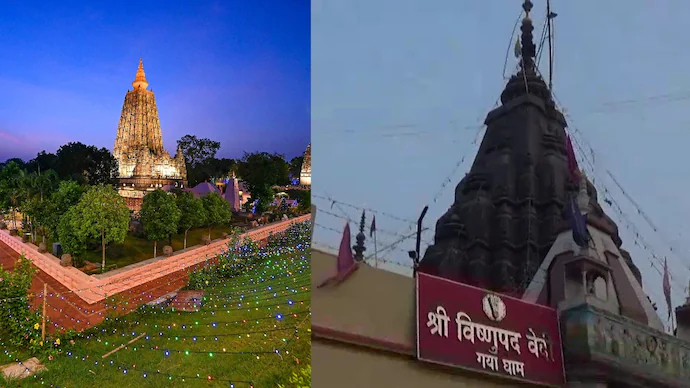
|
Details |
| Location |
Bodh Gaya, Bihar; |
| Significance |
Marks the location where Buddha attained enlightenment |
| UNESCO Status |
World Heritage Site since 2002 |
| Historical Importance |
- One of the four holy sites related to Buddha’s life (Enlightenment).
- Other holy sites: Lumbini (Birth) in Nepal, Sarnath (First Sermon) in Uttar Pradesh, Kushinagar (Death) in Uttar Pradesh
|
| Original Construction |
Built by Mauryan Emperor Ashoka around 260 BCE |
| Reconstruction |
Reconstructed in brick during the late Gupta period (5th or 6th centuries) |
| Archaeological Finds |
- Indicates site of veneration since the Mauryan period.
- Vajrasana (Diamond Throne): Located within the temple, dated to the third century BCE
|
| Main Temple Structure |
Dates from the 6th century CE, incorporates parts from 2nd or 3rd century CE |
| Architectural Features |
- Two large shikhara towers, the largest over 55 meters high
- Influenced Jain, Hindu, and Buddhist architecture globally
|
| Materials |
Made mostly of brick covered with stucco |
| Bodhi Tree |
Direct descendant of the original tree under which Buddha attained enlightenment |
| Traditional Accounts |
Describes 7 weeks Buddha spent meditating after enlightenment at various spots within the complex |
| Decline and Revival |
- Declined after Huna invasions and early Islamic invasions.
- Revived under the Pala Empire (8th-12th century).
- Declined again after 12th century CE invasions by Turk armies.
|