💥Mains Ready By December. Smash Mains & Smash PYQ Admissions Open

GS Paper: GS1-01.Indian Culture- Salient aspects of Art Forms, Literature and Architecture from ancient to modern times.

  • What are Oscar Awards?

    oscar

    A notable Indian song and a documentary has won the Oscar Award this year.

    What are Oscar Awards?

    • The Oscar Awards, also known as the Academy Awards, are an annual awards ceremony honouring excellence in the film industry.
    • The awards are presented by the Academy of Motion Picture Arts and Sciences (AMPAS), a professional honorary organization of over 9,000 members.
    • The first Oscars ceremony was held in 1929, and the awards are now widely considered to be the most prestigious awards in the film industry.
    • The ceremony typically takes place in late February or early March, and is broadcast live on television in over 225 countries and territories worldwide.

    How are the winners decided?

    • Awards are given out in various categories, including Best Picture, Best Director, Best Actor, Best Actress, Best Supporting Actor, Best Supporting Actress, and many more.
    • Nominees and winners are chosen by AMPAS members who work in various branches of the film industry, including actors, directors, writers, and producers.
    • Winning an Oscar can have a significant impact on a filmmaker’s career, as it is widely seen as a mark of prestige and can lead to increased funding and opportunities for future projects.


    Are you an IAS Worthy Aspirant? Get a reality check with the All India Smash UPSC Scholarship Test

    Get upto 100% Scholarship | 900 Registration till now | Only 100 Slots Left

  • Yaoshang festival begins in Manipur

    yaoshang

    The Yaoshang festival, which is Manipur’s version of Holi, has begun.

    Yaoshang Festival

    • Yaoshang festival is celebrated every year on the full moon of Lamta (February-March) of the Meitei lunar calendar.
    • It begins just after sunset followed by Yaosang Mei thaba, also known as Burning of the Straw Hut.
    • Children visit neighbours to ask for monetary donations, called nakatheng.
    • Yaoshang, unlike Holi, is celebrated with a traditional twist in Manipur.
    • During these five days, Manipur comes alive with sporting events during the day and traditional “thabal chongba” dance in the night.

    Key feature: Thabal Chongba Dance

    • The thabal chongba is a traditional dance of the Meitei, where boys and girls gathered in an open ground and dance in a circle.
    • But these days thabal chongba is performed throughout the month of Lamta.


  • Adopt a Heritage project and Monument Mitras: The Scrutiny

    Monument

    Central Idea

    • Businesses that enter agreements with ASI to adopt sites are going to be known as Monument Mitras. The tenfold increase in the number of sites being brought under the ambit of the controversial ‘Adopt a Heritage’ scheme of 2017 raises concerns. Unless the ‘revamped’ scheme is suspended, the nation’s precious pluralistic heritage stands at the threshold of obliteration.

    Get your Rs 10,000 worth of UPSC Strategic Package for FREE | PDFs, Zoom session, Tests, & Mentorship

    Monument

    All you need to know about Adopt a Heritage project

    • Initiative of Ministry of Tourism: The ‘Adopt a Heritage’ scheme was launched by the Indian government in September 2017 under the aegis of the Ministry of Tourism, Ministry of Culture, and Archaeological Survey of India (ASI).
    • Objective: The main objective of the scheme is to provide world class tourist facilities at the various natural/cultural heritage sites, monuments and other tourist sites to make them tourist friendly, enhance their tourist potential and cultural importance in a planned and phased manner across the country.
    • Primary focus: The project primarily focuses on providing basic amenities that include cleanliness, public convenience, drinking water, ease of access for tourists, signage etc. and advanced amenities like TFC, Souvenir shop, Cafeteria etc.
    • Monument Mitra: The public, private sector companies and individuals will develop tourist amenities at heritage sites. They would become ‘Monument Mitra’ and adopt the sites essentially under their Corporate Social Responsibility (CSR) activity.

    What are the concerns?

    • Current plan side-lines the ASI mandate: The current plan also side-lines the mandate of the Archaeological Survey of India (ASI) and abandons The Sarnath Initiative, guidelines devised by the ASI, the Getty Trust, U.S., the British Museum, and National Culture Fund to safe keep excavated objects and present them to visitors in an engaging manner.
    • Undermine local communities and their relationships with historical sites: Guided tours led by employees of large businesses who have received permission to adopt a monument may endanger livelihoods of those who have lived near the site and made a living by regaling visitors with stories of its colourful past.
    • Excessive wear and tear: The potential of big businesses to underwrite a monument’s illumination is also troubling. Night tourism will also pull electricity away from rural homesteads and hospitals.
    • It may alter historical character of monuments which are not under ASI: There are some monuments selected for the scheme that are not protected by the ASI and are in States without Archaeology Directorates. One fears that businesses that sign agreements with the Union Ministry of Culture to adopt these monuments will be able to alter their historical character without much opposition.

    Monument

    What might Corporate India instead do to look after the nation’s-built heritage?

    • Businesses can help citizens understand why monuments matter: This can be done by earmarking CSR funds for grants for researching, writing, and publishing high quality textbooks, and developing imaginative and effective ways of teaching history.
    • For instance: Corporates might also follow the lead taken by Sudha Murthy and N.R. Narayana Murthy in giving gifts to organizations such as the Bhandarkar Oriental Research Institute in Pune to continue their missions of writing history by rationally coordinating the textual record and the archaeological evidence.
    • Skillful conservation: Industrial houses can support the meaningful conservation of heritage buildings by looking within. Their CSR funds can be used to purchase new equipment that release fewer noxious gases that darken and corrode marble buildings and discharge fewer effluents into rivers, thus making these water bodies less likely to serve as breeding grounds of microbes that gather on the walls of ancient buildings erected on riverbanks and cause their decay.
    • For instance: In the past, Tata Sons, ONGC, and other companies have regularly contributed funds to organisations training individuals in much needed restoration skills and creating jobs for them.
    • Collaborative efforts: The private sector’s resources and expertise may also help the ASI and State Archaeology Directorates to secure monuments from dams, mining projects, defacement, and looting.

    Climate change: Significant threat to India’s historical monuments

    • Sanchi Stupa: The 3rd-century BC Buddhist monument in Madhya Pradesh is facing a threat from increasing rainfall and humidity. The stone is deteriorating due to the changes in weather patterns, leading to the loss of carvings and sculptures.
    • Mahabalipuram Monuments: The 7th-century rock-cut monuments in Tamil Nadu are facing a threat from sea-level rise and erosion. The monuments, which are located close to the shore, are being battered by the waves, leading to the loss of sculptures and carvings.
    • Sun Temple, Konark: The 13th-century temple, made of Khondalite stone, is facing a threat from rising temperatures and humidity. The stone is expanding and contracting due to the changes in temperature, leading to cracks and erosion.
    • Hampi Monuments: The 14th-century monuments in Karnataka are facing a threat from heavy rainfall and flooding. The monuments, which are made of granite, are being eroded by the rainwater, leading to the loss of carvings and sculptures.
    • Rajasthan’s Shekhawati’s murals: Shekhawati is known for its beautifully painted havelis with intricate frescoes and murals. Greater fluctuations in temperature are peeling away Shekhawati’s murals.
    • Ladakh’s stucco houses: Higher rainfall is leading Ladakh’s stucco houses to crumble. The traditional way of building houses in Ladakh is under threat due to climate change, which is affecting the durability of the structures.
    • Taj Mahal: The monument built in the 17th century, is facing a threat from rising pollution and changing weather patterns. The white marble is turning yellow due to air pollution.
    • Sea forts in Maharashtra: Rising sea levels are leading to water percolation into forts along Maharashtra’s coast. Salination is eating into their foundations.

    Monument

    Conclusion

    • Currently, India’s progress in diverse fields is being projected at G-20 events across the nation. By embracing forward-thinking principles of historical preservation, businesses, government agencies, and civil society groups can showcase India’s genuine progress in this arena. Maybe their efforts will inspire more citizens to participate in the pressing task of safeguarding India’s pluralistic heritage.

    Mains Question

    Q. What is Adopt a Heritage project? Why there needs a scrutiny of such project, highlight the concerns and suggest what else can be done?

    Attempt UPSC 2024 Smash Scholarship Test | FLAT* 100% OFF on UPSC Foundation & Mentorship programs

  • Assam’s Maidams meet UNESCO technical requirements for heritage centre

    maidam

    Assam’s pyramid-like structures known as moidams or maidams have met all the technical requirements of UNESCO’s World Heritage Centre.

    Charaideo Maidams

    • The Charaideo maidams represents the late medieval (13th-19th century CE) mound burial tradition of the Tai Ahom community in Assam.
    • The Ahoms preferred to place the departed family members at Charaideo where the first king Sukapha was laid to rest.
    • The historical chronicles inform that wives, attendants, pet animals and huge quantity of valuables were buried with the departed kings.
    • The Charaideo Maidams enshrine the mortal remains of the members of the Ahom royalty, who used to be buried with their paraphernalia.
    • After the 18th century, the Ahom rulers adopted the Hindu method of cremation and began entombing the cremated bones and ashes in a Maidam at Charaideo.
    • Out of 386 Maidams explored so far, 90 royal burials at Charaideo are the best preserved, representative of and the most complete examples of mound burial tradition of the Ahoms.

    Architecture details

    • Architecturally it comprises a massive underground vault with one or more chambers having domical superstructure.
    • It is covered by a heap of earthen mound and externally it appears a hemispherical mound.
    • At the top of the mound a small open pavilion chow-chali is provided.
    • An octagonal dwarf wall encloses whole maidam.


    Ahoms Dynasty

    • The Ahom, also known as the Tai-Ahom, are an ethnic group from Assam and Arunachal Pradesh in India.
    • This ethnic group is made up of interbred descendants of the Tai people, who first came to Assam’s Brahmaputra valley in 1228, and indigenous people who later joined them.
    • Sukaphaa, the Tai group’s leader, and his 9000 supporters founded the Ahom empire (1228–1826 CE), which ruled over part of modern-day Assam’s Brahmaputra Valley until 1826.
    • Charaideo, more than 400 km east of Guwahati, was the first capital of the Ahom dynasty founded by Chao Lung Sukaphaa in 1253.
    • The current Ahom people and culture are a mix of the ancient Tai people and culture, as well as indigenous Tibeto-Burman people and cultures that they assimilated in Assam.


    Are you an IAS Worthy Aspirant? Get a reality check with the All India Smash UPSC Scholarship Test

    Get upto 100% Scholarship | 900 Registration till now | Only 100 Slots Left

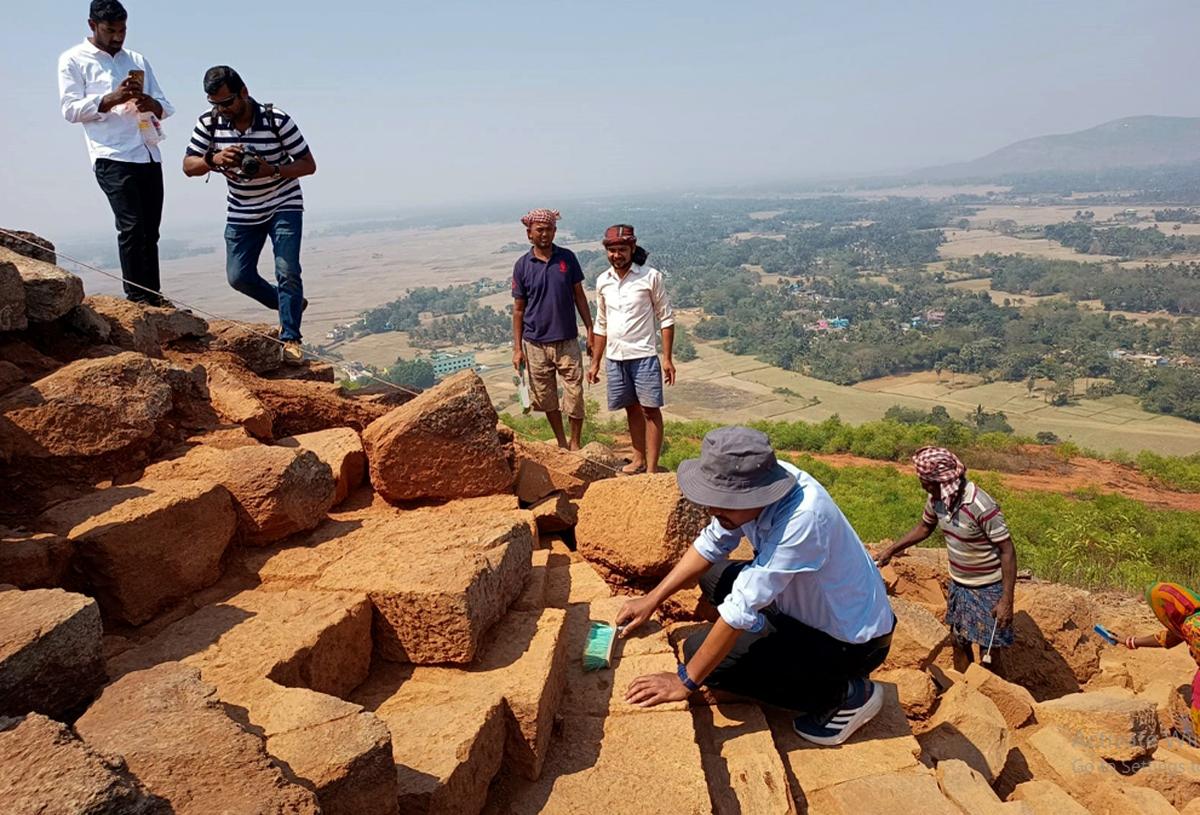
  • ASI finds 1,300-yr-old Buddhist Stupa in Odisha

    stupa

    The Archaeological Survey of India (ASI) stumbled upon a 1,300-year-old stupa right in the middle of a Khondalite mining site in Odisha’s Jajpur district.

    About the Stupa

    • The stupa could be 4.5-meter tall and initial assessment showed it may belong to the 7th or 8th
    • It was found at Parabhadi which is situated near Lalitagiri, a major Buddhist complex, having a large number of stupas and monasteries.
    • The newly discovered stupa was possibly disfigured in an earlier period.

    Khondalite

    stupa

    • Khondalite is a foliated metamorphic rock.
    • It is also called Bezwada Gneiss and Kailasa Gneiss.
    • It was named after the Khond tribe of Odisha and Andhra Pradesh because well-formed examples of the rock were found in the inhabited hills of these regions of eastern India.


    Back2Basics: Lalitagiri Buddhist Complex

    stupa

    • Lalitagiri is a major Buddhist complex in the state of Odisha.
    • The complex is home to stupas, ‘esoteric’ Buddha images, and monasteries (viharas), which is the oldest site in the region.
    • Significant finds at this complex include Buddha’s relics. Tantric Buddhism was practiced at this site.
    • Together with the Ratnagiri and Udayagiri sites a short distance away, Lalitagiri is part of the “Diamond Triangle”.
    • It used to be thought that one or all of these were the large Pushpagiri Vihara known from ancient records, but this has now convincingly located at a different site.

    Stupa Architecture

    stupa

    In the most basic sense, as an architectural representation of a sacred burial site, a stupa — no matter where it is located in the world or when it was built — has three fundamental features.

    • A hemispherical mound (anda) The anda’s domed shape (green highlights) recalls a mound of dirt that was used to cover the Buddha’s remains. As you might expect, it has a solid core and cannot be entered. Consistent with their symbolic associations, the earliest stupas contained actual relics of the Buddha; the relic chamber, buried deep inside the anda, is called the tabena. Over time, this hemispherical mound has taken on an even grander symbolic association: the mountain home of the gods at the center of the universe.
    • A square railing (harmika) The harmika (red highlights) is inspired by a square railing or fence that surrounded the mound of dirt, marking it as a sacred burial site.
    • A central pillar supporting a triple-umbrella form (chattra) The chattra, in turn, was derived from umbrellas that were placed over the mound to protect it from the elements (purple highlights). Just as the anda’s symbolic value expanded over time, the central pillar that holds the umbrellas has come to represent the pivot of the universe, the axis along which the divine descends from heaven and becomes accessible to humanity. And the three circular umbrella-like disks represent the three Jewels, or Triantha, of Buddhism, which are the keys to a true understanding of the faith: (a) Buddha; (b) dharma (Buddhist teachings or religious law); and (c) sangha (monastic community).

    Around these three core building blocks were added secondary features.

    • Enclosure wall with decorated gateways (toranas) at the cardinal directions The wall — with its trademark three horizontal stone bars (in the top image) — surrounds the entire structure. The wall is marked in light blue highlights and the toranas in yellow.
    • A circular terrace (medhi) The terrace — surrounded by a similar three-bar railing — supports the anda and raises it off the ground (black highlights); it likely served as a platform for ritual circumambulation.


    Attempt UPSC 2024 Smash Scholarship Test | FLAT* 100% OFF on UPSC Foundation & Mentorship programs

    Get your Rs 10,000 worth of UPSC Strategic Package for FREE | PDFs, Zoom session, Tests, & Mentorship
  • Key findings about Keeladi Excavation

    keeladi

    Central idea: Keeladi is an archaeological site that has been excavated by the Tamil Nadu State Department of Archaeology since 2014. Recent excavations here has pushed the Sangam age further back.

    About Keeladi

    keeladi

    • Keeladi is a tiny hamlet in the Sivaganga district in south Tamil Nadu.
    • It is about 12 km south-east to the temple city of Madurai and is located along the Vaigai River.
    • The excavations here from 2015 prove that an urban civilisation existed in Tamil Nadu in the Sangam age on the banks of the Vaigai River.

    How is Keeladi linked to Sangam age?

    • The Sangam age is a period of history in ancient Tamil Nadu which was believed to be from the third century BCE to the third century CE.
    • The name is derived from the renowned Sangam poets of Madurai from that time.

    Recent findings

    • In 2019, a TNSDA report dated the unearthed artefacts from Keeladi to a period between sixth century BCE and first century BCE.
    • Some samples sent for carbon dating in the US, dated back to 580 BCE.
    • The findings placed Keeladi artefacts about 300 years earlier than the previously believed third century BCE.

    Significance of the findings

    • Older than perceived: Recent finding at Keeladi has pushed the Sangam age to 800 BCE based on these archaeological findings.
    • Literary evidences: Keeladi, along with other Tamil Nadu sites which have over a thousand inscribed potsherds, clearly suggest the long survival of the script.
    • Substantial evidence to Sangam Age: It comes across as an industrious and advanced civilisation and has given evidence of urban life and settlements in TN during the Early Historic Period.
    • Another major civilisation: The unearthed Keeladi artefacts have led academics to describe the site as part of the Vaigai Valley Civilisation. It has all the characteristics of an urban civilisation, with brick structures, luxury items and proof of internal and external trade.
    • Filling in the cultural gaps: This could provide crucial evidence for understanding the missing links of the Iron Age (12th century BCE to sixth century BCE) to the Early Historic Period (sixth century BCE to fourth century BCE) and subsequent cultural developments.

    Links with Indus Valley

    Ans. A lot of digging and study has to be done to establish the links between these two civilisations.

    • The findings have invited comparisons with the Indus Valley Civilisation while acknowledging the cultural gap of 1,000 years between the two places.
    • Till now, the gap is filled with Iron Age material in south India, which serve as residual links.
    • However, some of the symbols found in pot sherds of Keeladi bear a close resemblance to Indus Valley signs.

    What has been unearthed so far?

    • Pottery: Unearthing of heaps of pottery suggest the existence of a pottery making industry, mostly made of locally available raw materials.
    • Inscriptions: Over 120 potsherds containing Tamil Brahmi inscriptions have been found.
    • Jewellery: There also existed a dyeing industry and a glass bead industry. Gold ornaments, copper articles, semi-precious stones, shell bangles, ivory bangles and ivory combs reflect the artistic, culturally rich and prosperous lifestyle of the Keeladi people.
    • Import of semiprecious stones: Agate and carnelian beads suggest import through commercial networks while terracotta and ivory dice, gamesmen and evidence of hopscotch have been unearthed revealing their pastime hobbies.

    Recent politicization of the excavation

    • The Keeladi site, since its discovery has been shrouded in controversies with several Dravidian and Left ideologues.
    • They claim that the archaeological finds prove that the Indus Valley Civilisation was a “Dravidian” culture and an independent “secular” Tamil civilisation.
    • The attempt to define the finds in narrow and racial terms is ideologically motivated to one, pump up Tamil exclusivist sentiments, and two, and challenge the view that sees India as one— unity in diversity.


    Attempt UPSC 2024 Smash Scholarship Test | FLAT* 100% OFF on UPSC Foundation & Mentorship programs

    Get your Rs 10,000 worth of UPSC Strategic Package for FREE | PDFs, Zoom session, Tests, & Mentorship

  • Dickinsonia Fossil found in Bhimbetka turns out to be decayed beehive

    bhim

    A Dickinsonia fossil found at Bhimbetka, previously believed to be one of the world’s earliest animals, and has been identified as a decayed beehive.

    About Bhimbetka

    bhim

    • The Bhimbetka rock shelters are an archaeological site in central India that spans the prehistoric Paleolithic and Mesolithic periods, as well as the historic period.
    • It exhibits the earliest traces of human life in India and evidence of Stone Age starting at the site in Acheulian times.
    • It is located in the Raisen District in Madhya Pradesh about 45 kilometres (28 mi) south-east of Bhopal.
    • It is a UNESCO World Heritage Site that consists of seven hills and over 750 rock shelters distributed over 10 km (6.2 mi).
    • At least some of the shelters were inhabited more than 100,000 years ago.
    • Some of the Bhimbetka rock shelters feature prehistoric cave paintings and the earliest are about 10,000 years old (c. 8,000 BCE), corresponding to the Indian Mesolithic.
    • These cave paintings show themes such as animals, early evidence of dance and hunting.
    • The Bhimbetka rock shelters were found by V S Wakankar 64 years ago. Since then, thousands of researchers have visited the site, but this rare fossil went undetected.

    What is Dickinsonia?

    bhim

    • Dickinsonia is an extinct genus of basal animal that lived during the late Ediacaran period in what is now Australia, Russia and Ukraine.
    • The individual Dickinsonia typically resembles a bilaterally symmetrical ribbed oval.
    • Its affinities are presently unknown; its mode of growth is consistent with a stem-group bilaterian affinity, though some have suggested that it belongs to the fungi or even an “extinct kingdom”.
    • The discovery of cholesterol molecules in fossils of Dickinsonia lends support to the idea that Dickinsonia was an animal.

    Cambrian Explosion and Dickinsonia

    • The ‘Cambrian Explosion’ is the term given to the period of time in history when complex animals and other macroscopic organisms such as molluscs, worms, arthropods and sponges began to dominate the fossil record.
    • Researchers from Australian found the Dickinsonia fossil since its tissue contained molecules of cholesterol a type of fat that is the hallmark of animal life.


    Try this PYQ:

    Q. Which one of the following statements is correct?

    (a) Ajanta Caves lie in the gorge of Waghora River

    (b) Sanchi Stupa lies in the gorge of Chambal River

    (c) Pandu-lena Cave Shrines lie in the gorge of Narmada River

    (d) Amaravati Stupa lies in the gorge of Godavari River


    [wpdiscuz-feedback id=”2pwq42fb8z” question=”Please leave a feedback on this” opened=”1″]Post your answers here.[/wpdiscuz-feedback]


    Attempt UPSC 2024 Smash Scholarship Test | FLAT* 100% OFF on UPSC Foundation & Mentorship programs

    Get your Rs 10,000 worth of UPSC Strategic Package for FREE | PDFs, Zoom session, Tests, & Mentorship

  • Folk dance in news: Lavani

    lavani

    Central idea: The article is based on the controversy surrounding the Maharashtra folk dance form, Lavani, which has come under criticism for being ‘vulgar’ and ‘obscene’.

    What is the Lavani folk art form?

    • The word Lavani comes from ‘lavanya’ or beauty.
    • Lavani is a traditional folk art form in which women dancers wearing nine-yard-long sarees in bright colours, make-up, and ghunghroos perform on dholak beats on a stage before a live audience.
    • As an indigenous art form, Lavani has a history going back several centuries, and it attained particular popularity in the Peshwa era in the 18th century.
    • Traditionally, performances were held in front of kings or lords, and for the entertainment of tired soldiers resting during breaks in fighting.

    Genres of Lavani

    • There are several types of Lavani, of which the most popular is the Shringarik (erotic) kind, in which the lyrics are often teasing, with sensuous dance steps and delicate gestures employed to convey erotic meaning.
    • Over the years, Lavani has gained more acceptability among the people, even though certain taboos around it continue.
    • The audience has historically been all-male, but in recent years, some women too have begun to attend performances.

    Why is it under fire these days?

    • Lost its original form: Some also argue that the commercialization of Lavani has led to a loss of authenticity and cultural significance.
    • Objectifying women: The criticism of Lavani dance centres on the traditional dance form’s alleged objectification and commodification of women’s bodies.
    • Public obscenity: It has been accused of promoting obscenity and vulgarity and reinforcing patriarchal attitudes towards women.
    • Communalizing/Stereotyping: Critics have also argued that the dance form perpetuates negative stereotypes of women from marginalized communities, such as the notion that Dalit women are “loose” or sexually promiscuous.


    Crack Prelims 2023! Talk to our Rankers

    (Click) FREE 1-to-1 on-call Mentorship by IAS-IPS officers | Discuss doubts, strategy, sources, and more

  • In news: Kingdom of Vijayanagara

    vijay

    A British author has published a book telling of the fictionalised story of the Vijayanagara Kingdom. He took accounts of the poet named Pampa Kampana, who witnessed Vijayanagara’s many victories and defeats.

    Who was Pampa Kampana?

    • Pampa Kampana was a 15th-century ruler of the Vijayanagara Empire, who reigned from 1484 to 1490.
    • He is known for his military campaigns against the Bahmani Sultanate and the Gajapati kingdom of Orissa.
    • He was a great patron of the arts and literature, and his court was home to illustrious poets and scholars such as Vyasatirtha.


    About Vijayanagara Kingdom

    • The Vijayanagara kingdom has long been a subject of historical and political interest.
    • From their capital, now known as Hampi, on the banks of the Tungabhadra River, the kings of Vijayanagara at the peak of their power ruled over a territory of more than 360,000 sq. km.
    • Founded in 1336, the kingdom of Vijayanagara lasted for more than three centuries, a period in which it withstood multiple political stresses, and saw significant advances in art and economy.
    • It was one of the most powerful kingdoms in the sub-continent.

    Its foundation

    • Over the course of its existence from 1336 to 1646, the kingdom saw various ups and downs.
    • Founded by Harihara I of the Sangama dynasty, Vijayanagara expanded from a strategic position on the banks of the Tungabhadra River.
    • By the 15th century, it had become a force to reckon with.

    Rise under Krishna Deva Raya I

    • The kingdom reached its peak under Krishna Deva Raya (reign 1509-1529).
    • It is a period in which Vijayanagara enjoyed military superiority to its rival kingdoms such as the Bahmani Sultanate, the Golconda Sultanate and the Gajapatis of Odisha.
    • At its peak, the kingdom stretched from Goa in the Konkan coast to parts of southern Odisha in the east and all the way to the very tip of the subcontinent in the south.

    Why the Vijayanagara history is so much celebrated?

    Ans. Economic Prosperity

    • Monetized economy: Coins were minted by the state as well as by merchant guilds using gold, silver, copper and brass, and their value depended on material weight.
    • Control over key commodities: The Empire’s principal exports were pepper, ginger, cinnamon, cardamom, myrobalan, tamarind timber, anafistula, precious and semi-precious stones, pearls, musk, ambergris, rhubarb, aloe, cotton cloth and porcelain.
    • Maritime trade: While the economy of the kingdom was largely dependent on agriculture, trade thrived in its many ports on either coast. Traveller Abd al-Razzaq Samarqandi chronicled how the ports of Mangalore, Honavar, Bhatkal, Barkur, Cochin, Cannanore, Machilipatnam, and Dharmadam saw traders from Africa, Arabia, Aden, the Red sea, China and Bengal and also served as ship building centres.

    Vijayanagara’s contributions to culture and architecture

    (1) Literary development

    • The Vijayanagar Empire was also known for its flourishing culture and literature.
    • The court was home to many poets and scholars, who wrote in both Sanskrit and Kannada.
    • The emperor Krishnadevaraya was himself a noted poet, authoring works such as the Amuktamalyada and the Jambavati Kalyanam.
    • The Vijayanagar Empire also patronized the arts, which led to a flourishing of music, dance, and painting.

    (2) Architectural development

    • Vijayanagara’s capital Hampi is a UNESCO World Heritage Site today, known for its sophisticated fortifications as well as innumerable temples and other architectural marvels.
    • From accounts of foreign travellers, by the beginning of the 16th century, Hampi-Vijayanagara was probably the second largest urban settlement on the planet (after Beijing) and among the most prosperous.
    • The most impressive architectural feat of the Vijayanagar Empire was the iconic Vitthala temple complex in Hampi.
    • This complex consists of a temple dedicated to the god Vitthala, a large audience hall, and a stone chariot shrine.
    • The Prasanna Virupaksha temple of Bukka I and the Hazara Rama temple of Krishna Deva Raya are striking examples of Vijayanagara’s characteristic style and intricate artistry.

    Causes of its decline

    • Military defeats: The first major defeat for the empire was the Battle of Talikota in 1565, in which the Vijayanagara Empire was defeated by a coalition of Muslim sultanates. This major defeat drastically weakened the Vijayanagara Empire and led to a period of political instability and civil war.
    • Economic disruption: This was further worsened by the Deccan Sultanates’ policy of destroying Vijayanagara’s economy and trade networks. This ultimately resulted in the loss of the empire’s political power and reduced its ability to defend itself from further attacks.
    • Internal conflict: Other contributing factors included internal divisions between the ruling families and the rise of local governors who declared their independence.

    Various travellers details of Vijayanagara kingdom

    • Vasco da Gama: The first encounter with the Vijayanagara Empire by a European traveller was by the Portuguese explorer, Vasco da Gama, who visited the kingdom in 1498, and was the first to recognize its wealth and power. After this, Krishnadevaraya in 1510 signed a treaty with the Portuguese to permit Albuquerque to construct forts in Bhatkal.
    • Nicolo Conti: The Italian traveller Nicolo Conti visited the kingdom in 1420 and documented his journey in a book titled “Viaggio in India”. He wrote about the grandeur of the cities and the wealth of the kingdom.
    • Jan Huyghen van Linschoten: The Dutch traveller Jan Huyghen van Linschoten visited the kingdom in 1583 and wrote a book describing his journey titled “Itinerario”. He wrote about the impressive forts, the magnificent temples, the thriving markets and the grand palaces.
    • Jean-Baptiste Tavernier: The French traveller Jean-Baptiste Tavernier visited the kingdom in 1665 and wrote a book about his journey titled “Les Six Voyages de Jean-Baptiste Tavernier”. He wrote about the fine architecture, the grandeur of the palaces, and the wealth and prosperity of the kingdom.
    • Robert Orme: The English traveller Robert Orme visited the kingdom in 1770 and wrote a book about his journey titled “Military Transactions in India”. He wrote about the size and scope of the empire, the grandeur of its cities and the advanced military technology used by the kingdom.

    Try this PYQ:

    Building ‘Kalyaana Mandapas’ was a notable feature in the temple construction in the kingdom of

    (a) Chalukya

    (b) Chandela

    (c) Rashtrakuta

    (d) Vijayanagara


    [wpdiscuz-feedback id=”hexvkj0dhf” question=”Please leave a feedback on this” opened=”1″]Post your answers here.[/wpdiscuz-feedback]


    Crack Prelims 2023! Talk to our Rankers

    (Click) FREE 1-to-1 on-call Mentorship by IAS-IPS officers | Discuss doubts, strategy, sources, and more

  • Sarna Religion of the Tribals

    sarna

    West Bengal Assembly has tabled a motion to recognize Sarna Religion of the tribals and have a Sarna Code.

    Sarna Religion

    • The followers of Sarna faith believe pray to nature.
    • The holy grail of the faith is “Jal (water), Jungle (forest), Zameen (land)” and its followers pray to the trees and hills while believing in protecting the forest areas.
    • Jharkhand has 32 tribal groups of which eight are from Particularly Vulnerable Tribal Groups.
    • While many follow Hindu religion, some have converted to Christianity — this has become one of the planks of demanding a separate code “to save religious identity”— as various tribal organisations put it.

    Demand for Sarna Code

    • Tribal groups in the region have long demanded the Sarna code, a separate religious classification in the census, recognising their status as independent religious communities.
    • It is believed that 50 lakhs tribal in the entire country put their religion as ‘Sarna’ in the 2011 census, although it was not a code.
    • The resolution will seek a special column for followers of the Sarna religion in the Census, 2021.
    • At present, they are not classified as a separate entity.

    Politics around the tribe

    • Many of the tribals who follow this faith have later converted to Christianity—the state has more than 4% Christians most of whom are tribals.
    • Some who still follow the Sarna faith believe the converted tribals are taking the benefits of reservation as a minority, as well as the benefits, are given to Schedule Tribes.
    • They also believe that benefits should be given specifically to them and not to those who have converted.

    What sense does a separate code make?

    • The protection of their language and history is an important aspect of tribals.
    • Between 1871 and 1951, the tribals had a different code. However, it was changed around 1961-62.
    • Experts argue that when today the entire world is focusing on reducing pollution and protecting the environment, it is prudent that Sarna becomes a religious code as the soul of this religion is to protect nature and the environment.


    Crack Prelims 2023! Talk to our Rankers

    (Click) FREE 1-to-1 on-call Mentorship by IAS-IPS officers | Discuss doubts, strategy, sources, and more