💥Mains Ready By December. Smash Mains & Smash PYQ Admissions Open

GS Paper: GS1-01.Indian Culture- Salient aspects of Art Forms, Literature and Architecture from ancient to modern times.

  • The Central Sanskrit Universities Bill, 2019


    The Union Minister of HRD has introduced The Central Sanskrit Universities Bill, 2019 in Rajya Sabha.

    Central Sanskrit Universities Bill, 2019

    The Bill is intended to convert India’s three deemed-to-be Sanskrit universities — (i) Rashtriya Sanskrit Sansthan, New Delhi, (ii) Shri Lal Bahadur Shastri Rashtriya Sanskrit Vidyapeeth, New Delhi, and (iii) Rashtriya Sanskrit Vidyapeeth, Tirupati — into Central Sanskrit Universities.

    The following are the salient features of the Bill:

    What the universities will do

    The proposed central universities will:

    1. disseminate and advance knowledge for the promotion of Sanskrit,
    2. make special provisions for integrated courses in humanities, social sciences, and science, and
    3. train manpower for the overall development and preservation of Sanskrit and allied subjects.

    Powers and functions

    These include:

    1. prescribing courses of study and conducting training programmes,
    2. granting degrees, diplomas, and certificates,
    3. providing facilities through a distance education system,
    4. conferring autonomous status on a college or an institution,
    5. providing instructions for education in Sanskrit and allied subjects.

    University authorities

    Some of the authorities that the universities will have:

    • A court, which will review the policies of the university and suggest measures for its development.
    • An Executive Council, which will be the principal executive body. The 15-member council will include the Vice-Chancellor appointed by the Centre, who will be the chairperson; a joint secretary of the Ministry of HRD, and two eminent academics from the field of Sanskrit or allied subjects.
    • The council will, among other functions, create teaching and academic posts and their appointment, and manage the revenue and property of the university.
    • An Academic and Activity Council, which will supervise academic policies.
    • A Board of Studies, which will approve the subjects for research and recommend measures to improve standards of teaching.

    Visitor of the universities

    • Like at all central universities, the President of India will be the Visitor of the central Sanskrit universities.
    • He may appoint persons to review and inspect the functioning of the University.
    • The Executive Council may take action based on the findings of the inspection.
  • [pib] Various schemes implemented by Zonal Cultural Centres (ZCCs)

    The Ministry of Culture and Tourism has informed about its various schemes in the Lok Sabha.

    Zonal Cultural Centres (ZCCs)

    • To preserve & promote various forms of folk art and culture of the tribals throughout the country including West Bengal, the govt. has set up seven Zonal Cultural Centres (ZCCs).
    • These are headquartered at Patiala, Nagpur, Udaipur, Prayagraj, Kolkata, Dimapur and Thanjavur.
    • These ZCCs organize various cultural activities and programmes all over the country on regular basis.

    These ZCCs under Ministry of Culture are also implementing a number of schemes for promoting the folk/tribal art and culture, details of which are as below –

    1) Award to Young Talented Artists:

    • The Scheme “Young Talented Artists” is carried out to encourage and recognize the young talents especially in the field of rare art forms.
    • Talented youngsters of the age group of 18-30 years are selected and given a one-time  cash award of Rs. 10,000/-.

    2) Guru Shishya Parampara:

    • This scheme envisages transmitting our valued traditions to the coming generations. Disciples are trained under veterans in art forms which are rare and vanishing.
    • Rare and vanishing art forms of the region are identified and eminent exponents are selected to carry out the training programmes in ‘Gurukula’ tradition.
    • The monthly remuneration for Guru – Rs. 7,500/-, Accompanist – Rs. 3,750/- and        Pupils – Rs. 1,500/- each for the period of six month to maximum 1 year for one scheme.
    • The names of the Gurus are recommended by the State Cultural Affairs Departments.

    3) National Cultural Exchange Programme (NCEP):

    • It can be termed as the lifeline of the Zonal Cultural Centers. Under this scheme, various festivals of performing arts, exhibitions, yatras etc are organized in member States.
    • Artists from other zones/states are invited to participate in these programmes. Participation of artists from the Zone in festivals held in other parts of the country are also facilitated.
    • Zonal centres also participate in Major festivals happening in member States by arranging performances during these festivals where large number of audience get chance to enjoy and understand art forms of other regions.
    • These festivals provide opportunity to taste and understand various cultures of our country.

    4) Preservation of Languages

    • Sahitya Akademi, an autonomous organization under Ministry of Culture, encourages the preservation and promotion of languages, especially the unrecognized and tribal languages.
    • The Akademi periodically organizes language conventions throughout the country in this regard.

    5) Theatre Rejuvenation:

    • To promote theatre activities including stage shows and Production oriented workshops, etc. Honorarium Up to Rs. 30,000/- per show excluding TA & DA is paid.
    • The groups finalized on the basis their credentials as well as the merit of project submitted by them.

    6) Research & Documentation:

    • To preserve promote and propagate vanishing visual and performing art forms including folk, tribal and classical in the field of music, dance, theatre, literature, fine arts etc. in print/ audio – visual media.
    • The art form is finalized in consultation with state Cultural Department.

    7) Shilpgram:  To promote folk and tribal art and crafts of the zone by organizing seminar, workshops, exhibitions, craft fairs, design development and marketing support to the artisans living in the rural areas.

    8) Octave:  To promote and propagate the rich cultural heritage of North East region comprising of eight States namely Arunachal Pradesh, Assam, Meghalaya, Mizoram, Sikkim, Nagaland, Manipur and Tripura to the rest of India.

  • [pib] India’s nominations for 2020 World Heritage List

    Government of India has submitted two nomination dossiers namely ‘Dholavira: A Harappan City’ and ‘Monuments and Forts of Deccan Sultanate’ for inclusion in the World Heritage List for the year 2020.  Govt. of Madhya Pradesh has submitted the proposal of ‘Group of Monuments at Mandu’ in the year 2019.

    What are World Heritage Sites?

    • A World Heritage Site is a landmark or area, selected by the United Nations Educational, Scientific and Cultural Organization (UNESCO) for having cultural, historical, scientific or other forms of significance, which is legally protected by international treaties.
    • The sites are judged to be important for the collective and preservative interests of humanity.
    • To be selected, a WHS must be an already-classified landmark, unique in some respect as a geographically and historically identifiable place having special cultural or physical significance (such as an ancient ruin or historical structure, building, city, complex, desert, forest, island, lake, monument, mountain, or wilderness area).
    • It may signify a remarkable accomplishment of humanity, and serve as evidence of our intellectual history on the planet.
    • The sites are intended for practical conservation for posterity, which otherwise would be subject to risk from human or animal trespassing, unmonitored/uncontrolled/unrestricted access, or threat from local administrative negligence.
    • The list is maintained by the international World Heritage Program administered by the UNESCO World Heritage Committee, composed of 21 “states parties” that are elected by their General Assembly.

    UNESCO World Heritage Committee

    • The World Heritage Committee selects the sites to be listed as UNESCO World Heritage Sites, including the World Heritage List and the List of World Heritage in Danger.
    • It monitors the state of conservation of the World Heritage properties, defines the use of the World Heritage Fund and allocates financial assistance upon requests from States Parties.
    • It is composed of 21 states parties that are elected by the General Assembly of States Parties for a four-year term.
    • India is NOT a member of this Committee.
    • Recently, its 42nd meeting in 2018 was held in Manama Bahrain.

    Also read:

    https://www.civilsdaily.com/news/pib-india-gets-its-37th-unesco-world-heritage-site/

    https://www.civilsdaily.com/news/jaipur-gets-unesco-world-heritage-tag/

    https://www.civilsdaily.com/news/orchha-on-unesco-world-heritage-sites-tentative-list/


    Read more about the Tentative lists from India at:

    http://whc.unesco.org/en/statesparties/IN

  • Taj Mahal Complex

    The Taj Mahal complex has been spruced up for the visit of US President Donald Trump and First Lady Melania Trump.

    About Taj

    • The Taj Mahal is an ivory-white marble mausoleum on the south bank of the Yamuna river in the city of Agra.
    • It was commissioned in 1632 by Shah Jahan (reigned from 1628 to 1658) to house the tomb of his favourite wife, Mumtaz Mahal; it also houses the tomb of Shah Jahan himself.
    • The tomb is the centrepiece of a 17-hectare (42-acre) complex, which includes a mosque and a guest house, and is set in formal gardens bounded on three sides by a crenellated wall.
    • The Taj Mahal complex is believed to have been completed in its entirety in 1653 at a cost estimated at the time to be around 32 million rupees, which in 2015 would be approximately 52.8 billion rupees (U.S. $827 million).
    • The construction project employed some 20,000 artisans under the guidance of a board of architects led by the court architect to the emperor, Ustad Ahmad Lahauri.
    • The Taj Mahal was designated as a UNESCO World Heritage Site in 1983 for being “the jewel of Muslim art in India and one of the universally admired masterpieces of the world’s heritage”.

    Various threats to Taj

    • The Supreme Court had earlier expressed concern over the marble of the Taj changing colour, and asked how the white marble, which had first become yellowish, was now turning brownish and greenish.
    • Firstly, the polluting industries and the vehicular emissions in the Taj Trapezium Zone (TTZ) area are a major source of pollution.
    • The second reason is that the Yamuna River, which flows behind the Taj, has become highly polluted.
    • There is no aquatic life in it, and has caused insect and algae infestation on the Taj Mahal and other monuments situated on its banks.

    Use of mud packs

    • Increasing pollution in the air over the Gangetic Valley affecting the Taj has been a reason for concern for archaeologists and conservationists for long now.
    • Mud packs were applied on the surface of the monument first in 1994, and then again in 2001, 2008, and, most recently, beginning 2014.
    • Mud packs have been one of the ASI’s favoured ways to remove the yellow stains that have appeared over the years on the Taj Mahal’s white marble facade.
    • The clay is applied in the form of a thick paste that absorbs the grime, grease and bird droppings on the marble, before being washed off using distilled water.
    • The process is slow and tortuous, but is believed to leave the marble cleaner and shinier.
    • The intricate parts are applied with special “multani mitti’ (Fuller’s clay) treatment.
  • International Mother Language Day


    Friday, February 21 was International Mother Language Day.

    International Mother Language Day

    • It has been observed since 1999 to promote “linguistic and cultural diversity and multilingualism”, according to the UN.
    • Of the world’s 6,000 languages, 43% are estimated as endangered, according to the UN.
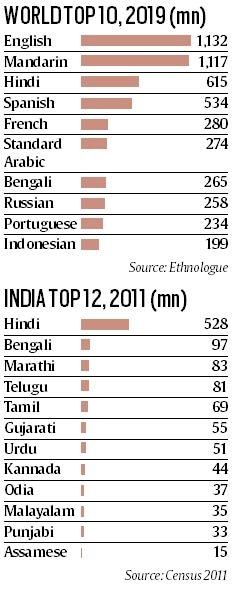
    • On the other hand, just 10 languages account for as many as 4.8 billion speakers — over 60% of the world population.
    • Globally, English remains the most widely spoken language with 1.13 billion speakers in 2019, followed by Mandarin with 1.17 billion, according to the online database Ethnologue.

    Why February 21?

    • UNESCO declared International Mother Language Day in 1999, to commemorate a 1952 protest against West Pakistan’s imposition of Urdu as the official language of East Pakistan (present-day Bangladesh).
    • According to a report, police opened fire on demonstrating Dhaka University students and “some people were killed”.
    • When thousands thronged the university the next day, police fired again, killing more people.
    • In Bangladesh, since 1953, February 21 is observed as Ekushe Day, after the Bengali word for twenty-one.
    • According to the South Asia Democratic Forum, five among those killed were recognised as “language martyrs — Abul Barkat, Abdul Jabbar, Rafiquddin Ahmad, Abdus Salman and Shafiur Rahman.

    Data on Indian languages

    • Hindi is third with 615 million speakers while Bengali is seventh with 265 million.
    • In India, Hindi is the most spoken language with over 528 million speakers in 2011, as per the Census.
    • Bengali had 97.2 million speakers in 2011, followed by Marathi (83 million), while other languages with over 50 million speakers are Telugu (81 million), Tamil (69 million), Gujarati (55.5 million) and Urdu (50.8 million).
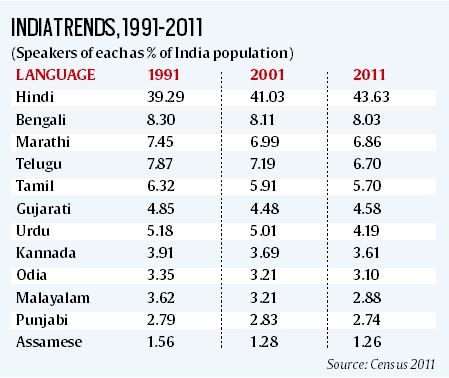
    • Percentage trends from 1991 to 2011 underline the growth of the most widely spoken language, Hindi, which was spoken by 39.29% of the Indian population in 1991, and whose share grew to 43.63% in 2011.
    • For other languages in India’s top 12, the 2011 percentage share has fallen when compared to that in 1991.
  • What did Harappan people eat?

    The National Museum in New Delhi has hosted “The Indus dining experience” a food event based on the food pattern of Indus valley civilization.

    Food of Harappans

    • Archaeological evidence from Indus Valley sites (c. 3300 BC to 1300 BC) in present-day India and Pakistan suggests that a purely vegetarian meal will not provide a complete picture of what the Harappan people ate.
    • To judge from the quantity of bones left behind, animal foods were consumed in abundance: beef, buffalo, mutton, turtles, tortoises, gharials, and river and sea fish.
    • Apart from meat, the people of the Indus Valley Civilisation grew and ate a variety of cereals and pulses.
    • There is archaeological evidence for cultivation of pea (matar), chickpea (chana), pigeon pea (tur/arhar), horse gram (chana dal) and green gram (moong).
    • Several varieties of wheat have been found at Harappan sites, as well as barley of the two-rowed and six-rowed kinds.
    • There is evidence that the Harappans cultivated Italian millet, ragi and amaranth, as well as sorghum and rice.
    • Oilseeds such as sesame, linseed, and mustard were also grown.
  • Person in news: Dara Shikoh


    The Ministry of Culture recently set up a panel of the Archaeological Survey of India (ASI) to locate the grave of the Mughal prince Dara Shikoh (1615-59) nearby Humayun’s Tomb complex in Delhi.

    Dara Shikoh’s legacy

    • The eldest son of Shah Jahan, Dara Shikoh was killed after losing the war of succession against his brother Aurangzeb.
    • Dara Shikoh is described as a “liberal Muslim” who tried to find commonalities between Hindu and Islamic traditions.
    • He translated into Persian the Bhagavad Gita as well as 52 Upanishads.

    Antithesis to Aurangzeb

    • Some historians argue that if Dara Shikoh had ascended the Mughal throne instead of Aurangzeb, it could have saved thousands of lives lost in religious clashes.
    • Dara Shukoh was the total antithesis of Aurangzeb, in that he was deeply syncretic, warm-hearted and generous — but at the same time, he was also an indifferent administrator and ineffectual in the field of battle.

    The remains of Dara Shikoh

    • According to the Shahjahannama, after Aurangzeb defeated Dara Shikoh, he brought the latter to Delhi in chains.
    • His head was cut off and sent to Agra Fort, while his torso was buried in the Humayun’s Tomb complex.
    • Italian traveller Niccolao Manucci gave a graphic description of the day in Travels of Manucci, as he was there as a witness to the whole thing. That is the basis of the thesis.
  • Conservation plan for Konark Sun Temple

    A plan to restore and preserve the nearly 800-year-old Konark Sun Temple in Odisha would be drawn up soon. Among the potential choices before the government would be to fill in more sand or to remove all the sand andput in place alternate support.

    Konark Sun Temple

    • Konark Sun Temple is a 13th-century CE Sun temple at Konark about 36 kilometres northeast from Puri on the coastline of Odisha, India.
    • The temple is attributed to king Narasinga Deva I of the Eastern Ganga Dynasty about 1250 CE.
    • Dedicated to the Hindu Sun God Surya, what remains of the temple complex has the appearance of a 100-foot (30 m) high chariot with immense wheels and horses, all carved from stone.
    • Once over 200 feet (61 m) high, much of the temple is now in ruins, in particular the large shikara tower over the sanctuary; at one time this rose much higher than the mandapa that remains.
    • The structures and elements that have survived are famed for their intricate artwork, iconography, and themes, including erotic kama and mithuna scenes.
    • Also called the Surya Devalaya, it is a classic illustration of the Odisha style of Architecture or Kalinga Architecture.
    • Declared a UNESCO world heritage site in 1984 it remains a major pilgrimage site for Hindus, who gather here every year for the Chandrabhaga Mela around the month of February.

    Earlier restoration efforts

    • It had been filled with sand and sealed by the British authorities in 1903 in order to stabilize the structure, a/c to ASI.
    • A scientific study was carried out by the Roorkee-based Central Building Research Institute from 2013 till 2018 to ascertain the temple’s structural stability as well as the status of the filled-in sand.
    • The sand filled in over 100 years ago had settled, leading to a gap of about 17 feet.  However the structure was found to be stable.
  • [pib] National List of Intangible Cultural Heritage

    Sangeet Natak Akademi (SNA) is preparing the National List of Intangible Cultural Heritage.

    National List of Intangible Cultural Heritage

    • SNA is an autonomous organization under the Ministry of Culture is the nodal agency for the Scheme for ‘Safeguarding the Intangible Cultural Heritage and Diverse Cultural Traditions of India’.
    • As of now, SNA is collaborating with Zonal Cultural Centers of Ministry, collating and preparing a list of ICH elements for National List of Intangible Cultural Heritage.
    • List of ICH elements is being compiled and at least 100 elements will be documented by March, 2020 and the aim is to document at least 20 new elements in ICH list every year.
    • Along with this establishment of an ‘Indian Institute for Culture’ is at conceptual stage and a mission called National Culture Mapping portal is being conceptualized for aggregating art forms and artists. It is in pilot phase.
  • Kumbhabishegam at Brahadeeswarar Temple, Thanjavur


    • Tens of thousands of pilgrims thronged Thanjavur in Tamil Nadu’s Cauvery delta to witness the Kumbhabishegam (consecration) ceremony at the Sri Brahadeeswarar Temple.
    • This enormously significant event was held after 23 years — and after the Madras High Court had settled an old argument over the ritual purification process only five days previously.
    • The judgment delivered by the Madurai Bench of the court addressed the struggle for supremacy between the Sanskrit and Tamil traditions.

    Sri Brahadeeswarar Temple and Kumbhabishegam ceremony

    • The Sri Brahadeeswarar Temple (also spelt Brihadisvara, and called Peruvudaiyar Koyil, which translates simply to ‘Big Temple’) is the most famous of the many temples in Thanjavur.
    • The temple, one of the world’s largest and grandest, was built between 1003 AD and 1010 AD by the great Chola emperor Raja Raja I (c. 985-1014 AD).

    Before the High Court

    • The court, in a dispute over which language should be used in the slokas at the kumbhabishegam, agreed with the state government’s affidavit that the ceremony should be in both Sanskrit and Tamil.
    • The Temple committee had demanded that the Kumbhabishegam should be held only in Tamil.
    • The court ruled the choice to be vested with the devotees to seek for their archanas to be performed at their wishes by chanting the manthras either in Tamil or in Sanskrit.