💥Join UPSC 2027,2028 Mentorship (August Batch) + XFactor Notes & Microthemes PDF

GS Paper: GS3-17.Awareness in the fields of IT, Space, Computers, Robotics, Nano-technology, Bio-technology and issues relating to Intellectual Property Rights.

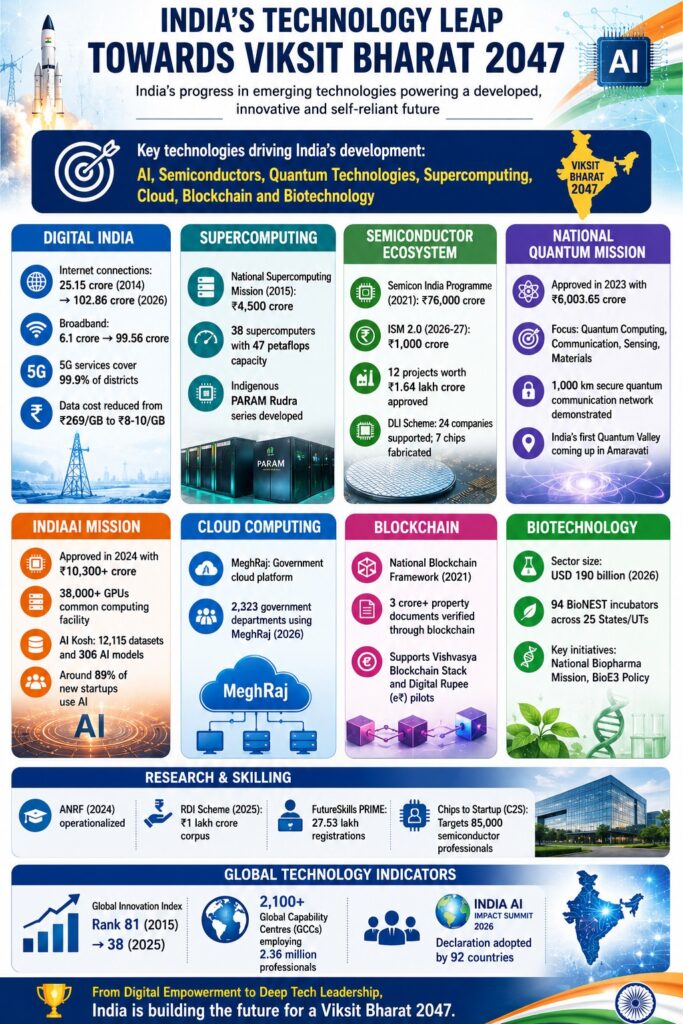
  • Amaravati Launches India’s First Quantum Computing Testing Facility 

    Why in the News?

    • Andhra Pradesh CM N. Chandrababu Naidu launched India’s first indigenous quantum computing testing facility at SRM University.
    • The initiative strengthens India’s push under the National Quantum Mission.

    About Amaravati Quantum Facility

    • Name: Amaravati Quantum Reference Facility (AQRF)
    • Location: Amaravati, Andhra Pradesh
    • Type: Indigenous quantum testing infrastructure
    • Feature:
      • Open-access system
      • Sovereign quantum infrastructure

    Key Highlights

    • First quantum computing testing facility in India
    • Includes:
      • Amaravati 1Q system (with cryogenic cooling processor)
      • Open demonstration system for research access
    • System housed at:
      • Medha Towers, Gannavaram

    Amaravati Quantum Valley

    • Flagship initiative under National Quantum Mission
    • Aim: Develop Amaravati as a global quantum hub

    Major Features

    • Hosting IBM 133-qubit quantum computer
    • 80+ industry and academic partnerships
    • Focus areas:
      • Quantum computing
      • Quantum cloud
      • Skill development
      • Innovation ecosystem

    What is Quantum Computing

    • Uses principles of Quantum Mechanics
    • Basic unit: Qubit (instead of classical bit)
    [2022] Which one of the following is the context in which the term “qubit” is mentioned? 
    (a) Cloud Services 
    (b) Quantum Computing 
    (c) Visible Light Communication Technologies 
    (d) Wireless Communication Technologies
  • Induction vs Infrared cooktops: How electric cooking push may strain power grid

    Why in the News?

    India is witnessing a policy-driven shift from LPG-based cooking to electric cooking solutions such as induction and infrared cooktops. While this transition supports clean energy goals and reduces dependence on imported fuels, it is projected to significantly increase electricity demand.

    What is an induction cooktop and how does it work?

    An induction cooktop is an energy-efficient, fast-acting electric stovetop that uses electromagnetism to heat cookware directly rather than heating the surface itself. Copper coils beneath a glass surface create a magnetic field that induces heat within magnetic pots (like cast iron or stainless steel), making it safer and cleaner.

    How does it work?

    The process relies on a few key physical principles:

    1. Electromagnetic Field: Beneath the glass-ceramic surface lies a copper coil. When you turn the cooktop on, a high-frequency alternating current (AC) flows through this coil, creating a rapidly oscillating electromagnetic field.
    2. Eddy Currents: When you place a ferromagnetic (magnetic) pan on the surface, this magnetic field penetrates the metal of the pan. Following Faraday’s Law of Induction, it induces swirling electrical currents within the pan’s base, known as eddy currents.
    3. Joule Heating: The metal in the pan has a natural electrical resistance. As the eddy currents fight to move through this resistance, their energy is converted into thermal energy (heat).
    4. Magnetic Hysteresis: In some magnetic materials, additional heat is generated as the alternating magnetic field constantly flips the magnetic domains of the metal back and forth.

    Why does the Surface Stay Cool?

    1. The heat is generated directly inside the pan and not by the stove itself, the glass-ceramic surface remains relatively cool. 
    2. It only becomes warm through residual heat, the heat that transfers back from the hot pan to the glass.

    What is the cookware requirement?

    1. This process requires ferromagnetic materials (like cast iron or magnetic stainless steel) because they respond effectively to the magnetic field. 
    2. Materials like copper, aluminum, or glass do not have the magnetic properties needed to generate sufficient eddy currents, so they will not heat up on a standard induction stove.

    What is an infrared cooktop?

    An infrared cooktop is a flameless electric stove that uses infrared radiation to transfer heat directly to your cookware. Unlike induction models that require specific magnetic pots, infrared cooktops are compatible with any flat-bottomed cookware, including aluminium, glass, ceramic, and clay.

    How does an infrared cooktop work?

    An infrared cooktop works by converting electrical energy into heat through a high-powered heating element, which then transfers that energy directly to your cookware using light waves. 

    Step-by-Step Heating Process

    1. Electrical Activation: When turned on, electricity flows through a heating element, typically a halogen lamp or a corrugated metal coil, situated beneath a ceramic glass surface.
    2. Infrared Emission: This element heats up rapidly until it glows red-hot, emitting infrared radiation (energy-carrying waves).
    3. Heat Transfer: These invisible infrared waves pass through the glass-ceramic top and are absorbed by the base of the cookware.
    4. Molecular Friction: The absorbed energy causes the molecules in the cookware to vibrate rapidly, which generates thermal heat that cooks the food.

    Why is it different from Induction

    1. Method: While induction uses magnetic fields to “excite” molecules only in magnetic pots, infrared uses radiant heat that physically warms the surface.
    2. Cookware: Because it relies on radiation rather than magnetism, it can heat any flat-bottomed material, including aluminium, ceramic, glass, and copper.
    3. Residual Heat: Unlike induction, where the glass stays relatively cool, the surface of an infrared cooktop becomes extremely hot and stays hot for a while after the unit is turned off.

    Can electric cooking significantly increase India’s peak power demand?

    1. Demand Surge: Adds 13-27 GW to electricity demand due to widespread adoption of induction cooktops.
    2. Peak Load Pressure: Pushes India’s peak demand to around 270 GW, particularly during summer months.
    3. Time Concentration: Concentrates demand during morning and evening cooking hours, intensifying grid stress.
    4. Grid Stress Amplification: Enhances risk of localized overloads in dense urban clusters.

    Why are induction cooktops emerging as a preferred alternative?

    1. Energy Efficiency: Converts electrical energy directly into heat via electromagnetic induction, minimizing losses
    2. Cost Competitiveness: Costs around ₹3,000-4,000, making it accessible to middle-income households.
    3. Operational Safety: Eliminates open flame, reducing fire hazards compared to LPG stoves.
    4. Policy Push: Supported as a cleaner alternative under electrification and decarbonization goals.

    What are the operational challenges of induction cooking?

    1. Cookware Compatibility: Requires magnetic cookware (iron or steel), limiting usability with traditional utensils.
    2. Power Dependency: Completely dependent on electricity, making it vulnerable during outages.
    3. Grid Sensitivity: High electricity consumption during peak hours creates stress on distribution networks.
    4. Socio-economic Barriers: Adoption varies across regions due to cooking habits and affordability.

    How do infrared cooktops differ and what challenges do they pose?

    1. Technology Mechanism: Uses infrared radiation to heat vessels indirectly via a glass surface.
    2. Universal Compatibility: Works with all types of cookware, including non-magnetic utensils.
    3. Higher Energy Use: Consumes more electricity than induction cooktops for similar cooking output.
    4. Market Trend: Rising demand, with sales increasing significantly in urban markets like Amazon India.

    What are the localized impacts on power distribution infrastructure?

    1. Cluster Effect: High adoption in specific areas leads to overloading of local transformers.
    2. Distribution Constraints: Existing infrastructure not designed for synchronized high-load usage.
    3. Incremental Demand Spike: Even 3-5 GW increase during peak hours can disrupt grid balance.
    4. Infrastructure Gap: Many regions lack upgraded distribution systems to handle additional loads.

    Does electric cooking reduce dependence on LPG imports?

    1. Energy Diversification: Reduces reliance on imported LPG, especially during geopolitical disruptions.
    2. Supply Resilience: Addresses vulnerabilities exposed during West Asia conflicts.
    3. Transition Trade-off: Shifts dependency from fossil fuel imports to electricity generation capacity.
    4. Strategic Shift: Aligns with long-term electrification and renewable integration goals.

    Can India’s grid infrastructure handle the transition?

    1. Capacity Constraints: Distribution networks face limitations in handling sudden peak demand spikes.
    2. Upgrade Requirements: Requires transformer upgrades and network strengthening.
    3. Planning Gap: Current infrastructure planning not aligned with rapid electrification of cooking.
    4. Policy Coordination: Needs synchronization between energy, urban planning, and appliance adoption policies. 

    Conclusion

    India’s transition to electric cooking reflects a critical shift toward cleaner energy systems but exposes structural weaknesses in power distribution. Without parallel investments in grid infrastructure, demand management, and policy coordination, the move risks transforming an energy solution into a systemic challenge. A balanced approach integrating electrification with infrastructure readiness is essential.

    PYQ Relevance

    [UPSC 2022] Do you think India will meet 50 percent of its energy needs from renewable energy by 2030? Justify your answer. How will the shift of subsidies from fossil fuels to renewables help achieve the above objective?

    Linkage: Technologies in news are frequently asked in Prelims as direct factual questions, while in Mains they are tested through analytical themes like feasibility, challenges, and policy impact. Example: UPSC in 2021 asked “In a pressure cooker, the temperature at which the food is cooked depends mainly upon which of the following?” In Prelims. Similarly in 2024 Mains, UPSC asked: “What is the technology being employed for electronic toll collection on highways? What are its advantages and limitations? Would this transition carry any potential hazards?”. For the 2022 UPSC Mains PYQ, the electric cooking push fits this theme as it shifts demand from fossil fuels (LPG) to electricity.

  • Gaganyaan-1 Crew Module Successfully Completes Air Drop Test

    Why in the News?

    ISRO successfully conducted the Gaganyaan-1 Crew Module air drop test off the Andhra Pradesh coast, marking another step toward India’s first human spaceflight mission.

    Key Highlights

    • Test Agency: ISRO
    • Location: Bay of Bengal near Satish Dhawan Space Centre (SHAR)
    • Aircraft Used: Indian Air Force Chinook helicopter
    • Drop Height: About 3 km altitude
    • Module Weight: 5.7 tonnes (simulated crew module)
    • Recovery: Indian Navy

    What is Crew Module

    • Pressurised capsule at the top of spacecraft
    • Houses astronauts
    • Designed for safe re-entry and splashdown
    • Equipped with parachute-based landing system

    About Gaganyaan Mission

    • India’s first human spaceflight mission
    • Planned by ISRO
    • Mission Structure:
      • 3 Uncrewed missions
      • 1 Crewed mission
    [2025] Consider the following space missions: 
    1 Axiom-4 
    2 SpaDeX 
    3 Gaganyaan  
    How many of the space missions given above encourage and support microgravity research?
    (a) Only one (b) Only two (c) All the three (d) None
  • Indian Scientists Develop New Method to Measure Distances in Deep Space

    Why in the News?

    Indian astronomers, including researchers from IIT Kanpur, have developed a new technique to measure distances in space using pulsars by combining dispersion measure and scatter broadening.

    What are Pulsars?

    • Pulsars are dense, rapidly spinning neutron stars
    • Emit regular radio wave pulses
    • Act as cosmic clocks due to highly stable rotation
    • Used to detect gravitational waves and deep space phenomena

    New Measurement Method

    Scientists combined two effects:

    1. Dispersion Measure (DM)

    • Radio waves pass through ionised gas
    • Lower frequency waves arrive later
    • Used to estimate distance

    2. Scatter Broadening

    • Plasma irregularities scatter signals
    • Signals follow multiple paths
    • Causes signal stretching

    New Approach

    • Combined Dispersion + Scattering
    • Improves accuracy of distance measurement

    Study Details

    • Observed 10 pulsars
    • Region studied: Gum Nebula
    • Found Vela Pulsar located behind nebula
    • Developed improved electron distribution model

    Significance

    • More accurate deep space distance measurement
    • No strict distance limitation
    • Can be used for Fast Radio Bursts (FRBs)
    • Improves understanding of interstellar medium
    [2023] Consider the following pairs: Objects in space : Description 
    1 Cepheids : Giant clouds of dust and gas in space 
    2 Nebulae : Stars which brighten and dim periodically 
    3 Pulsars : Neutron stars that are formed when massive stars run out of fuel and collapse 
    How many of the above pairs are correctly matched? 
    (a) Only one (b) Only two (c) All three (d) None
  • Record Space Activity in 2025: ISSAR Report

    Why in the News?

    The Indian Space Situational Assessment Report (ISSAR) 2025 revealed 315 global space launches in 2025, placing 4,651 objects into orbit.

    Global Space Activity 2025

    • Total launches: 315
    • Objects placed in orbit: 4,651
    • Objects re entered atmosphere: 1,911
    • Net growth in space objects: 74.5%

    India’s Space Assets

    Satellites

    • Total Indian satellites in orbit: 86
      • Operational: 27
      • Defunct: 23
      • Decayed: 36
    • Indian satellites launched in 2025: 8

    Rocket Bodies

    • 4 rocket bodies placed in orbit
    • 12 Indian objects re entered atmosphere
    [2022] Which one of the following statements best reflects the idea behind the “Fractional Orbital Bombardment System” often talked about in media?
    (a) A hypersonic missile is launched into space to counter the asteroid approaching the Earth and explode it in space.
    (b) A spacecraft lands on another planet after making several orbital motions.
    (c) A missile is put into a stable orbit around the Earth and deorbits over a target on the Earth.
    (d) A spacecraft moves along a comet with the same speed and places a probe on its surface.
  • How NASA will fly astronauts to the Moon and back for Artemis II

    Why in the News?

    NASA is set to launch Artemis II, the first crewed lunar mission since the Apollo era (1972), carrying four astronauts on a flyby trajectory around the Moon. It represents the first human return to deep space in over 50 years and the first time the Space Launch System (SLS) and Orion spacecraft will carry astronauts together.

    Why is Artemis II considered a historic milestone in space exploration?

    1. First Crewed Lunar Mission Since Apollo: Re-establishes human presence beyond low Earth orbit after 1972, marking a generational shift in exploration capability.
    2. Deep Space Human Travel: Ensures astronauts travel ~6,500 km beyond the Moon, the farthest distance humans have ever reached.
    3. Technological Transition: Validates next-generation systems replacing Saturn V and Apollo modules.
    4. Geopolitical Significance: Reinforces leadership in space amid rising competition (e.g., China’s lunar ambitions).
    5. Programmatic Continuity: Bridges Artemis I (uncrewed) and Artemis III (lunar landing).

    How does Artemis II’s trajectory and mission profile differ from earlier missions?

    1. Lunar Flyby Trajectory: Ensures a non-landing mission with orbital path around the Moon and return to Earth.
    2. Duration Optimization: Facilitates a ~10-day mission, shorter than robotic missions but efficient for human travel.
    3. Distance Benchmark: Extends human reach beyond Apollo missions, which remained closer (~400 km lunar orbit).
    4. Earth Orbit Phasing: Includes two Earth orbits before translunar injection, unlike direct Apollo launches.
    5. Splashdown Recovery: Maintains ocean landing protocol for safe retrieval.

    What technological advancements distinguish Artemis II from Apollo missions?

    1. Space Launch System (SLS): Ensures higher thrust capacity, surpassing Saturn V in operational configuration.
    2. Orion Spacecraft: Facilitates advanced life-support, navigation, and radiation shielding systems.
    3. Extended Duration Capability: Supports ~25-day endurance, compared to shorter Apollo missions.
    4. Modern Avionics: Integrates autonomous navigation and improved communication systems.
    5. Reusability Elements: Promotes partial reusability, unlike fully expendable Apollo systems.

    What challenges and risks are associated with Artemis II?

    1. Weather Sensitivity: Launch delays due to unfavorable conditions (reported 80% favorable window).
    2. Technological Validation Risks: First crewed use of SLS-Orion combination increases uncertainty.
    3. Deep Space Radiation Exposure: Extends astronaut exposure beyond Earth’s magnetosphere.
    4. Cost Constraints: High financial burden compared to earlier programs.
    5. Mission Complexity: Multi-stage trajectory and long-duration spaceflight increase operational risk.

    How does Artemis II contribute to future lunar and interplanetary missions?

    1. System Validation: Ensures reliability of life-support, propulsion, and navigation systems.
    2. Gateway Preparation: Supports future Lunar Gateway space station development.
    3. Lunar Landing Readiness: Facilitates Artemis III mission planning and execution.
    4. Mars Mission Foundation: Provides experience for long-duration deep space travel.
    5. Commercial Integration: Encourages private sector participation in space logistics.

    Conclusion

    Artemis II represents a transitional mission that bridges past achievements with future ambitions. It validates technologies, extends human reach into deep space, and lays the foundation for sustained lunar exploration and eventual Mars missions.

    PYQ Relevance

    [UPSC 2023] What is the main task of India’s third moon mission which could not be achieved in its earlier mission? List the countries that have achieved this task. Introduce the subsystems in the spacecraft launched and explain the role of the Virtual Launch Control Centre at the Vikram Sarabhai Space Centre which contributed to the successful launch from Srihari Kota.

    Linkage: The PYQ tests understanding of lunar mission objectives, spacecraft subsystems, and launch technologies, core to GS-III (Science & Tech) with emphasis on applied space capabilities. Artemis II similarly focuses on system validation (SLS-Orion) before lunar landing, paralleling Chandrayaan-3’s shift from failure to successful soft-landing capability.

  • Earth’s orbits are filling up because governance hasn’t kept pace

    Why in the News?

    Earth’s orbital space is transitioning from an open, sparsely used domain to a congested and commercially exploited environment. The issue has gained prominence due to the unprecedented surge in satellite launches, particularly large constellations like Starlink, enabled by reusable rocket technology. This marks a sharp shift from earlier state-controlled, low-density space activity to high-frequency, private-led deployments. The alarming rise in orbital debris, coupled with the absence of verifiable compliance mechanisms and enforceable global regulations, has exposed a major governance failure.

    Why is Earth’s orbital environment becoming increasingly congested and fragile?

    1. Commercial Expansion: Rapid increase in private satellite constellations has multiplied objects in orbit; Example: SpaceX’s Starlink deployment at scale.
    2. Reduced Launch Costs: Reusable rockets have lowered costs significantly, enabling frequent launches.
    3. Fragmentation Events: Collisions generate thousands of debris fragments, amplifying risks exponentially.
    4. Cumulative Congestion: Orbital space is finite; increasing density raises collision probability over time.
    5. Tracking Limitations: Small debris (even coin-sized) cannot be consistently tracked but can destroy satellites.

    What governance gaps are responsible for the current crisis?

    1. Lack of Verification Mechanisms: No regular system to verify whether operators safely dispose of satellites post-mission.
    2. Pre-launch Reliance: Regulators depend on company declarations rather than post-launch compliance checks.
    3. Fragment Identification Limits: Authorities cannot reliably identify debris origin until damage occurs.
    4. Weak Monitoring Infrastructure: Absence of global, transparent tracking systems accessible to all countries.
    5. Non-binding Norms: Existing guidelines rely on voluntary compliance without enforcement or penalties.
      1. UN Space Debris Mitigation Guidelines (2007): Adopted by the UN Committee on the Peaceful Uses of Outer Space (UNCOPUOS); provides best practices for limiting debris but has no legal enforcement.
      2. IADC (Inter-Agency Space Debris Coordination Committee) Guidelines: Technical recommendations followed by major space agencies; purely voluntary and not legally binding.
      3. Long-Term Sustainability (LTS) Guidelines (2019): Developed under UNCOPUOS to promote safe and sustainable space operations; depends on self-reporting and voluntary adoption.
      4. National-level licensing norms (e.g., US FCC, others): Often incorporate mitigation principles but lack uniform global enforcement, leading to regulatory gaps. 

    Why are existing international space laws inadequate for present challenges?

    1. Outdated Frameworks: Treaties were designed for a state-dominated, low-activity era.
    2. Outer Space Treaty Limitations: Assigns responsibility to states but lacks provisions to regulate private actors effectively.
      1. State-Centric Liability: Holds states responsible, not private companies directly.
      2. No Uniform Regulation: Leaves licensing and supervision to national laws.
      3. No Enforcement Mechanism: Lacks monitoring, verification, or penalties.
      4. Reactive Liability: Applies only after damage, not for prevention.
      5. Regulatory Fragmentation: Different national laws enable forum shopping.
      6. Outdated Framework: Does not account for large private constellations.
      7. Weak Dispute Resolution: Relies on slow state-to-state processes. 
    3. Absence of Liability Enforcement: No preventive liability mechanisms; action occurs only after damage.
    4. Innovation-Regulation Gap: Rapid private innovation has outpaced slow-moving international law.
    5. No Congestion Thresholds: Lack of defined limits for “acceptable” orbital crowding.

    How does orbital debris pose systemic risks to space infrastructure?

    1. High-Velocity Threat: Even small debris travels at orbital speeds, capable of disabling satellites.
    2. Cascade Effect (Kessler Syndrome): Collisions generate more debris, triggering chain reactions.
    3. Operational Disruptions: Satellites used for communication, GPS, and weather forecasting face increasing risks.
    4. Economic Losses: Damage to satellites leads to high replacement costs and service disruptions.
    5. Strategic Vulnerability: Space assets critical for defense and surveillance become exposed.

    What ethical and intergenerational concerns arise in orbital governance?

    1. Common Resource Ethics: Space is a global commons requiring shared responsibility.
    2. Intergenerational Equity: Current actions risk limiting future access to orbital resources.
    3. Precautionary Principle: Uncertainty should not justify inaction in preventing long-term damage.
    4. Unequal Burden Sharing: Responsible operators bear higher costs compared to non-compliant actors.
    5. Global Inequality: Developing countries face barriers in accessing already congested orbits.

    What role can India play in shaping responsible orbital governance?

    1. Policy Leadership: Opportunity to shape global norms through national legislation.
    2. Balanced Approach: Combines cost-effective space missions with sustainability concerns.
    3. Regulatory Framework Development: Licensing conditions can enforce debris mitigation.
    4. Global Norm Advocacy: India can push for enforceable international agreements.
    5. Technological Innovation: Investment in debris tracking and removal technologies. 

    Conclusion

    Orbital congestion represents a governance failure in managing a global commons. Transition from voluntary norms to enforceable regulations is essential. Sustainable space use requires integrating technological capability with ethical responsibility and international cooperation.

    PYQ Relevance

    [UPSC 2019] What is India’s plan to have its own space station and how will it benefit our space programme?

    Linkage: The PYQ tests understanding of India’s evolving space ambitions and long-term capabilities. The expansion of space infrastructure increases orbital activity, reinforcing concerns of congestion, debris, and the need for stronger global space governance.

  • NASA Artemis II: How Astronauts Will Fly to the Moon and Back

    Why in the News?

    NASA’s Artemis II mission is scheduled for launch, marking the first human mission to the Moon’s vicinity since 1972 Apollo missions.

    Artemis II Mission Overview

    • Mission: Artemis II
    • Agency: NASA
    • Type: Crewed lunar flyby
    • Duration: ~10 days
    • Astronauts: 4 astronauts
    • Launch Site: Kennedy Space Center, Florida
    • Landing: Splashdown in ocean

    Mission Path (Step by Step)

    1. Launch from Earth

    • Rocket: Space Launch System (SLS)
    • Spacecraft: Orion Crew Capsule
    • Launch from Kennedy Space Center

    2. Earth Orbit

    • Orion will make two orbits around Earth
    • Systems check and trajectory adjustment

    3. Journey to Moon

    • Travel time: 3 to 4 days
    • Similar to Apollo missions
    • Why fast?
    • SLS rocket is extremely powerful
    • Shorter route requires more fuel but less time

    4. Lunar Flyby

    • Orion will circle the Moon
    • Distance from far side of Moon: ~6,500 km
    • Farthest humans have ever travelled in space

    5. Return Journey

    • Orion returns to Earth
    • Travel time: 3 to 4 days

    6. Re-entry and Splashdown

    • Spacecraft re-enters Earth’s atmosphere
    • Ocean splashdown landing

    Why Some Missions Take Longer (Like Chandrayaan 3)

    • Fuel-efficient route used by many missions
    • Takes weeks to months
    • Lower fuel requirement
    • Artemis II uses: Shorter but fuel-intensive route and Faster travel
    [2016] Consider the following statements: 1 The Mangalyaan launched by ISRO is also called the Mars Orbiter Mission 2 made India the second country to have a spacecraft orbit the Mars after USA 3 made India the only country to be successful in making its spacecraft orbit the Mars in its very first attempt Which of the statements given above is/are correct? (a) 1 only (b) 2 and 3 only (c) 1 and 3 only (d) 1, 2 and 3
  • Indian Scientists Crack the Solar Radio Burst Mystery

    Why in the news?

    Researchers from the Indian Institute of Astrophysics IIA solved a long standing mystery of solar radio bursts, a breakthrough that could improve space weather forecasting and protect satellites, communication and navigation systems.

    What Are Type II Solar Radio Bursts?

    • Generated by Solar Flares and Coronal Mass Ejections CME
    • Produced by Shock waves in Sun’s Corona
    • Travel at Nearly 1000 km per second
    • Important for Space Weather Forecasting

    What Was the Long Standing Mystery?

    Scientists observed two radio emissions

    Fundamental Emission
    Harmonic Emission

    Earlier Expectation: Fundamental emission should be stronger

    But Observations Showed

    • Sometimes Harmonic emission stronger
    • This puzzled scientists for decades

    What Did Indian Scientists Discover?

    Researchers found

    • Strength depends on Location of Solar Activity
    Higher Solar Longitudes beyond 75 degree. Harmonic emission stronger

    Near centre of solar disk Fundamental emission stronger

    Why Does This Happen?

    Scientists identified two main reasons

    • Refraction in Solar Corona
    • Viewing Angle from Earth

    How Was the Study Conducted?

    • Analysed 58 Solar Events
    • Used Global CALLISTO Network
    • Used Gauribidanur Radio Observatory Karnataka
    • Published in Solar Physics Journal

    What Is CALLISTO Network?

    Global solar radio monitoring network
    • Tracks Solar radio bursts
    • Used for Space weather prediction

    [2022] If a major solar storm (solar flare) reaches the Earth, which of the following are the possible effects on the Earth? 1 GPS and navigation systems could fail. 2 Tsunamis could occur at equatorial regions. 3 Power grids could be damaged. 4 Intense auroras could occur over much of the Earth. 5 Forest fires could take place over much of the planet. 6 Orbits of the satellites could be disturbed. 7 Shortwave radio communication of the aircraft flying over polar regions could be interrupted. Select the correct answer using the code given below: (a) 1, 2, 4 and 5 only (b) 2, 3, 5, 6 and 7 only (c) 1, 3, 4, 6 and 7 only (d) 1, 2, 3, 4, 5, 6 and 7
  • Artemis II: NASA’s Moon missions could lay ground for deeper space exploration 

    Why in the News?

    Artemis II is important because it will be the first crewed mission to the Moon since Apollo 17 in 1972, ending a gap of over 50 years. Unlike Apollo’s short visits, it aims to support long-term human presence through lunar bases and continuous missions. It also involves private companies and multiple countries, showing a shift toward a global space race. The mission is now planned for 2026, marking a major step toward future Moon and Mars exploration.

    What is Artemis II?

    1. Artemis II is NASA’s first crewed mission of the Artemis program, scheduled to launch on April 1, 2026. 
    2. It will send a crew of four on a 10-day journey around the Moon, marking the first time humans have ventured beyond low Earth orbit since the Apollo 17 mission in 1972.

    Key Mission Details

    1. Objective: To test the Space Launch System (SLS) rocket and the Orion spacecraft’s life-support systems with a crew on board.
    2. Trajectory: The mission will follow a “free-return trajectory,” flying around the far side of the Moon and using lunar gravity to swing back toward Earth without entering lunar orbit.
    3. The Crew:
      1. Reid Wiseman (Commander): NASA.
      2. Victor Glover (Pilot): NASA, the first person of colour on a lunar mission.
      3. Christina Koch (Mission Specialist): NASA, the first woman on a lunar mission.
      4. Jeremy Hansen (Mission Specialist): Canadian Space Agency (CSA), the first non-American on a lunar mission.
    4. Launch Site: Launch Complex 39B at NASA Kennedy Space Center in Florida.
    5. Splashdown: The mission is expected to conclude with a splashdown in the Pacific Ocean off the coast of San Diego.

    How does Artemis II mark a shift from exploration to habitation?

    1. Mission Objective Shift: Ensures transition from short-term lunar visits to sustained human presence; Apollo missions lasted 12 days, Artemis envisions prolonged stays.
    2. Infrastructure Development: Facilitates creation of permanent bases like the Moon Gateway; supports long-term habitation and logistics.
    3. Technological Evolution: Strengthens reusable systems and deep-space capabilities; contrasts Apollo’s one-time mission design.
    4. Human Adaptation Focus: Promotes research on survival in extreme environments; essential for Mars missions.

    Why is a permanent lunar base critical for deep space exploration?

    1. Strategic Staging Ground: Enables Moon as a launchpad for Mars missions; reduces cost and energy requirements.
    2. Resource Utilization: Supports extraction of lunar resources (e.g., water ice); enables in-situ fuel production.
    3. Continuous Research: Ensures uninterrupted scientific experimentation; example: long-duration biological studies.
    4. Operational Efficiency: Facilitates reuse of materials and infrastructure; reduces dependency on Earth.

    What role do private players and global partnerships play?

    1. Commercial Integration: Enables participation of companies like SpaceX; ensures cost efficiency and innovation.
    2. International Collaboration: Strengthens cooperation among nations; example: Artemis Accords participation.
    3. Geopolitical Competition: Reflects emerging rivalry with China’s lunar plans; indicates multi-polar space race.
    4. Shared Infrastructure: Promotes joint use of space stations and bases; reduces duplication of efforts.

    How is Artemis II advancing technological frontiers?

    1. Deep Space Systems: Strengthens Orion spacecraft capabilities; supports long-duration missions.
    2. Nuclear Propulsion Research: Promotes faster interplanetary travel; example: NASA’s DRACO mission concept.
    3. Sustainability Models: Ensures closed-loop life support systems; reduces resource dependency.
    4. Cost Dynamics: Highlights high cost (~$400,000/kg); necessitates innovation in reusable technologies.

    What are the challenges and risks associated with Artemis missions?

    1. High Costs: Limits scalability of missions; requires sustained funding.
    2. Technological Uncertainty: Involves untested systems like nuclear propulsion; increases mission risk.
    3. Geopolitical Tensions: Intensifies competition with China and others; risks fragmentation of space governance.
    4. Human Survival Risks: Exposes astronauts to radiation and isolation; demands advanced life-support systems.

    How does Artemis redefine the global space race?

    1. Multi-Polar Competition: Expands participation beyond USA-Russia; includes China, India, Europe.
    2. Strategic Dominance: Ensures control over lunar resources and routes; critical for future space economy.
    3. Economic Opportunities: Promotes commercialization of space; example: mining and tourism prospects.
    4. Policy Evolution: Necessitates new frameworks for space governance; updates Outer Space Treaty relevance.

    Conclusion

    Artemis II represents a structural shift in space exploration, from symbolic achievements to strategic permanence. It integrates technology, geopolitics, and economics, positioning the Moon as a gateway to Mars and beyond. The mission underscores the emergence of a new space order driven by sustainability, competition, and collaboration.

    PYQ Relevance

    [UPSC 2019] What is India’s plan to have its own space station and how will it benefit our space programme?

    Linkage: The PYQ tests understanding of long-term space infrastructure and human spaceflight capabilities, a recurring UPSC theme in GS-3 (Science & Tech). Artemis II’s Moon Gateway and lunar base model provides a global reference to evaluate India’s space station ambitions and strategic positioning in deep-space exploration.