Why in News?
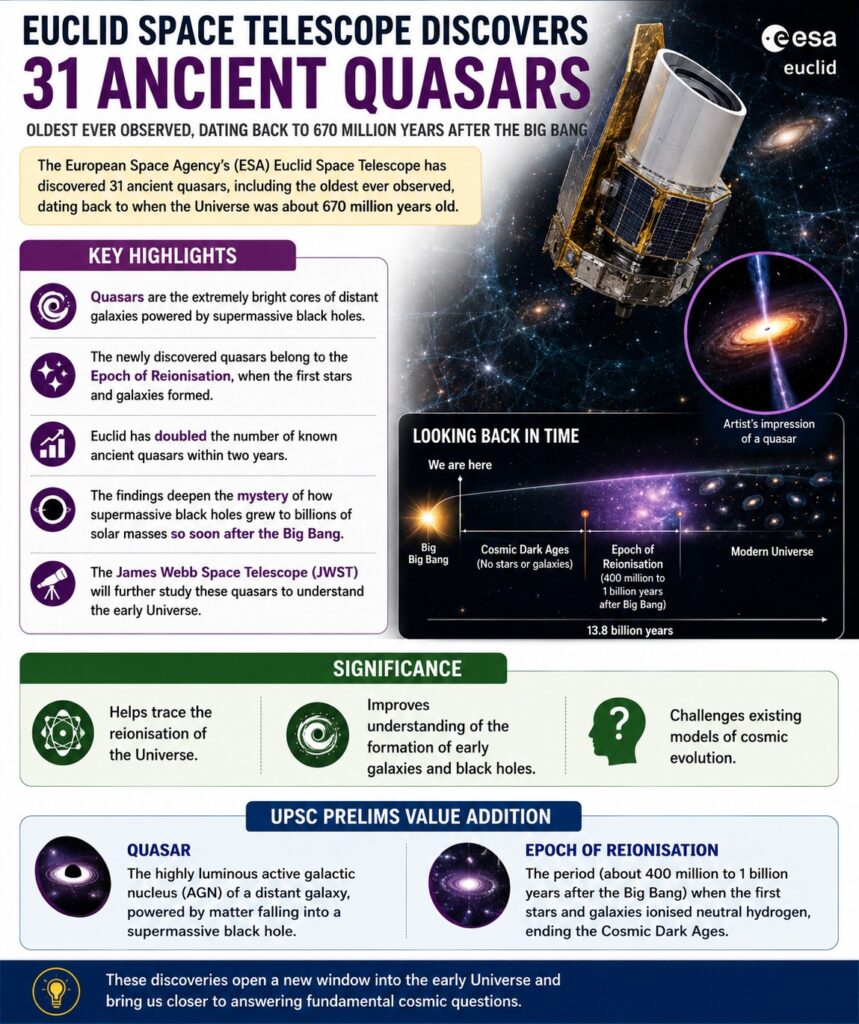
The European Space Agency’s (ESA) Euclid Space Telescope has discovered 31 ancient quasars, including the oldest ever observed, dating back to when the Universe was about 670 million years old.
Key Highlights
- Quasars are the extremely bright cores of distant galaxies powered by supermassive black holes.
- The newly discovered quasars belong to the Epoch of Reionisation, when the first stars and galaxies formed.
- Euclid has doubled the number of known ancient quasars within two years.
- The findings deepen the mystery of how supermassive black holes grew to billions of solar masses so soon after the Big Bang.
- The James Webb Space Telescope (JWST) will further study these quasars to understand the early Universe.
Significance
- Helps trace the reionisation of the Universe.
- Improves understanding of the formation of early galaxies and black holes.
- Challenges existing models of cosmic evolution.
UPSC Prelims Value Addition
- Quasar: The highly luminous active galactic nucleus (AGN) of a distant galaxy, powered by matter falling into a supermassive black hole.
- Epoch of Reionisation: The period (about 400 million to 1 billion years after the Big Bang) when the first stars and galaxies ionised neutral hydrogen, ending the Cosmic Dark Ages.
[2017] The terms ‘Event Horizon’, ‘Singularity’, ‘String Theory’ and ‘Standard Model’ are sometimes seen in the news in the context of:
(a) Observation and understanding of the Universe
(b) Study of the solar and the lunar eclipses
(c) Placing satellites in the orbit of the Earth
(d) Origin and evolution of living organisms on the Earth
