Mains Ready By December. Smash Mains & Smash PYQ Admissions Open

GS Paper: GS2-18.Bilateral, regional and global groupings and agreements involving India and/or affecting India’s interests.

  • Expanding the G7

    There has been a call for expansion of G7 by the U.S. President. Against this backdrop, this article examines the historical background in which the group emerged. But a lot has changed since. So, it would be appropriate for G7 to adjust to the new reality. But what would be the focus of a new mechanism? What are the areas in which India would be interested? All such questions are answered in this article.

    Call for expansion of G7 and China’s objection

    • Recently, the U.S. President proposed the expansion of G7 to G10 or G11,  with the inclusion of India, South Korea, Australia and possibly Russia.
    • Elaborating this logic, the White House Director of Strategic Communications said the U.S. President wanted to include other countries, including the Five Eyes countries.
    • Five Eye is an intelligence alliance comprising Australia, Canada, New Zealand, the United Kingdom and the United States.
    • The U.S. also stressed said the expanded group should talk about the future of China.
    • A Chinese Ministry of Foreign Affairs official immediately reacted, labelling it as “seeking a clique targeting China”.

    Should India care about China’s objection if invited to join?

    • China’s objection to an expanded G7 is no reason for India to stay away from it, if invited to join.
    • India has attended several G7 summits earlier too, as a special invitee for its outreach sessions.
    • India’s Prime Minister was guest invited to Biarritz, France to the G7 summit last year, along with other heads of government.

    The historical background of G7

    • The G7 emerged as a restricted club of the rich democracies in the early 1970s.
    • The quadrupling of oil prices just after the 1973 Arab-Israeli War, when  OPEC imposed an embargo against Canada, Japan, the Netherlands, and the United States, shocked their economies.
    • Although the French were spared the embargo, the chill winds of the OPEC action reverberated around the world.
    • So, French President invited the Finance Ministers of five of the most developed members of the Organisation for Economic Cooperation and Development, the United States, Germany, Japan, Italy, and the United Kingdom, for an informal discussion on global issues.
    • This transformed into a G7 Summit of the heads of government from the following year with the inclusion of Canada in 1976.
    • And the European Commission/Community (later Union) joined as a non-enumerated member, a year later.
    • On the initiative of U.S. President Bill Clinton and British Prime Minister Tony Blair, the G7 became the G8, with the Russian Federation joining the club in 1998.
    • This ended with Russia’s expulsion following the annexation of Crimea in 2014.

    Declining share G7 and rising of E7 in world GDP

    • When constituted, the G7 countries accounted for close to two-thirds of global GDP.
    • According to the 2017 report of the accountancy firm, PwC, “The World in 2050”, they now account for less than a third of global GDP on a purchasing power parity (PPP) basis.
    • And less than half on market exchange rates (MER) basis.
    • The seven largest emerging economies (E7, or “Emerging 7”), comprising Brazil, China, India, Indonesia, Mexico, Russia and Turkey, account for over a third of global GDP on purchasing power parity (PPP) terms.
    • And over a quarter on MER basis.

    Predictions for India

    • India’s economy is already the third largest in the world in PPP terms, even if way behind that of the U.S. and China.
    • By 2050, the PwC Report predicts, six of the seven of the world’s best performing economies will be China, India, the United States, Indonesia, Brazil, and Russia.
    • Two other E7 countries, Mexico and Turkey, also improve their position.
    • It projects that India’s GDP will increase to $17 trillion in 2030 and $42 trillion in 2050 in PPP terms, in second place after China, just ahead of the United States.
    • This is predicated on India overcoming the challenge of COVID-19, sustaining its reform process and ensuring adequate investments in infrastructure, institutions, governance, education and health.

    Limitations of G7

    • The success or otherwise of multilateral institutions are judged by the standard of whether or not they have successfully addressed the core global or regional challenges of the time.
    • The G7 failed to head off the economic downturn of 2007-08.
    • This failure led to the rise of the G20.
    • In the short span of its existence, the G20 has provided a degree of confidence, by promoting open markets, and stimulus, preventing a collapse of the global financial system.
    • The G7 also failed to address the contemporary issues, such as the COVID-19 pandemic, climate change, the challenge of the Daesh, and the crisis of state collapse in West Asia.
    • It had announced its members would phase out all fossil fuels and subsidies, but has not so far announced any plan of action to do so.
    • And their coal fired plants emit “twice more CO2 than those of the entire African continent”.

    Turmoil in West Asia and failure of Europe to act

    • Three of the G7 countries, France, Germany, and the U.K., were among the top 10 countries contributing volunteers to the ISIS.
    • West Asia is in a greater state of turmoil than at any point of time since the fall of the Ottoman Empire.
    • This turmoil has led to a migrants crisis.
    • Migrant crisis persuaded many countries in Europe to renege on their western liberal values, making the Mediterranean Sea a death trap for people fleeing against fear of persecution and threat to their lives.

    So, to deal with the unprecedented challenge, we need new institution

    • The global economy has stalled and COVID-19 will inevitably create widespread distress.
    • Nations need dexterity and resilience to cope with the current flux, as also a revival of multilateralism, for they have been seeking national solutions for problems that are unresolvable internally.
    • Existing international institutions have proven themselves unequal to these tasks.
    • A new mechanism might help in attenuating them.
    • It would be ideal to include in it the seven future leading economies, plus Germany, Japan, the U.K., France, Mexico, Turkey, South Korea, and Australia.
    •  The 2005 ad hoc experiment by Prime Minister Tony Blair in bringing together the G7 and the BRICS countries was a one-off.

    What should be the focus of this new institution?

    • A new international mechanism will have value only if it focuses on key global issues.
    • A related aspect is how to push for observing international law and preventing the retreat from liberal values on which public goods are predicated.
    • Global public health and the revival of growth and trade in a sustainable way -that also reduces the inequalities among and within nations- would pose a huge challenge.

    What should be India’s priority in new institution?

    • India would be vitally interested in three: 1) international trade, 2) climate change, 3) the COVID-19 crisis.
    • Second order priorities for India would be cross-cutting issues such as counter-terrorism and counter-proliferation.
    • An immediate concern is to ensure effective implementation of the 1975 Biological Weapons Convention .
    • And the prevention of any possible cheating by its state parties by the possible creation of new microorganisms or viruses by using recombinant technologies.
    • On regional issues, establishing a modus vivendi with Iran would be important to ensure that it does not acquire nuclear weapons and is able to contribute to peace and stability in Afghanistan, the Gulf and West Asia.
    • The end state in Afghanistan would also be of interest to India.
    • And also the reduction of tensions in the Korean Peninsula and the South China Sea.

    Consider the question “There has been a clamour for expanding G7 and India is being considered as one of the prospective candidates in the expanded group. In light of this examine the challenges and opportunities for India if it gets entry into the expanded group.”

    Conclusion

    The decaying influence in geopolitics and declining share in the world GDP calls for the formation of the new institution. IF and when that institution comes into being India should try to address its immediate concern with the help of new mechanism based on values.
  • LAC row: China reaches accord with India

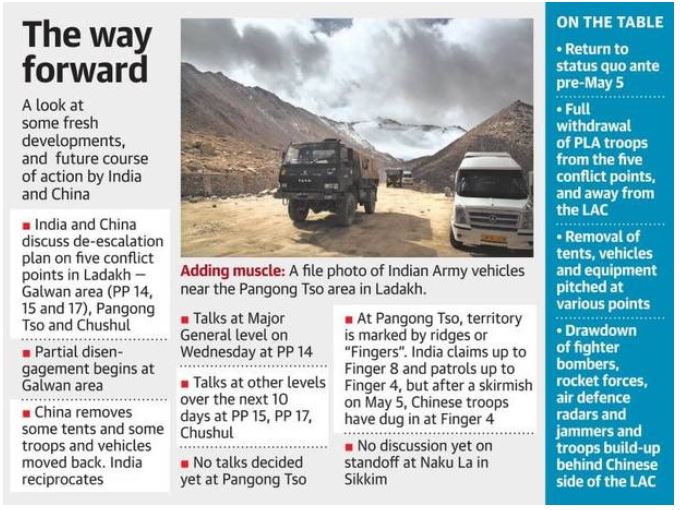
    China said that it had “reached an agreement” with India on the ongoing tensions along the Line of Actual Control (LAC), a day after India announced troops from both sides had begun a “partial disengagement” from some of the stand-off points.

    Practice question for mains:

    Q. “Early settlement of the boundary question serves the fundamental interests of both countries”. Discuss in light of the ongoing border skirmishes between India and China.

    Read the complete story here:

    [Burning Issue] India-China Skirmish in Ladakh

    Troops moving back

    • Partial deinduction has happened from some points in Galwan and Hot Springs areas.
    • Chinese side removed some of the tents and some troops and vehicles have been moved back, and the Indian side to has reciprocated.
    • At some points in the Galwan Valley, Chinese troops have moved back 2-3 km. However, there is no change in the ground situation at Pangong Tso.

    De-escalation begins

    • India and China held Major general-level talks to discuss further de-escalation at several standoff points in Eastern Ladakh including Patrolling Point (PP) 14, following a broad accord reached on Saturday in talks held at the Corps Commander-level.
    • As per the agreement, a series of ground-level talks would be held over the next 10 days, with four other points of conflict identified at PP15, PP17, Chushul and the north bank of Pangong Lake.
    • The Chinese Foreign Ministry said both sides had agreed to handle the situation “properly” and “in line with the agreement” to ease the situation.
    • However, it did not provide specific details on some of the stand-off points, such as Pangong Lake, where Chinese troops are still present on India’s side of the LAC.

    No final solution yet

    • At present, the two sides are taking actions in line with the agreement to ameliorate the border situation.
    • Government officials said a partial disengagement had happened at some points in the Galwan area and at Hot Springs, but there was no change at Pangong Lake.
    • Chinese state-run media has revealed that the ongoing dispute will not escalate into a conflict.
    • But it added due to the complexity of the situation, the military stand-off could continue for a little longer.

    Way forward

    • The military-level talks showed that both sides do not want to escalate tensions further.
    • It showed that China and India remain determined to peacefully resolve border issues.
    • However, the ongoing stand-off is not likely to end immediately, as concrete issues must still be resolved.
  • Cooperative security in Persian Gulf littoral and Implications for India

    This article analyses the security environment in the Gulf countries. Their common characteristic as being the oil producers and similarity in their social and security problems are also explained in detail in this article. And all this has implications for India. So, what are the implications? Read to know…

    Let’s look at the importance of countries surrounding Persian Gulf

    • The United Nations defines this body of water as the Persian Gulf.
    • The lands around it are shared by eight countries: Bahrain, Iran, Iraq, Kuwait, Oman, Qatar, Saudi Arabia, and the United Arab Emirates.
    • All are the members of the UN.
    • There is a commonality of interest among them in being major producers of crude oil and natural gas.
    • And thereby contribute critically to the global economy and to their own prosperity.
    • This has added to their geopolitical significance.
    • At the same time, turbulence has often characterised their inter se political relations.
    Arab Countries surrounding Persian Gulf

    Power play and security of the region

    • For eight decades prior to 1970, this body of water was a closely guarded British lake, administered in good measure by imperial civil servants from India.
    • When that era ended, regional players sought to assert themselves.
    • Imperatives of rivalry and cooperation became evident and, as a United States State Department report put it in 1973, ‘The upshot of all these cross currents is that the logic of Saudi-Iranian cooperation is being undercut by psychological, nationalistic, and prestige factors, which are likely to persist for a long time.’
    • The Nixon and the Carter Doctrines were the logical outcomes to ensure American hegemony.
    • An early effort for collective security, attempted in a conference in Muscat in 1975, was thwarted by Baathist Iraq.
    • The Iranian Revolution put an end to the Twin Pillar approach and disturbed the strategic balance.
    • The Iraq-Iran War enhanced U.S. interests and role.
    • Many moons and much bloodshed later, it was left to the Security Council through Resolution 598 (1987) to explore ‘measures to enhance the security and stability in the region’.

    Gulf regional security framework: Some questions

    • Any framework for stability and security thus needs to answer a set of questions:
    • Security for whom, by whom, against whom, for what purpose?
    • Is the requirement in local, regional or global terms?
    • Does it require an extra-regional agency?
    • Given the historical context, one recalls a Saudi scholar’s remark in the 1990s that ‘Gulf regional security was an external issue long before it was an issue among the Gulf States themselves.’

    What should be the ingredients of a  regional security framework?

    • The essential ingredients of such a framework would thus be to ensure: 1) conditions of peace and stability in individual littoral states; 2) freedom to all states of the Gulf littoral to exploit their hydrocarbon and other natural resources and export them; 3) freedom of commercial shipping in international waters of the Persian Gulf 4)freedom of access to, and outlet from, Gulf waters through the Strait of Hormuz; 5) prevention of conflict that may impinge on the freedom of trade and shipping and 6)prevention of emergence of conditions that may impinge on any of these considerations.
    • Could such a framework be self-sustaining or require external guarantees for its operational success?
    • If the latter, what should its parameters be?

    Misunderstanding the role great powers can play

    • Statesmen often confuse great power with total power and great responsibility with total responsibility.
    • The war in Iraq and its aftermath testify to it.
    • The U.S. effort to ‘contain’ the Iranian revolutionary forces, supplemented by the effort of the Arab states of the littoral (except Iraq)  GCC initially met with success in some functional fields and a lack of it in its wider objectives.

    The turbulent nature of US-Iran relations

    • In the meantime, geopolitical factors and conflicts elsewhere in the West Asian region — Yemen, Syria, Libya — aggravated global and regional relationships.
    • And it hampered a modus vivendi in U.S.-Iran relations that was to be premised on the multilateral agreement on Iran’s nuclear programme agreed to by western powers and the Obama Administration.
    • But it was disowned by U.S. President Donald Trump whose strident policies have taken the region to the brink of armed conflict.

    Perception of declining U.S. commitment to sub-regional security

    • Perceptions of declining U.S. commitment to sub-regional security have been articulated in recent months amid hints of changing priorities.
    • This is reported to have caused disquiet in some, perhaps all, members of the GCC, the hub of whose security concern remains pivoted on an Iranian threat (political and ideological rather than territorial).
    • And American insurance to deter it based on a convergence of interests in which oil, trade, arms purchases, etc have a role along with wider U.S. regional and global determinants.
    • It is evident that a common GCC threat perception has not evolved over time.
    • It has been hampered by the emergence of conflicting tactical and strategic interests and subjective considerations.
    • The current divisions within the organisation are therefore here to stay.
    • These have been aggravated by 1)the global economic crisis, 2) the immediate and longer term impact of COVID-19 on regional economies, 3) the problems in the Organization of the Petroleum Exporting Countries (OPEC), 4) and the decline in oil prices.

    Let’s look at the emerging trends in the region

    • One credible assessment suggests that in the emerging shape of the region.
    • 1) Saudi Arabia is a fading power.
    • 2) UAE, Qatar and Iran are emerging as the new regional leaders.
    • 3) Oman and Iraq will have to struggle to retain their sovereign identities.
    • 4)The GCC is effectively ended, and OPEC is becoming irrelevant as oil policy moves to a tripartite global condominium.
    • None of this will necessarily happen overnight and external intervention could interfere in unexpected ways.
    • But it is fair to say that the Persian Gulf as we have known for at least three generations is in the midst of a fundamental transformation.

    Improvement relations between Arab states and Iran

    • With the Arab League entombed and the GCC on life-support system, the Arab states of this sub-region are left to individual devices to explore working arrangements with Iraq and Iran.
    • The imperatives for these are different but movement on both is discernible.
    • With Iran in particular and notwithstanding the animosities of the past, pragmatic approaches of recent months seem to bear fruit.
    • Oman has always kept its lines of communication with Iran open.
    • Kuwait and Qatar had done likewise but in a quieter vein.
    • And now the UAE has initiated pragmatic arrangements.
    • These could set the stage for a wider dialogue.
    • Both Iran and the GCC states would benefit from a formal commitment to an arrangement incorporating the six points listed above.
    • So would every outside nation that has trading and economic interests in the Gulf. This could be sanctified by a global convention.
    • Record shows that the alternative of exclusive security arrangements promotes armament drives, enhances insecurity and aggravates regional tensions.
    • It unavoidably opens the door for Great Power interference.

    Ties with India and impact on its strategic interests

    • Locating the Persian Gulf littoral with reference to India is an exercise in geography and history.
    • The distance from Mumbai to Basra is 1,526 nautical miles and Bander Abbas and Dubai are in a radius of 1,000 nautical miles.
    • The bilateral relationship, economic and political, with the GCC has blossomed in recent years.
    • The governments are India-friendly and Indian-friendly and appreciate the benefits of a wide-ranging relationship.
    • This is well reflected in the bilateral trade of around $121 billion and remittances of $49 billion from a workforce of over nine million.
    • GCC suppliers account for around 34% of our crude imports and national oil companies in Saudi Arabia and Abu Dhabi are partners in a $44 billion investment in the giant Ratnagiri oil refinery.
    • In addition, Saudi Aramco is reported to take a 20% stake in Reliance oil-to-chemicals business.
    • The current adverse impact of the pandemic on our economic relations with the GCC countries has now become a matter of concern.

    India’s relationship with Iran

    • The relationship with Iran, the complex at all times and more so recently on account of overt American pressure, has economic potential and geopolitical relevance on account of its actual or alleged role in Pakistan and Afghanistan.
    • Iran also neighbours Turkey and some countries of Central Asia, the Caucasus and the Caspian Sea region.
    • Its size, politico-technological potential and economic resources, cannot be wished away, regionally and globally, but can be harnessed for wider good.

    Consider the question “Stability and security of the Persian Gulf region has wider consequences for Indians strategic concerns. Comment.”

    Conclusion

    Indian interests would be best served if this stability is ensured through cooperative security since the alternative — of competitive security options — cannot ensure durable peace.

  • Mission SAGAR (Security and Growth for All in the Region)

    As part of Mission SAGAR, INS Kesari has entered Port Victoria, Seychelles to providing assistance in dealing with the COVID-19 pandemic.

    Try this question from CSP 2017:

    Q. Which of the following is geographically closest to Great Nicobar?

    (a) Sumatra

    (b) Borneo

    (c) Java

    (d) Sri Lanka

    Mission SAGAR (Security and Growth for All in the Region)

    • SAGAR is a term coined by PM Modi in 2015 during his Mauritius visit with a focus on the blue economy.
    • It is a maritime initiative which gives priority to the Indian Ocean region for ensuring peace, stability and prosperity of India in the Indian Ocean region.
    • The goal is to seek a climate of trust and transparency; respect for international maritime rules and norms by all countries; sensitivity to each other`s interests; peaceful resolution of maritime issues; and increase in maritime cooperation.
    • It is in line with the principles of the Indian Ocean Rim Association.

    Back2Basics: IORA (Indian Ocean Rim Association)

    • Established in 1997 in Ebene Cyber City, Mauritius.
    • First established as Indian Ocean Rim Initiative in Mauritius on March 1995 and formally launched in 1997 by the conclusion of a multilateral treaty known as the Charter of the IORA for Regional Cooperation.
    • It is based on the principles of Open Regionalism for strengthening Economic Cooperation particularly on Trade Facilitation and Investment, Promotion as well as Social Development of the region.
  • India launches campaign brochure for UNSC seat

    India has launched its campaign brochure ahead of elections for five non-permanent members of UNSC.

    Practice question for mains:

    Q. By any calculus, India will qualify for UNSC permanent seat. Analyse.

    India’s agenda for UNSC

    The normal process of international governance has been under increasing strain as frictions have increased. Traditional and non-traditional security challenges continue to grow unchecked. India will highlight:

    • International terrorism
    • UN reforms and Security Council expansion, and
    • Streamlining the world body’s peacekeeping operations
    • Various technological initiatives

    India and UNSC

    • India is guaranteed a place in the UNSC as it is the sole candidate for Asia-Pacific but needs two-thirds of the 193-member General Assembly to vote in its favour in a secret ballot scheduled this month in New York.
    • While India is expected to sail through with the 129 votes required for the seat, the government is setting its sights on much higher numbers than that ahead of the election.
    • In 2010, when India stood for the UNSC seat of 2011-2012, it won 187 of the 190 votes polled.

    Streamlining new NORMS

    • This will be the eighth time India will occupy a non-permanent UNSC seat, with its last stint in 2011-2012.
    • India’s overall objective during this tenure in the UN Security Council will be the achievement of N.O.R.M.S: a New Orientation for a Reformed Multilateral System.

    Non-permanent membership  isn’t a cup of tea

    • The government launched its plan for the UNSC seat as far back as 2013, officials said, with a keen eye on 2021, and the year that will mark its 75th year of Independence.
    • To our good fortune, the Islamic Republic of Afghanistan agreed, in a gesture to our friendship, to step aside for the 2021-22 seats.
    • The next big challenge was to pursue the Asia-Pacific grouping nomination without any last-minute contenders being propped up against India.
    • While diplomacy between capitals certainly helps, the vote had to be tied down by negotiations on the ground.
    • India was able to win a unanimous endorsement from the 55-nation grouping that included both China and Pakistan, in June 2019.

    Back2Basics: United Nations Security Council

    • The UNSC is one of the six principal organs of the United Nations and is charged with the maintenance of international peace and security.
    • Its powers include the establishment of peacekeeping operations, the establishment of international sanctions, and the authorization of military action through Security Council resolutions.
    • It is the only UN body with the authority to issue binding resolutions to member states.
    • The Security Council consists of fifteen members. Russia, the United Kingdom, France, China, and the United States—serve as the body’s five permanent members.
    • These permanent members can veto any substantive Security Council resolution, including those on the admission of new member states or candidates for Secretary-General.
    • The Security Council also has 10 non-permanent members, elected on a regional basis to serve two-year terms. The body’s presidency rotates monthly among its members.

    Also read:

    India’s Bid to United Nations Permanent Seat

  • Setting agenda for G-12

    Recently, there was a call for expansion of the membership of the G-7 by the U.S. President. But the expanded group should not be seen as an anti-China gang-up. Disciplining and not isolating China is what most of the members of the group would want. And to do so, this new group needs to have new agenda. This article discusses the items that must form the part of the new agenda.

    Evolution of the G-7

    • When it started in 1975—with six members, Canada joining a year later—it represented about 70% of the world economy.
    • And it was a cosy club for tackling issues such as the response to oil shocks.
    • Now it accounts for about 40% of global gdp.
    • Since the global financial crisis of 2007-09 it has sometimes been overshadowed by the broader g20.
    • The G-7 became the G-8 in 1997 when Russia was invited to join.
    • In 2014, Russia was debarred after it took over Crimea.

    Call for expansion of the membership

    • It was the French who first flew the kite of membership expansion.
    • France had invited heads of government of several “emerging economies” for a meeting of the group at Évian-les-Bains, France, in June 2003. 
    • After 2003, G-8 host countries began organising a meeting on the sidelines of their summits with a select group of five or six developing countries.
    • India and China were invited to all those summits.
    • Now, President Trump has, however, gone a step further.
    • Rather than invite “guests” to a G-7 summit, he has suggested expanding the G-7 to a G-10 or G-11.
    • Trump has come up with an interesting list of new members — Australia, India, South Korea and, possibly, Russia.
    • Inclusion of Russia: Trump’s pragmatism in including Russia should be welcomed.
    • The advantage of getting Russia in is that the group would not be viewed merely as an anti-China gang-up but, in fact, as a club of “free market democracies”.
    • The group could easily be made the G-12 with the inclusion of Indonesia — one of the few democratic nations in the Islamic world.

    Discipline China, not isolate it

    • Trump’s motivation in expanding the G-7 to include India and Russia while keeping China out is transparent.
    • If keeping China out was not the intention, the G-7 could easily have dissolved themselves and revitalised the presently inert G-20.
    • There are, of course, good reasons why Xi Jinping’s China requires to be put on notice for its various acts of omission and commission and disrespect for international law.
    • However, disciplining China is one thing, isolating it quite another.
    • If the new group is viewed as yet another arrow in the China containment quiver it would place India and most other members of the group in a spot.
    • Everyone wants China disciplined, few would like to be seen seeking its isolation.
    • Asia needs a law-abiding China, not a sullen China.
    • Japan and Australia, have serious concerns about China’s behaviour.
    • But they may not like the new group to be viewed purely as an anti-China gang-up.
    • That may well be the case with South Korea too.
    • Indeed, even India should tread cautiously.
    • India has more issues with China than most others in the group, spanning across economic and national security issues and yet it should seek a disciplined China, not an isolated one.

    So, what should be on the agenda of the new group?

    • The proposed new group should define its agenda in terms that would encourage China to return to the pre-Xi era of global good behaviour.
    • The G-7 came into being in the mid-1970s against the background of shocks to the global financial and energy markets.
    • The G-12 would come into being against the background of a global economic crisis and the disruption to global trade caused both by protectionism and a pandemic.
    • The two items on the next summit agenda would have to be the global response to the COVID-19 pandemic, the rising tide of protectionism and mercantilism and the global economic slowdown.
    • The summit will have to come forward with some international dos and don’ts to deal with the challenge posed by these disruptions.

    New rules should apply to both the US and China

    • These new rules of international conduct would have to apply to both China and the US.
    • The G-12— have a shared interest in ensuring that both China and the US respect international law and desist from unilateralism in dealing with neighbours and global challenges.

    Widening the agenda

    • To be able to alter China’s behaviour without isolating it, the G-12 will have to widen their agenda.
    • Widening involves going beyond the purely economic issues that the G-7 originally focused on, and include climate change, health care and human rights.

    What should the “free market democracies” mean

    • In identifying themselves as “free market democracies” the G-12 must issue a new charter of respect for human rights, adherence to international law and multilateralism in trade and security.
    • This is easier said than done.
    • President Trump will have to re-assure the group’s members that he has their combined interests at heart in proposing a new group.
    • And he also has to show that he has an imagination beyond just an “America First” policy.
    • Even as the world is increasingly wary of an assertive China and of Xi Jinping’s China Dream and his version of a “China First” policy, it is also wary of Trump’s unilateralism on many fronts.

    What should the invitee nations consider before joining the group?

    • Many countries share Trump’s displeasure with China for its manipulation of the World Health Organisation.
    • But many of them are equally unhappy with the manner in which the Trump administration has treated the World Trade Organisation.
    • A G-12 cannot ignore such partisan behaviour by either the US or China.
    • If Trump does issue an invitation to the three or four new members to join the new group, they should seek clarity on the terms of membership.
    • Russia’s experience, of being invited and then disinvited and now being considered for being re-invited should be a salutary message to all others invitees.

    Consider the question- “The expanded new G-12 with India as its member, should also needs new agenda with its focus beyond China. Comment.”

    Conclusion

    As the world’s largest free market democracy India deserves to be a member of not just a G-12 but of even a new G-7. India’s political and economic credentials are certainly stronger than those of Canada, Britain and Italy.

  • India should focus on Middle powers

    Let’s play a game. India and this country are both members of Commonwealth of nations. Cricket, English language and Nuclear relations is something common to both of us. In fact, India was this nation’s eighth-largest trading partner and fifth-largest export market in 2018-19. The Indian diaspora in this country is now third largest and fastest growing diaspora. Any guesses?

    What is a middle power?

    In international relations, a middle power is a sovereign state that is not a great power nor a superpower, but still has large or moderate influence and international recognition. The concept of the “middle power” dates back to the origins of the European state system.

    Plugging the big gap in India’s diplomatic tradition

    • India remains preoccupied with the perennial challenges in its neighbourhood, resulting in missing out on the opportunities for productive partnerships with the middle powers.
    • Thursday’s virtual summit between Prime Minister of India and the Australian premier, Scott Morrison, is an important part of Delhi’s current diplomatic effort to plug that big gap in India’s diplomatic tradition.

    Let’s see what opportunities Australia holds for India

    • Economic weight: With a GDP of more than US$1.4 trillion, Australia is the 13th largest economy in the world, following closely behind Russia which stands at $1.6 trillion.
    • Australia is rich in natural resources that India’s growing economy needs.
    • It also has huge reservoirs of strength in higher education, scientific and technological research.
    •  Its armed forces, hardened by international combat, are widely respected.
    • Canberra’s intelligence establishment is valued in many parts of the world.
    • Australia has deep economic, political and security connections with the ASEAN and a strategic partnership with one of the leading non-aligned nations, Indonesia.
    • Canberra has a little “sphere of influence” of its own — in the South Pacific (now under threat from Chinese penetration).
    • All these Australian strengths should be of interest and value to India.
    • Jawaharlal Nehru, believed Australia is a natural part of Asia and invited it to participate in the Asian Relations Conference in Delhi in 1947, a few months before independence.

    India’s nuclear test and it’s repercussions

    • A political dust-up between Delhi and Canberra in the wake of India’s nuclear tests in 1998 complicated the possibilities that the end of the Cold War opened up.
    • But since 2000, Canberra has taken consistent political initiative to advance ties with India by resolving the nuclear difference and expanding the template of engagement.

    Comparing India and China’s approach to Middle powers

    • A gap of nearly three decades between Rajiv Gandhi’s visit to Australia in 1986 and Modi’s trip in 2014 only underlines how short-sighted India’s neglect of Australia has been.
    • It was exactly in these years that China transformed its relationship with Australia.
    • Delhi’s temptation to judge nations on the basis of their alignments with other powers stands in contrast to Beijing.
    • Beijing puts interests above ideology, promotes interdependence with a targeted middle power, turns it into political influence and tries to weaken its alignment with the rival powers.

    Growing India-Australia relations

    •  The Indian diaspora — now estimated at nearly 7,00,000— is the fastest growing in Australia and has become an unexpected positive factor in bilateral relations.
    • Common membership of many groupings like the G-20, East Asia Summit, IORA, and the Quad has increased the possibilities for diplomatic cooperation on regional and global issues.
    • Other host of emerging issues — from reforming the World Health Organisation to 5G technology and from strengthening the international solar alliance to building resilience against climate change and disasters — can lend to intensive bilateral political and institutional engagement.

    Geopolitics and Security cooperation

    • The geopolitical churn in the Indo-Pacific, growing Chinese assertiveness and the uncertain US political trajectory open space for security cooperation.
    • Over the last few years, defence engagement between the two countries has grown.
    • Defence engagement is likely to be capped by a military logistics support agreement to be unveiled at the summit.
    • For future, there is a need from both security establishments to develop strategic coordination in the various sub-regions of the Indo-Pacific littoral.

    Eastern Indian Ocean: top priority

    • The eastern Indian Ocean that lies between the shores of peninsular India and the west coast of Australia ought to be the top priority.
    • This is where Delhi and Canberra can initiate a full range of joint activities.
    • Joint activities should include maritime domain awareness, development of strategically located islands and marine scientific research.

    Seeking trilateral cooperation with Indonesia

    • The sea lines of communication between the Indian and Pacific oceans run through the Indonesian archipelago.
    • Given the shared political commitment to the Indo-Pacific idea between Delhi, Jakarta and Canberra and the growing pressures on them to secure their shared waters, Modi and Morrison must seek trilateral maritime and naval cooperation with Indonesia.

    Three other natural partners to expand cooperation

    • Besides Indonesia, three other powers present themselves as natural partners for India and Australia — Japan, France and Britain.
    • Tokyo has close ties with both Delhi and Canberra.
    • Their current trilateral dialogue can be expanded from the diplomatic level to practical maritime cooperation on the ground.
    • France is a resident power with territories in the Western Indian Ocean and the South Pacific.
    • Paris and Canberra are eager to develop a trilateral arrangement with Delhi that will supplement the bilateral cooperation among the three nations.

    Engagement between India & EPDA

    • There is the less discussed role of Britain, which wants to return to the oriental seas.
    • In the east, Britain continues to lead the so-called Five Power Defence Arrangement set up back in 1971, after Britain pulled back most of its forces from the East of Suez.
    • The FPDA brings together the armed forces of the UK, Malaysia, Singapore, Australia and New Zealand.
    • Modi and Morrison must explore the possibilities for engagement between India and the FPDA.

    Try a question:

    India and Australia nuclear deal was a major breakthrough in the bilateral relation. But this bilateral partnership has so much more potential in other areas. Critically examine.

    Conclusion

    It is only by building a series of overlapping bilateral and minilateral platforms for regional security cooperation that Delhi and Canberra can limit the dangers of the growing geopolitical imbalance in the Indo-Pacific.

  • Multilateralism in the new cold war

    The world is going through turmoil. The new world that will emerge will be different from what we have known. This provides India with some unique opportunities. This article explains the changes that are taking place and gives the outline of the changing order. So, how can India set and shape the global response? And what should be the principles on which the new multilateralism should be based? Read to know…

    Opportunity for India to set the global response

    • As chair of the Executive Board of the World Health Assembly – India can set the global response in terms of multilateralism, not just medical issues.
    • How can India set a global response in terms of multilateralism? Consider the following- a rare alignment of stars for agenda-setting.
    • 1) In September, the United Nations General Assembly will discuss the theme, “The Future We Want”.
    • 2) In 2021, India joins the UN Security Council (non-permanent seat).
    • 3) And chairs the BRICS Summit in 2021.
    • 4) Also hosts the G-20 in 2022.
    • New principles for international system: At the online summit of the Non-Aligned Movement, in May, Prime Minister Modi called for new principles for the international system.
    • His new globalisation model based on humanity, fairness and equality has wide support in a more equal world as, for the first time since 1950, everyone is experiencing the same (virus) threat.

    Changing global context

    • China is losing influence and the dynamics in its relations with the United States.
    • And Asia again is emerging as the centre of global prosperity.
    • The global governance, economy, scientific research and society are all in need of being re-invented.
    • India should use this opportunity to recover our global thought leadership.

    The US-China powerplay and its consequences for multilateralism

    • The clash between China and the U.S. at the just concluded World Health Assembly in May marks the end of the multilateralism of the past 70 years.
    • The donor-recipient relationship between developed and developing countries has ended with China’s pledge of $2-billion.
    • The agenda-setting role of the G7 over UN institutions and global rules has also been effectively challenged by WHO ignoring the reform diktat of the U.S. leading to its withdrawal, and characterisation of the G7 as “outdated”.
    • The U.S. has also implicitly rejected the G20 and UN Security Council, for an expanded G7 “to discuss the future of China”.
    • Important shift in the UN: After World War II, the newly independent states were not consulted when the U.S. imposed global institutions fostering trade, capital and technology dependence.
    • This was done ignoring the socio-economic development of these countries.
    • But social and economic rights have emerged to be as important as political and procedural rights.
    • Against this backdrop, China’s President Xi Jinping deftly endorsed the UN Resolution on equitable access to any new vaccine.

    Emergence of Asia and China: Challenges for the US and the West

    • The U.S. faces an uphill task in seeking to lead a new multidimensional institution in the face of China’s re-emergence.
    • The re-emergence of China is based on technology, innovation and trade balancing U.S. military superiority.
    • At the same time, there is a clear trend of declining global trust in free-market liberalism, central to western civilisation.
    • With the West experiencing a shock comparable to the one experienced by Asia, 200 years ago, the superiority of western civilisation is also under question.
    • The novel coronavirus pandemic has accelerated the shift of global wealth to Asia suggesting an inclusive global order based on principles drawn from ancient Asian civilisations.
    • Colonised Asia played no role in shaping the Industrial Revolution.
    • But, the Digital Revolution will be shaped by different values.
    • It is really this clash that multilateralism has now to resolve.

    World is questioning both U.S. and China’s exceptionalism

    • China has come out with alternative governance mechanisms to the U.S.-dominated International Monetary Fund, World Bank and World Trade Organization with its all-encompassing Belt and Road Initiative.
    • The U.S., European Union and Japan are re-evaluating globalisation as it pertains to China and the U.S. is unabashedly “America First”.
    • The world is questioning both U.S. and China’s exceptionalism.
    • For India, the strategic issue is neither adjustment to China’s power nor deference to U.S. leadership.

    Opportune moment for India to propose new multilateralism

    • The global vacuum, shift in relative power and its own potential, provides India the capacity to articulate a benign multilateralism.
    • It should include in its fold NAM-Plus that resonates with large parts of the world and brings both BRICS and the G7 into the tent.
    • This new multilateralism should rely on outcomes, not rules, ‘security’ downplayed for ‘comparable levels of wellbeing’ and a new P-5 that is not based on the G7.

    India in a important role

    • China, through an opinion piece by its Ambassador in India, has suggested writing “together a new chapter” with “a shared future for mankind”.
    • The U.S. wants a security partnership to contain China.
    • And the Association of Southeast Asian Nations trade bloc — with the U.S. walking out of the negotiations — is keen India joins to balance China.
    • With a new template. India does not have to choose.

    Three principles the new system should be based on-

    1. Peaceful coexistence

      • First, the Asian Century should be defined in terms of peaceful co-existence, freezing post-colonial sovereignty.
      • Non-interference in the internal affairs of others is a key lesson from the decline of the U.S. and the rise of China.
      • National security now relies on technological superiority in artificial intelligence (AI), cyber and space, and not expensive capital equipment, as India’s military has acknowledged.
      • Instead of massive arms imports, we should use the savings to enhance endogenous capacity.
      • And mould the global digital economy between state-centric (China), firm-centric (the U.S.) and public-centric (India) systems.

    2. New principles of trade

    • A global community at comparable levels of well-being requires new principles for trade, for example, rejecting the 25-year-old trade rule creating intellectual property monopolies.
    • Global public goods should include public health, crop research, renewable energy and batteries, even AI as its value comes from shared data.
    • We have the scientific capacity to support these platforms as part of foreign policy.

    3.  Civilisational values

    • Ancient civilisational values provide the conceptual underpinning, restructuring both the economic order and societal behaviour for equitable sustainable development.
    • Which is what a climate change impacted world, especially Africa, is seeking.

    Consider the question-“The global order is going through serious churn, and it provides India with an opportunity to shape the new multilateralism based on humanity, fairness and equality. Comment.”

    Conclusion

    In the new cold war, defined by technology and trade not territory, non-alignment is an uncertain option; India should craft a global triumvirate.

  • Seizing the moment at the WHO

    India has been tasked with helming the  WHO executive board at the turbulent times. The world is facing the health crisis. It is against this backdrop, India has to lead the executive board. This article suggests 5 elements that should form the part of India’s policy approach.

    Challenges for India as it heads WHO executive board

    • Minister of Health and Family Welfare is elected as the Chair of the World Health Organization’s (WHO) executive board.
    • The 34-member body is tasked with implementing the decisions of the recently concluded World Health Assembly (WHA).
    • The elevation affords India an important platform to steer the global public health response to COVID-19.
    • It also comes at a time when the WHO is being rocked politically as never before.

    WHO: caught between the US-China crossfire

    • Recently, U.S. President Donald Trump wrote a letter to the WHO Director-General.
    • In the letter, he threatened to make permanent his temporary funding freeze as well as reconsider the U.S’s membership in the organisation if the latter did not commit to major substantive reforms within 30 days.
    • By contrast, at the WHA plenary, Chinese President Xi Jinping pledged $2 billion to fight the virus.
    • He also promised to pair up 30 African hospitals with domestic counterparts, accelerate the building of the Africa Centers for Disease Control headquarters, and ensure that vaccine development in China, when available, would be made a global public good.

    So, as WHO executive body chair, India will have to navigate this treacherous power landscape with candour and tact. Following 5 elements should inform its policy approach.

    1. Set epidemic prevention and control as a priority

    • India must insist that epidemic prevention and control remain the international community’s foremost priority.
    • As the virus’ chain of transmission is broken, the focus should shift to identifying the animal-to-human transmission origins of SARS-CoV-2.
    • China shares an important interest in facilitating international access to investigate COVID-19’s zoonotic origins.
    • Why China shares interest? Because Wuhan and other previously infected zones could yet be susceptible to the risk of viral reintroduction.

    2. Review the early response of China and WHO to outbreak

    • India should lean on the WHO secretariat to fast-track the “impartial, independent, and comprehensive review” of the WHO’s – and China’s – early response to the outbreak.
    • The review’s findings should illuminate best practice and highlight areas for improvement, both in the WHO’s leadership and capacity as well as member states’ implementation of the International Health Regulations.
    • For those in New Delhi inclined to relish the prospect of Beijing’s comeuppance, the review’s findings may yet sorely disappoint.
    • The WHO-China Joint Mission featuring renowned global epidemiologists had termed China’s early COVID-19 response as the “most ambitious, agile and aggressive disease containment effort in history”.

    3. Ensure equitable access to COVID-19 vaccines for all

    • For ensuring equitable access to COVID-19 therapeutics and vaccines for all countries, India must promote the establishment of an appropriate multilateral governance mechanism.
    • The envisaged voluntary pooling mechanism to collect patent rights and regulatory test data should be suitably tailored to the needs of crisis.
    • And the World Trade Organization’s intellectual property rights provisions should be overridden as is allowed during a public health emergency to assure affordable vaccine availability.

    4. Taiwan issue at WHA: India should stay aloof

    •  India must stay aloof from the West’s campaign to re-seat Taiwan as an observer at the WHA.
    • When Taipei last attended in 2016, it did so under the explicit aegis of UN General Assembly Resolution 2758, whereby the UN considers Taiwan to be an integral part of the People’s Republic of China.
    • That the independence-minded Tsai government is unwilling to concede this basis for attendance has more to do with domestic political manoeuvring than Chinese or international ostracism.

    5.Global ban on consumption of wild animals

    •  India must lead the call for a permanent global ban on the consumption and trade of wild animals.
    • This ban should be with limited exceptions built-in for scientific research, species protection and traditional livelihood interests.
    • With two-thirds of emerging infections and diseases now arising from wildlife, the destruction of natural habitats and biodiversity loss must be taken much more seriously.

    Consider the question “The WHO has been facing the credibility crisis for its response to the Covid-19. In such a difficult time for the agency, India has to lead the executive board of WHA. In light of this, suggest the policy approach that India should adopt at WHA.”

    Conclusion

    India has its work cut out. The government should seize the moment to steer the global response in addressing the shortcomings in various areas exposed by the Covid-19 pandemic.

  • Depsang Plain near LAC

    Reports of a heavy Chinese presence at Depsang, an area at a crucial dip (called the Bulge) on the Line of Actual Control (LAC) have increased the recent tensions between Indian and Chinese troops.

    For the Depsang Plain, a prelim based question is hardly possible. However one must know all the fronts of border disputes from mains perspective.

    Depsang Plain

    • The “Depsang Plain” is one of the few places in the Western Sector where light armour (vehicles) would have ease of manoeuvre, so any Chinese buildup there is a cause for concern.
    • India controls the western portion of the plains as part of Ladakh, whereas the eastern portion is part of the Aksai Chin region, which is controlled by China and claimed by India.
    • The buildup invokes memories of both the 1962 war, when Chinese troops had occupied all of the Depsang plains.
    • More recently in April 2013, the PLA crossed the LAC and pitched tents on the Indian side for three weeks, before they agreed to pull out.

    Also read:

    [Burning Issue] India-China Skirmish in Ladakh