Mains Ready By December. Smash Mains & Smash PYQ Admissions Open

GS Paper: GS3-18.Conservation, Environmental Pollution and Degradation, Environmental Impact Assessment.

  • All animals need equal consideration

    All animals need equal consideration

    Why in the News

    A division Bench of the Supreme Court has ordered the Keralam government to take custody of Raman, Keralam’s tallest elephant, in Jayakrishna Menon vs. Krishnankutty & Ors. The Bench observed that the court cannot remain a mute spectator in matters concerning animals and that their wellbeing is of “paramount importance”. It held that it would fail in its duty towards “voiceless animals” if it ignored the elephant’s continued use for temple activities after its own prohibition. The order stands in contrast with Re: City Hounded by Strays, Kids Pay Price (2026). There a three judge Bench adopted a much narrower interpretation of the law. That reading led to the removal of large numbers of dogs from public institutions. The divergence raises the question whether Indian animal law grades animals by their value to humans rather than by their capacity to suffer.

    What is equal consideration?

    1. The principle: Framed by moral philosopher Peter Singer, equal consideration holds that the basic principle of equality does not require equal or identical treatment; it requires that the interests of each being be weighed equally.
    2. Who qualifies: Every being that has interests, some subjective awareness, or the capacity to feel pleasure or pain.
    3. Different treatment can follow: Equal consideration for different beings can lead to different treatment and different rights, because their needs differ.

    What questions does the differential treatment of two animals raise?

    1. The court’s own premise: The elephant order implicitly acknowledges an animal’s propensity to suffer and the need to ensure its wellbeing.
    2. One elephant against lakhs of dogs: Why one elephant’s wellbeing is of paramount importance and the welfare of lakhs of street dogs is disregarded.
    3. One institution, two approaches: How the same institution adopts two contrasting, if not contradictory, approaches to issues involving similar moral considerations.
    4. Whether courts should decide at all: Whether the judiciary is the best positioned institution to decide cases that seal the fate of animals, for better or for worse.

    Do the differences between the two animals justify different consideration?

    1. The elephant’s legal standing: The Indian elephant is a charismatic animal, listed as Endangered on the International Union for Conservation of Nature (IUCN) Red List, and explicitly protected under the Wild Life (Protection) Act, 1972.
    2. The street dog’s legal standing: The street dog is legally perceived as a problem that needs to be tackled.
    3. Different relationships with humans: One is expected to live in the wild away from human habitation. The other shares public spaces, requiring humans to learn to coexist in shared spaces.
    4. The test: Whether these differences are significant enough to attract completely different moral and legal considerations.
    5. What is actually missing: In the two judgments the absence of equal consideration itself drives the differential treatment. Equal consideration would require an assessment of the needs of each animal and then the determination of a course of action.

    Why does the remedy lie with Parliament rather than the courts?

    1. Anthropocentric bias in both statutes: The Wild Life (Protection) Act, 1972 for elephants and the Prevention of Cruelty to Animals Act, 1960 for street dogs evaluate the worth of animals by their value to humans. That valuation determines the nature and level of protection each animal receives.
    2. A gap in legislative guidance: Two cases involving different animals produced contrasting approaches from the same court. That exposes the absence of a legislative standard for animal well-being across legal categories.
    3. The Swiss model, cited in passing: The Swiss Constitution ensures the well-being of animals and also protects animal dignity, granting animals an inherent worth.
    4. Parliament’s responsibility: Parliament should extend protection to every being worthy of moral consideration, through a legislative foundation that provides moral consideration to all animals and pathways for ethical coexistence.

    Challenges to an equal consideration standard in Indian animal law

    1. Fragmented statutes: The same act of harm is governed by different laws depending on the animal’s legal category, so no single test of suffering applies. Eg. Street dogs fall under the Animal Birth Control Rules, 2023 made under the cruelty law, and elephants fall under Schedule I of the wildlife law.
      The Fix: Enact a single animal welfare code with a sentience-based standard that applies across categories, with the wildlife schedules layered on top for conservation purposes.
    2. Nominal penalties: Section 11 of the Prevention of Cruelty to Animals Act, 1960 punishes a first cruelty offence with a fine of Rs 10 to Rs 50, unchanged since enactment. Eg. The draft Prevention of Cruelty to Animals (Amendment) Bill, 2022 proposed fines up to Rs 75,000 and imprisonment for gruesome cruelty and has not been introduced in Parliament.
      The Fix: Introduce the amendment Bill with graded penalties and a statutory definition of sentience.
    3. Unsettled legal status of animals: High Courts and the Supreme Court have taken different positions on whether animals are legal persons, so lower courts have no stable rule. Eg. The Uttarakhand High Court in Narayan Dutt Bhatt v. Union of India (2018) and the Punjab and Haryana High Court in Karnail Singh v. State of Haryana (2019) declared animals legal persons, a status no Supreme Court ruling has endorsed.
      The Fix: Settle the legal status of animals in statute rather than leaving it to divergent judicial declarations.
    4. No enforcement arm: The Animal Welfare Board of India is advisory, and district level societies exist on paper. Eg. The Prevention of Cruelty to Animals (Establishment and Regulation of Societies for Prevention of Cruelty to Animals) Rules, 2001 require a society in every district, and many districts have none.
      The Fix: Fund district societies from State budgets with mandated veterinary and inspector staffing and a reporting line to the State Animal Welfare Board.

    Conclusion

    The two rulings leave a tension unresolved. Indian animal law protects by category, endangered species on one side and nuisance animals on the other, and the capacity to suffer sits on neither side of that line. A court can decide the case before it; it cannot write a standard that applies to every animal. The thing to watch is whether Parliament takes up the pending amendment to the cruelty law and whether it writes sentience, rather than human utility, into the test.

    Animal Welfare Law in India

    1. What it covers: Statutory protection of animals from cruelty and of wild species from harm, spread across a cruelty statute, a wildlife statute and subordinate rules for specific uses such as transport, slaughter, performance and experiments.
    2. Two regimes: The cruelty law applies to any animal, domestic, captive or stray. The wildlife law protects species by schedule, and the Wild Life (Protection) Amendment Act, 2022 reduced the schedules from six to four.
    3. Institutions: The Animal Welfare Board of India (statutory since 1962), the Committee for Control and Supervision of Experiments on Animals for laboratory use, and the National Board for Wildlife for protected species.
    4. Scale: India holds about 60 percent of the world’s Asian elephants, with 29,964 counted in the 2017 synchronised census, and the 20th Livestock Census (2019) counted 1.53 crore stray dogs.

    Challenges in Animal Welfare

    1. Rabies from an unmanaged stray population: Sterilisation and vaccination have not reached the coverage that stops transmission. Eg. India accounts for about 36 percent of global rabies deaths as per the World Health Organization.
      The Fix: Fund local bodies to reach 70 percent vaccination coverage of the dog population in each ward, since transmission breaks at that threshold.
    2. Captive elephants at festivals: Parading in heat, crowds and noise causes injury and deaths of animals and people. Eg. The Kerala High Court’s 2024 guidelines on distance and rest norms for parading elephants were contested before the Supreme Court by festival organisers.
      The Fix: Enforce microchip registration and the 2024 transfer rules so that every captive elephant has a traceable owner accountable for its welfare.
    3. Culture against welfare: Traditional events with animals are permitted by State amendments to the cruelty law. Eg. A five judge Bench in Animal Welfare Board of India v. Union of India (2023) upheld Tamil Nadu’s Jallikattu amendment.
      The Fix: Codify measurable welfare conditions for each permitted event under the Performing Animals rules, with veterinary supervision as a licence condition.
    4. Regulation of livestock trade: Welfare rules for animal markets have collapsed under political contest. Eg. The Prevention of Cruelty to Animals (Regulation of Livestock Markets) Rules, 2017 were stayed by the Supreme Court and withdrawn in 2018.
      The Fix: Re-notify market rules confined to welfare conditions such as water, shade and transport limits, without conditions on the purpose of sale.

    “[2022] Which one of the following has been constituted under the Environment (Protection) Act, 1986 ?

    (a) Central Water Commission

    (b) Central Ground Water Board

    (c) Central Ground Water Authority

    (d) National Water Development Agency

  • [2nd September 2026] The Hindu OpED: The two balance sheets behind every e-waste decision

    [2nd September 2026] The Hindu OpED: The two balance sheets behind every e-waste decision

    Question (2018): “What are the impediments in disposing the huge quantities of discarded solid wastes which are continuously being generated? How do we remove safely the toxic wastes that have been accumulating in our habitable environment?
    Linkage: Discarded computers, servers, and networking systems are a rapidly growing source of toxic and solid electronic waste. This question directly addresses the core administrative and logistical bottlenecks that prevent advanced recycling from becoming the default choice in India.

    Mentor Comment

    Governments and companies replace thousands of computers, servers, networking devices and storage systems every few years, and this discarded equipment holds copper, aluminium, gold, silver, palladium and critical minerals. Advanced recycling of such equipment has still not become the default choice in India. The reason is that procurement in both the public and private sectors rewards the lowest visible cost at the point of disposal. Every disposal decision creates two balance sheets, one financial and closed with the transaction, the other strategic and open long after it. The lowest-price principle that secures transparency and fiscal discipline in public procurement now sits in tension with the lifetime cost of decisions in electronics, batteries and renewable energy.

    What is urban mining?

    1. Definition: Urban mining is the recovery of valuable materials from products that have already served their purpose, in place of extracting fresh ore from the earth.
    2. The ore body: Discarded IT equipment is among the largest untapped sources of strategic raw materials as economies digitise, and it is hazardous waste when poorly handled.
    3. What safe recovery needs: Sophisticated technology, secure data destruction, environmentally compliant processing and traceable supply chains, with collection and segregation adding to the cost.

    Why has advanced recycling not become the default choice in India?

    1. Procurement rewards the lowest visible cost: Public and private buyers maximise resale value and minimise processing cost when they dispose of equipment.
    2. Strategic value stays off the invoice: Recovery of critical minerals, secure data destruction, environmental benefit and domestic industrial capability rarely appear in the price that decides the contract.
    3. The gains accrue to others: Less virgin mining, stronger domestic supplies of critical materials, lower import dependence and responsible handling of hazardous components are benefits the disposing organisation does not book.

    What are the two balance sheets every disposal decision creates?

    1. The first, financial and immediate: Purchase price, resale value and savings achieved, all measurable, auditable and reflected in annual budgets.
    2. The second, strategic and open ended: It stays open long after the transaction and records resource security, environmental sustainability, industrial capability, supply-chain resilience, public health and national competitiveness.
    3. Good governance manages both: Some investments look expensive at first and later transform economies. Eg. Fifteen years ago solar power struggled to compete with conventional electricity on cost and governments that invested early were criticised for paying too much. Scale and learning have since made solar one of the world’s cheapest sources of electricity, and countries that built manufacturing capacity early hold advantages a cost comparison could not have predicted.

    How do the costs left off the invoice return later?

    1. Recovery priced against disposal: Investment in urban mining infrastructure looks expensive when judged only against the cost of disposing of a computer. The calculation changes when recovered materials, avoided imports, environmental safeguards, data security and future industrial capability are counted together.
    2. Pollution becomes health-care expenditure: The public health cost of unsafe processing lands on the exchequer years after the disposal saving was booked.
    3. Resource depletion becomes import dependence: Metals not recovered at home are bought abroad, raising manufacturing costs.
    4. Weak domestic capability becomes strategic vulnerability: An economy without recovery capacity depends on others for the materials its industry runs on.
    5. Environmental costs turn economic: Governments spend more on remediation, businesses face higher compliance costs and citizens pay through taxes and lost productivity. The costs are delayed or redistributed and rarely avoided.

    What should an organisation ask before selecting a recycler?

    1. Secure data destruction: Whether sensitive data on the equipment is securely destroyed before any material moves.
    2. Refurbishment before recycling: Whether working equipment is refurbished for reuse before it is broken down for materials.
    3. Efficient and transparent mineral recovery: Whether critical minerals are recovered efficiently and the recovery is traceable.
    4. The cost of skipping the questions: A marginal gain today becomes tomorrow’s cybersecurity risk, import dependence, reputational damage and permanent loss of strategic resources.

    Can the lowest-price principle survive in sectors where acquisition cost is not lifetime cost?

    1. What the principle protects: Governments have relied on the lowest-price rule to ensure transparency and fiscal discipline in public spending.
    2. Where it fails: Renewable energy systems, batteries, electronics and advanced manufacturing are sectors where the lowest acquisition cost is rarely the lowest lifetime cost.
    3. The alternative many countries have adopted: Life-cycle costing (pricing an option across purchase, operation, disposal and recovery rather than at purchase alone) and value-based procurement ask which option delivers the greatest long-term public value. Procurement then becomes a tool of industrial policy that shapes which technologies scale and which capabilities are built.
    4. The same logic in compliance markets: Judging Extended Producer Responsibility (EPR, the obligation on a producer to finance the collection and recycling of the products it sells) compliance on the cheapest available certificate rewards the lowest-cost provider over the highest-quality outcome. Rewarding traceability, recovery efficiency and technological capability would instead draw investment into advanced recycling and strengthen India’s domestic supply of critical minerals.

    Challenges to urban mining of e-waste in India

    1. Fake certificates break traceability: An EPR certificate market cannot reward quality when the certificates themselves are unverified. Eg. The Central Pollution Control Board (CPCB) found over 600,000 fake recycling certificates in 2023 across Gujarat, Maharashtra, Karnataka.
      The Fix: Digitise certificate tracking against audited mass balance at each registered recycler, with cancellation of registration for a fake certificate.
    2. A floor price too low to sustain formal recycling: EPR pricing set below the cost of compliant recovery pushes material to informal and fraudulent channels. Eg. In April 2025 Daikin, Hitachi and Samsung sued the government opposing the mandated minimum recycler price.
      The Fix: Index the floor price to the audited cost of compliant recovery and revise it annually through a published formula.
    3. Inefficient recovery loses the minerals the policy exists to secure: Crude recycling wastes lithium, cobalt, nickel, copper, gold and silver. Eg. Improper battery handling alone could cost India over USD 1 billion in foreign exchange by 2030.
      The Fix: Fund research in advanced shredding, bioleaching and non-thermal recovery and tie EPR credit to recovery efficiency rather than to tonnage collected.
    4. No domestic refining of precious metals: Indian recyclers dismantle equipment and export the printed circuit boards, so the highest-value step happens abroad. Eg. Circuit boards from Indian dismantlers are shipped to integrated smelters in Belgium, Japan and South Korea for gold and palladium refining.
      The Fix: Mandate a minimum domestic refining share within EPR targets and treat integrated refining as eligible infrastructure under the critical mineral recycling incentive.

    Conclusion

    India’s discarded IT equipment will become either a strategic reserve or an environmental liability, and the deciding instrument is the procurement rule rather than the recycling technology. The reform that follows is to score public disposal tenders on lifetime value. That means amending the General Financial Rules, 2017, the rules for central procurement, so that a tender can weigh quality of recovery against the immediate price. The unresolved question is who pays: the buyer who funds advanced recycling is not the one who gains from resource security, and no mechanism yet closes that gap.

    E-Waste Management in India

    1. Scale: As per the CPCB, India generated 14,14,645 metric tonnes (about 1.41 million tonnes) of e-waste in 2025-26 till March 2026, of which 9,79,080 metric tonnes (about 0.98 million tonnes) was recycled.
    2. Global standing and growth: India is the third largest generator behind China and the United States. Volumes surged over 150 percent in six years from 0.71 million tonnes in 2017-18 and are projected to nearly double by 2030.
    3. Formal capacity: 386 registered recyclers across 19 States and Union Territories offer a capacity of about 34.66 lakh metric tonnes per annum.
    4. Concentration: Just 65 cities generate over 60 percent of total e-waste, and 10 States account for around 70 percent.

    Laws and Rules Governing E-Waste Management

    1. Environment (Protection) Act, 1986: The parent statute under which every set of e-waste rules is notified.
    2. E-Waste (Management) Rules, 2016: Introduced the Producer Responsibility Organisation (PRO) concept.
    3. E-Waste (Management) Rules, 2022: Make EPR the core engine, mandate registration of all producers, refurbishers and recyclers on the CPCB portal, and expand coverage from 21 to 106 electrical and electronic equipment items.
    4. E-Waste (Management) Second Amendment Rules, 2023: Added provisions for safe, sustainable refrigerant management in refrigeration and air-conditioning manufacturing.
    5. E-Waste (Management) Amendment Rules, 2024: Enabled CPCB supervised platforms for trading EPR certificates, priced between 30 percent and 100 percent of the environmental compensation for non-compliance.
    6. Hazardous and Other Wastes (Management and Transboundary Movement) Amendment Rules, 2025: Introduced an EPR framework for non-ferrous metal scrap, with targets rising from 10 percent in 2026-27 to 75 percent in 2032-33.
    7. Basel Convention, 1989: India is a signatory to this treaty limiting the transboundary movement of hazardous waste, including e-waste.

    Challenges in E-Waste Management

    1. Informal-sector dominance: Over 50 percent of e-waste is handled informally through open-air burning and acid leaching, exposing workers and residents to respiratory illness, neurological damage and DNA damage. Eg. Acid leaching of circuit boards in Moradabad releases toxic slurry into the Ramganga and local groundwater.
      The Fix: Train waste-pickers as certified green collar technicians with protective gear, certification and links to healthcare, insurance and pensions.
    2. Illegal imports: Developed nations export e-waste to India under cover of used goods. Eg. 29 illegal-import instances were identified during 2019-22 across Tamil Nadu, Maharashtra, Gujarat, West Bengal and Uttar Pradesh.
      The Fix: Pre-shipment inspection of used electronics consignments at ports under the Basel Convention notification procedure.
    3. Low awareness in the trade itself: The people who handle discarded electronics first do not know the rules. Eg. A 2021 Delhi study found 70 percent of repair workers and 79 percent of scrap dealers unaware of e-waste rules.
      The Fix: Run registration and awareness campaigns through resident welfare associations and self-help groups linked to registered collection points.
    4. Uneven infrastructure: Recycling capacity and expertise are concentrated in a few States. Eg. Telangana has built formal capacity, and Chandigarh lacks formal facilities.
      The Fix: Set up decentralised recycling hubs in every State with a collection target tied to the State’s generation share.
  • National Biodiversity Authority disburses Rs. 5.68 Crore in Access and Benefit Sharing funds

    National Biodiversity Authority disburses Rs. 5.68 Crore in Access and Benefit Sharing funds

    Why in the News

    The National Biodiversity Authority (NBA) disbursed Rs. 5.68 crore in Access and Benefit Sharing (ABS) funds.

    Core facts

    1. Disbursing body: The National Biodiversity Authority (NBA) released the funds.
    2. Amount: The verified headline figure is Rs. 5.68 crore, drawn from the release title.
    3. Mechanism: ABS returns a share of the commercial gains from biological resources to the communities and institutions that conserve them.
    4. Unverified detail: The recipient states, institutions and the per beneficiary split stated in the release body could not be verified this run. PRID 2304759.

    Static Context

    1. Biological Diversity Act, 2002: It gives effect to the Convention on Biological Diversity (CBD). It created a three tier structure.
    2. Three tier structure: The National Biodiversity Authority (NBA) sits at the national level. State Biodiversity Boards (SBBs) sit at the state level. Biodiversity Management Committees (BMCs) sit at the local body level.
    3. Access and Benefit Sharing: The principle flows from the Nagoya Protocol of 2010, a supplementary agreement to the CBD on fair and equitable sharing of benefits from genetic resources.
    4. Biopiracy check: The NBA regulates access to Indian biological resources by foreign entities. It clears Intellectual Property Rights (IPR) applications based on Indian biological material.
    5. 2023 amendment: The Biological Diversity (Amendment) Act, 2023 eased compliance for codified traditional knowledge and registered practitioners of Indian systems of medicine.

    Prelims angle

    The three tier NBA, SBB and BMC structure, the BMC role in ABS and the levy of collection fees, the Nagoya Protocol link, and the NBA gatekeeping of IPR applications are the testable static hooks.

    Mains angle

    GS Paper 3 (conservation, biodiversity governance). A question can assess whether the ABS mechanism delivers real incentives for community level conservation.

    “[2023] Consider the following statements:

    1. In India, the Biodiversity Management Committees are key to the realization of the objectives of the Nagoya Protocol.

    2. The Biodiversity Management Committees have important functions in determining access and benefit sharing, including the power to levy collection fees on the access of biological resources within its jurisdiction.

    Which of the statements given above is/are correct?

    (a) 1 only

    (b) 2 only

    (c) Both 1 and 2

    (d) Neither 1 nor 2

    “[2012] How does the National Biodiversity Authority (NBA) help in protecting the Indian agriculture?

    1. NBA checks the biopiracy and protects the indigenous and traditional genetic resources.

    2. NBA directly monitors and supervises the scientific research on genetic modification of crop plants.

    3. Application for Intellectual Property Rights related to genetic/biological resources cannot be made without approval of NBA.

    Which of the statements given above is/are correct?

    (a) 1 Only

    (b) 2 and 3 only

    (c) 1 and 3 only

    (d) 1, 2 and 3

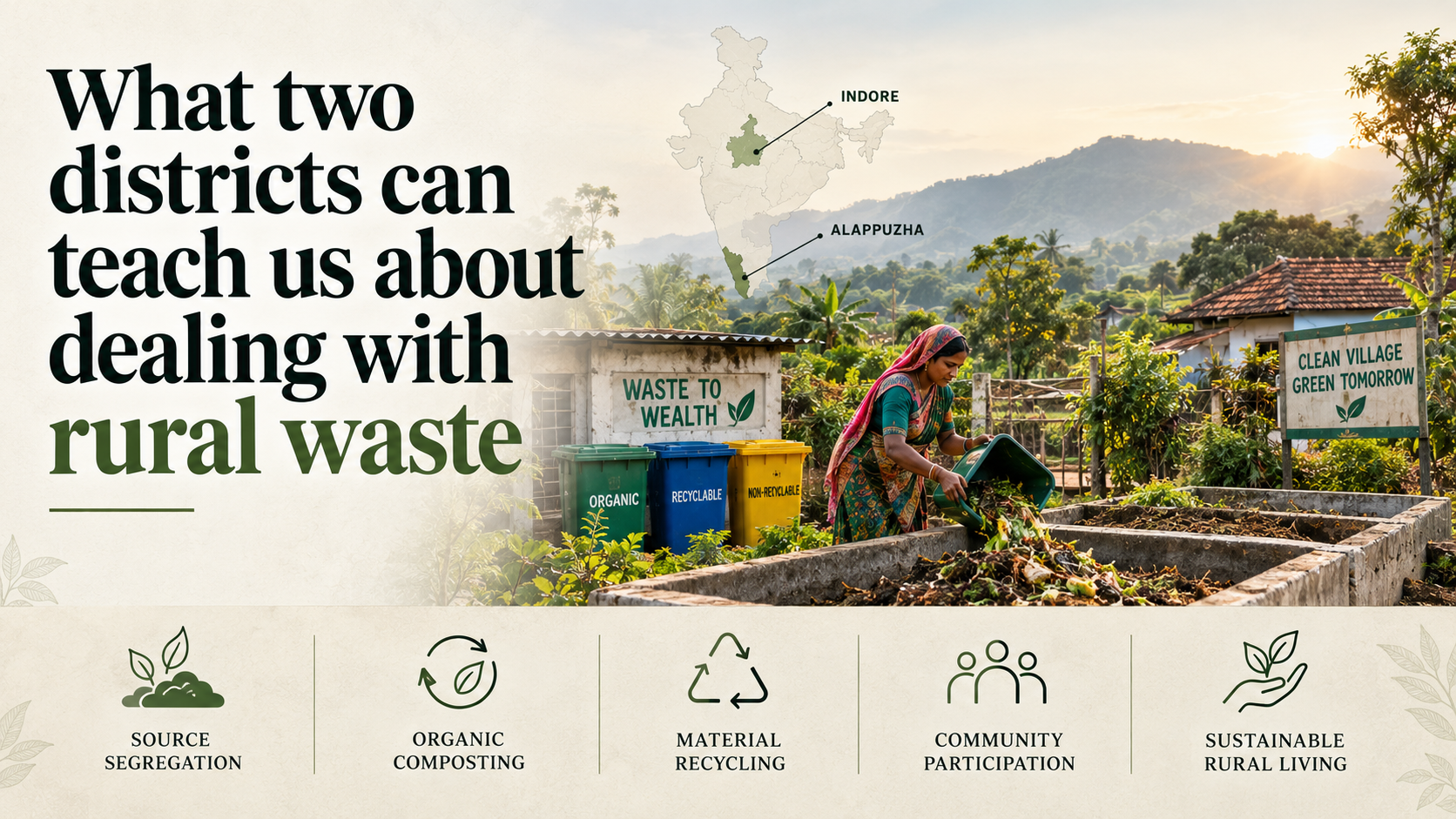
  • What two districts can teach us about dealing with rural waste

    What two districts can teach us about dealing with rural waste

    Why in the News

    The Supreme Court has demanded functional waste regulators, exposing weak institutionalisation. While India generates 1.7 lakh tonnes daily, successful community systems in Majuli and Tawang show operational gaps, especially rurally.

    Why does India’s waste system not see the countryside?

    1. Rural waste data are not collected: Waste data for rural areas do not exist, according to the Centre for Science and Environment (CSE), a New Delhi based research and advocacy body.
    2. The duty sits with bodies that do not discharge it: Urban and rural local bodies are tasked with solid waste management and with recording volumes and expenses, and they rarely do the needful.
    3. The gap is global and overwhelmingly rural: Around 2.7 billion people worldwide have no waste collection, and 2 billion of them live in rural areas, per an analysis by the United Nations Environment Programme (UNEP).
    4. Uncollected waste goes to land, water or fire: Where people cannot manage waste, they dump it on land or in rivers, streams and seas, or they burn it, which is a major concern in India.

    Why has rural waste grown without collection following it?

    1. Rural spending has risen: Data show a rise in per capita spending in India’s rural areas, and more consumption produces more waste.
    2. Packaging reached the remotest markets: Food, beverages and personal care or hygiene products are almost all wrapped in plastics or multi layered packaging, and those goods have penetrated the remotest rural markets.
    3. Waste management did not follow the goods: Collection systems did not extend into those markets alongside the products that created the waste.
    4. Organic waste had a use and mixed waste does not: Organic waste fed livestock or served as manure for centuries, and plastics and other non-biodegradable materials have produced a mixed waste that is harder to decompose.

    What did Majuli change after its facilities went unused?

    1. The sheds were built years before the system was: The Swachh Bharat Mission and the Public Health Engineering Department built Central Material Collection Facilities (CMCFs), the village level sheds where sorted waste is received and stored, in 19 of 20 panchayats between 2017 and 2022, along with mini collection facilities in most of the 160 villages.
    2. Neither the sheds nor the workers were put to use: The tin sheds went unused and the workers were not mobilised until the departments teamed up with the waste management non-profit Sahaas in 2024.
    3. The missing components were operational rather than physical: Funding, staffing and training of sanitation workers, vehicles for transport, operation of the collection facilities and buyers for the sorted material all had to be arranged.
    4. Participation was organised before collection began: Village leaders, homestay and hotel owners, schools and self-help groups (SHGs) ran awareness programmes and handed out bags for storage and segregation.
    5. Collection now runs in 19 of 20 panchayats: Garbage is now collected across them, in a district that faces flooding and erosion every year.
    6. Staffing remains thin against the population: Majuli’s 1.67 lakh people are served by 37 sanitation workers and 19 sorting staff.
    7. The fleet was funded only recently: The district departments purchased 21 e-vehicles and 15 tricycles and approved funds for the collection crew.
    8. The first river crossing was in April 2025: A tonne of waste left Majuli by boat across the Brahmaputra, the first time the island’s waste crossed the river instead of being dumped into it.
    9. The tonnage is now measurable: Majuli has collected 82.4 tonnes of waste since 2024, and it transferred 16.78 tonnes and earned Rs 1.47 lakh between April 2025 and May 2026.

    How does Tawang collect waste without sanitation workers?

    1. Scattered settlements rule out door to door collection: Households in these land-locked mountain villages sit too far apart for a sanitation worker to cover on a route.
    2. The pilot began in one village in 2024: Local officials and village leaders piloted a community led model in Chullyu in Keyi Panyor district through the Himalayan Fringes Project of the Further and Beyond Foundation.
    3. It spread across three districts in two years: A third of Tawang district and parts of Keyi Panyor and Upper Siang districts have adopted the model.
    4. Households store their own waste: Every household segregates biodegradable from non-biodegradable waste and keeps it at home until the collection day.
    5. Collection is a monthly village event: Each village organises a Swachchata Divas, or Cleanliness Day, at a designated point where residents arrive with sacks and sort the waste into 22 categories.
    6. The volumes are recorded: 26 villages in the project have organised more than 150 Swachchata Divas and collected 30 tonnes of waste.
    7. Secondary sorting happens at recovery facilities: The waste moves to material recovery facilities (MRFs), the sites where it is received, sorted and processed, at Zemithang, Lumla and Daporijo, with smaller community run facilities at Chullyu and Gobuk.
    8. Sorting deepens to 35 categories there: 12 full time MRF operators and dozens of women from self-help groups perform that second sort.
    9. Sanitary waste is handled rather than dumped: Sanitary napkins and diapers are washed, dried and stored at the facilities, and more than 20 tonnes have been sold to recyclers for Rs 3.53 lakh.
    10. One residue stream found a local use: About two tonnes of multi layered plastics went to a processing plant at Lhou in Jang sub-division and were used to make paver blocks.
    11. The first consignment left on Independence Day 2024: Villagers from Zemithang Circle, settled between 6,900 and 8,000 feet, sent 4.4 tonnes of garbage on a 390 km lorry journey of over 12 hours to scrap dealers in Tezpur in Assam.

    Who pays for rural collection, and who is accountable for it?

    1. Collection is the most expensive step in the chain: Crew wages, vehicle fuel and maintenance, insurance and other indirect costs make it the costliest link, per UNEP.
    2. Indian cities show the same cost structure: Primary collection and transportation account for the bulk of costs, per a CSE report on plastic waste management.
    3. Manpower dominates the rural cost: Nearly 50 per cent of the primary collection cost in rural Dharamshala was attributed to manpower.
    4. The Tawang model removes that cost line: Eliminating sanitation workers and door to door collection took the largest single expense out of the system.
    5. Households pay a monthly fee: Each household pays Rs 50 a month and shops and cafes pay Rs 100.
    6. Authority is vested in a village committee: A gaon bura, or village head, and a treasurer lead committees that draft waste management policies and set the rules, responsibilities and fines.
    7. A regional committee sits above them: Each region has a central committee chaired by a Circle Officer with a Lama, an influential religious leader, as secretary, and the committees meet every quarter.
    8. Financing remains the binding constraint: Money is the biggest problem in running such a system, per the officer who led the Zemithang effort.

    Where does the chain still break?

    1. Distance sets the transport economics: Waste travels farther from rural areas to reach recyclers, which renders the task less attractive for scrap dealers.
    2. One truckload costs Rs 45,000: Sending a truckload from Arunachal Pradesh to Assam costs that much, and fuel and the driver still cost Rs 20,000 a trip after State officials donated a truck.
    3. Boat transfers proved too costly to repeat: Majuli made three transfers across the Brahmaputra and now sells to local scrap dealers as well.
    4. Two streams have no buyer at all: Black polythene and textile scrap have found no takers.
    5. Storage is filling faster than offtake: Many CMCFs are filling up quickly, and rural collection facilities are commonly found full of baled waste with few takers.
    6. Processing capacity sits idle: Majuli’s long defunct plastics management facility is undergoing repairs.
    7. Segregation compliance is not universal: About 30 households in every 100 still hand over mixed waste.

    Challenges to rural solid waste management

    1. Panchayats have no funded sanitation establishment: A rural local body carries the duty without a permanent staffing line or a recurring budget head for waste, so the work depends on scheme money and an outside partner. Eg. Solid and liquid waste management money for gram panchayats arrives through Swachh Bharat Mission Grameen allocations and tied Fifteenth Finance Commission grants rather than through an own-source revenue stream.
      The Fix: Make a collected user fee a mandatory own-source revenue head for the panchayat, and release the matching grant only against fee actually collected.
    2. Legacy rural dumps are not inventoried: Remediation and bio-mining targets are written for urban dumpsites, so village dumps sit outside any list anyone is accountable for clearing. Eg. Dumpsite remediation targets under the second phase of the Swachh Bharat Mission are set for urban local bodies.
      The Fix: Require every gram panchayat development plan to carry a mapped inventory of existing dump points with a dated clearance commitment.
    3. Producer responsibility is verified on paper: A packaging producer discharges its obligation by buying a recycling certificate, and the certificate is easier to obtain than the collection is to perform. Eg. The CPCB has cancelled extended producer responsibility certificates issued by recyclers whose claimed processing capacity could not be verified.
      The Fix: Tie certificate issue to plant level input and output data reported from the processor’s own weighbridge.
    4. Rural sanitation work carries no protection: Workers handle mixed waste, including sanitary and medical items, without the equipment, registration or insurance that municipal employment carries. Eg. Rural collection crews are engaged on scheme funds rather than on a municipal payroll, which leaves them outside standing occupational safety obligations.
      The Fix: Register every rural sanitation worker on a State database and make supply of protective equipment a condition of releasing collection funds.
    5. Reported waste figures have no verification layer: Where a local body does report a number, no independent audit checks it against what a facility actually received. Eg. Swachh Survekshan Grameen scoring rests substantially on self-declared and observation based inputs rather than on weighed tonnage.
      The Fix: Make weighbridge or facility receipt records the reporting unit, and publish district level tonnage every month.

    Conclusion

    Rural India’s waste challenge is fundamentally an operational gap, not an infrastructure gap. Majuli and Tawang show that community-led collection can work, but sustained funding, accountable institutions, worker protection and reliable recycling markets are essential for a truly circular rural waste system.

    Back2Basics: Solid Waste Management Rules, 2016

    1. Legal basis: Notified by the Union Ministry of Environment, Forest and Climate Change under the Environment (Protection) Act, 1986, replacing the Municipal Solid Wastes (Management and Handling) Rules, 2000.
    2. Coverage beyond municipalities: They extend to census towns, notified industrial townships, and areas under railways, airports, defence establishments, special economic zones and places of pilgrimage.
    3. Source segregation is mandatory: A waste generator must separate waste into wet, dry and domestic hazardous streams and hand it to an authorised collector.
    4. Producers carry a post-consumer duty: Brand owners and manufacturers of non-biodegradable packaging must arrange to collect that packaging back from the market.

    [2019] As per the Solid Waste Management Rules, 2016 in India, which one of the following statements is correct?

    (a) Waste generator has to segregate waste into five categories.

    (b) The Rules are applicable to riotified urban local bodies, notified towns and all industrial townships only.

    (c) The Rules provide for exact and elaborate criteria for the identification of sites for landfills and waste processing facilities.

    (d) It is mandatory on the part of waste generator that the waste generated in one district cannot be moved to another district.

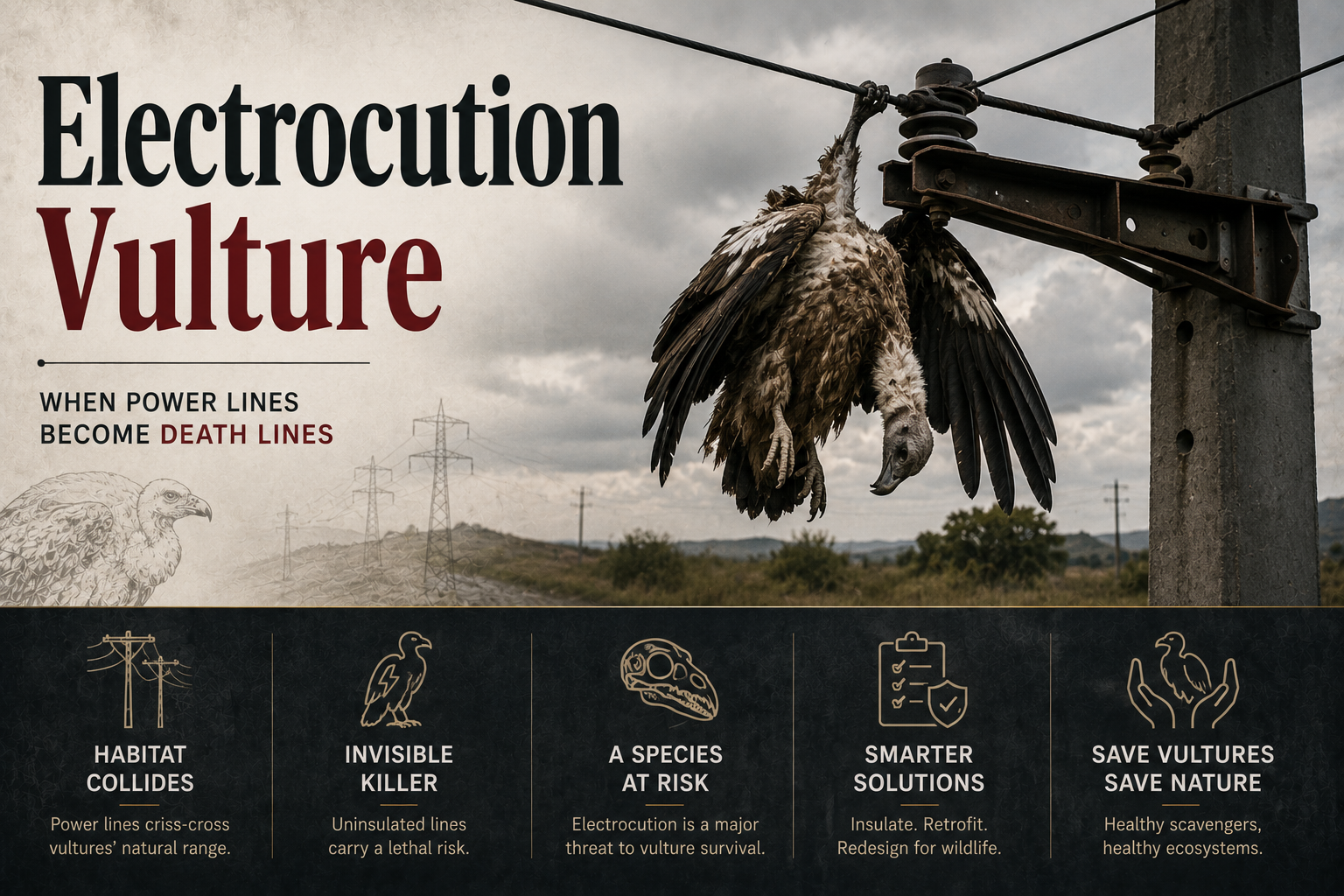
  • Deadly span

    Deadly span

    Why in the News

    Electrocution on India’s expanding power infrastructure is emerging as a threat to vultures capable of overtaking the chemical poisoning that caused their collapse.

    How far did the chemical crash take India’s vultures?

    1. The loss was among the world’s worst recorded: Numbers fell by 99.5 per cent by 2007 from a high of around four crore in the 1980s.
    2. Three species were nearly wiped out: The white-rumped, Indian and slender-billed vultures were the worst affected.
    3. The cause was a veterinary painkiller: Diclofenac administered to cattle destroyed the kidneys of vultures that fed on the carcasses.
    4. The regulatory response came in stages: The government banned diclofenac first, then added bans in 2023 on aceclofenac and ketoprofen among other NSAIDs.
    5. The population has not returned: One official survey reported in 2025 that vultures were nesting at only 50 per cent of their historic nesting sites.

    What did the collapse cost beyond the birds?

    1. Carcasses stayed exposed for longer: The loss of scavengers left livestock carcasses in the open, which supported feral dog populations.
    2. Rabies outbreaks followed: The growth in feral dog numbers led to outbreaks of rabies.
    3. Human mortality rose 4 per cent: A 2024 study in the American Economic Review estimated that increase as a consequence of the vulture decline.
    4. The damages were valued at 69.4 billion dollars a year: The same study put the associated cost to India at that figure.

    Why does power infrastructure kill vultures specifically?

    1. A wingspan can bridge two conductors: A large individual can contact two conductors at once, which is what completes the circuit through the bird.
    2. The birds seek elevated perches: Vultures habitually perch on elevated structures and are drawn to open landscapes, which is what a transmission corridor provides.
    3. Predictable food concentrates them: Vultures congregate where food availability is predictable, and dumping of food waste around electrical installations creates exactly that draw.
    4. Medium-voltage lines are also lethal: An assessment prepared for the State Climate Resilient Power System Development Project recorded an Egyptian vulture and steppe eagles electrocuted on medium-voltage rather than high-voltage lines.

    Why is the evidence on electrocution weaker than the threat?

    1. The deaths are removed before they are recorded: Avian electrocution is likely under-documented in India, since a dead bird can be taken by people or eaten by scavengers.
    2. The comparison with drugs understates the risk: Electrocution has not become as deadly as NSAIDs were, and the population it now acts on is a fraction of the one the drugs acted on.
    3. A local population can be lost to it alone: Research has noted that persistent mortality from electrocution by itself could render a local population extinct.
    4. Waiting for the data repeats the first failure: The fragility of the surviving population and the proliferation of unsafe power infrastructure are together the case for acting before the mortality record matures.

    Which interventions has the evidence actually tested?

    1. Moving the food source worked: Relocating a livestock carcass dump 2.4 km away from high-tension power infrastructure near Dehradun in Uttarakhand may have saved these scavengers from electrocution, per a recent study in the Journal of Threatened Taxa.
    2. Separation is the cheapest measure available: Keeping vulture feeding sites away from power infrastructure is a siting decision rather than a capital works programme.
    3. Insulating conductors removes the contact risk: Covering energised components stops a bird bridging them.
    4. Increasing clearances answers the wingspan: Widening the gap between energised and grounded components has to be sized against vulture wingspans rather than against smaller birds.
    5. Safe perches redirect the birds: Installing perches that carry no current gives raptors an alternative to the energised structure.

    Challenges to vulture conservation in India

    1. Human formulations substitute for the banned veterinary drug: Multi-dose human vials of diclofenac remain on sale and are diverted to cattle, so the ban is defeated at the pharmacy counter. Eg. India capped the human diclofenac vial at 3 ml in 2015 because larger vials were being used on livestock.
      The Fix: Make sale of injectable diclofenac without a veterinary prescription an enforceable offence policed by drug inspectors rather than by forest staff.
    2. New painkillers enter the market faster than they are tested: A molecule is approved for cattle without a vulture safety trial, so each ban is followed by the next drug. Eg. Nimesulide has been shown to be toxic to Gyps vultures and remains in veterinary use.
      The Fix: Require safety testing on Gyps vultures as a condition of veterinary marketing approval for any NSAID, with meloxicam as the reference safe alternative.
    3. Captive breeding cannot outpace adult mortality: Vultures lay a single egg a year and mature slowly, so releases add birds far more slowly than a landscape threat removes them. Eg. The Jatayu Conservation Breeding Centre at Pinjore has released birds only in small annual batches.
      The Fix: Certify the release landscape as safe before any release, with drug residue sampling and line insulation audited as the precondition.
    4. The food base has been engineered away: Rendering and burial of livestock carcasses removes the open food supply that once sustained large scavenger populations. Eg. Vulture restaurants in Maharashtra and Punjab exist because the traditional open carcass dump has disappeared from many districts.
      The Fix: Fund supplementary feeding sites from State animal husbandry budgets and site them by rule away from transmission corridors.
    5. No agency is answerable for bird deaths on power lines: Transmission and distribution utilities carry no reporting duty for wildlife mortality, so the threat has no dataset behind it. Eg. Bird deaths on power lines in the Thar landscape became visible only after Great Indian Bustard litigation forced surveys.
      The Fix: Make wildlife mortality reporting a licence condition for transmission and distribution licensees, with the returns published by the State electricity regulator.
    6. Bird safe design is not written into line standards: Construction standards specify electrical clearances, not clearances sized for large raptors. Eg. Directions on undergrounding power lines in Great Indian Bustard habitat were later narrowed on feasibility and cost grounds.
      The Fix: Write raptor safe pole and cross-arm geometry into the national electricity standards for new lines in identified vulture landscapes.

    Conclusion

    The chemical crash was answerable on paper, because a single molecule could be identified and banned. Electrocution offers no such lever, since the killing agent is ordinary infrastructure doing what it was built to do. The unresolved tension is that conservation authority sits with forest departments while the hazard sits with the power sector, and no rule connects the two. Until that link is made, the threat will keep being measured only after the fact.

    Back2Basics: White-rumped Vulture

    1. Status: Listed as Critically Endangered on the IUCN Red List and protected under Schedule I of the Wild Life (Protection) Act, 1972.
    2. Identification: It carries a white neck ruff and a white rump against black and brown plumage.
    3. Range and nesting: It is found near human settlements across northern and central India, nesting in tall trees and on cliffs.
    4. Ecological role: It is a social scavenger that feeds in flocks on carrion, garbage and slaughterhouse waste, which is how a small population clears waste across a wide landscape.

    [2012] Vultures which used to be very common in Indian countryside some years ago are rarely seen nowadays. This is attributed to:

    (a) the destruction of their nesting sites by new invasive species disease among them

    (b) a drug used by cattle owners for treating their diseased cattle persistent and fatal

    (c) scarcity of food available to them

    (d) a widespread, persistent and fatal disease among them

  • [31st August 2026] The Hindu OpED: Adopt policies for reuse of treated water

    [31st August 2026] The Hindu OpED: Adopt policies for reuse of treated water

    Question (2025, GS3): “Examine the factors responsible for depleting groundwater in India. What are the steps taken by the government to mitigate such depletion of groundwater?
    Linkage: The safe reuse of treated water is a critical step in mitigating groundwater depletion. By directing treated wastewater to agricultural fields (“farms”) and industrial units (“factories”), states can significantly reduce their dependence on fresh groundwater extraction.

    Mentor Comment

    Uttar Pradesh and Uttarakhand have notified treated wastewater reuse policies built for their own geography rather than on a single national template. Both were framed through an extensive consultative process, and both separate the needs of hill communities from those of densely populated plains. They follow the National Framework on Safe Reuse of Treated Water (SRTW), 2022, which made reuse a stated national priority and required States to frame reuse policies of their own. The tension is that sewage treatment capacity has already been built at scale under the Atal Mission for Rejuvenation and Urban Transformation (AMRUT), the central urban mission that funds water supply and sewerage, and a plant discharging into a drain rather than into a farm or a factory returns no water to the system.

    What is the National Framework on Safe Reuse of Treated Water, 2022?

    1. What it establishes: It sets the national position that reuse of treated water is a priority rather than a peripheral option, which is a policy signal as much as a guidance document.
    2. How it devolves: It requires States to develop their own reuse policies, on the reasoning that water solutions are local even where the ambition is national.

    What makes the two State policies a departure from template policymaking?

    1. Geography is written into the policy: Each policy accounts for the stark internal diversity of its State, treating hill settlements and dense plains as different reuse problems.
    2. Reuse is matched to purpose: Both embed fit for purpose reuse, so water is treated to the standard its end use needs rather than to a single quality for every user.
    3. Reuse is tied to other plans: Both integrate reuse with urban planning and with river rejuvenation, instead of running it as a standalone sanitation activity.
    4. Financing and monitoring are built in: Both carry community participation, blended finance and public private partnership pathways, and digital monitoring systems that make reuse accountable.

    Why does built treatment capacity not become reuse?

    1. A plant without an offtake is idle capacity: National missions have scaled treatment infrastructure, and pipes and plants alone do not close the loop when the output goes into a drain.
    2. Departments do not work together: Utilities, urban departments, irrigation agencies and industries operate in silos, and reuse succeeds only where they operate as one chain.
    3. There is no price signal: Reuse becomes economically rational only when pricing reflects what freshwater actually costs the system.
    4. End users have no assurance: Quality standards are what give a farmer or a factory confidence to take treated water as an input.
    5. National ambition has no local plan: City level roadmaps are what convert a national framework into action by a specific municipal body.

    What is the economic case for reuse?

    1. A supply that does not fail: Treated wastewater offers agriculture, industry, urban landscaping and ecological restoration a reliable and drought proof supply, which is increasingly rare.
    2. It reduces a costly dependence: Reuse cuts expenditure on sourcing fresh water and builds climate resilience into a city’s water balance.
    3. It removes a ceiling on growth: Industrial and urban expansion can proceed without straining existing freshwater supplies, and it supports low carbon urban development at scale.
    4. The case has not been made to the decision maker: Until this computable value is put clearly to State governments and planners, the policy remains an aspiration rather than a budget line.

    What decides whether a State actually adopts reuse?

    1. Money comes from convergence, not new allocations: The financial momentum for reuse targets is unlocked by identifying synergies with already funded schemes rather than by fresh budgetary provision.
    2. Public resistance is the deeper constraint: Misconceptions about the safety of treated water run deep, which is why the national framework and both State policies name treated water Apna Jal, our water.
    3. The shift required is psychological: No document can produce acceptance on its own, and the naming choice is an attempt to change how the resource is perceived before it is used.
    4. Delay compounds: States without a clear reuse plan for water security are not merely behind others, they are running out of time to catch up.

    Challenges to the National Framework on Safe Reuse of Treated Water, 2022

    1. The Framework carries no enforceable target: It directs States to frame reuse policies and fixes no volume any State must actually reuse, so a policy can be notified without a single litre changing hands. Eg. Maharashtra’s obligation to reuse 20 per cent of effluent comes from its own State water regulator rather than from any national instrument. Fix. Attach a reuse share to the consent to discharge issued under the Water (Prevention and Control of Pollution) Act, 1974, so the obligation sits on the discharger.
    2. Supply is continuous and demand is seasonal: A treatment plant produces a steady flow around the clock and agricultural offtake follows the cropping calendar, and the storage that bridges the two is rarely built. Eg. Chennai contracted its tertiary treatment output to industrial users in the Manali belt precisely because industry draws a steady year round volume. Fix. Contract an anchor buyer before a plant is commissioned rather than after it is built.
    3. Reuse in food crops carries a health exposure: Irrigation with partially treated sewage moves pathogens and heavy metals into the food chain, and the risk falls on consumers who never chose the input. Eg. The Musi river corridor downstream of Hyderabad has long been irrigated with untreated and partially treated sewage. Fix. Enforce end use specific quality tiers, with the strictest limits for crops eaten raw.
    4. The certifier is also the enforcer: State Pollution Control Boards must certify effluent quality and simultaneously prosecute the dischargers they certify, and they are thinly staffed for either task. Eg. Central Pollution Control Board reviews have repeatedly found a large share of sewage treatment plants operating outside discharge norms. Fix. Separate reuse quality certification from the enforcement function, and staff the certification arm to the number of plants it must clear.

    Conclusion

    The variable that decides reuse is not how much treatment capacity exists but who has contracted to take the output. What to watch is whether the States that have notified policies convert a stated reuse target into signed offtake agreements with irrigation agencies and industry, since that is the point at which a policy becomes a volume of water. The measure worth tracking is the share of treated sewage actually reused, not the share treated.

    Reuse of Treated Water in India

    1. What the activity is: Sewage or industrial effluent is processed to a defined quality standard and then supplied for a use that does not require freshwater.
    2. How little is recovered: Around 28 per cent of India’s sewage is treated and barely 3 per cent of that is beneficially reused, per the Central Pollution Control Board (CPCB).
    3. The resource ahead: Over 35,000 million cubic metres of treated wastewater is expected to be available by 2050.
    4. Why the resource matters: India holds around 18 per cent of the world’s population and about 4 per cent of its freshwater, and per capita availability had fallen to 1,486 cubic metres by 2021, below the 1,700 cubic metre stress threshold.

    Laws and Rules Governing Reuse of Treated Water

    1. Water (Prevention and Control of Pollution) Act, 1974: Created the Central Pollution Control Board and the State Pollution Control Boards, and made the discharge of sewage or trade effluent into a water body subject to their consent.
    2. Water (Prevention and Control of Pollution) Amendment Act, 2024: Rationalised the penalty regime, replacing prosecution for a set of minor offences with monetary penalties decided by an adjudicating officer.
    3. Environment (Protection) Act, 1986: The source of the effluent discharge standards a treatment plant must meet before its output is discharged or supplied to a reuse customer.
    4. Entry 17 of the State List: Water supply, irrigation and drainage are State subjects, which is why a national framework can direct States to act but cannot itself operate a reuse policy.

    Government Initiatives for Reuse of Treated Water

    1. Namami Gange Programme: Funds sewage treatment across the Ganga basin, including colony level decentralised plants and the reuse of treated water for irrigation.
    2. National Water Mission: Targets a 20 per cent improvement in water use efficiency, with reuse counted as a demand side measure alongside conservation.
    3. Maharashtra Water Resources Regulatory Authority mandate: The State regulator requires 20 per cent effluent reuse, a model NITI Aayog has endorsed for wider adoption.
    4. Water Reuse Certificates: Developed by the World Bank hosted 2030 Water Resources Group, these are tradable permits on a cap and trade model, with higher quality treated water earning more credits.
  • A quiet move that has kept Dehradun’s vultures safe

    Why in the News

    Relocating a livestock carcass dump 2.4 km away from high-tension power infrastructure near Dehradun in Uttarakhand appears to have ended vulture deaths at the site. The finding comes from a decade-old study published in the latest issue of the Journal of Threatened Taxa, which documented electrocution mortality at Sudhauwala before the move. Electrocution from power infrastructure is the most under-reported of the threats to vultures, a group already among the most threatened birds globally after severe population declines across Asia and Africa. The case sets a low cost siting decision against a threat that conservation policy has so far organised itself around drugs and poisoning to address.

    What did the Sudhauwala surveys record?

    1. The survey base: The study rests on 34 surveys conducted between May 2011 and February 2014 in the Sudhauwala region of Dehradun.
    2. The population observed: It recorded 743 individual vultures belonging to five species.
    3. The mortality count: 46 vulture carcasses attributable to electrocution were documented in proximity to high-tension power transmission structures.
    4. Which species paid most: The highest proportion of mortality relative to observations was recorded for the Himalayan griffon (Gyps himalayensis), followed by the Eurasian griffon (Gyps fulvus) and the cinereous vulture (Aegypius monachus).

    Why has electrocution stayed off the vulture conservation agenda?

    1. The recognised threat list excludes it: Poisoning, veterinary non-steroidal anti-inflammatory drugs (NSAIDs), food scarcity and habitat loss are the survival challenges vulture policy in India is built around.
    2. The under-reporting is the point: Electrocution from power infrastructure has been the most under-reported threat, so it does not enter the mitigation measures those policies fund.
    3. Siting concentrates the risk: A carcass dump placed near high-tension transmission structures draws large soaring scavengers directly into a hazard they do not otherwise encounter.

    What changed after the dump was moved?

    1. The intervention: Local authorities relocated the carcass dumping site about 2.4 km away from the high-risk electricity infrastructure in April 2015.
    2. The birds still came: Subsequent observations indicated continued use of the new site by vultures, so the food source was not lost in the process.
    3. The deaths stopped: No mortality events were recorded during the limited post-relocation monitoring.
    4. Other raptors followed: The black kite (Milvus migrans) and the crested serpent eagle (Spilornis cheela) were also recorded at the relocated site.

    How far does the evidence carry?

    1. The surveys were not systematic: The authors state the surveys were conducted on a non-systematic basis, which limits how far the counts can be generalised.
    2. The signal survives the caveat: The number of mortality events observed still suggests electrocution may represent a significant localised threat, particularly for long-lived scavengers such as vultures.
    3. The follow-up stopped: No studies have been conducted at the site after 2015, so the post-relocation result rests on limited monitoring rather than sustained observation.
    4. The measure is portable: Relocating carcass dumping sites away from hazardous power infrastructure is offered as a practical conservation measure that could be applied in other affected areas.

    Conclusion

    A single siting decision, moving a carcass dump away from transmission lines, removed a mortality source that no drug ban or breeding programme would have touched. The result stands on limited post-relocation monitoring and on surveys the authors themselves describe as non-systematic. No further study has been done at the site since 2015. The open question is whether carcass dump siting relative to transmission corridors is audited elsewhere in India, since the measure costs almost nothing and the threat it addresses is not currently counted.

    Back2Basics: Himalayan Griffon (Gyps himalayensis)

    1. What it is: One of the largest Old World vultures, a carrion feeding scavenger dependent on livestock and wild ungulate carcasses.
    2. Range and habitat: It breeds on cliffs across the Himalaya and the Tibetan Plateau at high elevations, and descends to lower hills and adjoining plains in winter.
    3. Conservation status: Listed as Near Threatened on the International Union for Conservation of Nature (IUCN) Red List, and in Appendix II of the Convention on International Trade in Endangered Species of Wild Fauna and Flora (CITES).
    4. Why status differs within the genus: Its high altitude range kept it away from the veterinary drug residues in plains livestock that pushed the resident Gyps vultures of the plains into the Critically Endangered category.

    Matching Previous Year Question

    “[2012] Vultures which used to be very common in Indian countryside some years ago are rarely seen nowadays. This is attributed to: (a) the destruction of their nesting sites by new invasive species disease among them (b) a drug used by cattle owners for treating their diseased cattle persistent and fatal (c) scarcity of food available to them (d) a widespread, persistent and fatal disease among them ANSWER: (b)”

  • Blaming climate change for extreme weather has limits

    Why in the News

    World Weather Attribution (WWA), an international research group that assesses the influence of climate change on extreme weather, has found that this year’s intense South Asian heatwave was made about three times likelier and up to 1 degree C warmer by climate change. The finding rests on extreme event attribution, a method that reruns climate models for a world without human emissions and reads the difference. Specialists have questioned how far that method can be pushed. The confidence it delivers for a multi-day heatwave collapses for a one hour cloudburst, and claims of legal liability for emissions rest on the stronger reading.

    How does extreme event attribution work?

    1. What it sets out to do: It traces the human fingerprint in a specific extreme weather event rather than in the climate record as a whole.
    2. Detection comes first: Detection establishes whether an event falls outside the range of its normal occurrence given natural variation in the climate system.
    3. The counterfactual run: Climate models are simulated first for a pre-industrial world with carbon dioxide at 280 parts per million (ppm), then for present day conditions above 420 ppm.
    4. Attribution reads the gap: The difference in the magnitude or the likelihood of the event between the two runs is assigned to human influence, and many simulations with rigorous statistical tests are required to rule out chance.

    Why is confidence higher for heatwaves than for local downpours?

    1. Long events sit inside model resolution: A day-long heatwave or several days of heavy rain unfolds slowly enough for a global climate model to represent it.
    2. Short bursts do not: Intense bursts of rain lasting an hour or so are harder to model and to link to climate change, because most global climate models cannot capture fast-changing processes.
    3. The resolution gap is documented: The Sixth Assessment Report of the Intergovernmental Panel on Climate Change (IPCC) notes that local phenomena such as land-sea breezes and mountain wind systems can only be realistically represented at a simulation resolution of around 10 km or less, which current models do not support.

    What data and computing limits hold the science back?

    1. The observational record is too short: Analysis of localised events is hampered by limited long-term weather records.
    2. Natural variability cannot be bounded without them: Without long-term hourly or sub-hourly rainfall observations for a particular place, the range of natural variability for a heavy rainfall event there cannot be marked out with confidence.
    3. Computing power is the second constraint: Insufficient computing power restricts how finely and how often localised events can be simulated.
    4. The consequence is overreach: Uncertainties arising from observations and from models lead to unscientific claims and sweeping generalisations.

    Why can scientists not agree on what counts as extreme?

    1. The baseline decides the verdict: An event that appears extreme against a 10 to 20 year timeline may not look exceptional when analysed against a dataset spanning 500 years.
    2. Long reconstructions change the picture: A reconstruction of droughts over roughly 1,200 years found that some kinds of drought seen in the past no longer occur at all.
    3. No agreed threshold exists: Scientists are not agreed on what amounts to extreme, so the same event can be classified differently by two competent groups.

    How strong is the scientific objection to single event attribution?

    1. The possibility itself is contested: At a 2025 committee hearing at the U.S. National Academies of Sciences, Engineering and Medicine (NASEM), a Stanford University climate scientist questioned whether single event attribution is even possible at all from a scientific point of view.
    2. The counterfactual cannot be validated: A former United Nations and United Kingdom government scientist has asked how it can be known that a climate model accurately represents a climate no one has ever observed.
    3. The difficulty is conceded by the panel: NASEM experts have previously noted that it is challenging to ascertain the influence of climate change on extreme weather.
    4. Extremes predate emissions: Extreme weather events can occur even without anthropogenic climate change, so the presence of an extreme is not itself evidence of a human cause.

    What rides on the answer, and what is the alternative?

    1. The liability is pursued at two levels: Claims are brought both against countries and against individual corporations, which are two different evidentiary burdens.
    2. The carbon majors claim: Studies claim that carbon majors, meaning businesses with particularly high emissions, can be defined and that specific climate changes can be attributed to specific organisations.
    3. The court is the real test: The open question is whether such findings hold up in court, and climate models will never be perfect enough for counterfactual worlds to be accepted without challenge.
    4. The competing priority: Developing more effective early warning systems and adaptation infrastructure saves more lives than establishing who is responsible.

    Conclusion

    Extreme event attribution is strongest exactly where it is least contested, on slow, large scale events such as heatwaves, and weakest on the short, localised events that cause most sudden loss of life. That asymmetry matters because liability claims are being built on the method as a whole rather than on the events it handles well. Sparse long-term records, limited computing power and an unsettled definition of extreme all remain unresolved. Until they are, preparedness through early warning and adaptation infrastructure delivers more than attribution can.

    Back2Basics: World Weather Attribution

    1. What it is: An international collaboration of climate scientists that assesses whether and how far climate change influenced a specific extreme weather event.
    2. When it began: It was set up in 2014, and is led from the Grantham Institute at Imperial College London.
    3. What makes it distinctive: It publishes rapid analyses within days or weeks of an event, against conventional studies that take months to years.

    Matching Previous Year Question

    “[2020] Which one of the following statements best describes the term ‘Social Cost of Carbon’? It is a measure, in monetary value, of the (a) long-term damage done by a tonne of CO2, emissions in a given year. (b) requirement of fossil fuels for a country to provide goods and services to its citizens, (c) efforts put in by a climate refugee to adapt to live in a new place. (d) contribution of an individual person to the carbon footprint on the planet Earth. ANSWER: (a)”

  • Let the Western Ghats breathe

    Why in the News

    The Rs 10,000 crore, 2,000 MW Sharavathi Pumped Storage Project in Karnataka is under an interim stay by the Karnataka High Court, with work frozen until further orders. The project sits entirely inside the Sharavathi Valley Lion-Tailed Macaque Wildlife Sanctuary. An expert panel constituted by the Standing Committee of the National Board for Wildlife (NBWL) had earlier recommended against approving it. The contest is between a state that needs storage to absorb intermittent renewable power and a protected rainforest where such construction is barred outright.

    How does the Sharavathi Pumped Storage Project work?

    1. What it connects: The project links the Talakalale and Gerusoppa reservoirs on the already heavily dammed Sharavathi river.
    2. What has to be built: The link runs through massive underground tunnels and powerhouses cut into the valley.
    3. The pumping cycle: Water is pumped uphill during off-peak hours, when demand and power prices are low.
    4. The generating cycle: The stored water is released downhill to generate power during peak demand.

    Why do the Western Ghats matter beyond their species counts?

    1. Scale of the chain: The Western Ghats run 1,600 kilometres along the edge of the peninsula.
    2. Global standing: They are one of the world’s eight hottest biodiversity hotspots.
    3. What they hold: They harbour nearly half of India’s flowering plant species, a third of its vertebrate fauna, and over 300 globally threatened species.
    4. Narrow endemics: Species such as the Katlekan Marsh Nut and the Gund Day Gecko are found only in these forests and nowhere else.
    5. What primary forest looks like: In the Katlekan dark forest of North Kanara the canopy cuts out light so completely that a torch is needed at midday, a structure the fragmented woodlots counted as forest elsewhere do not reproduce.

    What do the Ghats do for the peninsula’s water and climate?

    1. First contact with the monsoon: The chain takes the first impact of the southwest monsoon and releases it downstream.
    2. Source of the Deccan’s rivers: The Godavari, Krishna, Kaveri and Tungabhadra all originate here, sustaining hundreds of millions of people across six states.
    3. Regional climate function: The dense forests temper regional climate, draw down carbon, hold soil in place, and soften the runoff and flooding that would otherwise reach the downstream plains.
    4. A moisture recycling system: Like the Amazon basin, these rainforests cycle moisture back into the atmosphere, which sustains the monsoon that feeds them.

    Why did the wildlife expert panel advise against approval?

    1. The siting is barred by law: The project lies wholly within a wildlife sanctuary that carries one of the highest levels of protection under the Wildlife (Protection) Act, 1972, where such infrastructure is strictly prohibited.
    2. The panel’s finding: The expert panel constituted by the NBWL Standing Committee recommended against approval, citing irreversible ecological harm.
    3. The technical objection: The panel questioned the project’s technical justification and found it would yield no new net energy to the grid.
    4. A net energy loss: Pumping requirements would produce a net loss of approximately 500 MW.

    What are the physical costs of building inside the sanctuary?

    1. Primary forest cleared: The project requires clearing over 50 hectares of dense primary evergreen forest.
    2. Corridors broken: The clearance fragments wildlife corridors between the Anshi-Dandeli and Bhadra-Kudremukh landscapes, cutting the routes large mammals use to move between the two.
    3. Landslide risk: The zone is geologically fragile, and blasting for underground tunnels and powerhouses with heavy industrial explosives raises the risk of slope failure.

    Does rejecting the project leave Karnataka’s storage need unanswered?

    1. The need is real and conceded: Karnataka has an installed renewable energy capacity of 20.23 GW, and critics of the project accept that this output has to be firmed up.
    2. Why storage is the constraint: Solar and wind generation is intermittent, so the grid needs a way to shift surplus power to hours of peak demand.
    3. The options are plural, not singular: Battery Energy Storage Systems, compressed air energy storage and gravity energy storage sit alongside pumped storage as ways to manage that intermittency.
    4. The siting question is separable from the technology question: Accepting the need for storage does not settle where a storage project may be built.

    Conclusion

    The argument is not that pumped storage is wrong, it is that this catchment is the wrong place to put it. A project that yields no new net energy and consumes more power than it returns cannot justify clearing primary evergreen forest. The Karnataka High Court’s interim stay holds the position for now. What remains unresolved is whether the clearance system will treat the highest protection category as an absolute siting bar or as a threshold that can be crossed on a case by case finding.

    What is Environmental Impact Assessment?

    1. About: Environmental Impact Assessment (EIA) is a planning tool that predicts and seeks to mitigate the environmental consequences of a project before it is approved.
    2. Statutory history: India introduced EIA in 1978 for river valley projects, made it statutory through the 1994 notification under the Environment (Protection) Act, 1986, and consolidated it in the EIA Notification, 2006.
    3. Who appraises what: Category A projects are appraised centrally by the Ministry of Environment, Forest and Climate Change, and Category B projects by the State Environment Impact Assessment Authority, with Category B1 alone requiring a full study and a public hearing.

    Challenges in Environmental Impact Assessment

    1. Conflict of interest in who pays: The assessment is funded by the project proponent, which creates an incentive to understate impacts. Eg. Independent data on the Mundra Port and Special Economic Zone exposed deficiencies the proponent’s own assessment had missed. Fix. Have EIA reports audited by an autonomous body not funded by the proponent.
    2. Cumulative impact goes unmeasured: Appraisal runs project by project, so the combined load on one river is never assessed. Eg. National Green Tribunal orders in 2024 and 2025 cancelled clearances on this ground. Fix. Move to landscape level cumulative assessment for a whole catchment.

    Back2Basics: Sharavathi Valley Lion-Tailed Macaque Wildlife Sanctuary

    1. Location: In the Sharavathi river valley, Shivamogga district, Karnataka.
    2. Landmarks within it: Jog Falls and the Linganamakki reservoir lie inside it.
    3. Flagship species: The lion-tailed macaque, an endemic arboreal primate, is a keystone seed disperser and an indicator of forest health.

    Matching Previous Year Question

    “[2024, GS3, 10 marks] What role do environmental NGOs and activists play in influencing Environmental Impact Assessment (EIA) outcomes for major projects in India? Cite four examples with all important details.”

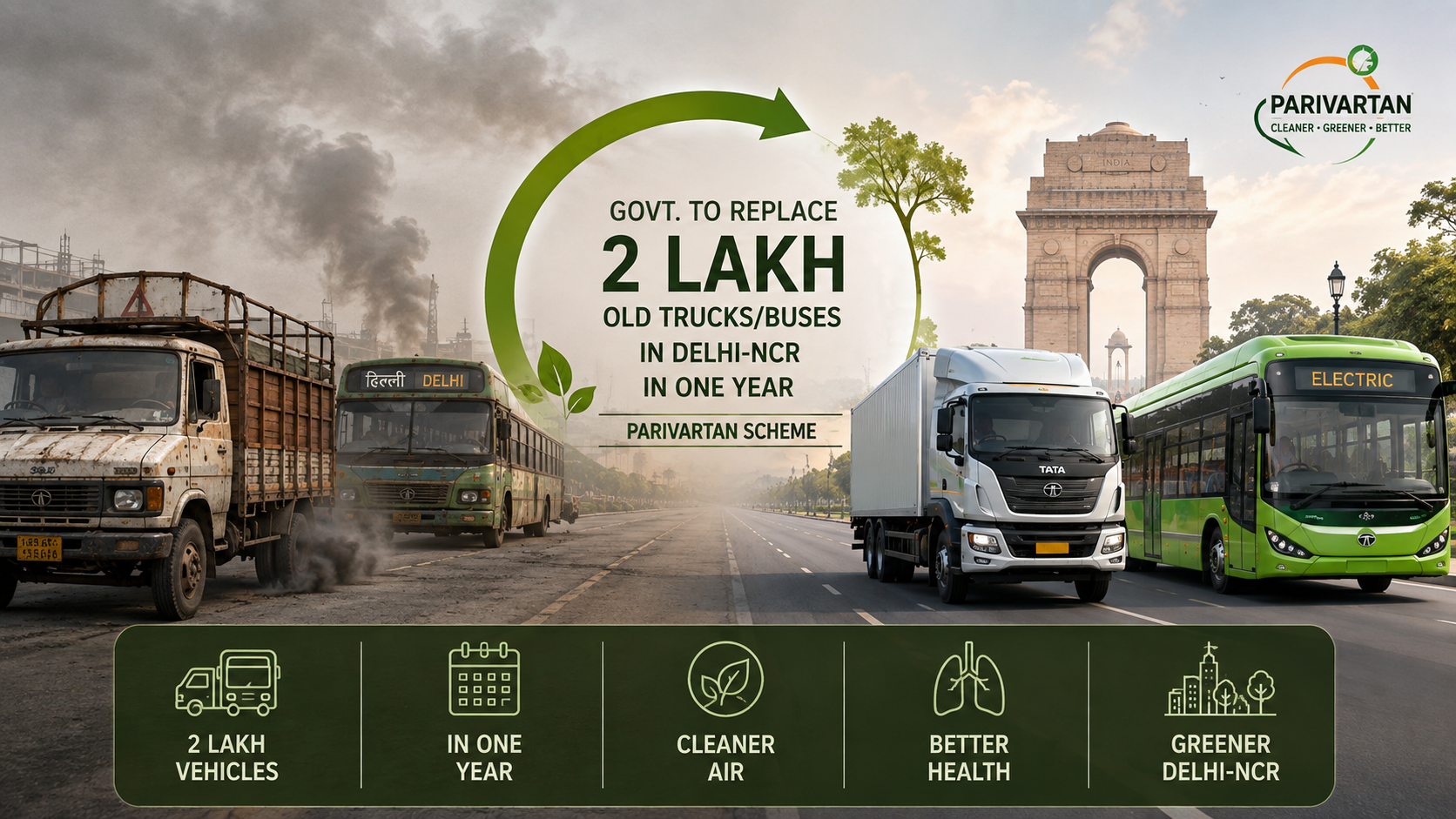
  • Govt. to replace 2 lakh old trucks/buses in Delhi-NCR in one year (PARIVARTAN scheme)

    Govt. to replace 2 lakh old trucks/buses in Delhi-NCR in one year (PARIVARTAN scheme)

    Why in the News

    The Union government aims to replace more than two lakh trucks and buses in Delhi and the National Capital Region with BS VI or electric vehicles within a year under the PARIVARTAN scheme, the Road Secretary has said. This brings forward a two year implementation timeline the Union Cabinet had earlier approved for the scheme. Trucks and buses make up only 3.1% of the region’s total vehicle fleet but contribute 36% of vehicular PM2.5 emissions, so the scheme concentrates replacement incentives on a small segment of the fleet rather than vehicles as a whole.

    What is the PARIVARTAN scheme?

    1. A vehicle renewal and incentive scheme: PARIVARTAN (the Programme for Accelerated Renewal and Incentivization of Vehicle Assets for Reducing Transport Air Pollution and Network Emissions) is a Union scheme to replace old trucks and buses in Delhi NCR with cleaner vehicles.
    2. Targets older commercial vehicles across four jurisdictions: It covers trucks and buses registered in Delhi and the NCR districts of Haryana, Rajasthan and Uttar Pradesh that conform to BS IV or older emission norms.
    3. Jointly funded and implemented: The scheme is funded through the National Capital Region Planning Board under the Ministry of Housing and Urban Affairs and implemented by the Ministry of Road Transport and Highways.

    What incentives does PARIVARTAN offer to push buyers toward cleaner vehicles?

    1. A large but shared financial outlay: The scheme carries a total financial outlay of Rs. 9,585 crore, of which Rs. 5,041 crore is central budgetary support.
    2. Lower cost of borrowing: Eligible buyers get a 5% interest subvention on vehicle loans for five years.
    3. Waived recurring and one time levies: Eligible buyers of new BS VI vehicles get a 100% road tax waiver for 10 years and exemption from registration fees.
    4. A manufacturer side discount: Eligible buyers also get at least an 8% discount on the ex showroom price from participating vehicle manufacturers.

    Challenges to the PARIVARTAN scheme

    1. Fleet turnover in one year is an aggressive compression: Compressing the replacement of over two lakh vehicles into one year against an originally planned two year timeline strains scrapping, registration and financing capacity built for a slower pace. Eg. India’s separate vehicle scrappage policy has itself faced slow uptake since 2021 because of limited authorised scrapping facility capacity in most States. Fix. Expand authorised vehicle scrapping facility capacity in Delhi NCR ahead of the compressed timeline, rather than relying on facilities sized for the original two year plan.
    2. Small operators may lack access to the incentives: Interest subvention and manufacturer discounts assume buyers can access formal vehicle financing, which many small truck and bus operators in the informal freight sector cannot. Eg. A large share of India’s freight trucking fleet is owned by operators with one to five vehicles, who typically borrow from informal lenders rather than banks. Fix. Route a dedicated financing window for small fleet owners through public sector banks or the National Capital Region Planning Board itself, with relaxed collateral norms.
    3. Cross state enforcement is harder than a single city ban: The scheme spans Delhi and NCR districts across three States, and inconsistent enforcement of the BS IV cutoff across State transport departments can let older vehicles keep operating in weaker enforcement pockets. Eg. Delhi’s earlier ban on end of life diesel vehicles pushed many such vehicles into neighbouring NCR districts rather than off the road entirely. Fix. Link registration renewal and permit issuance across all four jurisdictions to a shared, real time vehicle emission compliance database.

    Conclusion

    The PARIVARTAN scheme now targets replacing over two lakh Delhi NCR trucks and buses within one year instead of two, backed by a Rs. 9,585 crore incentive package. The scheme’s next milestone is the pace of actual vehicle replacement against this compressed one year timeline, particularly among small and informal fleet operators who face the greatest financing and enforcement gaps.