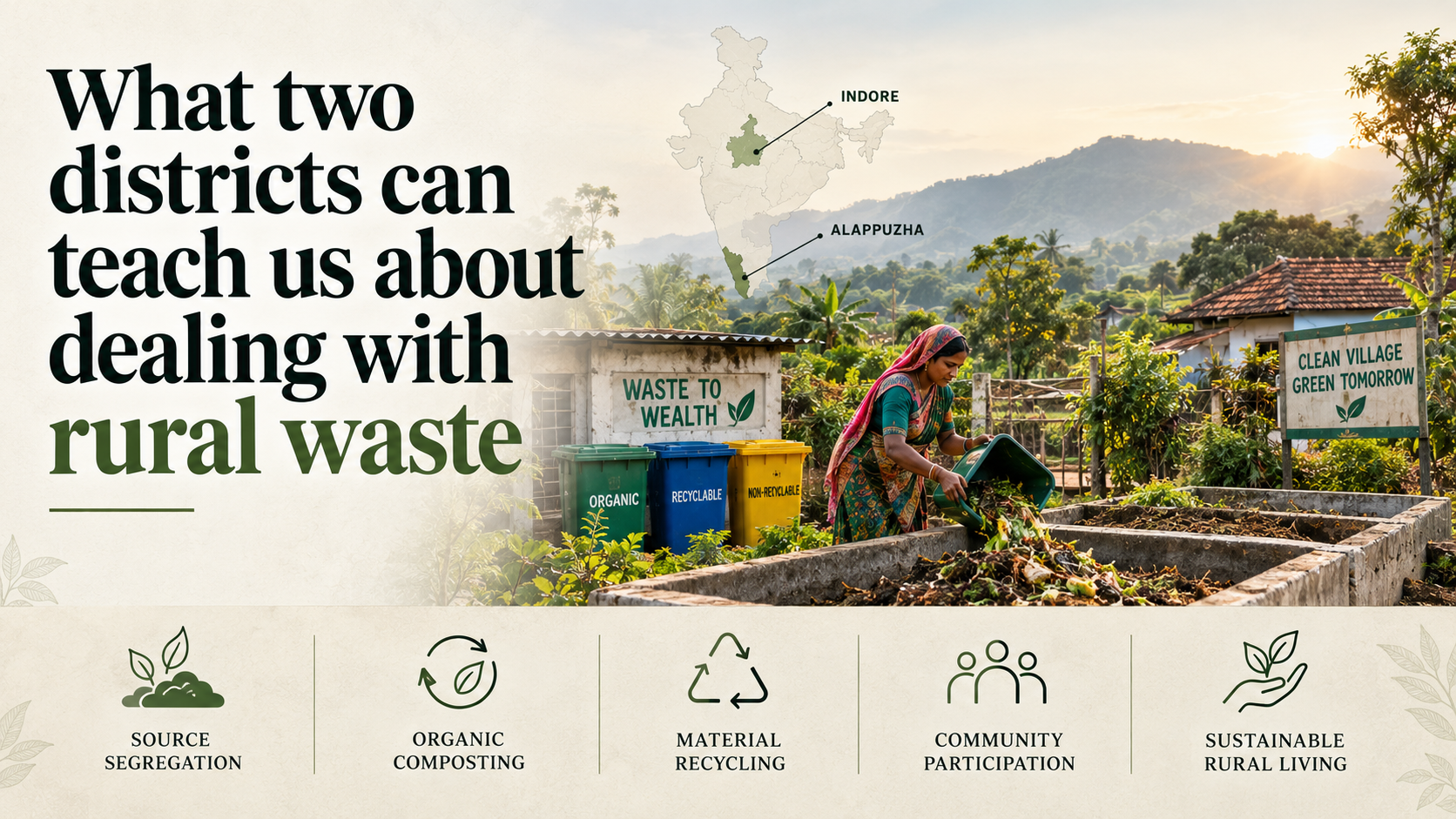
Why in the News
The Supreme Court has demanded functional waste regulators, exposing weak institutionalisation. While India generates 1.7 lakh tonnes daily, successful community systems in Majuli and Tawang show operational gaps, especially rurally.
Why does India’s waste system not see the countryside?
- Rural waste data are not collected: Waste data for rural areas do not exist, according to the Centre for Science and Environment (CSE), a New Delhi based research and advocacy body.
- The duty sits with bodies that do not discharge it: Urban and rural local bodies are tasked with solid waste management and with recording volumes and expenses, and they rarely do the needful.
- The gap is global and overwhelmingly rural: Around 2.7 billion people worldwide have no waste collection, and 2 billion of them live in rural areas, per an analysis by the United Nations Environment Programme (UNEP).
- Uncollected waste goes to land, water or fire: Where people cannot manage waste, they dump it on land or in rivers, streams and seas, or they burn it, which is a major concern in India.
Why has rural waste grown without collection following it?
- Rural spending has risen: Data show a rise in per capita spending in India’s rural areas, and more consumption produces more waste.
- Packaging reached the remotest markets: Food, beverages and personal care or hygiene products are almost all wrapped in plastics or multi layered packaging, and those goods have penetrated the remotest rural markets.
- Waste management did not follow the goods: Collection systems did not extend into those markets alongside the products that created the waste.
- Organic waste had a use and mixed waste does not: Organic waste fed livestock or served as manure for centuries, and plastics and other non-biodegradable materials have produced a mixed waste that is harder to decompose.
What did Majuli change after its facilities went unused?
- The sheds were built years before the system was: The Swachh Bharat Mission and the Public Health Engineering Department built Central Material Collection Facilities (CMCFs), the village level sheds where sorted waste is received and stored, in 19 of 20 panchayats between 2017 and 2022, along with mini collection facilities in most of the 160 villages.
- Neither the sheds nor the workers were put to use: The tin sheds went unused and the workers were not mobilised until the departments teamed up with the waste management non-profit Sahaas in 2024.
- The missing components were operational rather than physical: Funding, staffing and training of sanitation workers, vehicles for transport, operation of the collection facilities and buyers for the sorted material all had to be arranged.
- Participation was organised before collection began: Village leaders, homestay and hotel owners, schools and self-help groups (SHGs) ran awareness programmes and handed out bags for storage and segregation.
- Collection now runs in 19 of 20 panchayats: Garbage is now collected across them, in a district that faces flooding and erosion every year.
- Staffing remains thin against the population: Majuli’s 1.67 lakh people are served by 37 sanitation workers and 19 sorting staff.
- The fleet was funded only recently: The district departments purchased 21 e-vehicles and 15 tricycles and approved funds for the collection crew.
- The first river crossing was in April 2025: A tonne of waste left Majuli by boat across the Brahmaputra, the first time the island’s waste crossed the river instead of being dumped into it.
- The tonnage is now measurable: Majuli has collected 82.4 tonnes of waste since 2024, and it transferred 16.78 tonnes and earned Rs 1.47 lakh between April 2025 and May 2026.
How does Tawang collect waste without sanitation workers?
- Scattered settlements rule out door to door collection: Households in these land-locked mountain villages sit too far apart for a sanitation worker to cover on a route.
- The pilot began in one village in 2024: Local officials and village leaders piloted a community led model in Chullyu in Keyi Panyor district through the Himalayan Fringes Project of the Further and Beyond Foundation.
- It spread across three districts in two years: A third of Tawang district and parts of Keyi Panyor and Upper Siang districts have adopted the model.
- Households store their own waste: Every household segregates biodegradable from non-biodegradable waste and keeps it at home until the collection day.
- Collection is a monthly village event: Each village organises a Swachchata Divas, or Cleanliness Day, at a designated point where residents arrive with sacks and sort the waste into 22 categories.
- The volumes are recorded: 26 villages in the project have organised more than 150 Swachchata Divas and collected 30 tonnes of waste.
- Secondary sorting happens at recovery facilities: The waste moves to material recovery facilities (MRFs), the sites where it is received, sorted and processed, at Zemithang, Lumla and Daporijo, with smaller community run facilities at Chullyu and Gobuk.
- Sorting deepens to 35 categories there: 12 full time MRF operators and dozens of women from self-help groups perform that second sort.
- Sanitary waste is handled rather than dumped: Sanitary napkins and diapers are washed, dried and stored at the facilities, and more than 20 tonnes have been sold to recyclers for Rs 3.53 lakh.
- One residue stream found a local use: About two tonnes of multi layered plastics went to a processing plant at Lhou in Jang sub-division and were used to make paver blocks.
- The first consignment left on Independence Day 2024: Villagers from Zemithang Circle, settled between 6,900 and 8,000 feet, sent 4.4 tonnes of garbage on a 390 km lorry journey of over 12 hours to scrap dealers in Tezpur in Assam.
Who pays for rural collection, and who is accountable for it?
- Collection is the most expensive step in the chain: Crew wages, vehicle fuel and maintenance, insurance and other indirect costs make it the costliest link, per UNEP.
- Indian cities show the same cost structure: Primary collection and transportation account for the bulk of costs, per a CSE report on plastic waste management.
- Manpower dominates the rural cost: Nearly 50 per cent of the primary collection cost in rural Dharamshala was attributed to manpower.
- The Tawang model removes that cost line: Eliminating sanitation workers and door to door collection took the largest single expense out of the system.
- Households pay a monthly fee: Each household pays Rs 50 a month and shops and cafes pay Rs 100.
- Authority is vested in a village committee: A gaon bura, or village head, and a treasurer lead committees that draft waste management policies and set the rules, responsibilities and fines.
- A regional committee sits above them: Each region has a central committee chaired by a Circle Officer with a Lama, an influential religious leader, as secretary, and the committees meet every quarter.
- Financing remains the binding constraint: Money is the biggest problem in running such a system, per the officer who led the Zemithang effort.
Where does the chain still break?
- Distance sets the transport economics: Waste travels farther from rural areas to reach recyclers, which renders the task less attractive for scrap dealers.
- One truckload costs Rs 45,000: Sending a truckload from Arunachal Pradesh to Assam costs that much, and fuel and the driver still cost Rs 20,000 a trip after State officials donated a truck.
- Boat transfers proved too costly to repeat: Majuli made three transfers across the Brahmaputra and now sells to local scrap dealers as well.
- Two streams have no buyer at all: Black polythene and textile scrap have found no takers.
- Storage is filling faster than offtake: Many CMCFs are filling up quickly, and rural collection facilities are commonly found full of baled waste with few takers.
- Processing capacity sits idle: Majuli’s long defunct plastics management facility is undergoing repairs.
- Segregation compliance is not universal: About 30 households in every 100 still hand over mixed waste.
Challenges to rural solid waste management
- Panchayats have no funded sanitation establishment: A rural local body carries the duty without a permanent staffing line or a recurring budget head for waste, so the work depends on scheme money and an outside partner. Eg. Solid and liquid waste management money for gram panchayats arrives through Swachh Bharat Mission Grameen allocations and tied Fifteenth Finance Commission grants rather than through an own-source revenue stream.
The Fix: Make a collected user fee a mandatory own-source revenue head for the panchayat, and release the matching grant only against fee actually collected. - Legacy rural dumps are not inventoried: Remediation and bio-mining targets are written for urban dumpsites, so village dumps sit outside any list anyone is accountable for clearing. Eg. Dumpsite remediation targets under the second phase of the Swachh Bharat Mission are set for urban local bodies.
The Fix: Require every gram panchayat development plan to carry a mapped inventory of existing dump points with a dated clearance commitment. - Producer responsibility is verified on paper: A packaging producer discharges its obligation by buying a recycling certificate, and the certificate is easier to obtain than the collection is to perform. Eg. The CPCB has cancelled extended producer responsibility certificates issued by recyclers whose claimed processing capacity could not be verified.
The Fix: Tie certificate issue to plant level input and output data reported from the processor’s own weighbridge. - Rural sanitation work carries no protection: Workers handle mixed waste, including sanitary and medical items, without the equipment, registration or insurance that municipal employment carries. Eg. Rural collection crews are engaged on scheme funds rather than on a municipal payroll, which leaves them outside standing occupational safety obligations.
The Fix: Register every rural sanitation worker on a State database and make supply of protective equipment a condition of releasing collection funds. - Reported waste figures have no verification layer: Where a local body does report a number, no independent audit checks it against what a facility actually received. Eg. Swachh Survekshan Grameen scoring rests substantially on self-declared and observation based inputs rather than on weighed tonnage.
The Fix: Make weighbridge or facility receipt records the reporting unit, and publish district level tonnage every month.
Conclusion
Rural India’s waste challenge is fundamentally an operational gap, not an infrastructure gap. Majuli and Tawang show that community-led collection can work, but sustained funding, accountable institutions, worker protection and reliable recycling markets are essential for a truly circular rural waste system.
Back2Basics: Solid Waste Management Rules, 2016
- Legal basis: Notified by the Union Ministry of Environment, Forest and Climate Change under the Environment (Protection) Act, 1986, replacing the Municipal Solid Wastes (Management and Handling) Rules, 2000.
- Coverage beyond municipalities: They extend to census towns, notified industrial townships, and areas under railways, airports, defence establishments, special economic zones and places of pilgrimage.
- Source segregation is mandatory: A waste generator must separate waste into wet, dry and domestic hazardous streams and hand it to an authorised collector.
- Producers carry a post-consumer duty: Brand owners and manufacturers of non-biodegradable packaging must arrange to collect that packaging back from the market.
[2019] As per the Solid Waste Management Rules, 2016 in India, which one of the following statements is correct?
(a) Waste generator has to segregate waste into five categories.
(b) The Rules are applicable to riotified urban local bodies, notified towns and all industrial townships only.
(c) The Rules provide for exact and elaborate criteria for the identification of sites for landfills and waste processing facilities.
(d) It is mandatory on the part of waste generator that the waste generated in one district cannot be moved to another district.
