💥Join UPSC 2027,2028 Mentorship (July Batch) + XFactor Notes & Microthemes PDF

GS Paper: GS2-19.Effect of policies and politics of developed and developing countries on India’s interests, Indian diaspora.

  • US investigation into India’s Digital Services Tax (DST)

    The US government has announced the further suspension of punitive tariffs for six months on India, Austria, Italy, Spain, Turkey, and the UK while it continues to resolve the DST investigation amid the ongoing multilateral negotiations at the OECD and the G20.

    Do you remember?

    GAFA tax—named after Google, Apple, Facebook, Amazon—is a proposed digital tax to be levied on large technology and internet companies.

    What are the Digital Services Taxes in India?

    • The NDA government had moved an amendment in the Finance Bill 2020-21 imposing a 2 percent digital service tax on trade and services by non-resident e-commerce operators with a turnover of over Rs 2 crore.
    • The new levy has expanded the ambit of the equalization levy for non-resident e-commerce operators involved in the supply of services, including the online sale of goods and provision of services.
    • E-commerce operators are obligated to pay the tax at the end of each quarter.
    • Estimates by the USTR indicate that the value of the DST payable by US-based company groups to India will be up to approximately $55 million per year.

    Also read:

    What are Digital Services Taxes?

    What is the story?

    • The US is focused on finding a multilateral solution to a range of key issues related to international taxation, including our concerns with digital services taxes.
    • It is trying to reaching a consensus on international tax issues through the OECD and G20 processes.

    Investigation regarding DST

    • The US has conducted a year-long investigation into digital services taxes imposed by countries, stating that they are against tech companies like Apple, Amazon, Google, and Facebook.
    • It had determined that the digital services taxes adopted by Austria, India, Italy, Spain, Turkey, and the UK has discriminated against US digital companies and were inconsistent with principles of international taxation, and burdened US companies.

    What’s the case against India?

    • In the case of India, the USTR’s proposed course of action includes additional tariffs of up to 25 percent ad valorem on an aggregate level of trade.
    • Around 26 categories of goods are in the preliminary list of products that would be subject to the additional tariffs.
    • This includes shrimps, basmati rice, cigarette paper, cultured pearls, semi-precious stones, silver powder and silver articles of jewelry, gold mixed link necklaces, and neck chains, and certain furniture of bentwood.

    Why does India need DST?

    • The agenda to reform international tax law so that digital companies are taxed where economic activities are carried is still a work in progress.
    • Due to this, countries are worried that they might cede their right to tax incomes. Therefore, many countries have either proposed or implemented a digital services tax.
    • The proliferation of digital service taxes (DSTs) is a symptom of the changing international economic order.
    • Countries such as India which provides large markets for digital corporations seek a greater right to tax incomes.
    • The taxation of the digitalized economy turned out to be a relatively contentious issue because there is a huge asymmetry in digital service providers and consumers.
  • Israel and Palestine could take a leaf out of India’s book

    The article suggest the Indian model for peaceful coexistence as a possible solution to Israel-Palestine conflict.

    Brief history of the conflict

    • Britain renounced its Mandate over Palestine in 1948.
    • This paved the way for the United Nations to divide Palestine between the Jews and Arabs, giving them about 55% and 45% of the land, respectively.
    • The Jews, meanwhile, had declared the establishment of the state of Israel for which they had been working for long.
    • The Palestinians, who lacked the resources to conceive of a state, failed to form a state of their own in the land allotted to them.
    • Instead, a coalition of Arab countries invaded the nascent state of Israel to nip it in the bud.
    • Israel defeated the Arab armies.
    • Israel also destroyed about 600 Palestinian villages and expelled about 80% of Arabs from its territory.
    • In 1967, in the Six-Day War, Israel captured not just more Palestinian land but also Egypt’s Sinai Peninsula and Syria’s Golan Heights.
    • During the Yom Kippur War of 1973, the Arabs came to realise that Israel is here to stay.

    Need for realisation on both the sides

    • The Arab states failed to impress the realisation of permanency of Israel upon their Palestinian brethren, a sizeable number of whom remain committed to seeking a solution through counter-violence. 
    • Vicious cycle of violence is not going to end unless there is realism on both sides.
    • The Hamas should know that Israel will not give up on holding on to land it has held for years.
    • Israel should understand that total subjugation, expulsion or even decimation of Palestinians will not make it any safer.
    • A solution based on the common humanity of all stakeholders, one that is not riven by racial and religious schisms, needs to be explored.

    Viability of Indian model

    • The Indian model of democracy and secularism, which accommodates religious, ethnic, linguistic and other diversities, could be a viable model for the peaceful coexistence of formerly antagonistic groups.
    •  India evolved a unique model of accommodating the victors and the vanquished, without ever resorting to the latter’s decimation.
    • A modus vivendi has to evolve on the basis of hard realities, the first of which is that neither the Jews nor the Palestinians are going to vanish.
    • If the two-state solution is nowhere in the offing, a single state after the Indian model, i.e., a secular, democratic and pluralistic state, may be the only feasible option.
    • The Palestinian refugees have a right to return.
    • That the altered demographics would impinge on the religio-racial character of Israel is not an argument which behoves a modern democratic state.
    • It is true that a nation state belongs to the group which constituted itself into a nation.
    • A nation is an imagined community.
    • As imagination expands, the foundations of the nation become deeper.

    Consider the question “In the absence of two-state solution to the Israel-Palestine conflict, what lessons India could offer to the two parties for peaceful coexistence?”

    Conclusion

    Israel might not offer the right model of conflict resolution for India, but India presents a model of peaceful coexistence for Israel.

  • UAE’s Golden Visa Scheme

    A Bollywood actor has recently received a golden visa from the UAE government.

    What is the Golden Visa?

    • The Golden Visa system essentially offers long-term residency (5 and 10 years) to people belonging to the following groups: investors, entrepreneurs, individuals with outstanding talents the likes of researchers, medical professionals and those within the scientific and knowledge fields, and remarkable students.
    • The main benefit of the visa will be security.
    • The UAE government has made it clear that they are committed to providing expatriates, investors and essentially everyone looking to make the UAE their home an extra reason to feel secure about their future.

    Who are eligible to apply?

    • For the 10-year visa, investors having no less than AED (Dirham) 10 million worth of public investment, either in the form of an investment fund or a company, can apply.
    • However, at least 60 per cent of the total investment must not be in the form of real estate and the invested amount must not be loaned, or in case of assets, investors must assume full ownership.
    • The investor must be able to retain the investment for a minimum of three years as well.
    • The long-term visa can also include the holder’s spouse and children, as well as one executive director and one advisor.
    • In addition to the aforementioned, foreign nationals who are looking to set up their business in the UAE may also apply for permanent residency (5 years) through the Golden Business Visa scheme.

    Perks for the talent

    • Besides entrepreneurs, individuals with specialized talent can also apply for the visa. They include doctors, researchers, scientists, investors and artists.
    • These individuals may be granted a 10-year visa following accreditations granted by their respective departments and fields and the visa will also be extended to their spouses and children.
    • Exceptional high school and university students are eligible for a 5-year residency visa in the UAE.
  • Israel-Palestine conflict explained

    Context

    The Israeli–Palestinian conflict is one of the world’s most enduring hostilities, with the Israeli occupation of the West Bank and the Gaza Strip reaching 53 years. Various attempts have been made to resolve the conflict as part of the Israeli–Palestinian peace process.

    British Palestine & Jew Migration

    • The British, after the First World War, established a colony in Palestine maintaining that they would rule the area until the Palestinians were ready to govern themselves. This was called Mandatory Palestine as it was according to the League of Nations mandate.
    • Even before this time, there was a massive influx of Jews from Europe into Palestine in the hope of creating their homeland after being expelled from it for centuries.
    • Meanwhile, in the 1920s and 1930s, the Jewish population in Palestine increased by hundreds of thousands, facilitated by the British (who were honouring the Balfour Declaration).
    • During this time, tensions between the growing Jewish communities and the Arabs were increasing.
    • In 1936, the Palestinian Arabs revolted against the British as a result of the Palestinian Arabs viewing themselves increasingly as a nation.
    • This revolt was suppressed by the British with help from Jewish militias.
    • After the revolt, however, the British issued a white paper that limited Jewish immigration into Palestine and called for the establishment of a joint Jewish-Arab state in Palestine within ten years.
    • During the course of World War II, many Jews escaping Europe from the Holocaust were brought to Palestine illegally (because of the immigration limit) by Jewish organisations.
      Tensions escalated and the British handed over the problem to the newly established United Nations.
    • In 1947, the UN voted to establish separate Palestinian and Jewish states in the region dividing Palestine. This plan was rejected by the Arabs.

    Background of the Israel Palestine conflict

    Following the Declaration of the Establishment of the State of Israel on 14 May 1948, the Arab League decided to intervene on behalf of Palestinian Arabs, marching their forces into former British Palestine, beginning the main phase of the 1948 Arab–Israeli War.

    1948 Arab Israel War

    • The overall fighting, leading to around 15,000 casualties, resulted in cease-fire and armistice agreements of 1949, with Israel holding much of the former Mandate territory, Jordan occupying and later annexing the West Bank and Egypt taking over the Gaza Strip, where the All-Palestine Government was declared by the Arab League on 22 September 1948.
    • Through the 1950s, Jordan and Egypt supported the Palestinian Fedayeen militants’ cross-border attacks into Israel, while Israel carried out reprisal operations in the host countries.
    • Over the following years, tensions rose in the region, particularly between Israel and Egypt, Jordan, and Syria. Following the 1956 Suez Crisis and Israel’s invasion of the Sinai Peninsula, Egypt, Jordan, and Syria signed mutual defense pacts in anticipation of a possible mobilization of Israel troops.
    • The 1956 Suez Crisis resulted in a short-term Israeli occupation of the Gaza Strip and exile of the All-Palestine Government, which was later restored with Israeli withdrawal.
    • The All-Palestine Government was completely abandoned by Egypt in 1959 and was officially merged into the United Arab Republic, to the detriment of the Palestinian national movement. Gaza Strip then was put under the authority of the Egyptian military administrator, making it a de facto military occupation.
    • In 1964, however, a new organization, the Palestine Liberation Organization (PLO), was established by Yasser Arafat.[29] It immediately won the support of most Arab League governments and was granted a seat in the Arab League.

    1967 Six day War

    • The 1967 Six-Day War exerted a significant effect upon Palestinian nationalism, as Israel gained military control of the West Bank from Jordan and the Gaza Strip from Egypt.
    • The PLO was unable to establish any control on the ground and established its headquarters in Jordan, home to hundreds of thousands of Palestinians, and supported the Jordanian army during the War of Attrition, which included the Battle of Karameh.
    • However, the Palestinian base in Jordan collapsed with the Jordanian–Palestinian civil war in 1970. The PLO defeat by the Jordanians caused most of the Palestinian militants to relocate to South Lebanon, where they soon took over large areas, creating the so-called “Fatahland”.

    Camp David Accords 1978

    1)  The Camp David Accords were a pair of political agreements signed by Egyptian President Anwar Sadat and Israeli Prime Minister Menachem Begin on 17 September 1978.

    2)  The Camp David Accords established the so framework for peace in the Middle East and brought about the end of simmering conflict between Egypt and Israel.

    3)  They also called for the creation of Palestinian state in the area known as Gaza and on the West Bank of river Jordan.

    4)  However since the Palestinians were not represented at the talks, the resulting agreement was not formally recognized by the United Nations.

    • In 1982, following an assassination attempt on one of its diplomats by Palestinians, the Israeli government decided to take sides in the Lebanese Civil War and the 1982 Lebanon War commenced. The initial results for Israel were successful. Most Palestinian militants were defeated within several weeks, Beirut was captured, and the PLO headquarters were evacuated to Tunisia in June by Yasser Arafat’s decision.
    • First Intifada: The tension between Israel and Palestine escalated with Israel’s increased settlement in West Bank and Gaza Strip. Palestinians living in the West Bank and the Gaza Strip fomented the riots begun in 1987, known as the first intifada.
    • Second Intifada (2000-05): In 2000, a more violent Palestine Uprising started and a large number of civilians died on both sides. This is known as the second intifada. As a defensive measure, Israel constructed a West Bank Barrier along West Bank to separate Israel and Palestine settlements.

    Road Map for Peace

    • 1993 OSLO Accord: The Oslo Accords are a pair of peace agreements between the     Government of Israel and the Palestine Liberation Organization (PLO

    1) Oslo 1 Accord: It was officially called the Declaration of Principles on Interim Self-Government Arrangements. It was signed in Washington, D.C., in 1993.

    • The accords called for the withdrawal of Israeli forces from parts of the Gaza Strip and West Bank, and affirmed a Palestinian right of self-government within those areas through the creation of a Palestinian Interim Self-Government Authority.
    • Palestinian rule was to last for a five-year interim period during which “permanent status negotiations” would commence in order to reach a final agreement.
    • Israel was to grant interim self-government to the Palestinians in phases.
    • Along with the principles, the two groups signed Letters of Mutual Recognition—the Israeli government recognized the PLO as the legitimate representative of the Palestinian people, while the PLO recognized the right of the state of Israel to exist and renounced terrorism as well as other violence, and its desire for the destruction of the Israeli state.
    • In order that the Palestinians govern themselves according to democratic principles, free and general political elections would be held for the council.
    • Jurisdiction of the Palestinian Council would cover the West Bank and Gaza Strip, except for issues that would be finalized in the permanent status negotiations. The two sides viewed the West Bank and Gaza as a single territorial unit.
    • The five-year transitional period would commence with Israeli withdrawal from the Gaza Strip and Jericho area. There would be a transfer of authority from the Israel Defense Forces to the authorized Palestinians, concerning education and culture, health, social welfare, direct taxation, and tourism. The council would establish a strong police force, while Israel would continue to carry the responsibility for defending against external threats.

    2) Oslo 2 Accord: It was called The Interim Agreement on the             West Bank and the Gaza Strip and was signed on the 28th    September, 1995 in Taba (Egypt).

    • Oslo I also set the agenda for the follow-up agreement that became known as Oslo II, which would include discussion of the future governance of the city of Jerusalem (both sides claim it as their respective capital) as well as issues concerning borders, security and the rights, if any, of Israeli settlers in the West Bank.
    • A protocol for free elections for Palestinian Authority leadership was also established.
    • Oslo II, which was signed two years later, gave the Palestinian Authority, which oversees Gaza and the West Bank, limited control over part of the region, while allowing Israel to annex much of the West Bank, and established parameters for economic and political cooperation between the two sides.
    • As part of the treaty, both sides were prohibited from inciting violence or conflict against the other.
    • Israel was to collects taxes from Palestinians who work in Israel but live in the Occupied Territories, distributing the revenue to the Palestinian Authority.
    • Israel was also to oversee the trade of goods and services into and out of Gaza and the West Bank.

    3) Aftermath of the Oslo Accords

    • Unfortunately, any momentum gained from the ratification of the Oslo Accords was short-lived.
    • In 1998, Palestinian officials accused Israel of not following through on the troop withdrawals from Gaza and Hebron called for in the Oslo Accords.
    • After initially slowing down settlement construction in the West Bank, at the request of the United States, the building of new Israeli housing in the region began in earnest again in the early 2000s.
    • Conversely, critics of the Accords said that Palestinian violence against Israeli citizens increased in their aftermath, coinciding with the increasing power of the Palestinian Authority.
    • These critics felt that the Palestinian Authority was failing to adequately police Gaza and the West Bank, and identify and prosecute suspected terrorists.
    • With these disagreements providing the backdrop, negotiators from both sides reconvened, once again at Camp David, with the hope of following up on the Oslo Accords with a comprehensive peace treaty.
    • In September 2000, Palestinian militants declared a “Second Intifada,” calling for increased violence against Israelis after Sharon, who as prime minister visited the Temple Mount—a site sacred to both Jews and Muslims.

    Camp David Accord 2000

    • The 2000 Camp David Summit was a summit meeting at Camp David between United States president Bill Clinton, Israeli prime minister Ehud Barak and Palestinian Authority chairman Yasser Arafat. The summit took place between 11 and 25 July 2000.
    • Barak put forward the following as “bases for negotiation”, a non-militarized Palestinian state split into 3–4 parts containing 87–92% of the West Bank including only parts of East Jerusalem, and the entire Gaza Strip.
    • The offer also included that 69 Jewish settlements (which comprise 85% of the West Bank’s Jewish settlers) would be ceded to Israel, no right of return to Israel, no sovereignty over the Temple Mount or any core East Jerusalem neighbourhoods, and continued Israel control over the Jordan Valley.
    • Arafat rejected this offer. According to the Palestinian negotiators the offer did not remove many of the elements of the Israeli occupation regarding land, security, settlements, and Jerusalem.

    Taba Summit (2001)

    • The Israeli negotiation team presented a new map at the Taba Summit in Taba, Egypt in January 2001. The proposition removed the “temporarily Israeli controlled” areas, and the Palestinian side accepted this as a basis for further negotiation.
    • The sides declare that they have never been closer to reaching an agreement and it is thus our shared belief that the remaining gaps could be bridged with the resumption of negotiations following the Israeli elections.
    • The following month the Likud party candidate Ariel Sharon defeated Ehud Barak in the Israeli elections and was elected as Israeli prime minister on 7 February 2001. Sharon’s new government chose not to resume the high-level talks.

    Arab Peace Initiative

    • The Arab Peace Initiative was first proposed by Crown Prince Abdullah of Saudi Arabia at the Beirut Summit (2002). The peace initiative is a proposed solution to the Arab–Israeli conflict as a whole, and the Israeli–Palestinian conflict in particular.
    • The initiative was initially published on 28 March 2002, at the Beirut Summit, and agreed upon again in 2007 in the Riyadh Summit.
    • Unlike the Road Map for Peace, it spelled out “final-solution” borders based explicitly on the UN borders established before the 1967 Six-Day War. It offered full normalization of relations with Israel, in exchange for the withdrawal of its forces from all the occupied territories, including the Golan Heights, to recognize “an independent Palestinian state with East Jerusalem as its capital” in the West Bank and Gaza Strip, as well as a “just solution” for the Palestinian refugees.
    • The Israeli government has expressed reservations on ‘red line,’ issues such as the Palestinian refugee problem, homeland security concerns, and the nature of Jerusalem.

    What led to Recent Crash

    •  In October 2020, an Israeli court ruled that several Palestinian families living in Sheikh Jarrah—a neighborhood in East Jerusalem—were to be evicted by May 2021 with their land handed over to Jewish families.
    • In February 2021, several Palestinian families from Sheikh Jarrah filed an appeal to the court ruling and prompted protests around the appeal hearings, the ongoing legal battle around property ownership, and demanding an end to the forcible displacement of Palestinians from their homes in Jerusalem.
    • In late April 2021, Palestinians began demonstrating in the streets of Jerusalem to protest the pending evictions and residents of Sheikh Jarrah—along with other activists—began to host nightly sit-ins.  In early May, after a court ruled in favor of the evictions, the protests expanded with Israeli police deploying force against demonstrators.
    • On May 7, following weeks of daily demonstrations and rising tensions between protesters, Israeli settlers, and police during the month of Ramadan, violence broke out at the al-Aqsa Mosque compound in Jerusalem, with Israeli police using stun grenades, rubber bullets, and water cannons in a clash with protestors that left hundreds of Palestinians wounded.
    • On May 10, after several consecutive days of violence throughout Jerusalem and the use of lethal and nonlethal force by Israeli police, Hamas, the militant group which governs Gaza, and other Palestinian militant groups launched hundreds of rockets into Israeli territory.
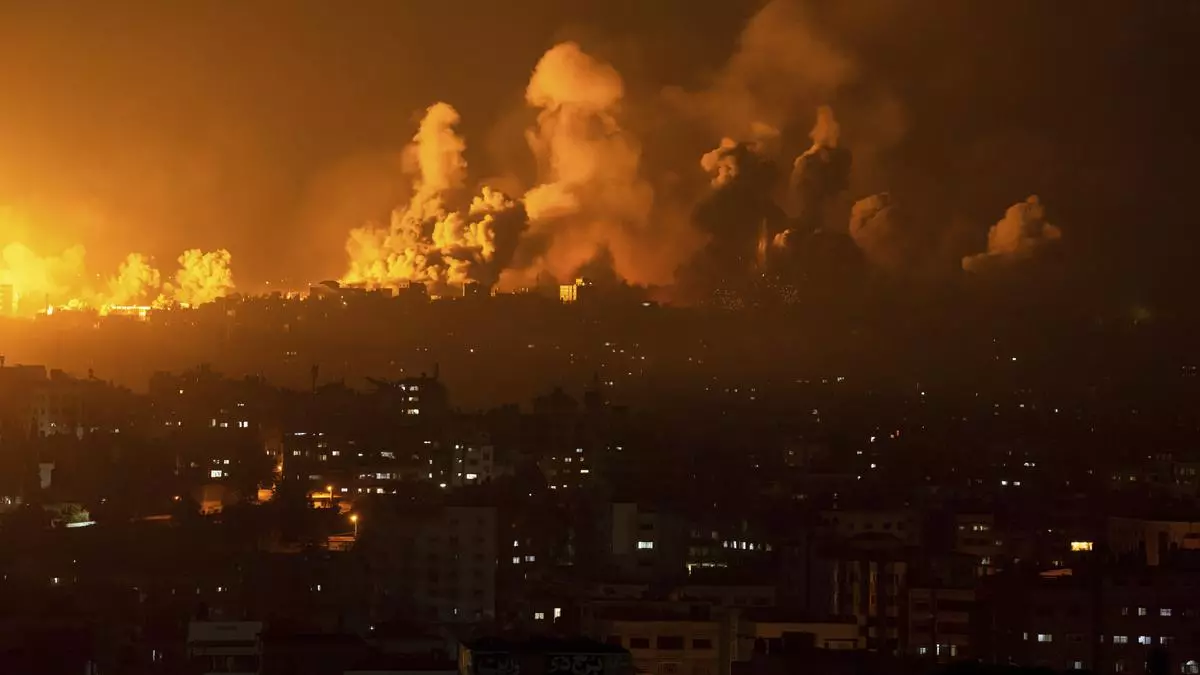
    • Israel responded with air strikes and later artillery bombardments against targets in Gaza, including launching several air strikes that killed more than twenty Palestinians. While claiming to target Hamas, other militants, and their infrastructure—including tunnels and rocket launchers—Israel has expanded its aerial campaign and struck targets including residential buildings, media headquarters, and refugee and healthcare facilities.

    Rival claims over Jerusalem

    • Both Israel and Palestine have declared Jerusalem their capital.
    • In July 1980, the Israeli Parliament passed the Jerusalem Law declaring it the country’s capital.
    • Palestinians declared Jerusalem the capital of the putative state of Palestine by a law passed by the Palestinian Authority in 2000.
    • The 1988 Palestinian Declaration of Independence also declared Jerusalem as the capital.
    • For the present, the Palestinian Authority has its headquarters in Ramallah.

    Hamas and Fatah

    • In 1987, Hamas (Islamic Militant group) for the liberation of Palestine through Jihad came into existence. It refused to recognize Israel as a country. It has received support from Iran and Syria.
    • On the other hand, Fatah, a faction of PLO under Yasser Arafat received support from Western nations.

    (Palestinians run for cover from tear gas during clashes with Israeli security forces near the border between Israel and the Gaza)

    What is happening in GAZA

    • Gaza is a densely populated strip of land that is mostly surrounded by Israel and peopled almost exclusively by Palestinians. Israel used to have a military presence, but withdrew unilaterally in 2005. It’s currently under Israeli blockade.
    • Egypt controlled Gaza until 1967, when Israel occupied it (along with the West Bank) in the Six-Day War.
    • Until 2005, Israeli military authorities controlled Gaza in the same way they control the West Bank, and Jews were permitted to settle there. In 2005, then–Israeli Prime Minister Ariel Sharon pulled out Israeli troops and settlers unilaterally.
    • Gaza is governed by the Islamist group Hamas, which formed in 1987 as a militant “resistance” group against Israel and won political power in a 2006 US-based election.
    • Hamas’s takeover of Gaza prompted an Israeli blockade of the flow of commercial goods into Gaza, on the grounds that Hamas could use those goods to make weapons to be used against Israel.
    • Israel has eased the blockade over time, but the cutoff of basic supplies like fuel still does significant humanitarian harm by cutting off access to electricity, food, and medicine.
    • Hamas and other Gaza-based militants have fired thousands of rockets from the territory at Israeli targets.
    • Israel has launched a number of military operations in Gaza, including an air campaign and ground invasion in late 2008 and early 2009, a major bombing campaign in 2012, and another air/ground assault in the summer of 2014.

    International Scenario

    Stand of USA

    • For decades, the U.S. has played a partisan role in the Israeli-Palestinian conflict.
    • It became involved shortly after World War II, joining the United Kingdom in a 1946 inquiry that recommended one hundred thousand Holocaust survivors relocate to Palestine, which would be neither a Jewish nor an Arab state.
    • The United States then became the first country to recognize Israel as a sovereign nation in 1948.
    • Shortly after the 1967 war, Israel began building settlements in some of the territories it had seized. For years, the United States officially condemned these settlements—branding them an obstacle to peace—but avoided outright calling them illegal to avoid the possibility that Israel would face international sanctions.
    • After the failed 2000 Camp David summit, Washington never made any meaningful attempt to push the Israelis to accept the two-state proposal.
    • The 2007 Annapolis conference was a failure too. The previous U.S. administration launched a peace bid which also collapsed at an early stage.
    • In 2018, the Trump administration canceled funding for the UN Relief and Works Agency, which provides aid to Palestinian refugees, and relocated the U.S. embassy from Tel Aviv to Jerusalem, a reversal of a longstanding U.S. policy.  The decision to move the U.S. embassy was met with applause from the Israeli leadership but was condemned by Palestinian leaders and others in the Middle East and Europe.
    • Biden has said he will continue the nearly two decades of , which calls for separate Israeli and Palestinian states with borders resembling those that existed before the 1967 war; this territory includes the Gaza Strip, the West Bank, and parts of East Jerusalem.

    Stand of Arab Countries

    a)   EGYPT

    • Egypt wants a unified Palestinian leadership. Therefore, it invests a lot in supporting a Palestinian reconciliation.
    • Egypt wants Gaza, the branches of Hamas and Fatah in Gaza, and other forces in Gaza, to have a bigger say in the Palestinian decision-making process.
    • Egypt wants to eradicate terror cells in Sinai.
    • Egypt wants Hamas to be less dependent (at least) on Iran, Turkey and Qatar. The Saudis and the Emiratis concur, and they can fund Gaza.

    b) Turkey

    • In December 1987, Turkey had already declared support for the Palestinians’ right to self-determination.  It described Israeli policy in the Gaza Strip as “state-sponsored terrorism”
    • The Turkish government’s condemnation of the 2008–2009 Israel–Gaza conflict strained relations between the two countries.

    c) Syria

    • Syria announced its complete support to Palestine after the 1948 Arab–Israeli War broke out, and had sent troops to fight against newly-formed Israel Defense Forces
    • Syria also joined the Six-Day War hoping to expel Israeli Army in order to restore Palestinian state, in which ended with a complete failure.

    d)  Lebanon

    • Lebanon did take a formal part in the 1948 Arab-Israeli War against Israel, but Lebanon was the first Arab league nation to signal a desire for an armistice treaty with Israel in 1949.
    • Israel also supported the secessionist Free Lebanon State during 1979-1984 and its successor South Lebanon Army.
    • In all Lebanon has maintained a pro Israeli stance.

    e)   Jordan

    • Jordan was not a member of the United Nations when the vote on the United Nations Partition Plan for Palestine was taken in November 1947, but following the establishment of the state of Israel on 14 May 1948, Jordan, then known as Transjordan, was one of the Arab League countries that invaded the former Palestinian Mandate territory precipitating the 1948 Arab–Israeli War.
    • By war’s end, Jordan was in control of the West Bank and East Jerusalem (including the Old City). It expelled its Jewish population, and formally annexed the territories in 1950.
    • Promoting peace between Israel and the Palestinian Authority is a major priority for Jordan. It supports U.S. efforts to mediate a final settlement, which it believes should be based on the 2002 Arab Peace Initiative, proposed by Saudi Arabia.

    f)    Saudi Arabia

    • Israel and Saudi Arabia do not have any official diplomatic relations.
    • Saudi Arabia played an active role in attempting to bring the Palestinians towards a self-governing condition which would permit negotiations with Israel. It has done so primarily by trying to mend the schism between Fatah and Hamas, most notably when King Abdullah invited the two factions to negotiations in Mecca resulting in the Mecca Agreement of 7 February 2007. The agreement soon failed, but Saudi Arabia has continued to support a national unity government for the Palestinians, and strongly opposed the war in Gaza in early 2009.

    3)   Stand of India

    • India was one of the few countries to oppose the UN’s partition plan in November 1947, echoing its own experience during independence a Few Months Earlier.
    • In the decades that followed, the Indian political leadership actively supported the Palestinian cause and withheld full diplomatic relations with Israel.
    • India recognised Israel in 1950 but it is also the first non-Arab country to recognise Palestine Liberation Organisation (PLO) as the sole representative of the Palestinian. India is also one of the first countries to recognise the statehood of Palestine in 1988.
    • In 2014, India favoured UNHRC’s resolution to probe Israel’s human rights violations in Gaza. Despite supporting the probe, India abstained from voting against Israel in UNHRC IN 2015.
    • As a part of Link West Policy, India has de-hyphenated its relationship with Israel and Palestine in 2018 to treat both the countries mutually independent and exclusive.
    • In June 2019, India voted in favour of a decision introduced by Israel in the UN Economic and Social Council (ECOSOC) that objected to granting consultative status to a Palestinian non-governmental organization

    Way Forward

    • Though not a shining example, Israel can learn a lesson from its neighbour, Lebanon. The sectarian model of power sharing, where Christians, Shias, Sunnis, Druze, Armenians etc. are offered government positions demographically, did help enable Lebanon transition to some degree of stability after the civil war ended in 1990.
    • There must be change in leadership in both the countries. Leaders are that are ready mentally and physically for a truce must be brought to power.

    To start a peace process following steps must be taken:

    • Israel must  end settlement expansion beyond the wall.
    • Easing restrictions on Gaza
    • Redesignating parts of the West Bank currently falling under full Israeli administration (Area C) as areas that fall under partial or full Palestinian administration (Areas B or A)
    • Removing impediments to Palestinian economic development
    • Ending home demolitions and other forms of collective punishment
    • Removing impediments to Palestinian elections in East Jerusalem, the West Bank and Gaza
    • Alleviating restrictions on movement and access
    • Gradually releasing Palestinian prisoners
    • Allowing the reopening of Palestinian institutions, such as the Orient House, in East Jerusalem

  • Places in news: Paracel Islands

    A United States warship sailed through the Paracel Islands in the disputed South China Sea.

    Paracel Islands

    • The Paracel Islands, also known as the Xisha Islands are a disputed archipelago in the South China Sea.
    • The archipelago includes about 130 small coral islands and reefs, most grouped into the northeast Amphitrite Group or the western Crescent Group.
    • They are distributed over a maritime area of around 15,000 square kilometers with a land area of approximately 7.75 square kilometers.
    • The archipelago includes Dragon Hole, the deepest underwater sinkhole in the world.
    • It is surrounded by productive fishing grounds and a seabed with potential, but as yet unexplored, oil and gas reserves.
  • Russia’s Nord Stream 2 Pipeline

    The US government has decided to waive sanctions on the company behind Russia’s Nord Stream 2 pipeline to Europe.

    Nord Stream 2 Pipeline

    • It is a system of offshore natural gas pipelines running under the Baltic Sea from Russia to Germany.
    • It includes two active pipelines running from Vyborg to Lubmin near Greifswald forming the original Nord Stream, and two further pipelines under construction running from Ust-Luga to Lubmin termed Nord Stream 2.
    • In Lubmin the lines connect to the OPAL line to Olbernhau on the Czech border and to the NEL line to Rehden near Bremen.
    • The first line Nord Stream-1 was laid and inaugurated in 2011 and the second line in 2012.
    • At 1,222 km in length, Nord Stream is the longest sub-sea pipeline in the world, surpassing the Langeled pipeline.

    US sanctions

    • Nord Stream projects have been opposed by the United States as well as by several Central and Eastern European countries because of concerns that the pipelines would increase Russia’s influence in the region.
    • The US resistance to Nord Stream 2 is also influenced by the country’s increased production of natural gas, which gives the US economic incentive to resist the Russian supply of gas to the EU, in favour of US shale gas.
  • The world cannot ignore the Palestinian question

    The article discusses the types of response the recent violence in the Israel-Palestine conflict would invoke across the world and also explains the perils of ignoring the conflict.

    Three types of responses

    • The deadly riots in Israel and the war in Gaza, is likely to evoke three kinds of responses: The indifferent, the imperial, the humanitarian.

    1) Moral indifference

    •  Instead of becoming the symbol of the unfinished tasks of decolonisation, and a human rights catastrophe, the Palestinian question is now mostly an occasion to vent cynicism.
    • The moral questions the oppression of Palestinians poses is avoided by claiming that in this conflict we can assigning rights and wrongs equally to both sides.
    • There is the spectacle of civilians on both sides living in terror.
    • There is the fanaticism of the right-wing in Israel and there is the fanaticism of Hamas and Fatah.
    • Blaming both sides also whitewashes the fact that there is a monumental injustice to the Palestinians at the heart of the problem.

    2) The imperial response

    • The events leading up to the recent clashes at the Al-Aqsa Mosque can be seen as part of a long pattern of pushing out Palestinians from territory Israel wants to claim.
    • American administration has not been able to significantly roll back this project of pushing the Palestinians out.
    • Palestine will once again be the site where the Biden administration’s liberal internationalism will face challenge.

    3) Humanitarian response

    • This third response is to dig beneath the politics and find bridges in shared humanity and suffering.
    • This is also the tack of the peace movements that use culture and a history of shared suffering to build bridges.
    •  They emphasise that dispossession and exile is something both communities share; they, of all the people, should be able to understand each other.
    •  Humanity and culture, even when deeply internalised, collapse quickly when subject to fear.
    • And they always fall short of acknowledging the core issue at stake: Political equality between two peoples.

    Geopolitical implications of conflict

    • The violence of Israel will beget more terrorist violence of Hamas and Fatah, with every world power from Russia to Iran influencing the chaos.
    • Israel needs to be reminded of the blowback of imperial politics: The ultimate consequence of trying to dominate a people is that you end up destroying the moral legitimacy of your own claims.
    • No amount of military capacity can compensate for the images of lynching, rioting, and provocations that we have seen this week.

    Conclusion

    We continually risk conflict if the Palestinian question is simply treated as an object of geo-political opportunism, not as a question of basic dignity and justice.

  • What does US departure from Afghanistan mean for South Asia?

    The article highlights the important role played by the US in the geopolitics of the region and the impact of the US retreat on the region foreign policy landscape.

    How the US shaped the regional politics of South Asia

    • Since it replaced Britain as the major external power in Greater Middle East half a century ago, America has been the pivot around which the regional politics has played out.
    • Many regional actors sought alliances with America to secure themselves against ambitious or troublesome neighbours.
    • Others sought to balance against America.
    • Israel’s security, ensuring oil supplies, competing with other powers, making regional peace, promoting democracy, and stamping out terrorism are no longer compelling factors demanding massive American military, political and diplomatic investments in the region.

    Region now has to learn to live with neighbours

    • As America steps back from the Middle East, most regional actors either need alternate patrons or reduced tensions with their neighbours.
    • Although China and Russia have regional ambitions, neither of them bring the kind of strategic heft America brought to bear on the Middle East all these decades.
    • Turkey has figured that its troubled economy can’t sustain the ambitious regional policies.
    •  After years of challenging Saudi leadership of the Islamic world, Erdogan is offering an olive branch to Riyadh.
    • After years of intense mutual hostility, Saudi Arabia and Iran are now exploring means to reduce bilateral tensions and moderate their proxy wars in the region.
    • Saudi Arabia is also trying to heal the rift within the Gulf by ending the earlier effort to isolate Qatar. 
    •  These changes come in the wake of the big moves last year by some Arab states — the UAE, Bahrain, Morocco and Sudan — to normalise ties with Israel.

    How India’s approach helped maintain ties in the region

    • India’s emphasis on good relations with all the regional actors without a reference to their conflicts has been vindicated by the turn of events.
    • Barring Turkey, which turned hostile to India under Erdogan, India has managed to expand its ties with most regional actors.
    • Hopefully, the new regional churn will encourage Turkey to take a fresh look at its relations with India.

    Effect on India-Pak relations

    • The regional reset in the Middle East has coincided with efforts by Delhi and Rawalpindi to cool their tensions.
    • The ceasefire on the Line of Control in Kashmir announced at the end of February appears to be holding.
    • The US withdrawal from Afghanistan poses major challenges to the Subcontinent.
    • India and Pakistan, for very different reasons, would have liked to see the US forces stay forever in Afghanistan.
    • For India, American military presence would have kept a check on extremist forces and created conducive conditions for an Indian role in Afghanistan.
    • For Pakistan, American military presence in Afghanistan keeps the US utterly dependent on Pakistan for geographic access and operational support.

    Challenge of terrorism

    • The prospect of trans-border links between the Taliban and other extremist forces in the region is a challenge that South Asian states will have to confront sooner than later.
    • Soaring levels of violence in Afghanistan and attack on the former president of Maldives, underlines South Asia’s enduring challenges with terrorism.
    • Unless the South Asian states collaborate on countering extremism and terrorism, every one of them will be weakened.

    Consider the question “How US troop withdrawal from Afghanistan will influence the regional geopolitics of the region?”

    Conclusion

    The region needs to focus on the peace and harmony in the region while resolving the bilateral issues through dialogue.

  • Israel-Palestine Clash

    Context

    On Monday, Israeli police stormed the Al-Aqsa mosque compound in East Jerusalem, leaving a reported 300 people injured. The stand-off came at the end of a week of tensions over the eviction of Palestinian residents from two neighbourhoods of East Jerusalem, Sheikh Jarrah and Silwan, to make way for Jewish settlers.

    Cause of the clashes

    • The Al-Aqsa is located on a plaza at Temple Mount, which is known in Islam as Haram-e-Sharif.
    • The Mount is also Judaism’s holiest site.
    • The most imposing structure on the compound is the Dome of the Rock, with its golden dome.
    • The Western Wall, also known as the Wailing Wall sacred to Jews, is one side of the retaining wall of the Al-Aqsa compound.
    • Soon after the 1967 Six-Day War ended, Israel gave back to Jordan the administration and management of the Al-Aqsa compound.
    • While non-Muslims have not been allowed to worship at Al-Aqsa, Jewish individuals and groups have made repeated attempts to gain entry to the Mount Temple plaza.
    • Since the late 1990s, around the time of the first intifada, such attempts began occurring with a regularity as Jewish settlers began claiming land in East Jerusalem and surrounding areas.
    • It has led to repeated clashes and tensions at Al-Aqsa.

    Rival claims over Jerusalem

    • Both Israel and Palestine have declared Jerusale their capital.
    • In July 1980, the Israeli Parliament passed the Jerusalem Law declaring it the country’s capital.
    • Palestinians declared Jerusalem the capital of the putative state of Palestine by a law passed by the Palestinian Authority in 2000.
    • The 1988 Palestinian Declaration of Independence also declared Jerusalem as the capital.
    • For the present, the Palestinian Authority has its headquarters in Ramallah.

    How the world is reacting

    • The Security Council held a meeting on the situation in Jerusalem, but did not make any statement immediately.
    • Last Friday, the US said it was “extremely concerned” .
    • The UAE, which recently recognised as Israel as a state and sealed a historic peace agreement to normalise relations with it, has “strongly condemned” the clashes and the planned evictions in Jerusalem over the past week.
    • Saudi Arabia said it “rejects Israel’s plans and measures to evict dozens of Palestinians from their homes in Jerusalem”.
    • Pakistan Prime Minister also condemned Israel for violation of international law.
  • U.S. to support intellectual property waiver for COVID-19 vaccines

    US in support of TRIPS waiver

    • The United States announced its support to an initiative at the World Trade Organisation (WTO) to waive Trade Related Intellectual Property Rights (TRIPS) protection for COVID-19 vaccines.
    • The initiative was first floated by India and South Africa last October.
    • Over a 100 countries have supported the proposal, according to the Associated Press.

    Opposition to the move

    • Among the arguments proffered to retain IP protection are that biotech jobs will be transferred from the U.S. to foreign countries and that waiving IP still not does overcome bottlenecks like manufacturing capacity.
    • Twelve Republican Members of Congress wrote to Mr. Biden on Tuesday urging him to consider other means to increase vaccine access that did not involve weaking IP protections.
    • Weakening protections would hamper American competitiveness and innovation, they said.