💥Mains Ready By December. Smash Mains & Smash PYQ Admissions Open

GS Paper: Government Scheme/Policies

  • Pradhan Mantri-Janjatiya Unnat Gram Abhiyan (PMJUGA)

    Why in the News?

    The Union Cabinet approved the “Pradhan Mantri Janjatiya Unnat Gram Abhiyan” with a total outlay of ₹79,156 crore (₹56,333 crore as central share and ₹22,823 crore as state share).

    About Pradhan Mantri Janjatiya Unnat Gram Abhiyan (PMJUGA)

    Details
    Objective Improve socio-economic conditions of tribal communities through scheme convergence.
    Outlay ₹79,156 crore (₹56,333 crore central; ₹22,823 crore state share).
    Coverage 63,000 villages; 5 crore people in 549 districts across 30 States/UTs.
    Focus Areas Housing, healthcare, education, skill development, livelihoods, infrastructure.
    Implementation 25 interventions by 17 ministries; monitored via PM Gati Shakti Portal.
    Social Component
    • Pucca houses (PMAY), water supply (Jal Jeevan Mission), road and mobile connectivity, education, healthcare.
    • Increase GER, build tribal hostels, reduce IMR & MMR through Mobile Medical Units.
    Economic Push Tribal Home Stays, Sickle Cell Disease management (Centers of Competence), 100 Tribal Multipurpose Marketing Centres (TMMCs) for tribal product marketing.
    Sustainable Livelihood Support 22 Lakh Forest Rights Act (FRA) patta holders for forest rights and sustainable agriculture, animal husbandry, and allied activities.
    Special Initiatives Tribal Home Stays, SCD management, and establishment of Tribal Multipurpose Marketing Centres (TMMC).
    Eligibility Tribal-majority villages: 500+ population (plains), 250+ (NE & Hill States), 100+ (LWE districts based on Census 2011).


    PYQ:

    [2021] At the national level, which ministry is the nodal agency to ensure effective implementation of the Scheduled Tribes and Other Traditional Forest Dwellers (Recognition of Forest Rights) Act, 2006?​

    (a) Ministry of Environment, Forest and Climate Change.​

    (b) Ministry of Panchayati Raj​

    (c) Ministry of Rural Development​

    (d) Ministry of Tribal Affairs​

    [2017] What are the two major legal initiatives by the State since Independence addressing discrimination against Scheduled Tribes (STs)?

    [2016] Why are the tribals in India referred to as ‘the Scheduled Tribes’? Indicate the major provisions enshrined in the Constitution of India for their upliftment.

  • NPS Vatsalya Scheme

    Why in the News?

    The Finance Ministry has launched the “NPS Vatsalya scheme” as per the Union Budget 2024-25 announcement.

    About NPS Vatsalya Scheme:

    Details
    Objective To secure children’s financial future by allowing parents to invest in a pension account early on.
    Nodal Agency Managed by Pension Fund Regulatory and Development Authority (PFRDA)
    Eligibility
    • Indian citizens, NRIs (Non-Resident Indians), and OCIs (Overseas Citizens of India) can open accounts for minors.
    • Parents or guardians.
    Contributions ₹500 per month or ₹6,000 annually
    Benefits offered
    • Contributions benefit from compounding, ensuring long-term wealth growth for the child.
    • At 18, Vatsalya account is converted into a regular NPS account for seamless retirement planning.
    • Promotes long-term financial security and retirement planning for future generations.


    PYQ:

    [2017] Who among the following can join the National Pension System (NPS)?

    (a) Resident Indian citizens only

    (b) Persons of age from 21 to 55 only

    (c) All State Government employees joining the services after the date of notification by the respective State Governments

    (d) All Central Government employees including those of Armed Forces joining the services on or after 1st April, 2004

  • Cabinet approves ₹5 lakh Health Cover for Senior Citizens

    Why in the News?

    The Union Cabinet has approved health coverage of ₹5 lakh for all senior citizens aged 70 years and above, regardless of their income, under the Ayushman Bharat Pradhan Mantri Jan Arogya Yojana (AB PM-JAY).

    About Ayushman Bharat Pradhan Mantri Jan Arogya Yojana (AB PM-JAY)

    • AB PM-JAY is the world’s largest publicly funded health assurance scheme, offering ₹5 lakh of coverage per family annually for secondary and tertiary care hospitalizations.
    • It was launched in February 2018.
    • It is a Centrally Sponsored Scheme having central sector component under the Ayushman Bharat Mission.
    • It covers surgery, medical and day care treatments, cost of medicines and diagnostics.
      • It covers up to 3 days of pre-hospitalization and 15 days post-hospitalization expenses.
    • It currently covers 55 crore people from 12.34 crore families, providing comprehensive health benefits regardless of the family members’ age.
    • 7.37 crore hospital admissions have been covered under the scheme, with 49% of the beneficiaries being women.

    Eligibility Criteria:

    • All senior citizens aged 70 and above are eligible for the scheme, receiving a ₹5 lakh health cover on a family basis.
    • Additional Benefits:
      • Senior citizens belonging to families already under AB PM-JAY will get an extra top-up of ₹5 lakh, exclusively for their personal healthcare.
      • Those with private health insurance can also avail of the scheme.
    • Senior citizens covered under other public health insurance schemes, like CGHS, ECHS, or CAPF, must choose between their current plan and AB PM-JAY.
    • All eligible beneficiaries will be issued a distinct health card for easy access to the scheme’s benefits.

    PYQ:

    [2012] With reference to National Rural Health Mission, which of the following are the jobs of Asha, a trained community health worker?

    1. Accompanying women to the health facility for antenatal care checkups

    2. Using pregnancy test kits for early detection of pregnancy

    3. Providing information on nutrition and immunization

    4. Conducting the delivery of baby

    Select the correct answer using the codes given below:

    (a) 1, 2 and 3 only

    (b) 2 and 4 only

    (c) 1 and 3 only

    (d) 1, 2, 3 and 4

  • Enemy Properties in India 

    Why in the News?

    The Union Home Affairs Ministry has notified the auction of land in Uttar Pradesh previously owned by the family of former Pakistan President Pervez Musharraf.

    Enemy Properties in India

    Details
    Definition Assets (movable and immovable) and properties of individuals or entities from countries at war with India, vested with CEPI.
    History Concept initiated after India-Pakistan wars (1965 & 1971) and the 1962 Sino-Indian war.
    Legislation Enemy Property Act, 1968; Enemy Property (Amendment and Validation) Act, 2017.
    Custodian Custodian of Enemy Property for India (CEPI), under the Ministry of Home Affairs.
    Total such Properties  12,611 enemy properties; 12,485 from Pakistani nationals, 126 from Chinese citizens.
    States with Highest Properties Uttar Pradesh (6,255), followed by West Bengal, Delhi, Goa, Maharashtra, and Telangana.
    Movable Assets Includes shares, gold, etc. Government has earned over ₹3,400 crore from the disposal of these assets.
    Immovable Properties No immovable enemy property has been sold so far.

    Significant Court Cases

    Raja of Mahmudabad Case (2005) Supreme Court ruled in favor of the son of the Raja, allowing him to claim enemy properties. This led to multiple claims by heirs.
    2010 Ordinance In response to the 2005 judgment, the government issued an ordinance to prevent the transfer of enemy properties to legal heirs.
    2016 Amendment & Ordinance The 2016 Enemy Property (Amendment and Validation) Ordinance nullified previous court orders, ensuring enemy properties remain with the Custodian.


    PYQ:

    [2017] With reference to the ‘Prohibition of Benami Property Transactions Act, 1988 (PBPT Act)’, consider the following statements:

    1. A property transaction is not treated as a benami transaction if the owner of the property is not aware of the transaction.

    2. Properties held benami are liable for confiscation by the Government.

    3. The Act provides for three authorities for investigations but does not provide for any appellate mechanism.

    Which of the statements given above is/are correct?

    (a) 1 only

    (b) 2 only

    (c) 1 and 3 only

    (d) 2 and 3 only

  • Swachh Bharat Mission averted 70,000 infant deaths a year

    Why in the News?

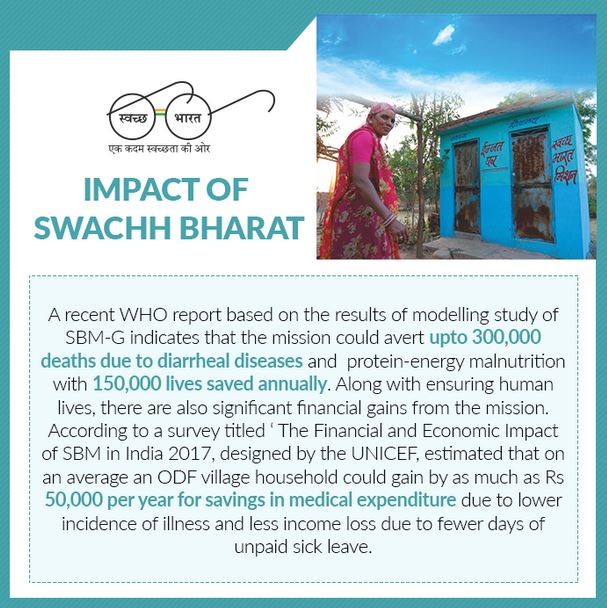
    A new study published in the peer-reviewed “journal Nature” has found that the construction of toilets under the government’s “Swachh Bharat Mission” helped prevent approximately 60,000 to 70,000 infant deaths annually between 2011 and 2020.

    Key Highlights of the Report:

    • Impact of SBM: The study revealed that districts with over 30% toilet coverage under SBM experienced reductions of 5.3 in the Infant Mortality Rate and 6.8 in the Under Five Mortality Rate per thousand live births.
      • Over 9.5 crore toilets being built across the country since 2014;
      • 564,658 villages being declared Open Defecation Free (ODF);
      • 30 States/UT’s being 100% covered with individual household latrines (as of 2019).
    • Unique Approach of SBM: The approach of combining toilet construction with substantial investments in IEC (Information, Education, and Communication) and community engagement represents a marked departure from traditional efforts in India.
    • Novel Evidence of Impact: The study provides novel evidence of reductions in infant and child mortality following SBM’s comprehensive national sanitation program, indicating its transformative role in improving public health outcomes.
    • Asian Enigma: The report touches on the “Asian Enigma,” which highlights persistently high levels of undernutrition and stunting among children despite sufficient food availability, linking it to poor sanitation practices and open defecation.


    Successful Journey since Inception (2014-present):

    • Phase I (2014): The SBM 1.0  aimed to make urban centers open-defecation-free and improve sanitation infrastructure, particularly toilets.
        • The mission targeted constructing household, community, and public toilets, converting insanitary latrines, and improving solid-waste management.
    • Phase II (2020): The SBM 2.0 commenced in 2020, and is expected to run till 2025-26. It aims to sustain the achievements of phase I and ensure that treatment of both liquid and solid waste is achieved through the help of technology and private sector engagement.
    • This will focus on making Indian cities garbage-free by improving scientific waste management systems.

    Way forward: 

    • Global Model for Sanitation: India’s national sanitation campaign under SBM could serve as a model for other low- and middle-income countries where sanitation remains a major public health challenge.
    • Focus on Behavioral Change: Alongside infrastructure development, efforts are needed to sustain behavioural changes to eliminate open defecation.
    • Expand Sanitation Infrastructure in Rural Areas: Prioritize extending sanitation coverage and scientific waste management systems to underserved rural regions, building on the success of SBM to reduce mortality further and improve public health.
  • Gap between allocations for health, outcomes in States 

    Why in the News?

    Realizing the full potential of Union Budget 2024-25 health allocations depends on State-level factors, as states share costs and handle the implementation of Centrally Sponsored Schemes (CSS).

    About the two major Centrally Sponsored initiatives  

    • Pradhan Mantri Ayushman Bharat Health Infrastructure Mission (PM-ABHIM): Focuses on improving health infrastructure through health and wellness centres (AB-HWCs), block-level public health units (BPHUs), district public health laboratories (IDPHLs), and critical care hospital blocks (CCHBs).
    • Human Resources for Health and Medical Education (HRHME): Aims to boost medical personnel by building new medical, nursing, and paramedical colleges, increasing seats, and upgrading district hospitals to medical colleges.

    Issue of Low Fund Utilization and Faculty Shortage:

    • Poor Fund Absorption in PM-ABHIM: Fund absorption has been poor, with only 29% used in 2022-23. The reasons are – complex execution structures, reliance on health grants from the 15th FC (only 45% utilized), and delays in construction due to rigid procedures.
    • Low Fund Utilization in HRHME: Utilization of funds in educational infrastructure was only around 25% of the budget estimates in both 2022-23 and 2023-24. 
    • Shortage of teaching faculty: There is a significant shortage of teaching faculty in newly established medical institutions, with over 40% vacancies reported in 11 of the 18 All India Institutes of Medical Sciences.
    • For example, in Uttar Pradesh, 30% of teaching faculty positions were vacant in 2022 for government medical colleges established between 2019-21.
    • Lack of specialist positions: The shortage of specialists affects the establishment and upgrading of medical colleges and district hospitals, with more than a third of sanctioned specialist positions in urban CHCs and two-thirds in rural CHCs remaining vacant as of March 2022.

    How can states work on Fiscal space? (Way forward)

    • Enhanced Budget Planning and Allocation: States should prioritize and allocate funds efficiently for health infrastructure and recurring costs.
    • Strengthening Revenue Generation: States can explore increasing their own revenue sources through improved tax collection, introducing new revenue streams, or enhancing public-private partnerships. 
    • Optimizing Expenditure Management: Implementing better financial management practices, such as cost control measures, transparent procurement processes, and efficient use of existing resources, can help in managing and maximizing the impact of budget allocations for health infrastructure and services.
  • [pib] 10 Years of Jan Dhan Scheme

    Why in the News?

    PM Modi launched the Pradhan Mantri Jan Dhan Yojana (PMJDY) on 28th August 2014.  It has now completed a decade of successful implementation.

    About PMJDY

    Details
    Objective Banking the Unbanked: Open basic savings bank deposit (BSBD) accounts with minimal paperwork, relaxed KYC, e-KYC, account opening in camp mode, zero balance & zero charges.
    Securing the Unsecured: Issue Indigenous Debit cards with free accident insurance coverage of ₹2 lakh.
    Funding the Unfunded: Provide micro-insurance, overdraft, micro-pension, and micro-credit facilities.
    Initial Features Universal Access to Banking Services: Access through branches and BCs.
    Basic Savings Bank Accounts: With an overdraft facility of up to ₹10,000 for every eligible adult.
    Financial Literacy Program: Promote savings and credit usage.
    Insurance: Accident cover up to ₹1 lakh and life cover of ₹30,000 for accounts opened between Aug 2014 to Jan 2015.
    Pension Scheme: For the unorganized sector.
    Creation of Credit Guarantee Fund.
    Key Provisions Inter-operability: Through RuPay debit card or Aadhaar-enabled Payment System (AePS).
    • Fixed-point Business Correspondents.
    • Simplified KYC / e-KYC.
    Extension and New Features (Post-2018) Focus Shift: From ‘Every Household’ to ‘Every Unbanked Adult’.
    RuPay Card Insurance: Increased accidental insurance cover to ₹2 lakh for new accounts.
    Overdraft Facilities Enhanced: Limit doubled from ₹5,000 to ₹10,000; up to ₹2,000 without conditions.
    Increase in upper age limit for OD: From 60 to 65 years.
    Eligibility for Other Programs  PMJDY accounts are eligible for Direct Benefit Transfer (DBT), Pradhan Mantri Jeevan Jyoti Bima Yojana (PMJJBY), Pradhan Mantri Suraksha Bima Yojana (PMSBY), and Atal Pension Yojana (APY).

    Successes of PMJDY

    • Financial Inclusion: PMJDY is recognized as the largest financial inclusion initiative globally, with over 53 crore bank accounts opened as of August 2024. 
      • It has facilitated access to credit for individuals without a formal financial history, as evidenced by the rise in Mudra loan sanctions at a compounded annual rate of 9.8% from FY 2019 to FY 2024.
    • Social Empowerment: 55.6% of Jan Dhan account holders are women, and 66.6% of accounts are in rural and semi-urban areas, demonstrating the program’s reach among marginalized communities.
    • Deposit Growth: The total deposits in PMJDY accounts have reached Rs. 2.31 lakh crore, showing a 15-fold increase since August 2015.
    • Digital Transaction Growth: Digital transactions under PMJDY have surged, with UPI financial transactions growing from 535 crore in FY 2018-19 to 13,113 crore in FY 2023-24.
    • Effective DBT Mechanism: The Jan-Dhan Aadhaar Mobile (JAM) trinity has enabled a diversion-proof subsidy delivery mechanism, with subsidies and social benefits directly transferred into the bank accounts of the underprivileged.
    • Savings and Financial Discipline: The average deposit in the PMJDY account has increased 4 times since August 2015, indicating improved saving habits among account holders.

    PYQ:

    [2015] ‘Pradhan Mantri Jan-Dhan Yojana’ has been launched for

    (a) Providing housing loan to poor people at cheaper interest rates.

    (b) Promoting women’s Self-Help Groups in backward areas.

    (c) Promoting financial inclusion in the country.

    (d) Providing financial help to the marginalized communities.

    [2016] Pradhan Mantri Jan Dhan Yojana (PMJDY) is necessary for bringing unbanked to the institutional finance fold. Do you agree with this for financial inclusion of the poorer section of the Indian society? Give arguments to justify your opinion.

  • What is the Unified Pension Scheme?

    Why in the News?

    The Union Cabinet approved the Unified Pension Scheme (UPS) for 23 lakh central government employees.

    About Unified Pension Scheme (UPS):

    Explanation
    Implementation Date Effective from April 1, 2025.
    Eligibility Central government employees with at least 10 years of service.
    Assured Pension
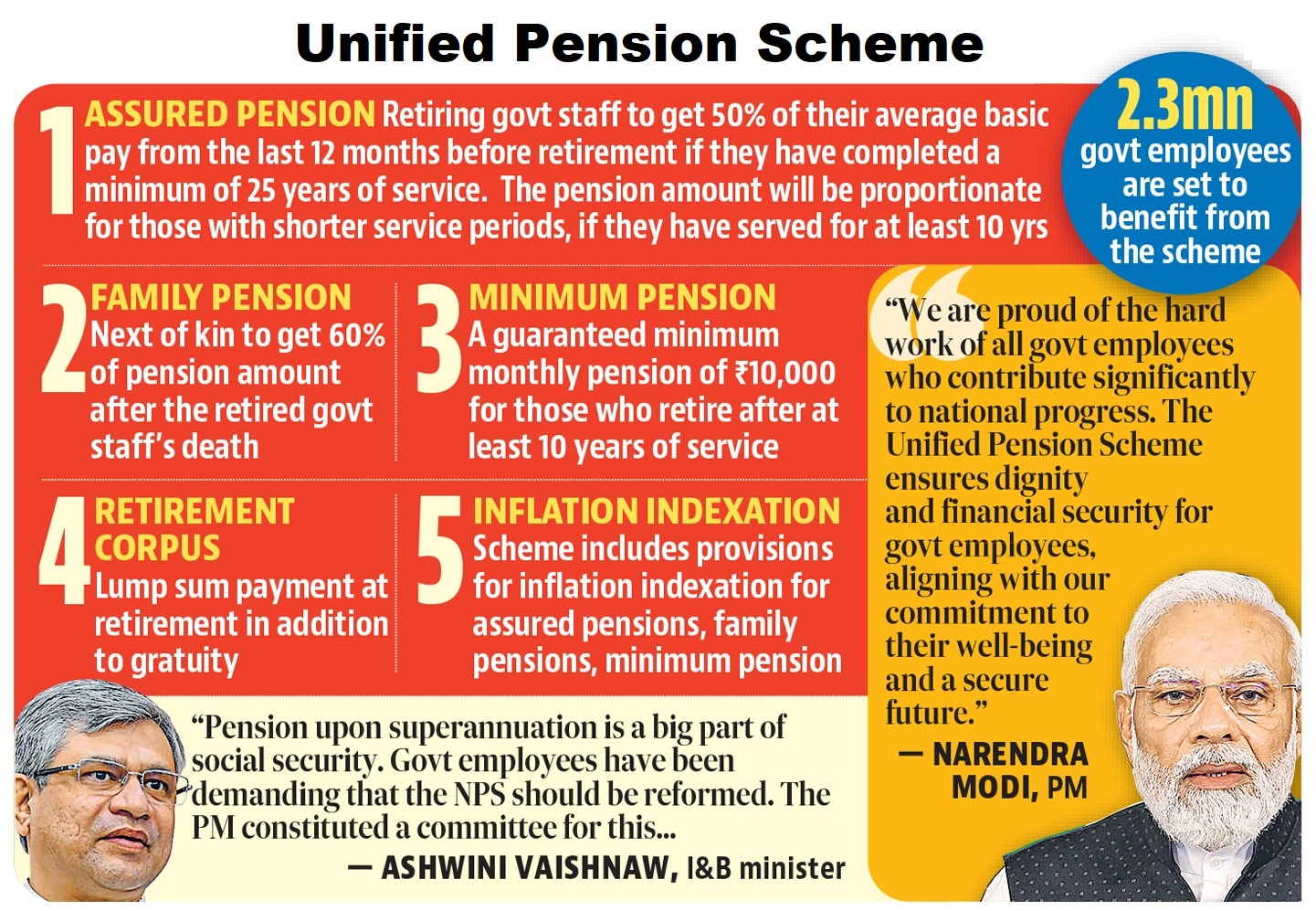
    • 50% of average basic pay over the last 12 months prior to retirement for employees with 25+ years of service.
    • Proportionate benefits for 10-25 years of service.
    Assured Minimum Pension ₹10,000 per month for employees with at least 10 years of service.
    Assured Family Pension 60% of the pension that the employee was drawing before their death.
    Inflation Protection
    • Pensions indexed to inflation;
    • Dearness Relief (DR) based on the All India Consumer Price Index for Industrial Workers (AICPI-IW).
    Government Contribution 18.5% of basic pay and DA, increased from 14% under the National Pension System (NPS).
    Employee Contribution 10% of basic pay and DA (same as under NPS).
    Lump Sum Payment on Superannuation One-tenth of the last drawn monthly pay (including DA) for every 6 months of completed service, in addition to gratuity.
    Option to Choose Employees can choose between UPS and NPS starting from the upcoming financial year; the choice is final once made.
    Beneficiaries
    • Initially benefits 23 lakh central government employees;
    • May extend to 90 lakh if adopted by state governments.
    Difference from NPS Unlike the market-dependent NPS, UPS provides a guaranteed pension amount, a minimum pension, increased government contribution, fixed family pension, and a lump sum payment at superannuation.

    Significance of the UPS

    • Financial Security: Guarantees a pension and family pension for stable post-retirement income.
    • Minimum Pension: Ensures at least ₹10,000 per month for retirees, supporting lower-income employees.
    • Inflation Protection: Indexes pensions to inflation, maintaining purchasing power over time.
    • Increased Benefits: Raises government contribution to 18.5%, enhancing employee retirement benefits.
    • Flexibility: Allows choice between UPS and NPS based on personal financial needs.
    • Family Support: Provides 60% of the pension to the spouse if the employee passes away.
    • Employee Welfare: Aligns with government goals to improve employee welfare and post-retirement life quality.

    PYQ:

    [2017] Who among the following can join the National Pension System (NPS)?

    (a) Resident Indian citizens only.

    (b) Persons of age from 21 to 55 only.

    (c) All State Government employees joining the services after the date of notification by the respective State Governments.

    (d) All Central Government employees including those of Armed Forces joining the services on or after 1st April, 2004.

  • [pib] PM-JANMAN Mission

    Why in the News?

    The Union Ministry of Tribal Affairs is conducting an Information, Education and Communication (IEC) campaign under the PM-JANMAN Mission.

    About Pradhan Mantri Janjati Adivasi Nyaya Maha AbhiyaN (PM-JANMAN):

    Details
    Launched on November 15, 2023, on Janjatiya Gaurav Diwas
    Objective Improve socio-economic welfare of Particularly Vulnerable Tribal Groups (PVTGs) through 11 critical interventions across 9 ministries.
    Vision Bridge gaps in health, education, and livelihoods; enhance infrastructure in PVTG communities aligned with existing schemes from nine ministries.
    Total Outlay
    • Rs 24,104 crore over three years
    • Rs 15,000 crore allocated under the Development Action Plan for the Scheduled Tribes (DAPST) for the housing component over three years.
    Implementation
    • Central Sector and Centrally Sponsored Schemes designed to enhance socio-economic conditions of PVTGs.
    • The Ministry of Tribal Affairs through the State Governments/ UT Administration/departments have undertaken habitation level data collection exercise through PM Gati Shakti mobile application to estimate PVTG population figures and infrastructure gaps under PM-JANMAN Mission.
    Coverage Targets 75 PVTGs in 18 states and 1 Union Territory, focusing on health, education, and livelihoods.
    Competitive Federalism Performance-based ranking of districts; top districts and Ministries recognized and rewarded for outstanding performance.


    PYQ:

    [2017] What are the two major legal initiatives by the State since Independence addressing discrimination against Scheduled Tribes (STs)?

    [2019] Consider the following statements about Particularly Vulnerable Tribal Groups (PVTGs) in India:

    1. PVTGs reside in 18 States and one Union Territory.
    2. A stagnant or declining population is one of the criteria for determining PVTG status.
    3. There are 95 PVTGs officially notified in the country so far.
    4. Irular and Konda Reddi tribes are included in the list of PVTGs.

    Which of the statements given above are correct?

    (a) 1, 2 and 3
    (b) 2, 3 and 4
    (c) 1, 2 and 4
    (d) 1, 3 and 4

  • Egg, sperm donors have no parental right on child: Bombay HC held

    Why in the News?

    On Tuesday, the Bombay High Court affirmed that sperm or egg donors cannot claim biological parenthood or legal rights over a child born using their gametes.

    About the Present Case and Rival Contentions

    • Background of the Case: The Bombay High Court ruled on a custody dispute involving twin girls born through altruistic surrogacy. The mother, a 42-year-old woman, sought visitation rights after her estranged husband took the children to live with him and her younger sister, who was the egg donor.
    Note: Altruistic surrogacy is a type of surrogacy arrangement where the surrogate mother carries a pregnancy for intended parents without receiving any monetary compensation for her services, aside from reimbursement for medical and pregnancy-related expenses.


    • Family Dynamics: The egg donor is the younger sister of the mother and had donated her eggs to help her sister and brother-in-law conceive. After the egg donation, the sister faced a tragic accident that resulted in the loss of her husband and daughter, complicating the family dynamics further.
    • Rival Claims: The mother argued that her daughters are legitimate children born within wedlock (being married), asserting her rights as the biological mother. In contrast, the estranged husband claimed that the egg donor had legitimate rights over the children, arguing that she should be recognized as a biological parent.
    Legal Framework: The case was governed by the 2005 National Guidelines on Assisted Reproductive Technologies (ART) since the surrogacy agreement was signed before the enactment of the Surrogacy (Regulation) Act, 2021. The guidelines say that both the donor and surrogate give up all rights as parents.

    Other key provisions of the Surrogacy (Regulation) Act, 2021

    • The Surrogacy (Regulation) Act, 2021 permits only altruistic surrogacy in India, where the surrogate mother cannot receive any monetary compensation beyond reimbursement for medical expenses and insurance coverage.
    • Commercial surrogacy, which involves payment beyond medical costs, is strictly prohibited.
    • Eligibility Criteria: Intended parents must be a legally married couple, with the female partner aged between 23 and 50 years and the male partner between 26 and 55 years. They must not have any biological children from previous marriages or through surrogacy. The surrogate must be married and have at least one child of her own.

    What the Bombay High Court Ruled

    • No Parental Rights for Egg Donors: The Bombay High Court ruled that an egg donor does not have legal rights as a biological parent. The court emphasised that while the egg donor may be considered a genetic mother, she cannot claim parental rights over the children born through surrogacy.
    • Recognition of Legal Parents: The court affirmed that the twin girls are the daughters of the petitioner (the mother) and her estranged husband, as they were born from their wedlock with their consent. The ruling highlighted that the couple signed the surrogacy agreement, establishing them as the intending parents.
    • Legal Precedent: The ruling clarified the legal standing of sperm and egg donors in surrogacy arrangements, reinforcing that they do not retain any parental rights or duties in relation to the child, as per the existing guidelines.

    Conclusion: The Bombay High Court confirmed that egg donors have no parental rights. The ruling reaffirmed that legal parentage lies with the intending parents as per surrogacy guidelines and existing laws.