💥Join UPSC 2027,2028 Mentorship (July Batch) + XFactor Notes & Microthemes PDF

GS Paper: GS1-10.Social empowerment, communalism, regionalism & secularism.

  • New regulations for Lakshadweep

    A series of regulations proposed by the Lakshadweep administrator has caused widespread resentment and fear among its residents.

    What are the new regulations?

    [1] Cow slaughter & beef

    • An order from the Administration seeks to ban the slaughter of cow, calf, bull, and buffalo without a certificate from a competent authority.
    • It prohibits the sale, transport, and storage of beef and beef products. Penalties include a jail term of up to one year and a fine of Rs 10,000.
    • The Administration has not provided an explanation on why the rule was brought in.
    • Residents view the rule as a direct infringement on their culture and eating habits. They allege the rule was decided without consultation with local bodies.

    [2] Two-child policy

    • Under the Draft Panchayat Regulation 2021, the Administration aims to bar people with more than two children from becoming a member of the gram panchayat.
    • For those who already have more than two children, the regulation does not disqualify them provided they do not have further children after the date on which the rule comes into effect.

    [3] Serving liquor to tourists

    • The Administration has decided to allow liquor to be served at resorts on inhabited islands.
    • Currently, prohibition is in place on all inhabited islands, with liquor served only at resorts on the uninhabited Bangaram Island.
    • The Dist Collector clarified that liquor permits would be given only to resorts for tourists, not for locals.
    • Residents have alleged that the move will lead to a proliferation of liquor sales on the island, which had been observing near-prohibition until now.

    [4] Land acquisition powers

    • The Administration brought in a draft Lakshadweep Development Authority Regulation (LDAR) to oversee the development of towns on the islands, with sweeping changes in the way land can be acquired and utilized.
    • It talks of the declaration of ‘planning areas’ and constitution of ‘planning and development authorities’ for preparing a land-use map and register, ostensibly for large projects.
    • Residents have protested against the way it was prepared and pushed through without consultation.
    • They fear large infrastructure and tourism projects can destabilize the ecology, and that the notification gives powers to the Administration to remove small landholdings of ST residents.

    [5] Anti-social activities regulation

    • The draft Lakshadweep Prevention of Anti-Social Activities Regulation provides for powers to detain a person for up to one year to prevent him from “acting in any manner prejudicial to the maintenance of public order”.
    • It allows for detention for anti-social activities from six months to a year without legal representation.
    • The Collector said while the island remains peaceful, there have been reports of drugs being found along with weapons and live ammunition.
    • He said the regulation is required to keep the “youth from getting misguided by illegal businesses”.
    • Residents are skeptical of the need for such stringent law in a UT with one of the lowest crime rates in the country. They allege it has been brought in to arrest those opposed to the Administration.

    Back2Basics: Lakshadweep Islands

    • There are 36 islands across 12 atolls, closest to Kerala, on which it depends for essential supplies. Only 10 of the islands are inhabited.
    • Once a part of the Malabar district of the Madras Presidency, Lakshadweep was given Union Territory status following Kerala state’s formation in 1956.
    • With a population of 65,000 (2011 Census), Lakshadweep is India’s smallest Union Territory.
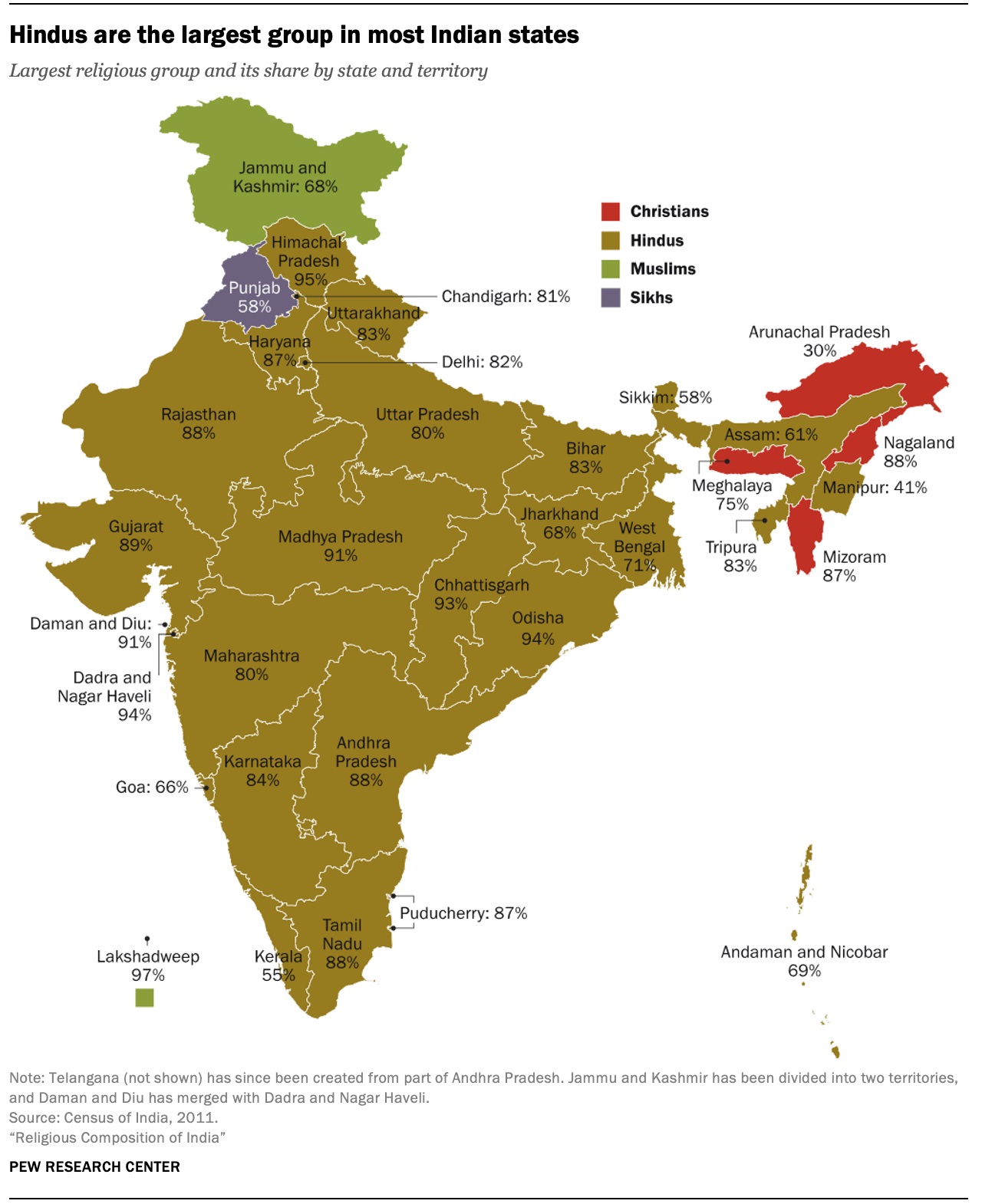
    • It has the highest population share of Muslims (96%) and Scheduled Tribes (94.8%) among the UTs.
    • Residents speak Malayalam and Dhivehi.
  • People are free to choose religion: Supreme Court

    The Supreme Court has said people are free to choose their own religion and lashed out at a PIL claiming that there is mass religious conversion happening across the country.

    Right to freedom of Religion

    Article 25 of the Constitution guarantees freedom of religion to all persons in India. It provides that all persons in India, subject to public order, morality, health, and other provisions:

    • Are equally entitled to freedom of conscience, and
    • Have the right to freely profess, practice and propagate religion.

    It further provides that this article shall not affect any existing law and shall not prevent the state from making any law relating to:

    • Regulation or restriction of any economic, financial, political, or secular activity associated with religious practice.
    • Providing social welfare and reform.
    • Opening of Hindu religious institutions of public character for all the classes and sections of the Hindus.

    What did the Supreme Court say?

    • Instead, a Bench led by Justice Rohinton F. Nariman said people have a right under the Constitution to profess, practise and propagate religion.
    • Justice Nariman said every person is the final judge of their own choice of religion or who their life partner should be. Courts cannot sit in judgment of a person’s choice of religion or a life partner.
    • Religious faith is a part of the fundamental right to privacy.
    • Justice Nariman reminded Mr Upadhyay of the Constitution Bench judgment which upheld inviolability of the right to privacy, equating it with the rights to life, dignity and liberty.
  • CJI’s remarks on Uniform Civil Code

    The Chief Justice of India (CJI) has lauded Goa’s Uniform Civil Code and encouraged “intellectuals” indulging in “academic talk” to visit the state to learn more about it.

    Again a controversial, conventional yet contested topic has come at our dispense! Save such articles for general idea esp. for essays.

    What is a Uniform Civil Code?

    • A Uniform Civil Code is one that would provide for one law for the entire country, applicable to all religious communities in their personal matters such as marriage, divorce, inheritance, adoption etc.
    • Article 44, one of the directive principles of the Constitution lays down that the state shall endeavour to secure a Uniform Civil Code for the citizens throughout the territory of India.
    • These, as defined in Article 37, are not justiciable (not enforceable by any court) but the principles laid down therein are fundamental in governance.

    Greater role for State

    • Fundamental rights are enforceable in a court of law.
    • While Article 44 uses the words “the state shall endeavour”, other Articles in the ‘Directive Principles’ chapter use words such as “in particular strive”; “shall, in particular, direct its policy”; “shall be the obligation of the state” etc.
    • Article 43 mentions “state shall endeavour by suitable legislation” while the phrase “by suitable legislation” is absent in Article 44.
    • All this implies that the duty of the state is greater in other directive principles than in Article 44.

    What are more important — fundamental rights or directive principles?

    • There is no doubt that fundamental rights are more important.
    • The Supreme Court held in Minerva Mills (1980): Indian Constitution is founded on the bedrock of the balance between Parts III (Fundamental Rights) and IV (Directive Principles).
    • To give absolute primacy to one over the other is to disturb the harmony of the Constitution.
    • Article 31C inserted by the 42nd Amendment in 1976, however, lays down that if a law is made to implement any directive principle, it cannot be challenged on the ground of being violative of the FRs under Articles 14 and 19.

    Does India not already have a uniform code in civil matters?

    • Indian laws do follow a uniform code in most civil matters – Indian Contract Act, Civil Procedure Code, Sale of Goods Act, Transfer of Property Act, Partnership Act, Evidence Act etc.
    • States, however, have made hundreds of amendments and therefore in certain matters, there is diversity even under these secular civil laws.
    • Recently, several states refused to be governed by the uniform Motor Vehicles Act, 2019.

    What about personal laws?

    • If the framers of the Constitution had intended to have a Uniform Civil Code, they would have given exclusive jurisdiction to Parliament in respect of personal laws, by including this subject in the Union List.
    • But “personal laws” are mentioned in the Concurrent List.
    • Last year, the Law Commission concluded that a Uniform Civil Code is neither feasible nor desirable.

    Is there one common personal law for any religious community governing all its members?

    • All Hindus of the country are not governed by one law, nor are all Muslims or all Christians.
    • Not only British legal traditions, even those of the Portuguese and the French remain operative in some parts.
    • In Jammu and Kashmir until August 5, 2019, local Hindu law statutes differed from central enactments.
    • The Shariat Act of 1937 was extended to J&K a few years ago but has now been repealed.

    Various customary laws

    • Muslims of Kashmir were governed by a customary law, which in many ways was at variance with Muslim Personal Law in the rest of the country and was, in fact, closer to Hindu law.
    • Even on the registration of marriage among Muslims, laws differ from place to place. It was compulsory in J&K (1981 Act), and is optional in Bengal, Bihar (both under 1876 Act), Assam (1935 Act) and Odisha (1949 Act).
    • In the Northeast, there are more than 200 tribes with their own varied customary laws.
    • The Constitution itself protects local customs in Nagaland. Similar protections are enjoyed by Meghalaya and Mizoram.
    • Even reformed Hindu law, in spite of codification, protects customary practices.

    How does the idea of a Uniform Civil Code relate to the fundamental right to religion?

    • Article 25 lays down an individual’s fundamental right to religion;
    • Article 26(b) upholds the right of each religious denomination or any section thereof to “manage its own affairs in matters of religion”;
    • Article 29 defines the right to conserve distinctive culture.
    • An individual’s freedom of religion under Article 25 is subject to “public order, health, morality” and other provisions relating to FRs, but a group’s freedom under Article 26 has not been subjected to other fundamental rights
    • In the Constituent Assembly, there was division on the issue of putting UCC in the fundamental rights chapter. The matter was settled by a vote.
    • By a 5:4 majority, the fundamental rights sub-committee headed by Sardar Patel held that the provision was outside the scope of FRs and therefore the UCC was made less important than freedom of religion.

    Minority opinion in the Constituent Assembly

    • Some members sought to immunize Muslim Personal Law from state regulation.
    • Mohammed Ismail, who thrice tried unsuccessfully to get Muslim Personal Law exempted from Article 44, said a secular state should not interfere with the personal law of people.
    • B Pocker Saheb said he had received representations against a common civil code from various organisations, including Hindu organisations.
    • Hussain Imam questioned whether there could ever be uniformity of personal laws in a diverse country like India.
    • B R Ambedkar said, “no government can use its provisions in a way that would force the Muslims to revolt”.
    • Alladi Krishnaswami, who was in favour of a UCC, conceded that it would be unwise to enact UCC ignoring strong opposition from any community.
    • Gender justice was never discussed in these debates.

    How did the debate on a common code for Hindus play out?

    • In June 1948, Rajendra Prasad, President of the Constituent Assembly, warned Nehru that to introduce “basic changes” in personal law was to impose “progressive ideas” of a “microscopic minority” on the Hindu community as a whole.
    • Others opposed to reforms in Hindu law included Sardar Patel, Pattabhi Sitaramayya, M A Ayyangar, M M Malaviya and Kailash Nath Katju.
    • When the debate on the Hindu Code Bill took place in December 1949, 23 of 28 speakers opposed it.
    • On September 15, 1951, President Prasad threatened to use his powers of returning the Bill to Parliament or vetoing it. Ambedkar eventually had to resign.
    • Nehru agreed to trifurcation of the Code into separate Acts and diluted several provisions.
  • Places of Worship Act, 1991

    The Supreme Court has asked the Centre to respond to a plea challenging the Places of Worship (Special Provisions) Act, 1991. The court has opened the doors for litigation in various places of worship across the country including Mathura and Varanasi.

    Take this ‘wonderful’ question from CS Mains 2019:

    Q.What are the challenges to our cultural practices in the name of secularism?

    Places of Worship Act, 1991

    • It was passed in 1991 by the P V Narasimha Rao-led government.
    • The law seeks to maintain the “religious character” of places of worship as it was in 1947 — except in the case of the Ram Janmabhoomi-Babri Masjid dispute, which was already in court.
    • The law was brought in at the peak of the Ram Mandir movement, exactly a year before the demolition of the Babri Masjid.
    • Introducing the law, then Home Minister S B Chavan said in Parliament that it was adopted to curb communal tension.

    What are its provisions?

    The objective of the law describes it as an Act to prohibit conversion of any place of worship.

    • It aims to provide for the maintenance of the religious character of any place of worship as it existed on the 15th day of August 1947, and for matters connected therewith or incidental thereto”.
    • Sections 3 and 4 of the Act declared that the religious character of a place of worship shall continue to be the same as it was on August 15, 1947.
    • No person shall convert any place of worship of any religious denomination into one of a different denomination or section.
    • Section 4(2) says that all suits, appeals or others regarding converting the character of a place of worship, that was pending on August 15, 1947, will stand abated when the Act commences and no fresh proceedings can be filed.
    • However, legal proceedings can be initiated after the commencement of the Act if the change of status took place after the cut-off date of August 15, 1947.

    What does it say about Ayodhya, and what else is exempted?

    • Act does not to apply to Ram Janma Bhumi Babri Masjid.

    Besides the Ayodhya dispute, the Act also exempted:

    • any place of worship that is an ancient and historical monument or an archaeological site, or is covered by the Ancient Monuments and Archaeological Sites and Remains Act, 1958;
    • a suit that has been finally settled or disposed of;
    • any dispute that has been settled by the parties or conversion of any place that took place by acquiescence before the Act commenced.

    What has the Supreme Court said about the Act?

    • In the 2019 Ayodhya verdict, the Constitution Bench led by former CJI Ranjan Gogoi referred to the law and said it manifests the secular values of the Constitution and strictly prohibits retrogression.
    • In providing a guarantee for the preservation of the religious character of places, Parliament determined that independence from colonial rule furnishes a constitutional basis for healing the injustices of the past.
    • The law addresses itself to the State as much as to every citizen of the nation. Its norms bind those who govern the affairs of the nation at every level.
    • Those norms implement the Fundamental Duties under Article 51A and are hence positive mandates to every citizen as well.

    Why is the law under challenge?

    • A politician has challenged the law on the ground that violates secularism.
    • He has also argued that the cut-off date of August 15, 1947, is “arbitrary, irrational and retrospective” and prohibits Hindus, Jains, Buddhists, and Sikhs from approaching courts to “reclaim” their places of worship.
    • Such places, he argued, were “invaded” and “encroached” upon by “fundamentalist barbaric invaders”.
    • The right-wing politicians have opposed the law even when it was introduced, arguing that the Centre has no power to legislate on “pilgrimages” or “burial grounds” which is under the state list.
    • Another criticism against the law is that the cut-off is the date of Independence, which means that the status quo determined by a colonial power is considered final.
  • Right to Marriage is a Fundamental Right

    An individual’s right to marry a person of his or her choice is a fundamental right that cannot be denied on the basis of caste or religion by anybody, re-iterated the Karnataka High Court.

    Discuss the various ethical and rights issues involved in interfaith marriages.

    Right to Marriage

    • The right to marry is a part of the right to life under Article 21 of the Indian Constitution.
    • The right to marriage is also stated under Human Rights Charter within the meaning of the right to start a family.
    • The right to marry is a universal right and it is available to everyone irrespective of their gender.
    • Various courts across the country have also interpreted the right to marry as an integral part of the right to life under Article 21.
    • A forced marriage is illegal in different personal laws on marriage in India, with the right to marry recognized under the Hindu laws as well as Muslim laws.

    Other laws that lay down a person’s right to marry in India are:

    1. The Prohibition of Child Marriage Act, 2006
    2. The Guardians and Wards Act, 1890
    3. The Majority Act, 1875
    4. The Family Courts Act, 1984
    5. The Protection of Women from Domestic Violence Act, 2005

    Back2Basics: Scope of Article 21

    • Article 21, considered the heart and soul of the Constitution, states, ‘No person shall be deprived of his life or personal liberty except according to the procedure established by law.

    It has a much more profound meaning that signifies the:

    • Right to live with human dignity
    • Right to livelihood
    • Right to health
    • Right to pollution-free air
    • Right to live a quality life
    • Right to go abroad
    • Right to privacy
    • Right against delayed execution,

    And anything and everything that fulfils the criteria for a dignified life.

  • Interfaith marriages and religious conversions

    Forced religious conversions for interfaith marriages cases are widely seen in news these days. And many states are attempting to ban religious conversion for the sole purpose of marriage.

    Try answering this:

    Q. The recent withdrawal of a TV commercial advertisement showing an interfaith marriage has led to an astonishing blowback. In light of this, discuss the various ethical and rights issues involved in interfaith marriages.

    Context

    • Though the Special Marriage Act, 1954 (SMA) was enacted to facilitate the marriage of couples professing different faiths, and preferring a civil wedding.
    • However, some practical problems arise in registering such marriages.
    • The law’s features on prior public notice being given and objections for the safety and privacy of those intending to marry across religions.
    • To overcome this, many settle for marriage under the personal law of one of them, with the other opting for religious conversion (accusingly termed as Love-Jihad).

    What are the features of the SMA?

    • Age: The marriage of any two persons may be solemnized under the SMA, subject to the man having completed 21 years of age and the woman 18.
    • Consent: Neither should have a spouse living; both should be capable of giving valid consent, should not suffer from any mental disorder of a kind that renders them unfit for marriage and procreation.
    • Liability: They should not be within the degrees of prohibited relationship — that is, they should not be related in such a way that their religion does not permit such marriages.
    • Registration: Parties to an intended marriage should give notice to the ‘marriage officer’ of the district in which one of them had resided for at least 30 days.
    • Objections: Any person can object to the marriage within 30 days of the publication of the notice on the ground that it contravenes one of the conditions for a valid marriage.
    • Publication: The notice will have to be entered in a ‘Marriage Notice Book’ and a copy of it displayed at a conspicuous place in the office. The Notice Book is open for inspection at all reasonable times without a fee.
    • Inquiry and approval: The marriage officer has to inquire into the objection and give a decision within 30 days. If he refuses permission for the marriage, an appeal can be made to the district court. The court’s decision will be final.
    • Severance from family: Also, the Act says that when a member of a Hindu undivided family, gets married under SMA, it results in his or her “severance” from the family.

    Threats after such marriages

    • The provisions relating to notice, publication and objection have rendered it difficult for many people intending to solemnize inter-faith marriages.
    • Publicity in the local registration office may mean that family members objecting to the union may seek to stop it by coercion.
    • In many cases, there may be a threat to the lives of the applicants.
    • There have been reports of right-wing groups opposed to inter-faith marriages for communal propaganda.

    Issues with the publication of notices

    • In July, the Kerala Registration department decided to discontinue the practice of uploading marriage notices on its websites following complaints that these were being misused.
    • However, the notices will be displayed on the notice boards of the offices concerned.
    • These provisions have been challenged in the Supreme Court recently on the grounds that they violate the privacy of the couples, their dignity and right to marry.
    • In the case of Hindu and Muslim marriage laws, there is no requirement of prior notice and, therefore, such a requirement in the SMA violates the right to equality of those opting for marriage under it.

    States against conversion for the sake of marriage

    • Even though Uttar Pradesh (U.P.) and Karnataka have spoken about a separate enactment, at least two States have legal provisions to the effect.
    • The Himachal Pradesh Freedom of Religion Act, 2019, and the Uttarakhand Freedom of Religion Act, 2018, both prohibit conversion by misrepresentation, force, fraud, undue influence, inducement, allurement and ‘by marriage’.
    • There is a separate section in both laws under which, not conversion for the purpose of marriage, but marriage has done solely for the purpose of conversion, may be declared null and void by a family court based on a suit by either party.
    • The U.P. State Law Commission has recommended a similar Freedom of Religion law in the State and favours a provision under which marriages solemnized solely for the conversion of one of the parties may be nullified by a family court.
  • Himachal Pradesh’s law against religious conversion

    Haryana government is considering a law against forced religious conversions and has sought information about such a law already in force in Himachal Pradesh.

    Try this question

    Q. How forced or misguided religious conversions pose a grave threat to the secular fabric of the Indian Society? Discuss.

    The Himachal anti-conversion law

    • The state had already enacted a law in 2007 which prohibited conversion from one religion to another by force or fraud. Last year it introduced a more stringent version of the legislation.
    • There was a rise in conversions by fraudulent means and unless checked well in time.
    • Such practice may erode the confidence and mutual trust between the different ethnic and religious groups in the state.

    What does the law say?

    • According to the Act, “no person shall convert or attempt to convert, either directly or otherwise, any other person from one religion to another by use of misrepresentation, force, undue influence, coercion, inducement or by any fraudulent means or by marriage; nor shall any person abet or conspire such conversion”.
    • The Act does not cover a person re-converting to his “parent religion”.
    • It further says that any marriage done for the sole purpose of religion conversion may be declared null and void by a court on a petition by either party.

    What happens if anyone wants to convert to any other religion?

    • As per the Act, anyone who wishes to convert to any other religion will give a declaration to the district authorities at least one month in advance, specifying that one is doing so as per his/her “own volition or free consent”.
    • In fact, even the religious priest who performs the conversion ceremony has to inform the authorities at least one month in advance.
    • The district magistrate will then conduct an inquiry regarding the “intention, purpose and cause of proposed conversion”.
    • The conversion will be rendered illegal if the authorities are not informed in advance.

    The burden of proof

    • The Act says that the burden of proof as to whether a religious conversion was not effected through force or fraud lies on the person so converted, or the person who has facilitated the conversion.

    Penal provisions

    • All offences under the Act are cognizable and non-bailable. The violator can be punished with a prison term ranging from one to five years, along with a fine.
    • In case the victim is a minor, woman or member of a Scheduled Caste or Tribe, the imprisonment may extend upto seven years.
    • Failure to declare the conversion in advance can also result in imprisonment of upto two years.
  • Religious Freedom and India

    The U.S. Commission on International Religious Freedom (USCIRF) has downgraded India to the lowest ranking, “countries of particular concern” (CPC) in its 2020 report.

    Religious freedom in India has been a contested issue since decades. Recent moves by the govt. since the abrogation of Art. 370 which triggered the riots in Delhi has left a big scar on the secular fabric of India.

    About USCIRF

    • It is a U.S. federal government commission created by the International Religious Freedom Act (IRFA) of 1998.
    • Its principal responsibilities are to review the facts and circumstances of violations of religious freedom internationally.

    Accusing India of religious intolerance

    • USCIRF has placed India alongside China, North Korea, Saudi Arabia and Pakistan.
    • India was categorised as a “Tier 2 country” in last year’s listing.
    • This is the first time since 2004 that India has been placed in the CPC category.
    • The commission also recommended that the U.S. government take stringent action against India under the “International Religious Freedom Act” (IRFA).

    What led India to lower its religious freedom?

    • India took a sharp downward turn in 2019 due to concerns about the Citizenship Amendment Act, the proposed National Register for Citizens, anti-conversion laws and the situation in Jammu and Kashmir.
    • The report accuses India using its strengthened parliamentary majority to institute national-level policies violating religious freedom across India.
    • The panel reported harassment and violence against religious minorities to continue with impunity, and engaged in and tolerated hate speech and incitement to violence against them.

    India’s reaction

    • The Centre reacted sharply to the USCIRF report terming it “biased and tendentious” and rejected its observations.
    • The biased and tendentious comments against India are not new. But on this occasion, its misrepresentation has reached new levels.
    • Major panellists of USCIRF dissented with the recommendation on India as being ‘too harsh’ and that ended up placing the country alongside what they termed as “rogue nations” like China and North Korea.
    • India regards the accusations as inaccurate and unwarranted and questioned the body’s “locus standi” in India’s internal affairs.

    US’s religious activism: Unwelcomed by all

    • The US earlier this month has announced the launch of a 27-nation International Religious Freedom Alliance, which aim to adopt a collective approach in protecting and preserving religious freedom across the world.
    • Among the prominent countries to join the alliance are Brazil, the United Kingdom, Israel, Ukraine, the Netherlands and Greece.
    • The USCIRF has been accused worldwide of being biased towards focusing on the persecution of Christians and of being anti-Muslim & Hinduphobic. It panels various controversial personalities.
  • [op-ed snap]Secularism’s Brexit moment


    Context

    In India, the debate on the issue of secularism needs to be based on a more principled and practical basis.

    Change in public discourse

    • Popular skepticism of secularism has been growing these days.
    • Secularism is being increasingly discounted not only by the hardliners but also by the moderate middle.
    • It is no longer taboo to raise questions that were formerly the preserve of the fringe.
    • Today, democracy is taken for granted by all the Indians. No one raises questions over its utility.
    • Secularism need to be elevated to the same level as is the democracy today, where no one raises the question on its utility.

    What are the issues with the defenders of secularism?

    • Rather than make case for secularism, its champions indulge in name-calling and citing the example from the past to tarnish and shut down critics.
    • They also cite the Constitution in their support-without realising that it is this very document’s secular thrust that has became suspect.
    • They also assume the obvious correctness of their cosmopolitan worldview.

    What changes need to be made?

    • They must make a case for secularism anew-principled and practical.
    • On principled basis-individual equality, freedom of conscience and personal habits.
    • On a practical basis-no country can flourish by degrading their minority.
    • They must stress the India’s plurality and “live and let live” culture, syncretic traditions and long history of respect and accommodation of differences.
    • They also need to show some humility.
    • They also have to show openness to fair-minded criticism.

    Conclusion

    These suggestions are urgently needed to be followed by those arguing in the defence of secularism otherwise there is a very real possibility of a large section of a society losing faith in secularism. In this anxious hours India needs to engage in open and self-critical debate-rather than polarising polemic.