💥Join UPSC 2027,2028 Mentorship (July Batch) + XFactor Notes & Microthemes PDF

GS Paper: GS2-03.Separation of Powers between different organs, dispute redressal mechanisms and institutions

  • Whether the Supreme Court Judgement (July 2018) can settle the political tussle between the Lt. Governor and elected government of Delhi? Examine.

    The governance of Delhi has remained contentious due to its special constitutional status under Article 239AA. The Supreme Court’s July 2018 Constitution Bench judgment in Government of NCT of Delhi v. Union of India sought to clarify the powers of the Lt. Governor (LG) vis-à-vis the elected government.

    Key Features of the 2018 Judgment

    Aid and Advice– LG is bound by the aid and advice of the Council of Ministers, except in matters of land, police, and public order.

    No Independent Power– LG cannot act independently; he is not an obstructionist authority.

    In case of conflict, LG should refer matter to President.

    SC concluded (following Balakrishnan Committee) that Delhi is not a state.

    Can the 2018 SC Judgment Settle the Tussle?

    Yes – Scope for Settlement

    Judicial clarity – LG bound by aid and advice except land, police, public order.

    Strengthens democracy – Elected govt. empowered.

    Curtails obstruction – LG cannot act independently or stall routine decisions.

    Constitutional morality – Promotes cooperative federalism, mutual trust.

    Checks arbitrariness – Limits misuse of “difference of opinion” clause.

    Encourages dialogue – Pushes for institutional maturity and coordination.

    No – Tussle Likely to Persist

    Ambiguity remains – Article 239AA(4) still allows LG to escalate disputes.

    Key exclusions – Land, police, public order under Centre control.

    Services issue – Left unresolved in 2018, led to fresh disputes till 2023.

    Party rivalry – Conflict driven by politics, not just legal text.

    Structural limits – Delhi lacks full statehood, unlike other states.

    Comparative experience – Capitals like Washington D.C. also face similar tussles.

    Way Forward

    Legislative clarity on Article 239AA to reduce ambiguity.

    Institutionalised cooperative mechanisms such as inter-governmental councils for Delhi.

    Judicial restraint and constitutional morality from all actors.

    Political maturity to balance Union concerns with the democratic mandate of Delhi’s citizens.

    “Federalism is not a monolith; it is a dialogue between self-rule and shared rule.” Both Union & States are creatures of the Constitution

  • Do you think that constitution of India does not accept principle of strict separation of powers rather it is based on the principle of ‘checks and balance’? Explain.

    SoP is derived from Montesquieu’s Spirit of Laws (1748) – dividing state power into Legislature, Executive, Judiciary to prevent concentration and arbitrariness.

    Separation of Powers in the Constitution

    Article 50 – Separation of executive and judiciary (Directive Principle).

    Articles 122 & 212 – Courts not to question proceedings of Parliament and State Legislatures.

    Articles 121 & 211 – Conduct of judges cannot be discussed in Parliament or State Legislatures (except during impeachment).

    Article 361 – President and Governors enjoy immunity; not answerable to courts for exercise of powers and duties.

    However, Strict Separation Does Not Exist due to

    Legislature & Executive Overlap – Executive is drawn from the legislature (Art. 74 & 75; Art. 163 & 164).

    Delegated Legislation – Legislature delegates rule-making powers to executive authorities.

    Judicial Functions of Legislature in cases of breach of privilege or impeachment of judges.

    Judicial Functions of Executivepardons and commutations (Art. 72 & 161) by President and Governors.

    Checks and Balances in Practice

    Judicial Review – Judiciary can strike down unconstitutional laws and executive actions. Eg – NJAC Judgment.

    Legislative Control over Executive via questions, motions, and no-confidence votes.

    Executive’s Role in appointment of judges through the collegium system consultation.

    Judiciary review of laws for conformity with Fundamental Rights and Basic Structure. Eg – Indira Gandhi v. Raj Narain (1975).

    Legislative control over judiciary – Eg- 2018 Amendments to Atrocities Act, Impeachment Motions

    “Power corrupts, and absolute power corrupts absolutely.” – Lord Acton
    Thus, checks and balances are essential to prevent tyranny and preserve democracy.

  • Judicial Legislation is antithetical to the doctrine of separation of powers as envisaged in the Indian Constitution. In this context justify the filing of large number of public interest petitions praying for issuing guidelines to executive authorities.

    Doctrine of separation of powers is derived from Montesquieu’s Spirit of Laws (1748) and divides state power into Legislature, Executive, Judiciary to prevent concentration and arbitrariness.

    Judicial legislation, i.e., when courts make laws or frame policies, is generally inconsistent with this doctrine.

    Separation of Powers in India

    Art. 245-246 & 368 – Only legislature can enact/amend laws under

    Article 105, 194 – Executive cannot breach parliamentary privileges

    Art. 122, 212 – Courts cannot inquire into parliamentary/state legislature proceedings ().

    Art. 124(4) Judicial Conduct Immunity

    Judicial Independence – Security of tenure, salaries, and contempt powers.

    Judicial Legislation Antithetical to Separation of Powers

    Encroachment on Legislative Domain undermines Separation of Powers.

    Undermines Democratic Accountability – judges are unelected and not responsible for policy outcomes. Eg- Criticism of Ban on firecrackers (2017)

    Creates judicial supremacy and Judicial governance (Bhikhu Parekh) – Eg- Prakash Singh guidelines on police reforms

    Weakens Public trust in Legislature and Executive – Eg- Coal Allocation Case (2014) – Court cancelled 214 coal blocks, creating policy paralysis in the energy sector.

    Courts lack technical and administrative expertise for framing complex policy guidelines. Eg- Ban on diesel vehicles in NCR (2016)

    Judicial itself has warned against overreach in

    Aravali Golf Club v. Chander Hass (2008)- Court warned against “judicial enthusiasm turning into judicial adventurism.”

    State of Tamil Nadu v. State of Kerala (2014)- Reiterated that courts should not enter the policy-making domain.

    Justification for Filing Large Number of PILs

    Executive Inaction or Policy Vacuum Eg- Vishaka guidelines on workplace sexual harassment.

    Protection of Fundamental RightsEg- Hussainara Khatoon (1979) case Recognized right to speedy trial as FR under Article 21.

    Accountability and TransparencyEg- In Vineet Narain case, SC issued directions to make CBI independent from political interference.

    Access to JusticeLiberal locus standi allows citizens to represent the poor and marginalized.

    Legislative or Administrative DelayEg- Navtej Johar (2018)- Decriminalized homosexuality after years of legislative inaction.

    Constitutional Mandate under Article 141 and 142 to uphold complete justice.

    Rise of Civil Society Activism – NGOs and activists use PILs to expose violations and empower citizens.Eg- M.C. Mehta Cases on environmental protection.

    Judicial Review powers under Article 13, 32, 226 to uphold Constitutional Supremacy

    Speedy Justice – timely intervention in cases affecting public interest. Eg- Olga Tellis (1985)- Protected the right to livelihood.

    Public Trust in Judiciary – Rise in PILs reflects citizens’ confidence in the judiciary as the last resort for justice.

    Issues

    Judicial Overreach- Encroachment into executive and legislative domains. Eg- SC ban on firecrackers was criticized for overreach.

    Weak Enforcement Capacity- Eg- Prakash Singh Police Reforms (2006) – Non-compliance by most states.

    Frivolous or Politically Motivated PILs increase pendency (more than 5Cr cases pending) Eg- Misuse in Election-related PILs delaying legitimate processes.

    Lack of Judicial Accountability- Eg- In-House Inquiry (Justice Ramaswamy case) exposed inadequacies in judicial discipline.

    Opaque Collegium System- criticised for lack of transparency and nepotism. Eg- uncle judge syndrome (law commission)

    Inconsistency and Selective Intervention- Uneven judicial response to similar issues affects credibility. Eg- Contrasting stances in Bail cases.

    Frequent judicial intrusion weakens separation of powers.

    Way Forward

    Institutional Restraint- Judiciary must uphold separation of powers

    Enforce strict scrutiny of PILs to prevent misuse for personal, political, or publicity motives.

    Develop a judgment-monitoring mechanism to ensure effective execution of court orders

    Promote constitutional literacy and encourage responsible use of judicial remedies by citizens.

    Dedicated PIL Cells in High Courts

    PILs represent participatory constitutionalism, ensuring that justice remains accessible, accountable, and rights-oriented.

  • To what extent, in your view, the Parliament is able to ensure accountability of the executive in India?

    The Parliament of India is the supreme instrument of democratic accountability. Under Article 75(3) of the Constitution, the Council of Ministers is collectively responsible to the Lok Sabha

    Parliament ensuring accountability of the executive

    Question Hour – Enables MPs to question ministers and expose administrative lapses

    Zero Hour – Allows MPs to raise urgent matters of public importance without prior notice.

    Adjournment and Censure Motions – Hold the executive accountable on specific issues of public or national concern.

    No-Confidence Motion – Tests the majority support of the government and can lead to its fall if lost.

    Budgetary Control (Articles 112-114)power of the purse by approving or rejecting demands for grants.

    Cut Motions to reduce or disapprove government expenditure, signalling disapproval of policy.

    Parliamentary Committees

    Public Accounts Committee (PAC) – Examines CAG reports and ensures post-audit accountability (e.g., 2G and coal scam scrutiny).

    Estimates Committee – Evaluates government expenditure efficiency.

    DRSCs) in-depth scrutiny of ministries.

    Joint Parliamentary Committees (JPCs) – Eg- Waqf Amendment Bill

    Parliamentary Privileges – Allow MPs to speak freely and fearlessly, enhancing deliberative accountability.

    Issues with parliamentary form of government

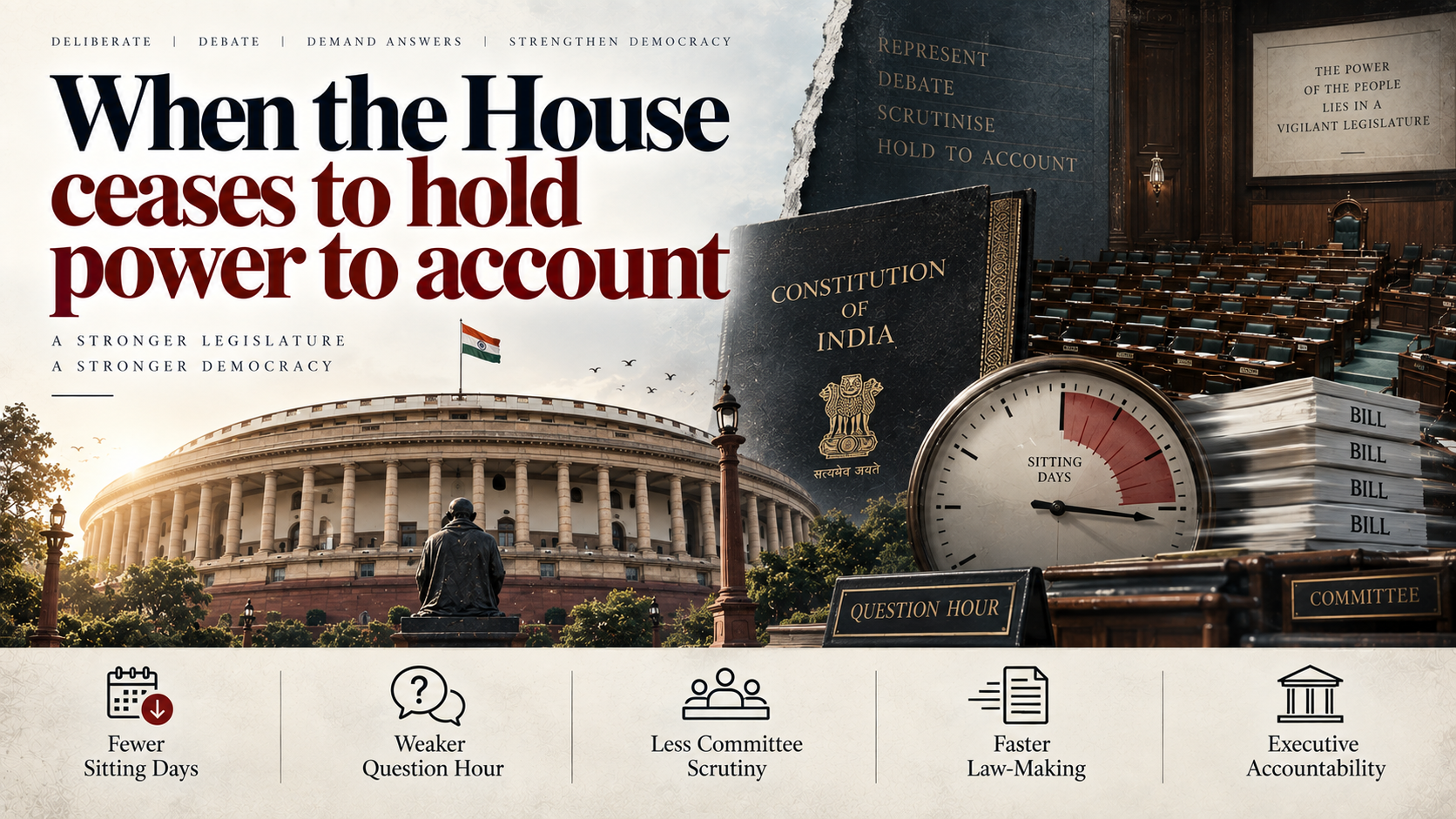
    Decline in the number of sittings- The 17th Lok Sabha sat for only 55 days

    Frequent Disruptions and Adjournments due to protests and unruly behavior, leading to wasted time and resources.

    Low Productivity- Eg- the 2023 winter session saw significant disruptions, resulting in the suspension of over 140 MPs and hindering legislative business.

    Inadequate Discussion- 58% of the Bills were passed within two weeks of their introduction in 17th LS. Eg- J&K Reorganisation Bill, 2019, and the Women’s Reservation Bill, 2023 were passed within two days

    About 31% of the total functioning time in Lok Sabha, and 32% in Rajya Sabha was spent on discussions other than legislation and budgets. Eg- President’s Address to Parliament, matters of public importance, and trust votes.

    Between 2019 and 2023, about 80% of the Budget was passed without discussion, and in 2023, the entire Budget was approved without debate.

    Rise Legislation through Ordinances bypassing the usual legislative process.

    Along with ‘maximum governance, there needs to be ‘maximum accountability’, which must start with an empowered and effective Parliament.

  • Discuss the essential conditions for exercise of the legislative powers by the Governor. Discuss the legality of re-promulgation of ordinances by the Governor without placing them before the Legislature.

    Articles 153-167 (Part VI) deal with the State Executive, and the Governor acts as the Chief Executive Head of the State. Under Article 213, the Governor has the power to promulgate ordinances.

    Legislative Powers-

    Summoning and Proroguing Houses (Article 174)

    Article 200 – Giving assent to the Bills

    Article 175- Addresses the first session of the State Legislature after each general election.

    Appoints the Speaker of the House

    Reservation of Bills for President’s Consideration (Article 201)

    Nominates one-sixth members of the Legislative Council (if it exists).

    Ordinance-Making Power (Article 213)

    Essential Conditions for Exercise of Legislative Powers by the Governor

    Legislature Not in Session – Ordinance can be issued only when both Houses (or the sole House) of the State Legislature are not in session.

    Immediate Need – The Governor must be satisfied that circumstances exist which render it necessary to take immediate legislative action.

    Legislative Competence – The ordinance can only be issued on a subject within the State Legislature’s competence under State or Concurrent Lists.

    Presidential Assent (Proviso to Article 213(1)) – Required if-

    The Bill would need the President’s previous sanction; or

    The law conflicts with any Parliamentary law; or

    It covers subjects where Parliament has overriding powers.

    Temporary Nature – The ordinance must be laid before the Legislature and will cease to operate six weeks after its reassembly, unless replaced by an Act.

    Legality of Re-promulgation of Ordinances

    Judicial Precedents

    D.C. Wadhwa v. State of Bihar (1987) – Re-promulgation of ordinances without legislative approval was termed as a “fraud on the Constitution”. SC has held that, An ordinance can be challenged if it-

    Constitutes colorable legislation;

    Violates Fundamental Rights;

    Contravenes constitutional provisions (e.g., Article 301); or

    Has unconstitutional retrospective effect.

    Krishna Kumar Singh v. State of Bihar (2017)Placing an ordinance before the Legislature is mandatory. Re-promulgation without fresh justification is invalid and violates legislative supremacy.

    R.C. Cooper case (1970) – Judicial review permissible if there is no genuine requirement of immediate action.

    A.K. Roy v. Union of India (1982)- The Supreme Court held that an ordinance cannot substitute parliamentary legislation and must be used only in cases of extreme urgency or unforeseen emergency.

    Constitutional and Democratic Implications

    Re-promulgation violates the “3D principle” – Debate, Discussion, Deliberation.

    It converts an emergency power into a routine legislative tool, eroding separation of powers.

    Failure to place an ordinance before the Legislature constitutes an “abuse of power” and fraud on the Constitution.

    Way Forward

    Mandatory Legislative Review within a fixed timeframe.

    Transparency in Justification – The Governor’s satisfaction for issuing an ordinance should be recorded in writing and made public.

    Adherence to Constitutional Morality – Governors must act within the spirit of the Constitution, using ordinance powers only in genuine emergencies.

    The ordinance power of the Governor is a tool of urgency, not convenience. As Soli Sorabjee observed, Governors can be a “driving force for democracy” only when they respect the principles of separation of powers and constitutional propriety.

  • “Constitutionally guaranteed judicial independence is a prerequisite of democracy”. Comment.

    Judicial independence refers to the freedom of judges from external pressures – political, or popular – enabling them to uphold the Constitution and rule of law without fear or favour.

    Constitutional Guarantee of Judicial Independence

    Separation of Powers (Article 50) – Directive to separate judiciary from the executive.

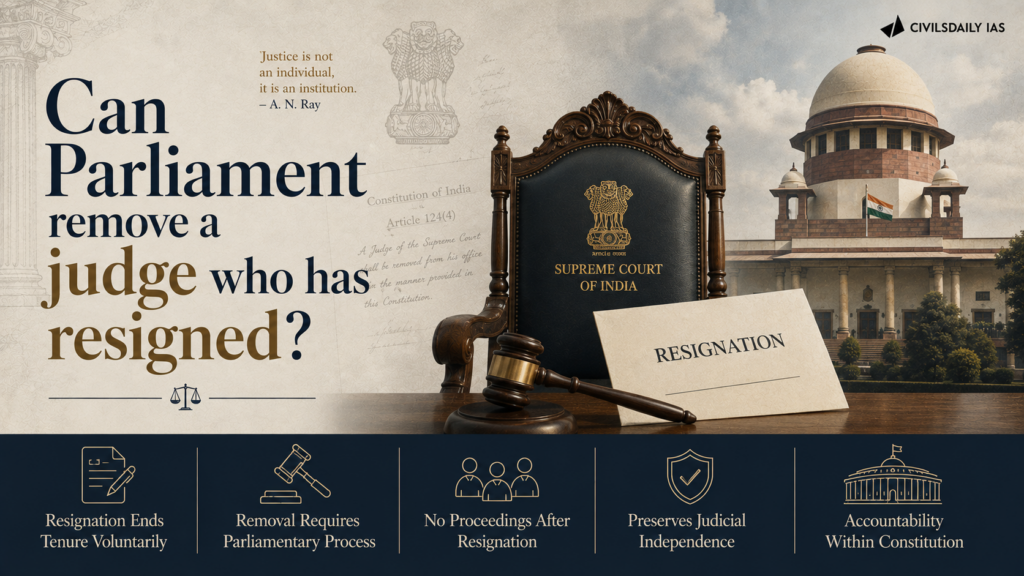
    Security of Tenure (Articles 124(4), 217) – Judges can be removed only through impeachment.

    Financial Autonomy (Article 112, 125) – Judicial salaries and pensions are charged on the Consolidated Fund.

    Appointment Process (Articles 124-147) – The Collegium system, evolved through Second Judges Case (1993), protects against executive dominance.

    Power of Judicial Review (Articles 13, 32, 226) – Enables courts to strike down unconstitutional laws or actions.

    Contempt of Court Powers (Article 129, 215) – Protects the dignity and authority of courts.

    Judicial independence as a prerequisite of democracy

    An independent judiciary safeguards rule of law over rule by power, ensuring that all state actions remain within constitutional limits.

    Courts act as guardians of the Constitution by protecting citizens’ fundamental rights from legislative or executive encroachment. Eg- Shreya Singhal case invalidating Section 66A of IT Act

    Maintains Separation of Powers and prevents concentration of power.

    In a democracy based on constitutional supremacy, courts act as a bulwark against populist or authoritarian tendencies. Eg- Basic Structure Doctrine.

    Ensures Accountability of the Government through judicial review (Articles 13, 32, 226). Eg- NJAC Judgment

    Upholds Constitutional Morality by progressive interpretation of laws. Eg- Sabrimala Verdict

    Prevents Executive Overreach – Independent courts can strike down arbitrary laws or actions (Indira Gandhi v. Raj Narain, 1975).

    Ensures Peaceful Resolution of Disputes – A credible judiciary provides non-violent conflict resolution, strengthening democratic stability.

    “There is no better test of the excellence of government than the working of its judicial system.” – Lord Bryce

  • “The growth of cabinet system has practically resulted in the marginalisation of the parliamentary supremacy.” Elucidate.

    The Cabinet system, a legacy of the British parliamentary model, is based on the principle of collective responsibility of the executive to the Legislature. However, the growth of the Cabinet system has concentrated power in the hands of the Prime Minister and Council of Ministers.

    Cabinet System Marginalising Parliamentary Supremacy

    Party Whip curtails independence of MPs, limiting free deliberation.

    Ordinance Power (Articles 123 & 213) bypasses legislative scrutiny.

    Prime Ministerial Supremacy due to centralisation of authority in PMO.

    Decline of Private Members’ Bills – The last such Bill was passed in 1970.

    Weak Legislative Scrutiny – Increasing absenteeism, fewer sittings, and guillotining of Demands for Grants.

    Decline of parliamentary Committees have weakened executive accountability.

    Coalition Politics results in bargaining politics instead of genuine legislative oversight.

    However, parliamentary control over executive can also be seen

    Executive Accountabilitycollective responsibility to Parliament under Article 75(3).

    Financial OversightFinance committees scrutinise government expenditure. Eg- PAC review of GST framework

    Budgetary Control (Art. 112) through Demands for Grants, and Appropriation Acts.

    Opposition’s Role – Eg- Farm Laws withdrawal.

    Role in Foreign Policy – Eg- debate on Civil Nuclear Deal with the US.

    Way Forward

    Publish Annual Parliamentary Calendar (NCRWC)

    Adopt Shadow Cabinet Model of UK, to institutionalise constructive opposition oversight.

    Allocate fixed time for Private Members’ Bills and Questions.

    Mandatory referral of Bill to Committees (UK system)

    “Parliament is the keystone of the democratic arch.” – Harold Laski

    For a resilient democracy, Parliament must function as the centre of deliberation and control, not as a department of the executive.