Why in the News?
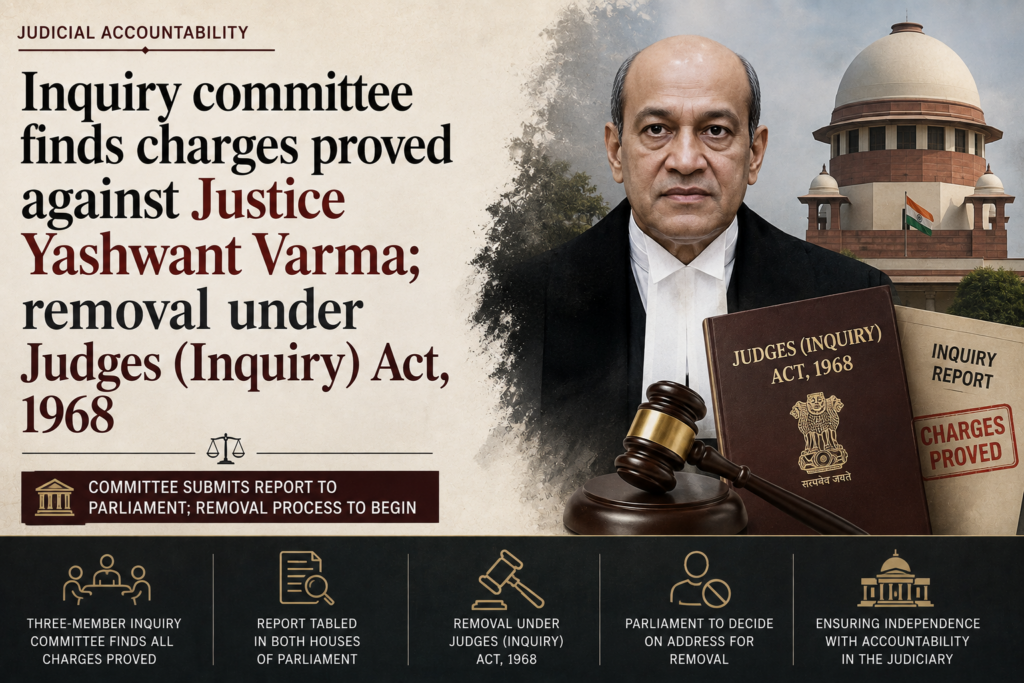
A three member inquiry committee found all three charges proved against former judge Justice Yashwant Varma over unexplained burnt currency found at his official residence. The key issue is whether Parliament can continue the removal process after his resignation.
Judicial Removal Process
Under the Judges (Inquiry) Act, 1968:
- Motion: Signed by 100 Lok Sabha or 50 Rajya Sabha members.
- Admission: Speaker/Chairman may admit or reject it.
- Inquiry Committee: Supreme Court Judge, Chief Justice of a High Court, and Distinguished jurist
- Parliamentary approval: Motion must pass in both Houses by:
- Majority of total membership, and
- 2/3 of members present and voting
- Final removal: President issues the removal order.
Constitutional Provisions
- Article 124(4): Removal of Supreme Court judges for proved misbehaviour or incapacity.
- Article 124(5): Parliament can regulate the inquiry procedure.
- Articles 217 & 218: Apply the removal framework to High Court judges.
- Article 121: Parliament cannot discuss a judge’s conduct except during a removal motion.
Varma Inquiry: Three Charges
- Unexplained cash: Burnt currency found at his official residence.
- Evidence preservation: Failure to preserve the material evidence.
- Evasive explanations: Committee found his explanations misleading and unsupported.
Key Constitutional Issue
- Removal motion was admitted before his resignation.
- The law does not expressly clarify whether proceedings can continue after resignation.
- The issue therefore exposes a legal gap concerning post resignation proceedings and consequences for pension and other benefits.
“[2019] Consider the following statements:
1. The motion to impeach a Judge of the Supreme Court of India cannot be rejected by the Speaker of the Lok Sabha as per the Judges (Inquiry) Act, 1968.
2. The Constitution of India defines and gives details of what constitutes “incapacity and proved misbehaviour” of the Judges of the Supreme Court of India.
3. The details of the process of impeachment of the Judges of the Supreme Court of India are given in the Judges (Inquiry) Act, 1968.
4. If the motion for the impeachment of a Judge is taken up for voting, the law requires the motion to be backed by each House of the Parliament and supported by a majority of total membership of that House and by not less than two-thirds of total members of that House present and voting.
Which of the statements given above is/are correct?
(a) 1 and 2 (b) 3 only (c) 3 and 4 only (d) 1, 3 and 4
