Mains Ready By December. Smash Mains & Smash PYQ Admissions Open

GS Paper: GS2-10.Government Policies & Interventions for development of various sectors (issues in their design, implementation)

  • Govt has deferred Census in Manipur amid calls for NRC to be carried out

    Govt has deferred Census in Manipur amid calls for NRC to be carried out

    Why in the News

    The Union government has decided to defer the 2027 Census in Manipur. The decision followed a meeting of the Union Home Minister with the Governor and the Chief Minister of Manipur, and the State government said it came out of discussions on the demand that the Census be held only after a National Register of Citizens (NRC), a register of persons verified as Indian citizens, is implemented in the State. Meitei and Naga organisations want citizenship settled before any population figure is recorded. Kuki-Zo organisations want the reverse order, arguing that the Census is the credible data source against which citizenship allegations should be tested. The count is contested because the same figures will eventually decide how Assembly seats are shared between the valley and the hills.

    Why is the Census being opposed?

    1. Citizenship and demographic change: Meitei civil society groups in the valley and Naga communities in the hill districts allege that migration from Myanmar and elsewhere has altered Manipur’s demographic composition. They want an exercise distinguishing Indian citizens from illegal immigrants before population figures are recorded.
    2. Displacement from the ethnic conflict: Thousands remain displaced more than three years after the violence that began in May 2023. Meitei groups say a count taken while people live away from their homes would record the consequences of displacement rather than the underlying population pattern.
    3. Political representation: Census figures will eventually govern delimitation, and Manipur has had no fresh delimitation implemented since the 1970s.

    How old is the NRC demand?

    1. It predates the current conflict: The demand existed before the May 2023 violence, and the influx from Myanmar and the conflict later gave it a sharper political and security dimension.
    2. A joint memorandum in 2022: In June 2022 the Coordinating Committee on Manipur Integrity (COCOMI), representing Meitei civil society, and the United Naga Council (UNC) jointly demanded an NRC and a State Population Commission.
    3. The Assembly endorsed it twice: The Manipur Assembly adopted a resolution seeking both on 5 August 2022, and reaffirmed it on 1 March 2024.
    4. The growth figures the resolution cited: The resolution recorded population growth of 153.3 percent between 1971 and 2001 and 250.9 percent between 2001 and 2011 in the hill districts, against 94.8 percent and 125.4 percent respectively in the valley. Those figures do not by themselves establish illegal immigration.
    5. An institution was created: The State government constituted the Manipur State Population Commission in February 2023.

    What did the Myanmar crisis add?

    1. Displacement across the border: Fighting in Myanmar’s Chin State and adjoining areas after the 2021 military coup drove thousands across the border into India.
    2. Ethnic links on both sides of the border: Many of those arriving belonged to Chin and related communities with ethnic and familial ties to the Kuki-Zomi population in Manipur.
    3. The State government’s framing: The Manipur government linked the influx to new settlements, poppy cultivation, encroachment and demographic change.
    4. The counter position: Kuki organisations disputed that framing, arguing that legitimate Indian citizens were being conflated with recent arrivals from Myanmar.
    5. A border policy change: The Centre scrapped the Free Movement Regime with Myanmar in February 2024, citing security and demographic concerns.

    What are the Meitei and Naga groups demanding now?

    1. A fixed sequence: The UNC stated on 18 August, “NRC first: No Census, No Delimitation Before Implementation of NRC in Manipur.”
    2. An old base year: It demanded an NRC with 1951 as the base year, followed by the Census and then delimitation.
    3. The demand cuts across party lines: The State Congress president, himself a former Chief Minister, supported the demand for an NRC before the Census on 19 and 20 August, placing the two main parties broadly on the same side.

    Why do the Kuki-Zo groups oppose it?

    1. A national exercise, not a State one: The Kuki-Zo Council called an NRC before the Census “premature and unjustified”, stating on 23 August that there is no provision for a community or a State government to unilaterally initiate a separate NRC in one State.
    2. Allegations should be tested against data: It argued that the demand rests on unsubstantiated allegations about the Kuki-Zo community, and that such claims should be tested against credible demographic data. The Census is the appropriate source of that data.
    3. It supports delimitation on verified data: The Council has backed delimitation once verified demographic figures exist.
    4. The documentary cut off is the underlying fear: Kuki, Zomi and Chin communities straddle the India-Myanmar border, so a register built on an old documentary cut off could raise doubts about people who have lived in Manipur for generations.

    Why does delimitation matter so much here?

    1. The present seat split: Manipur has 60 Assembly seats, 40 in the valley and 20 in the hills.
    2. The demographic map behind it: The State’s 16 districts divide broadly into hills, where Nagas and Kuki-Zomis predominate, and the valley, where Meiteis are in the majority.
    3. The map is more than fifty years old: The present political map goes back to the 1973 delimitation, which was based on the 1971 Census.
    4. Manipur was left out of the last exercise: A national delimitation based on the 2001 Census ran between 2002 and 2008, and Manipur, Assam, Arunachal Pradesh and Nagaland were excluded after the Centre deferred it in 2008, citing security concerns and challenges to the credibility of the 2001 Census data in the region.
    5. The disputed 2001 figures: In nine hill subdivisions the increase between 1991 and 2001 was over 40 percent, and in four it exceeded 100 percent.
    6. What the valley’s political class fears: A new Census followed by delimitation could move the 40:20 distribution to something closer to 35:25 or 30:30.

    Can an NRC be held only in Manipur, and what else is the Centre weighing?

    1. The usual national sequence is stalled: A nationwide NRC is supposed to follow an update of the National Population Register (NPR), a register of usual residents, and the government has not notified the NPR to be taken up with the 2027 Census.
    2. No legal bar on a State specific exercise: Section 14A of the Citizenship Act, 1955 vests the power to compulsorily register citizens and maintain the National Register of Indian Citizens in the Centre. No statutory requirement makes simultaneous nationwide deployment necessary.
    3. The decision is political rather than legal: The Centre could in principle notify the exercise for a particular State or border region, and the recorded position is that this is a political call.
    4. An alternative route already exists: A High-Level Committee on Demographic Change, announced in May this year, is examining demographic change arising from illegal immigration and other abnormal causes, and will recommend policy, legislative and administrative measures. Its findings could form the basis of a policy specific to Manipur.

    Challenges to holding the Census in Manipur

    1. Displacement distorts where people are counted: An enumeration records a person where they are living on the reference date, so a district hosting relief camps absorbs the population of the district people fled. Eg. Displaced Kashmiri Pandit families have been counted in Jammu and Delhi rather than in their home districts across successive Censuses.
      The Fix: Record a home district field for persons enumerated in relief camps, so displacement is visible in the data instead of silently altering district totals.
    2. A register built on an old base year excludes documented residents: Citizenship registration turns on producing legacy documents, which the poorest and the most mobile are least able to hold. Eg. Assam’s updated register, worked against a 1971 cut off, left 19,06,657 persons out of the final list published in August 2019, and the appeals process has still not concluded.
      The Fix: Publish the documentary standard and a binding appeal timeline before enumeration begins, so exclusion is contestable within a fixed period.
    3. A deferred count leaves the State on stale data: Allocations for welfare programmes are pegged to Census population, so a State that is skipped keeps running on figures more than a decade old. Eg. Coverage under the National Food Security Act, 2013 is still fixed against the 2011 Census population.
      The Fix: Notify an alternative statutory data source, such as updated ration and electoral rolls, for allocations in the deferred State until enumeration is held.
    4. The credibility of the count is itself contested in the region: A count that any side believes is inflated cannot settle the question it is being deferred to answer. Eg. Nagaland recorded decadal growth of about 64 percent in the 2001 Census and a fall of about 0.6 percent in 2011, and the earlier count was widely described within the State as inflated.
      The Fix: Publish subdivision level growth anomalies alongside post enumeration survey results, so a disputed count is audited rather than defended.

    Conclusion

    Deferring the count postpones the dispute without resolving either question behind it. The two demands cannot be met on the same timetable, since one side wants citizenship settled before people are counted and the other wants the count to test the citizenship allegations. A deferral also leaves the State without the current population data that its own programmes and its own representation ultimately rest on. What to watch is whether the Centre fixes a date for enumeration in the State or lets the deferral run open ended.

    Back2Basics: National Register of Indian Citizens

    1. What it is: A register of persons verified as citizens of India, maintained by the Centre.
    2. Its statutory basis: Section 14A of the Citizenship Act, 1955 empowers the Centre to compulsorily register every citizen and to issue national identity cards.
    3. How it is meant to be built: The rules contemplate verification of the particulars collected in the National Population Register to sort residents into citizens and doubtful cases.
    4. Where it has been done: The only State level exercise so far was in Assam, carried out under Supreme Court supervision, with the final list published in 2019.

    “[2009] Consider the following statements :

    1. Between Census 1951 and Census 2001, the density of the population of India has increased more than three times.

    2. Between Census 1951 and Census 2001, the annual growth rate (exponential) of the population of India has doubled.

    Which of the statements given abova is/are correct ?

    (a) 1 only

    (b) 2 only

    (c) Both 1 and 2

    (d) Neither 1 nor 2

  • US settlement with Meta is a start. India must protect itself

    US settlement with Meta is a start. India must protect itself

    Why in the News

    Meta has agreed to pay up to $17.1 billion to resolve child harm claims brought by a bipartisan coalition of attorneys general across the United States, its territories and the District of Columbia.

    What does the settlement require Meta to do?

    1. The scale and the date: The agreement was reached on 26 August and ranks among the largest consumer protection settlements in internet history.
    2. Default time limits and night restrictions: Users under 18 get default limits on time spent and restrictions on night time use.
    3. Limits on notifications during school hours: The company must curb notifications sent to minors while school is in session.
    4. Age assurance: The settlement requires enhanced measures to establish whether a user is a minor before the account is treated as an adult account.
    5. Independent compliance oversight: Compliance with the safeguards is monitored by an independent party rather than reported by the company itself.

    Why does the penalty carry little punitive weight?

    1. The sum is small against the revenue base: The company generated $201 billion in revenue in 2025, and the settlement is payable over 10 years.
    2. The market read it as a cost, not a shock: The stock rose 5 per cent after the settlement was announced.
    3. The reforms are the substance, not the money: The mandated safety changes go to how Facebook and Instagram are allowed to operate for minors, and they are overdue rather than novel.

    Why has India’s own debate produced no comparable outcome?

    1. The cycle is episodic and self closing: A tragedy occurs, outrage follows, a platform issues a statement, a parliamentary question may be asked, and silence returns.
    2. The harm is not less serious here: The absence of Indian legal action reflects the absence of a process capable of compelling answers, not a smaller problem.
    3. Regulatory attention has been lighter than in the West: Global platforms have operated in India with weaker oversight and lower public awareness than they face in other large markets.

    What did the American case produce that India lacks?

    1. Court compelled discovery: The litigation forced the company to produce internal research, design documents and executive communications about child safety, under oath, in public and subject to cross examination.
    2. The questions India cannot currently ask: What internal research shows about the mental health impact on Indian teenage girls, how the recommendation engine behaves in Hindi, Tamil and Bengali for a fourteen year old at 11 pm, and how many Indian children under 13 are active on platforms that legally prohibit their membership.
    3. The unmeasured scale of abuse material: The scale of child sexual abuse material affecting Indian users and the manner of its reporting are not on any public record. Eg. In the United States alone, 7.5 million such materials were under internal review.
    4. Whether the same design was applied here: If the addictive design features at issue in the American cases were applied to Indian users, those users have been exposed to the same harm with none of the protection.

    What legal tools does India already hold?

    1. The statutory base already exists: The Consumer Protection Act, 2019, the Information Technology (Intermediary Guidelines and Digital Media Ethics Code) Rules, 2021, the Protection of Children from Sexual Offences (POCSO) Act, 2012, the Juvenile Justice (Care and Protection of Children) Act, 2015 and the Constitution together cover the conduct alleged.
    2. A regulator level inquiry: The National Commission for Protection of Child Rights (NCPCR), the statutory body for child rights, can open a formal inquiry compelling platforms to produce India specific safety research, algorithm documentation, data on underage users and internal harm research.
    3. Direct recourse for families: Affected families can approach consumer forums and High Courts directly, without waiting for a regulator to act first.
    4. Coordinated State litigation: State governments can file consumer protection and child safety suits in Indian courts, and a single State moving first can trigger a wider set of filings.
    5. The policy standard is already stated: The Safe, Trusted and Accountable framework developed in 2021 was built so that platforms operating at scale bear legal responsibility for the consequences of their design choices.

    Why is new legislation still needed?

    1. Existing law compels disclosure only case by case: Each of the routes above produces documents inside one proceeding, so nothing survives the case that produced it.
    2. A statutory right to algorithmic disclosure: Parliament can create an obligation on platforms to reveal their content moderation policies, recommendation engine parameters and child safety research for Indian users.
    3. A standing recipient rather than a court: The disclosure would run to a designated Indian authority, which turns a litigated exception into a continuing duty.

    Challenges to compelling platform disclosure in India

    1. No child rights regulator holds standing discovery power: A statutory commission can summon information, and it cannot compel sworn production of internal research open to cross examination. Eg. Platform responses to Indian regulators are routinely filed as written submissions rather than as evidence tested in a hearing.
      The Fix: Give the child rights commission discovery powers with a stated penalty for non production, on the model available to a commission of inquiry.
    2. Consumer forums cannot read algorithmic evidence: A district or State consumer commission has no technical assessor able to interpret recommendation engine documentation. Eg. Consumer adjudication in India is built around defective goods and deficient services, not around product design telemetry.
      The Fix: Attach a standing panel of technical assessors to the National Consumer Disputes Redressal Commission for platform cases.
    3. The evidence sits outside Indian process: Internal research and design documents are held on servers abroad and reached through mutual legal assistance. Eg. Mutual legal assistance requests to the United States for platform records routinely take more than a year to return.
      The Fix: Write a production obligation for India specific safety research into intermediary due diligence, so the duty attaches to operating in India rather than to where a server sits.
    4. Safe harbour blunts liability for design: Section 79 of the Information Technology Act, 2000 shields intermediaries for third party content, and design and ranking choices are argued into that shelter. Eg. Platforms have defended recommendation ranking as an automated function rather than as an editorial act.
      The Fix: Separate design and ranking decisions from hosting in the due diligence rules, so safe harbour covers content and not product architecture.

    Conclusion

    Platform accountability in India has been argued at the level of statements and outrage, never at the level of evidence. The material that would establish whether Indian children were exposed to the same design choices sits with the platforms, and no Indian process currently compels its production. Legislation would convert that into a standing duty, and litigation would produce it once. The marker to watch is whether any Indian regulator or State government files an action carrying discovery powers, rather than another request for information.

    Online child safety in India

    1. What the domain covers: It governs how platforms design products for users below 18, across age of access, consent, exposure to content and collection of data.
    2. The regulatory age is higher than the platform age: Indian data protection law treats anyone below 18 as a child, while platforms set their own account creation floor at 13.
    3. States have moved before the Centre: Karnataka announced plans to bar social media for those under 16, and Andhra Pradesh announced restrictions for those under 13.
    4. The evidence base cited officially: Research highlighted in the Economic Survey 2025-26 records that adolescents lack the neurological brakes needed to resist addictive features such as infinite scroll.

    Laws and Rules Governing Online Child Safety

    1. Digital Personal Data Protection Act, 2023: It treats any individual below 18 as a child, requires verifiable parental consent before processing a child’s data, and prohibits behavioural tracking and targeted advertising directed at children.
    2. The Data Protection Board of India adjudicates breaches and imposes penalties under the Act, with appeals lying to the Telecom Disputes Settlement and Appellate Tribunal.
    3. Information Technology Act, 2000: Section 67B criminalises publishing or transmitting material depicting children in sexually explicit acts, and extends to browsing and downloading such material.
    4. Indian Penal Code and Bharatiya Nyaya Sanhita provisions on obscenity: They cover sale and circulation of obscene material to a person under 20, and operate alongside the specialised child protection statutes.

    Key Facts about Online Child Safety

    1. Australia set a minimum age of 16 for social media accounts through the Online Safety Amendment (Social Media Minimum Age) Act 2024, enforced from December 2025.
    2. Indonesia became the first Southeast Asian country to enforce a ban for under 16s, in March 2026.
    3. Gaming disorder is classified as a health condition in the World Health Organization’s International Classification of Diseases, Eleventh Revision (ICD-11).
    4. Kerala runs Digital De-Addiction centres, known as D-DAD centres, for children showing signs of compulsive device use.

    Challenges in Online Child Safety

    1. Age verification is easily circumvented: A minimum age holds only where the platform can establish age, and self declared dates of birth cannot be checked. Eg. Children open accounts on platforms barring under 13s using a false year of birth or an adult family member’s account.
      The Fix: Move to privacy preserving age estimation processed on the device, rather than to identity document uploads.
    2. Verification itself creates a new privacy risk: Establishing age through selfies, identity documents or bank details assembles a fresh database of minors’ sensitive data. Eg. Document based age checks require a child to hand a platform the exact identifiers the law is trying to keep from it.
      The Fix: Require age signals to be discarded once the check is complete, with a bar on retaining the underlying document.
    3. A ban pushes use underground: Restriction moves minors to less regulated services and to tools that hide their location. Eg. Teenagers migrate to smaller platforms or route access through virtual private networks.
      The Fix: Replace a binary ban with a graduated model, strict restriction under 13, supervised access from 13 to 15, and full access at 16.
    4. Restriction removes support networks for some children: Online communities are the only peer support available to some minors, and a blanket bar cuts that too. Eg. LGBTQ+, neurodivergent and disabled children frequently depend on such communities.
      The Fix: Exempt verified support, counselling and helpline services from minor account restrictions.

    [2025, GS2, 15 marks] The National Commission for Protection of Child Rights has to address the challenges faced by children in the digital era. Examine the existing policies and suggest measures the Commission can initiate to tackle the issue.”

  • Note on meeting over caste census rewritten after Ministry pushback

    Note on meeting over caste census rewritten after Ministry pushback

    Why in the News

    The Office of the Registrar General of India has rewritten its record of a meeting on caste enumeration after the Ministry of Social Justice and Empowerment objected to how its position had been minuted.

    What is the open ended caste question, and how does it differ from a drop down?

    1. An open ended question records what the respondent says: The enumerator writes down the caste name as reported, without matching it to any approved list at the point of collection.
    2. A drop down constrains the answer to a fixed list: The Census already uses drop down lists for the notified Scheduled Castes and Scheduled Tribes, where a legally settled list exists.
    3. The stated reason for the choice: The government’s position is that an open ended response is the only way to run the exercise without the state itself becoming an arbiter of caste identities.
    4. The cost is deferred, not avoided: The work of converting millions of individual responses into reliable, standardised caste data moves from the field to the stage after enumeration.

    How was the record of the June meeting rewritten?

    1. The Ministry offered the OBC list at the meeting: Ministry officials expressed willingness to share the list of Other Backward Classes (OBCs) maintained by the National Commission for Backward Classes (NCBC) for the caste enumeration exercise.
    2. The first draft minutes did not carry the offer: The initial draft of the minutes prepared by the Registrar General’s office did not reflect that offer accurately.
    3. The circulated note recorded a flat denial instead: A four paragraph note circulated on 8 June stated that Ministry officials had informed the meeting that there is no constitutional mandate for the Ministry to maintain a caste list, and that no such list is available with it.
    4. The note then drew the operative conclusion: It recorded that in view of the absence of any list of castes, enumeration of castes in Census 2027 may not be possible using any pre defined list in the Census question.
    5. The Ministry read the wording as a trap: Ministry officials said the onus for not going forward with a pre defined list was being shifted onto them.
    6. The amended note was accepted: The Ministry sent a revised version on 11 June, and the Registrar General’s office accepted the revised notes on 30 June.

    What lists does the Ministry actually maintain?

    1. Two statutory lists, not a general caste list: The revised note recorded that the Ministry maintains the List of Scheduled Castes and the Central List of Other Backward Classes as mandated by the Constitution, and that no separate list of castes is required to be maintained.
    2. The Scheduled Caste list: It comprises 1,258 entries and had already been shared with the Registrar General’s office by a letter dated 25 September 2025.
    3. The Central OBC list: It comprises nearly 2,483 entries, and the Ministry said it would be provided to the Registrar General’s office if required.
    4. Where the assistance stopped: The note recorded that officials of the Department of Social Justice and Empowerment were unable to assist further, given the absence of any mandate to maintain a list of castes beyond those two.

    Why does the 2011 experience shape this decision?

    1. The last attempt produced unusable variety: Respondents in the 2011 Socio Economic and Caste Census (SECC) reported 46.7 lakh distinct caste names, against 4,147 recorded in 1931.
    2. The cost: That exercise cost about ₹4,900 crore.
    3. The caste data was never released: The SECC data was published by the Ministries of Rural Development and Urban Development in 2016, and the dataset on caste was excluded.
    4. Classification was outsourced and never completed: The raw caste data went to the Ministry of Social Justice and Empowerment, which formed a group of experts under the then Vice Chairperson of NITI Aayog for classification and categorisation, and that data is yet to be made public.
    5. The government told the Supreme Court the data was unusable: Affidavits filed on 21 September and 14 December 2021 said the SECC 2011 data was inaccurate and marked by technical flaws.
    6. The Court recorded that position: On 15 December 2021 the Supreme Court noted that the affidavit before it states that the data as collated “is not accurate and is unusable for any purpose whatsoever”.
    7. The same failure is expected to recur: The assessment recorded inside the Ministry is that the 2027 count is set to repeat the failure of the previous exercise.

    How did the 2027 caste count come about?

    1. Cabinet approval reversed a standing position: The Cabinet Committee on Political Affairs approved caste enumeration in Census 2027 on 30 April 2025, conceding a long pending demand and reversing the government’s earlier position.
    2. The demand was first conceded in 2010: The then government promised caste enumeration alongside Census 2011 in May 2010 and referred the question to a Group of Ministers.
    3. It was then diverted out of the Census: Acting on that Group’s recommendations, the Union Cabinet decided in September 2010 to conduct a separate SECC instead of counting caste in the Census itself.
    4. The field timetable is already running: Population enumeration together with the caste census is scheduled across the country in February 2027, and it began on 1 September 2026 in hilly and snow bound areas to avoid winter difficulties.
    5. The Opposition objection is about usability, not about counting: The Leaders of the Opposition in the Lok Sabha and the Rajya Sabha argued that social justice policies cannot be effectively implemented without accurate data.

    Challenges to caste enumeration in Census 2027

    1. Open responses multiply into synonyms, sub castes and surnames: One community reports itself under several names across districts, and no field rule decides which of those names denote the same group. Eg. The Bihar caste survey of 2023 enumerated against a pre defined list of castes rather than an open field, precisely to avoid that outcome.
      The Fix: Publish the standardisation methodology and the mapping rules before enumeration begins, so the conversion is auditable rather than discretionary.
    2. The classification stage carries no statutory deadline: Raw responses become policy relevant only after grouping, and nothing fixes when that grouping must be completed or released. Eg. The Census Act, 1948 and its rules set the enumeration schedule and say nothing about publishing a caste classification.
      The Fix: Fix a statutory deadline for publishing classified caste tables, as already exists for the primary Census abstracts.
    3. Self reported caste can be reported strategically: Where a count is known to feed benefit eligibility, a respondent has an incentive to report the category that maximises entitlement. Eg. Reservation litigation regularly turns on disputed community claims to Other Backward Class or Scheduled Tribe status.
      The Fix: Delink the enumeration record from individual entitlement, using it only for aggregate policy design.
    4. Numbers alone do not satisfy the constitutional test: Population share does not establish that a group is socially and educationally backward, which is what the Constitution requires before reservation follows. Eg. Indra Sawhney v. Union of India (1992) fixed a ceiling on reservation and required backwardness to be demonstrated rather than assumed.
      The Fix: Collect the socio educational indicators the constitutional test needs in the same schedule as the caste question.
    5. Two arms of government own different halves of the exercise: The Registrar General’s office runs the enumeration and the Ministry of Social Justice and Empowerment holds the statutory lists, and neither is answerable for the output the other needs. Eg. The rewriting of the meeting note turned entirely on which of the two would be recorded as having ruled out a pre defined list.
      The Fix: Name a single accountable authority for the caste module, with the other body’s inputs recorded as statutory obligations rather than as offers.

    Conclusion

    The design of the caste question has been settled by default rather than by decision. Neither arm of government was willing to own the list a closed format needs, and the open format was what remained. The methodological problem that broke the last attempt is therefore untouched: responses will be collected freely and must still be grouped afterwards by someone. What to watch is whether the standardisation rules are published before enumerators go into the field, or arrive only after the data is already in.

    Back2Basics

    1. What it is: The National Commission for Backward Classes examines requests for inclusion in and exclusion from the Central List of Other Backward Classes and advises the Central government on them.
    2. Constitutional status: The Constitution (One Hundred and Second Amendment) Act, 2018 inserted Article 338B and gave the Commission constitutional status, replacing its earlier statutory basis.
    3. Composition: It consists of a Chairperson, a Vice Chairperson and three other members appointed by the President.
    4. States retain their own lists: The Constitution (One Hundred and Fifth Amendment) Act, 2021 restored the power of States and Union Territories to prepare and maintain their own lists of socially and educationally backward classes.
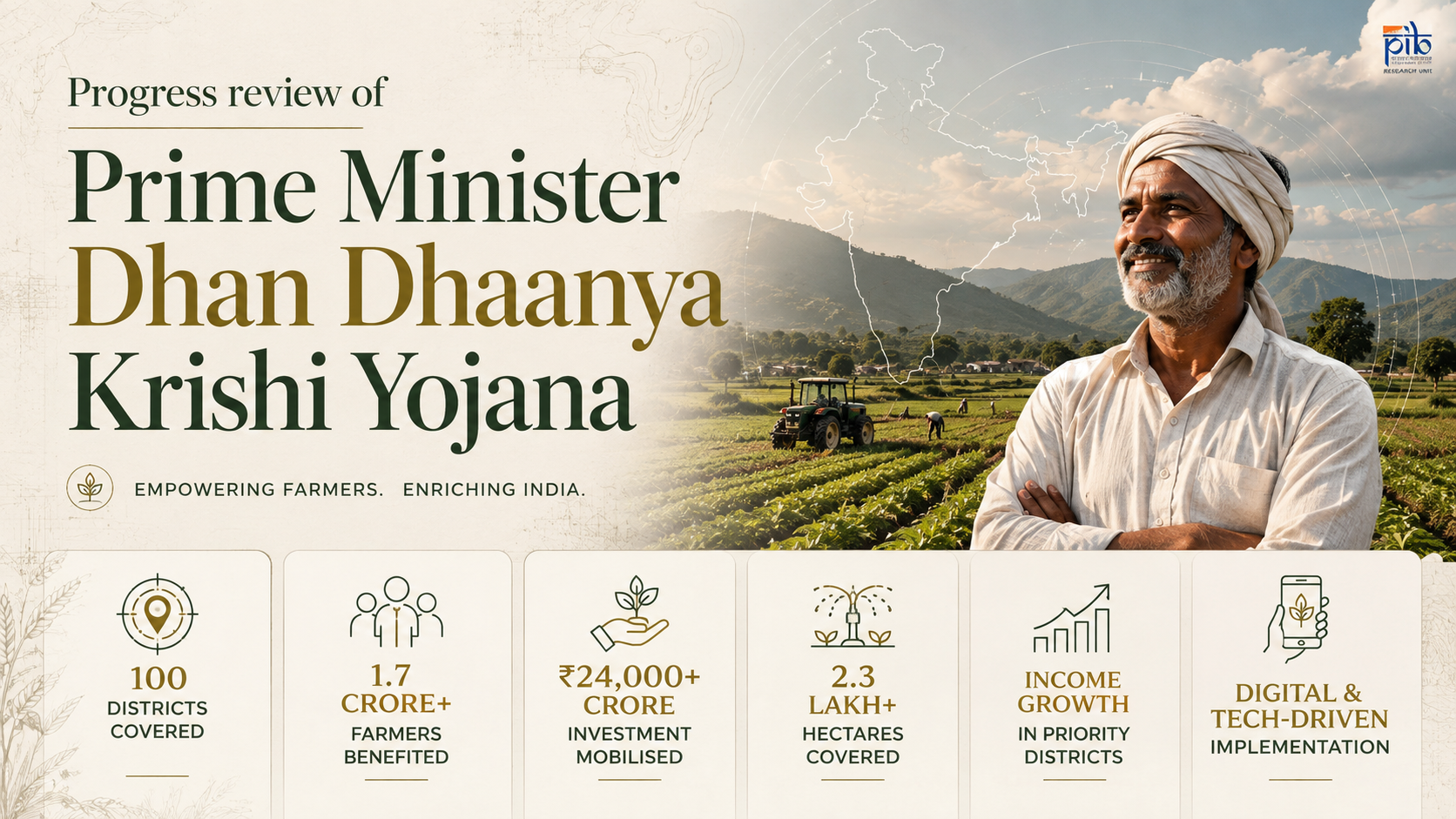
  • Progress review of Prime Minister Dhan Dhaanya Krishi Yojana

    Progress review of Prime Minister Dhan Dhaanya Krishi Yojana

    Why in News

    The Union Minister of Agriculture and Farmers Welfare reviewed the implementation progress of the Prime Minister Dhan Dhaanya Krishi Yojana (PMDDKY).

    Core facts

    1. What it is: PMDDKY is a district focused agriculture development scheme. It converges existing schemes to raise farm productivity in India’s weakest performing agricultural districts.
    2. Implementing ministry: Ministry of Agriculture and Farmers Welfare is the nodal ministry. Multiple line departments contribute converged schemes.
    3. Coverage: The scheme targets 100 districts. Districts are selected on three parameters. The parameters are low agricultural productivity, low cropping intensity, and low credit disbursement.
    4. Convergence design: The scheme pools 36 existing schemes across 11 departments. It layers these on a single district plan rather than creating a new fund line.
    5. Release specific review figures: The specific progress numbers, district status, and targets reported in PRID 2305501 could not be verified from PIB this run. They are not reproduced here.

    Static Context

    1. Origin: The scheme was announced in the Union Budget 2025 to 2026. The Union Cabinet approved it in July 2025.
    2. Duration: The scheme runs for 6 years from 2025 to 2026.
    3. Model: The scheme is modelled on the Aspirational Districts Programme. That programme uses ranking, convergence, and competitive monitoring to lift the weakest districts.
    4. Focus areas: The scheme covers productivity, crop diversification, sustainable agriculture, irrigation and water conservation, post harvest storage at panchayat and block level, and farm credit.
    5. Monitoring: District, State, and National level committees oversee the scheme. NITI Aayog and assigned Central Nodal Officers support monitoring.

    Prelims angle

    1. Number of districts covered: 100 districts.
    2. Selection parameters: low productivity, low cropping intensity, low credit disbursement.
    3. Number of converged schemes: 36 schemes across 11 departments.
    4. Parent design model: Aspirational Districts Programme.
    5. Nodal ministry: Ministry of Agriculture and Farmers Welfare.

    Mains angle

    GS3, agriculture theme (major crops, cropping patterns, agricultural productivity, and scheme convergence). A question can ask how a convergence and district targeting model raises productivity in low performing agricultural districts. It can also ask how crop diversification and integrated farming raise small farmer incomes.

    “[2022, GS3, 15] What is Integrated Farming System ? How is it helpful to small and marginal farmers in India ?”

    “[2025, GS3, 10] Explain the factors influencing the decision of the farmers on the selection of high value crops in India.”

  • Consumer Affairs notifies Legal Metrology (Indian Standard Time) Rules, 2026

    Consumer Affairs notifies Legal Metrology (Indian Standard Time) Rules, 2026

    Why in the News

    The Department of Consumer Affairs notified the Legal Metrology (Indian Standard Time) Rules, 2026.

    Core facts

    1. Notifying body: The Department of Consumer Affairs, under the Ministry of Consumer Affairs, Food and Public Distribution, issued the notification.
    2. Instrument: The rules are framed under the Legal Metrology Act, 2009, the parent law governing weights, measures and units of measurement.
    3. Purpose: The rules set Indian Standard Time (IST) as the single reference time for official, legal, commercial and administrative use.
    4. Unverified detail: The compliance timeline, exempted sectors and penalty provisions stated in the release body could not be verified this run. PRID 2304613.

    Static Context

    1. Legal Metrology Act, 2009: It replaced the Standards of Weights and Measures Act, 1976 and the enforcement Act of 1985. It standardises units, mandates verification of weighing and measuring instruments, and regulates packaged commodity declarations.
    2. Indian Standard Time: IST is fixed at the 82 degrees 30 minutes East standard meridian passing near Mirzapur, Uttar Pradesh. It runs 5 hours 30 minutes ahead of Coordinated Universal Time.
    3. Time keeping authority: The National Physical Laboratory (NPL), under the Council of Scientific and Industrial Research (CSIR), maintains and disseminates IST.
    4. Bureau of Indian Standards (BIS): BIS is the national standards body under the BIS Act, 2016. Standardisation of time complements product and quality standardisation functions.

    Prelims angle

    The parent Act (Legal Metrology Act, 2009), the standard meridian (82 degrees 30 minutes East), the IST offset (UTC plus 5:30), and the custodian of IST (NPL under CSIR) are the testable static hooks.

    Mains angle

    GS Paper 2 (Governance, regulation of standards) and GS Paper 3 (standardisation and the economy). A question can frame the costs and benefits of a single legal time reference for a country of India’s longitudinal span.

    [2017] Consider the following statements:

    1. The Standard Mark of Bureau of Indian Standards (BIS) is mandatory for automotive tyres and tubes.

    2. AGMARK is a quality Certification Mark issued by the Food and Agriculture Organization of the United Nations (FAO).

    Which of the above statements is/are correct?

    (a) 1 only

    (b) 2 only

    (c) Both 1 and 2

    (d) Neither 1 nor 2

  • Amid ‘NRC first’ demand, Centre defers Census exercise in Manipur

    Why in the News

    The Centre has deferred the house listing phase of Census 2027 in Manipur, which was to begin on 1 September. The deferment answers a demand from Meitei and Naga civil society groups that a National Register of Citizens (NRC) exercise be carried out in the State before any count is taken. The Manipur High Court was hearing a public interest litigation filed by the Kangleipak Students’ Association and the International Peace and Social Advancement, along with a connected writ petition. It recorded an undertaking from the Centre that the operation would be postponed, and ordered that it remain in abeyance until the next hearing on 12 October. The tension is that a Census is a statutory national exercise run on a single schedule, and it has been suspended in one State on the argument that counting people before verifying citizenship fixes the wrong population base for future delimitation and resource allocation.

    What is the house listing phase of the Census?

    1. It is the first of two field phases: House listing records buildings, households and their amenities before the population enumeration that follows.
    2. It fixes the frame for the count: The list of houses prepared at this stage is what enumerators use to reach every household in the second phase.
    3. It runs on a notified schedule: The Centre issued a notification on 7 January 2026 providing for the exercise, under which States issue notifications of their own.
    4. Administrative boundaries are frozen before it starts: Manipur froze all its boundaries from 1 January 2026 to 31 March 2027 to prepare for the operation.

    How was the deferment actually effected?

    1. A high level review preceded the decision: A meeting chaired by the Union Home Minister reviewed the situation in Manipur, attended by the Governor, the Chief Minister and the Union Home Secretary.
    2. The undertaking was given in open court: The Deputy Solicitor General told the High Court that on the instructions of the Registrar General and Census Commissioner a decision had been taken to postpone the house listing operations.
    3. The January notification is to be formally modified: The Centre was to issue a fresh notification modifying the one that had provided for the exercise, and the court recorded this as an undertaking.
    4. The State kept its own notification in abeyance: Manipur told the court it would not commence house listing and would hold its 22 March 2026 notification in abeyance pending the Centre’s formal notification.
    5. Two grounds were cited: The Centre cited the demands from Meitei and Naga groups and the tenuous security situation in the State.

    What is the demand, and how long has it been pressed?

    1. The State Assembly has resolved for a register twice: Resolutions dated 5 August 2022 and 1 March 2024 sought the introduction and enforcement of the NRC in Manipur.
    2. The State government wrote to the Centre twice: Communications in January 2023 and June 2024 referred to concerns over illegal immigration and demographic change.
    3. Civil society leaders and legislators lobbied in Delhi: Delegations from 14 civil society organisations and a group of BJP MLAs travelled to press the demand.
    4. The Chief Minister recorded the acceptance: His office stated that the Centre agreed to defer the exercise considering the feelings and aspirations of the people of Manipur.

    Why do the Valley groups object to counting first?

    1. A count before verification would include the undocumented: The groups argue that a Census held before an NRC would place undocumented or allegedly illegal immigrants inside the population figure.
    2. The consequences run to seats and money: They contend the resulting figure could affect future delimitation and the allocation of resources.
    3. Opposition has been concentrated in the Valley: The demand has come principally from the Meitei dominated Imphal Valley, with Naga groups also pressing it.
    4. The boundary freeze itself triggered protests: It produced massive strikes, torch rallies and closure of educational institutions across the valley districts.

    Challenges to conducting Census 2027 in Manipur

    1. The population to be counted is displaced: Ethnic violence since 2023 has moved large numbers into relief camps, so the household’s usual residence is not where the enumerator will find it. Eg. Kuki-Zo and Meitei residents were displaced across the hill and valley divide and have not returned to their original homes.
      The Fix: Record a displaced household against its pre-displacement address with a separate camp flag, so the count and the entitlement do not diverge.
    2. Enumerators cannot cross the ethnic divide: Field staff are locally recruited teachers and government employees, and staff from one community cannot safely work in areas held by another. Eg. Movement between the valley and the hill districts has required security escort since the violence began.
      The Fix: Recruit and deploy enumerators within each administrative unit, and open self-enumeration through the Census portal wherever field access fails.
    3. Deferring one State breaks national comparability: A Census counts a population against a common reference date, so a State enumerated later yields figures that cannot be set beside the rest. Eg. The exercise has already slipped from its due year of 2021 to 2027.
      The Fix: Fix a single revised reference date for the deferred State rather than letting the schedule drift with the litigation.
    4. The register being demanded has no settled cut off date: A citizenship register requires a date before which residence establishes citizenship, and none has been fixed for this State. Eg. Groups in Manipur have pressed for 1951 as the base year, a date that appears in no law applying to the State.
      The Fix: Legislate a cut off date and an appeals machinery before any register exercise is contemplated, so the demand has a determinate object.
    5. A deferment invites the same demand elsewhere: Conceding a precondition in one State supplies a template for others to seek their own. Eg. Demands for citizenship verification ahead of enumeration have been raised in other Northeastern States.
      The Fix: Publish the criteria on which a State level deferment is granted, so the next such decision is a rule rather than a negotiation.

    Conclusion

    The Census calendar has been reopened by a demand the Census cannot itself satisfy, since an enumeration counts residents and does not determine citizenship. Manipur’s house listing now depends on the progress of litigation rather than on a notified date. The unresolved position is that the State has asked for a register whose legal machinery has been built for only one State in the country, and the Centre has deferred the count without saying whether it will build that machinery here. The thing to watch is the next hearing before the Manipur High Court, where the Centre must produce the notification it has undertaken to issue.

    Back2Basics: National Register of Citizens

    1. What it is: A register of Indian citizens, first prepared from the 1951 Census, listing the persons enumerated as citizens in that count.
    2. Legal basis: Section 14A of the Citizenship Act, 1955 and the Citizenship (Registration of Citizens and Issue of National Identity Cards) Rules, 2003 provide for its preparation.
    3. Updated in Assam alone: The update ran under a separate schedule tied to the Assam Accord, 1985, using 24 March 1971 as the cut off date.
    4. Outcome of the Assam update: The final list published in August 2019 excluded about 19 lakh of roughly 3.3 crore applicants and has still not been notified by the Registrar General.

    Matching Previous Year Question

    “[2009] Consider the following statements : 1. Between Census 1951 and Census 2001, the density of the population of India has increased more than three times. 2. Between Census 1951 and Census 2001, the annual growth rate (exponential) of the population of India has doubled. Which of the statements given abova is/are correct ? (a) 1 only (b) 2 only (c) Both 1 and 2 (d) Neither 1 nor 2 ANSWER: (d)”

  • The broken promise of right to work

    Why in the News

    Employment under India’s rural work guarantee fell 68 per cent in July and August against the average of the preceding five years. The Viksit Bharat Guarantee for Rozgar and Ajeevika Mission (Gramin) Act, enacted by the Union government in December 2025 to replace the Mahatma Gandhi National Rural Employment Guarantee Act, 2005 (MGNREGA), came into implementation on 1 July. A three judge Supreme Court Bench led by the Chief Justice of India dismissed a petition on minimum wages in rural employment guarantee programmes on 21 August and sought a fresh one. The same Bench asked whether the right to work should be treated on par with Article 21, the fundamental right to life. The tension is that the right to work sits in the unenforceable Directive Principles, and the one statute that had converted it into a demand driven entitlement has been replaced by a law that caps funds and shifts cost onto the States.

    What is the VB-GRAM G Act?

    1. It replaced the 2005 employment guarantee law: The Viksit Bharat Guarantee for Rozgar and Ajeevika Mission (Gramin) (VB-GRAM G) Act took over from MGNREGA with effect from 1 July.
    2. Funding is capped rather than demand driven: The Act places an arbitrary cap on funds instead of releasing money against work actually demanded.
    3. The wage is not tied to a minimum wage: The Act does not link its wage rate to any statutory minimum wage.
    4. Areas can be denotified: It carries provisions to denotify specified areas and exclude them from the scheme, which ends the universality MGNREGA carried.

    What has happened to rural employment since 1 July?

    1. Employment fell 68 per cent in July and August: The comparison is with the average for those two months over the preceding five years.
    2. The five year average was 3.44 crore households: They generated about 44 crore person days of work in July and August.
    3. This year the figures are 1.39 crore households and 14.94 crore person days: The data are as on 31 August 2026 for 2026-27.
    4. The decline predates the new law: Households employed in those months fell steadily from 4.79 crore in 2021-22 to 2.44 crore in 2025-26 under MGNREGA itself.
    5. Household earnings have halved: Estimated total earnings of households in July and August fell to about half of the same months last year.

    Why does the Constituent Assembly debate matter to the present dispute?

    1. The disagreement was about placement, not value: Most members agreed that a right to work was vital, and the argument was whether it belonged among the fundamental rights or in the Directive Principles of State Policy (DPSP), which are precepts for framing law rather than enforceable rights.
    2. K.T. Shah argued for a fundamental right: He held that the State needed a constitutional and positive legal mandate to guarantee socio-economic security to its citizens.
    3. B.R. Ambedkar held it was not yet enforceable: He treated the right to work as an essential goal whose immediate universal enforcement was not fiscally or institutionally viable in a newly independent India hollowed out of its resources.
    4. The placement was aspiration, not abandonment: Locating the right among the Directive Principles reflected a deliberate constitutionalism of aspiration rather than a rejection of the welfare ideal.

    Which constitutional provisions carry the right to work?

    1. Article 41 states the obligation: The State shall, within the limits of its economic capacity and development, make effective provision for securing the right to work.
    2. Article 39 covers livelihood and equal pay: It directs the State towards an adequate means of livelihood and equal pay for equal work for both men and women.
    3. Articles 42 and 43 cover conditions and wages: They require just and humane conditions of work, and a living wage with a decent standard of life for all workers.

    How did the aspiration become a statutory right?

    1. Olga Tellis established the link to life: In Olga Tellis vs Bombay Municipal Corporation (1985) the Supreme Court ruled that the right to livelihood was a necessary condition for the fundamental right to life.
    2. Activists and rural workers drove the legislation: The National Rural Employment Guarantee Act was passed in 2005 following their collective effort.
    3. It made a pan-India right to work real for the first time: The State carried a statutory obligation to provide employment at minimum wages.
    4. The scope was always narrow: The guarantee covered 100 days of work per rural household, and the programme was chronically underfunded.

    What is wrong with the Bench’s own remark on minimum wages?

    1. The remark links a wage floor to fewer workers: The Bench observed that if financial resources remained the same, a minimum wage threshold could reduce the number of workers who could be given employment.
    2. It cuts against Sanjit Roy: In Sanjit Roy vs State of Rajasthan (1983) the Supreme Court held that payment below minimum wages violates Article 23 of the Constitution and is akin to forced labour.
    3. It assumes a fixed budget: The reasoning rests on the resources for a welfare programme remaining unchanged and constrained.
    4. Higher wages raise demand, not only cost: Higher rural wages increase purchasing power and effective demand for goods and services, producing a multiplier effect on productivity.

    How did the wage fall behind in the first place?

    1. Wages were delinked from the wage law in 2009: MGNREGA wages ceased to be tied to the Minimum Wages Act, 1948.
    2. They barely kept pace with inflation: The daily wage in July and August rose from Rs 210 in 2021-22 to Rs 282.5 this year while person days collapsed.
    3. They stayed below agricultural minimum wages: The MGNREGA rate remained lower than the minimum agricultural wage in most States.
    4. Women are increasingly unpaid family workers: Rural wages have been stagnant for a decade, and women are recorded in growing numbers as working without pay within the household.

    Why does the new Act face a constitutional objection?

    1. Non-retrogression bars rolling a realised right back: Once the State has reached a level of progressive legislation and enforceability of a right, it cannot adopt measures that deliberately undo it.
    2. The Supreme Court affirmed the doctrine in Navtej Singh Johar vs Union of India: It operates as a check on State power, ensuring that rights once realised are not diluted later.
    3. The replacement appears to breach it: Substituting a demand driven statutory entitlement with a fund limited mission dilutes a right that had already been realised in law.
    4. The fiscal shift compounds the problem: States already face curtailed borrowing limits under the Fiscal Responsibility and Budget Management (FRBM) framework, and the new Act adds to what they must fund.

    Challenges to the rural employment guarantee

    1. A capped budget converts a guarantee into a scheme: Work can be refused once the allocation is exhausted, so the entitlement lapses at the point demand peaks. Eg. MGNREGA allocations were routinely spent before the fourth quarter, leaving States carrying negative opening balances into the next year.
      The Fix: Treat the allocation as a first charge revised at the supplementary budget stage against verified work demand.
    2. Wage payment delay destroys the incentive to seek work: A worker who waits months for payment stops applying, and the falling application count is then read as falling need. Eg. Delayed wage payments under MGNREGA drew repeated censure from the Supreme Court and from parliamentary committees.
      The Fix: Release the statutory delay compensation automatically from the central account rather than on an individual worker’s complaint.
    3. Work demand is registered by the body that must then supply it: A gram panchayat under budget pressure has an incentive not to record demand, so the shortfall never appears in the data. Eg. Dated receipts against work applications are prescribed by law and are rarely issued in practice.
      The Fix: Allow demand to be registered through an independent time stamped channel outside the implementing agency.
    4. Social audit units depend on the governments they audit: Their staff and budgets come from the State administration, which limits what they are able to report. Eg. Social audit units in several States operate well below their sanctioned staff strength.
      The Fix: Fund social audit units through a ring fenced central allocation and place their findings before the State legislature.
    5. Asset creation is measured by expenditure rather than durability: A work is closed on payment rather than on verified usefulness, so the durable asset the programme exists to create goes unchecked. Eg. Comptroller and Auditor General audits of MGNREGA have repeatedly reported incomplete and unusable works.
      The Fix: Make geo-tagged completion and a one year durability check the condition for closing a work in the management information system.

    Conclusion

    An unenforceable directive principle survives only through the statute that implements it. India now has a rural work law that no longer carries the features which made the earlier one a right, and the collapse in employment is the first measurable consequence of that. What must change is that the wage be linked to a living wage standard, that payment be made on time, and that social audits be run by panchayati raj institutions holding real powers. These are the minimum conditions under which a work guarantee functions as a guarantee at all.

    Back2Basics: Minimum Wages Act, 1948

    1. Purpose: It empowers the appropriate government to fix and revise minimum rates of wages payable in scheduled employments.
    2. Dual authority: Both the Centre and the States act as appropriate governments, each notifying rates for the employments within its own sphere.
    3. Components of the wage: A minimum wage may combine a basic rate with a cost of living allowance, so it moves as prices move.
    4. Current status: It has been subsumed into the Code on Wages, 2019, which extends a statutory floor wage across all employments rather than scheduled ones alone.

    Matching Previous Year Question

    “[2011] Among the following who are eligible to benefit from the “Mahatma Gandhi National Rural Employment Guarantee Act”? (a) Adult members of only the scheduled caste and scheduled tribe households (b) Adult members of below poverty line (BPL) households (c) Adult members of households of all backward communities (d) Adult members of any household ANSWER: (d)”

  • Govt. notifies IST as common time reference across India; gives 180 days for compliance

    Why in the News

    The Union Ministry of Consumer Affairs, Food and Public Distribution has notified the Legal Metrology (Indian Standard Time) Rules, 2026, making Indian Standard Time (IST) the single reference for legal, administrative, commercial and other official purposes across the country. The Rules come into force 180 days after their publication in the Official Gazette, which gives government departments, businesses and institutions a compliance window to align their systems. The step follows the spread of digital and technology based systems whose records depend on accurate and synchronised time stamps, from banking and payments to telecommunications, railways, power grids and computer networks. A stated feature of the Rules is the reduction of dependence on foreign satellite based time sources that several critical systems currently rely on. The tension is that a legal mandate can fix which clock is authoritative and cannot by itself supply a domestic time signal accurate and reachable enough for the systems being asked to switch.

    What are the Legal Metrology (Indian Standard Time) Rules, 2026?

    1. A single legal reference: The Rules make IST the sole time reference for legal, administrative, commercial and other official purposes across India.
    2. Regulated as a measurement: The nodal authority is the Department of Consumer Affairs, so time is governed as a unit of measurement under legal metrology rather than as a scientific standard alone.
    3. Deferred commencement: Enforcement begins only after the compliance window closes, so existing systems are given time to re-synchronise instead of being placed in immediate default.

    Why does a single time reference matter for the systems that use it?

    1. Financial records: A common reference supports accurate time stamping of banking and digital payment transactions, which is what establishes the order of two competing entries.
    2. Transport coordination: It underpins coordination among railways, airports and other transport systems that run on shared schedules.
    3. Communication networks: Reliable functioning of telecommunication and internet networks depends on synchronised clocks across switching and routing equipment.
    4. Power systems: Precise timekeeping in power systems is what allows a grid disturbance to be sequenced and attributed after the event.
    5. Legal and government records: The upkeep of government and legal records rests on a timestamp that can be relied on as evidence.
    6. Emergency services: Coordination of emergency and other time critical services requires every responding agency to work off the same reference.

    Why are foreign satellite based time sources the actual target?

    1. The current dependence: Several critical systems draw their time signal from foreign satellite constellations rather than from a domestic source.
    2. Divergent sources produce divergent records: Inconsistencies between different time sources affect the coordination and the recording of transactions and operations.
    3. Sovereignty over the signal: A time signal controlled outside the country can be degraded or withdrawn, which places the legal record of a domestic transaction outside national control.
    4. Dissemination is being built: Infrastructure is being created to disseminate accurate IST through Indian institutions and legal metrology laboratories.

    Challenges to enforcing a single legal time reference

    1. Legacy equipment cannot be re-synchronised by notification: Older industrial and utility controllers carry their own internal clocks and no interface to accept an external time input. Eg. Supervisory control equipment in several State distribution utilities still runs on locally set device clocks. Fix. Make an external time input a condition of equipment certification, so replacement cycles carry the requirement instead of a one time drive.
    2. Millisecond accuracy needs a physical network, not a rule: A mandate names the reference and does not deliver the signal at the precision that payment switches and grid protection equipment need. Eg. India’s national time reaches most users through public internet time servers rather than through dedicated links. Fix. Extend optical fibre and radio based time dissemination to regional laboratories before the compliance window closes.
    3. Enforcement capacity sits with State departments: State legal metrology staff who inspect weights and measures are being asked to verify a technical time standard they hold no instruments for. Eg. State legal metrology departments already report inspector shortfalls for routine verification of weighing and measuring instruments. Fix. Fund a reference clock and calibration equipment at each State laboratory as part of the rollout rather than after it.
    4. One legal time does not answer the longitudinal spread: A single reference across a country spanning nearly 30 degrees of longitude leaves the northeast with early sunrise and working hours misaligned with daylight. Eg. Assam has repeatedly sought a separate tea garden time an hour ahead of IST for its plantation working hours. Fix. Meet the demand through statutory flexibility in working hours, since the Rules foreclose a second legal time.

    Conclusion

    What to watch through the compliance window is whether the domestic dissemination network is live before enforcement begins, since a mandate that outruns its infrastructure converts every unsynchronised system into a default. The wider question is whether a legal standard alone can displace a foreign signal that critical systems adopted because it was cheaper and easier to reach.

    Back2Basics

    1. Reference meridian: IST is set to the 82.5 degrees East longitude, which passes near Mirzapur in Uttar Pradesh.
    2. Offset: It runs 5 hours 30 minutes ahead of Coordinated Universal Time (UTC), the global time scale maintained by atomic clocks.
    3. Custodian: The Council of Scientific and Industrial Research (CSIR) National Physical Laboratory, New Delhi, maintains and disseminates India’s national time using caesium atomic clocks.
    4. Single zone: India uses one time zone for the entire country, unlike several states of comparable longitudinal span that use more than one.

    Matching Previous Year Question

    “[2017] Consider the following statements: 1. The Standard Mark of Bureau of Indian Standards (BIS) is mandatory for automotive tyres and tubes. 2. AGMARK is a quality Certification Mark issued by the Food and Agriculture Organisation (FAO). Which of the statements given above is/are correct? (a) 1 only (b) 2 only (c) Both 1 and 2 (d) Neither 1 nor 2 ANSWER: (a)”
  • All workers shifted to VB-G RAM G; e-KYC is not mandatory, says Centre

    Why in the News

    The Union Ministry of Rural Development has said that every worker registered under the Mahatma Gandhi National Rural Employment Guarantee Act (MGNREGA) has been migrated to the Viksit Bharat Guarantee for Rozgar and Ajeevika Mission (Gramin), or VB-G RAM G, irrespective of whether electronic Know Your Customer (e-KYC) verification of the job card is complete. The statement answers reporting that the job cards of 57 lakh active workers have not completed that verification. The Ministry has not disputed those numbers and says e-KYC is a database authentication measure rather than a precondition for exercising the statutory right to demand employment. The tension is that a verification requirement introduced to clean the worker database sits directly on top of a right that is meant to be exercisable on demand.

    What did the Ministry actually commit to?

    1. Migration is unconditional: Every worker registered under MGNREGA has been moved to the new mission regardless of e-KYC status.
    2. Pending verification does not block work: A pending e-KYC does not prevent a worker from demanding or from receiving employment.
    3. An exception route exists: An exception mechanism is available to facilitate the employment demand and the provision of work for workers whose verification is pending.
    4. The right is characterised as statutory: The Ministry’s position is that e-KYC authenticates the database and does not condition the statutory entitlement.

    What do the coverage numbers show?

    1. The verified total is large: e-KYC has been completed for 15.89 crore workers overall.
    2. Active worker coverage is near complete: 10.27 crore of 10.84 crore active workers have been verified, approximately 95 percent.
    3. The residual is the disputed group: 57 lakh active workers remain unverified, a figure the government has not contested.
    4. Employment provision is reported separately: Around 2.11 crore workers have so far been offered employment under the new mission, and the Ministry states that every worker who demanded employment was offered work as per demand.

    Where does responsibility for the verification sit?

    1. The task is with the States: e-KYC of workers is the responsibility of the concerned State and Union Territory governments.
    2. The stated purpose is database integrity: It is being undertaken to strengthen authentication and maintain an accurate and credible worker database.
    3. The Ministry characterises it as trivial: The process can ordinarily be completed in less than 30 seconds.
    4. The Centre’s role is advisory and supervisory: States have been advised to expeditiously complete verification of all active workers, with the Ministry monitoring the exercise.

    Challenges to biometric authentication of rural workers

    1. Fingerprint authentication fails for manual labourers: Sustained manual work erodes fingerprint ridges, so the biometric most commonly used for authentication is least reliable for the population the scheme is designed for. Eg. Authentication failures among elderly and manual workers were a documented cause of denied ration entitlements after Aadhaar seeding of the Public Distribution System. Fix. Make iris and face authentication, and offline verification against a signed identity document, equally valid at the field level.
    2. Connectivity gaps convert a 30 second process into a multi day one: Online authentication in low network blocks requires repeat visits to a common service centre at the worker’s own cost. Eg. Workers in remote blocks routinely travel to block headquarters for banking correspondent services because village level connectivity is intermittent. Fix. Permit offline capture at the gram panchayat with batch upload, so the worker’s trip does not depend on live connectivity.
    3. Database cleaning has historically deleted genuine workers: Bulk verification drives produce deletions of active job cards recorded as duplicates or as non existent. Eg. Crores of job cards were deleted during MGNREGA database cleaning exercises, with State level audits later finding genuine workers among them. Fix. Require a written, appealable deletion order served on the worker before a job card is removed.
    4. The exception mechanism is only as good as its field awareness: A right that survives on paper still fails where the panchayat functionary treats verification as mandatory. Eg. Aadhaar Based Payment System rollout saw wage payments stall for workers whose seeding was incomplete despite instructions that work could not be denied. Fix. Issue the exception route as a numbered circular to every gram panchayat with a stated escalation officer, rather than as a press statement.

    Conclusion

    The Ministry’s clarification settles the legal position and leaves the administrative one open, since the entitlement is denied at the panchayat counter rather than in the policy document. What to watch is whether the exception mechanism is actually invoked for the unverified workers in the coming employment season, measured by work provided to them rather than by the verification percentage.

    Back2Basics

    1. Statute: Enacted in 2005 and administered by the Ministry of Rural Development, it is the legal basis of the rural employment guarantee.
    2. The guarantee: It provides at least 100 days of guaranteed wage employment in a financial year to every rural household whose adult members volunteer to do unskilled manual work.
    3. Demand driven design: Work must be provided within 15 days of a demand being registered, failing which the worker is entitled to an unemployment allowance from the State.
    4. Delivery unit: The job card issued to a household is the document that records registration, demand and days of work provided.

    Matching Previous Year Question

    “[2011] Among the following who are eligible to benefit from the “Mahatma Gandhi National Rural Employment Guarantee Act”? (a) Adult members of only the scheduled caste and scheduled tribe households (b) Adult members of below poverty line (BPL) households (c) Adult members of households of all backward communities (d) Adult members of any household ANSWER: (d)”

  • Centre moves to simplify medical device regulations

    Why in the News

    The Ministry of Health and Family Welfare has proposed amendments to Rule 44 and Rule 63 of the Medical Devices Rules, 2017, adding the European Union to the list of jurisdictions whose regulatory approval India recognises for faster market entry. The Medical Devices Rules, 2017 currently grant an expedited licensing route in India to devices already approved by a short list of recognised foreign regulators, such as the US Food and Drug Administration. Adding the European Union’s regulatory approval to that recognised list extends the fast-track route to a much larger set of globally marketed devices.

    What do Rule 44 and Rule 63 currently govern?

    1. Rule 44, predicate device and approval-based licensing: Rule 44 of the Medical Devices Rules, 2017 sets out the conditions under which a device already approved in a recognised foreign jurisdiction can secure an Indian manufacturing or import licence through a faster review, rather than a full fresh evaluation.
    2. Rule 63, licensing timelines and reliance on foreign approval: Rule 63 governs the timelines and documentary requirements for import licences, with reliance on foreign regulatory approval used to compress India’s own review period for devices from recognised jurisdictions.
    3. Currently recognised jurisdictions are limited: The existing fast-track list includes major regulators such as the US Food and Drug Administration, but has not included the European Union’s regulatory framework, requiring EU-approved devices to go through India’s standard, longer review.

    Why add the European Union to the recognised list?

    1. The EU covers a large share of globally marketed devices: A significant share of medical devices sold worldwide first secure approval under the European Union’s regulatory framework, so recognising EU approval widens the pool of devices eligible for India’s fast-track route considerably.
    2. Reduces duplicate testing for already-approved devices: Recognising EU approval avoids re-running clinical and safety evaluations in India for a device that has already cleared a comparably rigorous regulatory process abroad.
    3. Intended to speed access to newer medical technology: A faster licensing route is expected to bring newer diagnostic and treatment devices to the Indian market sooner than the standard review timeline would allow.

    Conclusion

    The proposed amendments to Rule 44 and Rule 63 extend India’s fast-track medical device licensing route to European Union-approved devices, alongside the jurisdictions already recognised. The amendments are at the proposal stage, with the next step being their formal notification under the Medical Devices Rules, 2017.

    Back2Basics: Medical Devices Rules, 2017

    1. Notified under the Drugs and Cosmetics Act, 1940, the Medical Devices Rules, 2017 created a dedicated regulatory framework for medical devices, distinct from the drug-licensing framework they had earlier been regulated under.
    2. Classify devices by risk into four classes, A to D, with review stringency rising with the device’s risk class.
    3. Are administered by the Central Drugs Standard Control Organisation, the national regulator for drugs and medical devices.
    4. Recognise approval from specified foreign regulators to allow an expedited licensing route for devices already cleared in those jurisdictions.

    Matching Previous Year Question

    “[2015, GS2, 12 marks] For achieving the desired objectives, it is necessary to ensure that the regulatory institutions remain independent and autonomous. Discuss in the light of the
    experiences in recent past.”