Why in News
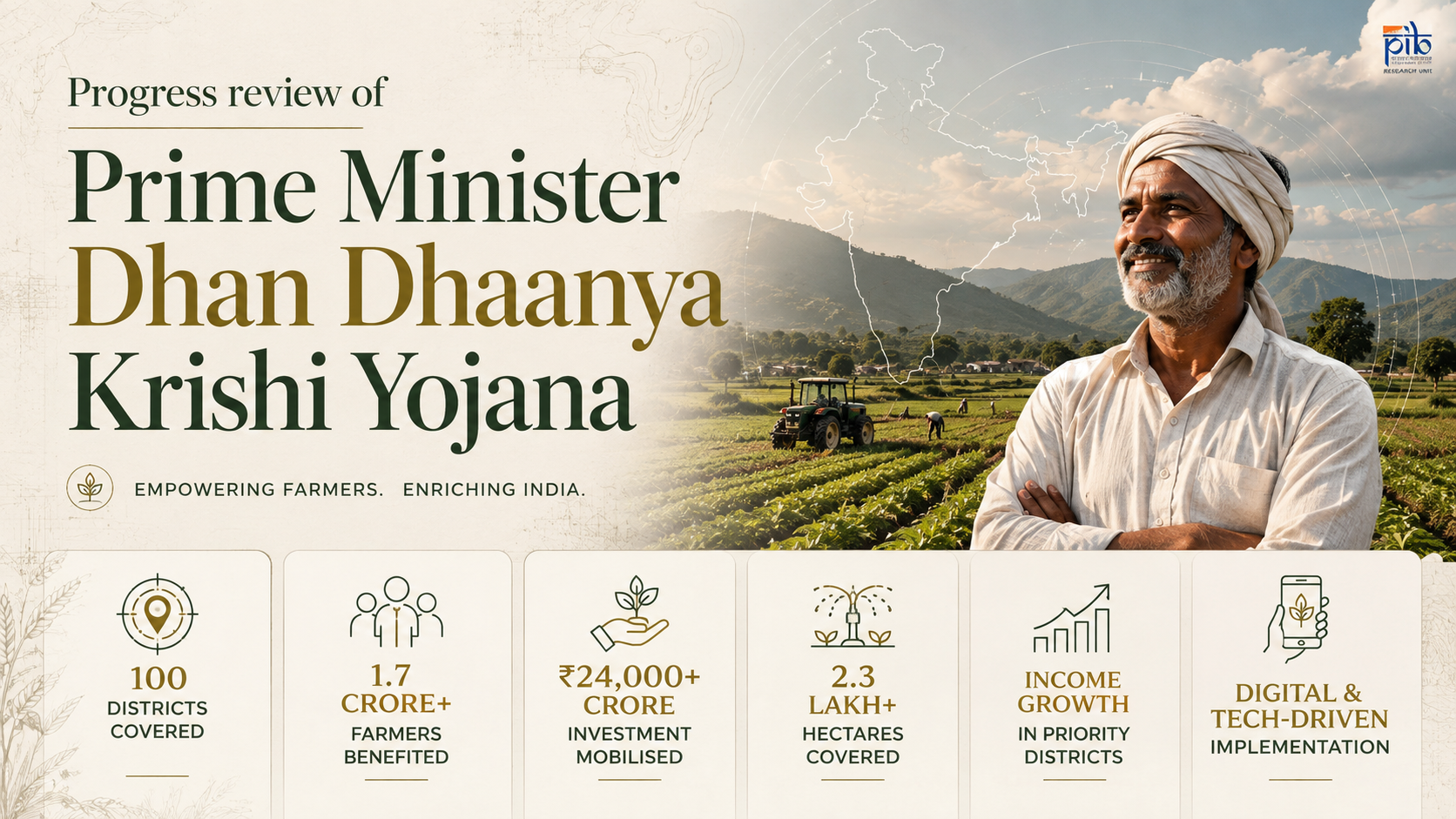
The Union Minister of Agriculture and Farmers Welfare reviewed the implementation progress of the Prime Minister Dhan Dhaanya Krishi Yojana (PMDDKY).
Core facts
- What it is: PMDDKY is a district focused agriculture development scheme. It converges existing schemes to raise farm productivity in India’s weakest performing agricultural districts.
- Implementing ministry: Ministry of Agriculture and Farmers Welfare is the nodal ministry. Multiple line departments contribute converged schemes.
- Coverage: The scheme targets 100 districts. Districts are selected on three parameters. The parameters are low agricultural productivity, low cropping intensity, and low credit disbursement.
- Convergence design: The scheme pools 36 existing schemes across 11 departments. It layers these on a single district plan rather than creating a new fund line.
- Release specific review figures: The specific progress numbers, district status, and targets reported in PRID 2305501 could not be verified from PIB this run. They are not reproduced here.
Static Context
- Origin: The scheme was announced in the Union Budget 2025 to 2026. The Union Cabinet approved it in July 2025.
- Duration: The scheme runs for 6 years from 2025 to 2026.
- Model: The scheme is modelled on the Aspirational Districts Programme. That programme uses ranking, convergence, and competitive monitoring to lift the weakest districts.
- Focus areas: The scheme covers productivity, crop diversification, sustainable agriculture, irrigation and water conservation, post harvest storage at panchayat and block level, and farm credit.
- Monitoring: District, State, and National level committees oversee the scheme. NITI Aayog and assigned Central Nodal Officers support monitoring.
Prelims angle
- Number of districts covered: 100 districts.
- Selection parameters: low productivity, low cropping intensity, low credit disbursement.
- Number of converged schemes: 36 schemes across 11 departments.
- Parent design model: Aspirational Districts Programme.
- Nodal ministry: Ministry of Agriculture and Farmers Welfare.
Mains angle
GS3, agriculture theme (major crops, cropping patterns, agricultural productivity, and scheme convergence). A question can ask how a convergence and district targeting model raises productivity in low performing agricultural districts. It can also ask how crop diversification and integrated farming raise small farmer incomes.
“[2022, GS3, 15] What is Integrated Farming System ? How is it helpful to small and marginal farmers in India ?”
“[2025, GS3, 10] Explain the factors influencing the decision of the farmers on the selection of high value crops in India.”
