💥Join UPSC 2027,2028 Mentorship (July Batch) + XFactor Notes & Microthemes PDF

GS Paper: GS2-15.Transaparency and accountability (institutional and other measures); Citizens Charter, E-Governance (applications, models, successes, limitations, potential)

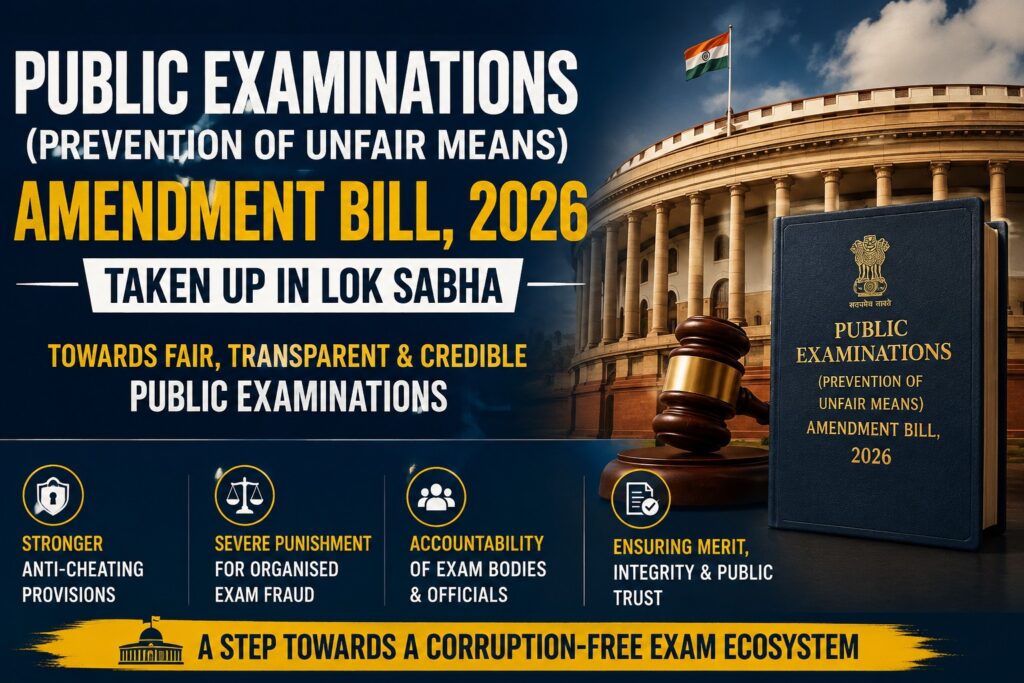
  • What are the aims and objects of the recently passed and enforced, The Public Examination (Prevention of Unfair Means) Act, 2024? Whether University/State Education Board examinations, too, are covered under the Act?

    The Public Examination (Prevention of Unfair Means) Act, 2024, was enacted to curb widespread malpractices, paper leaks, and organised cheating in recruitment and entrance examinations conducted by central authorities.

    Aims and Objectives of the Act

    Provide clear legal framework to deal with issue of paper leaks

    Defining Unfair Practices – Includes leakage of question papers, tampering of answer sheets, manipulation of computer systems, and collusion with officials or service providers.

    Empowering Examination Authorities – Allows surprise checks, blacklisting of service providers, and enhanced oversight mechanisms.

    Authorises the Centre to refer cases to Central Investigation Agencies for probing large-scale malpractices.

    Enables setting up of special courts for time-bound adjudication of offences.

    Stringent Punishments – Prescribes 3-5 years of imprisonment and fines up to , extendable for organised crimes, to restore public confidence.

    Addressing Organised Examination Crimes – Provides for property attachment and prosecution of institutions involved in organised cheating networks.

    Deterring Unfair Means – Prevents cheating, impersonation, and paper leaks, ensuring transparency, fairness, and credibility in examinations.

    Significance

    Ensuring Integrity of Public Examinations

    Deterring Organised Malpractices

    Protecting Merit and Equal Opportunity

    Enhancing Accountability of Examination Authorities

    Promoting Transparency and Trust

    Strengthening Governance and Fair Recruitment

    Coverage under the Act

    The Act applies to “Public Examinations” conducted by authorities listed in its Schedule or notified later by the Central Government.

    The Schedule presently includes:

    Union Public Service Commission (UPSC)

    Staff Selection Commission (SSC)

    Railway Recruitment Boards (RRBs)

    Institute of Banking Personnel Selection (IBPS)

    National Testing Agency (NTA) and other Central Government recruitment bodies.

    University and State Education Board examinations are not automatically covered unless specifically notified by the Central Government under Section 2 of the Act.

    Limitations of the Act

    Limited Coverage – State Boards and Universities are not automatically covered.

    No Dedicated Investigative Mechanism – Investigation left to DSP-level officers

    Technology Gaps – Insufficient use of digital tracking, encryption, and data protection tools to prevent leaks.

    Ambiguity in Defining “Unfair Means” – The broad wording may lead to subjective interpretation and misuse.

    Heavy reliance on Central Government notification powers may limit federal flexibility.

    Focuses mainly on punitive measures, not on systemic prevention and capacity-building.

    Judicial Burden – Creation of special courts without adequate infrastructure may lead to delays in trial.

    Training Deficit – Lack of awareness and training among invigilators and exam staff undermines effective implementation.

    The Act represents a major reform to uphold the integrity, fairness, and accountability of India’s examination system.

    Civil Services

  • e-governance is not just about the routine application of digital technology in service delivery process. It is as much about multifarious interactions for ensuring transparency and accountability. In this context evaluate the role of the ‘Interactive Service Model’ of e-governance.

    The World Bank defines e-governance as the use by government agencies of information technologies that can transform relations with citizens, businesses, and other arms of government.

    E-Governance – multifarious interactions for ensuring transparency and accountability.

    Government to Citizen (G2C)

    UMANG, DigiLocker – Online service access.

    CPGRAMS – Grievance redressal & feedback.

    MyGov, Jan Bhagidari – Citizen participation.

    Aadhaar-DBT, PM-KISAN – Direct benefit transfers.

    Government to Business (G2B)

    MCA21, GSTN, NSWS – Digital compliance & licensing.

    GeM Portal – Transparent procurement.

    Invest India, Ease of Doing Business Dashboard – Single-window clearance.

    Government to Government (G2G)

    PRAGATI, e-Office – Inter-departmental coordination.

    PFMS – Fund tracking & financial accountability.

    Government to Employee (G2E)

    SPARROW – Online performance appraisal.

    iGOT-Karmayogi – Capacity building & training.

    e-Office, HRMS – Paperless workflow.

    Interactive service model

    Role of the ‘Interactive Service Model’ of e-Governance

    Citizen-Centric Governance: Shifts from departmental silos to integrated, citizen-focused service delivery. Eg- Sakala (Karnataka) – time-bound, transparent service guarantee.

    Bridging Government-Citizen Gap: through digital and doorstep access to services. Eg- MPeSeva in Madhya Pradesh.

    Participative and Responsive Governance through two-way interaction between citizens and government. Eg- MyGov portal.

    Trust-Based Model of Governance through transparency and proactive disclosure of information. Eg- Jan Soochna Portal (Rajasthan) – real-time public data access.

    Transparency and Accountability in Service Delivery: Enables real-time grievance tracking and service feedback loops. Eg- CPGRAMS, UMANG, GeM Portal.

    Ensures zero tolerance to corruption through traceable digital transactions. Eg- DBT has saved

    Empowered and Informed Citizens to shape governance outcomes. Eg- Open Government Data Portal, NDAP.

    From Ad hoc to Whole-of-Government Approach: Promotes integrated and citizen-centric service delivery.

    Challenges in Implementing the Interactive Service Model

    Digital Divide: Only 43% of rural households have internet access (NFHS-5, 2021), limiting inclusivity.

    Digital Literacy: Merely 10% of rural population is digitally literate (NSSO data, 2022).

    Data Privacy and Security Risks: Eg- CoWIN data leak.

    Institutional Resistance to adopt open data and feedback-based systems.

    Multiple portals without integration and interoperability hinder seamless user experience.

    Exclusion and inclusion errors in digital systems reduce trust in e-services. Eg- authentication errors in Aadhaar-linked DBT or ration delivery.

    Weak Common Service Centre (CSC) Infrastructure: poor connectivity, limited equipment, and untrained staff

    Lack of People-Centric Governance: Most government websites are only in English, not in vernacular languages, excluding non-English users.

    Way Ahead

    Strengthening Digital Infrastructure: Extend optical fibre connectivity under BharatNet to all Gram Panchayats.

    Promote citizen digital engagement and training through PMGDISHA and Digital India initiatives.

    Embedding Digital Literacy in Education: Integrate e-literacy programmes like e-Kidz and IT Clubs in school curricula.

    Business Process Reengineering (2nd ARC): Simplify procedures, ensure platform integration, and promote seamless inter-departmental coordination.

    Leverage 4th Industrial Revolution Technologies: Use AI, IoT, and blockchain for predictive governance and smart delivery systems.

    This can transform e-Governance into a trust-based, citizen-driven, and participatory governance model.

  • The Citizens’charter has been a land mark initiative in ensuring citizen-centric administration. But it is yet to reach its full potential. Identify the factors hindering the realisation of its promise and suggest measures to overcome them.

    Originating in the United Kingdom (1991), India adopted Citizens’ Charters in 1997 to ensure administrative accountability.

    Importance in Citizen-Centric Administration

    Empowers Citizens: Transforms passive recipients into active stakeholders. Eg: Rights-based service delivery.

    Enhances Accountability: Holds specific officials responsible for service failures.

    Promotes Transparency: Clearly lists available services and required documents.

    Standardizes Quality: Establishes a uniform “benchmark” for public services. Eg: ISO certification.

    Grievance Redressal: Provides a structured mechanism for reporting dissatisfaction.

    Fosters Trust: Bridges the gap between the public and government through feedback loops.

    Time-Bound Delivery: Commits administration to strict deadlines. Eg: Passport issuance.

    Value for Money: Ensures taxpayers receive efficient services for their taxes.

    Factors Hindering Realisation of its Promise

    Vague Standards: Promises are often worded ambiguously rather than using quantifiable benchmarks. Eg: “Prompt service.”

    Lack of Legal Teeth: Voluntary nature means no penalties exist for violating charter commitments. Eg: Unenforceable timelines.

    Top-Down Approach: Centralized drafting ignores local ground-level constraints and resource availability. Eg: Uniform rural-urban charters.

    Resistance to Change: Bureaucratic inertia prevents officials from adopting a service-oriented mindset. Eg: Ignoring citizen feedback.

    Inadequate Infrastructure: Offices often lack the funds or manpower to meet promised standards.

    Poor Publicity: Awareness is often restricted to a small notice board inside the office.

    Static Nature: Most documents do not adapt to technological changes or evolving needs. Eg: Outdated manual forms.

    Siloed Operations: Focuses on individual departments rather than the citizen’s “end-to-end” journey.

    Language Barrier: Charters are often not available in regional or vernacular languages.

    Lack of Audits: Departments rarely publish independent evaluations of their adherence to standards. Eg: Missing annual reports.

    Stagnant Updates: A DARPG audit found several central charters haven’t been updated in over 5 years.

    Poor Grievance Disposal: Satisfaction rates for grievance redressal in many states hover below 40%.

    Successful Examples of Citizen Charters in India

    Passport Seva Kendra: clear timelines, digital tracking, and professional service environment

    Indian Railways: compensation, cleanliness standards, and punctuality targets.

    Taxpayers’ Charter: Defines rights like privacy and fair treatment.

    National Health Mission: Charters in government hospitals outlining free medicines and diagnostic services for the poor.

    Measures to Overcome Challenges

    Statutory Backing: Legally mandate service delivery through “Right to Services” Acts. Eg: MP Lok Sewa Act.

    Adopt Sevottam: Implement the 2nd ARC-recommended Sevottam model for quality management. Eg: IS 15700:2005 certification.

    Decentralized Drafting: Allow local units to customize charters based on specific resources.

    Technological Integration – Promote digital dashboards, online service tracking, and data-based performance monitoring. Eg: Sakala portal, Karnataka.

    Stakeholder Consultation: Conduct “Jan Sunwais” (public hearings) to update charters based on feedback.

    Independent Monitoring: Employ third-party NGOs to evaluate departmental performance annually. Eg: Quality Council of India audits.

    Capacity Building: Train frontline staff in technical aspects of service delivery through Mission Karmayogi.

    Awareness: Use social media and local languages to educate citizens. Eg: “Jago Grahak Jago” style ads.

    By aligning it with the 2nd ARC recommendations, it can evolve from a symbolic commitment to a practical framework for responsive, transparent, and citizen-centric governance.


  • E-governance projects have a built-in bias towards technology and back-end integration than user-centric designs. Examine.

    The World Bank defines e-governance as the use by government agencies of information technologies that can transform relations with citizens, businesses, and other arms of government.

    E-governance Projects

    Government to Citizen (G2C) – UMANG, DigiLocker

    Government to Business (G2B) – MCA21, GSTN, GeM Portal

    Government to Government (G2G) – PRAGATI, e-Office

    Government to Employee (G2E) – SPARROW, iGOT-Karmayogi

    Built-in Bias Towards Technology and Back-End Integration

    Infrastructure-Centric Approach: Focus on servers, networks, and databases rather than citizen interface.

    Neglect of ease of access for end-users. Eg- complexity in GSTN and MCA 21 portals.

    Exclusion Errors: Aadhaar authentication failures lead to denial of benefits. Eg- Jharkhand PDS (2017) saw 10-15% exclusion (NITI Aayog).

    Technology Outpacing Capacity: Rapid adoption of AI, blockchain, and analytics without adequate digital literacy or institutional capacity at the local level.

    Lack of User-Centric Designs

    Language and Accessibility Barriers: Most portals available only in English, excluding non-English users.

    Complex Interfaces and Poorly designed websites discourage participation. Eg- multiple logins and verification steps.

    Digital Divide and Exclusion: Only 43% of rural households have internet (NFHS-5, 2021).

    Most systems lack built-in feedback loops or grievance redressal.

    Absence of Design Thinking: Systems designed from administrative, not citizen, perspective

    One-Size-Fits-All Approach: Uniform design ignores regional, gender, and social diversity, affecting inclusivity.

    However, there are few Achievements

    UMANG App: Unified access to 2,300+ government services in 23 languages

    MyGov Platform: Enables citizen consultation and idea crowdsourcing.

    Jan Soochna Portal (Rajasthan): Promotes proactive disclosure of welfare data.

    eSanjeevani Telemedicine Platform: Over 18 crore consultations, with simple, accessible interface for rural users.

    BHASHINI: Supports 35+ Indian languages, breaking language barriers and enhancing inclusivity.

    PMGDISHA: Over 6.3 crore citizens trained in digital literacy.

    Way Forward

    Adopt Design Thinking: Involve citizens in service design and usability testing.

    Local Language Interfaces: Scale BHASHINI integration across all digital services.

    Social Audits and Human Interface: Combine digital governance with local institutions for last-mile trust.

    Strengthen Digital Infrastructure: Accelerate BharatNet Phase-II to connect all Gram Panchayats

    India must move toward “Technology with Inclusion” – ensuring no beneficiary is left behind.

    Civil Society Organisations