Mains Ready By December. Smash Mains & Smash PYQ Admissions Open

GS Paper: GS2-15.Transaparency and accountability (institutional and other measures); Citizens Charter, E-Governance (applications, models, successes, limitations, potential)

  • Police camera ‘caught’ murder, rape accused at Jantar Mantar protest

    Police camera ‘caught’ murder, rape accused at Jantar Mantar protest

    Why in the News

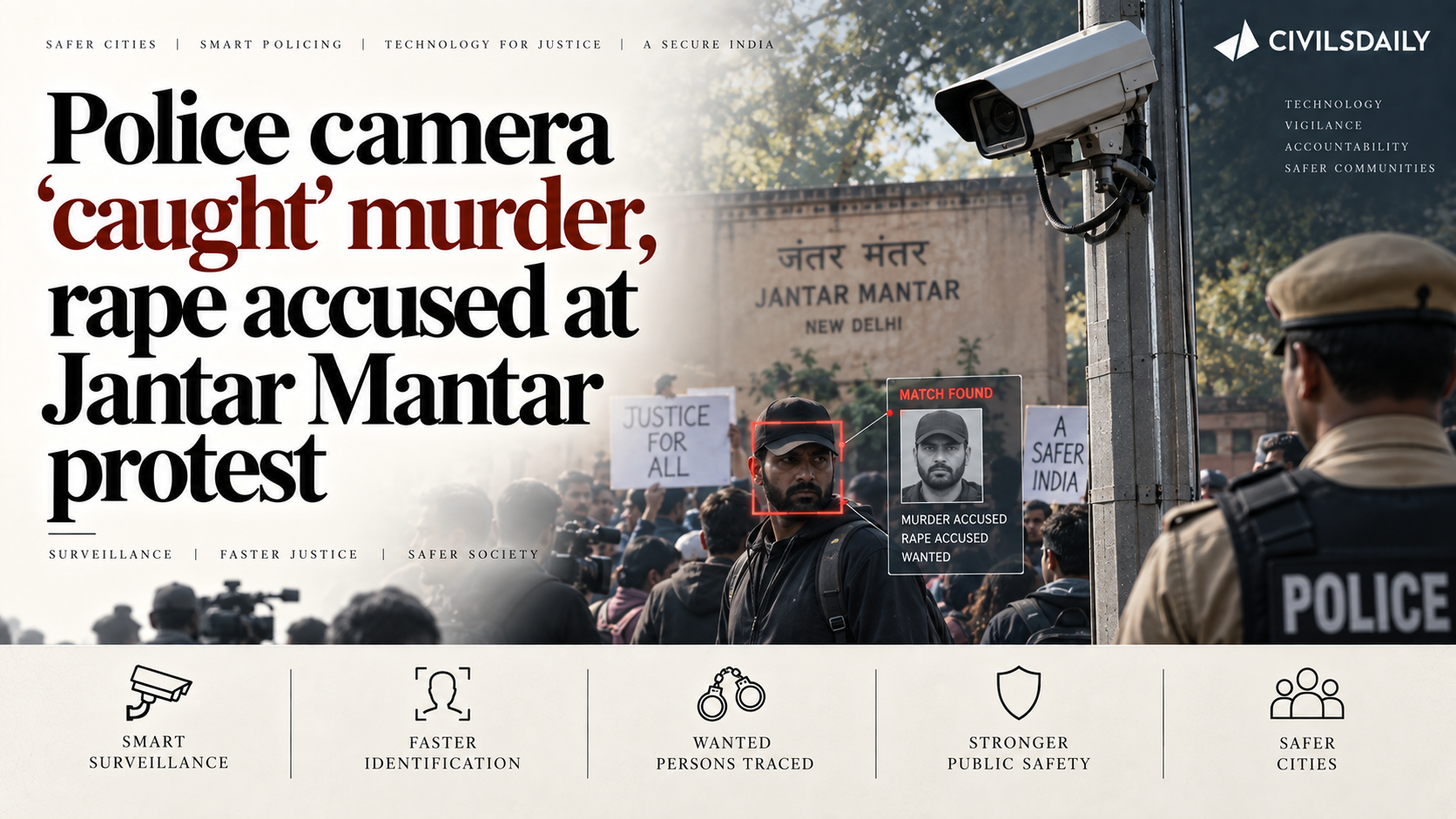
    The Delhi Police has told the Supreme Court that its Facial Recognition System (FRS) spotted 2,873 people with criminal antecedents at the main protest site at Jantar Mantar between 20 and 26 July. The submission follows a Supreme Court order quashing every First Information Report (FIR) arising from the exam leak student protests.

    What is the Delhi Police’s Facial Recognition System?

    1. What the software does: It places boxes around faces detected in a camera feed and compares them against images held in police databases.
    2. The threshold for a positive match: A match is treated as positive at an accuracy rate of 80 per cent, a figure the force disclosed in a 2022 reply under the Right to Information (RTI) Act, 2005.
    3. What it searches against: Of the 2,873 flags, 2,402 were attributed to Crime Kundli, the force’s own biometric database, and 471 to criminal records.
    4. What the output is not: A match is not by itself proof of identity, and performance varies with the algorithm, camera angle, lighting, image quality, masks and the database being searched.

    What does the offence-wise breakdown in the affidavit show?

    1. The residual category is the largest by far: 1,884 of the 2,873, close to two thirds, sit under other Indian Penal Code, Bharatiya Nyaya Sanhita and special law entries rather than under any named serious offence.
    2. The legal status of those flagged is unstated: The affidavit does not specify whether the people identified were accused, convicts, or merely named in criminal cases.
    3. The database is claimed to hold only serious offenders: The affidavit states that the face and other material of only those accused facing serious offences are in the police record, and not those facing petty offences such as traffic violations.
    4. The geographic concentration: The North district recorded the highest count at 285, followed by Outer at 257, North West at 256, North East at 174, East at 173 and South West at 166. Railways, Crime Branch, IGI Airport, Metro and the Special Cell were among the other units listed.

    What did the record check of 205 flagged individuals find?

    1. The sample examined: The 205 comprised 101 murder accused, 61 rape accused, 6 accused under the Protection of Children from Sexual Offences (POCSO) Act, 2012, and 37 of the 62 listed under attempt to murder.
    2. The finding: At least 25 of them were lodged in the Tihar, Mandoli or Rohini prison complexes at the time the system flagged them, according to police, jail and court records.
    3. The composition of the 25: 17 were accused in murder cases, 4 in rape cases of which 3 were under the POCSO Act, and 4 in attempt to murder cases.
    4. The dates of the flags: Three of the 25 were identified on 24 July, 21 on 25 July and one on 26 July, the final day of the protest.

    Why does the police assurance not settle the question?

    1. Verification is the only safeguard on record: The stated position is that action follows only after field verification establishes that the person was in fact present at the site, and no verification standard, timeline or reporting duty accompanies that assurance.
    2. Verification is still pending at scale: The force has stated that further verification of the identified individuals is pending, which leaves 2,873 names on a list that a court has already permitted the government to act on.
    3. The accuracy threshold is an internal setting, not a legal standard: An 80 per cent match is a configuration choice inside the software, and no statute, rule or judicial direction fixes what confidence level may be relied on before a person is named.
    4. The error is not random noise: People held in custody were placed at a protest site by the system, which points to database and matching failure rather than to a borderline image.

    Challenges to facial recognition in policing

    1. No statutory basis governs deployment: India has no law authorising or limiting police use of facial recognition, so procurement, matching thresholds and retention are set administratively. Eg. The Delhi Police’s 80 per cent threshold became public only through a Right to Information reply, not through a published rule.
      The Fix: Require prior legislative authorisation and a published operating standard for any biometric identification system before it is deployed in a public space.
    2. Accuracy falls sharply for some groups: Error rates in facial recognition are higher for darker skin tones, women and younger faces, so the burden of a false match is not evenly spread. Eg. The United States National Institute of Standards and Technology’s evaluation of commercial algorithms recorded higher false positive rates across demographic groups.
      The Fix: Mandate a published demographic error audit of the deployed algorithm before each operational use, with results filed with the sanctioning authority.
    3. The system was built for one purpose and used for another: A database assembled to trace missing persons or match crime scene images becomes a crowd screening tool without any fresh authorisation. Eg. The Delhi Police’s facial recognition capability was originally acquired for tracing missing children.
      The Fix: Attach a statutory purpose limitation to each biometric database, so any new use requires a separate written sanction that is placed on record.
    4. Surveillance at a protest changes who turns up: Recording and matching faces at an assembly deters lawful participation independently of any action that follows. Eg. Cameras mounted on police vans at the Jantar Mantar site were visible to those attending.
      The Fix: Bar identification of participants at a lawful assembly except on a written order naming a specific cognisable offence under investigation.
    5. There is no route to contest a match: A person flagged by the system is not told, so the error surfaces only if a journalist or a court checks the records. Eg. The 25 custodial mismatches came to light through a newspaper’s record check, not through any internal review.
      The Fix: Require written notice to every individual against whom a biometric match is acted on, with a stated procedure to seek correction of the underlying record.

    Conclusion

    A facial match is being treated as a sufficient basis to proceed against a named list, while the force’s own position is that a match establishes nothing on its own. Both cannot hold at once. Nothing on record fixes what field verification must consist of, who performs it, or who checks that it happened. The point to watch is whether the Court requires the verification outcome for each flagged individual to be filed before any action follows.

    [2024] Under which of the following Articles of the Constitution of India, has the Supreme Court of India placed the Right to Privacy?

    (a) Article 15

    (b) Article 16

    (c) Article 19

    (d) Article 21
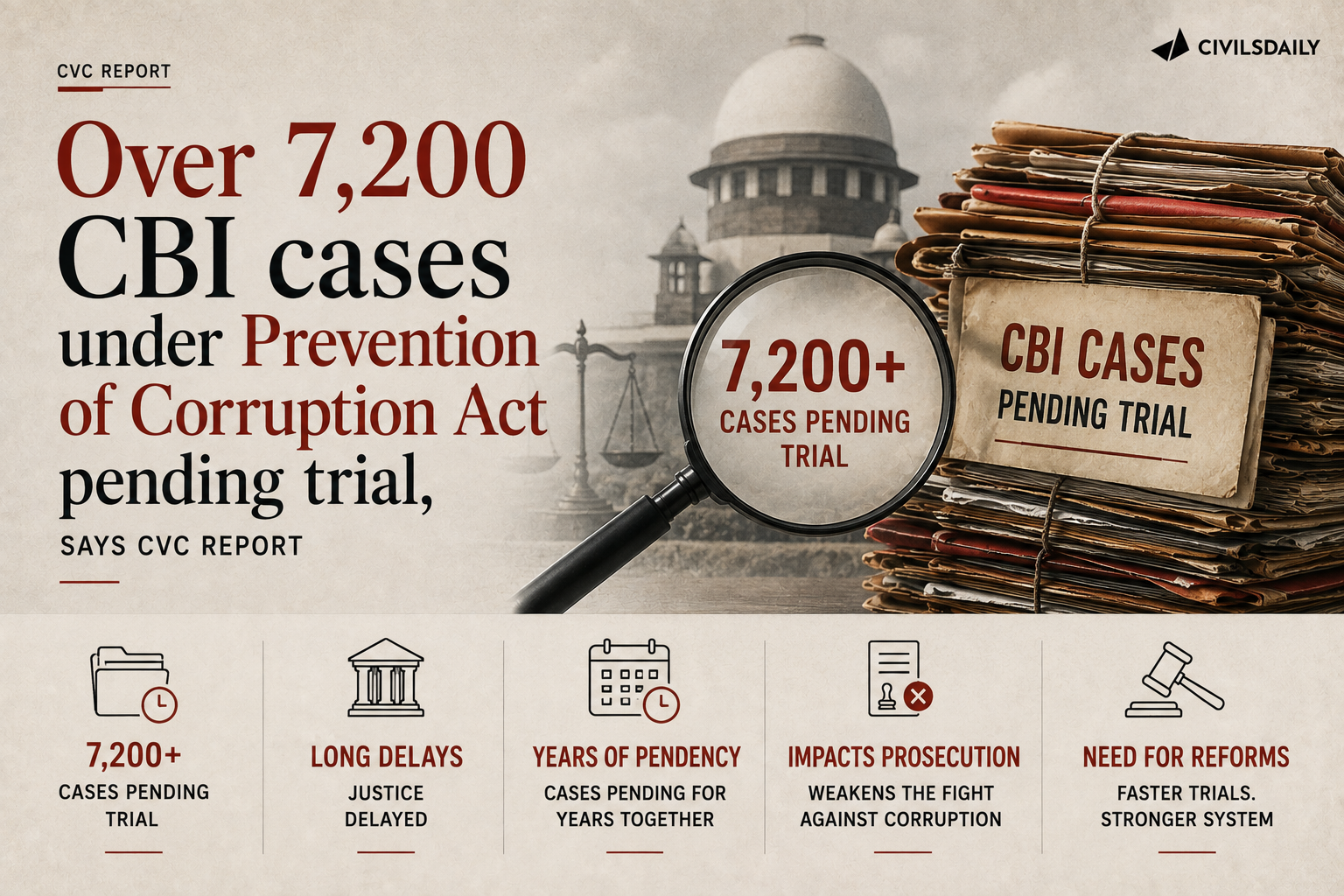
  • Over 7,200 CBI cases under Prevention of Corruption Act pending trial, says CVC report

    Over 7,200 CBI cases under Prevention of Corruption Act pending trial, says CVC report

    Why in the News

    The Central Vigilance Commission (CVC) has reported in its annual report that over 7,200 cases investigated by the Central Bureau of Investigation (CBI) under the Prevention of Corruption Act, 1988 were awaiting completion of trial at the end of 2025.

    Where does the anti-corruption pipeline stall?

    1. Trials run past two decades: More than 400 of the 7,229 pending Prevention of Corruption Act trials have been open for over 20 years.
    2. Appeals add a second backlog: 14,083 appeals, revisions and writ petitions under the Act were pending in the High Courts and the Supreme Court.
    3. Over a third of those are more than a decade old: 3,161 were 10 to 15 years old, 1,347 were 15 to 20 years old and 739 were over 20 years old.
    4. The wider trial load is larger still: Counting cases outside the Act, 11,510 CBI court cases were pending trial at the end of the year.

    What do the investigation and conviction figures show?

    1. Convictions improved: The conviction rate in CBI cases was 71.71 percent in 2025 against 69.14 percent in 2024.
    2. Investigation pendency is small by comparison: 755 corruption related cases were pending investigation, made up of 679 regular cases, 63 preliminary enquiries and 13 Lokpal references (cases the Lokpal has referred to the CBI for investigation).
    3. A year is the usual limit, and 274 cases crossed it: Of the 679 regular cases, 274 had been pending for over one year.
    4. The intake in 2025: The CBI registered 797 regular cases, 177 preliminary enquiries and recorded 31 Lokpal references during the year.

    What capacity does the vigilance system have?

    1. One in seven CBI posts is vacant: Against a sanctioned strength of 7,300, 1,088 posts were vacant, with the largest gap of 672 in the executive ranks.
    2. Departmental inquiries under the Commission: For officers under CVC jurisdiction, 1,460 departmental inquiries were in process during 2025 and 731 were completed.
    3. Inquiries outside its purview: For employees outside its jurisdiction, 9,883 inquiries were in process and 5,561 were completed.
    4. Complaint disposal kept pace: The Commission received 34,153 complaints in 2025 in addition to 1,260 carried forward from 2024, and disposed of 35,193.

    Challenges to prosecuting corruption under the Prevention of Corruption Act

    1. Sanction is a gate the executive controls: Section 19 requires the government’s sanction before a court can take cognisance against a public servant, and Section 17A, added by the Prevention of Corruption (Amendment) Act, 2018, requires prior approval even to begin an inquiry into a decision taken in official capacity. Eg. In Vineet Narain v Union of India (1997) the Supreme Court fixed a three month limit for sanction decisions, and the 2018 amendment wrote that limit, extendable by one month, into Section 19 itself.
      The Fix: Treat sanction as deemed granted when the statutory period lapses without a decision.
    2. Special courts are too few for the load: Section 3 of the Act requires trials before special judges, and the same judges carry other criminal work, so a corruption trial waits behind the general docket. Eg. In Ashwini Kumar Upadhyay v Union of India the Supreme Court in 2021 recorded 4,984 pending criminal cases against legislators and directed special courts to prioritise them.
      The Fix: Designate exclusive special judges for Prevention of Corruption Act trials in every district with a CBI court, with a monthly disposal target monitored by the High Court.
    3. State consent limits where the CBI can act: Under Section 6 of the Delhi Special Police Establishment Act, 1946 the CBI needs a State’s consent to investigate within it, and a growing list of States has withdrawn general consent so every case needs a fresh order. Eg. West Bengal withdrew general consent in November 2018, and in 2024 the Supreme Court allowed the State’s suit against the Union over CBI investigations to proceed to trial.
      The Fix: Enact a standalone CBI statute defining its jurisdiction, as the Parliamentary Standing Committee on Personnel, Public Grievances, Law and Justice recommended in 2023.
    4. Deputation, not a cadre, staffs the agency: The CBI fills most executive posts by deputation from State police and central forces, so vacancies persist when States decline to release officers. Eg. In May 2013, during the coal block allocation hearing, the Supreme Court described the CBI as a “caged parrot” after the agency’s status report had been shared with the Law Minister.
      The Fix: Expand direct recruitment at the sub inspector and deputy superintendent levels and offer fixed tenure with cadre security to reduce reliance on deputation.

    Conclusion

    The Commission’s numbers show the agency’s work improving at the stages it controls and stalling at the stages it does not. The pendency now sits with the courts and the sanctioning authorities rather than with the investigators. The marker to watch is whether the next annual report shows the oldest trials closing rather than the backlog growing.

    Back2Basics: Central Vigilance Commission (CVC)

    1. Origin: Set up in 1964 on the recommendation of the Santhanam Committee on Prevention of Corruption, and made a statutory body by the Central Vigilance Commission Act, 2003.
    2. Composition: A Central Vigilance Commissioner and up to two Vigilance Commissioners, appointed by the President on the recommendation of a committee of the Prime Minister, the Union Home Minister and the Leader of the Opposition in the Lok Sabha.
    3. Powers over the CBI: It exercises superintendence over the CBI’s investigations of offences under the Prevention of Corruption Act by virtue of Section 4 of the Delhi Special Police Establishment Act, 1946, and reviews the progress of those investigations.
    4. Reporting: It submits an annual report to the President, and the report is laid before both Houses of Parliament.

    [2026, GS2, 15 marks] “Transparency and accountability in governance are not about controlling corruption but about creating the trust of stakeholders in the policy process by following the Rule of Law and Participatory Governance.” Comment.”

  • Why India’s R&D system needs a map of where funds really go

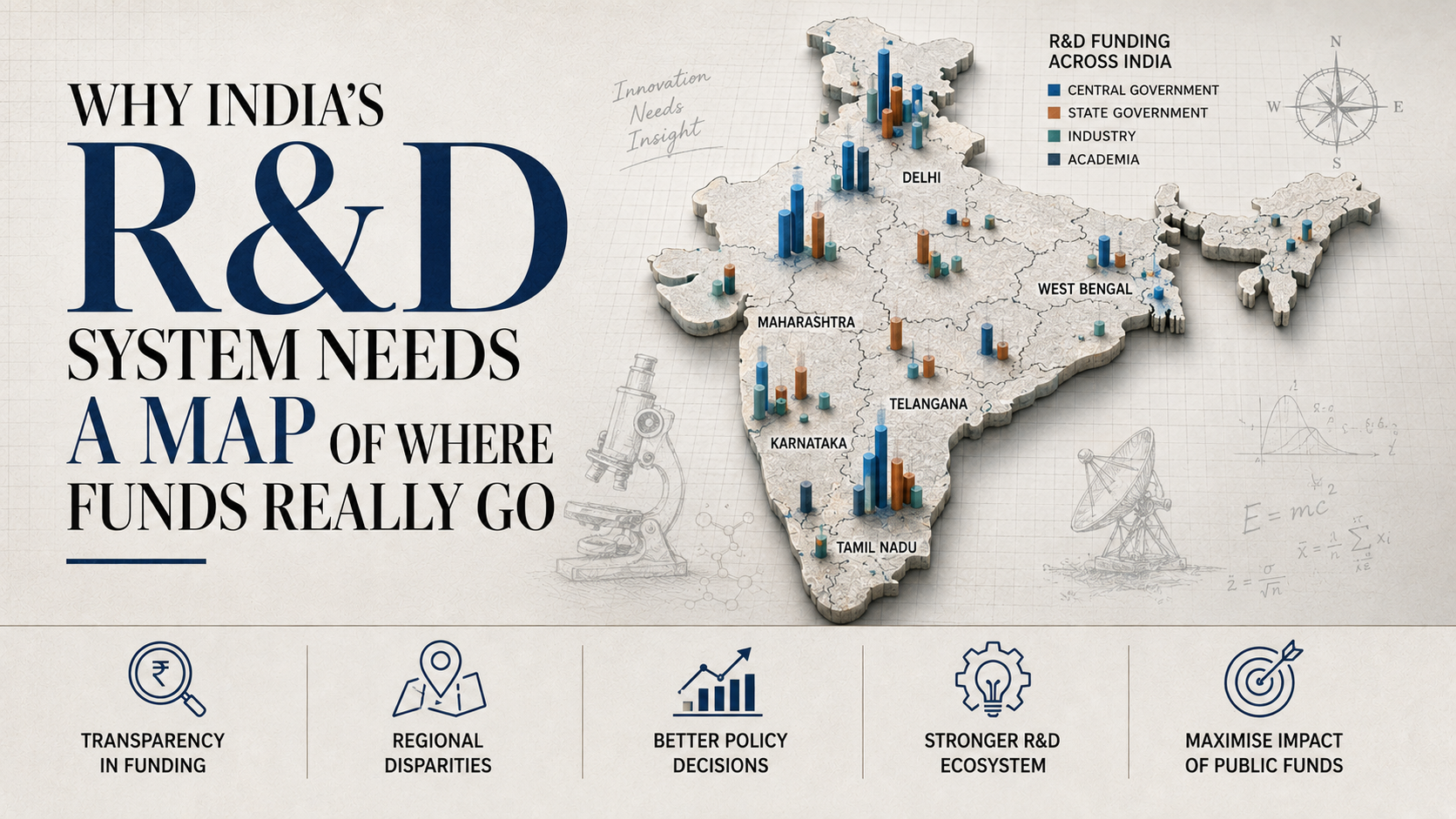
    Why India’s R&D system needs a map of where funds really go

    Why in the News

    A NITI Aayog report, ‘Ease of Doing R&D in India’, drawing on a survey of over 400 institutional leaders and 850 scientists, has found that close to 80% of funding under the Anusandhan National Research Foundation (ANRF, India’s apex research funding body, whose governing board is headed by the Prime Minister and which is mandated to draw much of its funding from non-governmental sources alongside Central contributions) is concentrated in the IITs, despite ANRF’s own mandate to support a wider base of universities and research bodies. The report also flagged that multiple central agencies may be funding overlapping research areas, leading to what it calls “inefficient” use of public money. NITI Aayog’s proposed response is the Unified Project Management System (UPMS), meant to streamline planning, funding, monitoring and evaluation of public R&D projects across ministries. The article argues that UPMS does not by itself fix the deeper gap it is meant to solve: India has no system that can tell funders, researchers or the public who is being funded, by whom, for what, and whether that funding has already been given elsewhere.

    What is a persistent digital identifier (PID), and why does India’s R&D funding lack one?

    1. Persistent digital identifier (PID): A permanent, unique, machine-readable identifier attached to every research grant, comparable to how a PAN number identifies a taxpayer or an IMEI number identifies a phone.
    2. Attached metadata: Each PID is meant to carry a standard set of details, which agency gave the money, to which institution, to which named researcher, what amount, over what period, and in which field, linked so officials can track outcomes when the PID is cited in a published paper.
    3. Scattered and inconsistent records today: This information already exists inside Indian funding agencies, but scattered across dozens of separate databases, in inconsistent formats, often as free text. Eg. A researcher’s name may appear as “IISc, Bangalore” in one dataset and “Indian Institute of Science, Bengaluru” in another, enough for an automated system to fail to recognise them as the same institution.

    What does the NITI Aayog report reveal about India’s R&D funding?

    1. Concentration in a few institutions: Close to 80% of ANRF funding is concentrated in the IITs, despite ANRF’s mandate to support a wider base of universities and research bodies than the traditional funding model has managed.
    2. Possible duplication across agencies: Multiple Central agencies are possibly funding similar research areas, resulting in overlap and “inefficient” use of public money, per the report’s survey of over 400 institutional leaders and 850 scientists.
    3. The underlying gap: Both findings point to the same root cause, the absence of a system that can tell funders, researchers or the public who is funded, by whom, for what, and whether that funding has already been given elsewhere.

    How have other countries solved this identifier problem?

    1. Crossref’s Grant Linking System (global, non-profit): Built by the open digital infrastructure organisation Crossref, this system now has more than 2 lakh grants registered worldwide from funders seeking to track duplication and concentration.
    2. Research Organisation Registry (ROR) and ORCID: A funder ID identifies the funding agency down to the division or department; a ROR ID identifies the receiving institution; an ORCID identifier, already familiar to Indian researchers since most journals require it, identifies the individual researcher so funding can be aggregated per person.
    3. Grant DOI, since 2020: Crossref extended its system to a permanent identifier for the grant itself, which can be linked to whatever the grant produces, papers, patents or data.
    4. Government-owned national portals compatible with the global standard: The U.K.’s “Gateway to Research” portal and the European Union’s CORDIS and OpenAIRE infrastructure run their own government-owned single points of entry for funding agencies, while generating identifiers fully compatible with the Crossref/ROR/ORCID standards, giving national governments ownership without breaking compatibility with the global dataset.
    5. Documented scale of the problem elsewhere: A 2013 analysis of U.S. federal grant applications using automated text-matching estimated duplicate or overlapping funding may have cost the U.S. nearly $70 million; a 2020 analysis of nearly 20,000 competitive grants in Denmark found funds concentrated among a small group of researchers and a narrow set of topics, a pattern the article says mirrors what NITI Aayog flagged for India.

    What are India’s options going forward?

    1. Build a sovereign national registry: India could develop and maintain its own India-specific grant registry from the ground up, giving it full control and the ability to tailor the system to its own agencies, federal structure and State research schemes.
    2. Join the existing global infrastructure: India’s funding agencies could become members of the Crossref ecosystem directly, which can be implemented faster since the technical standards and governance already exist internationally.
    3. A hybrid middle path: India could build a single national portal, the NITI Aayog’s own proposed UPMS, that internally mints Crossref-compatible grant DOIs and links every record to ROR and ORCID identifiers, following the model of the U.K.’s Gateway to Research and the EU’s CORDIS/OpenAIRE.

    Challenges to the Unified Project Management System (UPMS)

    1. Legacy data inconsistency: Migrating scattered, free-text agency records into a structured PID system requires resolving years of inconsistent naming across agencies before the system can produce reliable data. Eg. The same institution recorded as “IISc, Bangalore” in one dataset and “Indian Institute of Science, Bengaluru” in another. Fix. Mandate a common institutional and researcher master list, cross-validated against existing ORCID and ROR records, before agencies are required to report through UPMS.
    2. Compliance is not self-enforcing: A national portal only produces reliable data if every Central and State funding agency consistently deposits data into it; a voluntary or partially adopted system reproduces the same blind spots the report identifies. Fix. Make UPMS reporting a precondition for releasing funds under any Central research scheme, so compliance is enforced through the funding process itself.

    Conclusion

    NITI Aayog’s Unified Project Management System addresses the process of streamlining India’s R&D funding, but by itself does not supply the persistent digital identifier and metadata infrastructure that would let funders, researchers and the public actually see where public research money goes and whether it has already gone somewhere else. The next milestone is whether UPMS is designed to mint Crossref-compatible identifiers and how many agencies are made to report through it.

    “[2024, GS2, 15 marks] What are the aims and objects of the recently passed and enforced, The Public Examination (Prevention of Unfair Means) Act, 2024? Whether University/State Education Board examinations, too, are covered under the Act?”

  • Smart glasses highlight gaps in privacy laws

    Why in the News

    Meta’s smart glasses, which can discreetly record video and audio of anyone around the wearer, have renewed concerns over surveillance and consent, and over how far the Digital Personal Data Protection Act, 2023 actually protects a bystander who never agreed to be recorded. The Supreme Court’s nine-judge Bench in Justice K.S. Puttaswamy v. Union of India (2017) held privacy to be a fundamental right intrinsic to Article 21, developing a three-part legality-necessity-proportionality test for any restriction on it. Wearable recording devices normalised for everyday use test that framework in a setting the 2017 judgment did not anticipate: a bystander with no relationship to the device’s owner, and no practical way to know they are being recorded.

    Why do smart glasses expose a specific gap in India’s privacy framework?

    1. The Digital Personal Data Protection Act, 2023 is built around consent, which a bystander cannot give: The Act’s core protection mechanism requires a data principal’s consent before personal data is processed, a structure that assumes a data subject who is a party to the transaction, not a bystander recorded without their knowledge by someone else’s device.
    2. No dedicated framework for covert or discreet recording devices: Existing privacy protections address data processing by an identifiable data fiduciary, typically a company or platform, not the diffuse, device-level recording enabled by consumer wearables carried by private individuals.
    3. Enforcement depends on the bystander detecting the recording: Because smart glasses are designed to record discreetly, a bystander has no practical way to exercise any of the rights the 2023 Act grants a data principal, since exercising those rights first requires knowing that one’s data was processed at all.
    4. Cybercrime figures already show a rising surveillance-adjacent harm pattern: National Crime Records Bureau data has recorded a rising trend in cybercrime cases involving unauthorised recording and image-based harassment, a pattern smart-glasses-style wearables are positioned to accelerate.

    Conclusion

    Smart glasses expose a structural gap between a consent-based data protection framework and a recording technology that operates on people who never consented to anything. Closing that gap requires provisions specific to covert or ambient recording devices, rather than relying on the same consent architecture built for data fiduciaries processing information from their own users.

    What is the Right to Privacy, and what does it protect?

    1. About: The Right to Privacy is a fundamental right, read into Article 21’s guarantee of life and personal liberty, protecting an individual’s control over personal information, bodily integrity, and personal decisions from unjustified interference by the State.
    2. Rationale: The right exists because personal autonomy, from choice of partner to control over one’s own data trail, is treated as intrinsic to human dignity rather than a privilege the State may withdraw.
    3. Named typology: The Supreme Court in Puttaswamy (2017) recognised several strands within the right: informational privacy over personal data, decisional autonomy over intimate personal choices, bodily integrity against intrusive procedures, and digital privacy against online surveillance.
    4. Proportionality test for restrictions: Any state action restricting privacy must meet a three-part test: legality (backed by law), a legitimate aim, and proportionality between the means used and the aim pursued.
    5. Institutional gap in independent oversight: Agencies such as the Intelligence Bureau, the Research and Analysis Wing, and the National Investigation Agency operate without a dedicated, independent body reviewing their surveillance activity for privacy compliance.
    6. Colonial-era laws still authorise interception: Provisions in the Telegraph Act continue to authorise phone tapping under standards that predate the Puttaswamy proportionality test, creating a mismatch between old authorisation powers and the newer constitutional standard.
    7. Corporate data harvesting outside individual awareness: Technology platforms collect and monetise personal data at a scale most users do not track or understand, a form of privacy erosion the Digital Personal Data Protection Act, 2023 only partially addresses through its consent and purpose-limitation provisions.
    8. Low digital literacy limits the exercise of privacy rights: Citizens frequently do not know what data they have given consent to share, or how to invoke the correction and erasure rights the 2023 Act grants them.

    Challenges in protecting the right to privacy

    1. Mass surveillance without independent judicial oversight: Interception and surveillance decisions in India are authorised through executive processes rather than prior judicial warrant. Eg. Allegations around the use of Pegasus spyware against journalists and activists in 2021 raised exactly this oversight gap. Fix. Introduce a judicial or quasi-judicial warrant requirement before any interception order takes effect, replacing the current executive-only authorisation.
    2. National-security exemptions in the 2023 Act draw criticism: The Digital Personal Data Protection Act, 2023 permits government agencies to be exempted from several of its obligations on national security and public-order grounds. Eg. Government bodies notified under the Act’s exemption provisions are not bound by the same data-minimisation and purpose-limitation duties private data fiduciaries face. Fix. Require any national-security exemption to be time-bound and reviewed periodically by an independent oversight body rather than granted as a standing exemption.
    3. Corporate surveillance through data-driven advertising: Large technology platforms build detailed behavioural profiles from data users hand over without meaningfully understanding the trade-off. Eg. Targeted political and commercial advertising built on granular user profiling has drawn regulatory scrutiny in multiple jurisdictions. Fix. Mandate clear, layered consent disclosures under the 2023 Act’s rules that separate necessary data use from optional profiling-based use.
    4. Health data retention concerns from pandemic-era tools: Contact-tracing and health applications built during the COVID-19 pandemic raised unresolved questions about how long the government retains the health data those apps collected. Eg. Aarogya Setu’s data retention and sharing practices drew sustained criticism from privacy researchers. Fix. Set a statutory data-retention ceiling for any health-emergency application, with automatic deletion once the stated public-health purpose ends.
    5. No dedicated authority solely focused on privacy enforcement: The Data Protection Board established under the 2023 Act adjudicates complaints but does not function as a proactive privacy regulator auditing surveillance practices across government and industry. Fix. Expand the Data Protection Board’s mandate to include periodic, unprompted audits of large-scale surveillance and data-processing systems, government and private alike.

    Back2Basics: Digital Personal Data Protection Act, 2023

    1. India’s first standalone law on personal data processing, built around consent as the primary legal basis for processing, with defined exceptions for legitimate uses such as employment and government functions.
    2. Creates the Data Protection Board of India as the adjudicatory body for data-protection complaints and penalties.
    3. Grants data principals rights to access, correct, and erase their personal data, and imposes purpose-limitation and data-minimisation duties on data fiduciaries.
    4. Permits the government to exempt specified agencies from several of the Act’s obligations on national security and public-order grounds, a provision that has drawn criticism for its breadth.

    Matching Previous Year Question

    “[2024, GS3, 10 marks] Describe the context and salient features of the Digital Personal Data Protection Act, 2023”

  • What has fuelled the backlash against Flock cameras in the U.S.?

    Why in the News

    A backlash has grown in the United States against Flock Safety, a company supplying Automated License Plate Reader (ALPR) cameras, after reports that local police departments used the company’s camera network for purposes beyond its stated public-safety mandate, including tracking individuals without a warrant. Flock’s cameras were adopted by thousands of US municipalities on the promise of solving vehicle-related crime through license-plate matching. Evidence that police departments used the same network for broader surveillance, including in ways that reached beyond a single jurisdiction’s own authority, has turned a crime-fighting tool into a symbol of unchecked surveillance expansion.

    Why has Flock Safety specifically drawn this backlash?

    1. Scale of camera deployment across US municipalities: Flock Safety’s automated license-plate-reader cameras are installed across thousands of towns and cities in the United States, giving the company’s network a national footprint that few individual police departments could have built on their own.
    2. Cross-jurisdiction data sharing without matching oversight: Police departments using Flock’s network can search license-plate data captured by cameras in other jurisdictions, a capability that expands what a single local force can track well beyond its own legal boundary, without matching cross-jurisdiction oversight.
    3. Reported misuse beyond stated crime-fighting purpose: Instances have emerged of the camera network being used to track individuals in contexts such as reproductive-healthcare-related travel and immigration enforcement, uses that go well beyond the vehicle-theft and hit-and-run cases the system was marketed to solve.
    4. Absence of a federal framework governing ALPR use: The United States has no single federal law governing how automated license-plate-reader data can be collected, retained, or shared, leaving oversight to a patchwork of local ordinances and police department policy.

    What does this suggest for India’s own camera-based surveillance rollout?

    1. India is expanding AI-linked camera surveillance in parallel: Indian cities have been expanding networks of AI-enabled cameras for traffic and law-enforcement purposes, a rollout that mirrors the scale-up Flock’s network underwent in the United States before the current backlash.
    2. India’s privacy law does not yet address law-enforcement camera data specifically: The Digital Personal Data Protection Act, 2023 governs personal data processing generally but does not set out a dedicated framework for retention limits, access logging, or cross-agency sharing of camera surveillance data collected for law enforcement.
    3. The US backlash offers a design lesson before scale, not after: The concern in the United States surfaced only after the network had scaled to thousands of jurisdictions with data-sharing already built into the product, a sequencing that leaves oversight design catching up to deployment rather than preceding it.

    Conclusion

    The backlash against Flock Safety’s cameras in the United States is a warning about what happens when a surveillance network scales faster than the oversight framework governing its use. India’s own camera-based surveillance expansion is at an earlier stage, leaving room to build retention, access, and sharing safeguards into the framework before, rather than after, the network reaches a comparable scale.

    Back2Basics: Automated License Plate Reader (ALPR)

    1. A camera system that automatically captures and reads vehicle license plates, converting the image into searchable text data matched against watchlists or databases.
    2. Originally marketed for narrow uses such as locating stolen vehicles or vehicles linked to an active crime.
    3. Data captured by one camera can be pooled into a shared network, allowing a search across cameras operated by multiple, unconnected police jurisdictions.
    4. Raises retention and access-control questions distinct from a single fixed CCTV camera, because the data is structured, searchable, and easily aggregated across locations.

    Matching Previous Year Question

    “[2024, GS3, 10 marks] Describe the context and salient features of the Digital Personal Data Protection Act, 2023”

  • J&K Census enumerators raise tech concerns

    Why in the News

    A readiness review for the Population Enumeration phase in Doda district recorded that Census enumerators and supervisors in the snow bound areas of Jammu and Kashmir (J&K) hold mobile devices below the configuration the Census application requires. Census 2027 is India’s first digital headcount, and it runs on personal phones owned by school teachers and government employees rather than on equipment the state issues.

    What is the Digital Census 2027?

    1. First digital enumeration: Census 2027 is the first Census in India to be conducted digitally, with field data captured through a mobile application instead of printed schedules.
    2. Field workforce: Enumerators and supervisors are drawn mostly from school teachers and government employees, who record entries on their own handsets.
    3. Device specification: The application requires a minimum of 8 GB of RAM and Android 13 or above on the device used for Population Enumeration.
    4. Phased design: A self enumeration portal opens before field work, after which enumerators conduct door to door visits within a fixed window.

    What is self enumeration?

    1. Self enumeration: Self enumeration lets a household fill its own Census entries on an online portal instead of waiting for an enumerator to visit. The entry is verified later by the field functionary during the enumeration window.

    Why has device configuration become an enumeration problem?

    1. Hardware shifted to the enumerator: The Census application runs on the enumerator’s personal phone, so the capacity to count depends on assets the state neither owns nor issues.
    2. Specification threshold breached: Functionaries in the snow bound areas of Jammu and Kashmir were found holding phones below the 8 GB RAM and Android 13 requirement.
    3. Cost borne privately: The field workforce is composed of school teachers and government employees, so meeting the specification is a private expense rather than a budgeted input.
    4. Terrain compounds the gap: The affected districts are enumerated ahead of the rest of the country, which leaves the least time to replace or upgrade equipment.
    5. Resolution left open: The review recorded the shortfall for appropriate resolution without naming a procurement or substitution route.

    Why are Ladakh and the snow bound areas enumerated ahead of the rest of the country?

    1. Second phase advanced: The second phase of the Census in Ladakh and the snow bound areas of Jammu and Kashmir, Uttarakhand and Himachal Pradesh is being conducted ahead of the rest of the country.
    2. Weather window: Snowfall closes road access to these habitations, so the field round has to be completed before winter sets in.
    3. Self enumeration first: The self enumeration portal for these regions remains available from 17 August to 31 August.
    4. Field window: Door to door enumeration starts on 1 September and concludes by 30 September 2026.
    5. District level review: Doda district’s readiness for that window was reviewed at the Deputy Commissioner’s Office Complex under the Chief Principal Census Officer.

    How is the exercise being prepared for hard to count populations?

    1. Migratory populations: Special attention was directed to the enumeration of migratory populations, whose movement across the enumeration window produces both omission and double counting.
    2. Tribal communities: Tribal communities were named as a category requiring focused enumeration effort.
    3. Remote forest residents: Residents of remote forest areas were named alongside them, since habitations there fall outside routine administrative contact.
    4. Verification discipline: Enumerators and supervisors were directed to ensure that all entries are properly recorded, verified and cross checked.
    5. Field inspection: Charge officers and supervisors were instructed to conduct regular field inspections and quality checks.
    6. Awareness campaigns: District authorities were asked to intensify awareness campaigns through newspapers, pamphlets, social media and local outreach programmes ahead of enumeration.

    Why is the postponement of the Census in Manipur being demanded?

    1. Deferral sought: The principal Opposition party has sought postponement of the Census exercise in Manipur, citing continuing violence and the displacement of thousands of people.
    2. Displacement scale: Nearly 60,000 people have remained homeless since violence in the State began on 3 May 2023, with many still living in relief camps.
    3. Housing stock destroyed: Over 10,000 houses have been destroyed in the State.
    4. House listing defeated: Accurate house listing of thousands of homeless people living in relief camps is not practicable, so the record would capture a household structure that no longer exists.
    5. Postponement, not cancellation: The demand is for deferral until conditions become conducive, and not for cancellation of the exercise in the State.
    6. Raised in Parliament: The Inner Manipur Lok Sabha member said he had raised the matter in Parliament.

    Does a digital Census widen or narrow the count?

    1. Speed against reach: Digital capture shortens the gap between field entry and tabulation, and it makes the count conditional on device capability in the districts hardest to reach.
    2. Uniform standard on an uneven base: A single minimum specification treats a school teacher in Doda and one in a metropolitan district as equally equipped.
    3. Self enumeration favours the connected: An online portal transfers effort to the household, which advantages literate and connected households and leaves the rest dependent on a field visit.
    4. Displacement defeats the frame: A Census counts people at a usual place of residence, and conflict displacement breaks that anchor before any technology is applied.
    5. Errors travel further: A digital schedule locks an entry into a database at the point of capture, so an unverified record propagates instead of being caught at manual tabulation.

    “[2009] Consider the following statements:

    1. Between Census 1951 and Census 2001, the density of the population of India has increased more than three times.

    2. Between Census 1951 and Census 2001, the annual growth rate (exponential) of the population of India has doubled.

    Which of the statements given above is/are correct?

    (a) 1 only

    (b) 2 only

    (c) Both 1 and 2

    (d) Neither 1 nor 2

  • This is not the end. They will be back

    Why in the News

    Students wound down a 36-day protest at Jantar Mantar a month after their attempted march on Parliament. The state conceded the movement’s central demand within days of a crackdown that left over 100 injured, which separates the state’s capacity to repress from its capacity to prevail.

    What is the Cockroach movement?

    1. About: A student movement that held a 36-day protest at Jantar Mantar in Delhi and attempted a march on Parliament, built around demands on examination integrity and employment.
    2. Origin of the name: The movement took its name from an insult directed at its participants, which landed because it confirmed a generational suspicion that the system discounts merit in favour of proximity to power and capital.
    3. Structure: It is a distributed structure of social-media accounts, campus unions and Left student federations moving in loose, non-hierarchical coordination.
    4. Founder and allies: Its founder is a young man skilled at communications rather than a moral authority, and its closest unifying figure, Sonam Wangchuk, was an ally who lent his hunger strike to a cause he did not create.

    How does its structure differ from earlier Indian mass movements?

    1. The older template: Every major mass movement in India over the last century organised itself around a moral authority, with Gandhi, Jayaprakash Narayan and Anna Hazare as the reference points.
    2. The inversion: The Cockroach movement inverted that template, since its organisational logic makes a singular leader almost unnecessary for mobilisation.
    3. Where a leader may still be needed: A single figure may eventually become necessary for consolidation, which is a different task from mobilisation.
    4. Resilience without a leader: The movement functions less as a single episode than as a recurring condition that has found a name and a shared vocabulary, which gives it a resilience no single leader could provide.

    What does a leaderless structure gain and what does it cost?

    1. The gain: A leaderless structure is hard for the state to decapitate, since there is no single node whose removal stops the movement.
    2. The three costs: Coalitions without a centre struggle to negotiate coherently, to discipline internal tactical disagreement, and to convert a moment of mobilisation into an institution.
    3. The precedent: India Against Corruption never built that institutional layer, unlike the Aam Aadmi Party it produced. The movement dissolved and the party it created persisted.
    4. The open question: Whether anyone is building an equivalent institutional layer beneath the surface of the Cockroach movement is the most important unresolved question about it.
    5. The untested capacity: Sustaining coherence and pressure over years is a capacity the movement has not yet had occasion to demonstrate.

    Why did coercive dominance not deliver the outcome it promised?

    1. The asymmetry of resources: The state fields cadre strength, a police and paramilitary apparatus, and financial resources that no youth movement funded by small donations can match.
    2. The crackdown: When protestors tried to march on Parliament, the police response left over 100 injured and dozens arrested, with the record showing violence running in one direction only.
    3. The concession: Within days of the crackdown, the government conceded the central demand.
    4. The distinction that follows: The episode separates the state’s capacity to repress from its capacity to prevail, and disproves any account in which coercive machinery automatically wins.
    5. The exposure of the machinery: The students left behind a dazed government, a confused leadership and a police machinery exposed as brutal and lacking the sensitivity the moment required.

    Why was the medical entrance examination leak a trigger rather than a cause?

    1. The distinction: The leak of the National Eligibility cum Entrance Test (NEET), the single national entrance examination for undergraduate medical admission, is a scandal rather than a structural condition. Only a movement fuelled by a structural condition survives the resolution of the immediate grievance.
    2. The labour market: Underneath the leak sits a labour market that cannot absorb the graduates it produces.
    3. The examination system: The examination and recruitment system is widely perceived as corruptible, which is a standing condition rather than a single episode.
    4. The rural crisis: A rural unemployment crisis draws less media attention than its urban counterpart and is arguably deeper and more intractable.
    5. What the insult confirmed: The name given to the movement stuck because it matched what a generation already believed about how selection actually works.

    What separates a low-cost concession from a structural demand?

    1. The cheap concession: A single resignation is a low-cost concession, which is why the government conceded it quickly.
    2. The expensive demands: Systemic examination reform, large-scale job creation and accountability for the crackdown are much harder fiscally and politically.
    3. The durability test: Extracting one concession through a low-cost demand is a different task from sustaining pressure on a structural condition with no single remediable trigger.
    4. What the movement has proved: The movement has already outperformed what its lack of centralised leadership would predict.
    5. What remains unproved: Whether a leaderless coalition can maintain coherence and pressure over years is the test the movement has not yet faced.

    Challenges to Sustaining the Movement

    1. Negotiating without a centre: A distributed coalition cannot make binding commitments across the table, since no faction can deliver the others. Eg. India Against Corruption fragmented once talks moved from street demands to draft legislation, with its constituent groups splitting over the text of the Lokpal Bill.
    2. Conversion into an institution: Movements that do not build an organisational layer dissolve when the immediate demand is met. Eg. The Aam Aadmi Party survived the collapse of India Against Corruption because it built an electoral machine, and the parent movement did not.
    3. State response confined to force: The government has shown no evident plan beyond force, and a ham-handed approach paired with the hope that pressure deters the youth is likely to misfire. Eg. Appointing a committee whose composition is unpalatable to the protestors solves nothing and hardens positions.
    4. Funding asymmetry: A movement funded by small donations cannot sustain legal defence, medical costs and logistics against a prolonged state response. Eg. Dozens arrested after the Parliament march face criminal proceedings that will run for years.
    5. Attention decay: A structural condition without a fresh scandal loses media attention, and rural distress attracts less coverage than its urban counterpart. Eg. Rural unemployment runs deeper than urban graduate unemployment and receives far less national coverage.
    6. Substituting identity for mobility: Where the economic route to status narrows, religion, nationalism, caste and online tribes supply the standing a salary does not, which fractures a common economic demand. Eg. Youth mobilisation in India has repeatedly shifted from employment demands to identity assertion within the same cohort.

    Conclusion

    The movement’s durability rests not on its leaderlessness but on whether a distributed coalition can convert a structural grievance into sustained institutional pressure. The state conceded a single resignation quickly and left the labour market, the examination system and rural unemployment untouched. What is needed on the government’s side is a return to the drawing board rather than force paired with a committee the protestors reject. The alternative is a long confrontation with a generation the state has not learned how to answer.

    “[2024, GS2, 15] What are the aims and objects of the recently passed and enforced, The Public Examination (Prevention of Unfair Means) Act, 2024? Whether University/State Education Board examinations, too, are covered under the Act?”

  • NTA’s Big Reset: Air-Gapped & Tamper-Resistant

    Why in the News

    A day after the Education Ministry announced an overhaul of the examination system at the National Testing Agency (NTA), a senior agency official set out its operating design: shorter engagement periods for subject experts, information withheld even inside official circles, and question paper work confined to air gapped systems. The design treats paper leakage as an insider access problem rather than a detection problem.

    What does the four tier examination security system involve?

    1. Two distinct levels: The four tier system is operationalised at two levels, the first at the stage of setting question papers and the second at the stage of physical security during the process.
    2. Level one, separation of paper setting functions: Separate sets of people are involved with each key function, namely item writers and those moderating, translating and vetting the items, so no single group sees the paper end to end.
    3. Level two, layered physical screening: Persons coming to the centres are physically frisked, their credentials are established, their electronic devices are verified, and they work only on air gapped systems.
    4. Already field tested: The new system was tested in the recent Council of Scientific and Industrial Research examination and the National Eligibility cum Entrance Test (NEET) re examination, and is being institutionalised now.

    What is an air gapped system?

    1. Definition: An air gapped system is a computer or system completely isolated from unsecured external networks, including the public internet, so data cannot move in or out over a network connection. Isolation means any transfer requires physical access, which is what the frisking and device verification layers are designed to control.

    Why is the National Testing Agency shortening the engagement of subject experts?

    1. The stated reason: A senior agency official said engagement time is being curtailed because the mafia tries to make these people compromised if they are there for a longer duration.
    2. The threat characterised: The official described what the agency faces as a big mafia, framing leakage as organised rather than opportunistic.
    3. Scale of the churn: The Director General had announced the removal of 600 experts and the onboarding of new ones.
    4. The logic of rotation: A shorter tenure limits the window in which an expert can be identified, approached and cultivated by an organised network.

    Why is information being staggered even inside official circles?

    1. Partial disclosure by design: The agency and the Education Ministry are leaning towards a system where full information is not divulged even within official circles.
    2. The operating rule: Plans are confidential and divulged to people only in parts, on a need to know basis, so that no individual holds the complete process map.
    3. The stated intent: The official said the agency is not disclosing everything and is not opening all its cards, including to people within the system.

    How is physical security being tightened around the examination process?

    1. Frisking at entry: Persons coming to the centres are physically frisked before entry.
    2. Credential verification: Credentials of those entering are established rather than assumed from a pass or list.
    3. Device control: Electronic devices carried by such persons are verified.
    4. Isolated computing: Work is confined to air gapped systems, cutting the network route out of the secure area.
    5. Dedicated security force: Premises are being secured by the Central Industrial Security Force (CISF), which specialises in frisking.

    What did the Parliamentary Standing Committee find about the agency’s record?

    1. The report: The Parliamentary Standing Committee on Education, Women, Children, Youth and Sports flagged the agency’s problems in its 371st Report, 2025, submitted to Parliament.
    2. The 2024 record: Of the 14 competitive examinations conducted by the NTA in 2024, at least five faced major issues.
    3. Postponements: Three examinations, namely the University Grants Commission National Eligibility Test (UGC-NET), the Council of Scientific and Industrial Research National Eligibility Test (CSIR-NET) and the National Eligibility cum Entrance Test Postgraduate (NEET-PG), had to be postponed.
    4. Leak and result failure: One examination, the National Eligibility cum Entrance Test Undergraduate (NEET-UG), saw instances of paper leaks, and one, the Common University Entrance Test for undergraduate and postgraduate admission, saw its results postponed.
    5. Question setting errors: In the Joint Entrance Examination (JEE) Main held in January 2025, at least 12 questions had to be withdrawn due to errors noted in the final answer key.
    6. The Committee’s conclusion: Such instances do not inspire the confidence of examinees in the system, and the NTA needs to quickly get its act together so that they do not recur.

    Challenges to the four tier security overhaul

    1. Expert churn trades security for quality: Replacing subject experts frequently reduces the accumulated experience of the item writing pool, which is itself a source of error. e.g. 12 questions withdrawn from JEE Main January 2025 over answer key errors, a failure of question quality rather than of security.
    2. Air gapping does not cover the human carrier: Network isolation stops remote exfiltration but not a person who memorises or physically removes content. e.g. the government’s own submission before the Supreme Court that the system is foolproof but that at some point there is human intervention.
    3. Need to know secrecy weakens internal audit: Compartmentalised plans that even officials do not see in full make independent internal verification of the process harder. e.g. no single officer being able to certify end to end compliance when each holds only a fragment of the plan.
    4. Outsourced links remain the weak node: Printing, transport and centre operations run through contractors outside the agency’s direct control. e.g. arrests following the NEET-UG leak extended beyond the agency’s own staff.
    5. Frisking capacity does not scale to all centres: Deploying a specialised central force is feasible at paper setting and storage nodes but not at thousands of examination centres. e.g. NEET-UG is conducted for over 23 lakh candidates across the country on a single day.
    6. Tested at small scale, deployed at large scale: The system was validated on the CSIR examination and a re examination, both far smaller than a full national cycle. e.g. a re examination involves a fraction of the centres, invigilators and logistics of a first attempt NEET-UG.

    Conclusion

    The overhaul reorganises examination security around compartmentalisation: shorter expert tenures, split paper setting functions, partial information even internally, and isolated computing behind physical screening. It has been tested on the CSIR examination and the NEET re examination and is now being institutionalised across the agency’s calendar. The Parliamentary Standing Committee’s finding that five of 14 examinations in 2024 failed sets the benchmark this design has to beat. The unresolved element is the human intervention the government itself concedes remains in the chain.

    About the National Testing Agency

    1. Mandate: The NTA is an autonomous testing organisation set up in 2017 under the Ministry of Education to conduct entrance examinations for higher education institutions, and it became operational in 2018.
    2. Legal form: It is registered under the Societies Registration Act, 1860 and is headed by a Director General.
    3. Examination portfolio: It conducts NEET-UG, JEE Main, UGC-NET, CSIR-NET, the Common University Entrance Test, the Common Management Admission Test and the Graduate Pharmacy Aptitude Test, among others.
    4. Delivery mode: Its examinations run in both pen and paper and computer based modes, across thousands of centres and multiple sessions.
    5. Scale: Its examinations together cover crores of candidates a year, with NEET-UG alone drawing over 23 lakh candidates in 2026.

    Laws and Rules Governing Examination Security

    1. Public Examinations (Prevention of Unfair Means) Act, 2024: Criminalises leakage of question papers and answer keys, unauthorised access, tampering with computer networks and the conduct of fake examinations, with imprisonment of three to five years and a fine up to ten lakh rupees for individuals.
    2. Service provider liability: A fine up to one crore rupees and debarment from conducting public examinations for four years.
    3. Organised crime: Imprisonment of five to ten years and a fine of not less than one crore rupees, with all offences cognizable, non bailable and non compoundable.
    4. Bharatiya Nyaya Sanhita, 2023: Supplies the general offences of cheating, criminal conspiracy and forgery used alongside the special law.
    5. Central Industrial Security Force Act, 1968: The statute under which the force securing examination premises is constituted and deployed.
    6. State anti cheating laws: State statutes such as the Rajasthan Public Examination (Prevention of Unfair Means) Act, 2022 govern state recruitment and board examinations, which the central Act does not automatically cover.

    “[2024, GS2, 15 marks] What are the aims and objects of the recently passed and enforced, The Public Examination (Prevention of Unfair Means) Act, 2024? Whether University/State Education Board examinations, too, are covered under the Act?”

  • Supreme Court asks Centre to institutionalise National Testing Agency reforms, cites the Union Public Service Commission as the model

    Why in the News

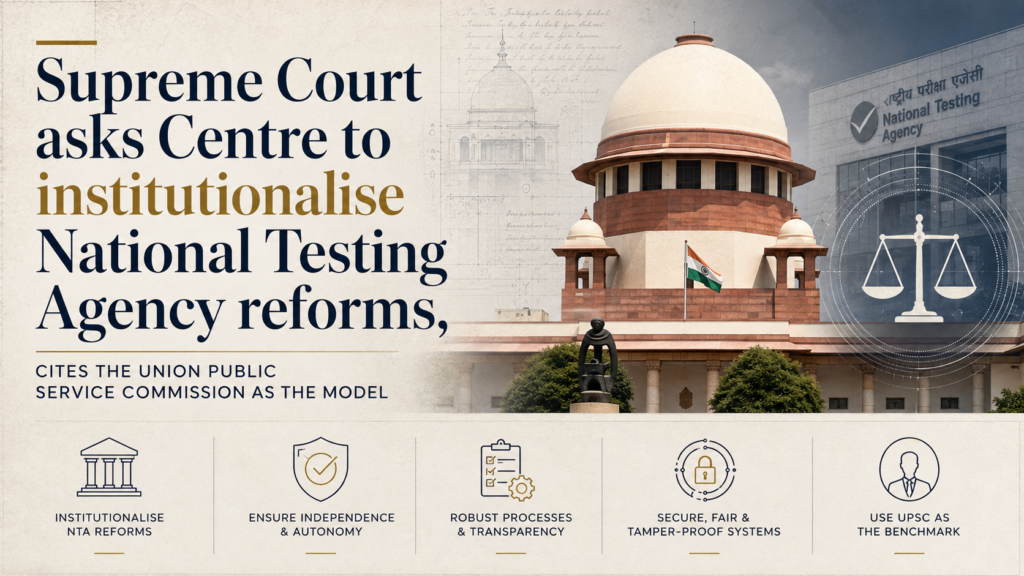
    The Supreme Court has directed the Union government to file an affidavit within three weeks setting out what it has done to implement the recommendations of the expert committee headed by a former Chairperson of the Indian Space Research Organisation (ISRO) on the National Testing Agency (NTA). The Bench held that reforms must be institutionalised and carried forward by successive officers rather than restarted with each new committee after each failure.

    What is the National Testing Agency (NTA)?

    1. Status: The National Testing Agency (NTA) is an autonomous testing organisation set up in 2017 under the Ministry of Education and registered under the Societies Registration Act, 1860, to conduct entrance examinations for higher education institutions.
    2. Examinations conducted: It conducts the National Eligibility cum Entrance Test Undergraduate (NEET-UG), the Joint Entrance Examination Main, the University Grants Commission National Eligibility Test, and the Common University Entrance Test, among others.
    3. Why it is before the Court: The agency has been under the Supreme Court’s scanner since the NEET-UG 2026 paper leaks, with petitioners describing the failure as recurring and systemic rather than isolated.

    What is a sovereign database?

    1. Meaning: A sovereign database is one whose servers, storage and control remain within the jurisdiction and ownership of the sovereign authority, rather than on infrastructure owned or operated by a third party or located abroad. The Bench asked whether the NTA has one and where question papers are stored.

    Why did the National Testing Agency come under the Supreme Court’s scrutiny?

    1. The trigger event: The 2026 NEET-UG question paper leaks led to cancellation of the examination and left over 23 lakh medical college aspirants stranded.
    2. Criminal process: A Central Bureau of Investigation (CBI) probe was ordered into the leaks and arrests were made.
    3. Political consequence: The leaks led to nationwide protests and a police crackdown on students, and ultimately to the resignation of the then Union Education Minister.
    4. The petitioners’ framing: The Court was hearing petitions by the Federation of All India Medical Association and the United Doctors Front, which characterised the 2026 leak as part of a recurring, systemic and catastrophic failure of the NTA in conducting NEET-UG.

    Why does the Court treat committee hopping as the problem rather than the solution?

    1. The Bench’s central objection: The Court held that it should not be that a committee gives recommendations and a new committee is then formed which removes the old one lock, stock and barrel.
    2. The specific sequence at issue: A seven member committee formed in 2024 under a former ISRO Chairperson recommended structural reforms in the NEET system, and the Centre has since constituted a task force under an Infosys co founder for new technological reforms.
    3. The Court’s fix, not replacement but review: The new task force must review the earlier committee’s recommendations and improve on them where necessary, and the earlier committee’s chairperson could be made part of the new body.
    4. The pattern is older than these two: The Bench pointed out that there were two more committees before the 2024 committee, and that recommendations must not remain on paper but must translate into action.
    5. The Solicitor General’s position: The Union government agreed on the need for a permanent mechanism to introduce reforms and maintain their continuity, and stated that it had already accepted the 2024 committee’s recommendations.

    What does the Court mean by institutional memory in an examination body?

    1. The failure mode named: A set of reforms implemented for one examination is undone in the next when senior NTA officers are shifted out, so continuity depends on individuals rather than on the institution.
    2. The standard set: Reforms must be vibrant, institutionalised and carried on within the NTA by successive officers, and must flow down from one generation of officers to the next.
    3. The comparator used: The Court cited the Union Public Service Commission (UPSC), which has conducted examination after examination without a hitch because it holds institutional memory and institutional expertise.
    4. What the earlier committee already said: The 2024 committee had itself focused on ways to build institutional memory and had identified the problem as systemic rather than logistical.

    What specific institutional gaps did the Bench probe?

    1. Technology capability: The Bench asked how the agency was facing new technological challenges, and whether the necessary infrastructure and software systems were in place.
    2. Data security and storage: It asked about cybersecurity and storage, whether the NTA has a sovereign database, and where question papers are stored.
    3. Physical premises: It asked where the agency’s office is situated and pressed on the need to secure office premises and operational infrastructure.
    4. Manpower: It asked how many officers the body has, how much staff is available, whether the various director and joint director positions had been filled, and how many had taken charge.
    5. Candidate facing systems: It stressed training and preparing personnel for the long term, candidate friendly arrangements and a grievance mechanism, and the strengthening of physical and intellectual capacity.
    6. The government’s response on hiring: The Solicitor General said hiring for scaling up digital infrastructure was under way and that the chief technology officer and chief financial officer had already been selected.

    What has the Centre placed on record?

    1. Earlier affidavit: The Court referred to an affidavit of 4 August filed by the Union government listing several senior appointments to be made to the NTA.
    2. Fresh affidavit directed: The Secretary must file an affidavit within three weeks, containing all details and indicative timelines, on steps taken to implement the 2024 committee’s suggestions as reflected and nuanced by the new task force.
    3. Measures claimed: The Centre’s affidavit described the Public Examinations (Prevention of Unfair Means) Act, 2024 and the constitution of the new task force as landmark measures against future paper leaks.
    4. Mandate of the new task force: It has been constituted to recommend end to end reforms focused on leveraging advanced technology such as artificial intelligence and blockchain to strengthen examination security and integrity.
    5. Limits on redesigning NEET-UG: Any structural change in the design of NEET-UG would be undertaken only in consultation with and with the concurrence of the Union Health Ministry and the National Medical Commission.
    6. Assurance to candidates: The Union government committed to giving candidates adequate advance notice of any change in the mode or design of the examination.
    7. The residual admission: The Solicitor General submitted that the system in place is foolproof but that at some point there is human intervention.

    Challenges to institutionalising reform in the National Testing Agency

    1. Officer rotation defeats continuity: Reforms owned by a posting rather than a post are reversed on transfer, which is precisely the failure the Court described. e.g. reforms implemented for one examination cycle being undone in the next after senior NTA officers were shifted out.
    2. No statutory foundation: The NTA is a registered society rather than a body created by statute, so its powers, tenure protections and accountability are weaker than those of a constitutional or statutory examination body. e.g. the UPSC derives its independence from Article 315 of the Constitution, which the NTA has no equivalent of.
    3. Recommendations without an implementation tracker: Successive committees have produced reports with no published mechanism to show which recommendation was executed and when. e.g. the Court had to direct an affidavit with indicative timelines three weeks out simply to learn the status of the 2024 committee’s recommendations.
    4. The human link in an otherwise sealed chain: Security design can cover technology and logistics but not the conduct of every person with access. e.g. the Solicitor General’s own submission that the system is foolproof but that at some point there is human intervention.
    5. Vendor and outsourcing dependence: Question paper printing, transport and centre operations run through private contractors whose staff sit outside the agency’s disciplinary reach. e.g. arrests following the NEET-UG leak extended beyond the agency’s own personnel.
    6. State level examinations remain outside the frame: The Court’s directions bind the NTA, and state recruitment and board examinations run on separate legal and administrative regimes. e.g. the Jharkhand government’s cancellation of 22 recruitment examinations over alleged irregularities in the same week.

    Conclusion

    The Court has shifted the remedy from constituting committees to building an institution, holding that reforms must survive the officers who introduced them. The immediate stage is a directed affidavit from the Secretary within three weeks, setting out implementation of the 2024 committee’s recommendations as nuanced by the new task force, with indicative timelines. Whether the NTA acquires a sovereign database, filled senior posts, secured premises and a grievance mechanism is the test the Court has set. Committee count is not the measure of reform; institutional memory is.

    [2024, GS2, 15 marks] What are the aims and objects of the recently passed and enforced, The Public Examination (Prevention of Unfair Means) Act, 2024? Whether University/State Education Board examinations, too, are covered under the Act?”

  • PM CARES corpus hits all-time high as utilisation collapses to Rs 87.85 lakh

    Why in the News

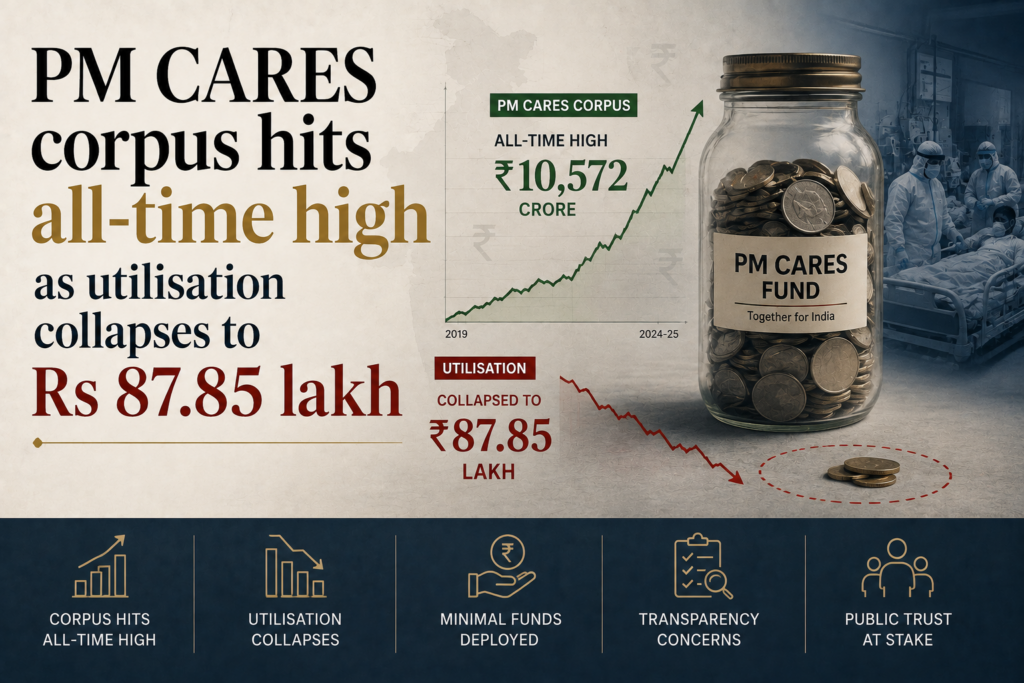
    Audited statements of the PM CARES Fund for 2023-24 and 2024-25, both published only on 17 August 2026 after a two year delay, show the closing balance at an all time high of Rs 8,452.06 crore while spending fell to a five year low of Rs 87.85 lakh. A fund created to disburse relief in emergencies is now accumulating faster through interest than it is spending, which raises the question of what a relief fund is for when it does not disburse.

    What is the PM CARES Fund?

    1. Full name: The Prime Minister’s Citizen Assistance and Relief in Emergency Situations Fund, created on 27 March 2020, days after the national lockdown was imposed.
    2. Legal form: A public charitable trust registered under the Registration Act, 1908, rather than a statutory or constitutional fund.
    3. Composition of the trust: The Prime Minister is the ex officio chairman, and the Defence Minister, Home Minister and Finance Minister are ex officio trustees.
    4. Sources of money: Voluntary domestic donations, foreign contributions, interest earned on bank balances and fixed deposits, and refunds returned by implementing agencies.
    5. Position on transparency: The Fund is not treated as a public authority under the Right to Information Act, 2005, and does not accept audit by the Comptroller and Auditor General of India, being audited instead by an independent chartered accountant.

    What is a public charitable trust?

    1. What it is: A public charitable trust is a private legal arrangement in which trustees hold property for a charitable purpose benefiting an indeterminate section of the public, created by a trust deed and registered under the Registration Act, 1908.
    2. Consequence of the form: It is not created by statute and does not draw on the Consolidated Fund, so parliamentary appropriation control and constitutional audit do not attach to it automatically.

    What is a refund from an implementing agency?

    1. What it is: A refund from an implementing agency is money previously released to an executing body for a sanctioned purpose and returned unspent or unutilised to the fund.
    2. Why it matters here: A refund inflates receipts without any relief being delivered, so a year with high refunds and low disbursement records activity that produced no outcome.

    What do the 2024-25 audited statements show?

    1. Total contributions: Contributions fell to Rs 479.96 crore, comprising Rs 479.04 crore domestic and about Rs 92 lakh foreign, down about 30 percent over the previous year.
    2. Interest income: The Fund received Rs 475.14 crore as interest, of which Rs 469.37 crore came from fixed deposits and Rs 5.76 crore from regular accounts.
    3. Other receipts: About Rs 13.49 lakh was received as refund of tax deducted at source on fixed deposit interest, and Rs 324.65 crore came back as refund from implementing agencies.
    4. Total income: Total income grew to Rs 1,279.9 crore, up 41 percent over the previous year.
    5. Total spending: Total spending fell to Rs 87.85 lakh, comprising Rs 87.84 lakh on the PM CARES for Children Scheme and Rs 451 in bank and short message service charges.
    6. Utilisation ratio: The Fund spent 0.01 percent of its closing balance, and between March 2020 and 31 March 2025 it spent less than one fifth, or 18.1 percent, of its total income.
    7. Closing balance: The closing balance touched an all time high of Rs 8,452.06 crore, 17.83 percent above the previous year’s Rs 7,173.03 crore.
    8. Two year corpus growth: The corpus grew 25.8 percent between 2022-23 and 2024-25, from about Rs 6,722 crore to about Rs 8,453 crore.

    Why has the corpus grown while spending collapsed?

    1. Interest now rivals donations: In 2024-25 interest income of Rs 475 crore was almost the same as donations of Rs 480 crore, so the Fund grows without any fresh public contribution.
    2. The instrument shift: The corpus was moved from savings bank accounts to fixed deposits in 2023-24, which is the immediate reason for the jump in interest earnings.
    3. Refunds outweigh disbursement: In 2024-25, Rs 324.65 crore came back from implementing agencies while only Rs 0.87 crore went out, so money returning exceeded money spent by a factor of over three hundred.
    4. Inflow consistently exceeds outflow: Since 2022-23 the money flowing in through donations and interest has far exceeded the money disbursed in every single year.
    5. Spending narrowed to one scheme: Almost the entire 2024-25 outgo went to the PM CARES for Children Scheme, so the Fund has effectively ceased to operate as a general emergency relief instrument.

    Why does a record corpus in a relief fund raise a governance question rather than settle one?

    1. Both readings are defensible: A large unspent corpus can be read as prudent reserve building for a future emergency, or as money raised on an emergency appeal and then withheld from that emergency.
    2. The appeal was purpose specific: Donations were solicited during a public health emergency, so accumulation departs from the stated purpose on which consent to donate was given.
    3. Scale of the mismatch: Utilisation of 0.01 percent of an available Rs 8,452 crore cannot be explained by a shortage of relief needs during a period of recurring floods, cyclones and heat emergencies.
    4. Refunds without explanation: Neither the identity of the implementing agencies, nor the nature of the payments, nor the reasons for the Rs 324 crore of refunds has been disclosed, so it is not known whether refunds followed faulty procurement.
    5. The oversight gap widens with the corpus: The larger the accumulation, the weaker the case for keeping the Fund outside both the Right to Information Act and constitutional audit.
    6. No competing claim is resolved: A public charitable trust is legally entitled to build a corpus, and the objection is not to legality but to the absence of any published disbursement policy that would justify the accumulation.

    What transparency questions remain unanswered?

    1. Sources of funds: No information is available on who the donors are, including donors of the foreign contributions the Fund has received.
    2. Identity of implementing agencies: The agencies that received and refunded money have not been named.
    3. Purpose of refunded allocations: The purpose for which the refunded money was originally allotted has not been disclosed, leaving open whether refunds followed faulty equipment supply.
    4. Missing audit annexures: The explanatory notes accompanying the audit report were not uploaded alongside the statements.
    5. Delay in publication: Statements for 2023-24 and 2024-25 were both released only on 17 August 2026, after a failure to upload annual disclosures since 2022-23, a lapse publicly flagged on 8 August 2026.
    6. Pattern of delay: The publication dates run 19 August 2020 for 2019-20, 8 February 2022 for 2020-21, 1 November 2022 for 2021-22, 28 December 2024 for 2022-23, and 17 August 2026 for the last two years together, computed from the Internet Archive and the Fund portal’s own metadata.
    7. Auditor change: The prolonged delay in releasing statements coincided with the Centre changing the Fund’s auditors.
    8. Statutory position: The Fund continues to refuse to submit itself to the Right to Information Act, 2005.

    Challenges to the PM CARES Fund

    1. Contested public authority status: The Fund’s exclusion from the Right to Information Act, 2005 rests on it being a trust rather than a body owned or controlled by government, a characterisation litigated repeatedly, e.g. the Delhi High Court has heard a series of petitions since 2020 seeking a declaration that the Fund is a public authority.
    2. Absence of constitutional audit: Money raised in the name of the highest offices of the State is audited by a private chartered accountant rather than the Comptroller and Auditor General, e.g. the National Disaster Response Fund, its statutory counterpart, is audited by the CAG under the Disaster Management Act, 2005.
    3. Donor disclosure gap: Neither domestic nor foreign donors are identified, so contributions from entities regulated by the same government cannot be scrutinised for conflict of interest, e.g. central public sector undertakings routed corporate social responsibility funds to the trust in 2020-21.
    4. Corporate social responsibility diversion: Recognition of contributions as qualifying corporate social responsibility spending channels statutory corporate obligations into an unaudited pool, e.g. the Ministry of Corporate Affairs clarified in March 2020 that PM CARES contributions count under Schedule VII of the Companies Act, 2013.
    5. Duplication with existing funds: The Fund overlaps the pre existing Prime Minister’s National Relief Fund and the statutory National Disaster Response Fund without a stated division of purpose, e.g. both the older relief fund and PM CARES made COVID-19 disbursements in the same period.
    6. Idle corpus with no disbursement policy: No published criteria govern when and to whom money is released, so a record balance can coexist with unmet relief demand, e.g. Rs 8,452 crore stood unspent while only Rs 87.85 lakh was disbursed in 2024-25.
    7. Refund opacity as an accountability risk: Large refunds from unnamed agencies can conceal procurement failure rather than reflect prudent recovery, e.g. Rs 324.65 crore was refunded in 2024-25 with no explanation of the original allotment.
    8. Delayed disclosure defeats scrutiny: Financial statements published two years late are of limited use to Parliament or the public, e.g. 2023-24 and 2024-25 accounts were both released on the same day in August 2026.

    Conclusion

    The PM CARES Fund now grows chiefly on interest from fixed deposits and on money returned by unnamed implementing agencies, while its actual relief spending has fallen to Rs 87.85 lakh against a corpus of Rs 8,452.06 crore. The accumulation is legally permissible for a public charitable trust and remains unexplained as public policy, because no disbursement criteria and no donor or agency disclosure accompany it. The gap will only close when the Fund is placed within either the Right to Information Act or constitutional audit, and until then each annual statement will restate the same unanswered questions.