Mains Ready By December. Smash Mains & Smash PYQ Admissions Open

GS Paper: GS3-01.Indian Economy and issues relating to planning, mobilization of resources, growth, development and employment.

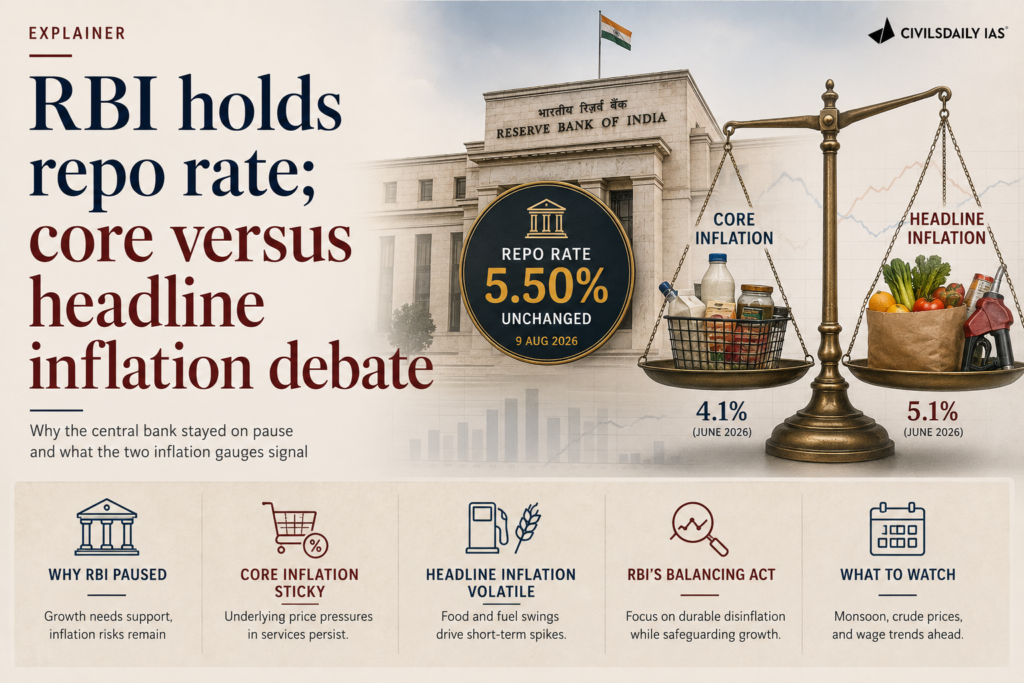
  • RBI holds repo rate; core versus headline inflation debate

    Why in the News

    The Reserve Bank of India (RBI) held the repo rate at 5.25%. Economists are divided over whether the central bank is anchoring policy to headline CPI or to core inflation, which strips out food and fuel.

    What is core inflation?

    1. Definition: Core inflation measures price change after removing volatile food and fuel components, showing the underlying, persistent trend.
    2. Why it matters: Monetary policy affects demand-driven prices, not a monsoon-driven food spike, so core is a cleaner signal for interest-rate decisions.

    Why is the anchor contested?

    1. Mandate is headline: The RBI’s legal target is headline retail inflation around 4%, not core, so leaning on core risks appearing to shift the goalpost.
    2. Food weight is large: Food is a large share of India’s consumption basket, so ignoring it understates the inflation households actually face.
    3. Credibility risk: Frequent redefinition of the operative measure weakens the predictability that anchors inflation expectations.

    Conclusion

    The rate hold reflects a judgement that underlying price pressure is easing even as headline stays elevated. The next milestone is whether food inflation cools enough to align headline with the target.

    PYQ Relevance

    [UPSC 2024] What are the causes of persistent high food inflation in India? Comment on the effectiveness of the monetary policy of the RBI to control this type of inflation.

    Linkage: The PYQ examines the limits of monetary policy in controlling persistent food-driven inflation. The debate over headline versus core inflation highlights how the RBI balances its inflation mandate with supply-side food shocks.
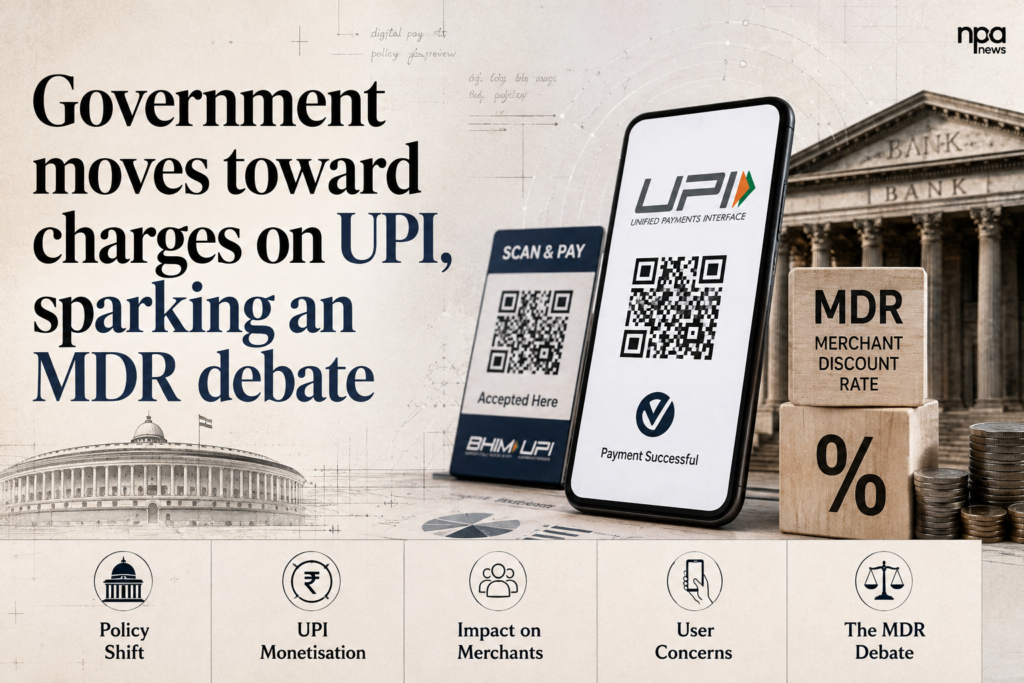

  • Government moves toward charges on UPI, sparking an MDR debate

    Why in the News

    A government move that could permit charges on Unified Payments Interface (UPI) transactions has revived the question of a Merchant Discount Rate (MDR). The tension is between funding the rising cost of a free public payments rail and preserving the zero cost model that drove its mass adoption.

    What is the Merchant Discount Rate (MDR)?

    1. Definition: The MDR is the fee a merchant pays a bank for accepting a digital payment from a customer.
    2. Current position: MDR on UPI and RuPay debit card payments has been zero since 2020, shifting the settlement cost onto the system.

    How would the proposed charge actually work?

    1. Large merchants only: Any MDR would apply to person to merchant (P2M) payments above a threshold, not to small traders.
    2. Enabling law: The change is routed through the Taxation and Other Laws (Amendment) Bill 2026.

    What is the case against charging for UPI?

    1. Adoption risk: A fee could push small merchants back toward cash and reverse formalisation gains.
    2. Alternative funding: The RBI’s surplus could subsidise the payments rail instead of a merchant levy.

    What are the pressures forcing the question?

    1. Scale cost: Processing billions of monthly transactions imposes real infrastructure and settlement costs on banks.
    2. Sustainability: A permanently free model leaves no revenue to maintain and expand the network.

    “[2018] Which one of the following best describes the term ‘Merchant Discount Rate’ sometimes seen in news?
    (a) The incentive given by a bank to a merchant for accepting payments through debit cards pertaining to that bank.
    (b) The amount paid back by banks to their customers when they use debit cards for financial transactions for purchasing goods or services.
    (c) The charge to a merchant by a bank for accepting payments from his customers through the bank’s debit cards.
    (d) The incentive given by the Government to merchants for promoting digital payments by their customers through Point of Sale (PoS) machines and debit cards.

  • RBI holds the repo rate for a fourth straight review

    Why in the News

    The Reserve Bank of India (RBI) kept its repo rate unchanged at 5.25% for a fourth consecutive Monetary Policy Committee (MPC) meeting. The decision exposes the tension between reviving growth through cheaper credit and defending price stability while inflation sits above target.

    What is the Monetary Policy Committee (MPC)?

    1. Statutory body: The MPC is the six member committee that sets the benchmark repo rate to keep retail inflation within a legislated band.
    2. Mandate: It is tasked with holding Consumer Price Index (CPI) inflation at 4%, within a tolerance range of 2% to 6%.

    Why has the RBI chosen to hold rather than cut?

    1. Inflation above target: Retail inflation has stayed above the 4% midpoint, removing headroom for a rate cut.
    2. Geopolitical spillover: The bank flagged the West Asia conflict and crude price risk as reasons to preserve policy space.
    3. External buffer: Protecting foreign exchange reserves and the rupee against capital outflows outranked a growth focused easing.

    What are the risks in a prolonged hold?

    1. Growth drag: A sustained high rate raises borrowing costs for firms and households and can slow investment.
    2. Transmission gap: Banks may not pass rate signals through fully, weakening the policy’s real economy effect.
    3. Fiscal friction: Elevated rates raise the government’s own interest burden on fresh borrowing.

    Conclusion

    The RBI is prioritising price and currency stability over a growth stimulus while inflation remains above target. The next MPC review will turn on whether inflation cools back toward 4% and whether the external environment stabilises.

    Back2Basics: Repo Rate

    1. Definition: The rate at which the RBI lends short term funds to commercial banks against securities.
    2. Function: It is the primary tool of monetary policy transmission; a higher repo rate raises the cost of money and cools demand.

    Matching Previous Year Question

    “[2017] Which of the following statements is/are correct regarding the Monetary Policy Committee (MPC)?
    1. It decides the RBI’s benchmark interest rates.
    2. It is a 12-member body including the Governor of RBI and is reconstituted every year.
    3. It functions under the chairmanship of the Union Finance Minister.
    Select the correct answer using the code given below:
    (a) 1 only
    (b) 1 and 2 only
    (c) 3 only
    (d) 2 and 3 only
    Answer: (a)”

  • Why households pledge gold instead of selling it

    Why in the News

    India’s gold market is witnessing a structural shift as investment demand and gold backed loans grow rapidly, while jewellery demand declines. The trend has also highlighted the limited success of the Gold Monetisation Scheme (GMS), 2015 in mobilising idle household gold.

    What is the Gold Monetisation Scheme (GMS), 2015?

    • Objective: Mobilise idle gold held by households and institutions into the formal financial system.
    • Mechanism: Individuals and institutions deposit physical gold with authorised banks and earn interest on the deposits.
    • Challenges: Limited participation due to taxation concerns, sentimental attachment to gold and procedural complexities.

    How is India’s gold demand changing?

    • Overall Demand: Total gold demand increased 2% year on year to 282 tonnes in the first half of the year.
    • Jewellery Demand: Fell 17.1% to 141.2 tonnes, among the weakest first quarter levels since 2000.
    • ETF Investment: Gold Exchange Traded Funds (ETFs) recorded a net inflow of 20 tonnes in the first quarter.
    • Bars and Coins: Demand rose 21.3% in volume and 105.5% in value during the first half of FY27.
    • Price Rise: Domestic gold prices have increased more than fivefold over the past decade.

    Why are households pledging gold instead of selling it?

    • Collateral Preference: Households increasingly use gold as collateral for loans rather than selling it.
    • Gold Loan Growth: Outstanding gold loan portfolios reached about Rs 5.4 lakh crore by June 2026.
    • Retail Loans: Bank loans backed by pledged jewellery touched about Rs 4.3 lakh crore by February 2026.
    • Limited Recycling: Despite record high prices, households continue to retain gold, resulting in low recycled supply.
    • External Stability: Household gold holdings and central bank gold purchases have supported India’s external balance and moderated pressure on the rupee.

    What are the concerns?

    • Financial Stability: Rapid expansion of gold loans requires close regulatory monitoring.
    • RBI Measures: Borrowers must fully repay principal and interest before the same gold can be repledged.
    • Price Risk: A sharp decline in gold prices could affect lenders through lower collateral values.

    [2016] What is/are the purpose/purposes of Government’s ‘Sovereign Gold Bond Scheme’ and ‘Gold Monetization Scheme’?
    1. To bring the idle gold lying with Indian households into the economy.
    2. To promote FDI in the gold and jewellery sector.
    3. To reduce India’s dependence on gold imports.
    Select the correct answer using the code given below.
    (a) 1 only (b) 2 and 3 only (c) 1 and 3 only (d) 1, 2 and 3

  • Taxation and Other Laws (Amendment) Bill and the UPI levy

    Why in the News

    The Lok Sabha passed the Taxation and Other Laws (Amendment) Bill, 2026 on 6 August 2026. The Bill gives legal backing to modify the zero charge regime on some digital payments. Analysis links the move to United States trade pressure over digital payment barriers.

    What is the zero Merchant Discount Rate regime on UPI and RuPay?

    1. Merchant Discount Rate (MDR): the fee a merchant pays to banks and card networks for processing a digital payment.
    2. Zero MDR rule: since 2020 India has barred any charge on Unified Payments Interface (UPI) and RuPay debit card transactions.
    3. Effect on users: UPI stays free at the point of payment, which drove mass adoption.
    4. Bill change: the amendment removes the link between the Payment and Settlement Systems Act, 2007 and the Income Tax Act, and lets the government modify the zero charge regime.
    5. Scope: any charge would apply to merchants, not end users, and the steering committee headed by the National Payments Corporation of India (NPCI) is yet to decide.

    What else does the Bill do?

    1. Manufacturing: it aims to promote domestic electronics manufacturing.
    2. Foreign capital: it replaces a June ordinance that exempted interest income and capital gains earned by Foreign Portfolio Investors from government securities.

    Why is the change linked to United States trade demands?

    1. Section 301 lever: the United States Trade Representative (USTR) runs a Section 301 investigation, a tool to act against foreign trade barriers.
    2. Barrier tag: in March 2026 USTR classified India’s digital payment policies as favouring domestic players.
    3. Lost business: Visa and Mastercard cite lost potential business as Indian consumers shifted to free UPI.
    4. Market cap concern: USTR flagged that two United States owned providers processed over 80 percent of UPI transactions, alongside the 30 percent cap on third party apps.
    5. Precedent: India earlier scrapped the 6 percent equalisation levy on digital services under similar pressure.

    What are the concerns around the levy?

    1. Adoption risk: charges could slow UPI use if passed to merchants and then to prices.
    2. Policy autonomy: critics read the change as a concession under trade negotiation rather than domestic reform.
    3. Revenue pool: an interoperable zero cost platform limits card network fee income, which the change could restore.

    [2026] Which one of the following best describes the key objective of India’s ‘Open Network for Digital Commerce’ (ONDC) initiative?
    (a) To allow digital government control over all digital commerce transactions
    (b) To replace private e-commerce players
    (c) To break the dominance of large e-commerce platforms by enabling interoperability across networks
    (d) To mandate UPI-based payments for all online transactions

  • Why is the government offloading stake in LIC?

    Why in the News

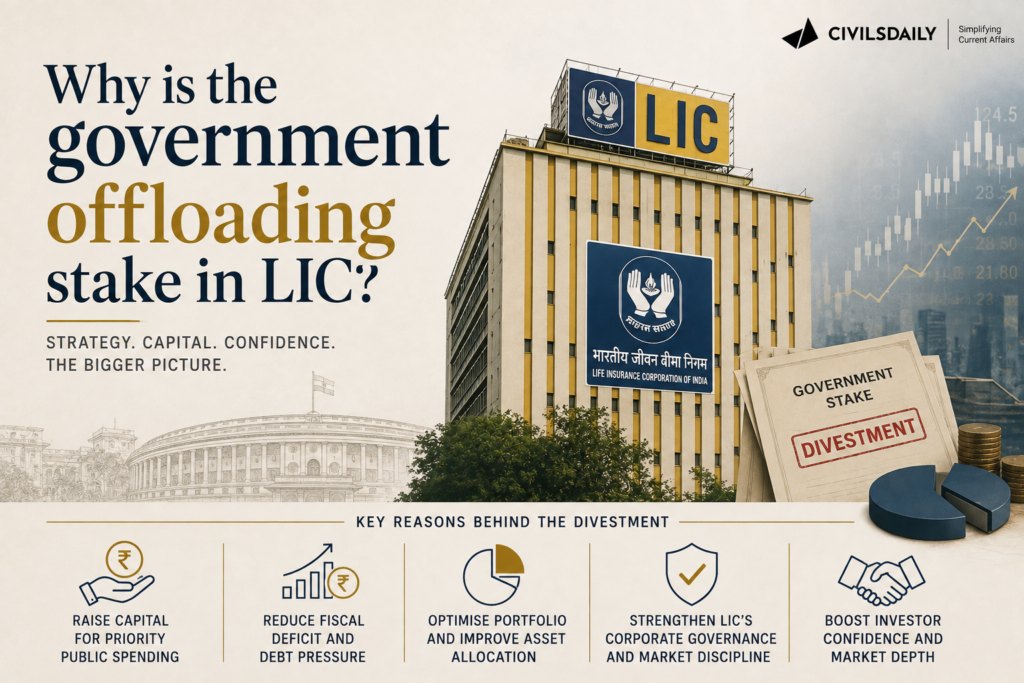
    The Government of India has launched an Offer for Sale (OFS) to reduce its stake in the Life Insurance Corporation of India (LIC). The move aims to meet SEBI’s minimum public shareholding (MPS) requirement and contribute to the government’s FY27 disinvestment target.

    What is an Offer for Sale (OFS)?

    • Definition: An Offer for Sale (OFS) is a mechanism through which an existing shareholder (promoter) sells shares to the public through the stock exchange.
    • No Fresh Capital: The company does not receive any funds; the sale proceeds go to the selling shareholder.
    • Current Issue: The Government offered 2.5% equity, with a 4% green shoe option, at a floor price of Rs 382 per share.
    • Discount: The floor price represented about a 10% discount to LIC’s closing market price on 3 August.

    What is the Minimum Public Shareholding (MPS) norm?

    • Requirement: SEBI mandates that listed companies maintain a minimum level of public shareholding.
    • LIC Deadline: LIC has been given time until 16 May 2027 to achieve 10% public shareholding.
    • Purpose: The OFS helps LIC move towards compliance with this regulatory requirement.

    Why is the Government selling its stake now?

    • Regulatory Compliance: To meet SEBI’s public shareholding norms.
    • Disinvestment Target: The sale contributes towards the FY27 disinvestment target of Rs 80,000 crore.
    • Estimated Receipts: At the base price, the issue could raise around Rs 31,000 crore.
    • Strong Demand: The institutional investor portion was oversubscribed 3.32 times, leading to the exercise of the green shoe option.
    • Implementing Agency: The process is managed by the Department of Investment and Public Asset Management (DIPAM).

    What is LIC’s position in the insurance sector?

    • Market Leader: LIC accounted for over 56% of India’s life insurance market in FY26.
    • Systemically Important: LIC is designated as a Domestic Systemically Important Insurer (D-SII), subject to enhanced regulatory supervision.
    • Listing History: LIC’s 2022 IPO sold 3.5% government stake and raised Rs 20,557 crore.

    [2025] Consider the following statements:
    I. Capital receipts create a liability or cause a reduction in the assets of the Government.
    II. Borrowings and disinvestment are capital receipts.
    III. Interest received on loans creates a liability of the Government.
    Which of the statements given above are correct?
    (a) I and II only

    (b) II and III only

    (c) I and III only

    (d) I, II and III

  • RBI keeps Tata Sons in the NBFC Upper Layer list

    Why in the News

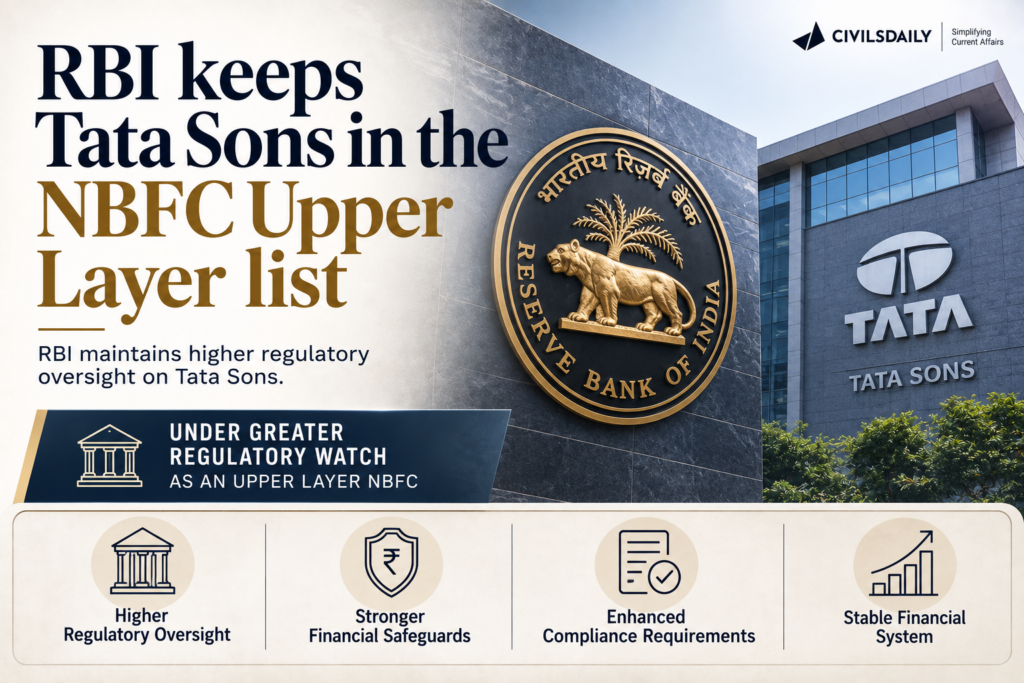
    The Reserve Bank of India (RBI) has retained Tata Sons in the NBFC Upper Layer (NBFC-UL) under its Scale Based Regulation (SBR) framework. This revives the requirement for Tata Sons to list on a stock exchange, while its request for deregistration as an NBFC remains under RBI’s consideration.

    What is the NBFC Upper Layer under the Scale Based Regulation (SBR) Framework?

    • Definition: The Scale Based Regulation (SBR) framework classifies NBFCs into four layers based on their size, activity and risk profile.
    • Upper Layer (NBFC-UL): Covers large, systemically important NBFCs requiring enhanced regulatory oversight.
    • Eligibility: RBI identifies NBFC-UL entities with assets of Rs 1 lakh crore or more.
    • Mandatory Listing: An NBFC classified in the Upper Layer must list on a recognised stock exchange within three years.
    • Minimum Tenure: Once classified, an NBFC remains in the Upper Layer for at least five years, even if it later falls below the threshold.

    What is a Core Investment Company (CIC)?

    • Definition: A Core Investment Company (CIC) is an NBFC that primarily holds investments in its group companies rather than engaging in public lending.
    • Tata Sons: RBI classifies Tata Sons as a Core Investment Company under the NBFC Upper Layer.

    Why has the listing issue resurfaced?

    • Debt Repaid: Tata Sons repaid its borrowings in 2024 and no longer directly raises public funds.
    • Indirect Public Funds: RBI considers investments held by listed Tata companies in Tata Sons as an indirect form of public funding.
    • Deregistration Pending: Tata Sons has sought deregistration as an NBFC, but RBI has stated that the Upper Layer classification is without prejudice to that request.
    • Internal Differences: The proposed listing has divided the Tata Trusts, while the Pallonji Mistry Group supports listing to unlock shareholder value.

    What additional regulations apply to NBFC Upper Layer entities?

    • Capital Requirements: Higher capital adequacy norms, including Common Equity Tier 1 (CET1) requirements.
    • Governance Standards: Mandatory board committees, stronger provisioning norms and prudent compensation policies.
    • Current Coverage: RBI has classified 17 NBFCs in the Upper Layer, including Bajaj Finance, Tata Capital and Shriram Finance.

    [2026] Consider the following statements about the Non-Banking Financial Companies (NBFCs) in India:
    1. NBFCs cannot accept demand deposits.
    2. All the NBFCs operating in India have to be registered with the RBI.
    3. NBFCs form part of the payment and settlement system and can issue cheque drawn on itself.
    4. Deposit insurance facility of Deposit Insurance and Credit Guarantee Corporation (DICGC) is not available to the depositors of deposit taking NBFCs.
    Which of the statements given above is/are correct?
    (a) 1 and 4

    (b) 1, 2 and 3

    (c) 4 only

    (d) 2, 3 and 4

  • RBI to resume licensing of Urban Cooperative Banks after two decades

    Why in the News

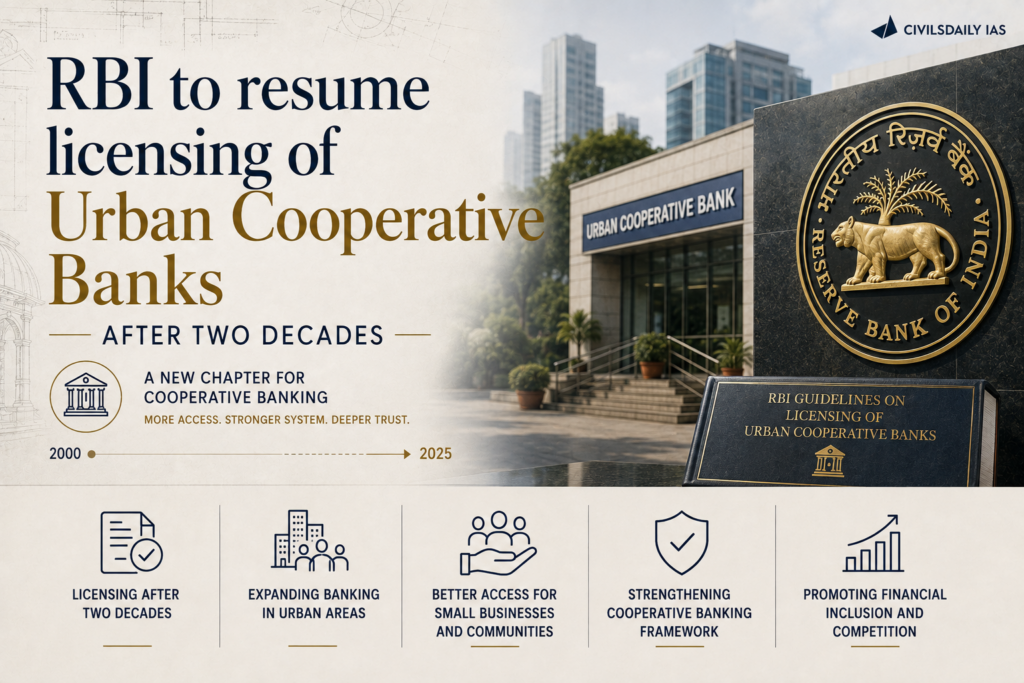
    The Reserve Bank of India (RBI) has announced that it will resume issuing licences for new Urban Cooperative Banks (UCBs) on an on tap basis, ending a pause of more than two decades. The move follows regulatory reforms aimed at strengthening governance and supervision in the cooperative banking sector.

    What is an Urban Cooperative Bank (UCB)?

    • Cooperative bank: A UCB is a cooperative society that provides banking services primarily in urban and semi urban areas.
    • Ownership: Owned and managed by its members on the principle of one member, one vote.
    • Dual regulation:
      • RBI: Banking operations, licensing, prudential norms and supervision.
      • State/Central Registrar of Cooperative Societies: Management, elections and administration.
    • Size: India has around 1,457 Urban Cooperative Banks.

    What is RBI changing?

    • On tap licensing: New UCB licences will be granted throughout the year, instead of one time licensing windows.
    • Review of concentration norms: RBI will revisit concentration risk norms for rural cooperative banks.
    • Interest rate framework: Plans to rationalise the interest rate framework across regulated entities for greater consistency.

    Why was licensing suspended?

    • Governance failures: Several UCBs suffered from weak governance, poor risk management and financial irregularities.
    • Bank failures: High profile failures raised concerns about depositor protection and financial stability.
    • Regulatory limitations: The dual control structure often hampered effective supervision.

    Why has RBI resumed licensing?

    • Stronger regulation: Amendments to the Banking Regulation Act, 1949 have enhanced RBI’s supervisory powers over cooperative banks.
    • Improved governance: Regulatory reforms have strengthened oversight and accountability.
    • Financial inclusion: New UCBs can expand access to affordable banking and credit in underserved urban and semi urban areas.

    Prelims Pointers

    • Urban Cooperative Banks (UCBs) operate mainly in urban and semi urban areas.
    • They are subject to dual regulation by the RBI and the Registrar of Cooperative Societies.
    • The Banking Regulation (Amendment) Act, 2020 strengthened RBI’s supervisory powers over cooperative banks.
    • On tap licensing allows eligible entities to apply for banking licences at any time instead of waiting for a specific licensing window.

    “[2021] With reference to ‘Urban Cooperative banks’ in India, consider the following statements:
    1.They are supervised and regulated by local boards set up by the State Governments.
    2.They can issue equity shares and preference shares.
    3.They were brought under the purview of the Banking Regulation Act, 1949 through an Amendment in 1966.
    Which of the statements given above is/are correct?
    (a) 1 only
    (b) 2 and 3 only
    (c) 1 and 3 only
    (d) 1, 2, and 3

  • Debate over who pays for UPI as the Taxation Bill enables charges on high value merchant transactions

    Why in the News

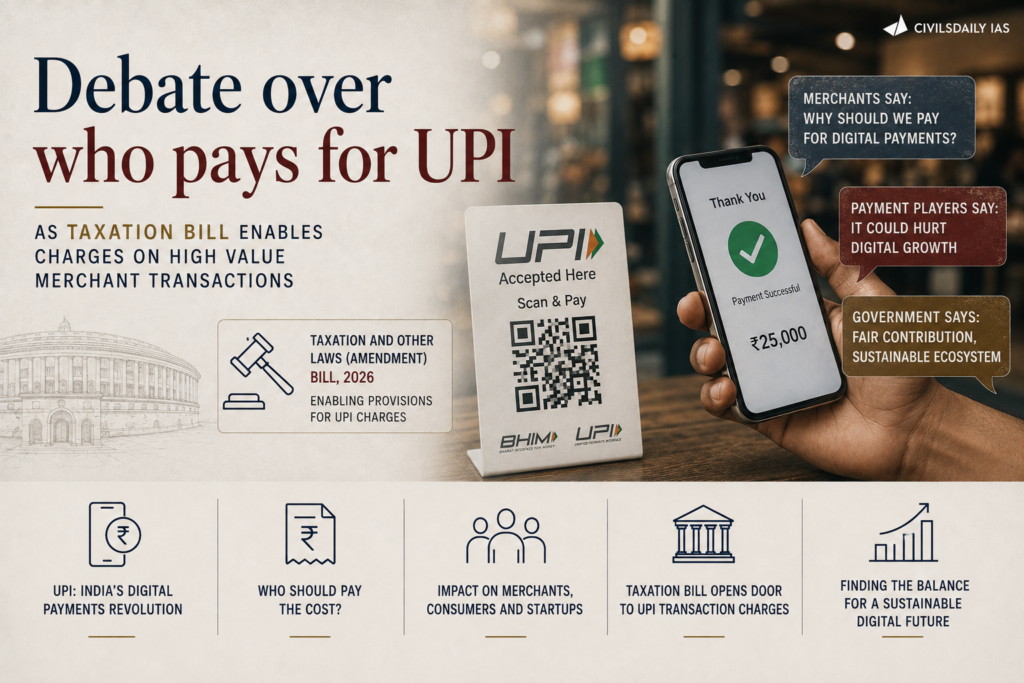
    The Taxation and Other Laws (Amendment) Bill, 2026 proposes to allow the government to impose Merchant Discount Rate (MDR) on selected Unified Payments Interface (UPI) transactions, reviving the debate over how India’s digital payments infrastructure should be financed.

    What is the Merchant Discount Rate (MDR)?

    • Transaction fee: The Merchant Discount Rate (MDR) is the fee charged to merchants by banks and payment service providers for processing digital payments.
    • Who pays? It is generally borne by the merchant, not the customer.
    • Current position: Since January 2020, UPI and RuPay debit card transactions have zero MDR, making them free for merchants and users.
    • Government support: The government has compensated service providers through incentive schemes to sustain the digital payments ecosystem.

    What does the Bill propose?

    • Enabling provision: The Taxation and Other Laws (Amendment) Bill, 2026 relaxes the existing restrictions on MDR.
    • Selective application: It empowers the government to notify specific UPI transactions on which MDR may be levied.
    • Likely scope: Discussions indicate the levy may apply to:
      • Merchants with high annual turnover, and
      • High value transactions above ₹2,000.
    • Objective: Ensure a financially sustainable digital payments ecosystem while protecting small merchants.

    Who should bear the cost of UPI?

    • Government funding: Continue compensating payment providers through budgetary support.
    • RBI surplus: The Reserve Bank of India’s surplus transfer could partly finance UPI infrastructure.
    • Banks and payment providers: Costs may be absorbed by financial institutions.
    • Merchants: Large merchants could bear MDR without affecting small businesses.
    • Policy challenge: Balance financial sustainability, merchant affordability, and continued digital payment adoption.

    Prelims Pointers

    • Merchant Discount Rate (MDR) is the fee paid by merchants for processing digital payment transactions.
    • UPI is operated by the National Payments Corporation of India (NPCI).
    • NPCI is an umbrella organisation for retail payment systems in India, established by the Reserve Bank of India (RBI) and the Indian Banks’ Association (IBA).
    • Zero MDR on UPI and RuPay debit card transactions has been in force since 2020.
    • The RBI periodically transfers its surplus to the Central Government under the provisions of the RBI Act, 1934.

    “[2025] Consider the following countries:
    I. United Arab Emirates
    II. France
    III. Germany
    IV. Singapore
    V. Bangladesh
    How many countries amongst the above are there other than India where international merchant payments are accepted under UPI?
    (a) Only two
    (b) Only three
    (c) Only four
    (d) All the five

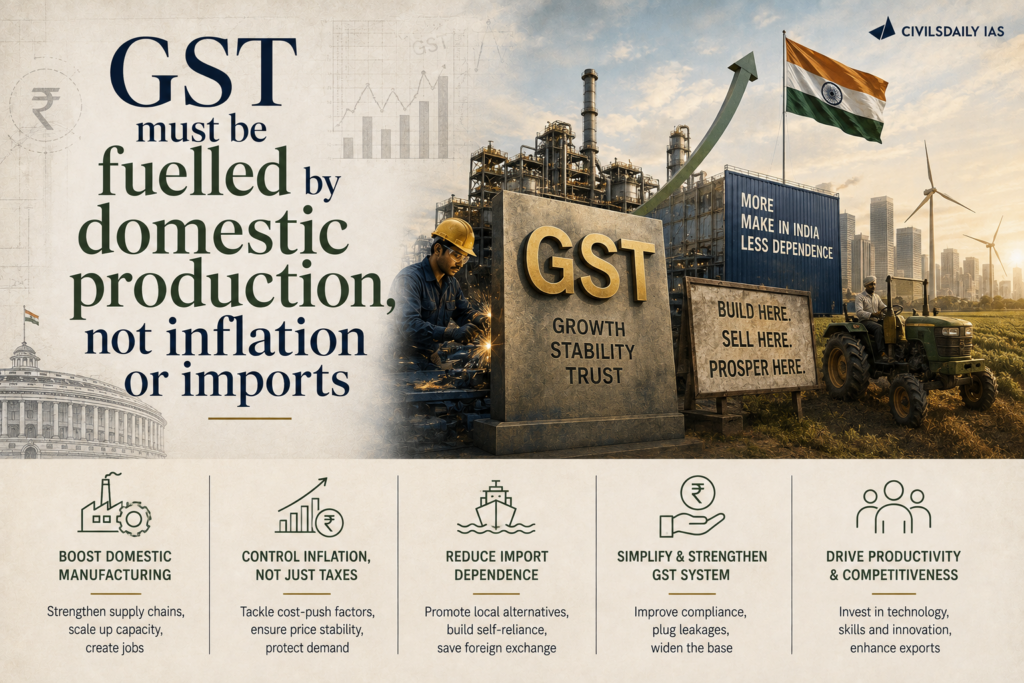
  • GST must be fuelled by domestic production, not inflation or imports

    Why in the News

    Record monthly Goods and Services Tax collection was driven more by imports and price rise than by domestic output. The tension is between a headline revenue high and a weak production base underneath it.

    What is the Goods and Services Tax (GST)?

    1. Indirect tax: The Goods and Services Tax (GST) is a destination based tax on the supply of goods and services, in force since July 2017.
    2. Dual structure: It has a Central component and a State component, with an Integrated GST (IGST) on inter state and import transactions.
    3. Council: Rates are set by the GST Council, a federal body of the Union and States.

    What does the latest collection actually show?

    1. Headline figure: July GST touched Rs 2.11 lakh crore, up 15.4% year on year.
    2. Import driven: Integrated GST (IGST) on imports grew 26.9%, against just 4.5% for the domestic component.
    3. Price effect: Rupee depreciation and high Wholesale Price Index manufacturing inflation of 7.18% inflated the nominal figure.

    Why is the revenue base narrow?

    1. Geographic concentration: Collection is heavily skewed toward a handful of industrialized or consumption-heavy regions. Only 16 States and Union Territories were above the national average collection.
    2. Weak domestic demand: Sluggish home production limits the tax base.
    3. Inflation illusion: A rising nominal collection can mask flat real activity. Rising nominal collection numbers can be deceptive, as high wholesale price inflation and currency depreciation artificially inflate transaction values.

    Conclusion

    Strong collection numbers are being read as growth when they partly reflect imports and inflation. A broad based GST 3.0 must widen the domestic production base rather than lean on price rise.

    Back2Basic

    GST 2.0

    Launched in 2025, GST 2.0 is a major overhaul of India’s indirect taxation system. It simplifies the multi-tier structure into core merit (5%) and standard (18%) slabs, eliminates the old 12% and 28% categories for most items, and introduces a 40% demerit rate for luxury and sin goods.

    Key Tax Slab Changes

    1. Nil / 0%: Life and health insurance, basic food staples (UHT milk, paneer, Indian breads), and 33 life-saving medicines.
    2. 5% (Merit Rate): Common household essentials, agricultural machinery (tractors, harvesters), gym/fitness services, and handicrafts.
    3. 18% (Standard Rate): Consumer durables (TVs, ACs), small cars, two-wheelers, and cement.
    4. 40% (Demerit Rate): Luxury cars, aerated drinks, pan masala, and tobacco products

    PYQ Relevance

    [UPSC 2019] Enumerate the indirect taxes which have been subsumed in the goods and services tax (GST) in India. Also, comment on the revenue implications of the GST introduced in India since July 2017.

    Linkage: The PYQ examines the revenue implications of GST and its impact on India’s indirect tax system. The article evaluates GST revenue quality, showing that recent collections are driven more by imports and inflation than broad-based domestic economic growth.