Why in the News
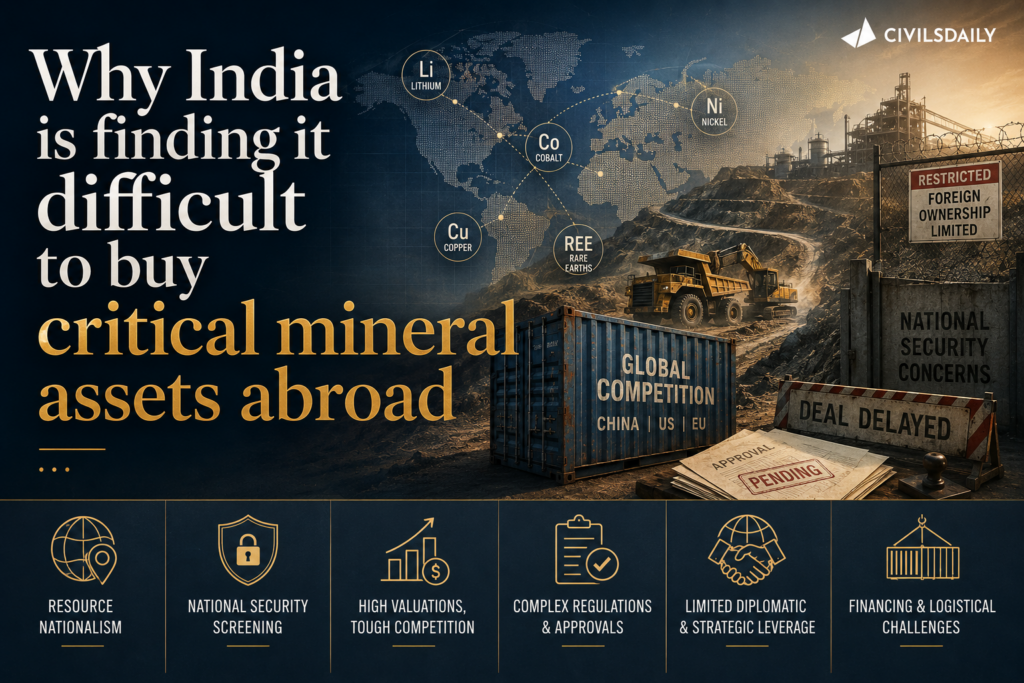
A Parliamentary panel report has highlighted the limited success of Khanij Bidesh India Limited (KABIL) in acquiring critical mineral assets overseas. So far, KABIL has completed acquisitions only in Argentina, while bids in Australia and Chile have failed or lapsed.
The issue highlights India’s challenge of securing critical minerals abroad without a sufficiently strong financial and domestic processing ecosystem.
What is KABIL?
- Established: 2019
- Purpose: Acquire and develop critical mineral assets overseas.
- PSUs involved:
- National Aluminium Company Limited (NALCO)
- Hindustan Copper Limited (HCL)
- Mineral Exploration and Consultancy Limited (MECL)
- Ministry: Ministry of Mines
- Major success: Five lithium brine blocks in Catamarca, Argentina, acquired in January 2024.
Key Terms
Spodumene Concentrate
- Concentrated hard-rock lithium ore.
- Must be processed into lithium carbonate or lithium hydroxide for battery applications.
Lithium Brine
- Lithium dissolved in underground saltwater.
- Extracted by pumping brine to the surface and concentrating it, traditionally through evaporation.
Non-Binding Offer
- Indicative offer that does not legally commit the bidder to complete the transaction.
- Allows access to the seller’s data room and due diligence stage.
Why did KABIL struggle?
- Limited financial capacity: KABIL cannot independently match large international bids.
- No domestic processing ecosystem: India lacks sufficient commercial-scale lithium conversion capacity.
- Price volatility: Lithium prices fluctuate sharply, making valuation difficult.
- Slow consortium decisions: Multiple PSUs can delay due diligence and bidding.
- Strong global competition: Integrated companies can pay more because they already possess refining and battery-making capacity.
- Exploration risk: Acquiring mineral acreage does not guarantee commercially viable reserves.
Australia: Why India Lost the Bid
- Indian consortium initially offered $184 million.
- Revised offer: $233 million.
- South Korea’s POSCO eventually offered $765 million.
- POSCO’s integrated mining and processing ecosystem allowed it to justify a much higher valuation.
- Core lesson: Mine ownership without processing capacity provides less strategic value.
Chile: Why the Opportunity Lapsed
- KABIL’s proposed Chilean lithium investment required a large financial commitment. A joint bid with other PSUs could not complete due diligence within the available timeline.
- This exposed two weaknesses:
- Limited capital + slow decision-making = missed strategic opportunities.
How Other Countries Approach Critical Minerals
- Japan: JOGMEC provides equity support and loan guarantees to Japanese companies.
- China: Combines overseas mining acquisitions with strong domestic refining capacity.
- South Korea: Vertically integrated companies such as POSCO connect mining with processing.
- EU: Critical Raw Materials Act targets domestic extraction, processing and recycling.
- USA: Minerals Security Partnership promotes joint financing of critical mineral projects.
Why Domestic Value Chain Matters
- India’s strategy needs to follow:
- Overseas mine → Concentrate → Domestic refining → Battery materials → Batteries → Manufacturing
- At present, the missing midstream processing stage reduces the economic value India can derive from an overseas mine.
“[2025] Consider the following statements:
I. India has joined the Minerals Security Partnership as a member.
II. India is a resource-rich country in all the 30 critical minerals that it has identified.
III. The Parliament in 2023 has amended the Mines and Minerals (Development and Regulation) Act, 1957 empowering the Central Government to exclusively auction mining lease and composite license for certain critical minerals.
Which of the statements given above are correct?
(a) I and II only
(b) II and III only
(c) I and III only
(d) I, II and III
