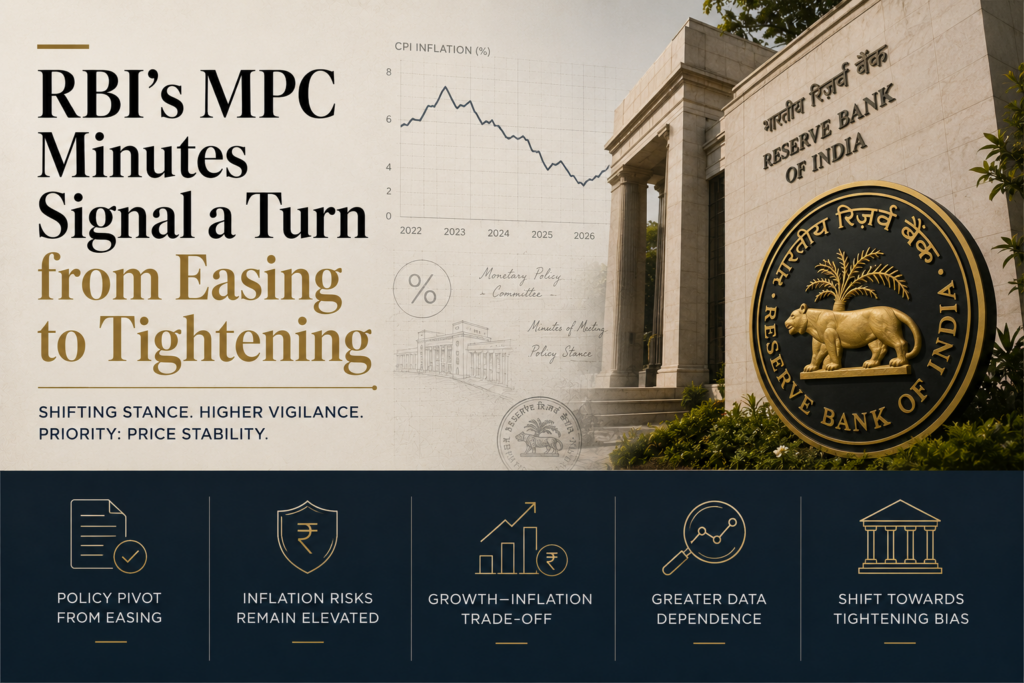
Why in the News
The August 2026 MPC minutes show growing concern over rising inflation. Although the repo rate was kept unchanged at 5.25%, some members see a possible rate hike later in 2026-27 as inflation is projected to peak at 5.9% in Q3.
MPC: Key Prelims Facts
- Legal basis: RBI Act, 1934, amended in 2016.
- Composition: 6 members
- 3 from RBI
- 3 external members appointed by the Central Government.
- Chairperson: RBI Governor.
- Voting: One vote per member; Governor has a casting vote in case of a tie.
- Minutes: Published on the 14th day after the meeting.
- Mandate: Set the policy repo rate to achieve the inflation target.
August 2026 Policy Review
- Repo rate: 5.25%, unchanged.
- Growth forecast: Raised from 6.6% to 6.7%.
- Inflation forecast: Lowered from 5.1% to 5%.
- Q3 inflation projection: 5.9%.
- Inflation is expected to decline after the Q3 peak, supporting the decision to wait rather than tighten immediately.
Core Inflation
- Core inflation = CPI inflation excluding food and fuel.
- It captures relatively persistent, demand-driven price pressures that monetary policy can influence.
- Core excluding precious metals additionally removes gold and silver, preventing bullion price movements from distorting the underlying inflation signal.
Second-Round Inflation Effects
- A first-round shock, such as higher oil prices, can spread through the economy:
- Higher oil prices → higher input costs → higher production costs → higher prices of goods/services → broader inflation
- This transmission is called a second-round effect.
De-Anchoring of Inflation Expectations
- When households and firms stop believing inflation will return to the 4% target, they may:
- Expect high inflation → demand higher wages/prices → firms raise prices → inflation becomes self-sustaining
- This is why MPC members are closely watching expectations and generalisation of price pressures.
Why a Rate Hike May Be Difficult
- Supply shocks: Interest rates cannot directly increase oil supply or food production.
- Transmission lag: Monetary policy affects the economy with a time lag.
- Food weight: Food shocks can substantially raise headline CPI.
- Growth trade-off: Higher rates can weaken investment and consumption.
- Exchange rate: Rate differentials and rupee depreciation can affect imported inflation.
- Fiscal/administered prices: Taxes, MSP and administered fuel prices lie largely outside MPC control.
- Changing CPI basket: Changes in CPI weights can affect historical comparisons.
“[2024, GS3, 10 marks] What are the causes of persistent high food inflation in India? Comment on the effectiveness of the monetary policy of the RBI to control this type of inflation.”
[2017] Which of the following statements is/are correct regarding the ‘Monetary Policy Committee (MPC)?
1. It decides the RBI’s benchmark interest rates.
2. It is a 12-member body including the Governor of RBI and is reconstituted every year.
3. It functions under the chairmanship of the Union Finance Minister.
Select the correct answer using the code given below:
[A] 1 only
[B] 1 and 2 only
[C] 3 only
[D] 2 and 3 only
