Mains Ready By December. Smash Mains & Smash PYQ Admissions Open

GS Paper: GS3-01.Indian Economy and issues relating to planning, mobilization of resources, growth, development and employment.

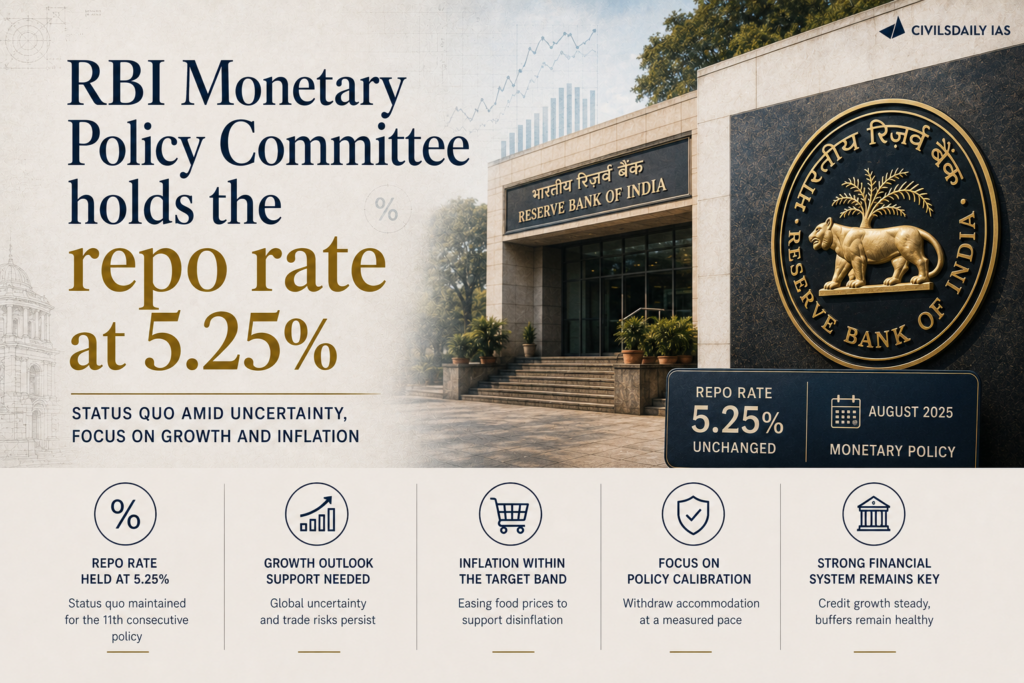
  • RBI Monetary Policy Committee holds the repo rate at 5.25%

    Why in the News

    The Monetary Policy Committee (MPC) of the Reserve Bank of India (RBI) has kept the policy repo rate unchanged at 5.25%, balancing inflation risks against the need to support economic growth amid global uncertainties.

    What is the Monetary Policy Committee (MPC)?

    • Statutory body: Constituted under the Reserve Bank of India Act, 1934 (amended in 2016).
    • Composition: Six members:
      • Three RBI members: Governor (Chairperson), Deputy Governor in charge of Monetary Policy, and one RBI nominee.
      • Three external members: Appointed by the Central Government.
    • Decision-making: Each member has one vote; in case of a tie, the Governor has a casting vote.
    • Mandate: Maintain Consumer Price Index (CPI) inflation at 4%, with a tolerance band of 2% to 6%.

    What did the MPC decide?

    • Repo rate unchanged: Retained at 5.25%.
    • Policy stance: Continues to remain neutral.
    • Liquidity corridor:
      • Standing Deposit Facility (SDF): 5.0%
      • Marginal Standing Facility (MSF): 5.5%
      • Bank Rate: 5.5%
    • Growth outlook: Real GDP growth projected at 6.7%.
    • Inflation outlook: CPI inflation rose to 4.4% in June 2026, crossing the 4% target after remaining below it for 16 months.

    Why did the MPC maintain the status quo?

    • Global uncertainties: Rising crude oil prices and geopolitical tensions in West Asia pose inflation risks.
    • Monsoon concerns: An El Nino driven deficient monsoon could increase food inflation.
    • Data dependent approach: The MPC prefers to wait for clearer inflation and growth signals before changing policy rates.

    Back2Basics: Reserve Bank of India (RBI)

    • Established: 1935 under the Reserve Bank of India Act, 1934.
    • Functions: Monetary authority of India, Banker to the Government, Banker to banks, Regulator and supervisor of the banking system, and Manager of foreign exchange reserves.
    • Major monetary policy instruments: Repo Rate, Standing Deposit Facility (SDF), Marginal Standing Facility (MSF), Cash Reserve Ratio (CRR), Statutory Liquidity Ratio (SLR), Open Market Operations (OMOs)

    “[2017] Which of the following statements is/are correct regarding the Monetary Policy Committee (MPC)?
    1. It decides the RBI’s benchmark interest rates.
    2. It is a 12-member body including the Governor of RBI and is reconstituted every year.
    3. It functions under the chairmanship of the Union Finance Minister.
    Select the correct answer using the code given below:
    (a) 1 only
    (b) 1 and 2 only
    (c) 3 only
    (d) 2 and 3 only
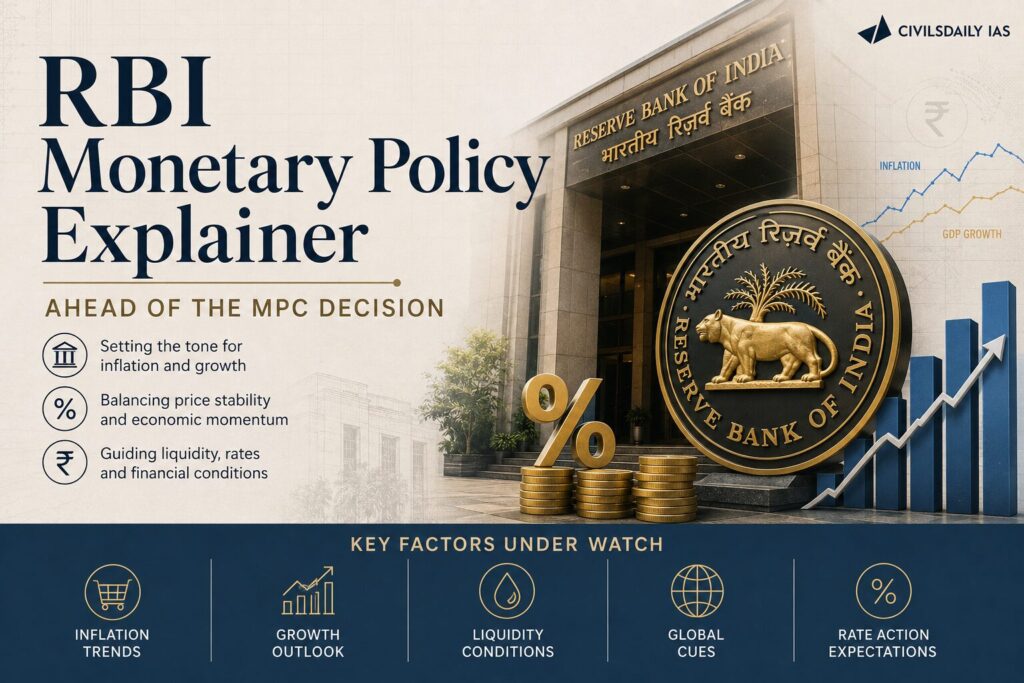
  • RBI monetary policy explainer ahead of the MPC decision

    Why in the News

    The Monetary Policy Committee (MPC) of the Reserve Bank of India (RBI) is set to announce its bi-monthly monetary policy. Most analysts expect it to keep the repo rate unchanged amid global economic uncertainty.

    What is the Monetary Policy Committee (MPC)?

    • The MPC decides the policy repo rate to maintain price stability while supporting economic growth.
    • Constituted under: Reserve Bank of India Act, 1934 (amended in 2016).
    • It meets every two months to review inflation and growth.

    Repo Rate & Inflation Target

    • Repo Rate: The interest rate at which the RBI lends short-term funds to commercial banks.
    • Inflation Target: 4%, with a tolerance band of 2%-6% under the Flexible Inflation Targeting (FIT) framework.

    Factors Considered by MPC

    • Rising crude oil prices.
    • US-Iran geopolitical tensions.
    • Weak monsoon and El Niño increasing food inflation.
    • Mixed domestic growth indicators.
    • Policy stance of major central banks (US Fed, ECB, BoJ, BoE).

    Challenges

    • Time lag in monetary policy transmission.
    • Supply-side inflation (food and fuel) beyond RBI’s control.
    • Balancing inflation with economic growth.
    • External risks affecting capital flows and the rupee.
    • Uncertain global and domestic economic conditions.

    Value Addition

    • Flexible Inflation Targeting (FIT): Adopted in 2016 to maintain inflation at 4% ± 2%.
    • Monetary Policy Tools: Repo Rate, Standing Deposit Facility (SDF), Cash Reserve Ratio (CRR), Statutory Liquidity Ratio (SLR), and Open Market Operations (OMOs).

    “[2017] Which of the following statements is/are correct regarding the Monetary Policy Committee (MPC)?
    1. It decides the RBI’s benchmark interest rates.
    2. It is a 12-member body including the Governor of RBI and is reconstituted every year.
    3. It functions under the chairmanship of the Union Finance Minister.
    (a) 1 only
    (b) 1 and 2 only
    (c) 3 only
    (d) 2 and 3 only
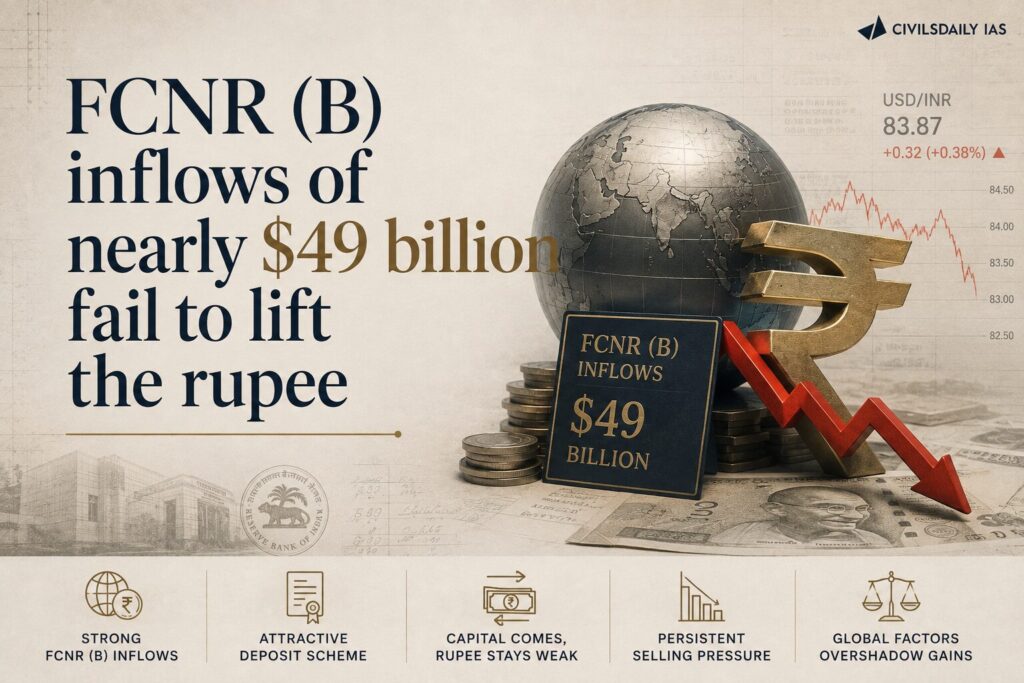
  • FCNR (B) inflows of nearly $49 billion fail to lift the rupee

    Why in the News

    India received nearly USD 49 billion during June-July 2026 through the Foreign Currency Non Resident (Bank) [FCNR(B)] swap window, foreign loans, and bond investments. However, the Indian Rupee (INR) remained stable at around ₹95.38/USD, unlike the sharp appreciation seen under a similar scheme in 2013.

    What are FCNR(B) Deposits and the Swap Window?

    FCNR(B) Deposits

    • Foreign currency term deposits maintained by Non-Resident Indians (NRIs) with Indian banks.
    • Protect depositors from exchange rate risk.
    • Tenure: 1-5 years.

    Swap Window

    • A facility by the Reserve Bank of India (RBI) where banks swap FCNR(B) dollar deposits for rupees.
    • Since dollars go directly to the RBI, they do not increase dollar supply in the forex market.

    Why Didn’t the Rupee Strengthen?

    • Dollar inflows bypassed the open forex market.
    • RBI sold dollars to stabilize the rupee amid global uncertainty.
    • Banks hedged future foreign currency liabilities.
    • Higher crude oil prices and a stronger US dollar offset the impact of inflows.

    Challenges

    • Strong US dollar and geopolitical risks.
    • Lower Foreign Direct Investment (FDI) inflows.
    • Rising crude oil prices widening the Current Account Deficit (CAD).
    • Risk of reversal of FCNR(B) deposits after the swap window ends.

    Value Addition

    • Spot Market: Immediate currency exchange.
    • Forward Market: Currency exchange at a future date and predetermined rate.
    • Foreign Exchange Reserves comprise:
      • Foreign Currency Assets (FCA) (largest component)
      • Gold
      • Special Drawing Rights (SDRs)
      • IMF Reserve Position

    Back2Basics:

    • FCNR(B): Foreign Currency Non Resident (Bank) Deposit.
    • Eligible: NRIs and Overseas Citizens of India (OCIs).
    • Tenure: 1-5 years.
    • Exchange Rate Risk: Borne by the bank/RBI, not the depositor.

    “[2017] Which of the following has/have occurred in India after its liberalization of economic policies in 1991?
    1. Share of agriculture in GDP increased enormously.
    2. Share of India’s exports in world trade increased.
    3. FDI inflows increased.
    4. India’s foreign exchange reserves increased enormously.
    (a) 1 and 4 only
    (b) 2, 3 and 4 only
    (c) 2 and 3 only
    (d) 1, 2, 3 and 4

  • SEBI Closing Auction Session goes live and moves index closing values

    Why in the News

    The Closing Auction Session (CAS) became operational from 3 August 2026 for stocks with Derivative Contracts. During its initial days, the National Stock Exchange (NSE) Nifty 50 and Bombay Stock Exchange (BSE) Sensex recorded unusually large differences in their closing values.

    What is the Closing Auction Session (CAS)?

    • The Closing Auction Session (CAS) is a dedicated 20-minute trading block (3:15 PM to 3:35 PM) introduced by SEBI on August 3, 2026.
    • It pools end-of-day buy and sell orders for eligible stocks to discover a single equilibrium closing price, replacing the final 30-minute VWAP method.

    What is Volume Weighted Average Price (VWAP)?

    • The Volume Weighted Average Price (VWAP) is the average price of a stock weighted by the trading volume, giving greater importance to prices with higher traded volumes.

    Why did Nifty and Sensex Diverge?

    • Separate CAS order books on the NSE and BSE.
    • Different index composition (Nifty 50: 50 stocks; Sensex: 30 stocks).
    • Different weightages of constituent stocks.
    • Initial adjustment to the new auction mechanism.

    Challenges

    • Temporary benchmark divergence.
    • Higher tracking error for Exchange Traded Funds (ETFs) and index funds.
    • Residual risk of price manipulation.
    • Liquidity concerns in less-traded stocks.
    • Operational adaptation by brokers and investors.

    Key Concept:

    • Equilibrium Price: The price at which the maximum quantity of buy and sell orders can be matched during the auction.
    • Derivative Contracts: Financial instruments whose value is derived from an underlying asset such as stocks or indices. Examples: Futures Contracts and Options Contracts
    • Collectively known as the Futures and Options (F&O) segment.

    Securities and Exchange Board of India (SEBI)

    • Established: 1988 (Statutory status in 1992).
    • Governing Act: Securities and Exchange Board of India Act, 1992.
    • Headquarters: Mumbai.
    • Functions: Protect investors. Regulate and develop the securities market. Regulate stock exchanges, mutual funds, and market intermediaries.
  • Strategic stockpiling of critical minerals under the National Critical Mineral Mission

    Why in the News

    India committed Rs 500 crore in 2025 towards critical mineral stockpiling under the National Critical Mineral Mission (NCMM). The commitment exposes a tension between long gestation domestic mining and the immediate supply risk that flows from dependence on China for processed minerals and rare earth elements.

    What is the National Critical Mineral Mission (NCMM)?

    1. Mandate: The NCMM is a scheme launched in 2025 to build a framework for self reliance across the critical mineral value chain, from exploration to processing.
    2. Stockpiling seed: It allocated Rs 500 crore in 2025 towards building strategic reserves of critical minerals.

    What are critical minerals and rare earth elements?

    1. Critical minerals: These are minerals essential to the economy and national security whose supply faces a high risk of disruption, such as lithium and cobalt.
    2. Rare earth elements (REEs): These are a set of 17 metallic elements used in permanent magnets, electronics and defence systems, most of which are refined in China.

    Why must a reserve hold processed minerals and not raw ores?

    1. Refining lead time: Converting raw ore into usable inputs needs onshore capacity with a long lead time, so raw stock is of little use during a shock.
    2. Composition rule: A reserve must hold refined rare earth oxides, processed minerals and finished components such as permanent magnets.
    3. Midstream gap: India’s midstream refining capacity is nascent, so supply agreements must cover intermediate goods rather than raw material.
    4. Storage integrity: Refined oxides are sensitive to moisture and oxidation, requiring climate controlled and nitrogen atmosphere warehousing.
    5. Rotation cycle: Reserves cannot stay static, so the government must release older stock into the market while procuring fresh supplies.

    What do international frameworks show about coordinated stockpiling?

    1. Quad Critical Minerals Initiative Framework: The Quadrilateral Security Dialogue (Quad) launched this USD 20 billion framework in 2025 to fortify regional supply chains.
    2. G7 Evian summit 2026: The Group of Seven (G7) reiterated a commitment to establishing a standards based market for critical minerals.
    3. Modelling caution: If seven major economies simultaneously built six month reserves, aggregate demand could consume 34% of annual global cobalt supply and 10% of lithium supply.

    Why can uncoordinated stockpiling worsen the shortage it aims to solve?

    1. Demand inflation: Uncoordinated buying inflates global demand and deepens the very shortages stockpiling is meant to ease.
    2. Volatility risk: It heightens the price volatility that a reserve is supposed to hedge against.
    3. Limits of price floors: A guaranteed minimum purchase price addresses underinvestment but rarely addresses scarcity.
    4. Dynamic price bands: A band with a floor near USD 12,000 and a ceiling near USD 30,000 triggers coordinated buying below the floor and releases above the ceiling.

    What are the challenges to critical mineral stockpiling?

    1. Capital intensity: Specialised storage demands heavy and continuous capital expenditure, commercial expertise and multi stakeholder involvement.
    2. Material decay: Reserves risk technological obsolescence and physical decay unless constantly rotated. (Nickel and cobalt powders or precursor materials must be constantly tested and rotated back into active commercial supply chains before their chemical integrity drops.)
    3. Access in friend shoring: Collaboration with industrialised powers requires hedging mechanisms so access matches the size of India’s contribution.
    4. Delayed releases: Reserve releases can be blocked by vetoes, so pre agreed market and geopolitical triggers are needed to automate them.
    5. Sidelining of emerging economies: Larger consumers can crowd out India unless minimum guaranteed allocation baselines are fixed.
    6. China concentration: China dominates the mining and processing of several rare earths, giving it leverage over prices and export flows. Past export restrictions on gallium, germanium, and graphite demonstrated how Beijing’s dominance allows it to instantly manipulate global export flows and drive up input costs for rival manufacturing nations.

    Conclusion

    India’s optimal strategy is to join a coordinated stockpiling platform, potentially housed within the G7, which also covers Quad members. This lets India tap a mature ecosystem without bearing the full cost of independent reserves, provided it secures staggered procurement, automatic release triggers and guaranteed allocation baselines.

    Back2Basics:

    National Critical Mineral Mission (NCMM)

    1. Nodal ministry: Ministry of Mines.
    2. Launched: 2025.
    3. Aim: self reliance across the critical mineral value chain covering exploration, mining, processing and recycling.
    4. Coverage: domestic exploration, overseas asset acquisition, stockpiling and building a processing ecosystem.
    5. Stockpiling outlay: Rs 500 crore seeded in 2025.

    PYQ Relevance

    “[2026] Which of the following statements about Rare Earth Elements (REEs) and Critical Minerals is/are correct?
    1. Modern technological innovations including Artificial Intelligence, robotics and space exploration extensively utilise Rare Earth Elements (REEs).
    2. China has the highest share in mining of REEs followed by India.
    3. The Government of India launched the National Critical Mineral Mission (NCMM) in 2025 to establish a robust framework for self-reliance in the critical mineral sector.
    4. Rare Earth Elements are a set of 13 metallic elements.
    (a) 1 and 3 only
    (b) 3 only
    (c) 1, 3 and 4
    (d) 1, 2 and 4

  • Mounting rupee pressure weighs on India’s external trade

    Why in the News

    The rupee has depreciated about 9% against the US dollar over a year, moving from around Rs 87.5 to Rs 95.4 to the dollar. The fall exposes how far India’s trade balance now depends on external shocks it does not control, rather than on domestic competitiveness.

    What is the Real Effective Exchange Rate (REER)?

    1. Meaning: The Real Effective Exchange Rate (REER) is the value of the rupee against a trade weighted basket of partner currencies, adjusted for inflation differences between the countries.
    2. What it signals: A falling REER means Indian goods are becoming cheaper abroad in real terms, which should aid exports but also signals weakening currency strength.
    3. Recent movement: The REER fell between 9% and 11.7% over the period, tracking the nominal depreciation of the rupee.

    What is driving the rupee’s depreciation?

    1. US tariff action: US tariffs on Indian goods rose as high as 50% from August 2025, before being reduced to 10% from February 2026, disrupting export earnings.
    2. Portfolio outflows: Foreign Portfolio Investors (FPI) pulled capital out of Indian markets, reducing dollar inflows and pressuring the currency.
    3. West Asia conflict: The conflict around the Strait of Hormuz raised crude oil prices, widening the oil import bill.
    4. Structural import dependence: India remains dependent on imports for electronics, Active Pharmaceutical Ingredients (API) and critical minerals, keeping import demand high regardless of the rupee’s level.

    Why does the depreciation worsen rather than correct the trade gap?

    1. Widening deficit: The trade deficit widened to $333.6 billion in 2025-26, showing that a cheaper rupee has not narrowed the import bill.
    2. Inelastic imports: Import dependence on energy and critical inputs means volumes do not fall much when the rupee weakens, so the import bill rises in rupee terms.
    3. Export limits: Tariff barriers in key markets cap the export gains a weaker rupee would normally deliver.

    What are the challenges to stabilizing the rupee and the trade balance

    1. Import concentration: Heavy reliance on a few import categories, energy, electronics and critical minerals, leaves the deficit exposed to global price swings.
    2. Reserve drawdown: Defending the rupee through Reserve Bank of India (RBI) dollar sales draws down foreign exchange reserves and cannot continue indefinitely.
    3. Imported inflation: A weaker rupee raises the cost of imported fuel and inputs, feeding into domestic inflation.
    4. Capital flow volatility: FPI flows can reverse quickly with shifts in US interest rates, making the rupee vulnerable to sudden outflows.
    5. Manufacturing gap: Without deeper domestic manufacturing of electronics and pharmaceutical inputs, the structural import bill stays high across cycles.

    Conclusion

    The rupee’s slide is driven mainly by external forces, US tariffs, portfolio outflows and oil prices, not by weaker domestic fundamentals alone. A cheaper currency has failed to correct the trade deficit because import demand is inelastic and export gains are capped by tariffs. Reducing import dependence in energy, electronics and critical minerals is the only durable route to a stronger external position.

    PYQ Relevance

    [UPSC 2020] With reference to the international trade of India at present, which of the following statements is/are correct?

    1. India’s merchandise exports are less than its merchandise imports. 2. India’s imports of iron and steel, chemicals, fertilisers and machinery have decreased in recent years. 3. India’s exports of services are more than its imports of services. 4. India suffers from an overall trade/current account deficit.

    Select the correct answer using the code given below: (a) 1 and 2 only (b) 2 and 4 only (c) 3 only (d) 1, 3 and 4 only

    Answer: (d)

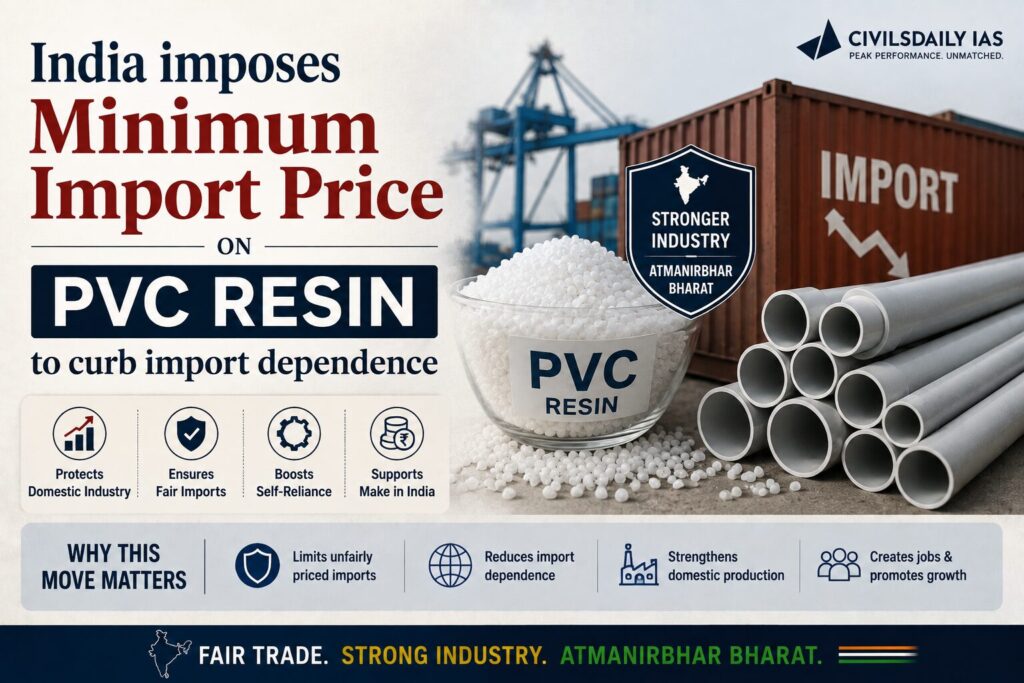
  • India imposes Minimum Import Price on PVC resin to curb import dependence

    Why in the News?

    The Government has imposed a Minimum Import Price (MIP) of US$0.766/kg on PVC (Polyvinyl Chloride) Suspension Resin to protect domestic manufacturers from cheap imports.

    What is MIP?

    • Minimum Import Price (MIP) is the minimum price below which a product cannot be imported.
    • It protects domestic industries from low-priced imports.
    • Unlike anti-dumping duty, MIP applies to all imports, irrespective of the exporting country.

    What is DGTR?

    • The Directorate General of Trade Remedies (DGTR) investigates unfair trade practices.
    • It recommends: Anti-dumping duties, Countervailing duties, and Safeguard measures

    Why was MIP Imposed?

    • Protect domestic PVC manufacturers from cheap imports.
    • Address import dependence due to insufficient domestic production.
    • Exemptions are available for:
      • Export Oriented Units (EOUs)
      • Special Economic Zones (SEZs)
      • Advance Authorisation Scheme imports.

    Challenges

    • Higher input costs for PVC-based industries.
    • Possible disputes at the World Trade Organization (WTO).
    • Does not address the domestic capacity gap.
    • Requires strict customs enforcement against under-invoicing.

    Prelims Facts

    • India uses MIP, anti-dumping duty, countervailing duty and safeguard duty as trade remedy measures.
    • PVC (Polyvinyl Chloride) is a widely used plastic in pipes, cables, packaging and construction.
    • DGTR functions under the Department of Commerce, Ministry of Commerce and Industry.

    [2020] With reference to the international trade of India at present, which of the following statements is/are correct?

    1.India’s merchandise exports are less than its merchandise imports.
    2.India’s imports of iron and steel, chemicals, fertilisers and machinery have decreased in recent years.
    3.India’s exports of services are more than its imports of services.
    4.India suffers from an overall trade/current account deficit.
    Select the correct answer using the code given below:
    a) 1 and 2 only
    b) 2 and 4 only
    c) 3 only
    d) 1, 3 and 4 only

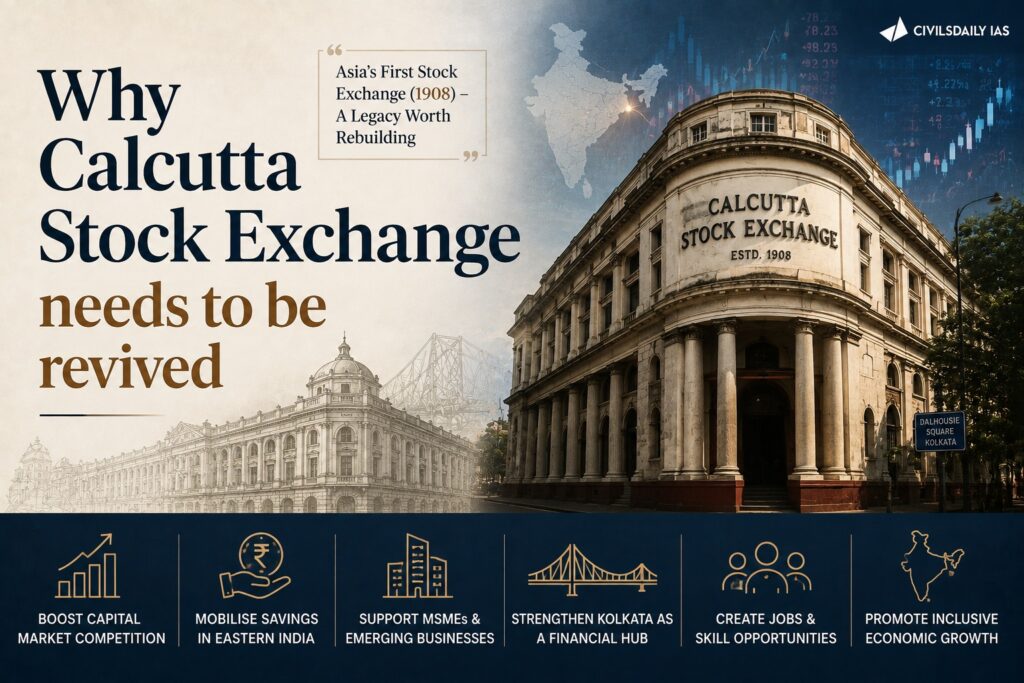
  • Why Calcutta Stock Exchange needs to be revived

    Why in the News

    The West Bengal government’s 2026–27 budget backs the revival of the Calcutta Stock Exchange (CSE) as India’s third exchange dedicated to pre-commercial deep tech listings. The proposal exposes a gap in India’s capital markets: intellectual property driven companies in semiconductors, biotech and space with years to go before revenue have no domestic listing path, forcing them toward foreign exchanges or private capital alone.

    What is the Calcutta Stock Exchange?

    1. Calcutta Stock Exchange (CSE): It was established in 1908, months after 8,000 Indian households financed Tata Steel by public subscription. CSE is India’s oldest stock exchange, now largely dormant, whose revival the West Bengal government’s 2026-27 budget backs.
    2. Pre-commercial listing: A pre-commercial listing allows a company to raise public capital before it has meaningful revenue, based on milestone data such as clinical trial results or chip tape-out yields rather than financial performance.

    How has China built a market for pre-revenue deep tech listings?

    1. China, STAR Market, disclosure gated deep-tech board: Opened in Shanghai in 2019 amid tightening American sanctions, the STAR Market lists companies based on milestone disclosure rather than profitability, and has raised about $160 billion across 592 companies in seven years.
    2. China, STAR 50 index, performance signal: The STAR 50 index rose 64 percent in the first half of 2026, and Cambricon, a chip designer that listed unprofitable in 2020, became the board’s first trillion-renminbi company. This gives the evidence that the model can produce durable winners.
    3. China, sectoral breadth, widening aperture: The STAR Market’s listing scope has expanded into artificial intelligence, robotics and space technology, tracking China’s evolving strategic priorities rather than staying fixed to its original mandate.

    What reforms would let the Calcutta Stock Exchange fill this gap?

    1. Milestone gated listing regime: Listings would be gated by disclosure and technical milestones, clinical data for biopharma, tape-out and yield data for semiconductors, flight heritage for aerospace, rather than financial performance thresholds.
    2. Accredited investor gate: A consolidated accredited investor definition would give family offices, global institutions and Alternative Investment Fund managers preferred initial access, with retail participation phased in as disclosure accumulates.
    3. Formalised unlisted shares dealer network: The existing informal grey market for unlisted shares, currently offline trading at one-way quotes, would be consolidated into a regulated dealer network under CSE.
    4. Interoperable settlement: Trades would settle through existing clearing corporations under interoperability, with mainboard migration to NSE or BSE available as a right once a listing has seasoned on CSE.
    5. Issuer-sponsored research: Research coverage would be seeded through issuer-sponsored analyst reports to build an information ecosystem where currently there is no listed deep-tech paper to analyse.

    What are the challenges to reviving the Calcutta Stock Exchange?

    1. Fragmentation risk: A third exchange adds a distinct venue for investors and issuers to track, raising the risk of fragmented liquidity relative to NSE and BSE.
    2. CSE’s institutional history: The exchange has a complicated operating history and would need fresh institutional capital and governance separated from its existing broker ownership to be credible as a new venue.
    3. Market for lemons risk: Pre-commercial listings without profitability as a filter raise the risk of low quality issuers exploiting the milestone disclosure regime, countered in the proposal only through lock-ins, shorting and surveillance built in by design.
    4. Retail investor protection: Phasing retail investors in only as disclosure accumulates depends on regulators enforcing that sequencing strictly, since retail demand for deep-tech exposure could otherwise push premature access.

    Conclusion

    The case for reviving the Calcutta Stock Exchange rests on India lacking any domestic listing path for companies whose value lies in intellectual property years away from revenue. Whether the exchange can be rebuilt with the governance and investor protection safeguards the proposal outlines, rather than repeating its earlier institutional troubles, will determine if it becomes a genuine third venue alongside NSE and BSE.

    Back2Basics

    Feature / DetailsBSE (Bombay Stock Exchange)NSE (National Stock Exchange)
    Establishment1875 (oldest in Asia)1992 (started with a modern, digital system)
    Main IndexSENSEX (Top 30 Companies)NIFTY 50 (Top 50 Companies)
    Listed companiesApproximately 5,900+ (more companies)Approximately 2,900+ (fewer companies)
    Trading VolumeLow (popular for small & mid-cap shares)Very high (leader in cash & derivatives market)
    Global rankingOne of the largest exchanges in the worldWorld’s No. 1 in derivatives contracts trading

    PYQ Relevance

    [UPSC 2023] Consider the following markets: 1. Government Bond Market 2. Call Money Market 3. Treasury Bill Market 4. Stock Market.

    How many of the above are included in capital markets? (a) Only one (b) Only two (c) Only three (d) All four.

    Answer: (b)

  • Bloomberg again defers India’s Global Aggregate Bond Index inclusion

    Why in the News?

    Bloomberg Index Services Ltd deferred India’s inclusion in the Bloomberg Global Aggregate Bond Index for the second time, stating that recent market reforms need to be fully reflected in operational practice before inclusion.

    What is the Bloomberg Global Aggregate Bond Index?

    • A global benchmark tracking investment-grade government and corporate bonds.
    • Widely followed by global institutional and passive investors.
    • Inclusion can attract passive foreign capital inflows into a country’s bond market.

    Why was India’s Inclusion Deferred?

    • Recent tax reforms are yet to be fully implemented in market operations.
    • Automated trading systems are not fully operational across investor regions.
    • Foreign investor onboarding and account opening remain cumbersome.
    • Bloomberg seeks evidence of sustained operational efficiency before inclusion.

    Significance

    • Inclusion could attract an estimated $20-30 billion in foreign investment.
    • Expands the investor base for Indian Government Securities (G-Secs).
    • Helps reduce government borrowing costs.
    • Enhances India’s integration with global financial markets.

    Challenges

    • Operational bottlenecks in trading and settlement.
    • Complex onboarding process for foreign investors.
    • Global market uncertainty affecting capital flows.
    • Need for robust market infrastructure despite policy reforms.

    Government Securities (G-Secs)

    • Debt instruments issued by the Government of India to finance fiscal deficits.
    • Considered virtually risk-free as they carry a sovereign guarantee.

    India’s Recent Bond Index Inclusions

    • JPMorgan Government Bond Index Emerging Markets (GBI-EM): June 2024.
    • Bloomberg Emerging Market Local Currency Government Index: January 2025.
    • FTSE Russell Emerging Markets Government Bond Index: September 2025.

    June 2026 Reforms

    • Removal of withholding tax to improve investment attractiveness.
    • Removal of capital gains tax for eligible foreign investors in specified government bonds.

    [2011] Both Foreign Direct Investment (FDI) and Foreign Institutional Investor (FII) are related to investment in a country. Which of the following statements best represents an important difference between the two?

    (a) FII helps bring better management skills and technology, while FDI only brings in capital.

    (b) FII helps in increasing capital availability in general, while FDI only targets specific sectors.

    (c) FDI flows only into the secondary market, while FII targets primary market.

    (d) FII is considered to be more stable than FDI.

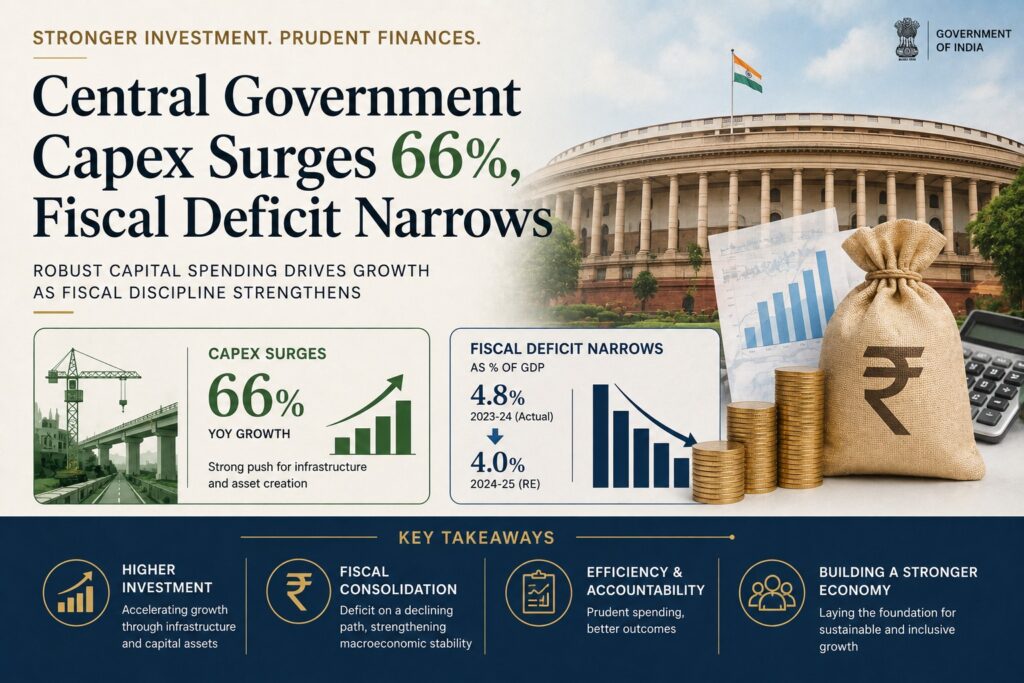
  • Central government capex surges 66%, fiscal deficit narrows

    Why in the News?

    The Central Government’s capital expenditure (capex) increased by 66% to ₹89,255 crore in June 2026, while the fiscal deficit narrowed by 46% to ₹1.45 lakh crore, reflecting strong public investment despite revenue pressures.

    Key Highlights

    • Capex: Up 66% YoY to ₹89,255 crore.
    • FY 2026-27 Capex Target: ₹12.22 lakh crore; 28% achieved in the first quarter.
    • Fiscal Deficit: Reduced by 46% in June.
    • Direct Taxes: Corporate tax up 20% and income tax up 7% (Apr-Jun).
    • Customs Duty: Increased 36%, supported by higher duties on gold and silver.

    Why is the Fiscal Position Under Pressure?

    • Urea subsidy increased 68% to ₹53,034 crore.
    • Excise collections declined 22% due to fuel duty cuts.
    • Weak GST growth affected overall revenue.
    • Higher global crude oil prices may increase future expenditure.

    Significance

    • Higher capex boosts infrastructure, employment and long-term economic growth.
    • Lower fiscal deficit improves macroeconomic stability.
    • Strong direct tax collections indicate resilient formal economic activity.

    Challenges

    • Rising subsidy burden.
    • Declining fuel excise revenue.
    • Volatile global oil prices.
    • Sustaining fiscal consolidation while maintaining capital investment.

    Capital Expenditure (Capex)

    • Spending that creates long-term productive assets, such as roads, railways, ports and power infrastructure.
    • Promotes economic growth by increasing productive capacity.

    Revenue Expenditure

    • Spending on salaries, pensions, subsidies, interest payments and day-to-day government operations.
    • Does not create permanent assets.

    Fiscal Deficit

    • Fiscal Deficit = Total Expenditure − (Revenue Receipts + Non-Debt Capital Receipts)
    • Indicates the government’s borrowing requirement during a financial year.
    • Primary Deficit: Fiscal deficit minus interest payments.
    • Revenue Deficit: Revenue expenditure exceeds revenue receipts.

    “[2025] A country’s fiscal deficit stands at ₹50,000 crores. It is receiving ₹10,000 crores through non-debt creating capital receipts. The country’s interest liabilities are ₹1,500 crores. What is the gross primary deficit?

    (a) ₹48,500 crores

    (b) ₹51,500 crores

    (c) ₹58,500 crores

    (d) None of the above.