Why in the News
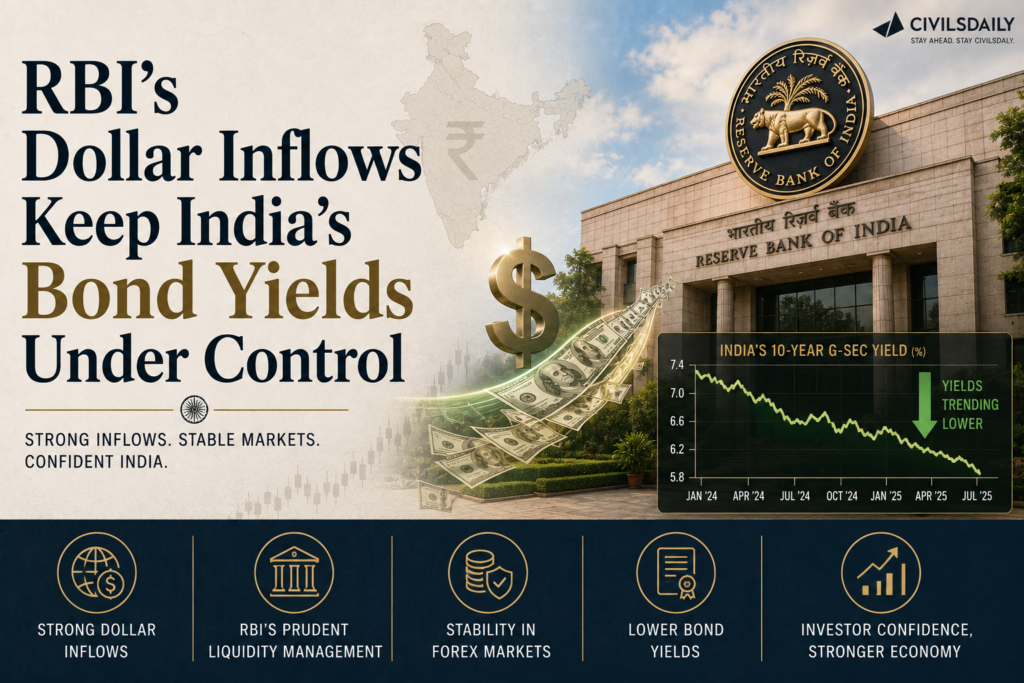
India’s ten year benchmark government bond yield rose by only 8 basis points over six months, against increases of 56 to 78 basis points across other major economies. The divergence follows a deliberate choice by the Reserve Bank of India (RBI) to lean on targeted foreign exchange and liquidity measures rather than on the policy rate.
What is the Foreign Currency Non Resident Bank, FCNR(B), deposit scheme?
- About: It is a term deposit that a non resident Indian holds with an Indian bank denominated in a permitted foreign currency, not in rupees.
- Why it attracts dollars: The depositor carries no exchange rate risk, since both principal and interest are repaid in the same foreign currency.
- How it supports the external sector: Banks bring the foreign currency in and swap it with the RBI. That adds to foreign exchange reserves and releases rupee liquidity into the banking system.
- Nature of the money: It is a borrowed inflow with a fixed maturity, not permanent capital.
What is a ten year benchmark bond yield?
- About: It is the return an investor earns on the most actively traded ten year government security at its prevailing market price.
- Why it moves: The yield rises when the bond’s price falls, so a rising yield signals selling pressure or expectations of higher rates. It anchors the pricing of corporate bonds and long tenor loans.
- Basis point: One basis point equals one hundredth of one percentage point.
What is the policy corridor under the liquidity adjustment facility?
- About: It is the band within which the RBI keeps the overnight money market rate, set at 25 basis points on either side of the repo rate.
- Its two edges: The marginal standing facility forms the ceiling at which banks borrow, and the standing deposit facility forms the floor at which banks park surplus funds.
What is a certificate of deposit?
- About: It is a short tenor negotiable instrument that a bank issues to raise funds from the money market.
- What its issuance signals: Heavy issuance signals that credit growth is outrunning deposit growth. Falling issuance signals that deposits are again covering lending.
What is the Bloomberg Global Aggregate Index?
- About: It is a global benchmark bond index tracked by passive funds, so a country’s inclusion obliges index tracking funds to buy its bonds.
- India’s position: The inclusion of Indian government bonds in the index was deferred, with the announcement made on 31 July.
What does the cross country movement in yields reveal about India’s position?
- Advanced economy benchmarks moved sharply: Ten year yields rose 60 basis points in the United States, 66 in Japan and 56 in the United Kingdom over the six months to 14 August.
- Emerging Asian peers moved further: Yields rose 72 basis points in South Korea, 78 in Indonesia and 61 in the Philippines over the same period.
- India is the outlier: The Indian ten year yield moved up by a modest 8 basis points.
- Rate action explains much of the gap: Within a span of three months many emerging markets hiked policy rates, either to contain inflation or to defend their currencies.
- What the comparison establishes: India absorbed the same energy price and global rate shock without either a rate hike or a yield spike.
Which opposing forces are acting on Indian bond yields?
- External pressure, West Asia: A protracted conflict in West Asia has kept energy prices and risk premia elevated.
- External pressure, El Nino: Lingering worries over rainfall precipitation due to El Nino threaten food prices and the inflation path.
- Offsetting force, inflation: India’s inflation trajectory has remained benign relative to the target.
- Offsetting force, growth: Economic growth has stayed resilient through the same period.
- Offsetting force, fiscal position: The outlook on the Centre’s fiscal finances has been steady.
- Offsetting force, external account: The RBI’s foreign exchange measures have improved the external sector position.
Why did the Monetary Policy Committee hold when peers hiked?
- Three consecutive holds: The Monetary Policy Committee (MPC), the statutory six member body that sets the policy rate, maintained a neutral hold across three straight meetings despite emerging market peer pressure to hike.
- A smaller deviation from target: Over the last six months India’s average inflation deviation from the 6 percent upper bound of the target band has been far smaller than that of peers.
- Second round effects were contained: Supply side steps and better management of second round effects limited the spillover of the energy price shock into broader inflation and activity.
- Core inflation created the room: The measure that excludes food and fuel components gave the committee the room to pause and assess, rather than pivot from a pause to hikes.
How did the RBI substitute targeted measures for the policy rate?
- Choice of instrument: The RBI leaned more on targeted market measures than on policy rate action.
- The three windows used: It stepped up dollar attracting measures through the non resident deposit and FCNR(B) scheme, external commercial borrowings and overseas foreign currency borrowings.
- Size of the inflow: Together these measures attracted around 56.8 billion dollars between 8 June and 13 August.
- Concentration in one window: The bulk came through the FCNR(B) scheme alone, at 52.3 billion dollars.
- Window pulled forward: Given the size of the FCNR(B) flows, the swap facility window will stay open only till end August, rather than end September as initially planned.
What did the dollar inflows do to domestic banking conditions?
- Deposits rose: System deposits ticked up at an aggregate level.
- Market borrowing was avoided: Credit demand is being funded without banks resorting to market borrowings.
- Certificate of deposit issuance fell: Issuance dropped as the deposit base covered lending growth.
- Liquidity surplus widened: The banking system surplus averaged Rs 3.2 lakh crore during 1 to 13 August, against Rs 1.3 lakh crore in the same window in July.
- Overnight rates fell below the repo rate: Easy liquidity pushed overnight rates below the repo rate towards the lower end of the policy corridor.
What has shaped foreign investor sentiment in Indian debt?
- Tax exemption for foreign debt investors: The government exempted foreign debt investors from tax, lowering the effective cost of holding Indian paper.
- Access restrictions eased: The RBI streamlined investment restrictions and widened the scope of investible securities.
- A record monthly inflow: These steps produced debt inflows of 5.6 billion dollars in June, the highest monthly inflow since January 2020.
- Index inclusion deferred: The deferment of the inclusion of Indian government bonds in the Bloomberg Global Aggregate Index was announced on 31 July and dented sentiment.
- Delay, not denial: The immediate gains from index driven inflows are postponed rather than lost.
Why does the calm in Indian bonds rest on borrowed strength?
- The inflow is a liability: FCNR(B) money is a dated deposit obligation that must be repaid in foreign currency, not equity or permanent capital.
- The instrument is being rationed: Closing the swap window a month early signals that the tool is being limited rather than extended.
- Time bought is not a pivot: The macro mix and the measures have bought the MPC time. They have not removed the need to eventually move on rates.
- The swing factors remain live: West Asia developments, El Nino and monsoon risk, and United States Federal Reserve policy actions remain the key variables.
- The rate path still points up: The expectation is one to two hikes in the latter half of financial year 2027, in the December or February policy, against street expectations of three.
Challenges to the RBI’s liquidity and external sector management
- Borrowed inflows create a repayment cliff: Large foreign currency deposit windows mature together and require an orderly redemption plan. e.g. the 2013 FCNR(B) swap window raised about 26 billion dollars, and its 2016 maturity had to be actively managed to avoid a rupee shock.
- A liquidity surplus eases policy without a decision: Overnight rates drifting to the floor of the corridor deliver de facto easing while the stated stance remains neutral. e.g. overnight rates in August fell below the repo rate towards the standing deposit facility level.
- Sterilisation carries a cost: Absorbing dollar inflows creates rupee liquidity that must be mopped up. e.g. variable rate reverse repo auctions used to drain surplus liquidity pay interest to banks and reduce central bank income.
- Concentration in a single instrument: A dominant share of the inflow through one scheme concentrates rollover risk. e.g. 52.3 billion dollars of the 56.8 billion dollar inflow came through the FCNR(B) window alone.
- Dependence on index driven flows: Passive index decisions taken abroad move the domestic bond market. e.g. the deferment of Bloomberg Global Aggregate Index inclusion announced on 31 July immediately dented foreign debt sentiment.
- Imported energy inflation bypasses domestic policy: India imports over 85 percent of its crude oil requirement, so a West Asia supply shock enters the inflation path irrespective of the policy rate. e.g. the current conflict has kept energy prices elevated through the last six months.
- Government borrowing shapes the long end: The Centre’s gross market borrowing programme is the largest single determinant of demand and supply at the ten year point. e.g. the borrowing calendar published each half year moves benchmark yields on announcement.
Conclusion
The Indian bond market has absorbed the same global shock as its peers with an 8 basis point move, because the RBI substituted external sector and liquidity management for a policy rate response. The measures have bought the Monetary Policy Committee time rather than removing the need to act. The path to a policy pivot remains calibrated and data dependent, with West Asia, the monsoon and Federal Reserve action as the swing factors, and the next move expected in the latter half of financial year 2027.
What is central bank liquidity management?
- About: Liquidity management is the set of operations through which a central bank keeps the quantity of reserves in the banking system consistent with its policy rate.
- Rationale: The policy rate is only a signal. Without matching control over the supply of bank reserves, the operative overnight rate drifts away from the repo rate and the policy stance stops binding.
- Named typology, the liquidity adjustment facility: Repo injects funds against collateral, the marginal standing facility caps overnight borrowing, and the standing deposit facility absorbs surplus funds without collateral.
- Named typology, quantity instruments: Open market operations buy or sell government securities to change durable liquidity, and the cash reserve ratio fixes the share of deposits banks must hold with the RBI.
- Named typology, fine tuning operations: Variable rate repo and variable rate reverse repo auctions adjust frictional liquidity over days.
- Named typology, foreign exchange operations: Dollar purchases add rupee liquidity and dollar sales drain it, so external sector intervention is also a liquidity instrument.
Key Concerns Regarding Liquidity Management
- Incomplete transmission to lending rates: Changes in the policy rate reach bank lending rates slowly and unevenly across loan categories.
- Durable versus frictional liquidity: Surpluses driven by temporary flows can mask an underlying durable deficit, leading to mistimed operations.
- Government cash balances: Large Centre and State balances parked with the RBI drain system liquidity without any policy decision.
- Currency in circulation leakage: Seasonal cash withdrawal by the public removes reserves from the banking system, particularly during festivals and elections.
- Cost of sterilisation: Mopping up liquidity created by dollar purchases carries an interest cost that falls on the central bank’s balance sheet.
- The impossible trinity: Defending the exchange rate while keeping capital accounts open constrains independent control of domestic monetary conditions.
Statutory Framework Governing Monetary Policy and Liquidity Management
- Section 45ZA, Reserve Bank of India Act, 1934: The Centre, in consultation with the RBI, fixes the inflation target once every five years.
- Section 45ZB, RBI Act, 1934: Constitutes the six member Monetary Policy Committee and provides for its appointment.
- Section 45ZI, RBI Act, 1934: Requires the MPC to meet at least four times a year, fixes a quorum of four, and gives the Governor a casting vote in a tie.
- Section 45ZN, RBI Act, 1934: Requires a report to the Centre when the inflation target is missed, defined as average inflation outside the band for three consecutive quarters.
- Section 42, RBI Act, 1934: Provides for the cash reserve ratio that banks must maintain with the RBI.
- Section 17, RBI Act, 1934: Empowers the RBI to transact in securities and in foreign exchange, which is the basis for open market operations and swaps.
- Section 24, Banking Regulation Act, 1949: Provides for the statutory liquidity ratio held in approved securities.
- Foreign Exchange Management Act, 1999: Governs FCNR(B) deposits, external commercial borrowings and non resident accounts.
- Government Securities Act, 2006: Governs the issue and management of government securities by the RBI on behalf of the government.
- Fiscal Responsibility and Budget Management Act, 2003: Sets fiscal deficit targets and bars the RBI from subscribing to primary issues of government securities.
Back2Basics: The Monetary Policy Committee
- Statutory basis: Constituted in 2016 under Section 45ZB of the Reserve Bank of India Act, 1934, as amended by the Finance Act, 2016.
- Composition: Six members, of whom three are from the RBI including the Governor as ex officio chairperson and the Deputy Governor in charge of monetary policy, and three are external members appointed by the Central Government.
- Term of external members: Four years, without eligibility for reappointment.
- Mandate: To fix the policy repo rate required to achieve the inflation target.
- Inflation target: 4 percent Consumer Price Index inflation with a tolerance band of plus or minus 2 percentage points, notified for five year cycles.
- Procedure: Meets at least four times a year, takes decisions by majority, and the Governor holds a casting vote in the event of a tie.
- Accountability: Minutes are published on the fourteenth day after the meeting, and a failure report goes to the Centre if inflation stays outside the band for three consecutive quarters.
Government and Regulatory Initiatives in the Debt Market
- Fully Accessible Route, 2020: Opens specified government securities to non resident investment without any quantitative ceiling, and made index inclusion feasible.
- RBI Retail Direct, 2021: Allows individual investors to open gilt accounts and buy government securities directly in the primary and secondary markets.
- Standing Deposit Facility, 2022: Gives the RBI a collateral free tool to absorb surplus liquidity and sets the floor of the policy corridor.
- Sovereign Green Bonds: Issued from financial year 2023 to fund public projects that reduce carbon intensity, with proceeds ring fenced for green expenditure.
- Bharat Bond Exchange Traded Fund: Pools public sector bonds into a listed target maturity fund for retail and institutional investors.
- Special Rupee Vostro Accounts, 2022: Permit invoicing and settlement of international trade in rupees through designated correspondent bank accounts.
- Sovereign Gold Bond Scheme: Substitutes physical gold demand with a government security, reducing gold import pressure on the current account.
Key Facts about the Reserve Bank of India and the Bond Market
- The Reserve Bank of India was established on 1 April 1935 under the Reserve Bank of India Act, 1934, and was nationalised in 1949. Its central office is in Mumbai.
- Flexible inflation targeting became India’s statutory monetary policy framework in 2016.
- The policy corridor is 25 basis points on either side of the repo rate, bounded by the marginal standing facility above and the standing deposit facility below.
- Indian government bonds entered the JP Morgan Government Bond Index Emerging Markets from June 2024, the first such global index inclusion.
- One basis point equals one hundredth of a percentage point.
- The Ways and Means Advances facility provides temporary cash to the Centre and States for mismatches in receipts and payments.
- India’s foreign exchange reserves rank among the largest held by any country.
Challenges in Monetary and External Sector Management
- Weak transmission to lending rates: Policy rate changes reach borrowers with a long and variable lag. e.g. the shift to external benchmark linked lending rates in 2019 was necessary because transmission under the marginal cost of funds based lending rate lagged by several quarters.
- Food price dominance in the price index: A large food weight makes headline inflation move on supply shocks that monetary policy cannot address. e.g. food and beverages carry close to 46 percent weight in the Consumer Price Index, so a tomato or onion price spike moves the headline number.
- Fiscal and monetary coordination gaps: Government cash management alters banking system liquidity independently of policy. e.g. large Centre and State balances parked with the RBI drain reserves without any monetary policy decision.
- Exchange rate and liquidity conflict: Defending the rupee through dollar sales tightens domestic liquidity unintentionally. e.g. sustained intervention during a depreciation episode simultaneously absorbs rupees from the banking system.
- Credit and deposit growth gap: Persistent divergence forces banks into costlier market funding. e.g. bank credit growth outran deposit growth through 2024, pushing banks towards certificates of deposit.
- Vulnerability to global rate cycles: Shifts in advanced economy policy trigger capital outflows regardless of domestic fundamentals. e.g. the 2013 taper tantrum drove the rupee past 68 to the dollar within months.
- Shallow corporate bond market: Long tenor private borrowing remains concentrated in a few highly rated issuers. e.g. the bulk of corporate bond issuance is by AAA rated public sector and financial entities, leaving mid rated firms dependent on bank credit.
Way Forward
- Publish a durable liquidity framework: Set out how the RBI distinguishes frictional from durable liquidity and what triggers open market operations, so market expectations align with intent.
- Diversify the external funding mix: Shift the balance from borrowed deposit inflows towards non debt creating flows such as foreign direct investment.
- Plan the redemption calendar publicly: Announce the maturity profile of swap linked FCNR(B) inflows in advance to avoid a bunched outflow shock.
- Deepen the corporate bond market: Expand market making, credit enhancement and repo in corporate bonds so the government bond market is not the only deep segment.
- Broaden the domestic investor base: Grow retail and pension participation through Retail Direct and target maturity funds to reduce dependence on foreign index flows.
- Strengthen supply side management of food inflation: Build buffer stocking, storage and import calibration for perishables so monetary policy is not asked to correct supply shocks.
- Maintain transparent forward guidance: State the conditions under which the neutral stance would change, so that a pivot does not itself become a yield shock.
Matching Previous Year Question
“[2022] With reference to the Indian economy, consider the following statements:
1. If the inflation is too high, Reserve Bank of India (RBI) is likely to buy government securities.
2. If the rupee is rapidly depreciating, RBI is likely to sell dollars in the market.
3. If interest rates in the USA or European Union were to fall, that is likely to induce RBI to buy dollars.
Which of the statements given above are correct?
(a) 1 and 2 only
(b) 2 and 3 only
(c) 1 and 3 only
(d) 1, 2 and 3

Answer: (b)”