Why in the News?
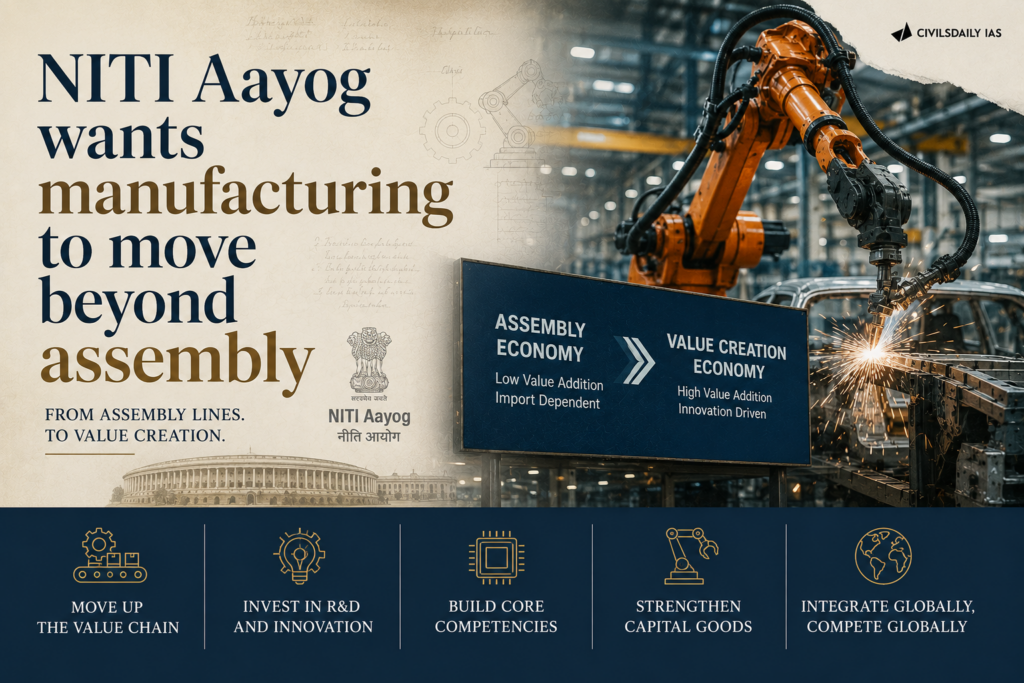
A NITI Aayog report titled Key Sectors to Position India as a Global Manufacturing Hub calls for deeper localisation and value addition across four sectors. It argues that India’s manufacturing remains stuck at assembly, with high import dependence for inputs.
What does the report cover?
- Four focus sectors: Chemicals, telecom and networking equipment, textiles, and solar photovoltaic (PV).
- Central diagnosis: India assembles finished goods but imports the high-value inputs, capping domestic value addition.
What are the sector-specific findings?
- Chemicals: The industry stood at $200-220 billion in FY25, roughly 3% to 3.5% of the global market, growing 6% to 8%.
- Textiles: About 80% of textile and apparel producers are MSMEs, limiting scale and technology adoption.
- Import reliance: Around 35% of mono-ethylene glycol, a key textile input, is imported.
- Solar PV: Domestic capacity depends on imported cells and wafers.
Why does deeper localisation matter?
- Value capture: Assembly adds little domestic value, so moving up the chain raises incomes and jobs.
- Strategic resilience: Import dependence for inputs exposes India to supply shocks and price volatility.
- Trade balance: Substituting imported inputs narrows the manufacturing trade deficit.
What are the challenges to a manufacturing hub strategy
- Scale deficit: An MSME-heavy base struggles to achieve globally competitive scale.
- Technology gap: Weak research and development limits movement into complex components.
- Logistics cost: High freight and power costs erode cost competitiveness.
- Skilling shortfall: A shortage of trained industrial labour slows productivity gains.
- Input ecosystem: Absence of a domestic supplier base for critical inputs keeps assembly dependent on imports.
Conclusion
The report reframes the manufacturing goal from output volume to domestic value addition. Its recommendations depend on building an input-supplier ecosystem, which the Production Linked Incentive (PLI) scheme alone has not delivered.
Back2Basics
Government Initiatives for manufacturing
- Make in India: Umbrella programme to raise manufacturing’s share of GDP.
- Production Linked Incentive (PLI) scheme: Output-linked incentives across 14 sectors.
- National Manufacturing Mission: Announced to coordinate sectoral manufacturing push.
- MUDRA & Credit Guarantee Scheme: Improve access to institutional credit for MSMEs, supporting investment, expansion and employment generation.
- Semicon India Programme: Supports semiconductor fabrication, packaging and related ecosystems to build strategic manufacturing capabilities and reduce import dependence.
Key Concepts
Assembly vs. Value Addition
- Assembly-led model: Importing components and assembling finished products in India.
- Value-added manufacturing: Domestic production of components, intermediate goods, technology and final products.
- Key concern: High domestic output does not necessarily mean high domestic value capture.
China+1 Strategy
- Global firms are diversifying supply chains beyond China.
- India can leverage this opportunity, but competitive costs, reliable infrastructure and deeper localisation are essential.
PYQ Relevance
[UPSC 2025] Discuss the rationale of the Production Linked Incentive (PLI) scheme. What are its achievements? In what way can the functioning and outcomes of the scheme be improved?
Linkage: The 2025 PYQ examines the role and effectiveness of the PLI scheme in strengthening India’s manufacturing sector. The report highlights the need to move beyond assembly towards deeper localisation, domestic value addition and stronger supplier ecosystems.
