💥Join UPSC 2027,2028 Mentorship (July Batch) + XFactor Notes & Microthemes PDF

GS Paper: GS3-02.Inclusive growth and issues therein

  • SWAMIH investment fund and its affordable housing push

    swami

    The Special Window for Affordable and Mid-Income Housing (SWAMIH) Investment Fund I has raised Rs 15,530 crore so far.

    What is the SWAMIH investment fund?

    • The SWAMIH Investment Fund I is a social impact fund specifically formed for completing stressed and stalled residential projects.
    • The Fund is sponsored by the Ministry of Finance and is managed by SBICAP Ventures Ltd., a State Bank Group company.
    • The Fund is considered as the lender of last resort for distressed projects.

    Who are eligible for this fund?

    It considers-

    • First-time developers,
    • Established developers with troubled projects,
    • Developers with a poor track record of stalled projects,
    • Customer complaints and NPA accounts, and even
    • Projects where there are litigation issues.

    Significance of the funds

    • The Fund’s presence in a project often acts as a catalyst for better collections and sales primarily in projects that were delayed for years.
    • According to the Finance Ministry, SWAMIH Fund has one of the largest domestic real estate private equity teams focused only on funding and monitoring the completion of stressed housing projects.

    How many projects so far have been financed by the Fund?

    • SWAMIH has so far provided final approval to about 130 projects with sanctions worth over Rs 12,000 crore.
    • The Fund has completed 20,557 homes and aims to complete over 81,000 homes in the next three years across 30 tier 1 and 2 cities.
    • The Fund has been able to complete construction in 26 projects and generate returns for its investors.
    • It has also played a critical role in the growth of many ancillary industries in real estate and infrastructure sector having successfully unlocked liquidity of more than Rs. 35,000 crore.

    Are you an IAS Worthy Aspirant? Get a reality check with the All India Smash UPSC Scholarship Test

    Get upto 100% Scholarship | 900 Registration till now | Only 100 Slots Left


  • South Asia Need to Invest In Human Capital

    South Asia

    Central Idea

    • The last few years have ushered in a harsh new reality where crises are the norm rather than the exception. Pandemics, economic slumps and extreme weather events were once tail-end risks, but all three have hit South Asia in rapid succession since 2020.  To strengthen resilience and protect the well-being of future generations, governments across South Asia need to take urgent policy action and invest in human capital.

    Get your Rs 10,000 worth of UPSC Strategic Package for FREE | PDFs, Zoom session, Tests, & Mentorship.

    South Asia Overview

    • Countries: Afghanistan, Bangladesh, Bhutan, India, Maldives, Nepal, Pakistan, and Sri Lanka.
    • Population: The region has a total population of over 1.8 billion people, making it the most populous region in the world.
    • Geography: South Asia has a diverse geography, with mountain ranges such as the Himalayas and Hindu Kush, major rivers like the Ganges, Indus, and Brahmaputra, and coastal areas along the Arabian Sea, Bay of Bengal, and Indian Ocean.
    • Economy: India is the largest economy in the region, accounting for more than 70% of the region’s total GDP. Agriculture is a major employer in most countries, with rice and wheat being staple crops. The manufacturing sector is also a significant contributor to the region’s economy, with textiles, garments, and leather products being major exports
    • Climate: The climate of South Asia is varied, with the monsoon season bringing heavy rainfall to much of the region and causing flooding in some areas. The region’s geography and size also result in varying climate patterns. In general, the region experiences hot and humid summers and mild winters.
    • Climate Change Risks: Climate change poses significant risks to the region, with some areas, such as the Maldives, at risk of sea level rise. Other risks include increased frequency and severity of extreme weather events, such as floods and droughts. The region is also vulnerable to the impacts of climate change on health, including increased incidence of heat-related illness and infectious diseases.
    • Biodiversity and Environmental Threats:
    • South Asia is home to several biodiversity hotspots, such as the Western Ghats in India and the Eastern Himalayas.
    • However, the region faces significant environmental threats, such as deforestation, air and water pollution, and climate change.
    • Deforestation is a major problem in the region, with logging and land use change leading to habitat destruction and loss of biodiversity.

    South Asia

    An underutilized asset of South Asia: Analysis

    • South Asia’s people are its biggest asset but remain wastefully underutilized:
    • With nearly half its population under the age of 24 and over one million young people set to enter the labour force every month until 2030, the region could reap an enviably high demographic dividend.
    • Stunting one of the significant challenges: South Asia is also home to over one third of the world’s stunted children. And a child born in the region today can, by the age of 18, expect to attain only 48% of their full productive potential.
    • Governments spending on Health and education: South Asian governments on average spend just 1% of GDP on health and 2.5% on education. In comparison, the global average is 5.9% on health and 3.7% on education.
    • COVID-19 pandemic, a blow to regions human capital: The COVID-19 pandemic, which pushed an additional 35 million people across South Asia into extreme poverty, dealt an unprecedented blow to the region’s human capital. Among its most woeful impacts is a rise in learning poverty, or the inability to read and understand a simple text by age 10. Ineffective remote instruction, during the pandemic increased South Asia’s learning poverty from 60% to 78%.
    • The poorest and most vulnerable people fell further behind: For example, in Bangladesh, the poorest students lost 50% more in terms of learning than the richest students. Several countries still show little to no signs of recovery, and South Asia’s students could lose up to 14.4% of their future earnings.

    Interventions that can make a difference

    • Affordable education: Recent evidence suggests that even simple and low-cost education programmes can lead to sizable gains in skills.
    • For instance:
    • In Bangladesh attending a year of additional pre-school through two-hour sessions significantly improved literacy, numeracy, and social-development scores.
    • In Tamil Nadu, six months of extra remedial classes after school helped students catch up on about two-thirds of lost learning linked to 18 months of school closures.
    • In Nepal, government teachers ran a phone tutoring programme that helped increase students’ foundational numeracy by 30%.
    • Robust systems for crisis management: The need for countries to have robust systems in place to support individuals and families during times of crisis. Such systems, which can include social safety nets, health care, and education programs, can help to mitigate the impact of crises like the pandemic, protect vulnerable populations, and promote resilience. By investing in these systems before a crisis strikes, countries can better prepare themselves to respond to the challenges that may arise.
    • Use data and technology: Effective systems are needed to respond to crises quickly and maintain vital services like healthcare and education. Coordination across sectors is important. Data and technology play a crucial role in the delivery of services, human development systems should ensure they are effectively used.

    South Asia

    World Bank study: Interdependence of health, education and skills for human development

    • A new World Bank study, Collapse and Recovery: how COVID eroded human capital and what to do about it, analyses the pandemic’s impacts on young people, stresses the multi-dimensional and complementary nature of human development.
    • The health, education, and skills people acquire at various stages of their lives, build and depend on each other.
    • To be effective, human development systems must recognise and exploit these overlapping connections. In other words, they should be agile, resilient and adaptive.

    Conclusion

    • The road ahead for South Asia is rocky. The next crisis may be just around the corner. A robust human development system would not only mitigate the damage but also help ensure lives and livelihoods are protected. It could provide the resilience South Asia needs to prosper in an increasingly volatile world. While the outlook is grim, it is important to remember that well-designed and implemented interventions can make a difference if governments act fast.

    Mains question

    Q. South Asia possesses remarkable human capital, but it remains underutilized and has been further impacted by the COVID-19 pandemic. Discuss and suggest what can be done to address the issues?

    Attempt UPSC 2024 Smash Scholarship Test | FLAT* 100% OFF on UPSC Foundation & Mentorship programs

  • SDGs: India’s Progress Analysis

    SDG

    Central Idea

    • A recent analysis published in The Lancet has concluded that India is not on-target to achieve 19 of the 33 Sustainable Development Goals (SDGs) indicators. The critical off-target indicators include access to basic services, wasting and overweight children, anaemia, child marriage, partner violence, tobacco use, and modern contraceptive use.

    Get your Rs 10,000 worth of UPSC Strategic Package for FREE | PDFs, Zoom session, Tests, & Mentorship

    Analysis

    • On-Target: Districts that have not met the SDG target by 2021 and have observed a magnitude of improvement between 2016 and 2021 sufficient to meet the target by 2030.
    • Off-Target: Districts that have not met the SDG target by 2021 and either observed worsening between 2016 and 2021 or observed an insufficient magnitude of improvement between 2016 and 2021. If these districts continue with either of these trends, they will not meet their targets by 2030.
    • Progress in: Indicators shows the progress in reducing adolescent pregnancy, tobacco use in women, multidimensional poverty, teenage sexual violence, and improving electricity access.
    • Areas where more efforts are needed: More efforts are needed for reducing anaemia in women, improving access to basic services, providing health insurance for women, and reducing anaemia in pregnant women.

    Sustainable Development Goals (SDGs)

    • The SDGs, otherwise known as the Global Goals, are a universal call to action to end poverty, protect the planet and ensure that all people enjoy peace and prosperity.
    • The SDGs were adopted by the United Nations in 2015 with a vision to achieve a better and more sustainable future for all. The 17 SDGs came into force with effect from 1st January 2016 as a part of 2030 Agenda for Sustainable Development.
    • India is one of the signatory countries that has committed to achieving these goals by 2030.
    • Though not legally binding, the SDGs have become de facto international obligations and have the potential to reorient domestic spending priorities of the countries during the next fifteen years.
    • Countries are expected to take ownership and establish a national framework for achieving these goals.

    SDG

    Targets set for each of the SDGs

    • No Poverty: By 2030, eradicate extreme poverty for all people everywhere, currently measured as people living on less than $1.25 a day.
    • Zero Hunger: By 2030, end hunger and ensure access by all people, in particular the poor and people in vulnerable situations, including infants, to safe, nutritious and sufficient food all year round.
    • Quality Education: By 2030, ensure that all girls and boys complete free, equitable and quality primary and secondary education leading to relevant and effective learning outcomes.
    • Gender Equality: End all forms of discrimination, violence, harmful practices against all women and girls everywhere. Ensure women’s full and effective participation and equal opportunities for leadership at all levels of decision-making in political, economic, and public life.

    SDG

    India’s progress towards achieving SDGs so far

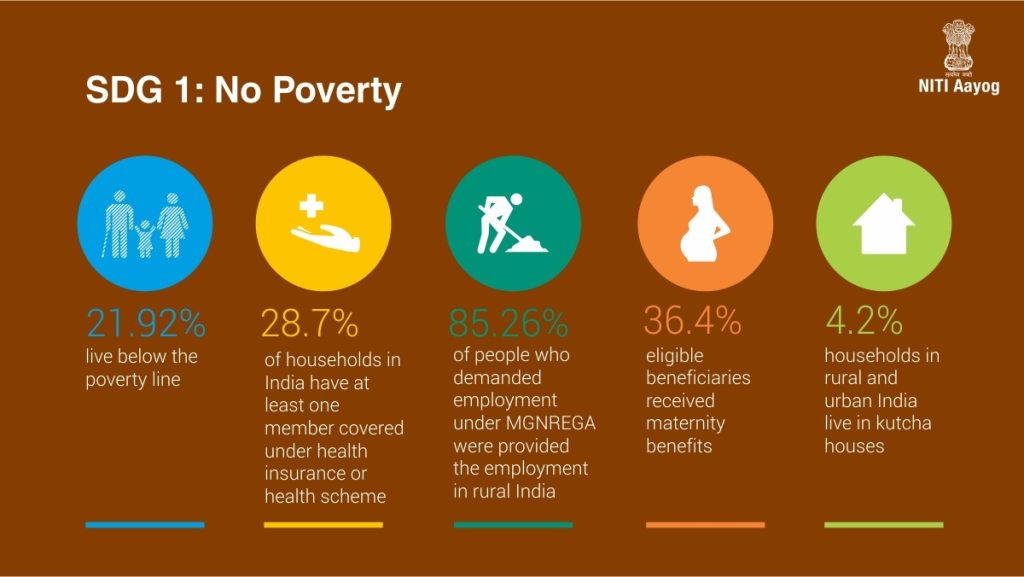
    • SDG 1 (No Poverty): India has made significant progress in reducing poverty, with the poverty rate declining from 21.9% in 2011-12 to 4.4% in 2020. The government’s efforts to provide financial inclusion and social protection schemes have contributed to this progress.
    • SDG 2 (Zero Hunger): India has made progress in reducing hunger, with the prevalence of undernourishment declining from 17.3% in 2004-06 to 14% in 2017-19. The government’s initiatives such as the National Food Security Act and the Pradhan Mantri Garib Kalyan Anna Yojana have contributed to this progress.
    • SDG 3 (Good Health and Well-being): India has made progress in improving maternal and child health, with maternal mortality ratio declining from 167 per 100,000 live births in 2011-13 to 113 in 2016-18. The government’s efforts to strengthen health systems and increase access to healthcare services have contributed to this progress.
    • SDG 4 (Quality Education): India has made progress in improving access to education, with the gross enrolment ratio for primary education increasing from 93.4% in 2014-15 to 94.3% in 2019-20. The government’s initiatives such as the Sarva Shiksha Abhiyan and the Right to Education Act have contributed to this progress.
    • SDG 5 (Gender Equality): India has made progress in improving gender equality, with the sex ratio at birth increasing from 918 in 2011 to 934 in 2020. The government’s initiatives such as the Beti Bachao Beti Padhao and the Maternity Benefit Programme have contributed to this progress.

    Recent findings by National Family Health Survey

    • Multidimensional poverty declined: At a compounded annual average rate of 4.8 per cent per year in 2005-2011 and more than double that pace at 10.3 per cent a year during 2011-2021.
    • Declining child mortality: There are some issues with the 2011 child-mortality data, but for each of the 10 components of the MPI index, the rate of decline in 2011-2021 is considerably faster than in 2005-2011.
    • Average decline in overall indicators: The average equally weighted decline for nine indicators was 1.9 per cent per annum in 2005-2011 and a rate of 16.6 per cent per annum, more than eight times higher in 2011-2021.
    • Consumption inequality decline: Every single household survey or analysis has shown that consumption inequality declined during 2011-2021. This is consistent with the above finding of highly inclusive growth during 2011-2021.

    Conclusion

    • The analysis provides a valuable tool for policymakers to address the gaps and focus on the indicators that require more attention, thereby improving the well-being of its citizens and creating a sustainable future for all.

    Mains question

    Q. What are Sustainable Development Goals (SDGs)? Discuss India’s progress made so far in achieving these targets

    Attempt UPSC 2024 Smash Scholarship Test | FLAT* 100% OFF on UPSC Foundation & Mentorship programs

  • Food Security and Energy Crisis In The South Asian neighbourhood

    Central Idea

    • To be sure, the Ukraine-Russia conflict has thrown the energy markets into a crisis in several Global South nations. In addition, the supply cuts by edible-oil exporting countries, alongside the rise in fuel prices, have led to a surge in food prices, making food security a primary concern, especially for the vulnerable sections of society. In addition, China’s COVID-19 surge has dampened global economy, especially in BoB.

    Get your Rs 10,000 worth of UPSC Strategic Package for FREE | PDFs, Zoom session, Tests, & Mentorship

    How the South Asian neighbourhood is in flux?

    • Sri Lanka and Pakistan: Sri Lanka and Pakistan are facing economic headwinds, with the former having gone through a full-blown economic collapse and the latter facing huge external debts, power shortages, and extreme inflation.
    • Bangladesh: The IMF sanctioned a precautionary loan of US $4.7 billion to Bangladesh amidst the precarious macroeconomic situation in the country, with high inflation and volatility of the Bangladeshi Taka.
    • Myanmar: A post-coup Myanmar sees a shutdown of businesses and a massive spike in unemployment.
    • Nepal: Nepal, too, sees widening trade deficits and declining foreign exchange reserves.

    How Russia-Ukraine war challenges Food security?

    • Russia-Ukraine war and the resulting food crisis: Ukraine and Russia play a significant role in the global food supply chains, further affecting low- and middle-income countries and vulnerable populations already grappling with hunger in the post-pandemic world.
    • Wheat suppliers: Since both countries exported more than one-third of the world’s wheat and barley, and about 70 percent of sunflower oil, governments around the world were severely hit as the war stopped exports of around 20 million tons of Ukrainian grain.
    • Agricultural commodities exports to Asia have dried up: An estimated 6 million tons of agricultural commodities were exported monthly to Asia, Africa, and the Middle East. As of June 2022, this number had dried up to a fifth of its original value.
    • Ripple effects on food prices and availability: According to the United Nations’ (UN) Food and Agriculture Organization (FAO), global food prices have risen by 20 percent. It further predicts a rise in the undernourished population to be between 7.6 to 13.1 million, because of the conflict situation and its ripple effects on food prices and availability.

    Sri Lanka: A case of Food security crisis

    • The economic meltdown in Sri Lanka wreaked havoc on the food security of the local population.
    • For Sri Lanka, the sudden switch to organic farming in 2021 worsened its trade performance in the agricultural sector.
    • The island nation had to import sugar, rice, and various other commodities, including intermediate goods in which the economy had had a previous surplus.
    • By 2022, the tea industry, which was a major commodity of exchange, incurred losses of approximately US $425 million, further worsening the economy’s foreign exchange situation.

    Energy crisis

    • Heavy on energy imports: The data analysis on energy imports shows that all the countries in Bay of Bengal Initiative for Multi-sectoral Technical and Economic Cooperation (BIMSTEC), especially India, Myanmar, and Bhutan, rely heavily on energy imports.
    • Fuel dependency makes the region highly vulnerable to external shocks: The trade dependency on fuel is a major curse for the region, making it highly vulnerable to exogenous macroeconomic shocks. The Russia-Ukraine conflict underscores the importance of nations having self-reliance regarding energy.
    • Absence of infrastructure and synchronisation in BIMSTEC Grid plan: Despite the BIMSTEC countries having developed a ‘Plan of Action for Energy Cooperation in BIMSTEC’ and also signed a MoU for the establishment of the BIMSTEC Grid Interconnection in August 2018, the absence of required infrastructure and adaptive power market, the lack of synchronisation of the grid system, the lack of financial policies, and other related issues have made progress in energy cooperation slow among the countries in the region.

    Bangladesh: In a tough spot

    • Unable to set in motion the transition to renewable energy, alongside heavy dependence on fuel imports, Bangladesh, especially, has been placed in a tough spot concerning energy security.
    • The Russia-Ukraine conflict has added more fuel to this fire. With energy prices climbing upwards and subsidy bills increasing, the fiscal balances and current account deficits have been worrisome for Bangladesh’s economy.
    • The government had to finally put in place some austerity measures. The domestic prices of diesel, kerosene, octane, and petrol were increased to achieve price parity with its neighbours such as India, China, and Nepal.

    Way ahead

    • Safeguard against food security crisis: It becomes imperative for regional groupings to set up safeguards against crises where their food security is affected by geopolitical events and domestic macroeconomic threats.
    • Food Bank for BIMSTEC: The idea of a food bank for the BIMSTEC countries modelled on the Association of Southeast Nations (ASEAN) Food Bank is a good start as it will aid in stabilising prices.
    • India urged to develop regional strategy and promoting millets: Recently, in November 2022, India hosted the second Agriculture Ministerial-level meeting of the BIMSTEC nations, where it urged the member countries to develop a regional strategy for transforming agriculture and promoting millets into the food systems.
    • Millets have potential to ameliorate food insecurity: Promotion and intra-regional trade of food items such as millets, where these countries have surplus production, can help ameliorate food insecurity to a large extent.
    • Self-reliance in energy: Overdependence on fuel will make the region more vulnerable and affect its financial stability. Therefore, developing a domestic energy market is critical for the region. This can be achieved by accelerating the green transition.
    • For instance: FDI from Japanese firms has constantly seen more impacts and spillovers in the Indian economy. If Japanese firms’ economies of scale and their potential in developing different green energy technologies could be fully utilised, it would reduce the regional dependence on China, which is currently the dominant player in the domain of solar energy.

    Conclusion

    • Regional economies have huge potential to invest in research for green transition technologies and sustainable agriculture which can help them have self-reliant energy and food markets respectively. Led by India, the Bay of Bengal region can lead the way in innovations in renewable forms of energy such as solar and wind.

    Mains Question

    Q. The South Asian neighbourhood is in flux. Discuss the major challenges and suggest a way ahead.

    Attempt UPSC 2024 Smash Scholarship Test | FLAT* 100% OFF on UPSC Foundation & Mentorship programs

  • Agriculture: An Inclusive Model of Madhya Pradesh

    Agriculture

    Central Idea

    • India is today a $3.5 trillion economy. As per the IMF forecast, If the current growth trend continues, the country is likely to be a $5.4 trillion economy by 2027.  No wonder, Prime Minister Narendra Modi has termed the next 25 years, when India completes 100 years of Independence, as Amrit Kaal. There are lessons from Madhya Pradesh’s agriculture model for inclusive sustainable growth.

    Crack Prelims 2023! Talk to our Rankers

    India’s Growth trajectory

    • India seems to be on the right path and is doing pretty well especially when compared to its progress in the first six decades after 1947.
    • As per IMF, it took India almost 59 years since Independence to become a $0.95 trillion economy in 2006. But then it became a $2.3 trillion economy by 2016 it added $1.35 trillion in 10 years.
    • In 2022, it became a $3.5 trillion economy by adding $1.2 trillion in just six years. If India stays this course, the country could rise to a $25 to $30 trillion economy by 2047.

    How inclusive is this growth?

    • Inclusiveness measurement and performance: Inclusiveness is measured by looking at the record of the laggard states, especially the so-called BIMARU states (Bihar, Madhya Pradesh, Rajasthan and Uttar Pradesh), and also the performance of the agricultural sector that engages the largest share of workforce 46.5 per cent in 2020-21.
    • Performance of GDP at the state level: The country averaged a GDP growth of 6.7 per cent per annum in this period and its agri GDP growth stood at 3.8 per cent per annum. This is satisfying, though not as outstanding as China’s performance.
    • Of all the major states: Gujarat topped the list in overall GDP growth at 8.9 per cent closely followed by Uttarakhand (8.7 per cent), Telangana (8.6 per cent) and Haryana (8 per cent). At the bottom of this list were Jammu and Kashmir (5.2 per cent), Assam (5.4 per cent), West Bengal (5.5 per cent), Uttar Pradesh (5.6 per cent) and Jharkhand (5.7 per cent).
    • Madhya Pradesh (MP): MP is the only state whose agriculture contribution to overall GDP has increased to 40 per cent, as against 18.8 percent at the all-India level its model should aptly be described as inclusive and sustainable.
    • Jharkhand: Jharkhand has performed exceptionally well in agriculture with a growth rate of 6.4 per cent per annum, largely driven by diversification towards horticulture and livestock.
    • Punjab: In contrast, the Green Revolution champion Punjab hasn’t done well. Its Agri-GDP growth was a meagre 2 per cent per annum over this period.

    Inclusive and sustainable Model of Madhya Pradesh

    • Highest growth rate: Madhya Pradesh has performed very well it has clocked the highest growth rate in agriculture at 7.3 per cent. Its overall GDP growth is a respectable 7.5 per cent.
    • Agri-GDP growth is above India Agri-GDP growth: The state’s agri-GDP growth is way above the all India agri-GDP growth and the state is a shining example of doubling the contribution of horticulture in its value of agriculture and allied sector.
    • Well-diversified portfolio in agriculture: MP has made its mark as a top-notch player in tomato, garlic, mandarin oranges, pulses especially gram and soyabean cultivation. MP is also the second-largest producer of wheat after UP, and the third-largest milk producer after UP and Rajasthan.
    • Doubled irrigation coverage: It is following a well-diversified portfolio in agriculture while doubling irrigation coverage from 24 to 45.3 per cent of its gross cropped area over the last two decades.

    Conclusion

    • Madhya Pradesh agriculture model suggests that a well-diversified portfolio in crops is behind the high growth in the farm sector. This is inclusive and sustainable and offers a path for other Indian states.

    Mains Question

    Q. A well-diversified portfolio in crops could be an engine of high growth in India’s farm sector. Discuss. Support your answer with an illustration.

    (Click) FREE 1-to-1 on-call Mentorship by IAS-IPS officers | Discuss doubts, strategy, sources, and more

  • Startup20 Engagement Group On India’s Proposal

    Engagement

    “A small group of determined and like-minded people can change the course of history.”-M.K. Gandhi

    Central Idea

    • By agreeing to India’s proposal to create the Startup20 Engagement Group, the only new group by which G20 has turned itself into an ambidextrous institution, one where both large corporations and startups have an equal voice in taking the economies forward. In the new architecture, while the existing B20 Engagement Group continues its focus on corporations, the Startup20 takes on the policy issues concerning the global startup ecosystem, with the necessary linkages between the two groups.

    Crack Prelims 2023! Talk to our Rankers

    What is meant by ambidexterity?

    • Ambidexterity is the ability to use both hands with equal skill and ease.
    • In the context of organizations, it is the ability to simultaneously pursue both exploratory and exploitative strategies. This means being able to balance the need for innovation and new opportunities with the need for efficiency and optimization of current operations.
    • For example, Indian IT services companies like TCS and Infosys are investing in areas like artificial intelligence, blockchain, and the IoT, even as they continue to deliver traditional IT services to their clients.

    What is B20 Engagement Group?

    • Official G20 dialogue forum representing the global business community: The B20 (Business 20) Engagement Group is a forum for international business leaders from the G20 countries.
    • Established in 2010: It is among the most prominent Engagement Groups in G20, with companies and business organizations as participants.
    • A single voice for the entire G20 business community: The B20 leads the process of galvanizing global business leaders for their views on issues of global economic and trade governance and speaks in a single voice for the entire G20 business community.
    • Aim is to provide recommendations: The group’s aim is to provide recommendations to the G20 on issues such as economic growth, trade, investment, digitalization, sustainability, and job creation.
    • Platform for different stakeholders: The B20 is one of several engagement groups, which also include groups representing civil society, labor, think tanks, and youth, that provide a platform for different stakeholders to share their views and insights with the G20.
    • B20 Secretariat: Confederation of Indian Industry (CII) has been designated as the Business 20 (B20) Secretariat for the India’s G20 Presidency.

    What is Startup20?

    • Initiated under India’s G20 Presidency: The Startup20 Engagement Group has been initiated under India’s G20 Presidency in 2023.
    • Aims to support Startups: The group aims to create a global narrative for supporting startups and enabling synergies between startups, corporates, investors, innovation agencies and other key ecosystem stakeholders.
    • Three taskforces: The engagement group comprises of three taskforces, namely Foundation & Alliance, Finance, and Inclusion & Sustainability, where delegates will come together to discuss efficient policy frameworks to promote scaling up of startups in the G20 nations.

    How these taskforces will work?

    1. Foundation and Alliances Taskforce:
    • Promotes consensus-based ecosystem: The Foundation and Alliances Taskforce will work to harmonize the global Startup ecosystem through consensus-based definitions and promote a global community of knowledge sharing among the Startup ecosystems to explore opportunities.
    • Help to bridge the knowledge gaps: It will also bridge the knowledge gap between the Startup ecosystems of G20 member countries and emerging economies through partnerships to enable more industry players across G20 nations to work with Startups and concrete solutions.
    • To create supportive policies and point of contact: It will aim to create supportive policies for industry players and government organizations to work with Startups and provide points of contact for the participating G20 countries sustained collaboration.
    1. The Finance Taskforce:
    • To provide financing and investment platforms: The finance taskforce will aim to increase access to capital for Startups by providing financing and investment platforms specifically for early-stage Startups to broaden the array of financial instruments available to Startups.
    • Networking opportunities: It will also create pitching and networking opportunities for Startups with the global investor community.
    • Best practices for funding ecosystem: It will work to provide a framework built upon best practices for global investors to fund Startups across G20 member nations, helping build suggestive frameworks that could be implemented in emerging ecosystems for building investment capabilities.
    1. Taskforce for Inclusion and Sustainability
    • Women led startups and community inclusive: For Inclusion and Sustainability, the roadmap involves increasing support for women led Startups and organizations; promotion of Startups working on making communities more inclusive and to promote Startups working on SDGs in areas of global interest.
    • Encouraging investors to invest in startups built upon sustainable practices: This Task Force aims to enable more investors to invest responsibly in Startups built upon sustainable practices and to encourage mentorship support to the Startup ecosystems of the G20 member countries and emerging economies.

    Conclusion

    • Some of the most pressing challenges facing the world today require innovative solutions at scale. The need for solutions to global problems such as climate change, food security, and energy security is urgent. However, by leveraging global ambidexterity and taking advantage of the G20’s new architecture of B20 and Startup20, we can be optimistic about our ability to systematically solve these problems. With deliberate efforts and focused action, we can create a more sustainable and prosperous future for all.

    Mains question

    Q. What is Startup20 engagement group initiated under India’s G20 presidency? How this framework will work to boost startup ecosystem globally?

    (Click) FREE 1-to-1 on-call Mentorship by IAS-IPS officers | Discuss doubts, strategy, sources, and more

  • Divyang friendly digital infrastructure in India

    digital

    Central Idea

    • The estimation in Census 2011, that 2.21% of India’s population is disabled is a gross underestimation. According to the World Health Organization, about 16% of the global population is disabled. While technology has enormous potential to level the playing field for the disabled, it can, at the same time, reinforce the barriers that the disabled otherwise face if it is not designed with their needs in mind.

    Crack Prelims 2023! Talk to our Rankers

    Smartphone users with disabilities in India

    • It is difficult to determine the exact number of smartphone users with disabilities in India, as there is no specific data available on this.
    • However, according to the 2011 Census of India, there are approximately 2.68 crore (26.8 million) people with disabilities in the country.
    • India, it is reported, had 750 million Internet/smartphone users in 2020.
    • Applying the 16% figure here, this works out to be roughly 120 million (12 crore) Internet/smartphone users with disabilities.

    A Report on Accessibility of Apps

    • Evaluation of the most widely used apps: A report that evaluates the accessibility of 10 of the most widely used apps in India, across five sectors. The apps were Zomato, Swiggy, PayTM, PhonePe, Amazon, Flipkart, Uber, Ola, WhatsApp and Telegram.
    • Goal for launching this report is to start discussion on digital accessibility: 1. Objective assessment of the digital accessibility of the apps. 2. To work with these service providers and help them design practices and processes that will not only improve app accessibility but also educate their stakeholders about accessibility and people with disabilities.
    • Findings of the report: Based on the number of violations, categories developed on the level of accessibility of the apps as high, medium and low. Report found that four out of the 10 apps ranked low, while five were in the medium category.

    digital

    key efforts for Divyanga friendly digital infrastructure

    • Guidelines for Indian Government Websites: The Department of Administrative Reforms and Public Grievances (DARPG) has developed guidelines for making government websites accessible to people with disabilities. The guidelines cover various aspects of website design and development, such as colour contrast, keyboard accessibility, and assistive technology compatibility.
    • Accessible India Campaign/ Sugamya Bharat Abhiyan: The Campaign was launched by the government in 2015 to make public spaces, including government buildings, transportation, and information and communication technologies (ICT), more accessible to people with disabilities.
    • Bharat Interconnectivity Limited (BIL): BIL is a subsidiary of Bharat Sanchar Nigam Limited (BSNL) that provides accessible internet and telecom services to people with disabilities. It offers services such as audiobooks, sign language interpretation, and accessible websites and mobile applications.
    • National Institute of Speech and Hearing (NISH): NISH is an autonomous institute under the Department of Empowerment of Persons with Disabilities, Ministry of Social Justice and Empowerment. It provides training and research in the field of speech and hearing disabilities and also offers services like audiobooks and accessible software.
    • Making assistive technology more affordable and accessible: The government has also taken steps to make assistive technology more affordable and accessible to people with disabilities.
    • For example: The Department of Empowerment of Persons with Disabilities provides financial assistance to purchase assistive devices and the Assistive Technology Industry Association (ATIA) has been established to promote research and development of assistive technology.

    digital

    Measures to improve the accessibility of digital services

    • Promoting education and awareness: Steps must be taken to raise awareness about the needs and capabilities of people with disabilities. This could include providing training to developers and designers on how to create accessible digital products and services.
    • Enforcing web accessibility standards: The government should ensure that all websites and mobile applications comply with web accessibility standards such as the Web Content Accessibility Guidelines (WCAG). This will make it easier for people with disabilities to access digital services.
    • Encouraging inclusive design: Designing products and services that are accessible to all users, including those with disabilities, should be an essential part of the design process. Companies and developers should be encouraged to incorporate inclusive design principles into their products from the beginning.
    • Conducting regular accessibility audits: Regular accessibility audits should be conducted to ensure that digital products and services are accessible to people with disabilities. This can help identify barriers and areas of improvement.

    Conclusion

    • Core to the project of securing a more disabled friendly digital ecosystem must be the conviction that, everything digital must be accessible to everyone. This starts with incorporating the principles of accessibility and inclusive design into every digital offering, right from inception. India needs to be truly accessible for all people with disabilities. Organisations, companies, civil society, the government and the courts must make this happen.

    Mains question

    Q. Discuss the efforts of the Indian government towards creating a Divyanga-friendly digital infrastructure and suggest measures to improve the accessibility of digital services.

    (Click) FREE 1-to-1 on-call Mentorship by IAS-IPS officers | Discuss doubts, strategy, sources, and mor

  • ‘BIMARU’ Tag: What does this term mean?

    Central idea: While addressing a summit in UP, PM recalled the tag of ‘BIMARU’, once used to describe the state.

    What are BIMARU states?

    • The term “BIMARU” is an acronym formed from the first letters of five states – Bihar, MP, Rajasthan, and UP – that were believed to be economically and socially backward in the 1980s and 1990s.
    • The term was popularized by economist Ashish Bose in the 1980s to describe the poor economic and social indicators of these states.
    • He coined this term in a paper presented to then-PM Rajiv Gandhi.
    • These states were characterized by low literacy rates, poor infrastructure, high poverty rates, and low levels of industrialization.
    • The term “BIMARU” itself is an amalgamation of the Hindi words “bimar” (sick) and “ru” (a suffix meaning “land of”).

    Behind the slang name ‘BIMAR’

    The BIMARU states of Bihar, Madhya Pradesh, Rajasthan, and Uttar Pradesh are characterized by several economic and social features that distinguish them from other states in India. Some of these features include:

    • Low per capita income: These have traditionally had low per capita income levels compared to other states in India, with Bihar having the lowest per capita income among Indian states.
    • High poverty rates: They have a high percentage of people living in poverty, with Bihar and Uttar Pradesh having some of the highest poverty rates in the country.
    • Low literacy rates: They have lower literacy rates than the national average, with Bihar having the lowest literacy rate among Indian states.
    • Poor healthcare indicators: They have traditionally had poor healthcare indicators, with high infant and maternal mortality rates.
    • Agriculture-based economy: These states are primarily agricultural states, with a significant percentage of the population engaged in agriculture and related activities.
    • Significant population: They are among the most populous states in India, with Uttar Pradesh being the most populous state in the country.

    Overall, the BIMARU states have traditionally lagged behind other states in India in terms of economic and social development, although in recent years, there has been progress in improving development indicators.

    Persisting challenges

    These states still face significant challenges, including high levels of poverty and unemployment.

    • Still a national laggard: There is still a significant development gap between these states and the more developed regions of the country. For example, in 2019-20, per capita income in Bihar was only about a third of the national average, and in UP, only about half of the population has access to basic sanitation facilities.
    • High Population: The share of BIMARU states in the absolute increase in India’s population during 2001-26 will be of the order of 50.4 per cent while the share of the south will be only 12.6 per cent.

    How are these states faring now?

    • In recent years, some of these states, such as Rajasthan and Madhya Pradesh, have shown significant improvement.
    • In terms of economic growth, several of these states have experienced high growth rates in recent years, with Madhya Pradesh and Bihar recording growth rates of over 10% in 2019-20.
    • Uttar Pradesh and Rajasthan have also recorded growth rates of over 7% in recent years.
    • There has also been progress in improving social indicators such as literacy rates and healthcare infrastructure.
    • For example, Bihar has seen a significant increase in literacy rates, with the state’s literacy rate increasing from 47% in 2001 to 63% in 2011.

    Alternatives to ‘BIMARU’ terms

    • PM has urged to refrain the use of such terms as they only serves to reinforce negative stereotypes and inhibit progress towards more equitable development across the country.
    • He coined the term such as ‘Aspirational Districts/Blocks’ as alternative to such negative word.

    Way forward

    This involves several key strategies to address the economic and social challenges that these states face. Some of these strategies include:

    • Enhancing economic growth: The BIMARU states need to focus on enhancing economic growth through policies that encourage investment, job creation, and entrepreneurship. This can include measures such as improving the ease of doing business, providing infrastructure, and investing in sectors with high growth potential.
    • Improving social indicators: They need to focus on improving social indicators such as literacy rates, healthcare, and sanitation. This can involve investing in education and healthcare infrastructure, and implementing programs that target poverty reduction and social inclusion.
    • Enhancing agricultural productivity: Given that agriculture is a major contributor to the economy of BIMARU states, efforts should be made to enhance agricultural productivity and efficiency. This can include investments in irrigation and modern agricultural techniques, and support for small and marginal farmers.
    • Encouraging inclusive development: In order to reduce disparities and ensure inclusive development, policies and programs should be targeted towards the most vulnerable and marginalized sections of society. This can include measures to promote gender equality, social inclusion, and address issues such as caste-based discrimination.
    • Leveraging technology: The BIMARU states can leverage technology to enhance economic and social development. This can involve the use of digital technologies to improve access to education and healthcare and promote entrepreneurship and innovation.

    Conclusion

    • Overall, while the BIMARU states have made progress in recent years, there is still a long way to go in terms of achieving more equitable development across the country.


    Crack Prelims 2023! Talk to our Rankers

    (Click) FREE 1-to-1 on-call Mentorship by IAS-IPS officers | Discuss doubts, strategy, sources, and more

  • What are Primary Agricultural Credit Societies (PACS)?

    pacs

    The Union Budget has announced Rs 2,516 crore for computerization of 63,000 Primary Agricultural Credit Societies (PACS) over the next five years.

    Primary Agricultural Credit Societies (PACS)

    • PACS are village level cooperative credit societies that serve as the last link in a three-tier cooperative credit structure headed by the State Cooperative Banks (SCB) at the state level.
    • Credit from the SCBs is transferred to the district central cooperative banks, or DCCBs, that operate at the district level.
    • The DCCBs work with PACS, which deal directly with farmers.
    • Since these are cooperative bodies, individual farmers are members of the PACS, and office-bearers are elected from within them.
    • A village can have multiple PACS.

    What is its lending mechanism?

    • PACS are involved in short term lending — or what is known as crop loan.
    • At the start of the cropping cycle, farmers avail credit to finance their requirement of seeds, fertilisers etc.
    • Banks extend this credit at 7 per cent interest, of which 3 per cent is subsidised by the Centre, and 2 per cent by the state government.
    • Effectively, farmers avail the crop loans at 2 per cent interest only.

    NPAs with PACS

    • NABARD’s annual report of 2021-22 shows that 59.6 per cent of the loans were extended to the small and marginal farmers.
    • A report published by the Reserve Bank of India on December 27, 2022 put the number of PACS at 1.02 lakh.
    • At the end of March 2021, only 47,297 of them were in profit.
    • The same report said PACS had reported lending worth Rs 1,43,044 crore and NPAs of Rs 72,550 crore. Maharashtra has 20,897 PACS of which 11,326 are in losses.

    Why are PACS attractive?

    • The attraction of the PACS lies in the last mile connectivity they offer.
    • For farmers, timely access to capital is necessary at the start of their agricultural activities.
    • PACS have the capacity to extend credit with minimal paperwork within a short time.


    Crack Prelims 2023! Talk to our Rankers

    (Click) FREE 1-to-1 on-call Mentorship by IAS-IPS officers | Discuss doubts, strategy, sources, and more

  • Indian women’s labor force participation is declining

    participation

    Context

    • According to the World Bank report released in June 2022, Indian women’s labour force participation proportion of the population over the age of 15 that is economically active has been steadily declining since 2005 and is at a low of 19 percent in 2021.

    Crack Prelims 2023! Talk to our Rankers

    How the experts are analysing the falling participation of women?

    • Patriarchy in continuity: According to some experts there is continuities of patriarchal oppression and structural barriers to women’s economic participation in India.
    • Informal economy not accounted: Other group of experts says these claims fail to acknowledge that this measure does not capture women’s participation in the informal economy.
    • Preference for home-based work: In developing economies such as India, women are concentrated in the informal sector and demonstrate a preference for home-based work opportunities that allow them to balance their domestic duties with income-generating activities.
    • Social consideration: It is simplistic and instrumental link between women’s labour force participation and measures of societal development.
    • Reductionist approach: It is important to move beyond reductionist explanations and probe how women’s employment operates in specific contexts. This calls for a more comprehensive understanding of women’s decision-making and navigation around employment.

    participation

    Economy theory about women participation in labour force

    • Standard economic theory: Standard economic theory predicts that as household income increases, women withdraw from devalued labour because their income is no longer required to run the household.
    • Income employment: As household income rises and educational attainment improves, women re-enter the workforce.
    • Mismatch of skills: But for moderately educated women from upwardly mobile families, there is often a mismatch between available jobs and their skills and ambitions.
    • Aversion towards low-paid jobs: As their families are in the process of claiming middle-class status, young women are often averse to taking up low-paid jobs in the formal economy.
    • Class and social mobility: If they are unable to secure high-status white-collar jobs, they prefer home-based work such as tailoring or running tuitions for young children. Thus, women’s employment preferences are often intertwined with family-centred projects of class and social mobility.

    participation

    Study of ground reality about women employment

    • Facilitated study group: In a recent study, facilitated study group (FSG) interviewed 6,600 women of working age from low-income communities across 16 cities in India.
    • Small job and business: It found that women’s ability to work outside the home is defined by the views of their family members who prefer women working from home or engaging in a small business to allocate more time to household responsibilities. But 59 percent of women prefer jobs in the formal sector over entrepreneurship.
    • Less use of child care: Less than 1 percent of working mothers with children under 12 years old have used paid childcare services. 89 percent are unwilling to use paid childcare services.
    • Preference to family care: Affordability isn’t a key factor in not considering paid day-care. It’s because mothers do not trust day-care services as they do not provide ‘family-like’ care.
    • Balancing the familial expectations: These findings suggest that Indian women’s employment-related decisions are shaped by considerations of providing caregiving to their children and balancing their preferences with familial expectations.

    What should be the right approach about women participation?

    • Family responsibility and career: women, especially in low-income communities in India, have a composite view of their lives (jobs, enterprises, care work, upholding traditions, and community connections) and navigate through these with their household and extended family.
    • Comprehensive view of life: The non-compartmentalisation emerges from a culturally embedded and empirically grounded perspective that does not view culture as a limitation, but as a resource and enabler that provides a comprehensive valuation for all kinds of work that women do (informal and formal).
    • Understanding the cultural context: This translates into everyday negotiations that have less to do with upturning the current social structure and more with negotiating for increased autonomy within the cultural context.
    • Flexible working Hours: Policy solutions must derive from the negotiations women are interested in undertaking with their employers around home-based work or flexible working hours. It is important to perceive women’s employment goals as reflective of preferences defined not only by their gender but also by their social and cultural context.

    participation

    Conclusion

    • The breakdown of the family structure and caregiving systems in developed economies offers an important lesson. If Indian women want to participate in the formal labour force while retaining their family structure, this preference should be accommodated in institutional and interpersonal responses.

    Mains Question

    Q. In the context of world bank report analyse the declining participation of women in labour force. What should be the right approach to increase the participation of women in labour force?

    (Click) FREE 1-to-1 on-call Mentorship by IAS-IPS officers | Discuss doubts, strategy, sources, and more