Mains Ready By December. Smash Mains & Smash PYQ Admissions Open

GS Paper: GS2-01.Indian Constitution-Historical underpinnings & evolution; Features, amendments, significant provisions, basic structure of Constitution

  • SC upholds Property Inheritance Rights for Gond Tribal Women

    Why in the News?

    The Supreme Court of India has affirmed that women of the Gond community, a Scheduled Tribe under Article 342, are entitled to inherit ancestral property, even where no explicit tribal custom confers this right.

    Supreme Court Verdict on Gond Women’s Inheritance Rights:

    • Background: Case concerned women of the Gond Scheduled Tribe seeking equal inheritance rights over their maternal grandfather’s ancestral property.
    • Lower Court Rulings: The trial court and Madhya Pradesh High Court dismissed the plea, holding that no tribal custom granted such rights and placing the burden of proof on the women.
    • Supreme Court Review: On 17 July 2025, a Bench of Justices Sanjay Karol and Joymalya Bagchi examined whether constitutional equality overrides unwritten tribal customs excluding women from succession.
    • Legal Context: Under Section 2(2) of the Hindu Succession Act (1956), Scheduled Tribes are excluded unless specifically notified—none apply to Gonds—so the dispute was governed by customary tribal law.

    Supreme Court’s Ruling:

    • Presumption of Equality: The Court reversed lower findings, holding that equality must be presumed unless a proven, valid custom denies it.
    • Burden of Proof: Stated that custom cannot be presumed; it must be ancient, certain, and reasonable, proven through credible evidence.
    • Gender Justice: Rejected patriarchal inferences drawn from Hindu traditions, asserting such predispositions have “no place” in the case.
    • Guiding Principle: In absence of valid custom, courts must decide per “justice, equity, and good conscience.”

    Constitutional Principles Applied:

    • Article 14: Ensures equality before law; male-only inheritance lacks rational basis.
    • Article 15(1):  Prohibits sex-based discrimination; used to strike down exclusion of women.
    • Article 38: Mandates elimination of inequality across social and gender lines.
    • Article 46:  Requires protection of Scheduled Tribes from exploitation and injustice.
    • Hindu Succession (Amendment) Act, 2005 cited for illustrating gender-equal intent, not direct applicability.

    Constitutional–Customary Balance:

    • Conflict: Between tribal autonomy under Fifth/Sixth Schedules and constitutional equality under Part III.
    • Precedent Shift: Unlike Madhu Kishwar v. State of Bihar (1996), which upheld male-only inheritance, the 2025 ruling held that when custom is unproven or discriminatory, Article 14 prevails.
    • Significance: Moves jurisprudence from deference to custom toward enforcement of constitutional morality, ensuring tribal women’s equal property rights.
    [UPSC 2023] Explain the constitutional perspectives of Gender Justice with the help of relevant Constitutional Provisions and case laws.

    [UPSC 2015] Discuss the possible factors that inhibit India from enacting for its citizens a uniform civil code as provided for in the Directive Principles of State Policy.


  • [1st October 2025] The Hindu Op-ed: A 100-year journey as the guardian of meritocracy

    PYQ Relevance

    [UPSC 2018] The Comptroller and Auditor General (CAG) has a very vital role to play. Explain how this is reflected in the method and terms of his appointment as well as the range of powers he can exercise.

    Linkage: Such constitutional bodies, like UPSC, completing 100 years, are often asked in exams, similar to questions on CAG’s appointment, tenure, and powers, highlighting the significance of understanding their independence and functions.

    Mentor’s Comment

    On October 1, the Union Public Service Commission (UPSC) completed a century of its establishment. From its inception under colonial rule to its present role as the guardian of meritocracy in independent India, the Commission has stood as a symbol of fairness, trust, and integrity in governance. As aspirants preparing for UPSC Civil Services Examination (CSE), understanding the history, philosophy, challenges, and reforms of this institution is vital — not just as knowledge, but also as inspiration for your own journey.

    Introduction

    The UPSC is more than an examining body; it is an institution that embodies the idea of equal opportunity, fairness, and trust in public life. Established in 1926, it has evolved through colonial, constitutional, and modern phases, transforming into one of the most complex yet respected recruitment agencies in the world. Conducting one of the toughest examinations with lakhs of aspirants each year, it ensures that merit alone decides entry into the highest echelons of governance. As the UPSC turns 100, this milestone is both a celebration of its legacy and a reflection on the road ahead.

    The Historical Foundations of UPSC

    1. Colonial beginnings (1926): Set up as the Public Service Commission following the Lee Commission’s recommendations (1924), initially with limited powers.
    2. Government of India Act 1935: Elevated to Federal Public Service Commission, giving Indians a greater role.
    3. Constitutional status (1950): Became UPSC, enshrined in the Constitution as an independent institution to safeguard meritocracy.

    What makes UPSC a Pillar of Fairness and Trust?

    1. Trust: Millions of aspirants rely on its transparency and impartiality; success depends solely on merit.
    2. Integrity: UPSC has remained insulated from political/external pressures, maintaining confidentiality and resisting malpractice.
    3. Fairness: Provides a level playing field — urban/rural, rich/poor, English/non-English — ensuring inclusivity in a diverse nation.
    4. Philosophy: Embodies the spirit of the Bhagavad Gītā — performing duty with rigor and detachment from outcomes.

    Why is the UPSC Examination Unique Globally?

    1. Scale: From 10–12 lakh prelim applicants annually to final merit lists through multi-stage filtering.
    2. Diversity: 48 optional subjects, 22 languages, making it the world’s most sophisticated competitive exam.
    3. Logistics: Prelims across 2,500+ venues; complex distribution for Mains subject papers across the country.
    4. Equity: Special arrangements for differently-abled candidates.
    5. Resilience: Seamless functioning even during COVID-19.

    How Has UPSC Expanded the ‘Indian Dream’?

    1. Democratization: Once elite-centric, now aspirants come from remotest districts and underprivileged regions.
    2. Opportunity: UPSC embodies the idea that talent + hard work can overcome barriers.
    3. Nation-building: Its selected civil servants have steered India through crises, reforms, environmental challenges, and growth.

    Who are the Unsung Heroes Behind UPSC?

    1. Paper-setters and evaluators: Finest academics and experts, anonymous contributors ensuring fairness.
    2. Role: Guarantee quality, unbiased assessment, and rigorous standards, remaining away from recognition.

    What Reforms Define UPSC’s Future-readiness?

    1. Digital modernization: Online application portal, face-recognition tech to prevent impersonation.
    2. PRATIBHA Setu initiative: Creates job opportunities for those who clear interview but miss the final list.
    3. Use of AI: To enhance efficiency and transparency without compromising integrity.
    4. Commitment: Adaptation to global disruptions in governance while preserving fairness.

    Conclusion

    The UPSC is not merely an examining authority; it is the guardian of meritocracy and a living institution embodying India’s faith in fairness and justice. As it celebrates its centenary, the challenge lies in preserving its values while adapting to a rapidly transforming world. For aspirants, the story of UPSC is not only an institutional history but also a guiding philosophy — to work with perseverance, detachment, and integrity.

    Value Addition 

    Constitutional Framework of UPSC (Articles 315–323)

    Establishment (Art. 315)

    1. UPSC for the Union and State Public Service Commissions (SPSC) for each state.
    2. Ensures independent and impartial recruitment of civil servants.

    Appointment of Members and Chairman (Art. 316)

    1. Chairman appointed by the President of India.
    2. Members appointed by the President.
    3. Qualifications: Not specified; expected to have experience in administration, academics, or law.

    Removal and Suspension (Art. 317)

    • Chairman or members can only be removed by President on:
      1. Proven misbehavior (after Supreme Court inquiry)
      2. Incapacity
      3. Protection ensures independence from political pressure.

    Conditions of Service (Art. 318)

    1. President regulates terms of service, pay, allowances, and pensions of chairman and members.
    2. Members can resign with prior notice.

    Cessation of Office (Art. 319): Member ceases to hold office on:

    1. Completion of tenure
    2. Resignation
    3. Removal under Art. 317

    Functions of UPSC (Art. 320)

    1. Recruitment: Conduct examinations for All India and Group A & B services.
    2. Promotions and Transfers: Advises government on appointments, promotions, and transfers.
    3. Disciplinary Matters: Advises on punishment or removal of civil servants.
    4. Advisory Role: Any service-related matters referred by the government.

    Extension of Functions (Art. 321)

    1. Parliament or State Legislature can expand UPSC’s functions.

    Budgetary Provisions (Art. 322)

    1. Expenses of UPSC charged on Consolidated Fund of India — ensures financial autonomy.

    Reporting to President/Parliament (Art. 323)

    1. Annual and special reports submitted to President.
    2. President places them before Parliament along with comments.
  • How are courts protecting personality rights?

    Introduction

    Personality rights, the right to control one’s name, image, likeness, and voice, have become a critical issue in India’s courts. With AI enabling deepfakes, voice cloning, and digital impersonation, Bollywood celebrities like Aishwarya Rai Bachchan, Abhishek Bachchan, Anil Kapoor, and Jackie Shroff have approached courts to restrain unauthorised commercial exploitation of their persona. While these judicial interventions protect individual dignity and brand equity, they also raise complex questions about the balance between Article 21 (privacy and autonomy) and Article 19(1)(a) (freedom of speech and expression).

    Why is this in the news?

    The Delhi High Court recently issued orders protecting Aishwarya Rai Bachchan and Abhishek Bachchan from AI-generated misuse of their images and voices. This is significant because:

    1. Novel threat: It highlights how AI deepfakes and voice cloning are creating unprecedented risks for identity and privacy.
    2. Judicial trend: Courts are extending personality rights protections to celebrities such as Karan Johar, Amitabh Bachchan, Anil Kapoor, Jackie Shroff, and Arijit Singh.
    3. Big problem: Without regulation, AI-driven impersonation undermines trust, dilutes brand equity, and strips individuals of control over their identity.
    4. Turning point: Courts are now explicitly linking personality rights to Article 21 of the Constitution, signalling a constitutional recognition of digital dignity.

    How are personality rights defined in India?

    1. Safeguards: Personality rights protect name, likeness, image, voice, signature, and other unique traits.
    2. Legal foundation: Rooted in common law doctrines of privacy, publicity, and defamation, supported by judicial precedents.

    Statutory framework:

    1. Copyright Act, 1957: Sections 38A & 38B grant performers exclusive and moral rights over their performances.
    2. Trade Marks Act, 1999: Allows registration of names/signatures as trademarks (e.g., Shah Rukh Khan, Priyanka Chopra).
    3. Tort of Passing Off: Prevents misrepresentation of a celebrity’s persona as endorsement.

    How have courts shaped personality rights?

    1. R. Rajagopal v. State of Tamil Nadu (1994): Supreme Court recognised the right to control one’s identity, grounding it in privacy under Article 21.
    2. Rajinikanth case (2015): Madras HC restrained unauthorised use of the actor’s persona in a film.
    3. Anil Kapoor case (2023): Delhi HC granted wide-ranging protection, clarifying that free speech covers parody/satire but not commercial misuse.
    4. Jackie Shroff case (2024): Court restrained misuse of his persona on e-commerce and AI platforms.
    5. Arijit Singh case (2024): Bombay HC recognised risks of voice cloning through AI.

    Do personality rights restrict free expression?

    Free speech scope: Article 19(1)(a) allows criticism, parody, satire, and lampooning of public figures.

    Judicial caution:

    1. DM Entertainment v. Baby Gift House (2010): Caricatures and parodies do not usually infringe publicity rights.
    2. Digital Collectibles v. Galactus Funware (2023): Material already in the public domain may be used without implying endorsement.
    3. Balancing test: Courts strike a balance between creative freedom and protection of dignity/brand equity.

    Why is regulation urgently needed?

    1. Fragmented protections: Enforcement is currently piecemeal, relying on case law.
    2. Digital threats: Generative AI expands risks of impersonation and deepfakes.
    3. Disproportionate impact: Ordinary citizens, especially women targeted through revenge porn, face greater harm.
    4. Policy need: Experts call for a comprehensive legislative framework to clearly define exceptions and ensure free speech is not chilled.

    Conclusion

    The judiciary is laying down crucial guardrails for personality rights in the digital age, particularly against AI-driven impersonation. However, without a clear legislative framework, judicial interventions remain reactive. The challenge lies in balancing dignity and privacy with freedom of speech, ensuring that protections do not turn into censorship while still safeguarding individuals, from Bollywood celebrities to ordinary citizens, against misuse of their identity.

    [UPSC 2024] Right to privacy is intrinsic to life and personal liberty and is inherently protected under Article 21 of the constitution. Explain. In this reference discuss the law relating to D.N.A. testing of child in the womb to establish its paternity.

    Linkage: The PYQ on Right to Privacy under Article 21 examines autonomy over personal identity, like in DNA testing. This article is relevant as it shows courts extending privacy into personality rights against AI misuse, with case laws and statutes providing examples to balance privacy and free speech in UPSC answers.

    Value Addition

    Global Context & Reports

    1. WIPO Intellectual Property Report (2022): Notes rapid rise of personality/IP litigation due to digital commerce.
    2. UNESCO Report on AI & Ethics (2021): Warns against deepfakes undermining democratic discourse and human dignity.
    3. US “Right of Publicity” Laws: Celebrities can sue for unauthorised commercial use of their persona, providing comparative perspective.
    4. EU GDPR (2018): Protects personal data, extending indirectly to digital identity misuse.


  • Sixth Schedule demand for Ladakh

    Why in the News?

    The recent protests in Ladakh led by activist Sonam Wangchuk, which turned violent, have been driven by demands for inclusion under the Sixth Schedule of the Indian Constitution and a call for statehood.

    Background: Ladakh’s Governance Post Article 370 Repeal

    • Union Territory Recognition: After the 2019 repeal of Article 370, Ladakh became a Union Territory without legislature, unlike Jammu & Kashmir.
    • Local Demands: The Apex Body Leh (ABL) and Kargil Democratic Alliance (KDA) have consistently demanded Sixth Schedule inclusion for autonomy and protection of tribal interests.

    Centre’s earlier offer:  

    • Article 371-like Protections: Ministry of Home Affairs proposed safeguards similar to NE states, addressing land, jobs, and cultural protection.
    • Exclusion from Sixth Schedule: Centre ruled out Sixth Schedule inclusion, preferring alternative mechanisms for autonomy.

    What is the Sixth Schedule?

    • Constitutional Basis: Mentioned under Article 244 in Part X of the Constitution.
    • Coverage: Applies only to Assam, Meghalaya, Tripura, and Mizoram (ATM²).
    • Relation to Fifth Schedule: The Fifth Schedule covers scheduled areas in other states except these four.

    Salient Features of the Sixth Schedule:

    • Autonomous Districts: Tribal areas are designated as autonomous districts; Governor empowered to create, reorganize, or alter boundaries.
    • District & Regional Councils:
      • Each district council has 30 members (26 elected, 4 nominated).
      • Councils can legislate on land, forest management, shifting cultivation, village administration, inheritance of property, marriage/divorce, and social customs.
      • They run schools, healthcare, markets, and village courts, and can levy certain taxes.
    • Law Application: Acts of Parliament/State may not apply directly or apply with Governor/President’s modifications.
    • Governor’s Authority: Can appoint commissions, examine issues of districts, and dissolve councils based on recommendations.
    • Areas under the Sixth Schedule:
      • Assam: Karbi Anglong, North Cachar Hills, Bodoland Territorial Areas District.
      • Meghalaya: Khasi Hills, Jaintia Hills, Garo Hills.
      • Tripura: Tripura Tribal Areas District.
      • Mizoram: Chakma, Mara, Lai districts.
    [UPSC 2023] With reference to ‘Scheduled Areas’ in India, consider the following statements :

    1. Within a State, the notification of an area as Scheduled Area takes place through an Order of the President.

    2. The largest administrative unit forming the Scheduled Area is the District and the lowest is the cluster of villages in the Block.

    3. The Chief Ministers of the concerned States are required to submit annual reports to the Union Home Ministry on the administration of Scheduled Areas in the States.

    How many of the above statements are correct?

    Options: (a) Only one * (b) Only two (c) All three (d) None


  • [24th September 2025] The Hindu Op-ed: Criminal Defamation is incompatible with democratic debate

    PYQ Relevance

    [UPSC 2014] What do you understand by the concept ‘freedom of speech and expression’? Does it cover hate speech also? Why do the films in India stand on a slightly different plane from other forms of expression? Discuss.

    Linkage: The 2014 PYQ on freedom of speech, hate speech, and films directly links with criminal defamation as both test the limits of Article 19(1)(a) under Article 19(2). Just as films and hate speech face special restrictions, criminal defamation raises the question of whether jail for reputational harm is a proportionate curb on free expression.

    Mentor’s Comment

    The debate around criminal defamation in India has resurfaced with the Supreme Court itself acknowledging the growing misuse of the law. What began as a safeguard for reputation has increasingly turned into a tool of intimidation, propaganda, and political retribution. This article examines why criminal defamation is incompatible with democratic debate, the disproportionate nature of its penalties, and how its misuse has shaped India’s political and media landscape. We will also provide value additions, practice questions, and related UPSC linkages.

    Introduction

    In 2016, the Supreme Court upheld the constitutionality of criminal defamation in the Subramanian Swamy v. Union of India case, equating reputation with the right to life. However, recent developments show that this reasoning has produced more problems than it has solved. On September 22, Justice M.M. Sundresh expressed concern over the growing use of criminal defamation by political actors and private individuals as a shield against criticism and as a weapon of retribution. With imprisonment prescribed as a penalty, the law now threatens democratic debate, fosters self-censorship, and risks turning the judiciary into a tool for silencing dissent.

    Criminal Defamation in the News

    The issue has returned to the spotlight because of rising judicial unease over its misuse. Justice M.M. Sundresh’s recent remarks highlight how criminal defamation cases are no longer rare or exceptional but routine weapons used by politicians, business interests, and individuals to stifle criticism. From Rahul Gandhi and Shashi Tharoor to journalists and opposition leaders, many face disproportionate litigation that results in prolonged trials, loss of political time, and harassment. This represents not just isolated misuse but a systemic problem that undermines free speech and democratic accountability.

    Defamation (criminal) — statutory text & essentials

    1. Statutory definition: Section 499 of the Indian Penal Code defines defamation as making or publishing an imputation concerning any person intending to harm, or knowing or having reason to believe that such imputation will harm, that person’s reputation.
    2. Punishment: Section 500 prescribes simple imprisonment up to two years, or fine, or both.
    3. Exceptions: Section 499 contains ten exceptions (e.g., truth for public good, fair comment on public conduct, parliamentary proceedings, etc.) — these are crucial in practice and often determinative in defamation disputes.
    • Under Bharatiya Nyaya Sanhita (BNS), 2023:

      • Section 354(2) – punishment up to 2 years simple imprisonment, or fine, or both, or community service.
      • Section 356 – covers words, signs, or visible representations harming reputation.
    • Scope: Applies to individuals, companies, and deceased persons if family reputation is harmed.
    • Essential Elements: False statement, harm to reputation, communication to third party, and intent/knowledge of likely harm.
    • Nature of Offence: Non-cognizable and bailable – requires a warrant for arrest; bail available.
    • Digital Extension: Covers defamatory posts on social media, websites, and messaging platforms.
    • Defences/Exceptions: Truth in public interest, fair comment on public servants, judicial proceedings, public performances, and cautionary statements made in good faith.

    Supreme Court timeline (select landmark decisions on defamation) 

    1. S. Rangarajan v. P. Jagjivan Ram (1989): refined the reasonable-restriction test under Article 19(2); held that state action to restrain expression must demonstrate proximate danger (not remote/conjectural). Important when courts assess whether alleged speech is dangerously likely to cause harm.
    2. R. Rajagopal v. State of Tamil Nadu (Auto-Shankar case) (1994): balanced freedom of press with right to privacy; held privacy has constitutional status but public interest/public record may limit privacy claims. Relevant to defamation where publication concerns public servants/official acts.
    3. Subramanian Swamy v. Union of India (2016): Supreme Court upheld constitutionality of Sections 499 and 500, treating reputation as part of human dignity under Article 21 and holding criminal defamation a reasonable restriction on Article 19(1)(a). This remains the leading authority sustaining criminal defamation in India

    Why is criminal defamation disproportionate?

    1. Imprisonment for speech: Criminal defamation proposes jail time for reputational injury, which is disproportionate compared to civil remedies like damages or injunctions.
    2. Nature of harm: Unlike physical injury, reputational harm can be addressed through compensation and retractions, not imprisonment.
    3. Global comparison: Many countries such as the U.K. have abolished criminal defamation laws as incompatible with democratic debate.

    How has the law been misused in politics and media?

    1. Weaponisation of complaints: Political actors distort or take statements out of context, using the threat of jail to suppress opponents. Examples:
      • Editors of The Hindu faced cases under Jayalalithaa’s government.
      • Rahul Gandhi faced criminal defamation for remarks against political leaders.
      • Nitin Gadkari and Arun Jaitley’s cases against Arvind Kejriwal and AAP tied up governance in litigation.
    2. Judicial burden: Lower courts often issue summons without assessing whether the speech crosses the threshold of defamation.

    What is the impact on journalism and public debate?

    1. Intimidation of journalists: Local reporters face harassment from politicians and business groups, including threats of arrest and travel to distant courts.
    2. Self-censorship: The chilling effect forces media houses and individuals to avoid criticism of powerful actors.
    3. Distortion of democratic debate: Criminal defamation converts political disagreements into legal battles, weakening accountability and transparency.

    Are civil remedies a better alternative?

    1. Civil courts as recourse: Aggrieved individuals can seek damages, injunctions, or retractions through civil suits.
    2. Balanced protection: Civil remedies protect reputation without curbing free expression.
    3. Reduced misuse: Without the threat of imprisonment, civil proceedings reduce the scope of intimidation.

    Comparative perspective and lessons for India

    1. U.K. model: Abolished criminal defamation, relying instead on civil law to handle reputational disputes.
    2. Global democratic practice: Democracies increasingly view criminal defamation as incompatible with free speech.
    3. India’s opportunity: Reforms are needed to align India’s legal framework with global standards and democratic values.

    Conclusion

    Criminal defamation in India has shifted from being a safeguard for dignity to a political weapon that curtails free expression and democratic accountability. Justice Sundresh’s remarks signal a broader judicial recognition that the law’s misuse has become systemic. Moving toward civil remedies while abolishing criminal defamation is necessary for strengthening free speech, protecting journalists, and ensuring political debates remain democratic rather than litigative. India must now act to strike the right balance between dignity and liberty.

  • Criminal Defamation in India

    Why in the News?

    Justice M.M. Sundresh of the Supreme Court remarked that the time has come to decriminalise defamation, reflecting concern over its growing misuse.

    Free Speech and Defamation: Constitutional Provisions

    • Article 19(1)(a): Freedom of speech & expression.
    • Article 19(2): Allows reasonable restrictions in the interests of:
      • Sovereignty & integrity of India.
      • Security of the State.
      • Friendly relations with foreign States.
      • Public order, decency or morality.
      • Contempt of court, defamation, or incitement to an offence.
    • Article 21: Right to reputation is part of right to life (Subramanian Swamy v. UOI, 2016).

    What is Criminal Defamation?

    • Overview: Offence of harming a person’s character, fame, or reputation with false and malicious statements.
    • Forms:

      1. Libel: False defamatory statement in writing.
      2. Slander: False defamatory statement spoken orally.
    • Indian Context: Both libel & slander are criminal offences if made publicly.
    • Earlier IPC Section 499: Criminalised communication of false info harming reputation; punishment under IPC Section 500 – up to 2 years imprisonment.
    • Law under Bharatiya Nyaya Sanhita (BNS), 2023:

      • Section 354(2) – punishment up to 2 years simple imprisonment, or fine, or both, or community service.
      • Section 356 – covers words, signs, or visible representations harming reputation.
    • Scope: Applies to individuals, companies, and deceased persons if family reputation is harmed.
    • Essential Elements: False statement, harm to reputation, communication to third party, and intent/knowledge of likely harm.
    • Nature of Offence: Non-cognizable and bailable – requires a warrant for arrest; bail available.
    • Digital Extension: Covers defamatory posts on social media, websites, and messaging platforms.
    • Defences/Exceptions: Truth in public interest, fair comment on public servants, judicial proceedings, public performances, and cautionary statements made in good faith.

    Judicial Pronouncements related to Defamation:

    • Subramanian Swamy v. Union of India (2016): SC upheld constitutionality of IPC Sections 499 & 500; held that reputation is part of Article 21; criminal defamation valid under Article 19(2) restrictions.
    • Kaushal Kishore v. Union of India (2017): SC held no extra restrictions on free speech beyond Article 19(2).
    • Shreya Singhal v. Union of India (2015): SC struck down Section 66A of IT Act, calling it vague and violative of free speech.
    • Imran Pratapgarhi Case (March 2025): Court adopted the “reasonable person” test (Clapham omnibus standard), not that of overly sensitive individuals.
    • Recent Stays: SC stayed multiple cases (incl. against Rahul Gandhi and Shashi Tharoor) stressing courts should not be tools for political vendetta.
    [UPSC 2014] What do you understand by the concept of “freedom of speech and expression”? Does it cover hate speech also? Why do the films in India stand on a slightly different plane from other forms of expression? Discuss.

    [UPSC 2021] ‘Right to Privacy’ is protected under which Article of the Constitution of India?

    Options: (a) Article 15 (b) Article 19 (c) Article 21 * (d) Article 29


  • Supreme Court cites Preamble to reject a plea

    Why in the News?

    The Supreme Court rejected a plea against a religious leader inaugurating Mysuru Dasara, reminding that the Preamble upholds secularism, liberty, equality, and fraternity as core ideals of unity.

    Backgrounder:

    • The Karnataka government invited Banu Mushtaq, 2025 International Booker Prize winner, to inaugurate Mysuru Dasara Festival and perform the pooja.
    • A 2023 video resurfaced where she questioned the worship of Goddess Bhuvaneshwari, sparking controversy.
    • BJP and others opposed the invite, for her selective criticism of Hindu rituals and demanded withdrawal of the invite sent to her.

    Supreme Court’s Observations:

    • Secular Character: The Court reminded that the Preamble enshrines secularism, liberty, equality, and fraternity as unifying ideals.
    • State’s Neutrality: Dasara inauguration was a State event, not a private ritual. The State “maintains no religion of its own” (echoing M. Ismail Faruqui, 1994).
    • Key Precedents Recalled:
      • Kesavananda Bharati (1973) & S.R. Bommai (1994): Secularism = basic feature of the Constitution.
      • R.C. Poudyal (1994): Even before “secular” was inserted (42nd Amendment, 1976), the Constitution upheld equal treatment of all faiths.
      • Dr. Balram Singh v. UOI (2024): State can intervene to curb religious practices impeding equality & development.

    Preamble

    About the Preamble:

    • Nature: Introductory statement; reflects philosophy, vision, and objectives.
    • Origin: Based on Objectives Resolution (Nehru, 1946); adopted 1947.
    • Declarations: India as Sovereign, Socialist, Secular, Democratic, Republic ensuring Justice, Liberty, Equality, Fraternity.
    • Symbolism:

      1. Source of Authority: “We, the People of India.”
      2. Nature of State: Sovereign, Socialist, Secular, Democratic, Republic.

    Amendment of the Preamble:

    • Permissible: Supreme Court (Kesavananda Bharati, 1973) has held that Preamble is part of Constitution and can be amended without violating Basic Structure.
    • Only Amendment: 42nd Constitutional Amendment Act, 1976 (during Emergency).
      • Added “Socialist” and “Secular” between Sovereign and Democratic.
      • Added “Integrity” to Unity of the Nation.

    Key Judicial Pronouncements:

    • Berubari Union Case (1960): Preamble not a part of the Constitution; only a tool for interpretation.
    • Kesavananda Bharati Case (1973): Overruled Berubari; Preamble is part of the Constitution, embodies basic structure but cannot override provisions.
    • S.R. Bommai Case (1994): Secularism upheld as basic feature of the Constitution.
    • LIC of India Case (1995): Reaffirmed Preamble as integral, but non-justiciable (not enforceable in court).
    [UPSC 2020] The Preamble to the Constitution of India is:

    Options: (a) a part of the Constitution but has no legal effect

    (b) not a part of the Constitution and has no legal effect either

    (c) part of the Constitution and has the same legal effect as any other part

    (d) a part of the Constitution but has no legal effect independently of other parts*


  • SC on amended Waqf Act: What has been stayed, what remains

    Introduction

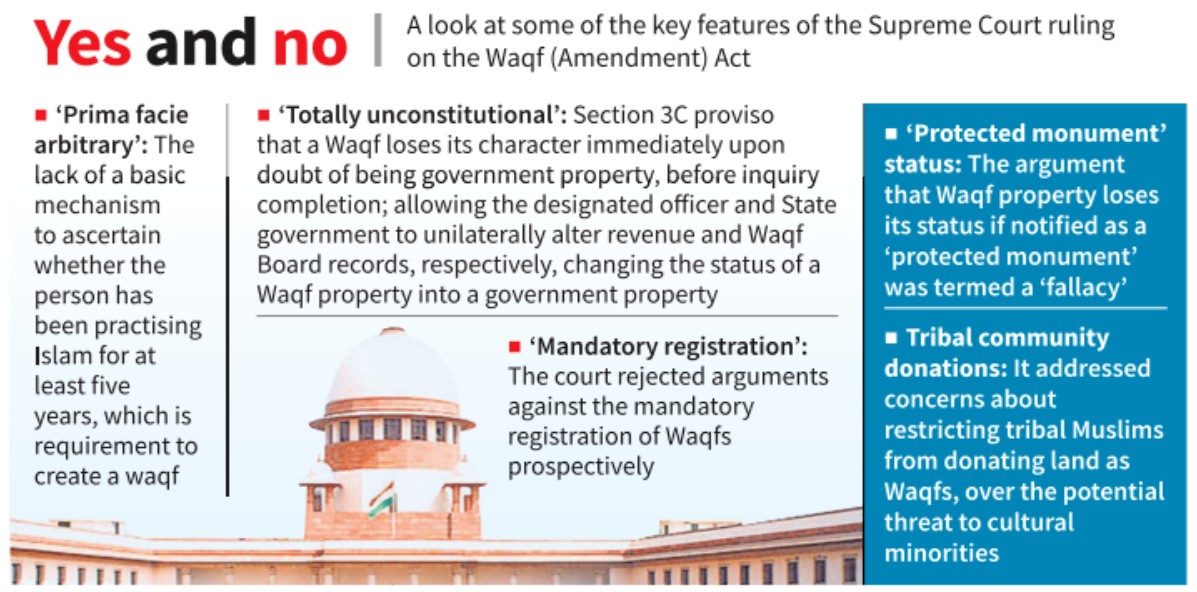
    The Waqf (Amendment) Act, 2025, passed by Parliament earlier this year, faced widespread opposition from political leaders, religious organisations, and civil society. Over 65 petitions were filed, challenging its constitutional validity. On September 15, the Supreme Court issued an interim order staying several key provisions, particularly those expanding the powers of district collectors, imposing a five-year Islam practice condition for creating a waqf, and capping non-Muslim representation in Waqf boards. At the same time, the Court upheld other significant changes such as the removal of “waqf-by-user” and the applicability of the Limitation Act. This selective intervention reflects the judiciary’s cautious approach in balancing equity, religious freedom, and governance.

    Waqf

    Why is the Supreme Court’s interim stay significant?

    1. First major judicial intervention: The SC’s order is the first substantive check on the Waqf (Amendment) Act, 2025 since its passage.
    2. Large-scale impact: With nearly 65 petitions filed, the matter affects thousands of properties and the rights of the Muslim community across India.
    3. Balance of powers: The Court flagged violation of the separation of powers doctrine by preventing revenue officers from adjudicating property titles.
    4. Guardrails against misuse: While not striking down the Act, the Court has added interim safeguards to prevent dispossession and misuse of powers.

    What powers of District Collectors were stayed?

    1. Section 3C inquiry power: District Collectors could declare that land claimed as waqf is government property. The SC stayed the clause that made waqf status cease immediately upon inquiry.
    2. Arbitrariness highlighted: Entrusting title determination to a revenue officer was held to be prima facie arbitrary.
    3. Safeguard applied: Waqf properties will retain their status until adjudicated by a Waqf Tribunal. However, no third-party rights can be created until final resolution.

    How did the Court deal with non-Muslim representation in Waqf Boards?

    1. Capping membership: Central Waqf Council (22 members) shall not have more than 4 non-Muslims; State Waqf Boards (11 members) shall not have more than 3 non-Muslims.
    2. Community rights upheld: This ensures that the Muslim community’s right under Article 26 to manage religious affairs is not diluted.
    3. Avoiding ambiguity: The SC clarified numbers to prevent misinterpretation of the law.

    What about the ‘five years of practising Islam’ rule?

    1. New definition of waqf: The 2025 Act required proof of practising Islam for five years to create a waqf.
    2. Provision stayed: SC stayed this rule until the government frames rules and mechanisms for proof.
    3. Judicial caution: The Court noted concerns of arbitrariness and discrimination, but also recognised historical misuse of waqf as a tool to evade creditors.

    Which provisions were not stayed?

    1. Abolition of ‘waqf by user’: The Court upheld its removal, citing misuse to encroach upon government lands.
    2. Applicability of the Limitation Act: Waqfs must now act within statutory limitation periods. This was upheld as removing previous discrimination.
    3. Registration compliance: SC emphasised that waqfs had 102 years (since 1923) to register, hence claims of arbitrariness were weak.

    What is the larger constitutional and governance context?

    1. Presumption of constitutionality: Laws passed by Parliament carry weight until struck down.
    2. Balancing equities: The SC avoided blanket suspension, staying only contentious clauses.
    3. Protection of minority rights: Ensures Article 26 freedoms are not eroded.
    4. Preventing property misuse: Legislative intent to protect government property and curb misuse was acknowledged.

    Conclusion

    The Supreme Court’s interim order on the Waqf (Amendment) Act, 2025 reflects a nuanced judicial approach—protecting religious freedoms while respecting legislative authority. By drawing constitutional boundaries for state power and emphasising procedural fairness, the Court has reinforced its role as a guardian of equity and minority rights. The final verdict will have long-lasting implications for governance of religious endowments and minority trust in legal institutions.

    PYQ Relevance:

    [UPSC 2019] What are the challenges to our cultural practices in the name of secularism.

    Linkage: The Waqf (Amendment) Act, 2025 has been challenged for allegedly curbing the Muslim community’s right under Article 26 to manage its religious endowments, showing how state intervention can threaten cultural practices. The Supreme Court’s interim stay on provisions like non-Muslim majority in Waqf Boards and “five years of practising Islam” directly reflects the tension between secular governance and religious autonomy. Thus, the case exemplifies the broader challenge of balancing secularism with protection of cultural practices, as asked in the 2019 question.

  • A Sense of Drift: Democracy at the Crossroads: Youth, Corruption and the New Global Malaise

    Introduction

    Democracy, once celebrated as the ultimate safeguard of freedom and governance, is witnessing profound crises across continents. Nepal’s weak institutions, France’s protest-prone presidentialism, and America’s violent polarisation reveal that democratic malaise is not confined to one geography. The recurring theme is stark: young people feel robbed of their future.

    Why is democracy back in crisis?

    1. Recurring crises: Democracies appear to follow cycles of expansion (40–50 years) followed by exhaustion.
    2. Current triggers: Corruption in Nepal, unsustainable economic models in France, and violent political divisions in the US.
    3. Historical echoes: Similar crises were witnessed in the 1920s–30s and the 1960s–70s, culminating in debates such as the Trilateral Commission’s 1975 report on “The Crisis of Democracy.”

    What role does youth disillusionment play?

    1. Stolen future: Across Nepal, France, and the US, young people feel alienated and betrayed.
    2. Lack of consensus: Youth anger does not translate into youth unity; it produces anxiety but not collective solutions.
    3. Gerontocracy problem: Democracies like India and the US are led largely by older generations, deepening generational divides.

    How does inequality and polarisation fuel the malaise?

    1. Different consensus: Unlike the 1970s when “excess participation” was blamed, today growing inequality is seen as the root of discontent.
    2. Dual polarisation: A clash of values coupled with diametrically opposed economic visions — Left demanding more state investment, Right fearing socialist excess.
    3. Jobless growth: Declining employment elasticity of capital threatens to erode trust even in well-designed policies.

    Why does corruption persist as a democratic fault line?

    1. Structural vs transactional corruption: Elites monopolising power versus ostentatious lifestyles of politicians.
    2. Anti-corruption paradox: Movements rarely eliminate corruption and often fuel authoritarian turns, seen in Nepal’s staggering levels of rent extraction.
    3. Authoritarian co-option: Anti-corruption rhetoric is used to justify illiberal governance.

    What is the role of war and misinformation?

    1. Historical corrosion: Vietnam and Iraq wars eroded democratic legitimacy in the US.
    2. Current crises: Gaza conflict risks corroding Western liberal legitimacy.
    3. Misinformation cycle: Radical democratisation of information through social media has dissolved authority and deepened adversarial suspicion.

    Can democracies reinvent themselves?

    1. Past reinventions: Post-1930s depression and 1970s crises were followed by new waves of democratisation.
    2. Paradox of protest: While protests mobilise energy, they often breed drift, violence, or nihilism.

    Way Forward for Democracies

    1. Institutional Reinvention: Strengthen checks and balances through judicial independence, parliamentary accountability, and free media — preventing democratic backsliding.
    2. Inclusive Growth: Address structural inequality and jobless growth by creating policies focused on employment elasticity and equitable redistribution.
    3. Youth Participation: Channel youth disillusionment into institutionalised participation (youth parliaments, policy fellowships, digital consultative platforms).
    4. Taming Polarisation: Build broad-based social coalitions that transcend Left–Right economic divides and cultural polarisation.
    5. Responsible Information Order: Regulate misinformation while protecting freedom of speech; strengthen media literacy to combat nihilism fuelled by social media.
    6. Corruption Reform: Focus on structural corruption (elite monopolisation of power) rather than episodic “anti-corruption crusades” that risk authoritarian capture.
    7. Global Learning: Draw lessons from past crises (1930s, 1970s) where institutional reinvention, new social contracts, and reform waves revitalised democracy.

    Value Addition

    Samuel P. Huntington’s Views and Theory on Democracy

    Political Order and Institutionalisation

    • Book: Political Order in Changing Societies (1968).
    • Core Argument: The stability of a political system depends more on the strength of its institutions than on the level of modernisation.
    • Key Point: Modernisation without strong institutions leads to instability (e.g., corruption, coups, unrest).
    • Quote: “The most important political distinction among countries is not their form of government but their degree of government.”

    The Third Wave of Democratisation

    • Book: The Third Wave: Democratisation in the Late Twentieth Century (1991).
    • Theory: Democracies emerge in “waves,” each followed by a possible “reverse wave.”
      • First Wave (1828–1926): Expansion in Western countries.
      • First Reverse Wave (1922–1942): Rise of fascism, military regimes.
      • Second Wave (1945–1962): Post-WWII, decolonisation.
      • Second Reverse Wave (1960–1975): Coups in Latin America, Africa, Asia.
      • Third Wave (1974 onwards): Started with Portugal’s Carnation Revolution, followed by democratisation in Latin America, Eastern Europe, parts of Asia and Africa.

    Key Factors for Third Wave:

    • Declining legitimacy of authoritarian regimes.
    • Economic growth and rising middle class.
    • Religious changes (e.g., Catholic Church’s role in Latin America).
    • Global democratic norms (influence of EU, US).
    • “Snowballing effect” (success in one country inspired others).
    • Relevance: Many current democracies (including in Asia, Latin America, Eastern Europe) emerged in this wave

    Clash of Civilisations (1993)

    • Book: The Clash of Civilizations and the Remaking of World Order.
    • Argument: Post-Cold War conflicts would be driven not by ideology or economics, but by cultural and civilisational differences.
    • Link to Democracy: Democracies rooted in Western civilisation may clash with non-Western civilisations (Islamic, Sinic/Chinese).

    Relevant Quotes on Democracy 

    On Cycles and Fragility

    • John Adams: “Democracy never lasts long. It soon wastes, exhausts, and murders itself.”
    • Samuel Huntington: “Democracy is the only political system that is self-correcting.”

    On Reinvention

    • Winston Churchill: “Democracy is the worst form of government — except for all those other forms that have been tried from time to time.”
    • Amartya Sen: “No famine has ever taken place in the history of the world in a functioning democracy.”

    On Corruption and Morality

    • Mahatma Gandhi: “Corruption and hypocrisy ought not to be inevitable products of democracy, as they undoubtedly are today.”
    • Alexis de Tocqueville: “The health of a democratic society may be measured by the quality of functions performed by private citizens.”

    On Youth and Future

    • Jawaharlal Nehru: “The future belongs to those who can give to the next generation reasons for hope.”
    • Kofi Annan: “Young people should be at the forefront of global change and innovation.”

    How to Use in UPSC Answers

    • Quote John Adams or Huntington when talking about cycles of democracy.
    • Quote Gandhi or Amartya Sen when linking democracy with corruption or development outcomes.
    • Quote Churchill when emphasising democracy’s resilience despite flaws.

    PYQ Relevance:

    [UPSC 2023] Constitutionally guaranteed judicial independence is a prerequisite of democracy. Comment.

    Linkage: The current crisis of democracy, as highlighted in Nepal, France, and the US, shows that without robust and independent institutions, democratic legitimacy erodes. Judicial independence acts as a bulwark against corruption, elite capture, and authoritarian drift. Thus, safeguarding constitutional autonomy of the judiciary is indispensable for reinvigorating democracy.

  • Election of the Vice-President

    Why in the News?

    Thiru CP Radhakrishnan has been elected as Vice President of India.

    About Vice-President (VP) of India:

    • Position: Second-highest constitutional post; deputy to the President.
    • Parliamentary Role: Serves as ex-officio Chairman of the Rajya Sabha.
    • Succession: Ranks second in order of precedence and first in line to become President.
    • Membership: Is a member of Parliament, not directly elected by the people.

    Qualifications:

    • Citizenship: Must be a citizen of India.
    • Age: Minimum 35 years.
    • Office of Profit: Should not hold any.
    • Parliamentary Eligibility: Must qualify for election to Rajya Sabha (unlike President, who must qualify for Lok Sabha) due to the VP’s role in the Upper House.

    Roles and Responsibilities:

    • Rajya Sabha Chairmanship: Presides over sessions and ensures order.
    • Bill Classification: Refers money bills to the Lok Sabha Speaker.
    • No Independent Powers: Has no executive or legislative powers unless acting as President.

    Election Procedure:

    • Constitutional Basis: Governed by Article 66.
    • Electoral College: Comprises 543 Lok Sabha MPs, 233 elected Rajya Sabha MPs, and 12 nominated Rajya Sabha members.
    • Voting Method: Proportional representation by single transferable vote and secret ballot.
    • No Whip Allowed: Parties cannot issue voting whips.
    • Conduct: Managed by the Election Commission; Returning Officer is the Secretary-General of either House (on rotation).
    • Winning Quota: Requires 50% of valid votes + 1; votes are transferred in rounds if no candidate secures majority in the first round.

    Resignation and Removal:

    Resignation

    • Article 67(a): VP submits his/her resignation to the President. Parliamentary approval is NOT needed, and the resignation takes effect immediately upon receipt.
    • No Acting VP: Constitution doesn’t provide for an acting Vice-President.
    • Presiding in Absence: Deputy Chairman of Rajya Sabha presides in VP’s absence (currently Harivansh Narayan Singh).
    • Example: Dhankhar, who took office in 2022, is only the third VP in Indian history to resign before completing his term, after V.V. Giri and R. Venkataraman.

    Removal

    • Article 67(b): Removal process begins in Rajya Sabha with 14 days’ notice.
    • Voting Requirement: Needs effective majority in Rajya Sabha and simple majority in Lok Sabha.
    • No Grounds Specified: Constitution doesn’t list specific removal grounds.
    • Judicial Immunity: Article 122 bars courts from questioning parliamentary proceedings related to removal.
    • No Precedent: No VP has been removed so far.
    [UPSC 2013] With reference to Parliament, consider the following statements:

    1.The Chairman and the Deputy Chairman of the Rajya Sabha are not the members of that House.

    2.While the nominated members of the two Houses of the Parliament have no voting right in the presidential election, they have the right to vote in the election of the Vice President.

    Which of the statements given above is/are correct?

    Options: (a) 1 only (b) 2 only (c) Both 1 and 2* (d) Neither 1 nor 2