Mains Ready By December. Smash Mains & Smash PYQ Admissions Open

GS Paper: GS2-01.Indian Constitution-Historical underpinnings & evolution; Features, amendments, significant provisions, basic structure of Constitution

  • RTE Act and Minority Educational Institutions

    Why in the News?

    The Supreme Court has referred to a larger Bench the question of whether Minority Educational Institutions (MEIs) are completely exempt from the purview of the Right to Education (RTE) Act, 2009.

    About Minority Educational Institutions (MEIs):

    • Constitutional Basis:
      • Article 30(1) grants religious and linguistic minorities the right to establish and administer educational institutions of their choice.
      • Article 29 protects their cultural and educational rights.
    • Legal Framework:
      • Defined under the National Commission for Minority Educational Institutions (NCMEI) Act, 2004.
      • The NCMEI adjudicates disputes, grants recognition, and safeguards the autonomy of such institutions.
    • Recognized Minority Communities: Muslims, Christians, Sikhs, Buddhists, Jains, and Zoroastrians (Parsis) are notified as minorities by the Government of India.
    • Judicial Principles:
      • In T.M.A. Pai Foundation vs. State of Karnataka (2002), SC held that minority status is determined state-wise, not nationally.
      • Minority institutions can reserve seats for their community and enjoy greater control over administration and recruitment.
    • Purpose and Role:
      • Preserve the cultural, linguistic, and religious heritage of minority groups.
      • Provide quality education with constitutional protection from excessive state interference.

    What is the Right to Education (RTE) Act, 2009?

    • Genesis: Stemming from Unnikrishnan vs. State of Andhra Pradesh (1993), where SC declared education as a Fundamental Right under Article 21.
      • Later given constitutional backing through the 86th Amendment Act (2002), which inserted Article 21A – free and compulsory education for children aged 6–14 years.
    • Enactment: To operationalize Article 21A, Parliament passed the Right of Children to Free and Compulsory Education Act, 2009.
    • Key Provisions:
      • Free and compulsory education for all children aged 6–14 in a neighbourhood school.
      • 25% reservation in private schools for children from disadvantaged groups and weaker sections.
      • No detention, expulsion, or board exams up to Class VIII (amended in 2019 to allow states discretion).
      • Teacher norms: TET (Teachers Eligibility Test) qualification mandatory; ban on private tuitions by teachers.
      • School Management Committees (SMCs): Parents, local authority reps, and teachers oversee school functioning.
      • Curriculum & Standards: Developed by an academic authority (often NCERT/SCERT).
    • Amendments:
      • 2012: Included children with disabilities; exempted minority/religious institutions.
      • 2019: Abolished uniform “no-detention policy,” left to states’ choice.


    [UPSC 2018] Consider the following statements:

    1. As per the Right to Education (RTE) Act, to be eligible for appointment as a teacher in a State, a person would be required to possess the minimum qualification laid down by the concerned State Council of Teacher Education.

    2. As per the RTE Act, for teaching primary classes, a candidate is required to pass a Teacher Eligibility Test conducted in accordance with the National Council of Teacher Education guidelines.

    3. In India, more than 90% of teacher education institutions are directly under the State Governments

    Which of the statements given above is/are correct?

    Options: (a) 1 and 2 (b) 2 only* (c) 1 and 3 (d) 3 only


  • False righteousness

    Introduction

    In a democracy, the judiciary acts as the guardian of fundamental rights, ensuring that executive and legislative actions remain within constitutional limits. However, recent judicial pronouncements urging the executive to tighten controls over online speech raise a worrying question: Is the Court inadvertently enabling state encroachment into constitutionally guaranteed freedoms? This concern is sharpened by the backdrop of the IT Rules, 2021, which already tilt power heavily towards the government in regulating digital speech.

    Expanding Powers of the Executive over Free Speech

    1. Judicial Instructions: The Supreme Court recently directed the Union government to frame guidelines on regulating online speech.
    2. Problematic Precedent: Instead of protecting rights, the Court’s instructions risk empowering the executive to expand censorship powers under vague grounds like “misuse of freedom of speech.”

    Digital Speech: Between Regulation and Censorship

    1. IT Rules, 2021: These rules already allow the government to flag and order removal of online content, with penalties for intermediaries.
    2. 2023 Amendment: Expanded scope to hold social media companies accountable for user-generated content, giving the state wide-ranging discretionary powers.
    3. Challenge Pending in SC: These rules are already under constitutional challenge, making further expansion questionable.

    The Risk of False Righteousness

    1. Distasteful vs. Criminal: While hate speech and incitement to violence are already criminalised, regulating distasteful humour or dissenting opinions risks expanding censorship beyond constitutional boundaries.
    2. Chilling Effect: Citizens begin to self-censor, fearing repercussions for expressing views.
    3. Suppression of Creative Expression: Film producers, directors, and journalists face FIRs and restrictions, stifling art, reporting, and debate necessary for a vibrant democracy.

    Judiciary’s Institutional Role under Question

    1. Protector of Rights: The Court is constitutionally mandated to check executive overreach.
    2. Risk of Overstepping: By urging executive rulemaking, the judiciary risks acting like an unquestioned lord in a feudal setup rather than a rights-protecting institution.
    3. Misplaced Priorities: Instead of fortifying existing protections against hate speech, the Court seems to encourage executive expansion into grey zones.

    Broader Democratic Implications

    1. Weaponisation of Laws: Governments have a record of using regulations to target political opponents and inconvenient voices.
    2. Threat to Democratic Discourse: An atmosphere of censorship undermines deliberation, dissent, and innovation—all vital for a progressive society.
    3. Global Comparison: Mature democracies often rely on civil remedies and self-regulation, rather than empowering the state to police thought and humour.

    Conclusion

    The judiciary’s role is not to expand executive power but to ensure constitutional freedoms are protected. Hate speech and incitement to violence are already criminalised; expanding censorship to regulate humour, dissent, or artistic expression risks creating an atmosphere of fear and conformity. The Supreme Court must remember its constitutional role as the sentinel on the qui vive—guarding liberty, not enabling its curtailment.

    PYQ Relevance

    [UPSC 2014] Discuss Section 66A of the IT Act, with reference to its alleged violation of Article 19 of the Constitution.

    Linkage: The present debate on the Supreme Court urging the executive to frame guidelines for regulating social media echoes the concerns raised in Section 66A of the IT Act, where vague terms led to misuse against free expression. Just like 66A, expanding executive powers risks creating a chilling effect on speech beyond Article 19(2)’s reasonable restrictions. Both highlight the judiciary’s responsibility to act as a protector of rights, not an enabler of censorship.

  • [25th August 2025] The Hindu Op-ed: The new Constitution Bill, the need for a balancing act

    Mentor’s Comment

    The Constitution (One Hundred and Thirtieth Amendment) Bill, 2025 has sparked intense debate in Parliament and across the country. While it appears to be a strong step toward cleaner politics, it also raises deep constitutional and democratic concerns. For UPSC aspirants, this issue is important not only for its immediate political relevance but also for its intersection with constitutional morality, criminalisation of politics, separation of powers, and due process. This article breaks down the Bill, its context, judicial linkages, and its broader implications for democracy.

    Introduction

    India has long grappled with the paradox of demanding clean politics while being governed by leaders facing serious criminal charges. The Constitution (130th Amendment) Bill, 2025, introduced in the Lok Sabha on August 20, seeks automatic resignation or removal of Ministers, Chief Ministers and even the Prime Minister if they remain in custody for over 30 days in offences punishable with five years or more. While aimed at restoring public trust, the Bill risks undermining due process and democratic safeguards.

    Why is this Bill in the news?

    The Bill marks the first time Parliament has proposed automatic removal of top executive leaders on mere detention without conviction. This is in sharp contrast with the current legal position under the Representation of the People Act, where disqualification begins only upon conviction. The stakes are high: India already faces a staggering rise in criminalisation of politics, with 46% of MPs in 2024 declaring criminal cases, up from 30% in 2009. Against this backdrop, the Bill seeks to restore public trust but also risks political misuse, raising concerns of democratic erosion.

    Judicial foundations and constitutional morality

    1. Articles 75, 164, 239AA: Provide for ministerial tenure “at the pleasure” of President/Governor, limited by constitutional morality.
    2. S.R. Bommai case: Stressed that integrity and accountability are core to constitutional morality.
    3. Manoj Narula case: Warned against entrusting power to those with serious criminal charges.
    4. Lily Thomas case: Held that disqualification of legislators must occur upon conviction, striking down earlier appeal window.
    5. Tension: While courts upheld high ethical standards, they stopped short of mandating automatic removal before conviction, the Bill goes further, creating friction with Article 21 (right to life and liberty).

    Risk of Bill being misused as a political weapon

    1. Executive discretion: PM/CM advice governs removal; if withheld, automatic removal applies after 30 days. This dual mechanism may be exploited politically.
    2. Selective shield or target: PM may protect allies temporarily, while hostile leaders may allow rivals to fall under automatic removal.
    3. Politicisation of accountability: Instead of insulating governance, it may embed accountability in partisan strategies.

    Inconsistency in the treatment of legislators and Ministers

    1. RPA framework: Legislators disqualified only on conviction.
    2. Ministerial paradox: A Minister under arrest is removed after 30 days, but a legislator convicted of corruption may still technically hold ministerial office until disqualification proceedings.
    3. Asymmetry: Creates harsher standards for Ministers than legislators, risking deterrence for capable leaders.

    Political instability and the “revolving door”

    1. Reappointment clause: Once released, Ministers can be reinstated.
    2. Cycle of instability: Arrest → resignation → release → reinstatement may lead to political uncertainty without improving accountability.
    3. Tactical misuse: Legal proceedings could be manipulated to weaken opponents through timed arrests.

    Why do critics demand a more nuanced model?

    1. Criminalisation of politics: Rising trend demands reform, 251 MPs (46%) with criminal cases in 2024.
    2. Judicial milestone approach: Removal linked to framing of charges by a competent court rather than arrest alone ensures judicial scrutiny.
    3. Independent review: Tribunal/judicial panel could prevent executive misuse.
    4. Interim suspension: Instead of removal, suspension of ministerial functions during trial could balance governance and accountability.
    5. Scope refinement: Apply only to corruption and moral turpitude offences, not all crimes with five years’ punishment (which may include minor offences).

    Conclusion

    The 130th Amendment Bill embodies India’s long-standing demand for clean politics. However, its blunt approach risks weakening constitutional safeguards like presumption of innocence, creating political instability, and enabling misuse of arrest as a weapon. The Joint Parliamentary Committee must recalibrate the Bill with judicially tested safeguards, narrowing its scope to serious offences and ensuring impartial mechanisms for enforcement. Only then can India achieve the delicate balance where power is exercised with integrity without sacrificing fairness.

    UPSC Relevance:

    [UPSC]: “There is a need for simplification of procedure for disqualification of persons found guilty of corrupt practices under the Representation of Peoples Act.” Comment.

    Linkage: “The 130th Amendment Bill echoes the long-standing concern flagged in the 2020 PYQ on RPA disqualification: India needs clearer and fairer procedures to ensure accountability in politics. While the PYQ emphasised simplification post-conviction, the Bill risks moving the trigger point too early (mere custody), thereby complicating rather than simplifying the disqualification process.”
  • [22nd August 2025] The Hindu Op-ed: Poll integrity and self-sabotage, parties and the ECI

    PYQ Relevance

    [UPSC 2019] On what grounds a people’s representative can be disqualified under the Representation of People Act, 1951? Also mention the remedies available to such person against his disqualification.

    Linkage: The Representation of People Act, 1951 provides the legal foundation for ensuring free and fair elections, including grounds for disqualification such as corrupt practices, electoral offences, and irregularities. The issue of flawed electoral rolls and voter fraud, as highlighted in this article, connects directly with the broader framework of the RPA. While the Act prescribes remedies against wrongful disqualification, its effectiveness depends heavily on accurate voter lists, active oversight by parties, and neutrality of the ECI. Thus, the credibility of electoral rolls is not only an administrative concern but also a legal and constitutional safeguard under the RPA, 1951.

    Mentor’s comments

    India’s democracy depends not just on strong institutions but also on the integrity of political actors. The ongoing debate around flawed electoral rolls, the role of the Election Commission of India (ECI), and political parties’ complicity exposes serious challenges. This article unpacks how poll integrity is being compromised and how both parties and the ECI are shaping voter trust.

    Introduction

    Electoral rolls are the backbone of free and fair elections, yet duplicate entries, ghost names, and ineligible voters continue to mar them. These flaws enable impersonation and multiple voting, weakening public faith in the system. While the ECI faces criticism, political parties too are responsible for neglecting local structures and prioritising short-term electoral wins.

    The contrast is sharp: In the 1990s under T.N. Seshan, the ECI was hailed as a global model of electoral probity. Today, suspicion surrounds the institution, raising doubts about whether both the ECI and political parties are failing in their constitutional roles.

    The Fall of the Election Commission’s Credibility

    1. From Trust to Suspicion: Once among India’s most trusted institutions, the ECI’s opacity and lack of accountability now fuel mistrust.
    2. Contrast with the Past: T.N. Seshan’s tenure saw strict enforcement of the Model Code of Conduct, monitoring of expenses, and the EPIC system to curb bogus voting.
    3. Present Decline: Instead of fixing flawed rolls, the ECI made inspections harder, deepening suspicion over its neutrality.

    How Political Parties Weakened Themselves

    1. Shift from Ground to Tech: Local campaigns with house visits and meetings are being replaced by social media, phone calls, AI tools, creating an illusion of connection.
    2. Reliance on Consultants: Campaign strategy and candidate selection now rest with professional consultants, centralising power and weakening grassroots.
    3. Neglect of Local Cadres: Once the backbone of political parties, local workers are sidelined, leaving little vigilance against electoral fraud.

    The Booth Level Agent System and Its Vulnerabilities

    1. Role of BLAs: Booth Level Agents (BLAs) are meant to be the vital link between voters, parties, and the ECI by verifying draft rolls.
    2. Safeguards in Place: Rules cap BLAs at 10 applications a day; exceeding 30 requires personal verification by officers.
    3. Failures in Practice: Cases like Mahadevapura (Karnataka) reveal inactive BLAs, manipulations, and possible bias, showing safeguards are poorly enforced.

    Opportunities for Political Redemption

    1. Reviving Local Units: The crisis is a chance for parties to strengthen grassroots structures, not just depend on consultants.
    2. Kerala’s Example: Parties there are now diligently flagging duplicate voters and multiple IDs during local elections.
    3. Historical Warning: Weak grassroots units once undermined land reforms post-Independence; neglect today risks hollowing out democracy again.

    The Deeper Democratic Implications

    1. Beyond Elections: Roll revisions, though routine, are crucial to maintaining democratic fairness.
    2. Erosion of Trust: Prioritising short-term electoral gains over constitutional values leaves institutions hollow.
    3. Democracy at Risk: Weak local organisations and complicit institutions together may end up surrendering democracy itself.

    Conclusion

    The integrity of India’s democracy depends not just on robust institutions but also on vigilant political participation at the grassroots. The ECI must reclaim its credibility by ensuring transparency, while political parties must revive their local cadres to safeguard electoral rolls. Without these corrective steps, the erosion of trust may reach a tipping point where democracy is hollowed out from within.

    Value Addition

    T.N. Seshan’s Reforms in the 1990s

    1. Strict Enforcement of MCC – First CEC to rigorously implement the Model Code of Conduct (MCC), curbing misuse of official machinery.
    2. Curbing Electoral Malpractices – Took action against bribery, muscle power, and use of religion/caste in campaigns.
    3. Electoral Photo Identity Card (EPIC) – Introduced voter ID cards to check bogus voting.
    4. Monitoring Poll Expenditure – Set strict limits on candidate expenses and ensured scrutiny of accounts.
    5. Independent Authority of ECI – Asserted autonomy of the Election Commission, making it a powerful guardian of free and fair elections.
    6. Public Trust Restored – Citizen surveys during the 1990s ranked ECI among the most credible institutions.

    Why it matters: T.N. Seshan’s tenure is often cited as the “gold standard” of electoral probity, offering a benchmark against which today’s decline in trust and credibility is judged.

    Mapping Microthemes

    1. GS Paper II (Polity & Governance): Electoral integrity, role of ECI, political accountability.
    2. GS Paper I (History & Society): Weakening of grassroots political movements.
    3. GS Paper III (Technology): Impact of AI-driven campaigns and professional consultants.
    4. GS Paper IV (Ethics): Institutional neutrality, self-restraint, erosion of trust.
  • Sedition Redux: On trampling on press freedom

    Why in the News?

    On August 12, 2025, The Wire’s editors Siddharth Varadarajan and Karan Thapar were summoned by the Assam Police under Section 152 of the BNS, even as the Supreme Court had that very day issued protection while examining the constitutional validity of the new sedition law. This open defiance of judicial authority and the use of procedurally defective summons marks a serious blow to press freedom. What makes this moment significant is that the law being challenged is wider and harsher than colonial sedition provisions, despite India claiming to have moved away from such colonial baggage.

    Introduction

    The sedition debate in India has returned in a new form. While Section 124A IPC was suspended in 2022, the government introduced Section 152 of the BNS, which critics say is “sedition by another name.” The law widens state powers and lowers the threshold for prosecution, making legitimate criticism vulnerable to criminalisation. Recent cases against journalists show how easily this provision can be misused.

    Section 152 and Its Differences from the Old Sedition Law

    • Expanded scope: Goes beyond “disaffection” against government, criminalising acts deemed to endanger sovereignty, unity, and integrity.
    • Lower bar for prosecution: Words like “knowingly” dilute intent requirements; mere criticism can be dragged into criminality.
    • Colonial continuity: Despite being marketed as decolonisation, Section 152 retains the same suppressive essence as 124A IPC.

    The Wire Case and Procedural Violations

    • Summons despite SC protection: Assam Police issued notices on the very day of SC’s order, reflecting executive defiance.
    • Lack of transparency: Summons omitted FIR dates, details of offence, and copies of FIR, violating BNSS safeguards.
    • Political overtones: Linked to The Wire’s report on Operation Sindoor, raising concerns of vendetta-driven policing.

    Threats to Press Freedom

    • Chilling effect: Journalists may self-censor for fear of harassment.
    • Vague definitions: Broad terms like “unity” and “sovereignty” give unchecked power to authorities.
    • Targeting dissent: Questioning government policy risks being equated with undermining national integrity.

    Judicial Response and Challenges

    • Supreme Court scrutiny: SC is examining the constitutional validity of Section 152.
    • Precedent of 2022: Earlier suspension of sedition cases showed judicial recognition of misuse.
    • Executive overreach: Assam Police’s defiance underlines the need for stronger judicial safeguards and guidelines.

    Broader Democratic Implications

    • Freedom of expression at stake: Democracy thrives on criticism; silencing it weakens accountability.
    • Comparative perspective: UK repealed sedition in 2009; US limits it only to violent overthrow.
    • Governance paradox: Instead of transparency, India risks sliding into a majoritarian security state.

    Way Forward

    • Clear legislative safeguards: Narrow the scope of Section 152 with precise definitions of terms like “unity” and “sovereignty” to prevent misuse.
    • Judicial guidelines: The Supreme Court can lay down binding principles (on the lines of Kedar Nath Singh and Shreya Singhal) that limit sedition to cases of direct incitement to violence or armed rebellion
    • Independent oversight: A judicial or quasi-judicial body should vet sedition cases before FIR registration, reducing frivolous prosecutions.
    • Strengthening press freedom: Institutional mechanisms like a Media Commission or independent ombudsman can address grievances without criminalisation.
    • Comparative best practices: India can draw from the UK model of repeal and the US model of narrow application, balancing national security with democratic freedoms.
    • Civic education: Promoting awareness among citizens, journalists, and law enforcement about constitutional morality and reasonable restrictions can ensure a culture of restraint and accountability.

    Conclusion

    Section 152 represents the persistence of colonial-style suppression under a new name. Unless the judiciary firmly strikes it down or introduces robust safeguards, it will continue to erode press freedom and democratic dissent, pillars without which India’s constitutional promise cannot stand strong.

    Value Addition

    Constitutional Angle

    • Article 19(1)(a): Freedom of speech.
    • Article 19(2): Reasonable restrictions (sovereignty, unity, public order, etc.).
    • Basic Structure Doctrine: Democracy, liberty, and rule of law as inviolable.

    Judicial Precedents

    • Kedar Nath Singh vs State of Bihar (1962): Sedition valid only when incitement to violence/public disorder is proven.
    • Shreya Singhal vs Union of India (2015): Vague terms in laws (like IT Act Section 66A) struck down for chilling free speech.
    • SC Order 2022: Suspended all 124A cases, acknowledging misuse.

    Reports & Perspectives

    • Law Commission of India (2018): Recommended clearer safeguards; questioned necessity of sedition.
    • Global practices: UK repealed sedition; US restricts it narrowly.
    • BNSS debate: Marketed as decolonisation but seen as repackaging colonial control.

    Mapping Microthemes

    • GS Paper II: Freedom of speech, judiciary, Centre-State federalism
    • GS Paper III: Internal security vs. dissent.
    • GS Paper IV: Misuse of power, ethics in public life, constitutional morality.

    PYQ Relevance

    [UPSC 2014] What do you understand by the concept “freedom of speech and expression”? Does it cover hate speech also? Why do the films in India stand on a slightly different plane from other forms of expression? Discuss.

    Linkage: The 2014 question on freedom of speech, hate speech, and films mirrors today’s debate on Section 152. Just as films face stricter scrutiny due to mass impact, the new sedition law risks wrongly placing legitimate criticism and dissent in the same bracket as hate speech or violent incitement. This makes the boundary of free expression a central issue in both contexts.


  • ‘Creamy Layer’ condition in OBC Quota

    Why in the News?

    The government is considering measures to ensure uniform application of the ‘creamy layer’ condition in OBC reservations across central and state government jobs, public sector enterprises, universities, and autonomous bodies.

    About the Concept of Creamy Layer:

    • Origin: Emerged from Indra Sawhney vs Union of India (1992); excluded affluent Other Backward Class (OBC) groups from reservations.
    • 1993 DoPT Rules: Defined creamy layer – children of Group A/Class I officers, early-promoted officials, Group B parents, senior armed forces, high constitutional functionaries, professionals, traders, and large landowners.
    • Income Criteria:
      • Ceiling: ₹1 lakh in 1993, revised to ₹8 lakh in 2017.
      • Exclusions: Salary and agricultural income not counted.

    2004 Clarification & Implementation Issues:

    • Clarification: DoPT directed separate assessment of salary and other income (except agriculture).
    • Rule: If either exceeded limit (₹2.5 lakh then) for 3 consecutive years → creamy layer.
    • Problem: Poor enforcement (2004–14) due to political sensitivities; stricter checks after 2014.
    • Impact: Between CSE 2015–23, over 100 OBC caste certificates rejected under new interpretations.

    Equivalence Efforts:

    • Consultations: Involved Social Justice, Education, Law, Labour Ministries, DoPT, NITI Aayog, NCBC.
    • Goal: Standardise creamy layer rules across universities, Public Sector Undertakings (PSUs), and autonomous bodies.
    • Proposal: Retrospective relief suggested by Home Minister Amit Shah and NCBC.

    Key Proposals Under Consideration:

    • University Teachers: Salaries start at Group A-equivalent → children to be creamy layer.
    • Autonomous Bodies: Posts aligned with central pay scales.
    • Non-Teaching Staff: Categorisation based on equivalence with government jobs.
    • PSU Executives: Already included since 2017; those ≤₹8 lakh excluded.
    • Aided Institutions: Staff categorised based on parity with govt. employees.

    Likely Beneficiaries:

    • Lower Govt. Staff: Children of employees earning just above ₹8 lakh gain most.
    • Correction of Anomalies: Ensures parity between teachers and aided staff.
    • State PSU Issues: Fixes cases like fuel pump attendants in PSUs being declared creamy layer.
    • Private Sector: No change; creamy layer based only on income/wealth criteria.
    [UPSC 2023] Consider the following organizations/bodies in India:

    1. The National Commission for Backward Classes

    2. The National Human Rights Commission

    3. The National Law Commission

    4. The National Consumer Disputes Redressal Commission

    How many of the above are constitutional bodies?

    Options: (a) Only one *(b) Only two (c) Only three (d) All four


  • The Constitution (130th Amendment) Bill, 2025

    Why in the News?

    The Union Home Minister is set to introduce three bills in the Lok Sabha to provide legal framework for removal of the Prime Minister, Union Ministers, Chief Ministers and Ministers in States and UTs who are “arrested and detained in custody on account of serious criminal charges.”

    Which are the three Bills?

    1. 130th Constitutional Amendment Bill, 2025 (discussed below)
    2. Jammu and Kashmir Reorganisation (Amendment) Bill, 2025 – Provides clarity on removal of CM and Ministers in J&K.
    3. Government of Union Territories (Amendment) Bill, 2025 – Defines similar provisions for Puducherry and other UTs.

    About the 130th Constitutional Amendment Bill, 2025:

    • Scope: Applies to Prime Minister, Chief Ministers, and Ministers at Union, State, and Union Territory levels.
    • Grounds for Removal: Arrest and detention for 30 consecutive days for an offense punishable by five years or more.
    • Reappointment: Possible after release from custody.
    • Objective: Prevent prolonged tenure of arrested leaders in office (e.g., recent case involving Delhi CM Arvind Kejriwal).

    Amendments proposed to the following Articles:

    Current Provision Limitation Changes Proposed
    Article 75 (Union – PM & Union Ministers) PM appointed by President; Ministers appointed on PM’s advice. They hold office during the pleasure of the President. Removal is political (loss of confidence, resignation, dismissal). No explicit mechanism to remove PM/Ministers if detained/arrested for long periods. New provision: If PM or any Union Minister is detained in custody for 30 consecutive days for a serious offense (≥5 years punishment), they must resign by 31st day or automatically cease to hold office. They may be reappointed after release.
    Article 164 (States – CM & State Ministers) CM appointed by Governor; Ministers appointed on CM’s advice. They hold office during the pleasure of the Governor. Council of Ministers collectively responsible to State Assembly. No clear rule for automatic removal if CM/Ministers remain in custody. Similar to Union level: If CM or Minister is detained in custody for 30 consecutive days under serious charges (≥5 years punishment), they automatically lose office. Reappointment allowed after release.
    Article 239AA (Union Territory of Delhi – CM & Ministers) Special status for Delhi (NCT). CM and Council of Ministers aid & advise LG. They hold office as per political responsibility to the Assembly. No explicit provision for automatic removal on detention. A new Section 5A to be inserted: CM/Ministers of NCT of Delhi cease office if detained for 30 days under serious charges (≥5 years). Reappointment possible after release.

    Rationale and Significance:

    • At present, the Constitution has no provision for automatic removal of ministers in custody.
    • Bill ensures that office bearers uphold public trust and do not undermine governance during detention.
    • The statement of objects emphasized that elected representatives must rise above political interests and maintain conduct beyond suspicion.
    • Promotes integrity of democracy by aligning ministerial positions with constitutional morality and accountability.
    [UPSC 2020] Consider the following statements:

    1. According to the Constitution of India, a person who is eligible to vote can be made a minister in a State for six months even if he/she is not a member of the Legislature of that State.

    2. According to the Representation of People Act, 1951, a person convicted of a criminal offence and sentenced to imprisonment for five years is permanently disqualified from contesting an election even after his release from prison.

    Options: (a) 1 only (b) 2 only (c) Both 1 and 2 (d) Neither 1 nor 2*


  • Section 152 of the Bharatiya Nyaya Sanhita (BNS)

    Why in the News?

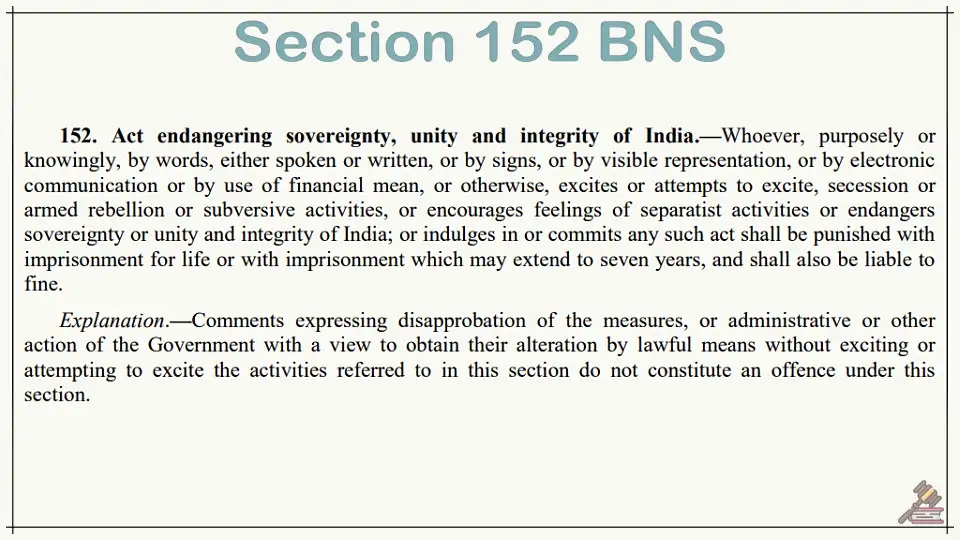
    The Supreme Court has raised a key question—whether the “potentiality of abuse” of Section 152 of the Bharatiya Nyaya Sanhita (BNS), which punishes acts endangering the sovereignty, unity, and integrity of India, could be a ground to declare the provision unconstitutional.

    Section 152 of the Bharatiya Nyaya Sanhita (BNS)

    About Section 152 BNS:

    • Deals with: Acts endangering sovereignty, unity, and integrity of India.
    • Origin: Introduced in the Bharatiya Nyaya Sanhita, 2023, effective 1 July 2024, replacing Section 124A IPC (sedition).
    • Scope: Criminalises purposeful or knowing acts that:
      • Excite secession, armed rebellion, or subversive activities.
      • Encourage separatist feelings.
      • Endanger sovereignty, unity, or integrity of India.
    • Means Covered: Words (spoken/written), signs, visible representation, electronic communication, financial means, or any other method.
    • Punishment: Life imprisonment or imprisonment up to 7 years + fine.
    • Nature of Offence: Cognizable, non-bailable, triable by Court of Session.
    • Exception Clause: Lawful criticism of government measures to seek change—without inciting rebellion/secession—is not an offence.
    • Key Difference from Section 124A IPC: Focus shifted from “disaffection against Government” to direct threats against the nation’s unity and sovereignty, with explicit recognition of digital-era methods.

    Issues with Section 152 BNS:

    • Potential for Misuse: Broad and subjective terms like “endangering sovereignty” can be stretched to target political dissent, journalism, and activism.
    • Vagueness: Undefined concepts (e.g., “sovereignty” in context of speech) create uncertainty, enabling arbitrary interpretation by authorities.
    • Similarity to Sedition Law: Despite rewording, its core effect mirrors Section 124A IPC, which is under constitutional challenge for curbing free speech.
    • Chilling Effect on Free Speech: Risk of self-censorship among journalists, activists, and citizens due to fear of prosecution.
    • High Punishment and Cognizability: Harsh penalties combined with arrest without warrant heighten scope for harassment before judicial scrutiny.
    • Digital Surveillance Concerns: Explicit coverage of electronic communication and financial means may widen investigative reach into personal digital activities.
    • Judicial Burden: Courts will need to repeatedly interpret the law to balance Article 19(1)(a) freedom of speech with state security.
    [UPSC 2025] Sedition has become my religion” was the famous statement given by Gandhiji at the time of:

    (a) the Champaran Satyagraha (b) publicly violating Salt Law at Dandi* (c) attending the Second Round Table Conference in London (d) the launch of the Quit India Movement


  • Revision of creamy layer income limit ‘need of the hour’:

    The Parliamentary Committee on Welfare of Other Backward Classes (OBCs) has reiterated the need to revise the “creamy layer” income ceiling for OBC reservation benefits. It called the revision the “need of the hour”, citing inflation and rising income levels, which have rendered the current ₹8 lakh per annum limit (fixed in 2017) inadequate. The Ministry of Social Justice and Empowerment (MoSJE), however, stated that there is currently no proposal under consideration for a revision.

    Understanding the “Creamy Layer” Concept

    1. Introduced following the Indra Sawhney v. Union of India (1992) judgment of the Supreme Court, which upheld 27% OBC reservation but excluded the socially advanced among them.
    2. The creamy layer criterion is an economic threshold: those above the prescribed annual family income are excluded from OBC reservation benefits.
    3. Initially set at ₹1 lakh (1993), it has been revised periodically, ₹2.5 lakh in 2004, ₹4.5 lakh in 2008, ₹6 lakh in 2013, ₹6.5 lakh in 2014, ₹8 lakh in 2017 (last revision)
      1. As per DoPT norms, revision should occur every 3 years.

    OBC Reservations in India: Historical Background

    Constitutional Foundation

    • Article 15(4): Allows the State to make special provisions for the advancement of socially and educationally backward classes (SEBCs), Scheduled Castes (SCs), and Scheduled Tribes (STs).
    • Article 16(4): Empowers the State to provide reservation in appointments or posts in favour of any backward class not adequately represented in State services.
    • Article 340: Empowers the President to appoint a commission to investigate conditions of backward classes and recommend measures.

    Significance of Revising the Creamy Layer Limit

    1. Social Justice: Ensures benefits reach those who truly need them, keeping pace with economic changes.
    2. Reducing Inequality: Supports more OBC families in accessing education, jobs, and government schemes.
    3. Compliance with Policy Guidelines: DoPT’s 1993 order mandates periodic revisions.

    Challenges

    1. Balancing Reservation Benefits: Avoiding over-expansion that may dilute benefits for the most marginalized.
    2. Economic vs. Social Backwardness: Income is only one indicator; social deprivation is harder to quantify.
    3. Political Consensus: Reservation policy changes are politically sensitive.

    Committee’s Concerns on the Current ₹8 Lakh Threshold

    • Erosion by Inflation: Rising basic income levels have reduced the effectiveness of the threshold.
    • Exclusion of Needy Segments: Many OBC families in need of reservation benefits are above ₹8 lakh but still economically disadvantaged in terms of education and access to resources.
    • Socio-Economic Goals: Wider coverage will help raise the social and educational status of more OBC families.

    Way Forward

    • Periodic & Transparent Revision: Institutionalize automatic inflation-indexed adjustments.
    • Comprehensive Backwardness Index: Incorporate education, occupation, and rural/urban disparities along with income.
    • Targeted Scholarships: Expand pre-matric support for lower classes to improve educational pipelines.
    • Better Data: Conduct regular socio-economic surveys for evidence-based policy.


    The creamy layer provision is a critical filter to ensure reservation benefits reach the truly disadvantaged among OBCs. With inflation and rising income levels, the current ₹8 lakh ceiling may no longer serve its purpose effectively. The Parliamentary Committee’s push for revision aligns with constitutional principles of equality and social justice, but implementation will require careful balancing of inclusivity, efficiency, and fairness.


    Value Addition

    Key Developments:

    1. First Backward Classes Commission (Kaka Kalelkar Commission, 1953) – recommended caste-based reservations, but not implemented due to lack of quantifiable data.
    2. Second Backward Classes Commission (Mandal Commission, 1979) – recommended 27% reservation for OBCs in government jobs and educational institutions, implemented in 1990.
    3. Indra Sawhney Case (1992) – capped total reservation at 50% and introduced the creamy layer exclusion for OBCs.

    Recent Trends

    1. The 102nd Constitutional Amendment (2018) gave constitutional status to the National Commission for Backward Classes (NCBC).
    2. The 105th Constitutional Amendment (2021) restored the power of states to identify OBCs for their own purposes.


    Mains Practice Questions:

    1. “Reservation for backward classes should be based on social and educational backwardness rather than economic criteria alone.” Discuss.
    2. The creamy layer in OBC reservation is a safeguard for ensuring equity within equity.’ Comment.
  • Legal Status of Right to Vote

    Why in the News?

    The ongoing Supreme Court hearings on the Special Intensive Revision (SIR) of electoral rolls in Bihar have reignited discussions on the legal status of the ‘right to vote’ in India.

    About Right to Vote in India:

    • Overview: It is also known as suffrage, allows citizens to elect their representatives in democratic institutions.
    • Constitutional Basis: Guaranteed under Article 326 of the Constitution of India, which provides for universal adult franchise.
    • Eligibility: Every citizen of India aged 18 and above is entitled to vote, unless disqualified by law.
    • Supervision: Organised and overseen by the Election Commission of India.
    • Supporting Laws:
      • Representation of the People Act, 1950: Defines voter eligibility and grounds for disqualification.
      • Representation of the People Act, 1951: Governs the procedures for conducting elections.

    Judicial Interpretation:

    • N.P. Ponnuswami v. Returning Officer (1952): Declared the Right to Vote as a statutory right.
    • Jyoti Basu v. Debi Ghosal (1982): Reiterated that the Right to Vote is neither a fundamental right nor a common law right.
    • People’s Union for Civil Liberties v. Union of India (2003): Recognised the Right to Vote as at least a constitutional right.
    • Kuldip Nayar v. Union of India (2006): Held that the Right to Vote continues to be a statutory right.
    • Raj Bala v. State of Haryana (2015): Recognised the Right to Vote as a constitutional right.
    • Anoop Baranwal v. Union of India (2023):
      • Majority View: Right to Vote is a statutory right.
      • Dissenting Opinion by Justice Ajay Rastogi:
        • Linked the Right to Vote with the freedom of speech and expression under Article 19(1)(a).
        • Considered it essential to free and fair elections and thus part of the basic structure of the Constitution.

    Current Legal Status:

    • Nature: It is legally a statutory right.
    • Constitutional Context: It is shaped by constitutional provisions but does not hold the status of a fundamental right.

    Back2Basics: Other Types of Rights in India

    Description Enforceability
    Natural Rights Inherent and inalienable rights (e.g., life, liberty); not directly enforceable unless linked to fundamental rights. Indirectly through Fundamental Rights
    Fundamental Rights Guaranteed under Part III of the Constitution (e.g., right to equality, speech, life). Enforceable in Supreme Court under Article 32
    Constitutional Rights Rights given in the Constitution but outside Part III (e.g., property, trade). Enforceable under Article 226 via High Courts
    Statutory Rights Granted by ordinary laws (e.g., MGNREGA, Forest Rights Act, Food Security Act). Enforceable as per respective legislations


    [UPSC 2017] Right to vote and to be elected in India is a:

    Options: (a) Fundamental Right (b) Natural Right (c) Constitutional Right* (d) Legal Right