Mains Ready By December. Smash Mains & Smash PYQ Admissions Open

GS Paper: GS2-01.Indian Constitution-Historical underpinnings & evolution; Features, amendments, significant provisions, basic structure of Constitution

  • Sixteenth Finance Commission submits its report for 2026-31 to the President 

    Why in the News?

    The Sixteenth Finance Commission (16th FC), chaired by Arvind Panagariya, has formally submitted its report to the President of India on 17 November 2025.

    Recommendations will be made public once tabled in Parliament under Article 281.

    Back2Basics: Finance Commission

    • Constitutional Body: Established under Article 280 of the Constitution to define financial relations between the Union and the States.
    • Appointment: Constituted every 5 years or earlier by the President.
    • Composition: A Chairperson and 4 members, all appointed by the President.
    • Qualifications (under Finance Commission Act, 1951):
      • Chairperson must have experience in public affairs.
      • Members must be persons with expertise as:
        1. a High Court judge,
        2. an expert in government finance and accounts,
        3. a specialist in financial administration,
        4. an economist.
    • Functions: Recommends
      • Distribution of net proceeds of central taxes between Centre & States (vertical devolution);
      • Allocation of States’ share across individual States (horizontal distribution);
      • Principles governing grants-in-aid under Article 275;
      • Measures to augment State resources to support Panchayats and Municipalities;
      • Any additional financial matter referred by the President.
    • Submission & Tabling: Submits report to President; President lays it before both Houses of Parliament along with an explanatory memorandum.
    • Purpose: Ensures cooperative fiscal federalism, balanced revenue distribution, financial stability, and predictable Union–State relations.

    About Sixteenth Finance Commission:

    • Constitution & Basis: Constituted by the President of India under Article 280(1) in November 2024 to examine Union and State finances and recommend tax-sharing for the period 1 April 2026 to 31 March 2031.
    • Chairperson & Members: Chaired by Dr. Arvind Panagariya with members Annie George Mathew, Dr. Manoj Panda, T. Rabi Sankar, Dr. Soumyakanti Ghosh, and Secretary Ritvik Pandey.
    • Report Submission: Submitted its report to the President on 17 November 2025; copies also presented to the Prime Minister and the Union Finance Minister.
    • Term of Work: Mandated to submit the report by 31 October 2025, covering a five-year award period starting FY 2026-27.
    • Mandate (Terms of Reference): Recommend
      • Vertical devolution – share of States in the Centre’s divisible pool;
      • Horizontal distribution – breakup of the States’ share across individual States;
      • Principles for grants-in-aid to States under Article 275;
      • Measures to augment State resources to support Panchayats and Municipalities;
      • Review of financing arrangements for Disaster Management, including National and State Disaster Response Funds;
      • Any other matter referred by the President.
    • Method of Work: Analysed finances of Union & States; held extensive consultations with
      • Central government, all State governments,
      • Local governments (urban & rural),
      • Chairpersons of previous Finance Commissions,
      • Multilateral institutions, academic & research bodies,
      • Advisory Council and domain experts.
    • Structure of Report: Final output organised in two volumes – Volume I (recommendations) and Volume II (annexures and analytical backup).
    [UPSC 2023] Consider the following:

    1. Demographic performance 2. Forest and ecology 3. Governance reforms 4. Stable government 5. Tax and fiscal efforts

    For the horizontal tax devolution, the Fifteenth Finance Commission used how many of the above as criteria other than population area and income distance?

    Options: (a) Only two (b) Only three* (c) Only four (d) All five


  • Article 32 of Indian Constitution

    Why in the News?

    At an event marking 75 years of the Constitution, the Chief Justice of India B.R. Gawai, said Ambedkar saw Article 32 as the core provision allowing citizens to approach the Supreme Court for the enforcement of fundamental rights.

    About Article 32:

    • Right to Constitutional Remedies: Article 32 allows any individual to directly approach the Supreme Court for the enforcement of Fundamental Rights under Part III of the Constitution.
    • Judicial Review Power: Empowers the Supreme Court to issue directions, orders, or writs to protect Fundamental Rights, making judicial review an essential constitutional feature.
    • Fundamental Right Status: The right to move the Supreme Court is itself a Fundamental Right and can be suspended only during a National Emergency under Article 359.
    • Jurisdiction: Grants the Supreme Court original but not exclusive jurisdiction; High Courts also have concurrent writ powers under Article 226.
    • Types of Writs Under Article 32:
      1. Habeas Corpus: Commands authorities to produce a detained person before the Court to prevent illegal detention.
      2. Mandamus: Orders public officials or bodies to perform a legal duty they have failed to discharge.
      3. Certiorari: Quashes orders of courts or tribunals that act without jurisdiction or violate due process.
      4. Prohibition: Stops lower courts or tribunals from exceeding their lawful authority during proceedings.
      5. Quo Warranto: Requires a person holding a public post to prove their legal authority, preventing illegal occupation of public office.

    Ambedkar’s Rationale for Article 32:

    • Rights Need Remedies: Ambedkar held that rights are meaningless without enforceable remedies; therefore, Article 32 had to be placed within the Constitution itself.
    • Objective Resolution Gap: He noted that the Objective Resolution (1946) declared rights but failed to guarantee mechanisms for enforcement.
    • “Heart and Soul” of the Constitution: Ambedkar called Article 32 the heart and soul because it transforms Fundamental Rights into legally enforceable claims against the State.
    • Supreme Court as Protector: He believed the Supreme Court must act as the guardian of individual liberty, ensuring no authority can violate fundamental freedoms.
    • Living Constitution Principle: Article 32 works alongside the amendment power under Article 368, ensuring adaptability while preserving core civil liberties.
    [UPSC 2012] Which of the following is included in the original jurisdiction of the Supreme Court?

    1. Dispute between the Government of India and one or more States
    2. A dispute regarding elections to either House of the parliament or that of Legislature of a State
    3. A dispute between the Government of India and Union Territory
    4. A dispute between two or more States.

    Select the correct answer using the codes given below:

    (a) 1 and 2  (b) 2 and 3  (c) 1 and 4* (d) 3 and 4


  • Digital Personal Data Protection (DPDP) Rules, 2025

    Why in the News?

    The Centre has notified major provisions of the Digital Personal Data Protection (DPDP) Act, 2023 under the DPDP Rules, 2025, operationalising India’s first comprehensive digital privacy law. The notification is a major shift from years of unregulated data collection where companies faced minimal obligations for consent, breach reporting, or user rights.

    Key Features of the DPDP Rules, 2025:

    • Phased Compliance: All entities receive 18 months; full compliance by May 2027 for large entities and SDFs.
    • Consent Management: Consent must be explicit, purpose-specific, and revocable, managed through licensed Consent Managers (Indian-registered entities).
    • Protection for Children & Persons with Disabilities: Requires verifiable parental consent for minors and lawful guardian consent for persons unable to provide consent.
    • Transparency Obligations: Data Fiduciaries must publish Data Protection Officer (DPO) details and respond to access/deletion requests within 90 days.
    • DPBI: Fully digital grievance-redressal and enforcement body monitoring compliance and imposing penalties.
    • Enhanced Oversight for SDFs: Includes regular audits, data protection impact assessments, and appointment of independent DPOs.
    • Exemptions: For activities related to national security, judiciary, law enforcement, and academic/statistical research.
    • Cross-Border Transfers: Allowed under approved conditions; data localisation can be required for national interest.

    What Counts as Personal Data and Who Can Process It

    1. Digital Personal Data: Covers only digital data, including digitised versions of non-digital inputs.
    2. Specified Categories: Government will determine kinds of data that can be processed by “significant data fiduciaries”, entities requiring higher safeguards due to volume/sensitivity.
    3. Cross-border Transfer Rules: Transfers to certain jurisdictions may be restricted, with details notified separately.

    Breach Reporting, Accountability and Penalties

    1. Breach Notification Requirement: Mandatory reporting of personal data breaches to individuals and the Data Protection Board of India (DPBI).
    2. Penalty Regime: Fines can go as high as ₹250 crore for inadequate safeguards, making the Act one of the strongest deterrent frameworks in India
    3. Government Exemptions: Certain exemptions apply to government agencies processing data for national security or other notified purposes.
    4. Past Controversies: Previous allegations involving the National Health Authority triggered scrutiny over exemptions, highlighting need for strong safeguards.

    Key Concerns and Regulatory Gaps

    1. Narrow scope (digital-only coverage): Limits protection by excluding non-digital personal data.
    2. Broad government exemptions: Allows wide-ranging State access without strong necessity-proportionality safeguards.
    3. Lack of independent regulator: Data Protection Board remains executive-controlled, reducing autonomy and accountability.
    4. Vague “legitimate use” clauses: Enables processing without consent under broadly defined categories.
    5. Weak child data safeguards: No explicit bar on profiling or behavioural targeting despite mandatory parental consent.
    6. Uniform obligations for all fiduciaries: Absence of sensitive data classification under-protects high-risk sectors.
    7. Unclear cross-border data transfer norms: Pending notifications create uncertainty for global data operations.
    8. Delayed enforcement timeline: 12-18 month rollout slows effective protection and compliance.

    Way Forward

    1. Independent oversight mechanism: Reform Board appointments to ensure autonomy similar to global regulators.
    2. Narrower exemptions with safeguards: Introduce necessity, proportionality, and audit requirements for government agencies.
    3. Clearer child protection standards: Explicitly prohibit profiling, targeted ads, and manipulative algorithms for minors.
    4. Higher safeguards for sensitive data: Introduce tiered protection for health, biometric, and financial data.
    5. Transparent cross-border criteria: Notify clear principles for permitted and restricted jurisdictions.
    6. Privacy-by-design compliance: Mandate encryption, data minimisation, and privacy impact assessments.
    7. Capacity-building and templates: Provide model compliance tools, especially for MSMEs and public agencies.
    8. Digital literacy and awareness: Enhance user understanding of consent rights and grievance mechanisms.

    Precursor to the Digital Personal Data Protection (DPDP) Act, 2023:

    • Constitutional Trigger: The Justice K.S. Puttaswamy vs Union of India (2017) judgment recognised the Right to Privacy as a Fundamental Right under Article 21, creating the constitutional basis for a dedicated data protection law.
    • Earlier Regime: India previously relied on the Information Technology (Reasonable Security Practices and Procedures and Sensitive Personal Data or Information) Rules, 2011, which were limited and sector-specific.
    • Legislative Evolution: The 2023 Act was preceded by the Personal Data Protection Bill, 2018, the Personal Data Protection Bill, 2019, and the Data Protection Bill, 2021.
    • Data Localisation Debate: Earlier drafts mandated strict localisation; later relaxed to enable interoperability and simplify compliance.
    • Final Outcome: The 2023 Act introduced a principle-based, simplified, globally aligned digital privacy framework.

    What is the Digital Personal Data Protection (DPDP) Act, 2023?

    • Overview: India’s first comprehensive digital data protection law, enacted on 11 August 2023, governing how personal data is collected, processed, and stored.
    • Seven Core Principles:
      1. Lawful Consent
      2. Purpose Limitation
      3. Data Minimisation
      4. Accuracy
      5. Storage Limitation
      6. Security Safeguards
      7. Accountability
    • Applicability: Applies to all digital personal data processed in India, and to processors abroad if they offer goods/services to people in India.
    • Rights of Data Principals (Individuals): Right to access, correct, update, erase, obtain grievance redressal, and nominate a representative for incapacity or death.
    • Obligations of Data Fiduciaries: Must ensure accuracy, prevent misuse, report breaches, erase data after purpose is fulfilled, and maintain security safeguards.
    • Significant Data Fiduciaries (SDFs): Must appoint a Data Protection Officer (DPO), conduct independent audits, and prepare Data Protection Impact Assessments (DPIAs).
    • Exemptions: For functions involving sovereignty, security of the state, public order, judicial activities, and statistical/research purposes.
    • Penalties: Fines up to ₹250 crore for major violations such as breach, unlawful processing, or failure to protect personal data.
    • Global Alignment: Creates an Indian framework aligned with global standards such as the European Union General Data Protection Regulation (EU-GDPR), while remaining simpler and business-friendly.
    [UPSC 2024] Under which of the following Articles of the Constitution of India, has the Supreme Court of India placed the Right to Privacy?

    Options: (a) Article 15 (b) Article 16 (c) Article 19 (d) Article 21*

    [UPSC 2024] Describe the context and salient features of the Digital Personal Data Protection Act, 2023.

    Linkage: The PYQ is directly relevant as the DPDP Act operationalises India’s first privacy law after the Supreme Court’s right-to-privacy ruling. Its recent rules on consent, fiduciary duties and breach reporting make it a high-priority current topic for UPSC.


  • Right to Vote NOT same as Freedom of Voting: Centre

    Why in the News?

    The Union Government has submitted before the Supreme Court that the ‘right to vote’ is distinct from the ‘freedom of voting’.

    About the Case and Centre’s Affidavit:

    • Petition: Filed by Vidhi Centre for Legal Policy and the Association for Democratic Reforms (ADR).
    • Context: Concerns Section 53(2) of the Representation of the People Act (RPA), 1951, which allows uncontested candidates to be declared elected without polling.
    • Core Challenge: Argues that uncontested elections deny voters the right to dissent through NOTA, violating Article 19(1)(a) of the Constitution.
    • Centre’s Argument: Draws a distinction between the “Right to Vote” (statutory) and “Freedom of Voting” (fundamental right).
    • Legal Basis:
      • Right to Vote – Granted by Section 62 of RPA, 1951, subject to statutory limits.
      • Freedom of Voting – A form of free expression under Article 19(1)(a), as held in PUCL v. Union of India (2003).
    • Government’s Position: The freedom of voting exists only when a poll occurs; in uncontested elections, no poll means no expressive act under Article 19.

    Legal Reasoning by the Government:

    • Poll Dependency: Freedom of voting arises only during active polling; without a poll, no expressive right is engaged.
    • Statutory Framework:
      • Section 53(1) – Poll required when candidates exceed seats.
      • Sections 53(2) & 53(3) – If candidates ≤ seats, no poll needed; candidate declared elected.
    • NOTA’s Legal Status: NOTA is not a “candidate” under Section 79(b); it is merely an expression option, not an electoral participant.
    • Administrative Rationale: Holding polls solely to include NOTA would waste resources and delay electoral outcomes.
    • EC’s View: The Election Commission concurred, treating NOTA as a candidate would need legislative amendment.
    • Empirical Data: Only 9 uncontested elections since 1951, making such instances rare exceptions in Indian democracy.

    About Right to Vote in India:

    • Overview: It is also known as suffrage, allows citizens to elect their representatives in democratic institutions.
    • Constitutional Basis: Guaranteed under Article 326 of the Constitution of India, which provides for universal adult franchise.
    • Eligibility: Every citizen of India aged 18 and above is entitled to vote, unless disqualified by law.
    • Supervision: Organised and overseen by the Election Commission of India.
    • Supporting Laws:
      • Representation of the People Act, 1950: Defines voter eligibility and grounds for disqualification.
      • Representation of the People Act, 1951: Governs the procedures for conducting elections.
    • Current Legal Status: : It is legally a statutory right.
    • Constitutional Context: It is shaped by constitutional provisions but does not hold the status of a fundamental right.

    Judicial Interpretation:

    • N.P. Ponnuswami v. Returning Officer (1952): Declared the Right to Vote as a statutory right.
    • Jyoti Basu v. Debi Ghosal (1982): Reiterated that the Right to Vote is neither a fundamental right nor a common law right.
    • People’s Union for Civil Liberties v. Union of India (2003): Recognised the Right to Vote as at least a constitutional right.
    • Kuldip Nayar v. Union of India (2006): Held that the Right to Vote continues to be a statutory right.
    • Raj Bala v. State of Haryana (2015): Recognised the Right to Vote as a constitutional right.
    • Anoop Baranwal v. Union of India (2023):
      • Majority View: Right to Vote is a statutory right.
      • Dissenting Opinion by Justice Ajay Rastogi:
        • Linked the Right to Vote with the freedom of speech and expression under Article 19(1)(a).
        • Considered it essential to free and fair elections and thus part of the basic structure of the Constitution.

    Back2Basics: Other Types of Rights in India

    Description Enforceability
    Natural Rights Inherent and inalienable rights (e.g., life, liberty); not directly enforceable unless linked to fundamental rights. Indirectly through Fundamental Rights
    Fundamental Rights Guaranteed under Part III of the Constitution (e.g., right to equality, speech, life). Enforceable in Supreme Court under Article 32
    Constitutional Rights Rights given in the Constitution but outside Part III (e.g., property, trade). Enforceable under Article 226 via High Courts
    Statutory Rights Granted by ordinary laws (e.g., MGNREGA, Forest Rights Act, Food Security Act). Enforceable as per respective legislations


    [UPSC 2017] Right to vote and to be elected in India is a:

    Options: (a) Fundamental Right (b) Natural Right (c) Constitutional Right* (d) Legal Right


  • CAG plans to create two new cadres for more centralisation

    Why in the News?

    The Comptroller and Auditor General of India approved two new Indian Audit and Accounts Department (IA&AD) cadres, the Central Revenue Audit and Central Expenditure Audit, effective from 1 January 2026.

    About the New Cadres:

    • Objective: Designed to build deeper professional expertise in auditing Central receipts and expenditures, streamline manpower management, and reduce dependence on regional deployments.
      1. Central Revenue Audit (CRA): Focuses on auditing Central Government revenues, including direct taxes, indirect taxes, customs, excise, and non-tax receipts. It ensures compliance, accuracy, and transparency in revenue administration.
      2. Central Expenditure Audit (CEA): Concentrates on auditing Central Government expenditures, assessing legality, efficiency, and prudence in public spending across ministries and departments.
    • Impact: The reform consolidates around 4,000 audit professionals (out of a total CAG strength of ~42,000), improving manpower flexibility, domain expertise, and data-driven audit capabilities.
    • Significance: Marks a major shift toward centralised auditing, ensuring a uniform approach to the examination of national finances and reinforcing accountability in public administration.

    About the Comptroller and Auditor General (CAG) of India:

    • Overview: Established under Article 148, the CAG heads the Indian Audit and Accounts Department (IA&AD) and acts as guardian of public finance.
    • Legal Framework: Functions under the CAG (Duties, Powers and Conditions of Service) Act, 1971, amended in 1976, 1984, and 1987.
    • Appointment & Tenure:
      • Appointed by the President under warrant and seal.
      • Tenure – Six years or until age 65, whichever earlier.
      • Removal – Same as a Supreme Court judge, requiring special majority in Parliament.
    • Independence Safeguards:
      • Salary and expenses charged on the Consolidated Fund of India.
      • No reappointment to government posts after retirement.
      • No minister can defend the CAG in Parliament.
    • Duties & Powers:
      • Audits Consolidated Funds of the Union, States, and UTs.
      • Examines PSUs, autonomous bodies, and grant-in-aid institutions.
      • Submits reports to the President, later examined by the Public Accounts Committee (PAC).
    • Role & Importance: Serves as the watchdog of public finance, conducting regulatory and propriety audits to ensure legality and efficiency in expenditure.
    • International Role: Currently the External Auditor for IAEA (2022–2027) and FAO (2020–2025), enhancing India’s global audit leadership.
    [UPSC 2012] In India, other than ensuring that public funds are used efficiently and for intended purpose, what is the importance of the office of the Comptroller and Auditor General (CAG)?

    1. CAG exercises exchequer control on behalf of the Parliament when the President of India declares national emergency/financial emergency

    2. CAG reports on the execution of projects or programmes by the ministries are discussed by the Public Accounts Committee.

    3. Information from CAG reports can be used by investigating agencies to press charges against those who have violated the law while managing public finances.

    4. While dealing with the audit and accounting of government companies, CAG has certain judicial powers for prosecuting those who violate the law.

    Which of the statements given above is/are correct?

    (a) 1, 3 and 4 only  (b) 2 only  (c) 2 and 3 only * (d) 1, 2, 3 and 4


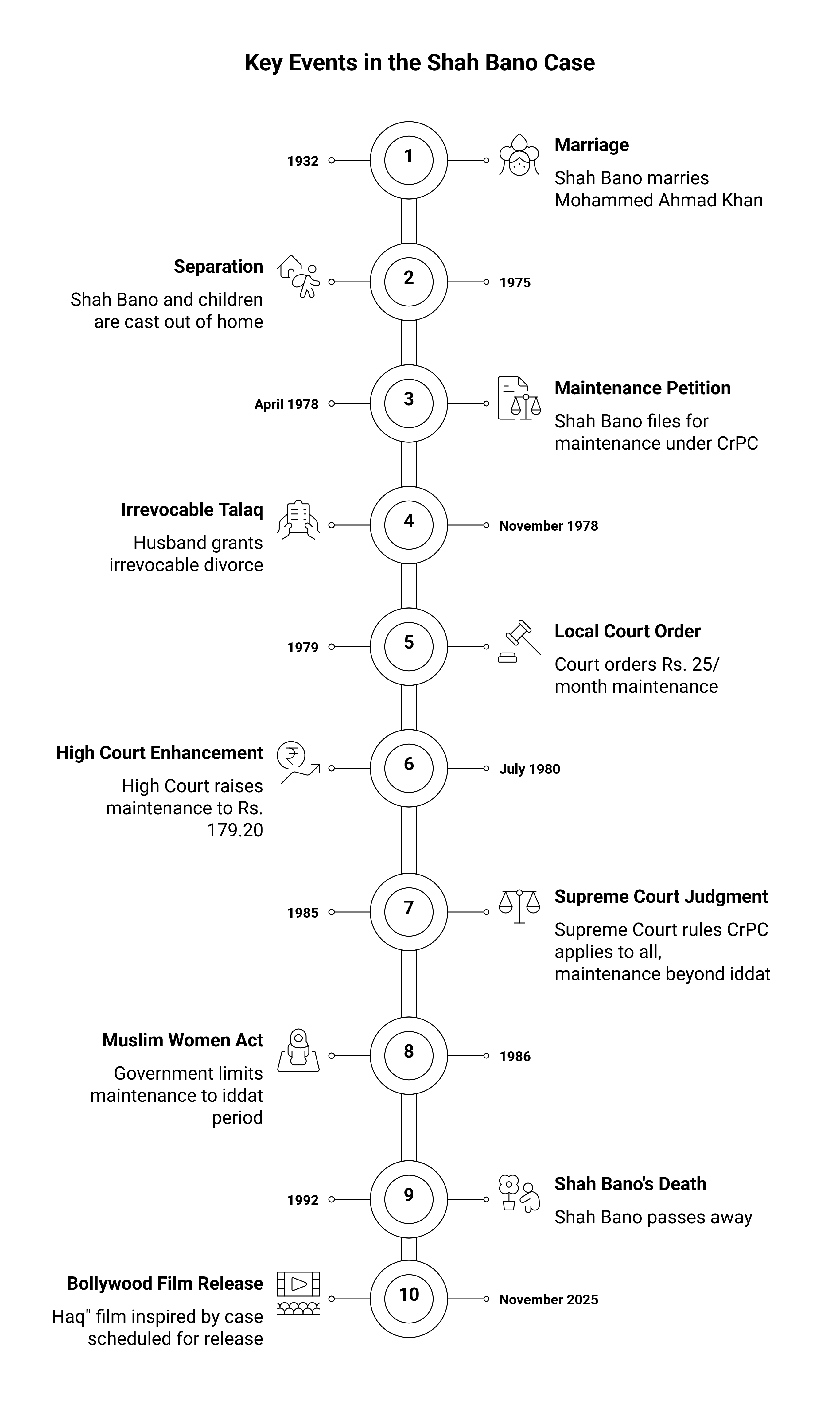
  • Recalling the landmark Shah Bano Case

    Why in the News?

    The upcoming Bollywood film revisits the historic Shah Bano case (1985), one of India’s most politically charged legal battles.

    Recalling the landmark Shah Bano Case

    Background of the Case:

    • Origin: In 1978, Shah Bano Begum, a 62-year-old Muslim woman from Indore, was divorced by her husband, Mohammad Ahmad Khan, a lawyer, via triple talaq after 43 years of marriage.
    • Legal Action: She filed for maintenance under Section 125 of the CrPC (1973), a secular law ensuring financial support for dependents unable to maintain themselves.
    • Husband’s Argument: Claimed that under Muslim personal law, his obligation ended after the iddat period (~3 months) and that payment of mahr (dower) fulfilled his duty.
    • Lower Court Ruling: Ordered payment of ₹25/month; the Madhya Pradesh High Court raised it to ₹179.20. Khan appealed to the Supreme Court, triggering the landmark 1985 judgment.

    Supreme Court Verdict of April 23, 1985:

    • Bench & Ruling: A five-judge Constitution Bench led by CJI Y.V. Chandrachud dismissed the appeal, upholding the High Court’s decision.
    • Secular Applicability: Held that Section 125 CrPC applies to all religions, as its purpose is to prevent destitution, not to regulate personal law.
    • Maintenance Beyond Iddat: Affirmed that a divorced Muslim woman is entitled to maintenance beyond the iddat period if she cannot sustain herself.
    • Religious Harmony: Cited Quranic verses to show consistency between Islamic principles and maintenance under secular law.
    • Uniform Civil Code (UCC): Expressed concern that Article 44 remained a “dead letter,” urging steps toward a common civil code.

    Muslim Women (Protection of Rights on Divorce) Act, 1986:

    • Enactment: Passed after protests from Muslim organisations and AIMPLB, reversing the Shah Bano ruling.
    • Key Provision: Limited husband’s liability to maintenance during iddat, shifting later responsibility to relatives or Waqf Boards.
    • Judicial Interpretation:
      • Danial Latifi v. Union of India (2001) – Upheld the Act but read it progressively, requiring lump-sum payment within iddat for lifetime support.
      • Mohd. Abdul Samad v. State of Telangana (2024) – Reaffirmed that Muslim women may still claim relief under Section 125 CrPC, preserving the choice of remedy.

    Legacy and Significance:

    • Landmark Impact: Became a watershed case in India’s struggle between gender justice and religious identity.
    • Political Consequence: The 1986 Act was seen as appeasement politics, deepening the secularism debates.
    • Reform Catalyst: Revived the UCC discourse, influenced feminist legal reform, and reinforced constitutional morality.
    • Enduring Symbol: Continues to shape discussions on minority rights, women’s empowerment, and judicial activism in India’s plural legal framework.
    [UPSC 2020] Customs and traditions suppress reason, leading to obscurantism. Do you agree?


  • [27th October 2025] The Hindu Op-ed: The contours of constitutional morality

    PYQ Relevance

    [UPSC 2021] Constitutional Morality’ is rooted in the Constitution itself and is founded on its essential facets. Explain the doctrine of ‘Constitutional Morality’ with the help of relevant judicial decisions.

    Linkage: This topic is highly significant for UPSC Mains, especially in GS Paper II (Polity & Governance) and GS Paper IV (Ethics), as it tests the understanding of how ethical governance aligns with constitutional principles.

    Mentor’s Comment

    Constitutional morality lies at the heart of India’s democratic ethos, acting as the invisible moral compass that guides law, governance, and justice. The article, written by Justice K. Anand Venkatesh, explores how morality is embedded within constitutional functioning. It is not embedded as a sentimental ideal, but as a living principle that upholds the dignity of institutions and individuals alike. In a time when popular morality often clashes with constitutional values, this debate assumes renewed urgency.

    Introduction

    The Supreme Court of India has repeatedly reaffirmed the link between law and morality, from P. Rathinam v. Union of India (1994) to the Indian Young Lawyers Association v. State of Kerala (2018). The concept of constitutional morality, originally discussed by Greek historian George Grote in 1846, has resurfaced as a vital restraint against arbitrary governance and populist impulses. It demands adherence to constitutional values, equality, liberty, justice, and fraternity, by all organs of the State and its citizens.

    Why in the News

    Recent judicial pronouncements have revived debates around constitutional morality as a guiding force for both lawmakers and administrators. Justice Venkatesh’s commentary highlights that democracy without moral discipline risks degenerating into majoritarian rule, where transient popular sentiments override fundamental rights. The renewed emphasis on cultivating constitutional morality reflects India’s struggle to reconcile ethical governance with political pragmatism.

    Evolution and Context of Constitutional Morality

    1. Historical Roots: Greek historian George Grote coined “constitutional morality” to describe citizens’ disciplined adherence to constitutional norms ensuring liberty and restraint in governance.
    2. Indian Adoption: The term entered Indian discourse through Dr. B.R. Ambedkar, who viewed it as essential for the successful working of democracy in a diverse society.
    3. Judicial Recognition: The Supreme Court acknowledged the interlinkage of law and morality in P. Rathinam (1994). It emphasized the law’s moral purpose , “to conserve not only the safety and order but also the moral welfare of the State.”
    4. Hart-Devlin Debate: In the 1960s, the famous Hart-Devlin debate discussed whether the law should enforce moral standards. This is an idea that continues to influence Indian jurisprudence.

    What Distinguishes Constitutional Morality from Popular Morality

    1. Constitutional Morality: Reflects adherence to constitutional principles such as rule of law, equality before law, and institutional propriety.
    2. Popular Morality: Represents transient societal opinions or majoritarian values, often inconsistent with constitutional ethics.
    3. Judicial Balancing: Courts have often upheld constitutional morality against majoritarian pressures, as seen in Navtej Singh Johar v. Union of India (2018), where decriminalization of homosexuality was justified on constitutional grounds rather than social acceptance.
    4. Outcome: Promotes stability, fairness, and inclusivity in democratic functioning.

    Judicial Approach and Key Judgments

    1. S.R. Bommai v. Union of India (1994): Reinforced secularism as a constitutional principle forming part of basic structure.
    2. Kesavananda Bharati v. State of Kerala (1973): Introduced the “basic structure doctrine,” embedding constitutional morality as a restraint on legislative excess.
    3. Indian Young Lawyers Association v. State of Kerala (2018): Stressed that constitutional morality must prevail over religious or social morality, allowing women’s entry into Sabarimala Temple.
    4. Navtej Singh Johar (2018): Affirmed that constitutional morality demands protection of individual autonomy and dignity, even if social morality disagrees.
    5. State (NCT of Delhi) v. Union of India (2018): Asserted that constitutional functionaries must act within “constitutional morality,” not political expediency.

    Challenges in Practising Constitutional Morality

    1. Institutional Erosion: Weakening of legislative debate and executive accountability dilutes constitutional culture.
    2. Majoritarian Pressures: Electoral populism often overrides institutional restraint and judicial independence.
    3. Moral Ambiguity: Absence of a codified moral code makes enforcement of constitutional morality subjective.
    4. Public Awareness: Limited civic understanding of constitutional ethics hampers its internalization at citizen level.

    Way Forward

    1. Cultivation of Ethical Citizenship: Strengthens democratic maturity through civic education and moral training.
    2. Institutional Accountability: Ensures public functionaries act within constitutional boundaries through transparent checks.
    3. Judicial Vigilance: Maintains the moral compass of the State through continued emphasis on rights-based interpretation.
    4. Political Restraint: Encourages lawmakers to prioritize constitutional conscience over populist demand.

    Conclusion

    Constitutional morality ensures that democracy functions not merely through elections but through adherence to constitutional ethics. It provides a moral foundation for governance, ensuring that justice, liberty, equality, and fraternity are lived realities, not abstract ideals. In an era of polarization, it acts as the Republic’s moral compass, binding the State and its citizens to the spirit of the Constitution.

  • Gorkhaland statehood, Government names ex-DY NSA as interlocutor

    Introduction

    India’s federal architecture is unique: it allows the creation of new states to accommodate cultural, linguistic, administrative, or developmental aspirations under Article 3 of the Constitution. Yet, every statehood movement also reflects deeper struggles over identity, representation, and development.

    The Gorkhaland issue, revived by the Centre’s recent move to appoint an interlocutor, is one of the oldest and most persistent among these. While it directly concerns the Darjeeling hills and adjoining areas of West Bengal, it mirrors similar aspirations voiced across India, from Vidarbha to Bodoland, Harit Pradesh, and Kukiland.

    The Gorkhaland Appointment: Why is this news significant?

    The Centre’s decision to name ex-Dy NSA Pankaj Kumar Singh as interlocutor for Gorkha talks is a politically charged step:

    1. First formal engagement in years: It revives official talks after a long hiatus, moving beyond ad hoc arrangements like the Gorkhaland Territorial Administration (GTA).
    2. High-level signalling: The appointment of a senior security expert signals that the government sees the issue as sensitive, with implications for internal security and electoral politics.
    3. Identity at stake: It concerns recognition of the Gorkha community’s distinct identity, and a permanent political solution to decades of protests and autonomy struggles.
    4. Pre-election dimension: With West Bengal Assembly elections approaching, the move is seen as an attempt to politically engage the hill electorate, which has historically swung between national and regional parties.
    5. Potential precedent: Success in structured dialogue may offer a model for addressing other regional aspirations through negotiation instead of agitation.

    Understanding the Gorkhaland Issue

    Historical Context

    1. Origins: The demand for Gorkhaland dates back to 1907, when the Hillmen’s Association first sought a separate administrative unit for the Nepali-speaking people of Darjeeling under British rule.
    2. Post-Independence Phase: With linguistic reorganisation (1950s), Nepali-speaking Gorkhas felt their identity was inadequately represented in Bengali-dominated West Bengal.
    3. 1980s Uprising: The movement, led by Subhash Ghising’s Gorkha National Liberation Front (GNLF), turned violent; it led to the creation of the Darjeeling Gorkha Hill Council (DGHC) in 1988 as a compromise.
    4. Second Wave: In 2007, Bimal Gurung formed the Gorkha Janmukti Morcha (GJM), renewing the demand; this led to the Gorkhaland Territorial Administration (GTA) in 2011, but unrest persisted.
    5. Present Phase: The latest talks under an interlocutor aim to find a “permanent political solution” and recognition of 11 sub-tribes as Scheduled Tribes.

    Key Demands

    1. Separate Gorkhaland State: Carved out of Darjeeling and parts of Kalimpong, to ensure administrative autonomy and cultural recognition.
    2. Scheduled Tribe Status: For 11 Gorkha sub-tribes to ensure constitutional protections and socio-economic inclusion.
    3. Constitutional Recognition: Safeguards for the political identity and rights of the Gorkha people under the Indian Constitution.

    Statehood Demands in India: The Bigger Picture

    India has witnessed over 30 major statehood demands since Independence. While the Constitution empowers Parliament to reorganize states under Article 3, these movements have tested the balance between administrative efficiency, cultural autonomy, and political representation.

    Why Do Statehood Demands Arise?

    • Cultural & Linguistic Identity:
        1. Key reason: Desire for recognition of unique language, ethnicity, or cultural practices.
        2. Examples: Gorkhaland (Nepali-speaking identity), Bodoland (Bodo tribes), Vidarbha (Marathi dialect and identity).
    • Developmental Disparities:
        1. Economic neglect and poor resource distribution often drive demands.
        2. Example: Telangana’s movement was anchored in perceived neglect by Andhra’s political elite.
    • Administrative Efficiency:
        1. Smaller states are believed to ensure better governance and resource management.
        2. Example: Creation of Chhattisgarh and Uttarakhand in 2000.
    • Political Representation & Power-sharing:
        1. Regional elites demand greater political space or autonomy to reflect local aspirations.
    • Ethnic Security and Integration:
      1. Fear of cultural assimilation or discrimination by dominant groups drives ethnic-based mobilisation (e.g., Bodoland, Kukiland, Karbi Anglong).
    Year Movement Outcome
    1953 Andhra State (Potti Sriramulu movement) First linguistic state formed
    1960 Maharashtra & Gujarat Bombay Reorganisation Act
    1972 Meghalaya, Manipur, Tripura New northeastern states created
    1987 Mizoram & Arunachal Pradesh Granted full statehood
    2000 Chhattisgarh, Jharkhand, Uttarakhand Created for administrative and developmental reasons
    2014 Telangana Result of sustained agitation
    Ongoing Gorkhaland, Bodoland, Vidarbha, Bundelkhand Unresolved, periodic agitations

    Constitutional Mechanism for Creating New States

    Article 3 empowers Parliament to form new states by altering the boundaries or names of existing ones.

    Procedure:

    1. Process: Bill introduced in Parliament → Referred to State Legislature for views (not consent) Passed by simple majority.
    2. Centre’s Discretion: State opinion is advisory, not binding — ensuring national flexibility but sometimes triggering discontent.
    3. Examples:
      • Telangana was created despite Andhra Pradesh’s legislature opposing it.
      • Jharkhand was carved out of Bihar through a parliamentary process.

    Challenges and Implications of Statehood Movements

    1. Political Fragmentation: Multiplying small states may weaken national coherence and increase Centre-State friction.
    2. Administrative Burden: Creating new bureaucratic structures increases fiscal costs.
    3. Resource Distribution Issues: Conflicts over rivers, minerals, and forest resources (e.g., Telangana-Andhra).
    4. Ethnic Competition: One community’s recognition can fuel new demands from others.
    5. Positive Outcomes: Improved local governance, targeted development, and better representation when well-implemented (e.g., Chhattisgarh’s success in rural health and PDS).

    Lessons from Gorkhaland and Other Movements

    1. Need for Institutional Dialogue: Interlocutors and commissions reduce the risk of violent agitation by creating formal channels for negotiation.
    2. Multi-stakeholder Approach: Engagement should include Centre, State, local bodies, and civil society, not just political parties.
    3. Development-Based Solutions: Autonomy and identity must align with socio-economic development for long-term peace.
    4. Model for Others: If successful, the Gorkhaland dialogue could serve as a precedent for resolving other autonomy demands peacefully.

    Conclusion

    The Gorkhaland issue is not merely a regional agitation; it is part of India’s broader story of balancing unity with diversity, integration with autonomy, and identity with development. The Centre’s interlocutor initiative provides a constitutional, consultative path forward, one that aligns with India’s ethos of resolving internal aspirations democratically.

    As India continues to evolve, the challenge will be to ensure that new demands for statehood or autonomy are addressed through dialogue, data, and development, not through division or delay.

    PYQ Relevance

    [UPSC 2013] Creation of a large number of smaller States would bring in effective governance at the State level. Discuss.

    Linkage: This PYQ links directly with Gorkhaland and other statehood demands, testing ideas of better governance and federal balance. The article helps students with examples, chronology, and constitutional context to write precise GS II answers.
  • 20 years of Right to Information (RTI)

    Why in the News?

    RTI activists across India marked 20 years since the Right to Information Act, 2005, came into effect.

    About the Right to Information (RTI) Act, 2005:

    • Overview: Passed by Parliament in 2005, replacing the Freedom of Information Act, 2002.
    • Objective: Empower citizens to access information freely from public authorities to promote openness and good governance.
    • Scope: Applicable to Central, State, and Local Governments, public sector undertakings, and statutory bodies.
    • Key Provision: Under Section 22, the RTI Act overrides all other laws that may restrict access to information.
    • Constitutional Basis:
      • It is derived from Article 19(1)(a), the Right to Freedom of Speech and Expression.
      • The Supreme Court has recognized access to information as implicit in freedom of expression.
      • Backed by Article 32 and Article 226, citizens can seek redress for violations through the Supreme Court and High Courts.
      • RTI upholds constitutional principles of equality (Article 14) and personal liberty (Article 21) by ensuring informed citizen participation.
    • Timeframe for Response:
      • 30 days in general cases.
      • 48 hours when life or liberty is involved.
    • Exemptions from Disclosure:
      • Section 8(1): Exempts disclosure of information that could compromise sovereignty, national security, strategic or economic interests, or affect foreign relations.
      • Section 8(2): Allows disclosure if public interest outweighs potential harm to protected interests.
      • Proactive Disclosure: Every public authority must digitize records and proactively publish information to minimize formal RTI requests.
    • RTI (Amendment) Act, 2019:
      • The amendment removed fixed tenure (5 years) and salary parity with Election Commissioners.
      • It vested powers in the Central Government to determine terms of service, tenure, and allowances for CIC and ICs.
      • This was viewed as reducing the institutional autonomy of the RTI framework, raising concerns among transparency advocates.

    Institutional Framework:

    1. Central Information Commission (CIC)

    • Composition: Chief Information Commissioner (CIC) + up to 10 Information Commissioners (ICs).
    • Appointment: By the President on recommendation of a committee comprising the Prime Minister (Chairperson), Leader of Opposition (Lok Sabha), and a Union Cabinet Minister.
    • Tenure: As prescribed by the Central Government or until 65 years of age, whichever is earlier.
    • Functions:
      • Inquire into complaints and appeals under RTI.
      • Exercise civil court powers for summoning witnesses or documents.
      • Conduct suo motu inquiries in cases of systemic non-compliance.
    1. State Information Commissions (SICs)

    • Composition: State Chief Information Commissioner + up to 10 Information Commissioners.
    • Appointment: By the Governor, based on recommendations from a committee chaired by the Chief Minister, along with the Leader of Opposition and a Cabinet Minister.
    • Qualifications: Persons of eminence in public life, not affiliated with political parties or profit-making roles.
    • Functions: Parallel to CIC at the state level, ensuring local compliance with RTI obligations.
    [UPSC 2019] There is a view that the Officials Secrets Act is an obstacle to the implementation of RTI Act. Do you agree with the view? Discuss.

    [UPSC 2018] The Right to Information Act is not all about citizens’ empowerment alone, it essentially redefines the concept of accountability.” Discuss.


  • SC exempts pre-2022 Surrogacy Cases from Age Restrictions

    Why in the News?

    The Supreme Court has ruled that age limits prescribed under the Surrogacy (Regulation) Act, 2021 do not apply retrospectively to couples who had frozen their embryos and initiated the surrogacy process before January 25, 2022, the date when the law came into effect.

    Case Background:

    • Petitions: Filed by three couples who had undergone IVF and frozen embryos before Jan 25, 2022, when the Surrogacy Act came into effect.
    • Issue: They became ineligible under Section 4(iii)(c)(I) (age limits: women 23–50, men 26–55).
    • Argument: Since embryos were created pre-2022, the process was already initiated and could not be retrospectively invalidated.
    • Court’s View: Recognised embryo freezing as a lawful start to surrogacy; held that new age restrictions cannot retroactively disqualify such couples.

    Supreme Court’s Observations and Constitutional Findings:

    • No Retrospective Disqualification: The age restrictions introduced by the 2021 law cannot apply retrospectively to cases where medical procedures had already begun.
    • Equality in Conception Modes: Justice Nagarathna emphasised that couples conceiving through assisted reproductive technologies (ART) must enjoy the same constitutional protection as those conceiving naturally.
    • Article 21 & Reproductive Autonomy: The Court reaffirmed that the right to reproductive choice including IVF, ART, or surrogacy, forms part of personal liberty and privacy under Article 21.
    • Article 14 & Equality Before Law: Retrospective age-based exclusion was termed arbitrary and unreasonable, amounting to a violation of equality.
    • Parenting Competence Argument Rejected: The Court rejected the notion that older parents are inherently less capable, stating that state authorities cannot retrospectively judge parenting ability once medical procedures have been initiated lawfully.
    • Non-Retroactivity Principle: Reinforced the rule that unless a statute explicitly states otherwise, it operates prospectively.
    • Precedent Applied: Relied on Suchita Srivastava v. Chandigarh Administration (2009), where the Court recognised reproductive autonomy and bodily integrity as constitutionally protected rights.

    Back2Basics: Surrogacy (Regulation) Act, 2021

    • Objective: To regulate surrogacy, prevent commercial exploitation, and ensure ethical, altruistic surrogacy based solely on medical necessity.
    • Legislative Intent: To promote ethical medical practices, protect the rights of surrogate mothers and children, and curb commercialisation while respecting constitutional morality and reproductive dignity.
    • Applicability: Extends to all surrogacy cases involving Indian citizens and permanent residents, and works alongside the Assisted Reproductive Technology (Regulation) Act, 2021.
    • Key Provisions:
      • Type Permitted: Only altruistic surrogacy (no payment except medical expenses).
      • Eligibility for Couples: Married for at least five years; woman 23–50 yrs, man 26–55 yrs; no living biological, adopted, or surrogate child.
      • Single Women: Only widows or divorcees (35–45 yrs) are eligible; unmarried women excluded (under legal challenge).
      • Surrogate Requirements: Must be a close relative, married, with at least one biological child; age 25–35 years.
      • Certification: Requires Certificate of Essentiality, infertility proof, parentage order, and insurance for the surrogate.
      • Penalties: Commercial surrogacy banned; violation punishable by up to 10 years’ imprisonment and ₹10 lakh fine.
      • Regulatory Bodies: Establishment of National and State Surrogacy Boards for implementation and oversight.

    Issues Highlighted by the Supreme Court:

    • Absence of Transitional Provisions: The 2021 Act lacks a “grandfather clause” protecting couples already in process before its commencement.
    • Inconsistent Standards: The Court questioned why adoption laws have no upper age limit, while surrogacy does, creating unequal treatment among parents.
    • Gender Discrimination: Restricting surrogacy access to only married couples and excluding unmarried women was flagged as a potential Article 14 violation.
    • Fundamental Rights Impact: Retrospective restrictions infringe upon the right to equality and reproductive freedom under Articles 14 and 21.
    • State Overreach: The Court cautioned that the state’s intent to protect child welfare cannot override individual liberty or invalidate rights exercised under prior legal norms.

    Significance of the Judgment:

    • Reinforcement of Reproductive Rights: Confirms that assisted reproduction and surrogacy fall within the ambit of reproductive autonomy and personal liberty.
    • Protection Against Legal Injustice: Shields couples who initiated lawful medical procedures from retrospective disqualification.
    • Constitutional Precedent: Establishes that statutory changes cannot nullify pre-existing lawful rights, strengthening India’s jurisprudence on non-retroactivity.
    • Judicial Balance: Maintains a balance between ethical regulation of surrogacy and protection of individual autonomy.
    • Wider Applicability: Permits similarly placed couples to seek relief before respective High Courts, widening the ruling’s scope.
    • Affirmation of Constitutional Morality: The Court underscored that justice, equity, and good conscience must guide interpretation where legislation creates unintended inequities.
    [UPSC 2024] Under which of the following Articles of the Constitution of India, has the Supreme Court of India placed the Right to Privacy?

    (a) Article 15 (b) Article 16 (c) Article 19 (d) Article 21*