Mains Ready By December. Smash Mains & Smash PYQ Admissions Open

GS Paper: GS2-01.Indian Constitution-Historical underpinnings & evolution; Features, amendments, significant provisions, basic structure of Constitution

  • Not an unfettered right

    Context

    The UN High Commissioner for Human Rights filed an application seeking to intervene as amicus curiae in the pending litigation in the Supreme Court against the Citizenship (Amendment) Act, 2019.

    What are the implications of intervention?

    • Concern over international attention: That the case has attracted the attention of the international human rights agency is a matter of concern for the Indian government.
    • International law principles: The intervention may enable the Supreme Court to read in public international law principles in determining the constitutionality of CAA.
    • Law on concepts of sovereignty: Ultimately, this would assist in laying down the law on concepts of sovereignty in addition to determining the obligations of a nation-state to the international community at large.

    Why the intervention matters?

    • Basis of the application: The application is based on the belief that the High Commissioner’s intervention will provide the Court “with an overview of the international human rights norms and standards with respect to the state’s obligations to provide international protection to persons at risk of persecution in their countries of origin”.
    • This application stands out for a number of reasons.
    • First, this is a voluntary application rather than at the invitation of the Supreme Court.
    • Second, she accepts that India is a state party and signatory to various international conventions including the International Covenant on Civil and Political Rights and the International Covenant on Economic, Social and Culture Rights which contain important non-discrimination clauses, including on the ground of religion.
    • India’s obligations towards migrants: India is obliged, under international law, to ensure that migrants in its territory or under its jurisdiction receive equal and non-discriminatory treatment regardless of their legal status or the documentations they possess.
    • Locus standi issue raised by India: In response, the External Affairs Ministry argued that “no foreign party has any locus standi on issues pertaining to India’s sovereignty”.
    • The High Commissioner has filed similar amicus curiae briefs on issues of pubic importance before a range of international and national judicial fora.
    • A precedent for future: This intervention, if permitted, would serve as a precedent for a number of future applications. It would also provide an opportunity for the Supreme Court to lay down the law on whether such applications interfere with national sovereignty.

    Sovereignty as responsibility

    • Defining sovereignty: International Court of Justice judge James Crawford defines sovereignty as, among other things, the “capacity to exercise, to the exclusion of other states, state functions on or related to that territory, and includes the capacity to make binding commitments under international law” and states that “such sovereignty is exercisable by the governmental institutions established within the state”.
    • Sovereignty in Indian Constitution: The Preamble to the Constitution lays out the position, wherein the people of India have resolved to constitute the Indian Republic into a sovereign and not just any one authority.
    • As such, the courts (judiciary), the government (executive) and elected legislatures (legislature) are equally sovereign authorities.
    • No one can claim exclusivity over sovereignty. Furthermore, Article 51 (c) of the Constitution directs the state to “foster respect for international law”.

    Responsibility to citizens and the international community

    • Responsibility of political authority: According to the International Commission on Intervention and State Sovereignty, “national political authorities are responsible to the citizens internally and to the international community through the UN”.
    • Constraints on sovereignty: Therefore, it is trite to say that an authority’s right to sovereignty is not unfettered. It is subject to constraints including the responsibility to protect its citizenry and the larger international community.
    • Extending Article 14: Furthermore, Article 14 extends the right to equality to all persons, which is wider than the definition of citizens. Even illegal immigrants shall, consequently, be treated by the government in a manner that ensures equal protection of Indian laws.

    Conclusion

    It is hoped that the Supreme Court will conclude that the intervention is necessary as the Court would benefit from the High Commissioner’s expertise in public international law principles.

  • Right of an accused to be defended


    Recently the Karnataka High Court observed that it is unethical and illegal for lawyers to pass resolutions against representing accused in court.  This is not the first time that bar associations have passed such resolutions, despite a Supreme Court ruling that these are “against all norms of the Constitution, the statute and professional ethics”.

    What does the Constitution say about the right of an accused to be defended?

    • Article 22(1) gives the fundamental right to every person not to be denied the right to be defended by a legal practitioner of his or her choice.
    • Article 14 provides for equality before the law and equal protection of the laws within the territory of India.
    • Article 39A, part of the DPSP, states that equal opportunity to secure justice must not be denied to any citizen by reason of economic or other disabilities, and provides for free legal aid.

    What has the Supreme Court said about such resolutions by bar associations?

    • The Supreme Court referred to writer Thomas Paine, who had been tried for treason in England in 1792.
    • Thomas Erskine, Attorney General for the Prince of Wales, was warned of dismissal if he defended Paine, but still took up the brief, saying: “… If the advocate refuses to defend from what he may think of the charge or of the defence, he assumes the character of the Judge…”
    • The Supreme Court cited other historical examples of accused being defended — revolutionaries against British rule; alleged assailants of Mahatma Gandhi and Indira Gandhi; Nazi war criminals at the Nuremberg trials.

    A matter of professional ethics

    • The Supreme Court ruled that such resolutions are wholly illegal, against all traditions of the bar and against professional ethics.
    • Every person however wicked, criminal, perverted or repulsive he may be regarded by society has a right to be defended in a court of law and correspondingly and it is the duty of the lawyer to defend him.
    • It said such resolutions were against all norms of the Constitution, the statute and professional ethics, called these a disgrace to the legal community, and declared them null and void.

    How are the professional ethics of lawyers defined?

    • The Bar Council of India has Rules on Professional Standards, part of the Standards of Professional Conduct and Etiquette to be followed by lawyers under the Advocates Act.
    • An advocate is bound to accept any brief in the courts or tribunals, at a fee consistent with his standing at the Bar and the nature of the case.
    • The Rules provide for a lawyer refusing to accept a particular brief in “special circumstances”.
    • Last year, The Uttarakhand HC clarified that these special circumstances refer to an individual advocate who may choose not to appear in a particular case, but who cannot be prohibited from defending an accused by any threat of removal of his membership of the bar association.
  • Freedom in the World 2020


    India has become one of the world’s least free democracies, according to a global survey.

    Freedom in the World Report

    • It is a yearly survey and report by the U.S. based non-governmental organization Freedom House.
    • It measures the degree of civil liberties and political rights in every nation and significant related and disputed territories around the world.
    • The report derives its methodology from the Universal Declaration of Human Rights, adopted by the UN General Assembly in 1948.
    • It covers 195 countries, awarding scores based on political rights indicators such as the electoral process, political pluralism and participation and government functioning, as well as civil liberties indicators related to freedom of expression and belief associational and organisational rights, the rule of law and personal autonomy and individual rights.

    Highlights of the report


    Deteriorating freedom in India

    • The report ranks India at the 83rd position, along with Timor-Leste and Senegal.
    • This is near the bottom of the pile among the countries categorised as “Free”.
    • India’s score fell by four points to 71, the worst decline among the world’s 25 largest democracies this year.
    • India scored 34 out of 40 points in the political rights category, but only 37 out of 60 in the civil liberties category, for a total score of 71, a drop from last year’s score of 75.
    • The report treats “Indian Kashmir” as a separate territory, which saw its total score drop precipitously from 49 to 28 this year, moving it from a status of “Partly Free” to “Not Free”.

    Reason for the downfall

    • The annulment of autonomy and the subsequent shutdown of Kashmir, the NRC and the CAA, as well as the crackdown on mass protests, have been listed as the main signs of declining freedom in the report.
    • These three actions have shaken the rule of law in India and threatened the secular and inclusive nature of its political system said the report.
    • The report slammed the internet blackout in Kashmir terming it the longest shutdown ever imposed by democracy.
    • It said freedom of expression was under threat in India, with journalists, academics and others facing harassment and intimidation when addressing politically sensitive topics.
    • It warned that the Indian government’s alarming departures from democratic norms under present govt. could blur the values-based distinction between Beijing and New Delhi.
  • Defining Anti-national Activities

    Ever since the anti-CAA protests erupted across the country, the MHA has been quite active in filtering out foreigners among the protesters and serving them with ‘Leave India’ notices’.

    What contributes to ‘Anti-government’ activities?

    • According to visa guidelines laid out by the MHA, Foreign nationals shall be required to strictly adhere to the purpose of visit declared while submitting the visa application.
    • However, a foreign national (other than a Pakistani national) coming to India on any type of visa will be allowed to avail activities permitted under tourist visa.
    • However, there are no provisions specified under “anti-government” activities subhead.
    • The absence of any such provision in visa laws or Foreigner’s Act makes it necessary for the government to define “anti-government” activities under a statute.
    • Visa laws are not in any derogation with any other law, so inferences can be drawn — which means a court can rule that whatever are defined as “anti-government” activities for Indian national is “anti-government” for foreign national too.”

    What do ‘anti-government’ activities mean for an Indian national?

    • According to the lawyers, anti-government activities are those which are listed as punishable under Section 124A (sedition) of the Indian Penal Code.
    • Section 124A IPC deals with attempts to bring into hatred or contempt, or excites or attempts to excite disaffection towards, the Government established by law in India.
    • Such offences shall be punished with imprisonment for life, to which a fine may be added; or, with imprisonment which may extend to three years, to which a fine may be added; or, with fine.

    Does a foreigner on Indian visa have a right to protest?

    • Right to protest peacefully is enshrined under Article 19(1)(a) of Indian Constitution which guarantees the freedom of speech and expression.
    • Article (19)(b) guarantees the citizens of the country the right to assemble peacefully and without arms.
    • Since Article 14 of the Constitution ensures equality to any person before the law or the equal protection of the laws within the territory of India, foreigners also have the right to protest peacefully, argue proponents.
    • However, the act done by the foreigner must not be anything in contravention to the existing laws of India.
    • Being a part of a peaceful protest isn’t illegal and thus, being a part of it isn’t anything wrong even if that is against the Indian government, critic says.
  • Rights, duties and the Constitution

    Context

    At an International Judicial Conference 2020 this weekend, the Chief Justice of India, S.A. Bobde, drew attention to the Constitution’s Fundamental Duties chapter.

    The logic of duties

    • Wide range of duties: The first thing to note is that as citizens, there exists a wide range of duties that bind us in everyday life.
      • Duties towards the state and individual: These duties are owed both to the state and to other individuals.
    • Legal duties: We have a legal duty to pay our taxes, to refrain from committing violence against our fellow-citizens, and to follow other laws that Parliament has enacted.
      • Breach of these legal duties triggers financial consequences (fines), or even time in jail.
    • Following the duties is price for living in the society: At any given time, therefore, we are already following a host of duties, which guide and constrain how we may behave.
      • This is the price that must be paid for living in society, and it is a price that nobody, at least, in principle, objects to paying.
    • Self-contained whole: Our duties and the consequences we bear for failing to keep them, therefore, exist as a self-contained whole.
      • Co-existence and sacrifice: The peaceful co-existence requires a degree of self-sacrifice, and that if necessary, this must be enforced through the set of sanctions.

    The logic of rights

    • Understanding the logic through history: Rights, on the other hand, follow a different logic entirely. This is a logic that is best understood through history.
      • Two concerns: At the time of the framing of the Indian Constitution and its chapter on Fundamental Rights, there were two important concerns animating the Constituent Assembly.
      • Treatment as subjects: The first was that under the colonial regime, Indians had been treated as subjects.
      • Their interests did not count, their voices were unheard, and in some cases — for example, the “Criminal Tribes”- they were treated as less than human.
      • Holocaust example: Apart from the long and brutal history of colonialism, the framers also had before them the recent example of the Holocaust, where the dignity of more than six million people had been stripped before their eventual genocide.
    • The first role of fundamental rights chapter: To stand as a bulwark against dehumanisation.
      • Dignity and equality guaranteed: Every human being no matter who they were or what they did had a claim to basic dignity and equality that no state could take away, no matter what the provocation.
      • Unconditional right: One did not have to successfully perform any duty, or meet a threshold of worthiness, to qualify as a rights bearer. It was simply what it meant to be human.
    • Second role of the fundamental rights: To stand against the hierarchy.
      • Removing the subordination and degradation: The axes of gender, caste and religion had all served to keep masses of individuals in permanent conditions of subordination and degradation.
      • Equalising and democratising: Through guarantees against-
      • Forced labour.
      • Against “untouchability”.
      • Against discriminatory access to public spaces, and others.
      • Fundamental rights were meant to play an equalising and democratising role throughout society, and to protect individuals against the depredations visited on them by their fellow human beings.
    • Significance of the above two roles
      • Transformative purpose: The twin principles of anti-dehumanisation and anti-hierarchy reveal the transformative purpose of the fundamental rights chapter.
      • The recognition that true democracy could not exist without ensuring that at a basic level, the dignity and equality of individuals were protected, both from the state as well as from social majorities.
      • Rise from subject to citizen: It was only with these guarantees could an individual rise from the status of subject to that of the citizen.
      • And, as should be clear by now, it was only after that transformation had been wrought, that the question of duties could even arise.
    • Importance of the language of the duty:
      • The language of duties can play an important role in a society that continues to be divided and unequal.
      • In such a society, those who possess or benefit from entrenched structural and institutional power (starting with the state, and going downwards) certainly have a “duty” not to use that power to the detriment of those upon whom they wield it.
      • That is precisely what the guarantees against “untouchability”, forced labour, and discriminatory access in the Constitution seek to accomplish.

    Issue of conflating duties and rights

    • The problem lies in the conflation of rights and duties.
    • In that context, it is always critical to remember Dr B.R. Ambedkar’s words in the Constituent Assembly (which were also cited by the CJI in his speech): that the fundamental unit of the Constitution remains the individual.
    • If the position of the individual and the Constitution’s commitment to combating hierarchy is kept in mind, then the language of duties can be understood in its proper context.
    • Chances of duties leading to unpleasant consequences: Without the moral compass of rights and their place in the transformative Constitutional scheme the language of duties can lead to unpleasant consequences.
      • It can end up entrenching existing power structures by placing the burden of “duties” upon those that are already vulnerable and marginalised.
    • The constitution is about rights: It is for this reason that, at the end of the day, the Constitution, a charter of liberation, is fundamentally about rights.

    Conclusion

    It is only after guarantee to all the full sum of humanity, dignity, equality, and freedom promised by the Constitution, that we can ask of them to do their duty. Perhaps, then, it is time to update Hind Swaraj for the constitutional age: “real duties are the result of the fulfilment of rights”.

  • System Risk Indicator (SyRI)

    • In a first anywhere in the world, a court in the Netherlands recently stopped a digital identification scheme for reasons of exclusion.
    • This has a context for similar artificial intelligence (AI) systems worldwide, especially at a time when identity, citizenship and privacy are pertinent questions in India.

    SyRI

    • Last week, a Dutch district court ruled against an identification mechanism called SyRI (System Risk Indicator), because of data privacy and human rights concerns.
    • It held SyRI was too invasive and violative of the privacy guarantees given by European Human Rights Law as well as the EU’s General Data Protection Regulation.
    • The Dutch Ministry of Social Affairs developed SyRI in 2014 to weed out those who are most likely to commit fraud and receive government benefits.
    • Legislation passed by Dutch Parliament allowed government agencies to share 17 categories of data about welfare recipients such as taxes, land registries, employment records, and vehicle registrations with a private company.
    • The company used an algorithm to analyse data for four cities and calculate risk scores.

    What were the arguments in court?

    • After taking into account community concerns, civil society groups and NGOs launched a legal attack on this case of algorithmic governance.
    • Legal criticism mounted, alleging that the algorithm would begin associating poverty and immigrant statuses with fraud risk.
    • The Dutch government defended the programme in court, saying it prevented abuse and acted as only a starting point for further investigation instead of a final determination.
    • The government also refused to disclose all information about how the system makes its decisions, stating that it would allow gaming of the system.
    • The court found that opaque algorithmic decision-making puts citizens at a disadvantage to challenge the resulting risk scores.
    • The Netherlands continuously ranks high on democracy indices.

    How relevant is this for India?

    • Similar to the Supreme Court’s Aadhaar judgment setting limits on the ID’s usage, the Hague Court attempted to balance social interest with personal privacy.
    • However, the Aadhaar judgment was not regarding algorithmic decision-making; it was about data collection.
    • The ruling is also an example of how a data protection regulation can be used against government surveillance.
    • India’s pending data protection regulation, being analysed by a Joint Select Committee in Parliament, would give broad exemptions to government data processing in its current form.
    • India’s proposed regulation is similar to the US in the loopholes that could be potentially exploited.
  • Ninth Schedule of the Indian Constitution

    A parliamentarian has said in an interview that reservation should be put under the Ninth Schedule of the Constitution.  His comments came days after the Supreme Court ruled that reservation in the matter of promotions in public posts was not a fundamental right and that a state cannot be compelled to offer quota if it chooses not to.

    What is the Ninth Schedule?

    • The Ninth Schedule contains a list of central and state laws which cannot be challenged in courts.
    • Currently, 284 such laws are shielded from judicial review.
    • The Schedule became a part of the Constitution in 1951, when the document was amended for the first time.
    • It was created by the new Article 31B, which along with 31A was brought in by the government to protect laws related to agrarian reform and for abolishing the Zamindari system.
    • While most of the laws protected under the Schedule concern agriculture/land issues, the list includes other subjects, such as reservation.
    • A Tamil Nadu law that provides 69 per cent reservation in the state is part of the Schedule.

    Article 31A and 31 B

    • While Article 31A extends protection to ‘classes’ of laws, A. 31B shields specific laws or enactments.
    • Article 31B also has retrospective operation: meaning if laws are inserted in the Ninth Schedule after they are declared unconstitutional, they are considered to have been in the Schedule since their commencement, and thus valid.
    • Although Article 31B excludes judicial review, the apex court has said in the past that even laws under the Ninth Schedule would be open to scrutiny if they violated fundamental rights or the basic structure of the Constitution.
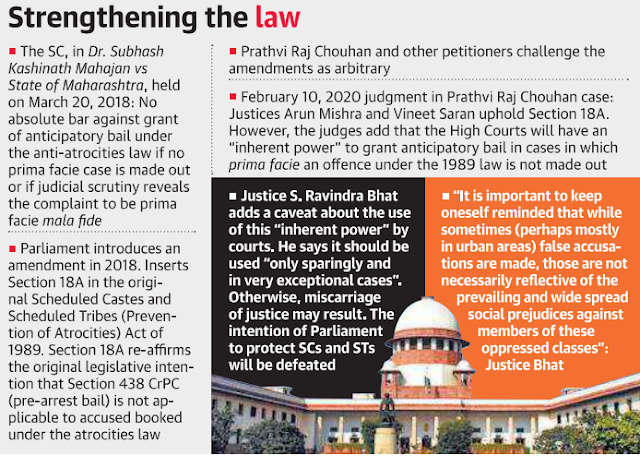
  • SC uphold changes in SC/ST Atrocities Law


    The Supreme Court has upheld the SCs/STs (Prevention of Atrocities) Amendment Act of 2018, which nullified it’s own controversial March 20, 2018 judgement.  Earlier judgment had diluted the original 1989 legislation, saying they were using its provisions to file false criminal complaints against innocent persons.

    Why such ruling?

    • The 2018 Act had nullified a March 20 judgment of the Supreme Court, which allowed anticipatory bail to those booked for committing atrocities against Scheduled Castes and Scheduled Tribes members.
    • The original 1989 Act bars anticipatory bail.
    • The Supreme Court verdict saw a huge backlash across the country. Several died in ensuing protests and property worth crores of rupees was destroyed.
    • The government reacted by filing a review petition in the Supreme Court and subsequently amended the 1989 Act back into its original form.
    • The government had enacted the Amendments, saying the SCs and STs continued to face the same social stigma, poverty and humiliation which they had been subjected to for centuries.

    Why was the SC/ST Act enacted?

    • Since crimes against SCs and STs are fundamentally hate crimes, the Rajiv Gandhi enacted the Act in 1989.
    • It gave furtherance to the provisions for abolition of untouchability (Article 17) and equality (Articles 14, 15).

    Why it was amended?

    • The Bench reasoned that human failing and not caste is the reason behind the lodging of false criminal complaints.
    • The Supreme Court condemned its own earlier judgment, saying it was against “basic human dignity” to treat all SC/ST community members as “a liar or crook.”
    • Caste of a person cannot be a cause for lodging a false report, the verdict observed.
    • Members of the SCs and STs, due to backwardness, cannot even muster the courage to lodge an FIR, much less, a false one, the judgment noted.

    The Subhash Kashinath Mahajan case

    • Mahajan was Director of Technical Education in Maharashtra.
    • Two non-SC officers had made an adverse entry on the character and integrity of a Dalit employee, whom Mahajan in 2011 denied sanction for prosecution against those officers.
    • The denial was challenged on the ground that the state government and not the director was the competent authority.
    • The apex Court held that safeguards against blackmail are necessary as by way of rampant misuse, complaints are largely being filed against public servants with oblique motive for the satisfaction of vested interests.

    In what manner had the 2018 judgment diluted provisions for arrest?

    ANTICIPATORY BAIL

    • In section 18 of the Act, Parliament had laid down that the provision of anticipatory bail under Section 438 of the CrPC of 1973 will not be available to an accused under the Act.
    • The provision of anticipatory bail was introduced for the first time on the recommendation of 41st Law Commission in 1973.
    • It is a statutory right, not part of the right to life and personal liberty under Article 21 of the Constitution, and thus there is no fundamental right to anticipatory bail.
    • In the 2018 judgment, the Court laid down safeguards, including provisions for anticipatory bail and a “preliminary enquiry” before registering a case under the Act.
    • While review the Bench said Section 18 was enacted to instil a sense of deterrence and relied on Kartar Singh (1994) in which the court had held that denial of anticipatory bail does not violate Article 21.

    FIR

    • The court had observed that “liberty of one cannot be sacrificed to protect another”, and the “Atrocities Act cannot be converted into charter for exploitation or oppression by unscrupulous persons or by police for extraneous reasons”.
    • He ordered that neither is an FIR to be immediately registered nor are arrests to be made without a preliminary inquiry by an SSP.
    • An arrest can only be made if there is “credible” information and police officer has “reason to believe” that an offence was committed.
    • In the review judgment, Justice Mishra said public servants already have a remedy in false cases under CrPC Section 482 and can get such FIRs quashed by High Courts.
    • He rejected the need of an SSP’s approval for arrest.

    PERMISSION

    • In 2018, the court had said that even if a preliminary inquiry is held and a case registered, arrest is not necessary, and that no public servant is to be arrested without the written permission of the appointing authority.
    • The court extended the benefit to other citizens and said they cannot be arrested without the written permission of the SSP of the district.
    • In review the court said that the decision on arrest is to be taken by the investigating authority, not the appointing authority.

    Were other provisions diluted?

    • The court had observed that interpretation of Atrocities Act should promote constitutional values of fraternity and integration of the society.
    • This may require ‘check on false implication of innocent citizens on caste lines’.
    • Observing that the law should not result in caste hatred, the court overlooked the fact that the Act had to be enacted due to caste hatred.
    • The review judgment said that such riders for registering a report are wrong and it would give an advantage to upper castes whose complaints can be registered without any such inquiry.

    How frequently do SCs/STs face atrocities?

    • A crime is committed against an SC every 15 minutes. Six SC women are raped every day on an average.
    • Between 2007 and 2017, there was a 66 per cent growth in crimes against SCs.
    • Data from the National Crime Record Bureau, which the 2018 judgment was based on, showed cases of rape of SC women had doubled in 10 years.

    Assist this newscard with:

    [Burning Issue] SC/ST Prevention of Atrocities Act

  • Private Members Bill

    A member in Rajya Sabha appeared to abandon his plan of introducing a private member’s Bill on the Uniform Civil Code (UCC), a code that would be applicable to all religious communities in personal matters such as marriage, divorce, inheritance and adoption.

    Private Member’s Bill

    • A private member’s Bill is different from a government Bill and is piloted by an MP who is not a minister. An MP who is not a minister is a private member.
    • Individual MPs may introduce private member’s Bill to draw the government’s attention to what they might see as issues requiring legislative intervention.

    Difference between private and government Bills

    • While both private members and ministers take part in the lawmaking process, Bills introduced by private members are referred to as private member’s Bills and those introduced by ministers are called government Bills.
    • Government Bills are backed by the government and also reflect its legislative agenda.
    • The admissibility of a Private Bill is decided by the Chairman in the case of the Rajya Sabha and the Speaker in the case of the Lok Sabha.
    • Before the Bill can be listed for introduction, the Member must give at least a month’s notice, for the House Secretariat to examine it for compliance with constitutional provisions and rules on legislation.
    • While a government Bill can be introduced and discussed on any day, a private member’s bill can only be introduced and discussed on Fridays.

    Has a private member’s bill ever become a law?

    • No private member’s Bill has been passed by Parliament since 1970.
    • To date, Parliament has passed 14 such Bills, six of them in 1956.
    • In the 14th Lok Sabha, of the over 300 private member’s Bills introduced, roughly four per cent were discussed, the remaining 96 per cent lapsed without a single dialogue.
    • The selection of Bills for discussion is done through a ballot.
  • Explained: Uniform Civil Code — the debate, the status

    Last week, while hearing a matter relating to properties of a Goan, the Supreme Court described Goa as a “shining example” with a Uniform Civil Code, observed that the founders of the Constitution had “hoped and expected” a UCC for India but there has been no attempt at framing one.

    What is a Uniform Civil Code?

    • A UCC is one that would provide for one law for the entire country, applicable to all religious communities in their personal matters such as marriage, divorce, inheritance, adoption etc.
    • Article 44 of the Constitution lays down that the state shall endeavour to secure a UCC for the citizens throughout the territory of India.
    • Article 44 is one of the directive principles. These, as defined in Article 37, are not justiciable (not enforceable by any court) but the principles laid down therein are fundamental in governance.
    • Fundamental rights are enforceable in a court of law. While Article 44 uses the words “state shall endeavour”, other Articles in the ‘Directive Principles’ chapter use words such as “in particular strive”; “shall in particular direct its policy”; “shall be obligation of the state” etc.
    • Article 43 mentions “state shall endeavour by suitable legislation” while the phrase “by suitable legislation” is absent in Article 44.
    • All this implies that the duty of the state is greater in other directive principles than in Article 44.

    What are more important — fundamental rights or directive principles?

    • There is no doubt that fundamental rights are more important.
    • The Supreme Court held in Minerva Mills (1980): “Indian Constitution is founded on the bed-rock of the balance between Parts III (Fundamental Rights) and IV (Directive Principles).
    • To give absolute primacy to one over the other is to disturb the harmony of the Constitution”.
    • Article 31C inserted by the 42nd Amendment in 1976, however, lays down that if a law is made to implement any directive principle, it cannot be challenged on the ground of being violative of the fundamental rights under Articles 14 and 19.

    Does India not already have a uniform code in civil matters?

    • Indian laws do follow a uniform code in most civil matters – Indian Contract Act, Civil Procedure Code, Sale of Goods Act, Transfer of Property Act, Partnership Act, Evidence Act etc.
    • States, however, have made hundreds of amendments and therefore in certain matters, there is diversity even under these secular civil laws.
    • Recently, several states refused to be governed by the uniform Motor Vehicles Act, 2019.
    • If the framers of the Constitution had intended to have a Uniform Civil Code, they would have given exclusive jurisdiction to Parliament in respect of personal laws, by including this subject in the Union List.
    • But “personal laws” are mentioned in the Concurrent List. Last year, the Law Commission concluded that a Uniform Civil Code is neither feasible nor desirable.

    Is there one common personal law for any religious community governing all its members?

    • All Hindus of the country are not governed by one law, nor are all Muslims or all Christians.
    • Not only British legal traditions, even those of the Portuguese and the French remain operative in some parts.
    • In Jammu and Kashmir until August 5, 2019, local Hindu law statutes differed from central enactments.
    • The Shariat Act of 1937 was extended to J&K a few years ago but has now been repealed.
    • Muslims of Kashmir were thus governed by a customary law, which in many ways was at variance with Muslim Personal Law in the rest of the country and was, in fact, closer to Hindu law.
    • Even on registration of marriage among Muslims, laws differ from place to place. It was compulsory in J&K (1981 Act), and is optional in Bengal, Bihar (both under 1876 Act), Assam (1935 Act) and Odisha (1949 Act).
    • In the Northeast, there are more than 200 tribes with their own varied customary laws.
    • The Constitution itself protects local customs in Nagaland. Similar protections are enjoyed by Meghalaya and Mizoram. Even reformed Hindu law, in spite of codification, protects customary practices.

    How does the idea of a UCC relate to the fundamental right to religion?

    • Article 25 lays down an individual’s fundamental right to religion; Article 26(b) upholds the right of each religious denomination or any section thereof to “manage its own affairs in matters of religion”; Article 29 defines the right to conserve distinctive culture.
    • An individual’s freedom of religion under Article 25 is subject to “public order, health, morality” and other provisions relating to fundamental rights, but a group’s freedom under Article 26 has not been subjected to other fundamental rights
    • In the Constituent Assembly, there was division on the issue of putting Uniform Civil Code in the fundamental rights chapter.
    • The matter was settled by a vote. By a 5:4 majority, the fundamental rights sub-committee headed by Sardar Patel held that the provision was outside the scope of fundamental rights and therefore the UCC was made less important than freedom of religion.

    What was the view of Muslim members in the Constituent Assembly?

    • Some members sought to immunise Muslim Personal Law from state regulation.
    • Mohammed Ismail, who thrice tried unsuccessfully to get Muslim Personal Law exempted from Article 44, said a secular state should not interfere with the personal law of people.
    • B Pocker Saheb said he had received representations against a common civil code from various organisations, including Hindu organisations.
    • Hussain Imam questioned whether there could ever be uniformity of personal laws in a diverse country like India.
    • B R Ambedkar said “no government can use its provisions in a way that would force the Muslims to revolt”.
    • Alladi Krishnaswami, who was in favour of a Uniform Civil Code, conceded that it would be unwise to enact Uniform Civil Code ignoring strong opposition from any community.
    • Gender justice was not mentioned in these debates.

    How did the debate on a common code for Hindus play out?

    • In June 1948, Rajendra Prasad, President of the Constituent Assembly, warned Jawaharlal Nehru that to introduce “basic changes” in personal law was to impose “progressive ideas” of a “microscopic minority” on the Hindu community as a whole.
    • Others opposed to reforms in Hindu law included Sardar Patel, Pattabhi Sitaramayya, M A Ayyangar, M M Malaviya and Kailash Nath Katju.
    • When the debate on the Hindu Code Bill took place in December 1949, 23 of 28 speakers opposed it.
    • On September 15, 1951, President Prasad threatened to use his powers of returning the Bill to Parliament or vetoing it.
    • Ambedkar eventually had to resign. Nehru agreed to trifurcation of the Code into separate Acts and diluted several provisions.