Mains Ready By December. Smash Mains & Smash PYQ Admissions Open

GS Paper: GS2-01.Indian Constitution-Historical underpinnings & evolution; Features, amendments, significant provisions, basic structure of Constitution

  • Right to Walk on Footpaths Declared a Fundamental Right

    Why in the news?

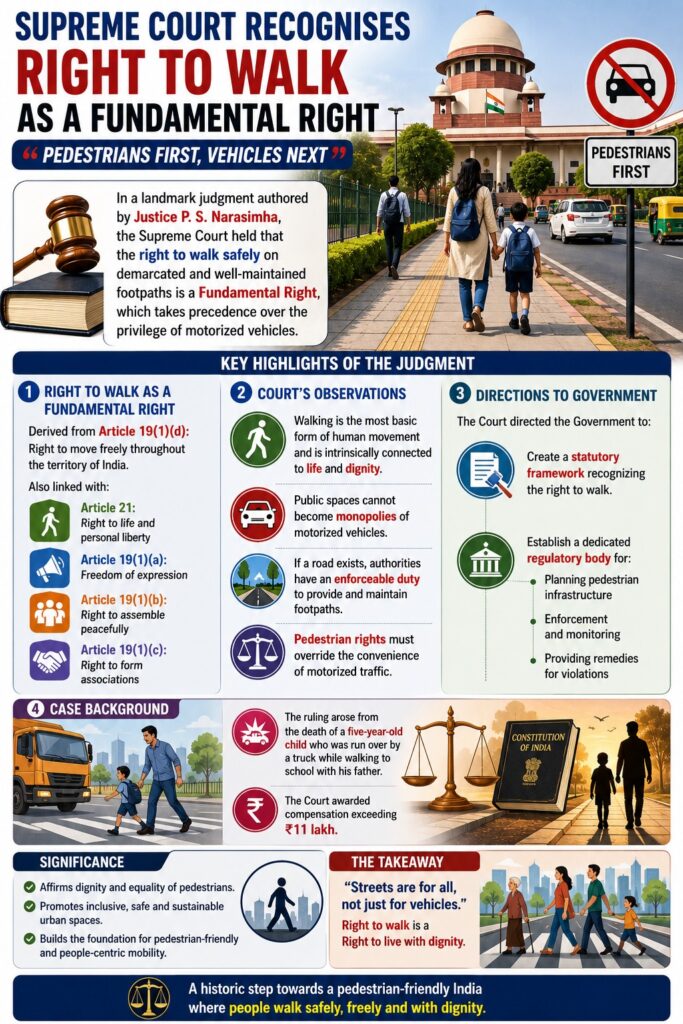
    The Supreme Court, in a landmark judgment authored by Justice P. S. Narasimha, held that the right to walk safely on demarcated and well-maintained footpaths is a Fundamental Right, which takes precedence over the privilege of motorized vehicles.

    Right to Walk as a Fundamental Right

    • Derived from Article 19(1)(d): Right to move freely throughout the territory of India.
    • Also linked with:
      • Article 21: Right to life and personal liberty.
      • Article 19(1)(a): Freedom of expression.
      • Article 19(1)(b): Right to assemble peacefully.
      • Article 19(1)(c): Right to form associations.

    Court’s Observations

    • Walking is the most basic form of human movement and is intrinsically connected to life and dignity.
    • Public spaces cannot become monopolies of motorized vehicles.
    • If a road exists, authorities have an enforceable duty to provide and maintain footpaths.
    • Pedestrian rights must override the convenience of motorized traffic.

    Directions to Government

    • Create a statutory framework recognizing the right to walk.
    • Establish a dedicated regulatory body for:
      • Planning pedestrian infrastructure.
      • Enforcement and monitoring.
      • Providing remedies for violations.
    • Judgment sent to Ministries of:
      • Housing & Urban Affairs
      • Rural Development
      • Road Transport & Highways

    Case Background

    • The ruling arose from the death of a five-year-old child who was run over by a truck while walking to school with his father.
    • The Court awarded compensation exceeding ₹11 lakh.

    [2018] Right to Privacy is protected as an intrinsic part of Right to Life and Personal Liberty. Which of the following in the Constitution of India correctly and appropriately imply the above statement?

    (a) Article 14 and the provisions under the 42nd Amendment to the Constitution.

    (b) Article 17 and the Directive Principles of State Policy in Part IV.

    (c) Article 21 and the freedoms guaranteed in Part III.

    (d) Article 24 and the provisions under the 44th Amendment to the Constitution.

  • [16th June 2026] The Hindu OpED: Peace with peace: On preventive detentions

    Mentor’s Comment

    The Allahabad High Court’s ruling in Chander Pal Singh v. State of Uttar Pradesh has revived debate on the misuse of preventive detention and preventive proceedings in India. The judgment is significant because it directly questions the routine use of extraordinary executive powers against citizens without substantive criminal charges.

    Why has the Allahabad High Court judgment become a significant intervention in preventive detention jurisprudence?

    The Allahabad High Court, in Chander Pal Singh, criticized the routine misuse of preventive proceedings by police and executive magistrates in Uttar Pradesh. The Court observed that powers intended to prevent threats to public order were being employed to detain individuals without substantive criminal charges, resulting in unjustified deprivation of personal liberty. The judgment seeks to strengthen accountability mechanisms and reaffirm constitutional safeguards against arbitrary state action.

    1. Judicial Intervention: The Court simultaneously addressed an individual case and a broader systemic problem involving preventive proceedings.
    2. Liberty Concerns: The judgment described the situation as a “highly irresponsible” deprivation of personal liberty.
    3. Structural Reform: It proposed guidelines to regulate preventive powers and strengthen accountability.
    4. Constitutional Significance: It re-emphasized Article 21 protections against arbitrary deprivation of liberty.
    5. First Major Pushback: The ruling attempts to impose personal accountability on officials responsible for unlawful detention, a relatively rare judicial approach.

    How are preventive powers intended to function and how are they allegedly being misused?

    1. Preventive Purpose: Preventive powers allow the State to intervene before a crime occurs when there is reasonable apprehension of threat to public order.
    2. Exceptional Nature: Such powers are intended for extraordinary situations involving potential disturbances.
    3. Routine Application: The Court observed that authorities increasingly employ these powers as routine administrative tools.
    4. Absence of Criminal Charges: Individuals are often detained without substantive criminal accusations.
    5. Minor Disputes: Authorities reportedly invoke preventive proceedings even in neighbourhood and property disputes.
    6. Executive Overreach: Police officers and executive magistrates allegedly use preventive provisions based on weak or speculative apprehensions.

    What constitutional principles are involved in the debate on preventive detention?

    1. Article 21: Ensures protection of life and personal liberty except according to procedure established by law.
    2. Article 22: Provides safeguards against arbitrary arrest and detention while permitting preventive detention under specific circumstances.
    3. Rule of Law: Requires legality, reasonableness and non-arbitrariness in state action.
    4. Natural Justice: Supports fair hearing and procedural safeguards.
    5. Proportionality: Restricts excessive state action beyond legitimate objectives.
    6. Constitutional Morality: Balances public order with civil liberties and democratic dissent.

    What facts in the Chander Pal Singh case exposed systemic concerns?

    1. Petitioner: Chander Pal Singh, a physically challenged Dalit advocate.
    2. Immediate Cause: He was arrested following a petty dispute with a neighbour.
    3. Illustration of Misuse: The Court treated the case as representative of broader misuse of preventive powers.
    4. Administrative Pattern: The judgment highlighted recurring executive reliance on preventive incarceration rather than ordinary criminal procedures.

    How serious is the scale of preventive proceedings highlighted by the Court?

    1. Magnitude: Around 2,500 individuals were reportedly subjected to preventive detention proceedings in Ghaziabad between May 2025 and April 2026.
    2. Policy Failure: These actions occurred despite a 2021 State policy intended to guide and regulate such powers.
    3. Systemic Nature: The data indicates that misuse is not isolated but institutional in scale.
    4. Governance Challenge: The figures suggest preventive provisions may have become a substitute for regular legal processes.

    What reforms and safeguards did the Court seek to introduce?

    1. Executive Justification: Requires executive magistrates to justify preventive detention decisions.
    2. Constitutional Review: Encourages constitutional challenges against unlawful detention.
    3. Appellate Scrutiny: Promotes higher judicial review of compensation mechanisms.
    4. Compensation Framework: Strengthens remedies available to victims of unlawful detention.
    5. Administrative Accountability: Enables recovery of compensation from salaries of responsible magistrates and/or police officers after disciplinary proceedings.
    6. Deterrence Effect: Seeks to discourage arbitrary use of preventive powers.

    How could the ruling affect protest-related and dissent-related detentions?

    1. Communal Tension Claims: The Court criticized reliance on vague references to “communal tensions” to justify incarceration.
    2. Bond Requirements: It questioned the practice of imposing prohibitively expensive bonds for release.
    3. Protection of Dissent: The judgment rejects the notion that maintaining peace can justify silencing dissent.
    4. Sonam Wangchuk Context: Though not directly related to his detention under the NSA, the ruling implicitly critiques similar uses of preventive powers against activists.
    5. Recent Detentions: The principles may apply to persons detained under Sections 126 and 170 of the BNSS without valid grounds.
    6. Democratic Significance: Reinforces that public order cannot become a blanket justification for restricting civil liberties.

    What challenges may hinder implementation of the Court’s directions?

    1. Administrative Reluctance: Governments have historically been hesitant to penalize officials for misuse of authority.
    2. Institutional Incentives: Executive magistrates are part of the State administration and often operate within bureaucratic hierarchies.
    3. Career Pressures: Officials may prioritize maintaining “peace” as defined by the State.
    4. Weak Enforcement: Accountability provisions may remain ineffective without sustained judicial monitoring.
    5. Structural Dependence: The executive and law enforcement apparatus often function in close coordination, reducing internal checks.

    Value Addition

    How does the Constitution regulate preventive detention under Article 22?

    1. Constitutional Architecture: Balances state security concerns with minimum procedural safeguards for personal liberty.
    2. Constitutional Recognition: Article 22(3)-22(7) explicitly permits preventive detention while prescribing safeguards against arbitrary exercise of power.
    3. Exceptional Nature: Preventive detention operates outside ordinary criminal justice procedures because detention occurs based on anticipated threats rather than proven offences.

    Suspension of Standard Criminal Procedure Rights

    1. Exemption from Article 22(1) and 22(2): Preventive detainees do not enjoy certain protections available to ordinary arrestees.
    2. Grounds of Arrest: Authorities are not required to provide immediate disclosure in the same manner as ordinary criminal arrests.
    3. Legal Representation: Detainees do not possess an absolute right to consult a lawyer of their choice at the detention stage.
    4. Magisterial Production: Requirement of production before a magistrate within 24 hours does not apply to preventive detention cases.

    Procedural Safeguards Retained by Detainees

    1. Communication of Grounds: Article 22(5) requires authorities to communicate grounds of detention as soon as possible.
    2. Representation against Detention: Authorities must provide the earliest opportunity to challenge the detention order through representation.
    3. Natural Justice Principle: Ensures minimum procedural fairness despite the exceptional nature of detention.

    State Privilege of Non-Disclosure

    1. Public Interest Exception: Article 22(6) permits withholding information whose disclosure is considered against public interest.
    2. Security Consideration: Protects sensitive intelligence and security-related inputs underlying detention decisions.

    What is the significance of the Advisory Board mechanism under Article 22?

    Advisory Board Review: Provides independent scrutiny of executive detention orders.

    1. Three-Month Limit: Article 22(4) prohibits detention beyond three months unless reviewed by an Advisory Board.
    2. Independent Assessment: Board examines whether sufficient cause exists for continued detention.
    3. Check on Executive Power: Prevents indefinite detention solely on executive discretion.

    Composition of the Advisory Board

    1. Judicial Qualification: Members must be persons who are, have been, or are qualified to be appointed as High Court Judges.
    2. Institutional Safeguard: Introduces legal expertise into preventive detention review.

    Which legislature has the authority to enact preventive detention laws?

    1. Legislative Competence: Divides law-making powers between Parliament and State Legislatures under the Seventh Schedule.

    Exclusive Parliamentary Jurisdiction (Union List – Entry 9)

    1. Defence of India: Parliament alone can legislate on preventive detention related to national defence.
    2. Foreign Affairs: Parliament exclusively regulates detention linked to international relations.
    3. Security of India: National security-related detention laws fall solely within Union competence.

    Concurrent Jurisdiction (Concurrent List – Entry 3)

    1. Security of the State: Both Parliament and State Legislatures may enact laws.
    2. Public Order: Legislatures can provide preventive detention mechanisms to address threats to public order.
    3. Essential Supplies and Services: Laws may prevent activities disrupting critical community supplies and services.

    Which major preventive detention laws operate in India today?

    1. National Security Act (NSA), 1980
      1. National Security: Authorizes detention to prevent activities prejudicial to India’s security.
      2. Public Order: Permits detention for maintaining public order.
      3. Executive Authority: Empowers both Central and State Governments.
    2. Unlawful Activities (Prevention) Act (UAPA), 1967
      1. Counter-Terrorism Framework: Addresses terrorism and unlawful activities.
      2. Stringent Bail Provisions: Restricts bail, resulting in prolonged incarceration during investigation.
      3. Preventive Effect: Functions similarly to preventive detention in certain cases.
    3. Prevention of Blackmarketing and Maintenance of Supplies of Essential Commodities Act, 1980
      1. Economic Security: Prevents activities affecting availability of essential commodities.
      2. Supply Chain Protection: Ensures uninterrupted access to essential goods.
    4. State-Specific Preventive Detention Laws
      1. Public Safety Act (PSA): Operates in Jammu & Kashmir for security-related concerns.
      2. Goonda Acts: Various states use these laws against habitual offenders and perceived threat actors.
      3. Localized Framework: Addresses region-specific law and order challenges.

    What powers does Parliament possess under Article 22(7)?

    Parliamentary Oversight: Determines the outer limits of preventive detention laws.

    1. Maximum Detention Period: Prescribes the maximum duration of detention under specific laws.
    2. Extended Detention Categories: Defines circumstances where detention beyond three months may occur without Advisory Board review.
    3. Advisory Board Procedure: Establishes procedural rules governing Board inquiries and review mechanisms.

    How has the judiciary evolved safeguards against misuse of preventive detention?

    1. Procedural Rigidity: Ensures strict compliance with constitutional safeguards
    2. Technical Compliance: Courts routinely invalidate detention orders for procedural violations.
    3. Delay in Representation: Unreasonable delay in considering detainee representations can render detention unconstitutional.
    4. Burden on State: Authorities must strictly adhere to statutory requirements.

    Subjective Satisfaction Doctrine

    1. Credible Material: Executive authorities must rely on relevant and credible evidence.
    2. Genuine Threat Assessment: Detention must be based on actual apprehension of future harm.
    3. Protection against Arbitrariness: Courts reject detention based on vague suspicions or unsupported allegations.

    Proximity Principle

    1. Live Link Requirement: Past conduct must have a direct and continuing connection with the present threat.
    2. Stale Incidents Insufficient: Old criminal records alone cannot justify fresh detention orders.
    3. Future-Oriented Assessment: Preventive detention must address imminent risks rather than punish past actions.

    Conclusion

    Preventive detention may be constitutionally permissible, but its legitimacy depends on strict procedural safeguards and judicial oversight. The Allahabad High Court’s intervention reiterates that public order cannot come at the cost of personal liberty, and that accountability is essential to preserving the rule of law.

  • Why is Nicobar debating elections

    Why in the News?

    The Andaman and Nicobar Administration has released the Andaman and Nicobar Islands Tribal Councils (Preparation of Electoral Rolls and Conduct of Elections) Rules, 2026, proposing formal elections for Nicobarese Village Councils and Tribal Councils. This is a major development because, for the first time, the administration seeks to replace a predominantly consensus-based indigenous governance model with a structured electoral system involving constituencies, electoral rolls, nominations, withdrawals, reserved seats for women, and fixed election procedures. 

    How does the traditional Nicobarese governance system function?

    The Nicobarese community inhabiting the Nicobar Islands has historically governed itself through Village Councils and Tribal Councils rooted in customary traditions. While the Andaman and Nicobar Islands (Protection of Aboriginal Tribes) Regulation, 1956 (ANPATR) and the Nicobar Islands Tribal Council (Regulation), 2009 provided statutory recognition to these institutions, leadership selection largely continued through consensus and community consultations.

    1. Recent Institutional Evolution: While village captaincy has existed for generations, the Tribal Council emerged only in the 1990s primarily to facilitate coordination with government development programmes and poverty alleviation initiatives.
    2. Village-Centred Governance: Ensures local administration through village-based institutions that have historically managed social, economic, and community affairs.
    3. Tribal Council Structure: Provides island-level coordination through representatives drawn from various villages across the Nicobar group of islands.
    4. Tuhet System: Traditional Nicobarese society is organised around extended kinship groups called Tuhets, which historically served as the foundation of social organisation and leadership selection.
    5. Community Representation: Village Captains emerged as intermediaries between Tuhet-based communities and external administrative authorities.
    6. Customary Leadership: Ensures community legitimacy through socially recognised leadership rather than formal electoral competition.
    7. First Captain Institution: Functions as the principal village leader and acts as the primary interface between the community and administration.
    8. Collective Decision-Making: Facilitates consensus-based governance through village meetings and consultations rather than majoritarian voting.
    9. Administrative Linkage: Supports implementation of government schemes through tribal institutions, making them an important bridge between communities and the district administration.

    How are leaders currently selected in Nicobar?

    1. Consensus-Based Selection: Ensures community acceptance through public consultations and collective agreement.
    2. Village Meetings: Facilitates leadership identification through open participation of community members.
    3. Captain System: Provides leadership through Village Captains headed by a First Captain in each village.
    4. Community Legitimacy: Strengthens trust as leaders derive authority from customary acceptance rather than electoral competition.
    5. Tribal Council Chairperson Selection: Traditionally occurs through consensus among representatives rather than a formal electoral contest.
    6. Social Leadership Model: Treats leaders as custodians of community welfare rather than political representatives.

    What changes do the 2026 Draft Rules propose?

    1. Statutory Basis: The draft rules derive authority from the Nicobar Islands Tribal Council Regulation, 2009, which formally recognised Tribal Councils and Village Councils while preserving significant customary practices.
    2. First Electoral Framework: The 2026 Draft Rules represent the first detailed attempt to operationalise elections under the 2009 Regulation.
    3. Formal Elections: Introduces structured elections for Village Councils and Tribal Councils.
    4. Electoral Rolls: Establishes official voter lists for conducting elections.
    5. Constituency Delimitation: Creates constituency-based representation for council elections.
    6. Nomination Procedures: Prescribes rules for filing, scrutiny, withdrawal and conduct of elections.
    7. Reserved Representation: Introduces reservation of seats and leadership positions for women.
    8. Five-Year Tenure: Establishes a fixed electoral cycle for councils.
    9. Codified Governance: Replaces informal customary procedures with legally prescribed electoral mechanisms.
    10. Administrative Oversight: Expands the role of formal administrative structures in local governance processes.

    Why are tribal councils opposing the proposed electoral model?

    1. Erosion of Customary Governance: Weakens traditional decision-making systems embedded within Nicobarese society.
    2. Administrative Override Powers: The 2009 Regulation already permits district authorities to veto council decisions deemed injurious to public interest, creating concerns about excessive administrative influence over tribal institutions.
    3. Loss of Consensus Culture: Replaces collective agreement with competitive electoral politics.
    4. Institutional Transformation: Converts social leadership positions into formal political offices.
    5. Reduced Community Control: Increases bureaucratic influence over local governance structures.
    6. Threat to Indigenous Identity: Alters institutions that have evolved alongside Nicobarese cultural traditions.
    7. Development Project Concerns: Some tribal leaders fear the proposed governance restructuring could weaken community resistance to major projects such as the ₹81,000-crore Great Nicobar development initiative, including the transshipment port and associated infrastructure.
    8. Consultation Deficit: Raises concerns regarding insufficient community engagement before introducing major institutional reforms.

    How have tribal institutions evolved historically?

    1. Colonial Origins of Captaincy: Emerged during British rule when colonial administrators sought village representatives for communication and administration.
    2. Clan-Based Foundations: Developed within the traditional social structure organised around extended family groups.
    3. Institutional Adaptation: Combined customary norms with evolving administrative requirements over time.
    4. Tribal Council Formation: Expanded in the 1990s to facilitate interactions with government agencies and development programmes.
    5. Statutory Recognition: Received legal backing through the 2009 Nicobar Islands Tribal Council Regulation.

    What constitutional and governance issues does the debate raise?

    1. Tribal Self-Governance: Examines the extent of autonomy available to indigenous communities.
    2. Democratic Representation: Evaluates whether formal elections improve accountability and participation.
    3. Customary Institutions: Questions how traditional governance systems should coexist with modern democratic frameworks.
    4. State Intervention: Assesses limits of administrative involvement in indigenous governance structures.
    5. Inclusive Representation: Considers the potential benefits of women’s reservation and wider political participation.
    6. Cultural Preservation: Balances democratic reforms with protection of tribal traditions.

    Can formal elections strengthen governance in Nicobar?

    Potential Benefits

    1. Transparency: Establishes clear procedures for leadership selection.
    2. Accountability: Enables periodic review of leadership through fixed electoral cycles.
    3. Women’s Representation: Expands participation through reserved positions.
    4. Legal Certainty: Reduces ambiguity regarding authority and tenure.
    5. Administrative Coordination: Facilitates interaction between government institutions and tribal bodies.

    Potential Risks

    1. Political Polarisation: Introduces electoral competition into traditionally consensus-driven societies.
    2. Customary Erosion: Weakens indigenous institutions developed over generations.
    3. Bureaucratisation: Shifts authority from community norms to administrative procedures.
    4. Social Fragmentation: Risks creating factional divisions within small island communities.

    Conclusion

    The proposed electoral reforms in Nicobar are not merely an administrative exercise but a test of India’s approach towards indigenous self-governance. The challenge lies in ensuring that democratic institutionalisation strengthens rather than displaces traditional systems that have historically provided social cohesion and local legitimacy. A consultative and culturally sensitive approach will be essential to harmonise constitutional values with tribal aspirations.

    Value Addition

    UN Declaration on the Rights of Indigenous Peoples (UNDRIP), 2007

    1. Self-Governance Rights: Recognises the right of indigenous communities to maintain and strengthen their distinct political, legal, economic, social and cultural institutions.
    2. Free, Prior and Informed Consent (FPIC): Requires meaningful consultation before decisions affecting indigenous communities are implemented.

    PYQ Relevance

    [UPSC 2013] The PESA Act, 1996 is a landmark legislation for tribal self-governance. Critically examine its implementation and effectiveness.

    Linkage: The PYQ deals directly with tribal autonomy, customary institutions and grassroots self-governance. The Nicobar debate revolves around whether traditional tribal governance systems should continue to function through customary practices or be reshaped through formal electoral mechanisms. The core issue in both cases is the protection of tribal self-rule while ensuring democratic accountability.

  • [22nd May 2026] The Hindu OpED: Ladakh seeks belonging through representation

    PYQ Relevance[UPSC 2024] What changes has the Union Government recently introduced in the domain of Centre-State relations? Suggest measures to be adopted to build the trust between the Centre and the States and for strengthening federalism.Linkage: This PYQ is highly relevant as the Ladakh debate concerns federal balance, democratic representation, and Centre-region relations in a Union Territory framework. The article directly examines tensions between administrative centralisation and political autonomy, making it useful for answers on cooperative and asymmetrical federalism.

    Mentor’s Comment

    Ladakh’s demand for constitutional representation has intensified after the Union Ministry of Home Affairs reportedly argued that additional districts and administrative decentralisation may be more suitable for Ladakh than a legislature or Sixth Schedule protections. The issue is significant because Ladakh occupies a strategically sensitive frontier bordering China and Pakistan. At the same time, it remains without legislative representation after the abrogation of Article 370 and reorganisation of Jammu & Kashmir in 2019. 

    Why Is Ladakh’s Demand for Representation a Major Constitutional Question?

    1. Post-2019 Governance Shift: Ladakh became a Union Territory without a legislative assembly after the reorganisation of Jammu & Kashmir in 2019, creating a governance vacuum in political representation.
    2. Constitutional Demand: Local groups have demanded Sixth Schedule protections, statehood, or legislative mechanisms to safeguard land, employment, culture, and local autonomy.
    3. Democratic Deficit: Governance remains concentrated in bureaucratic institutions despite growing aspirations for elected representation.
    4. Strategic Significance: Ladakh shares sensitive borders with China and Pakistan, making political legitimacy and local trust crucial for national security.
    5. Sharp Institutional Contrast: While the Centre advocates administrative decentralisation through districts, local stakeholders seek constitutional and political decentralisation.

    Can Administrative Decentralisation Substitute Democratic Representation?

    1. Administrative Accessibility: Creation of five new districts, Nubra, Changthang, Sham, Zanskar and Drass, improves access to local administration in geographically difficult terrain.
    2. Harsh Terrain Constraints: Ladakh spans nearly 59,000 sq km, with mountain barriers, harsh winters, and sparsely distributed settlements requiring local accessibility.
    3. Functional Limitation of Districts: District administrations implement policies but cannot legislate on land rights, employment priorities, education, renewable energy governance, or cultural protection.
    4. Political Accountability Gap: A district magistrate remains accountable upward to administrative superiors, whereas legislatures ensure accountability downward to citizens.
    5. Democratic Agency: Administrative convenience cannot replace political voice in a representative democracy.

    Why Is the “Population and Viability” Argument Against Representation in Ladakh Being Questioned?

    The debate centres on whether low population, financial dependence, and difficult geography should limit Ladakh’s political representation. A key argument against a legislature is that Ladakh’s sparse population and dependence on the Centre make elected governance impractical. However, this view is contested because India has historically prioritised political inclusion and strategic integration over population size or economic viability, especially in sensitive border regions where representation strengthens trust and stability.

    1. Democratic Equality Principle: India has not historically linked representation exclusively to population size or economic profitability. Several small or fiscally dependent regions have received legislative institutions to strengthen democratic participation.
    2. Northeast Precedent: Nagaland (1963), Mizoram (1987), and Arunachal Pradesh (1987) received statehood despite sparse populations, difficult terrain, and heavy dependence on central transfers, reinforcing political integration in strategic frontier regions.
    3. Strategic Imperative: Frontier populations contribute to national security through territorial presence, local intelligence, and social resilience. Political inclusion strengthens trust in border areas adjoining adversarial neighbours.
    4. Fiscal Federalism Logic: Redistributive federalism under institutions such as the Finance Commission exists precisely because regions possess unequal economic capacities. Fiscal dependence has not been a constitutional ground for limiting political representation.
    5. Governance versus Representation Distinction: Administrative decentralisation through districts may improve service delivery, but districts cannot legislate on land rights, employment safeguards, resource governance, or cultural protections, which require representative institutions.
    6. Normative Constitutional Concern: The larger question is whether strategically vital citizens who bear frontier hardships should remain politically underrepresented despite their central role in safeguarding territorial integrity.

    How Does the Northeast Challenge Arguments Against Ladakh’s Representation?

    1. Arunachal Pradesh Example: Despite sparse population and strategic sensitivity near China, Arunachal Pradesh received statehood in 1987, reinforcing political integration.
    2. Mizoram Example: Mizoram became a state in 1987 despite a relatively small population, demonstrating that representation was prioritised over demographic size.
    3. Nagaland Example: Nagaland received statehood in 1963, despite limited population and fiscal dependence.
    4. Security Through Inclusion: India historically integrated border regions through political accommodation rather than purely military or bureaucratic administration.
    5. Belonging-Based Integration: Political participation strengthened trust and national integration in sensitive frontier regions.

    Is Fiscal Dependence a Valid Reason to Deny Political Representation?

    1. Redistributive Federalism: India’s fiscal system operates through redistribution via the Finance Commission, recognising unequal developmental capacities.
      1. Example: Northeastern and Himalayan states receive higher per capita transfers due to difficult terrain and limited revenue bases.
    2. Intergovernmental Transfers: Several states depend heavily on central transfers for governance and welfare expenditure.
    3. Regional Disparity Reality: Mountainous terrain, sparse population, and strategic limitations naturally constrain revenue generation in border regions.
    4. Developmental Equity: Fiscal dependence has never been an accepted constitutional basis for limiting democratic rights.
      1. Example: Mizoram and Nagaland received statehood despite limited economic self-sufficiency.
    5. Comparative Illustration: Even large states receive significant fiscal devolution despite differing revenue capacities.
      1. Example: States such as Uttar Pradesh and Bihar receive large transfers due to population and developmental criteria, though for different reasons.

    Why Is Land Governance Emerging as the Core of Ladakh’s Anxiety?

    1. Large-Scale Renewable Projects: Proposed renewable energy expansion in the Pang region of Changthang reportedly seeks access to nearly 13 GW of solar and renewable capacity.
    2. Land Transformation Concerns: Approximately 50,000 hectares of land may be impacted, raising questions over ecological sustainability and local consent.
    3. Economic Stakes: Investments nearing ₹50,000 crore and potential annual income of approximately ₹7,000 crore make land governance politically significant.
    4. Livelihood Concerns: Questions arise regarding Changpa pastoralist grazing rights, ecological safeguards, and benefit-sharing.
    5. Representation Deficit: The article argues that decisions on land, royalties, sustainability, and livelihoods require locally accountable institutions.

    How Is Ladakh’s Demand About Belonging Rather Than Separatism?

    1. Constitutional Inclusion: The article frames Ladakh’s demand as a desire to belong more fully within India’s constitutional framework.
    2. Political Trust: Greater representation strengthens legitimacy in border areas where citizens bear high strategic burdens.
    3. Frontier Citizenship: Border communities often experience developmental and climatic hardships while contributing significantly to territorial security.
    4. Democratic Principle: India’s strength lies in deepening participation rather than expanding administrative centralisation.

    Conclusion

    Ladakh’s demand highlights the broader challenge of balancing strategic administration with democratic representation in frontier regions. Administrative decentralisation may improve governance access, but it cannot substitute political voice, accountability, and local participation in decisions concerning land, resources, and identity. India’s experience in border regions suggests that durable integration is strengthened not merely through security and administration, but through constitutional inclusion and representative institutions.

  • In federalism challenges, consensus is the solution

    Why in the News?

    India’s federalism debate has regained urgency because the post-2026 delimitation exercise could significantly reshape parliamentary representation due to changing demographic patterns. The discussion has gained further traction through a book, A Sixth of Humanity, which identifies a growing democratic deficit in representation, rising fiscal resentments, and weakening democratic sensitivity as emerging fault lines in Indian federalism.

    How Is India Witnessing a Rising Democratic Deficit in Representation?

    1. Equal Citizenship: Democracy requires that citizens possess broadly equal political weight, making periodic adjustment of parliamentary representation inevitable.
    2. Constitutional Freeze: Constitutional amendments in 1976 and 2002 froze delimitation until the first Census after 2026 to avoid penalising states that achieved population control.
    3. Demographic Divergence: Southern states and West Bengal have reached or fallen below replacement fertility levels, while parts of the Hindi heartland continue to record relatively higher population growth.
    4. Population Redistribution: Population share has increasingly shifted toward northern states, raising pressure for seat redistribution in Parliament.
    5. Striking Data: Based on recent population estimates:
      1. Southern States: Andhra Pradesh, Karnataka, Kerala, Tamil Nadu, Telangana, may collectively lose approximately 23 Lok Sabha seats.
      2. Northern States: Bihar, Madhya Pradesh, Rajasthan, Uttar Pradesh, may collectively gain around 31 seats.
    6. Governance Disincentive: States that successfully implemented family planning increasingly perceive delimitation as penalising demographic success.
    7. Democratic Deficit: Federal tensions are no longer restricted to administrative authority; they increasingly concern the distribution of political voice itself.

    How Are Rising Fiscal Transfers Intensifying Federal Strains?

    1. Rising Fiscal Transfers: Finance Commission transfers have increased significantly over time. Redistribution has become a major federal issue.
    2. Widening Fiscal Gap: The gap between contributing and beneficiary states has widened sharply, especially after the 1990s.
      1. Hindi Heartland Gains: By 2023, Hindi heartland states received nearly 90% more transfers relative to economic contribution.
      2. Southern States’ Loss: Southern states received nearly 44% less relative to contribution, despite stronger economic and demographic performance.
      3. Western States’ Loss: Western states received around 58% less relative to contribution, increasing perceptions of fiscal imbalance.
    3. Beyond North-South Divide: The divide is not purely regional.
      1. Major contributors: Gujarat, Maharashtra, Haryana, besides southern states.
      2. Major beneficiaries: Odisha and West Bengal, alongside Hindi belt states.
    4. Redistributive Tension: Better-performing states increasingly view transfers as penalising economic and demographic success.
    5. Federal Concern: Redistribution is necessary for national cohesion. However, prolonged asymmetry risks creating regional resentment and combative federal politics.

    Why Is Cooperative Federalism Gradually Turning Combative?

    Cooperative Federalism ensures consultation, negotiation, and consensus-building between the Centre and States in policymaking. States function as partners rather than subordinates.

    Combative Federalism reflects increasing political confrontation, distrust, and unilateral decision-making, where Centre-State relations become adversarial.

    1. Consultative Deficit: Several major policy decisions are increasingly perceived to involve limited state consultation, weakening institutional trust.
    2. Policy Examples:
      1. Demonetisation (2016): Implemented with minimal prior state consultation.
      2. CAA, 2019: Triggered opposition from several states.
      3. Farm Laws: Generated strong resistance, especially from Punjab and other agrarian states.
      4. Criminal Law Reforms: Replacement of IPC, CrPC, and Evidence Act raised concerns over inadequate deliberation.
      5. Electoral Changes: Perceived centralisation in electoral processes created federal sensitivities.
      6. Women’s Reservation Act: Linking implementation to future delimitation revived regional anxieties.
    3. Power Asymmetry: India’s federal system gives the Union greater institutional power, increasing the need for restraint and accommodation.
    4. Changing Federal Culture: Earlier federal bargaining and compromise are increasingly perceived as giving way to majoritarian policymaking.
    5. Visible Consequence: Federal dissatisfaction has surfaced in Kashmir, Ladakh, Manipur, southern states, and among religious minorities, reflecting declining political trust.
    6. Resultant Shift: Weak consultation risks transforming cooperative federalism into combative federalism, where negotiation is replaced by confrontation.
    7. Visible Grievances: Federal dissatisfaction has surfaced in Kashmir, Ladakh, Manipur, southern states, and among religious minorities, reflecting weakening trust in institutions.

    What are the Deeper Causes Behind Federal Strains?

    Divergent Economic and Demographic Performance

    1. Economic Divergence: Since the 1980s, southern and western states, along with Haryana and West Bengal, have recorded faster growth in per capita GDP.
    2. Developmental Gap: Better-performing states increasingly generate greater economic output while simultaneously experiencing slower population growth.
    3. Migration Dynamics: Faster-growing regions attract labour migration, increasing demands on infrastructure and public expenditure
    4. Federal Contradiction: States generating greater economic value increasingly demand greater fiscal retention and political influence, whereas poorer states remain dependent on redistribution.
    5. High-Stakes Politics: Federal debates now concern both power and resources simultaneously, making compromise more difficult.

    Erosion of Democratic Sensitivity 

    1. Democratic Sensitivity: Federal systems require consultation, accommodation, compromise, and respect for dissent, especially within diverse societies.
    2. Historical Practice: Earlier federalism functioned through negotiation and bargaining, even amid political disagreements.
    3. GST Council Example (2018): The then Union Finance Minister reportedly avoided pushing through a vote on gambling taxation due to lack of consensus, preserving cooperative legitimacy.
    4. Current Challenge: Increasing unilateralism weakens the trust that sustains federal systems beyond constitutional text.
    5. Political Risk: Weakening democratic sensitivity may convert manageable disagreements into structural federal crises.

    What is Consensus-based federalism?

    Consensus-Based Federalism refers to a model of federalism where the Centre and States resolve disputes through consultation, negotiation, compromise, and mutual accommodation rather than unilateral decision-making. It prioritises trust-building and shared decision-making in managing political, fiscal, and administrative differences.

    Examples of Consensus-Based Federalism

    1. GST Council: Ensures Centre-State bargaining through consensus-based tax decisions. In 2018, the Union government reportedly avoided forcing a vote on gambling taxation due to lack of consensus.
    2. Linguistic Reorganisation (1956): Prevented regional alienation through negotiated accommodation of linguistic identities instead of coercive centralisation.
    3. 14th Finance Commission: Increased states’ share in the divisible tax pool from 32% to 42%, strengthening fiscal autonomy and cooperative federalism.
    4. COVID-19 Coordination: Facilitated Centre-State cooperation on vaccination, containment measures, and disaster response despite political differences.
    5. Creation of Telangana (2014): Reflected constitutional accommodation of regional aspirations through democratic negotiation.
    6. Inter-State Water Sharing Arrangements: Agreements on Krishna and Ravi-Beas rivers demonstrate negotiated, though contested, federal settlements.
    7. Key Outcome: Consensus-based federalism reduces regional alienation, strengthens legitimacy, and prevents cooperative federalism from turning combative.

    Can Consensus-Based Federalism Provide a Sustainable Solution?

    1. Institutional Consultation: Strengthens cooperative mechanisms such as the Inter-State Council (Article 263) and structured Centre-State dialogue.
    2. Delimitation Safeguards: Balances demographic justice with protection against penalising population-control success.
    3. Fiscal Reform: Ensures transparent and legitimate redistribution through balanced Finance Commission criteria.
    4. Consensus-based Policymaking: Reduces adversarial politics by prioritising negotiation over unilateral assertion.
    5. Democratic Self-restraint: Requires stronger constitutional actors to exercise restraint for preserving federal legitimacy.

    Conclusion

    India’s federal challenge today is not solely about constitutional distribution of powers but about preserving trust between unequals. Demographic shifts, fiscal redistribution disputes, and political centralisation have exposed tensions within the federal compact. Sustainable solutions require consultation, accommodation, compromise, and democratic self-restraint, ensuring that federalism remains an instrument of national integration rather than regional alienation.

    Value Addition

    Constitutional Provisions Related to Federalism

    1. Article 1: India as a “Union of States”.
    2. Seventh Schedule: Union, State and Concurrent Lists.
    3. Article 246: Legislative competence.
    4. Article 263: Inter-State Council.
    5. Article 280: Finance Commission.
    6. Article 275: Grants-in-aid.
    7. Article 356: President’s Rule.
    8. 73rd & 74th Amendments: Decentralisation.

    Key Commissions/Reports

    1. Sarkaria Commission (1983): Recommended cooperative rather than coercive federalism.
    2. Punchhi Commission (2007): Recommended greater consultation and state autonomy.
    3. 15th Finance Commission: Added demographic performance as a criterion.

    Key Supreme Court Judgments

    1. S.R. Bommai v. Union of India: Strengthened federalism and limited misuse of Article 356.

    Government of NCT of Delhi v. Union of India: Reinforced cooperative federalism and constitutional morality.

    PYQ Relevance

    [UPSC 2024] What changes has the Union Government recently introduced in the domain of Centre-State relations? Suggest measures to be adopted to build the trust between the Centre and the States and for strengthening federalism.Linkage: This PYQ is directly aligned with the article’s core argument on eroding cooperative federalism, consultation deficit, and trust deficit between Centre and States.The article provides contemporary examples to enrich answers on strengthening federalism.
  • Supreme Court on Workers’ Right to Living Wage

    Why in the News?

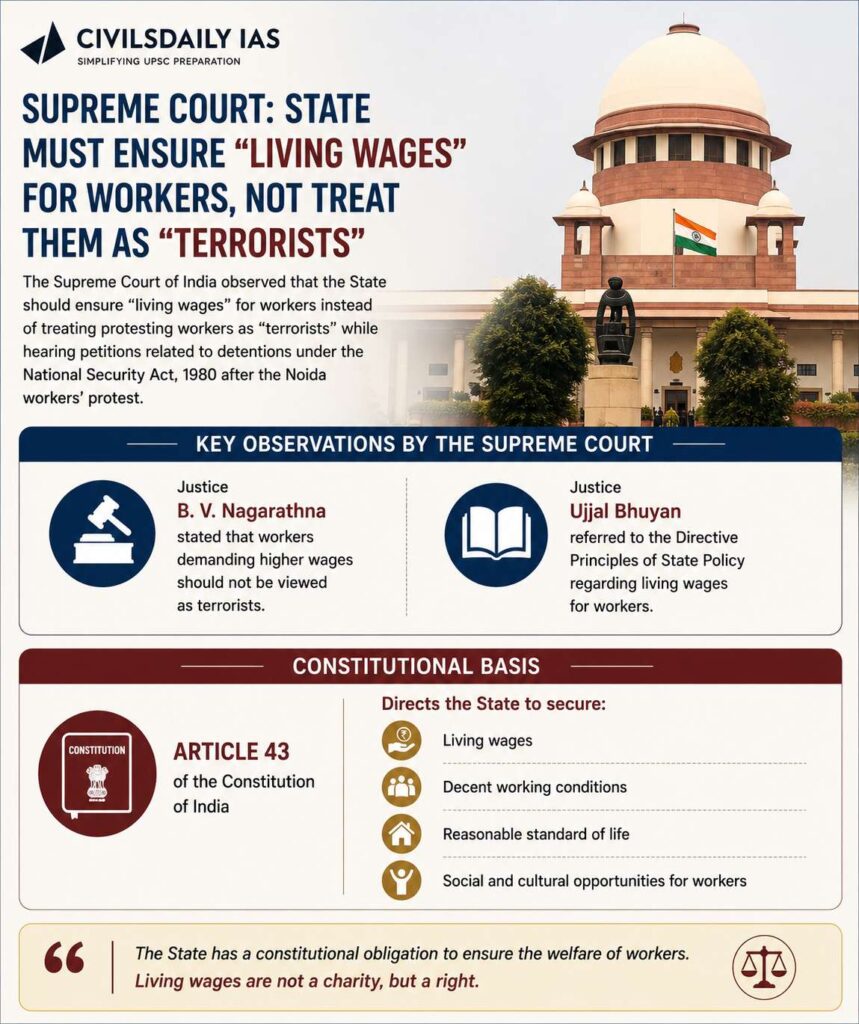
    The Supreme Court of India observed that the State should ensure “living wages” for workers instead of treating protesting workers as “terrorists” while hearing petitions related to detentions under the National Security Act, 1980 after the Noida workers’ protest.

    Key Observations by the Supreme Court

    • Justice B. V. Nagarathna stated that workers demanding higher wages should not be viewed as terrorists.
    • Justice Ujjal Bhuyan referred to the Directive Principles of State Policy regarding living wages for workers.

    Constitutional Basis

    Article 43 of the Constitution of India

    • Directs the State to secure:
      • Living wages
      • Decent working conditions
      • Reasonable standard of life
      • Social and cultural opportunities for workers

    Issue Before the Court

    • Family members of detained protestors challenged arrests under the NSA.
    • Petitioners alleged:
      • Multiple FIRs based on the same conspiracy
      • No preliminary enquiry
      • Protestors labelled as “left-wing sympathisers”

    Court Directions

    • The Supreme Court ordered production of two detainees from Kasna jail on May 18.
    • Restrained the Uttar Pradesh government from shifting them to police remand.
    • Allegations of custodial torture were also raised before the Court.

    About the National Security Act (NSA), 1980

    • Preventive detention law allowing detention to maintain:
      • National security
      • Public order
      • Essential supplies and services
    • Allows detention without formal charges for a specified period.
    [2017] Which principle among the following was added to the Directive Principles of State Policy by the 42nd Amendment to the Constitution? 
    (a) Equal pay for equal work for both men and women 
    (b) Participation of workers in the management of industries 
    (c) Right to work, education and public assistance 
    (d) Securing living wage and human conditions of work to workers
  • Sabarimala Review Case and Religious Freedom

    Why in the News

    • During the Sabarimala Temple Entry Dispute review hearing, the Union government argued before the Supreme Court that all religious practices are presumed constitutionally protected unless they violate: Public order, Morality, and Health
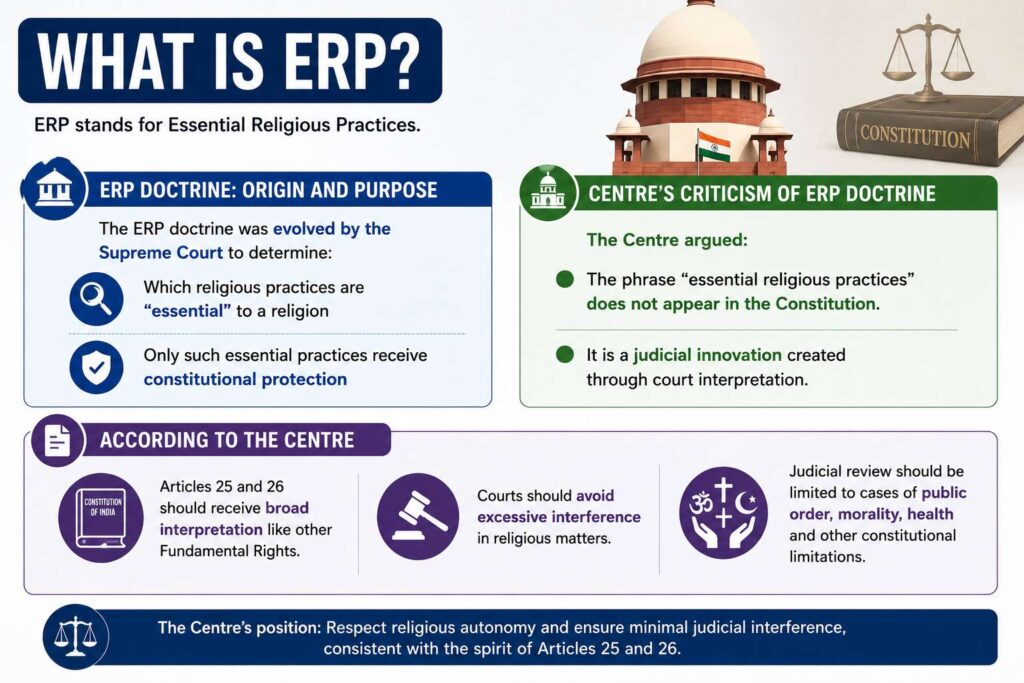
    • The Centre also questioned the judicially evolved doctrine of “Essential Religious Practices” (ERP).

    What is ERP?

    The ERP doctrine was evolved by the Supreme Court to determine:

    • Which religious practices are “essential” to a religion
    • Only such essential practices receive constitutional protection

    Centre’s Criticism of ERP Doctrine

    • The Centre argued:
      • The phrase “essential religious practices” does not appear in the Constitution.
      • It is a judicial innovation created through court interpretation.
    • According to the Centre:
      • Articles 25 and 26 should receive broad interpretation like other Fundamental Rights.
      • Courts should avoid excessive interference in religious matters.

    Supreme Court’s Observations

    • Faith Beyond Rituals: Surya Kant observed:
      • One need not visit temples to be religious.
      • Even lighting a lamp in a hut can express faith.
    • Hinduism as a Way of Life: Justice B. V. Nagarathna remarked:
      • Hinduism is a “way of life”
      • It is not dependent solely on rituals or temple visits

    Related Case Laws

    • Shirur Mutt Case
      • Origin of ERP doctrine
      • Court held religion includes essential practices
    • Indian Young Lawyers Association v. State of Kerala
      • Allowed women of all ages entry into Sabarimala Temple
      • Linked exclusion to constitutional equality
    • Sardar Syedna Taher Saifuddin Case: Upheld denominational autonomy regarding excommunication
    [2020] Consider the following statements: 
    1. The Constitution of India defines its ‘basic structure’ in terms of federalism, secularism, fundamental rights and democracy. 
    2. The Constitution of India provides for ‘judicial review’ to safeguard the citizens’ liberties and to preserve the ideals on which the Constitution is based. 
    Which of the statements given above is/are correct? 
    a) 1 only b) 2 only c) Both 1 and 2 d) Neither 1 nor 2
  • Tamil Nadu Assembly Floor Test 2026

    Why in the News

    Vijay won the confidence motion in the Tamil Nadu Legislative Assembly with 144 votes, ensuring the survival of the TVK-led coalition government.

    Key Highlights of the Floor Test

    • Confidence Motion Passed
      • The motion moved by Chief Minister Vijay received: 144 votes in favour
    • Supporting Parties
      • Indian National Congress
      • Communist Party of India
      • Communist Party of India (Marxist)
      • Viduthalai Chiruthaigal Katchi
      • Indian Union Muslim League
      • 25 rebel AIADMK MLAs
      • One AMMK MLA

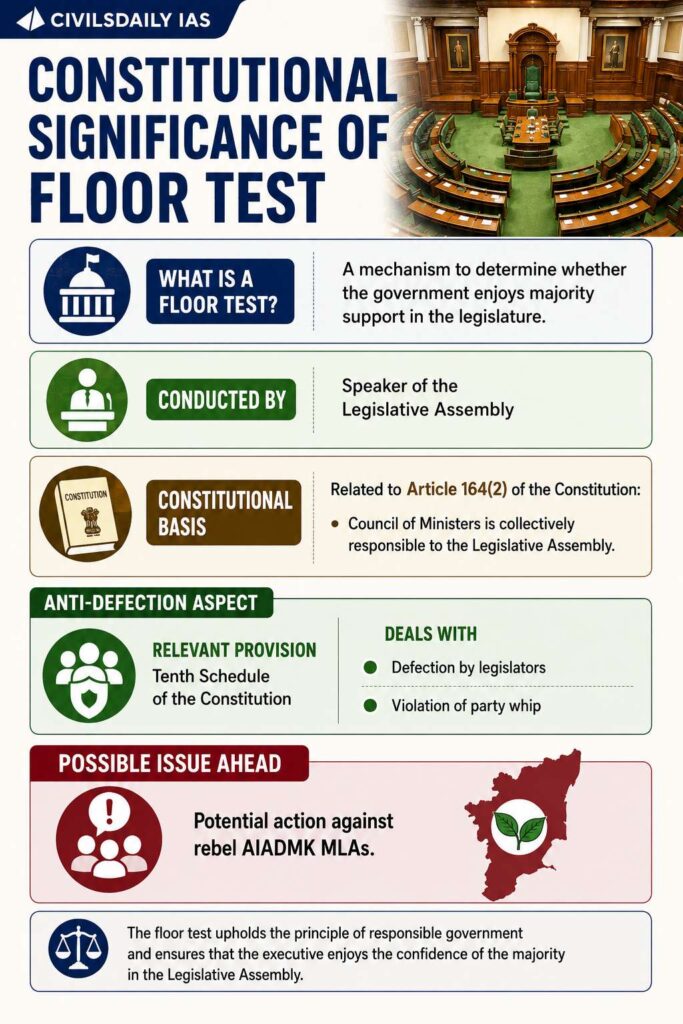
    Constitutional Significance of Floor Test

    • What is a Floor Test?: A mechanism to determine whether the government enjoys majority support in the legislature.
    • Conducted By: Speaker of the Legislative Assembly
    • Constitutional Basis: Related to Article 164(2) of the Constitution:
    • Council of Ministers is collectively responsible to the Legislative Assembly.

    Anti-Defection Aspect

    • Relevant Provision: Tenth Schedule of the Constitution
    • Deals With
      • Defection by legislators
      • Violation of party whip
    • Possible Issue Ahead
    • Potential action against rebel AIADMK MLAs.

    Note: In India, the office of the “whip” is not explicitly mentioned in the Constitution, the Rules of the House, or any parliamentary statute; rather, it is based on convention. However, the authority to issue whips and the consequences for defying them are legally upheld by the Tenth Schedule (Anti-Defection Law).

    [2020] A Parliamentary System of Government is one in which 
    a) All political parties in the Parliament are represented in the Government 
    b) the Government is responsible to the Parliament and can be removed by it 
    c) the Government is elected by the people and can be removed by them 
    d) the Government is chosen by the Parliament but cannot be removed by it before completion of a fixed term
  • Supreme Court on Abortion Law for Minor Rape Victims 

    Why in the News

    The Supreme Court of India has asked the Union government to consider removing the time limit on abortion in cases involving minor rape survivors, while hearing a case allowing termination of a 30 week pregnancy of a 15 year old survivor.

    Background

    • Under the Medical Termination of Pregnancy Act, 1971 (amended in 2021):
      • Abortion allowed up to 24 weeks for special categories
        • Rape survivors
        • Minors
        • Women with disabilities

    Key Observations of the Court

    • State or doctors cannot decide for the survivor
    • Decision should rest with:
      • Survivor
      • Parents or guardians
    • Emphasised reproductive autonomy and dignity
    • Forcing continuation of pregnancy may cause lifelong trauma

    Court’s Suggestions

    • Amend law to:
      • Remove time limit for abortion in minor rape cases
      • Ensure speedy trial (within one week)
      • Provide compensation to victim (including property of accused)

    Legal and Constitutional Aspects

    Article 21

    • Right to life and personal liberty
    • Includes reproductive autonomy and bodily integrity
    • Reproductive Rights: Recognised as part of privacy and dignity

    Key Issues Highlighted

    • Conflict between: Foetal rights vs rights of the survivor
    • Importance of informed consent
    • Role of doctors: Provide medical guidance, not impose decisions

    Important Concepts

    • Medical Termination of Pregnancy (MTP): Legal framework governing abortion in India
    • Reproductive Autonomy: Right of a woman to make decisions about her body and pregnancy
    [2019] Which Article of the Constitution of India safeguards one’s right to marry the person of one’s choice? 
    (a) Article 19 (b) Article 21 (c) Article 25 (d) Article 29
  • Hate speech stems from an ‘us versus them’ mindset

    Why in the News?

    The Supreme Court recently held that hate speech comes from an “us vs them” mindset. It weakens fraternity and social harmony. The Court refused to ask for new laws. It stressed poor enforcement of existing laws as the real problem. This is important because public debate often demands stricter laws. The Court says laws already exist but are not applied well. Petitions showed hate speech continues despite past judgments. This points to a system failure, not a legal gap.

    What is the constitutional and philosophical basis of the Court’s observation?

    1. Fraternity as a constitutional value: Ensures social cohesion and unity in diversity as part of the Preamble.
    2. Moral fabric of society: Strengthens dignity and mutual respect among citizens.
    3. Civilizational ethos: Reflects Vasudhaiva Kutumbakam, emphasizing universal brotherhood.
    4. Antithesis of hate speech: Undermines inclusiveness by promoting exclusion and hostility.

    Why did the Court refuse to mandate new laws on hate speech?

    1. Judicial restraint: Preserves separation of powers by avoiding legislative functions.
    2. Existing legal framework: Includes provisions under IPC/BNS addressing public order and incitement.
    3. Institutional role clarity: Limits judiciary to interpretation and application of law.
    4. Avoidance of overreach: Prevents creation of parallel regulatory regimes.

    What are the existing hate speech laws in India?

    1. Article 19(1)(a): Ensures freedom of speech.
    2. Article 19(2): Allows restrictions for public order and morality.
    3. Bharatiya Nyaya Sanhita (BNS):
      1. Section on promoting enmity: Penalizes speech causing hatred between groups.
      2. Public mischief provisions: Punish rumours leading to fear or violence
    4. Representation of People Act, 1951:
      1. Electoral hate speech: Bars appeals based on religion, caste, etc.
    5. IT Rules and IT Act:
      1. Online regulation: Targets fake news and harmful content.

    What explains the persistence of hate speech despite legal provisions?

    1. Enforcement deficit: Weak implementation by law enforcement agencies.
    2. Administrative failure: Inconsistent application of laws across regions.
    3. Delayed justice delivery: Reduces deterrence effect of existing laws.
    4. Societal normalization: Continued tolerance of divisive narratives.

    How does hate speech threaten constitutional order and public harmony?

    1. Erosion of fraternity: Weakens unity in a diverse society.
    2. Public order disruption: Leads to inter-group hostility and violence.
    3. Institutional strain: Challenges governance and law enforcement credibility.
    4. Democratic decline: Undermines inclusive participation and trust.

    What role should institutions play in addressing hate speech?

    1. Law enforcement agencies: Ensure consistent and unbiased application of laws.
    2. Judiciary: Uphold constitutional values through interpretation.
    3. Legislature: Maintain clarity and adequacy of legal provisions.
    4. Civil society: Promote awareness and counter divisive narratives.

    What broader societal transformation is required?

    1. Mindset shift: Moves from identity-based exclusion to inclusive citizenship.
    2. Ethical reinforcement: Promotes empathy and respect in public discourse.
    3. Educational reforms: Integrates constitutional values into curricula.
    4. Media responsibility: Reduces sensationalism and misinformation.

    Conclusion

    The Supreme Court reframes hate speech as a societal and enforcement issue rather than a legislative gap. Addressing it requires strengthening institutional accountability and nurturing constitutional values of fraternity and inclusiveness.

    PYQ Relevance

    [UPSC 2022] Right of movement and residence throughout the territory of India are freely available to the Indian citizens, but these rights are not absolute. Comment.

    Linkage: This question reflects the idea that Fundamental Rights are subject to reasonable restrictions, similar to Article 19(2) limits on hate speech. The Supreme Court judgment reinforces that free speech is not absolute and must align with public order, dignity, and fraternity.