Mains Ready By December. Smash Mains & Smash PYQ Admissions Open

GS Paper: GS2-01.Indian Constitution-Historical underpinnings & evolution; Features, amendments, significant provisions, basic structure of Constitution

  • Sabarimala Review and Religious Reform 

    Why in the News

    The Supreme Court of India, while hearing the Sabarimala review case, observed that courts cannot reform religion, even as debates continue on balancing religious freedom and constitutional rights.

    Background of the Case

    • Concerns entry of women aged 10 to 50 years into the Sabarimala Temple
    • 2018 judgment allowed entry, upholding right to worship
    • Review petitions challenge this verdict

    Key Observations by the Court

    • Courts cannot initiate religious reform
    • Reform must come from within religion or society
    • Need to balance:
      • Religious practices
      • Constitutional values

    Arguments Presented

    For Reform (Indira Jaising’s View)

    • Religion must evolve to remain relevant
    • Equality (Article 14) and dignity (Article 21) cannot be subordinate to religion
    • Religious practices must align with constitutional morality

    Concerns Raised by Judges

    • Reforms should not destroy core religious identity
    • Need to avoid excessive interference in doctrinal matters

    Key Constitutional Provisions

    • Article 14: Right to equality before law
    • Article 21: Right to life and dignity
    • Article 25: Freedom of religion and worship

    Important Legal Concepts

    • Essential Religious Practices Test
      • Determines which practices are essential to a religion
      • Only essential practices get constitutional protection
    • Constitutional Morality: Principles like equality, dignity, and justice guide interpretation of laws
    [2019] Which Article of the Constitution of India safeguards one’s right to marry the person of one’s choice? 
    (a) Article 19
    (b) Article 21
    (c) Article 25
    (d) Article 29
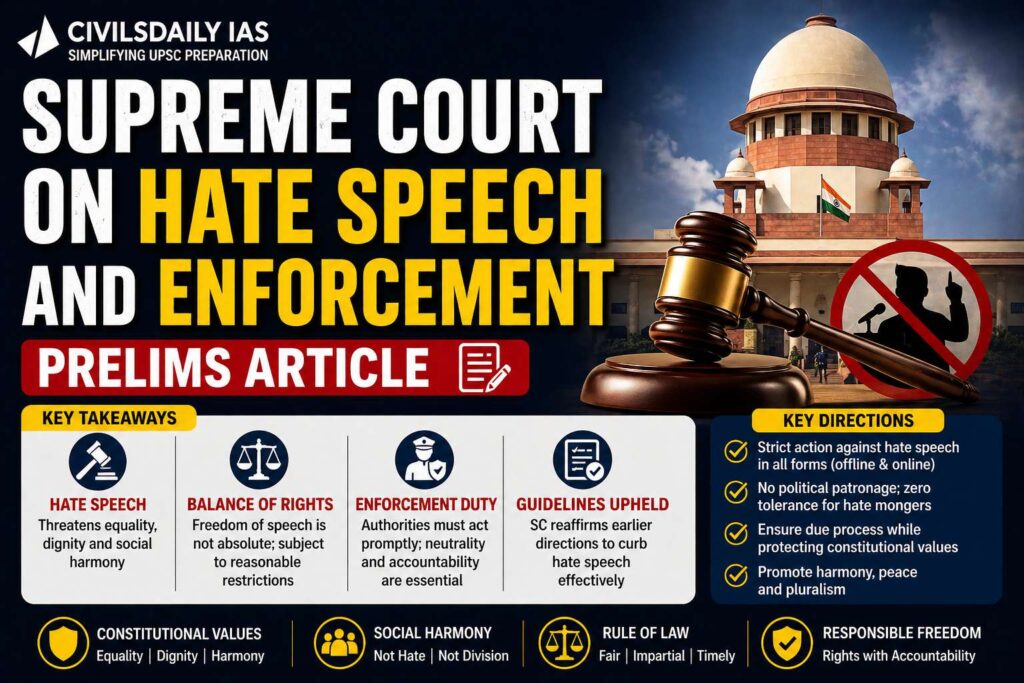
  • Supreme Court on Hate Speech 

    Why in the News?

    The Supreme Court of India, in an April 2026 judgment, highlighted that hate speech and rumour mongering threaten the constitutional value of fraternity, but declined to direct enactment of new laws, emphasizing effective enforcement of existing legal provisions.

    Key Observations of the Court

    • Hate speech arises from an “us versus them” mindset
    • It promotes exclusion and discrimination
    • Undermines fraternity and unity in a diverse society
    • Considered against constitutional morality and civilisational ethos
    • Linked to the idea of “Vasudhaiva Kutumbakam” (world is one family)

    Constitutional Provisions Involved

    • Article 19(1)(a): Guarantees freedom of speech and expression
    • Article 19(2): Allows reasonable restrictions on grounds like:
      • Public order
      • Decency
      • Morality
      • Sovereignty and integrity
    • Fraternity (Preamble): Ensures unity and sense of brotherhood among citizens

    Legal Position on Hate Speech

    • No single comprehensive law exclusively defining hate speech
    • Covered under various provisions:
      • Indian Penal Code sections related to
        • Promoting enmity
        • Public mischief
      • IT laws for online content

    Court’s Stand

    • Court cannot legislate new laws
    • Responsibility lies with: Legislature and Executive
    • Focus should be on better implementation of existing laws

    Key Concepts

    • Hate Speech: Speech that incites hatred, discrimination, or violence against groups
    • Fraternity: A constitutional value promoting unity, dignity, and brotherhood
    [2017] The mind of the makers of the Constitution of India is reflected in which of the following? 
    (a) The Preamble 
    (b) The Fundamental Rights 
    (c) The Directive Principles of State Policy 
    (d) The Fundamental Duties
  • Right to Safe Roads as a Part of Right to Life: Supreme Court Judgment

    Why in the News?

    In a significant expansion of fundamental rights, the Supreme Court of India ruled in August 2025 that access to safe, motorable, and well-maintained roads is an integral part of the Right to Life under Article 21 of the Constitution.

    Key Legal Pronouncements

    The Bench, comprising Justices J.B. Pardiwala and R. Mahadevan, linked the quality of infrastructure to constitutional guarantees:

    • Article 21 (Right to Life): The Court held that “life” is not merely physical existence but includes the right to live with dignity, which is hindered by poor and unsafe road conditions.
    • Article 19(1)(d): The right to move freely throughout the territory of India is a basic right. The Court noted that this right becomes “illusory” if the state fails to provide motorable roads.
    • State Responsibility: The judgment explicitly stated that it is the mandatory responsibility of the State to develop and maintain roads under its control.

    Case Background

    The ruling emerged from a dispute between Umri Pooph Pratappur (UPP) Tollways Private Limited and the Madhya Pradesh Road Development Corporation Limited (MPRDC).

    • The Project: A ‘Build, Operate, and Transfer’ (BOT) agreement for a 43.7-km road project in Madhya Pradesh worth ₹73.68 crore.
    • The Shift: While the case was a commercial dispute over a concession agreement, the Court used the platform to emphasize the public interest aspect of infrastructure.
    [2019] Which Article of the Constitution of India safeguards one’s right to marry the person of one’s choice? 
    (a) Article 19  
    (b) Article 21  
    (c) Article 25  
    (d) Article 29
  • The twin moves that will reshape Indian democracy

    Why in the News?

    India’s electoral framework is undergoing potential transformation through, delimitation based on population changes, expansion of Lok Sabha strength (543 to 850) and implementation of 33% women’s reservation. These reforms aim to restore representational parity but create inter-state asymmetry risks.

    Why is delimitation being revisited after decades of freeze?

    1. Constitutional Mandate: Ensures periodic readjustment under Articles 81 and 82 based on Census.
    2. Frozen Representation: Maintained seat distribution since 1976, extended till 2026 via amendments.
    3. Political Sensitivity: Successive governments avoided redistribution due to interstate conflict (“kicking the can”).
    4. Demographic Change: Population growth uneven across regions, creating representational distortion.

    What are the competing models of seat redistribution?

    1. Uniform Expansion Model (Scenario 1): Maintains interstate proportion while increasing seats by ~50%; ensures political stability but limits correction of imbalance.
    2. Population-Based Model (Scenario 2): Allocates seats strictly by 2011 population; ensures representational equity but disrupts federal balance.
    3. Policy Trade-off: Balances electoral fairness vs political acceptability.

    How does delimitation address the ‘value of vote’ principle?

    Delimitation addresses the “value of vote” principle by redrawing electoral boundaries to ensure that constituencies have roughly equal population sizes, giving each citizen’s vote equal weight. By readjusting seat allocations based on the latest census data, it corrects demographic disparities to uphold the core democratic tenet of “one person, one vote, one value”.

    1. Representation Inequality: Bihar MP represents ~25 lakh people vs Himachal MP ~17 lakh.
    2. Constitutional Principle: Upholds “one vote, one value” across constituencies.
    3. Corrective Mechanism: Reduces constituency size from ~22 lakh to ~14 lakh.
    4. Outcome: Ensures equal weight of citizen votes across regions.

    Does population-based redistribution distort federal balance?

    1. North-South Divide: Northern states gain seats due to higher population growth.
    2. Southern Disadvantage: States like Tamil Nadu, Kerala risk reduced proportional influence.
    3. Political Power Shift: Concentrates legislative power in demographically larger states.
    4. Coalition Impact: Alters parliamentary arithmetic and bargaining dynamics.

    Does delimitation create an incentive distortion in population policy?

    Delimitation can create an incentive distortion in population policy by potentially rewarding regions with higher population growth and penalizing those that successfully implemented family planning. This phenomenon is often termed a “demographic penalty“.

    1. Population Control Success: Southern states achieved lower fertility rates.
    2. Reward Mechanism: Higher population states gain more seats.
    3. Policy Distortion: Penalises demographic governance efforts.
    4. Outcome Conflict: Undermines long-term population stabilisation goals.

    What contradictions exist in the government’s approach?

    1. Expansion vs Redistribution Conflict: Increasing Lok Sabha seats to ~850 implies a need for fresh allocation, while maintaining existing interstate proportions prevents meaningful redistribution based on population.
    2. Equity vs Status Quo Tension: Delimitation aims to restore “one vote, one value”, but preserving current seat shares perpetuates existing representational inequalities.
    3. Reform vs Political Comfort: Structural reform requires correcting regional imbalances, whereas status quo assurance reflects political reluctance to disturb existing power equations.
    4. Population Principle vs Federal Sensitivity: Population-based allocation strengthens democratic fairness, but maintaining proportions prioritises federal stability-creating a policy deadlock.
    5. Outcome Ambiguity: Simultaneous pursuit of expansion and proportional stability lacks a clear operational formula, leading to uncertainty in implementation.

    What role does Census play in delimitation and reservation?

    1. Operational Dependency: Delimitation linked to Census data.
    2. Delay Factor: Next Census expected ~2027.
    3. Reservation Impact: Women’s reservation implementation postponed.
    4. Administrative Constraint: Constitutional reform tied to data availability.

    What are the implications for women’s political representation?

    1. Reservation Provision: 33% seats reserved in Lok Sabha and Assemblies.
    2. Deferred Realisation of Inclusion: Linkage with delimitation and Census postpones implementation, delaying actual political empowerment despite constitutional provision.
    3. Rotational System: Periodic change of reserved constituencies affects continuity.
    4. Power Redistribution within Parties: Reservation compels internal restructuring in party hierarchies, altering candidate pipelines and leadership dynamics.
    5. Outcome: Enhances inclusion but delays execution.

    How does the issue reflect intra-state vs inter-state equity tensions?

    1. Internal Equalisation vs External Imbalance: Delimitation equalises constituency population within states but increases disparities in seat share across states.
    2. Electoral Fairness vs Federal Parity: Equal voters per MP improves fairness locally, while population-based allocation weakens parity among states.
    3. Local Gain vs National Shift: Smaller constituencies enhance local accountability but shift legislative power toward high-growth states.
    4. Correction vs Stability: Updating seats corrects representational distortion but disrupts the existing federal balance.

    Does delimitation affect federal trust and political cohesion?

    Delimitation significantly affects federal trust and political cohesion, particularly in “holding together” federations like India. While its technical goal is to ensure equal representation (“one person, one vote”), it often acts as a major source of political tension by altering the balance of power between regions with different population growth rates

    1. Regional Concerns: Delimitation based solely on population growth disadvantages states that have successfully implemented family planning (e.g., Southern Indian states) and rewards those with higher population growth (e.g., Northern Hindi-heartland states). This causes resentment, as progressive states fear losing political representation due to success in national objectives.
    2. Trust Deficit: Perception of bias in redistribution process.
    3. Cooperative Federalism: Risk of weakening consensus-based governance.

    Impact on Political Cohesion

    1. Regional Divide: Delimitation can strengthen cultural, linguistic, and economic divisions, specifically exacerbating north-south disparities in India.
    2. Shift in Political Power: The projected shift in seats (e.g., southward to northward in India) threatens to create a “majority” in the parliament that is concentrated in specific linguistic and geographic regions, weakening the cohesiveness of a diverse nation.
    3. Risks to Unity: If a large segment of the federation perceives the process as unfair or a tool for centralizing power, it can lead to political unrest and undermine national unity.

    What alternatives can balance equity and federalism?

    Alternatives to balance equity and federalism in legislative representation and fiscal devolution aim to reconcile the principle of “one person, one vote” with the need to protect the political influence and financial viability of smaller or more developed states.

    1. Weighted Allocation Model: Moves beyond a strictly population-based model to include other performance indicators. This model integrates criteria like Total Fertility Rate (TFR), Human Development Index (HDI), and fiscal performance to ensure that states with successful population control or better development outcomes are not penalized.
    2. Dual Criteria System: Incorporates economic contribution alongside population numbers to determine resource sharing. The 16th Finance Commission in India, for example, introduced a 10% weightage for a state’s contribution to GDP to balance equity (assisting poorer states) with efficiency (rewarding states that drive economic growth).
    3. Cap Mechanism(Cap on Seat Shares): Limits the maximum seat share for any single state to prevent a few populous states from dominating the national legislature. This mechanism is used in other federal structures to maintain a balance of power, ensuring regional diversity in policy-making.
    4. Phased Redistribution (Gradualism): Implements changes to seat allocations slowly over time rather than all at once, allowing states to adapt to changes in their political weight without immediate, severe disruption.
    5. “Seat-Addition” Model: Increasing the total size of the legislature to add seats for under-represented states while ensuring no state loses its existing number of seats.

    Conclusion

    Delimitation and seat expansion aim to restore electoral equality, but risk disrupting federal balance and policy incentives. A calibrated approach must integrate population justice, governance performance, and cooperative federalism to ensure long-term institutional stability.

    PYQ Relevance

    [UPSC 2020] How far do you think cooperation, competition and confrontation have shaped the nature of federation in India? Cite some recent examples.

    Linkage: Delimitation directly affects cooperative vs confrontational federalism by altering political power distribution among states. Seat redistribution and representation shifts can intensify Centre-State tensions, reflecting evolving federal dynamics in India.

  • What are the legal consequences of piracy

    Why in the News?

    The pre-release leak of the Tamil film Jana Nayagan has intensified concerns over film piracy in India, especially after the Cinematograph (Amendment) Act, 2023 introduced stricter penalties. Unlike routine post-release piracy, this case involves a high-definition leak before theatrical certification, pointing to internal security lapses. The episode reinforces India’s classification as a high-risk piracy market globally and highlights the widening gap between legal provisions and effective enforcement.

    Why does pre-release piracy indicate deeper systemic vulnerabilities?

    1. Content breach: Reflects insider leak or mishandling of authorized access, unlike traditional piracy
    2. High-definition leak: Suggests direct extraction from original digital source, not cam recording
    3. Economic impact: Reduces theatrical revenues and downstream rights valuation (OTT, satellite)
    4. Case evidence: Jana Nayagan leak before certification disrupted release pipeline

    How comprehensive and effective is India’s legal framework on piracy?

    1. Copyright Act, 1957: Ensures 3-year imprisonment or ₹2 lakh fine (Sections 63, 63A)
    2. Cinematograph Amendment Act, 2023: Introduces penalty up to 5% of audited gross production cost
    3. IT Act, 2000: Facilitates blocking of online piracy platforms
    4. Enforcement gap: Results in low conviction rates and delayed judicial outcomes

    What has been the role of the Supreme Court and judiciary in shaping anti-piracy jurisprudence?

    1. Eros International Media Ltd. v. BSNL (2016): Recognized online piracy as infringement requiring blocking orders
    2. UTV Software Communication Ltd. v. 1337X (2019, Delhi HC): Introduced concept of “rogue websites” enabling bulk blocking
    3. Department of Electronics & IT v. Star India (2016): Validated site-blocking under IT Act
    4. John Doe Orders (Ashok Kumar orders): Allows preemptive injunctions against unknown infringers
    5. Dynamic injunctions: Ensures real-time extension of blocking orders to mirror websites

    Why is piracy enforcement weak despite judicial innovations?

    1. Jurisdictional complexity: Involves cross-border digital platforms
    2. Technological lag: Enforcement agencies lack advanced cyber forensic capabilities
    3. Low deterrence: Judicial delays weaken punitive impact
    4. Fragmentation: Limited coordination between police, ISPs, and judiciary

    What technological and operational factors enable piracy networks?

    1. DRM bypass: Allows extraction of near-original quality content
    2. Encrypted platforms: Uses Telegram, private groups, peer-to-peer networks
    3. Cloud sharing: Facilitates mass distribution through links
    4. Watermark evasion: Reduces traceability of original leak source

    How do filmmakers and regulators attempt to counter piracy?

    1. Forensic watermarking: Enables source identification of leaks
    2. Encrypted distribution: Limits unauthorized duplication
    3. Legal takedowns: Uses copyright notices and court orders
    4. Limitation: Remains reactive and slower than piracy spread

    What are the global best practices in tackling digital piracy?

    1. United States (DMCA regime): Ensures swift takedown through notice-and-action mechanism
    2. European Union: Implements graduated response systems and ISP liability frameworks
    3. United Kingdom: Uses site-blocking orders with strict compliance timelines
    4. South Korea: Combines strong enforcement with public awareness campaigns
    5. Outcome: Demonstrates integration of law, technology, and awareness reduces piracy rates

    What broader governance and economic issues are linked to piracy?

    1. Creative economy loss: Reduces revenue, employment, and investment in film sector
    2. Tax implications: Lowers government revenue from entertainment industry
    3. Cybercrime linkage: Connects piracy networks with organized digital crime
    4. Ethical dimension: Reflects low public awareness on intellectual property rights

    Conclusion

    Piracy in India reflects institutional inefficiency, technological gaps, and weak deterrence mechanisms. Strengthening enforcement through judicial innovation, global best practices, and technological integration remains essential to protect intellectual property and sustain the creative economy.

    PYQ Relevance

    [UPSC 2024] “What is the present world scenario of intellectual property rights with respect to life materials? Although India is second in the world to file patents, still only a few have been commercialized. Explain the reasons behind this less commercialization.”

    Linkage: The PYQ highlights IPR protection and enforcement gaps, similar to weak anti-piracy enforcement in India. It connects piracy issues to commercialization, valuation, and protection of intellectual assets in the digital economy.

  • [10th April 2026] The Hindu OpED: Have elections in India become plutocratic?

    PYQ Relevance[UPSC 2024] Examine the need for electoral reforms as suggested by various committees with particular reference to ‘one nation-one election’ principle.Linkage: The PYQ directly connects to systemic flaws in electoral processes, including rising costs and inefficiencies. It links with the need for financial transparency and reducing excessive campaign expenditure.

    Mentor’s Comment

    Plutocracy refers to a system where political power is effectively controlled by the wealthy, either directly or through influence over decision-making. Plutocratic Elections describes a situation where money, rather than merit, ideology, or public support, becomes the decisive factor in electoral outcomes. India’s electoral system operates under strict legal expenditure limits imposed by the Election Commission, yet actual campaign spending often exceeds these limits by several multiples. This divergence reflects systemic opacity in political financing, weak enforcement mechanisms, and evolving campaign practices. This further raises concerns about the credibility and fairness of elections in the world’s largest democracy.

    Why do official election expenditure limits fail to reflect ground realities?

    1. Legal Ceiling Constraint: Imposes strict caps on candidate spending but excludes party and third-party expenditures, creating systemic loopholes. The Legal Ceilings on Election Expenditure are as follows:
      1. Statutory Basis: Governed under the Representation of the People Act, 1951 (Sections 77 & 78) and prescribed by the Election Commission of India (ECI).
      2. Lok Sabha Elections: ₹95 lakh (larger states) / ₹75 lakh (smaller states & UTs) per candidate. State Assembly Elections: ₹40 lakh (larger states) / ₹28 lakh (smaller states) per candidate.
      3. Scope Limitation: Applies only to individual candidates, not to political parties.
      4. Exclusions (Core Loophole): Party expenditure, star campaigners’ costs, media campaigns, and third-party spending are excluded from candidate limits (as per RPA provisions).
      5. Monitoring Mechanism: Candidates must maintain a day-to-day expenditure register and submit accounts within 30 days of result declaration; non-compliance leads to disqualification under Section 10A. 
    2. Underreporting Incentives: Encourages candidates to show minimal official expenditure to avoid disqualification risks.
    3. Cash-Based Campaigning: Enables unaccounted spending through informal cash transactions, especially in voter mobilization.
    4. Weak Audit Mechanisms: Limits post-election verification due to lack of forensic auditing and real-time scrutiny.
    5. Third-Party Spending: Allows supporters, contractors, and local networks to incur expenses outside official candidate accounts.

    How does opaque political funding distort democratic competition?

    1. Unequal Playing Field: Advantages resource-rich candidates, marginalizing smaller parties and independents.
    2. Policy Capture Risk: Strengthens influence of corporate donors over policy priorities and governance decisions.
    3. Vote Buying Potential: Facilitates inducements such as cash distribution, gifts, and welfare targeting during elections.
    4. Reduced Electoral Credibility: Weakens public trust in fairness and legitimacy of election outcomes.
    5. Barrier to Entry: Discourages capable but financially weaker candidates from contesting elections.

    What are the institutional limitations of election monitoring mechanisms? (Corrected & Aligned)

    1. Limited Statutory Powers: Constrains the Election Commission of India to act primarily within RPA provisions, restricting independent investigation into unaccounted or third-party expenditures.
    2. Candidate-Centric Legal Framework: Limits regulation to individual candidates, while political parties remain outside expenditure ceilings, weakening institutional oversight.
    3. Fragmented Institutional Architecture: Disperses responsibilities across ECI, Income Tax Department, Enforcement Directorate, leading to weak coordination and accountability gaps.
    4. Reactive Monitoring Design: Structures oversight around post-facto scrutiny of submitted accounts, rather than proactive, continuous financial surveillance.
    5. Inadequate Transparency Mandate: Lacks compulsory real-time disclosure mechanisms for political funding, reducing institutional capacity to detect violations.
    6. Weak Deterrence Framework: Provides limited and delayed penalties (e.g., disqualification), which fail to create strong institutional deterrence against overspending. 

    How has the scale of election spending evolved in India?

    1. Rising Campaign Costs: Reflects increasing expenditure on media, advertising, and voter outreach strategies.
    2. 2014 Elections Benchmark: Estimated spending crossed ₹30,000 crore collectively by parties and candidates.
    3. 2019 Elections Expansion: Considered among the most expensive globally, with estimates exceeding ₹60,000 crore.
    4. Digital Campaign Surge: Increased reliance on social media, data analytics, and targeted political advertising.
    5. Logistical Intensification: Higher spending on rallies, transportation, booth management, and grassroots mobilization.

    What reforms are necessary to enhance transparency and accountability?

    1. Comprehensive Disclosure Norms: Mandates reporting of all candidate, party, and third-party expenditures.
    2. State Funding of Elections: Reduces dependence on private and corporate financing sources.
    3. Real-Time Expenditure Tracking: Introduces digital platforms for monitoring campaign spending continuously.
    4. Stronger Audit Framework: Establishes independent bodies for forensic auditing of political finances.
    5. Legal Reforms: Expands scope of Representation of the People Act to cover entire ecosystem of election funding. 

    Conclusion

    The divergence between declared and actual election expenditure reflects a structural flaw in India’s democratic framework. Addressing this requires systemic reforms in political finance, enhanced institutional capacity, and greater transparency, ensuring that elections remain free, fair, and credible.

  • Right to be considered for promotion, how it is implemented

    Why in the News?

    The Punjab and Haryana High Court (March 2025) held that denial of fair consideration for promotion violates fundamental rights under Articles 14 and 16. The recent High Court judgment has elevated the “right to be considered for promotion” to a fundamental rights issue, marking a significant shift from its earlier treatment as a mere statutory entitlement. The case exposes systemic administrative failures such as delayed Departmental Promotion Committee (DPC) meetings and misinterpretation of service rules. With multiple High Courts flagging similar violations, the issue reflects a widespread governance gap affecting career progression of public servants.

    What distinguishes the right to promotion from the right to be considered?

    1. The fundamental distinction between the right to promotion and the right to be considered for promotion lies in their legal status: promotion itself is generally not a Fundamental Right, whereas the right to be considered for promotion is a constitutionally protected Fundamental Right, provided the employee meets eligibility criteria. 
    2. While an employee cannot demand an automatic promotion merely by meeting minimum qualifications or due to a vacancy, they have a right to a fair, timely, and lawful evaluation process for that promotion. 

    Key Differences

    1. Right to Consideration (Fundamental/Constitutional):
      1. Basis: Rooted in Articles 14 (Equality before Law) and 16(1) (Equality of Opportunity in Public Employment) of the Indian Constitution.
      2. Scope: Every employee falling within the “zone of consideration” (i.e., meeting eligibility, seniority, and qualifications) has a right to have their service records evaluated by the Departmental Promotion Committee (DPC).
      3. Violations: Failure to hold DPCs regularly, arbitrary exclusion, or delayed evaluation constitutes a violation of this Fundamental Right.
      4. Nature: Active, enforceable right; if ignored, the employee can approach the courts to compel the DPC to meet.
    2. Right to Promotion (Statutory/Vested):
      1. Basis: Depends on the existence of vacancies, merit, performance, and specific Service Rules.
      2. Scope: An employee has no automatic or inherent right to be promoted just because a vacancy exists or they have completed a minimum service period.
      3. Violations: Promotion can be denied based on merit, penalty records, or lack of vacancy, as long as the denial is not arbitrary or discriminatory.
      4. Nature: Not an automatic right. It only vests once the selection process is complete and an order is issued. 

    How is the right to be considered rooted in constitutional provisions?

    1. Article 14 (Equality before law): Ensures non-arbitrary evaluation.
    2. Article 16(1) (Equal opportunity): Guarantees fairness in public employment.
    3. Expansion of ‘employment’: Courts interpret it to include career progression.
    4. Ajit Singh vs State of Punjab (1999): Recognizes denial of consideration as violation of Fundamental Rights.

    What administrative failures undermine the Right to Consideration for Promotion in practice?

    1. Delayed DPC meetings: Causes stagnation and career uncertainty.
    2. Misinterpretation of rules: Example: Kulwant Singh case, distance education wrongly treated as disqualification.
    3. Inconsistent application: States fail to follow amended service rules.
    4. Lack of accountability: No strict enforcement of timelines for promotions.

    How has the judiciary enforced this right across cases?

    1. Punjab & Haryana HC (2025) (Kulwant Singh vs. State of Punjab and others): Recognized denial as violation of fundamental right.
    2. Supreme Court (July 2024) (Major General S.S. Gill vs. Union of India (and similar cases like Arun Kumar M. vs. Union of India): Reaffirmed right as fundamental, though promotion itself is not.
    3. Himachal Pradesh HC (2025): Directed fast-tracking of DPC for lecturers above 57 years.
    4. Manipur HC (2022): Granted relief to inspectors eligible since 2007 but promoted in 2021.
    5. Delhi HC (2024): Mandated regular DPC intervals.

    What are the broader implications for governance and public administration?

    1. Ensures administrative fairness: Prevents arbitrary exclusion.
    2. Improves efficiency: Motivates employees through career progression.
    3. Reduces litigation: Clear rules reduce disputes.
    4. Strengthens rule of law: Enforces accountability of executive actions.

    Why is this issue significant in the context of public employment reforms?

    1. Systemic delays: Reflect institutional inefficiencies.
    2. Career stagnation: Impacts morale and productivity.
    3. Equity concerns: Unequal application affects fairness.
    4. Judicial overreach concerns: Frequent court interventions indicate executive failure.

    Conclusion

    Recognition of the right to be considered for promotion as a fundamental right strengthens constitutional governance. Administrative reforms ensuring timely DPCs and rule clarity are essential to uphold equality and efficiency in public services.

    PYQ Relevance

    [UPSC 2023] The Constitution of India is a living instrument with capabilities of enormous dynamism. Illustrate with special reference to the expanding horizons of the right to life and personal liberty.

    Linkage: It demonstrates how constitutional interpretation evolves, with courts expanding Fundamental Rights beyond original text (Articles 14, 16, 21). The “right to be considered for promotion” reflects this dynamism, as judiciary has elevated service-related fairness into a facet of equality and fundamental rights.

  • On the implications of euthanasia

    Why in the News?

    The recent judgment in Harish Rana v. Union of India marks a significant evolution in India’s euthanasia jurisprudence by operationalising the right to die with dignity under Article 21 of the Indian Constitution. For the first time, the Supreme Court has explicitly permitted withdrawal of Clinically Assisted Nutrition and Hydration (CANH), going beyond earlier precedents like Common Cause v. Union of India and Aruna Shanbaug v. Union of India. This is a major shift from a highly restrictive regime to a more autonomy-centric approach, reducing procedural hurdles (such as multiple medical boards) and emphasizing patient dignity. However, it simultaneously raises critical concerns of misuse, coercion, and socio-economic inequality.

    What constitutional transformation does the judgment signify?

    1. Right to Dignity: Expands Article 21 to include dignified death; integrates life and death within the same constitutional continuum.
    2. Autonomy Recognition: Recognizes individual decision-making in end-of-life care; validates living wills and refusal of treatment.
    3. Judicial Evolution: Moves beyond Aruna Shanbaug (2011) and Common Cause (2018) by simplifying execution mechanisms.
    4. State Obligation: Ensures access to palliative care as part of the right to life; links dignity with healthcare delivery.

    How does the judgment simplify procedural mechanisms?

    1. Procedural Rationalisation: Reduces requirement from multiple medical boards to fewer layers; ensures faster decision-making.
    2. Administrative Feasibility: Removes district collector oversight; reduces bureaucratic delays.
    3. Advance Directives: Strengthens legal validity of living wills; facilitates implementation without excessive verification.
    4. Medical Oversight: Retains safeguards through medical opinion; ensures balance between autonomy and ethics.

    What are the ethical principles governing euthanasia decisions?

    1. Autonomy: Ensures patient’s right to choose treatment withdrawal; extends to next of kin in incapacitated cases.
    2. Beneficence: Prioritizes patient welfare; ensures decisions aim to relieve suffering.
    3. Non-Maleficence: Prevents harm; prohibits actions that actively cause death.
    4. Justice: Ensures fairness; raises concerns of unequal access to dignified death due to socio-economic disparities.
    5. Doctrine of Double Effect: Permits actions with dual outcomes (pain relief + possible death); justified if intent is relief, not death.

    What social risks and inequalities does euthanasia raise?

    1. Vulnerability Risk: Elderly, disabled, and poor may face coercion; financial pressures may influence consent.
    2. Economic Burden: High cost of prolonged treatment may push families toward withdrawal decisions.
    3. Social Neglect: Weak family support structures may lead to disguised abandonment.
    4. Cultural Conflict: Traditional belief in preserving life at all costs vs emerging autonomy-based ethics.
    5. Healthcare Inequality: Limited access to palliative care skews decision-making toward euthanasia.

    What is the economic and healthcare dimension of the debate?

    1. Resource Allocation: Prolonged life-support strains healthcare resources; raises efficiency concerns.
    2. Cost of Care: Long-term ICU treatment imposes financial stress; especially on middle and lower-income groups.
    3. Palliative Care Gap: India’s limited palliative infrastructure restricts genuine “choice.”
    4. Policy Implication: Need for integrated end-of-life care systems alongside euthanasia regulation.

    Does the judgment clarify or complicate the legal position?

    1. Terminological Shift: Discourages use of “passive euthanasia”; avoids confusion between acts and omissions.
    2. Legal Clarity: Establishes withdrawal of treatment as legally permissible; aligns with constitutional morality.
    3. Continuity of Care: Mandates ongoing palliative care even after withdrawal decisions.
    4. Interpretational Scope: Leaves grey areas regarding coercion and consent verification. 

    Conclusion

    The judgment marks a shift toward autonomy and dignity but must be complemented by strong safeguards, palliative care expansion, and ethical oversight to prevent misuse and ensure equitable application.

    PYQ Relevance

    [UPSC 2023] Is conscience a more reliable guide when compared to laws, rules and regulations in the context of ethical decision making? Discuss.

    Linkage: The PYQ tests ethical decision-making where legal frameworks may be insufficient or rigid. In euthanasia, even with legal sanction, final decisions rely on conscience, balancing dignity, suffering, and moral responsibility beyond written law.

  • Supreme Court: Vande Mataram Advisory Not Mandatory or Threat to Conform

    Why in the News

    The Supreme Court stated that the Union Home Ministry advisory on Vande Mataram is not mandatory and does not violate constitutional freedoms.

    Background

    • Union Home Ministry issued January 28 advisory
    • Suggested:
      • Playing Vande Mataram in full
      • At public and ceremonial events
    • Petition filed challenging advisory

    Supreme Court Observations

    Advisory Not Mandatory

    • Court clarified:
      • Advisory is not binding
      • No penalty for non compliance
      • No legal consequences

    Court stated

    • Advisory only prescribes protocol
    • No threat to constitutional freedoms
    • Petition based on vague apprehensions

    Petitioner’s Arguments

    Petitioner argued

    • Advisory makes singing socially mandatory
    • Creates pressure to conform
    • May burden those refusing to sing
    • Playing Vande Mataram before National Anthem reduces anthem’s importance

    Court’s Response

    • No legal burden exists
    • No notice or punishment mentioned
    • Advisory uses non mandatory language

    Example

    • Schools may begin day with Vande Mataram
    • “May” means optional

    Government’s Position

    Solicitor General argued

    • Respect for national symbols should be organic
    • Cited Article 51A Fundamental Duties
    • Citizens must respect:
      • National Flag
      • National Anthem

    National Anthem vs National Song

    Historical Context

    • January 24, 1950 decision
    • Jana Gana Mana adopted as National Anthem
    • Vande Mataram adopted as National Song

    Important

    • Article 51A mentions National Anthem
    • Does not explicitly mention National Song

    Supreme Court Decision

    • Petition termed premature
    • Court refused to intervene
    • Petitioners may approach court if: Discrimination occurs and Coercion happens
    [2011] Under the Constitution of India, which one of the following is not a Fundamental Duty? 
    (a) To vote in public elections 
    (b) To develop the scientific temper 
    (c) To safeguard public property 
    (d) To abide by the Constitution and respect its ideals
  • India’s national symbols under scrutiny over use, meaning and law

    Why in the News?

    A recent complaint against a cricketer for allegedly mishandling the national flag during post-match celebrations has reignited a wider debate on the use, sanctity, and legal regulation of India’s national symbols. The issue is significant because it reflects a growing trend of casual or performative display of national symbols in mass celebrations, often in violation of codified norms like the Flag Code of India, 2002 and the Prevention of Insults to National Honour Act, 1971.

    What explains the renewed controversy over national symbols?

    1. Legal Trigger: Complaint filed against Hardik Pandya for alleged violation of flag norms during ICC World Cup celebrations.
    2. Public Behaviour Shift: Increasing use of national symbols in mass celebrations, rallies, and sports events, often without awareness of legal provisions.
    3. Political Context: Renewed debates over Vande Mataram and its mandatory singing in institutions.

    How did India’s national flag evolve historically?

    1. 1906 (Calcutta Flag): It was hoisted on August 7, 1906, in Calcutta (now Kolkata), during the Swadeshi and Boycott struggle. It featured three horizontal stripes of orange (top, with eight lotus flowers), yellow (middle, with Vande Mataram), and green (bottom, with a sun and crescent moon).
    2. 1907 (Berlin Committee Flag): Madam Bhikaji Cama hoisted this modified 1906 flag in Paris, with the top stripe being saffron, featuring a lotus and seven stars representing the Saptarishi constellation. This flag was also exhibited in Berlin at a socialist conference and thus came to be called the Berlin Committee Flag.
    3. 1917 (Home Rule Movement): Annie Besant and Lokmanya Tilak used a flag featuring five red and four green horizontal stripes, with the Union Jack in the corner and a seven-star design. The flag signified autonomous rule for Indians within the Colonial Empire.
    4. 1921 (Pingali Venkayya’s Design): In 1921, at the Bezwada (now Vijayawada) session of Congress, Pingali Venkayya presented a design to Mahatma Gandhi with white, green, and red stripes (representing different communities). Gandhi added a spinning wheel (charkha) to symbolize self-reliance, though the flag was not officially adopted by the Congress.
    5. 1931 (Pre-independence Flag): In 1931, a formal resolution was passed adopting Pingali Vekaiah’s flag with a little modification. It was a tricolour flag featuring saffron (top), white (middle), and green (bottom), with a charkha in the center. This served as the basis for the current flag.
    6. 1947 (National Flag of India): On July 22, 1947, the Constituent Assembly adopted the 1931 design, but replaced the charkha with the Ashoka Chakra (a 24-spoke wheel) from the Sarnath Lion Capital, representing the eternal wheel of law. 

    What legal framework governs the use of national symbols?

    1. Prevention of Insults to National Honour Act, 1971: Penalizes any public burning, defiling, or disrespect of the national flag, constitution, or national anthem.
    2. Flag Code of India, 2002: While not a statute, this code consolidates conventions and instructions for the proper display of the national flag by citizens, private organizations, and government institutions.
    3. Emblems and Names (Prevention of Improper Use) Act, 1950: Prevents the improper use of national symbols, names, and emblems for professional, commercial, or personal gain. It prohibits using government emblems, names, or pictorial representations in trademarks, patents, or advertisements.
    4. State Emblem of India (Prohibition of Improper Use) Act, 2005: Restricts the improper usage of the official State Emblem, ensuring it is not used by non-governmental entities to suggest official association. It specifies that only authorized personnel may use it.

    Why do national symbols evoke strong emotional responses?

    1. Historical Memory: Symbols are linked to freedom struggle and collective sacrifice.
    2. Identity Formation: They function as markers of national unity and belonging.
    3. Emotional Mobilization: Used in movements and events to generate solidarity and patriotism.
    4. Example: Public reactions to flag misuse during sports celebrations show deep emotional attachment.

    What is the debate surrounding Vande Mataram?

    1. Constitutional Status: National song, not equivalent to the national anthem (Jana Gana Mana).
    2. Historical Context: Written by Bankim Chandra Chattopadhyay; associated with freedom struggle.
    3. Controversy: Some verses invoke religious imagery, raising concerns about inclusivity in a secular state.
    4. Policy Debate: Recent discussions on making it mandatory in schools and official functions.

    How does law balance symbolism and freedom?

    1. Regulatory Balance: Ensures respect without curbing individual expression excessively.
    2. Challenge: Over-regulation may conflict with freedom of expression (Article 19).
    3. Judicial Approach: Courts emphasize dignity of symbols while safeguarding fundamental rights.
    4. Example: Supreme Court rulings on anthem in cinemas reflect evolving interpretation.

    Conclusion

    India’s national symbols operate at the intersection of law, history, and emotion. Ensuring their dignity requires not only legal enforcement but also civic awareness and constitutional sensitivity, balancing pride with responsibility.

    PYQ Relevance

    [UPSC 2014] “In the context of defence services, ‘patriotism’ demands readiness to even lay down one’s life. According to you, what does patriotism imply in everyday civil life?”
    Linkage: It tests the value of patriotism in everyday conduct, linking duty, integrity, and constitutional morality beyond symbolic acts. It connects to debates on flag, anthem, and Vande Mataram, highlighting the shift from performative nationalism to ethical patriotism guided by law.