💥Join UPSC 2027,2028 Mentorship (July Batch) + XFactor Notes & Microthemes PDF

GS Paper: Indian Economy

  • [8th September 2025] The Hindu Op-ed: A complex turn in India’s FDI story

    PYQ Relevance

    [UPSC 2016] Justify the need for FDI for the development of the Indian economy. Why there is gap between MOUs signed and actual FDIS? Suggest remedial steps to be taken for increasing actual FDIs in India.

    Linkage: The article highlights that although India records high gross inflows ($81 bn in FY 2024–25), massive repatriations and outward FDI reduce net retained capital, weakening industrial growth, directly reflecting the gap between headline FDI figures and actual developmental impact, just like the MOU–FDI gap in the question. Structural barriers such as regulatory opacity, policy unpredictability, and weak infrastructure explain why capital commitments don’t translate into long-term projects. The remedial steps suggested, simplified regulations, policy consistency, and infrastructure upgrades, align with the measures demanded in the UPSC 2016 question.

    Mentor’s Comment

    Foreign Direct Investment (FDI) has long been celebrated as one of the most powerful engines of India’s growth since the reforms of 1991. It brought in capital, technology, and global linkages. Yet, beneath the shining surface of record inflows lies a disquieting reality, unprecedented outflows, disinvestments, and a shift away from long-term industrial commitments. This article explores the nuanced challenges in India’s FDI ecosystem, the divergence between inflows and outflows, and the urgent need for reforms.

    Introduction

    FDI has been central to India’s growth story, particularly after liberalisation in 1991, modernising industries and integrating India into global markets. While e-commerce and IT saw transformative capital inflows, recent years mark a complex shift. Despite India recording $81 billion in gross FDI inflows in FY 2024–25, net retained capital fell drastically due to massive repatriations and rising outward investments by Indian firms. This has profound implications for industrial growth, job creation, and long-term economic resilience.

    Divergence Between Inflows and Outflows

    1. Gross inflows: $81 billion in FY 2024–25, up 13.7% from last year.
    2. Sharp withdrawals: Disinvestments surged by 51% in FY 2023–24 to $44.4 billion and further to $51.4 billion in FY 2024–25.
    3. Net retained capital: Fell to just $0.4 billion after accounting for outflows, a stark erosion of confidence.
    4. Investor behaviour shift: From long-term commitments to short-term tax arbitrage and profit-seeking.

    The Decline of Manufacturing in FDI Trends

    1. Declining share: Manufacturing’s share in FDI dropped to a mere 12% of total inflows.
    2. Short-term focus: Preference for rent-seeking sectors such as financial services, hospitality, and energy distribution.
    3. Weak multiplier effects: Unlike manufacturing or infrastructure, these sectors do not create broad-based industrial or technological growth.

    The Surge of Indian Capital Abroad

    1. Outward FDI: Rose from $13 billion in FY 2011–12 to $29.2 billion in FY 2024–25.
    2. Reasons cited: Regulatory inefficiencies, infrastructure gaps, and unpredictable policies.
    3. Destinations: Nearly half of outflows directed toward developed economies with stable tax regimes and strategic resources.

    Structural Barriers in India’s Investment Climate

    1. Regulatory opacity: Complex compliance requirements discourage investors.
    2. Legal unpredictability: Frequent policy shifts undermine confidence.
    3. Governance inconsistencies: Contrast between reforms on paper and actual execution.
    4. Dominance of tax havens: Mauritius and Singapore continue to account for bulk inflows, driven by treaty-based tax strategies.

    Why the Long Term Matters

    1. FDI as stability cushion: Supports balance of payments, currency stability, and external accounts.
    2. Declining net inflows: Curtails India’s monetary policy flexibility.
    3. RBI’s concern: Outflows align with global emerging market trends but pose systemic risks if unchecked.
    4. Need for committed capital: Advanced manufacturing, clean energy, and technology sectors require sustained inflows.

    What Needs to Be Done

    1. Simplify regulations: Reduce compliance burden and procedural delays.
    2. Ensure policy consistency: Long-term clarity to build investor trust.
    3. Upgrade infrastructure: Logistics, energy, and digital backbones to attract manufacturing FDI.
    4. Strengthen institutions: Predictable legal frameworks and efficient governance.
    5. Invest in human capital: Education and skilling to meet industry demands.

    Conclusion

    India’s FDI story is at a crossroads. Gross inflows remain high, but capital is no longer staying long enough to catalyse industrial growth. The rising tide of disinvestment by foreign firms and outward FDI by Indian companies reflects systemic inefficiencies, weak confidence, and policy unpredictability. If India aspires to be a global investment hub, reforms must focus on quality, durability, and alignment of capital with national developmental goals.

    Value Addition

    Official Definition of FDI

    • IMF/UNCTAD definition: A cross-border investment where a resident entity in one economy obtains a lasting interest and a significant degree of influence in the management of an enterprise in another economy.
    • India (RBI): “Investment by a person resident outside India in the capital of an Indian company under Schedule 1 of FEMA Regulations, 2000.”

    Foreign Direct Investment (FDI) Routes in India

    • Automatic Route: No prior approval required; investor only informs RBI after investment.
      • Examples: 100% FDI in e-commerce marketplace model, renewable energy, and computer software.
    • Government Route: Prior approval of the Government of India required.
      • Examples: FDI in multi-brand retail, defence beyond 74%, and print media.

    Regulation of FDI in India

    • Ministry of Commerce and Industry: Frames FDI policy, announced via Consolidated FDI Policy Circular.
    • Department for Promotion of Industry and Internal Trade (DPIIT): Nodal body for policy formulation and coordination.
    • RBI: Governs reporting, inflows, and compliance under FEMA, 1999.
    • Sectoral Regulators: Defence, Insurance, Banking, Telecom, etc. may impose additional conditions.

    Barriers to FDI in India

    • Regulatory opacity: Complex rules and compliance increase transaction costs.
    • Policy unpredictability: Frequent changes in taxation (e.g., retrospective tax) weaken investor trust.
    • Infrastructure gaps: Logistics bottlenecks, power shortages, and urban congestion raise costs.
    • Legal uncertainties: Contract enforcement and dispute resolution remain weak.
    • Governance challenges: Land acquisition, bureaucratic delays, and inconsistent state-level policies.

    Global Comparative Analysis

    • China: Strong manufacturing-centric FDI policies, large SEZs, predictable incentives, and world-class infrastructure helped it emerge as the world’s largest FDI recipient.
    • Vietnam: Stable policy frameworks, competitive labour costs, and integration into global supply chains (electronics, textiles) made it a hub for relocated investments.
    • Singapore & Mauritius: Dominant sources of FDI into India, largely due to tax treaty advantages rather than productive investment.
    • India: Despite being among the top FDI destinations (UNCTAD report), outflows and repatriations remain high, reflecting weak long-term retention.
  • [5th September 2025] The Hindu Op-ed: GST 2.0 is a landmark in India’s Tax Journey

    PYQ Relevance

    [UPSC 2020] Explain the rationale behind the Goods and Services Tax (Compensation to States) Act of 2017. How has COVID-19 impacted the GST compensation fund and created new federal tensions?

    Linkage: The GST (Compensation to States) Act, 2017 was meant to assure states of revenue stability post-GST rollout, but COVID-19 strained the fund, creating federal tensions over delayed compensation. In contrast, GST 2.0 reflects cooperative federalism, with consensus on slab rationalisation, inverted duty correction, and GSTAT. This marks a shift from fiscal disputes to collaborative reform, strengthening trust in India’s tax federalism.

    Mentor’s Comment

    The 56th meeting of the Goods and Services Tax (GST) Council has ushered in a decisive set of reforms, marking a new chapter in India’s fiscal federalism. By moving towards a simplified two-rate structure and addressing long-standing distortions, GST 2.0 promises to reshape consumption patterns, boost competitiveness, and build a fairer system. For UPSC aspirants, this development offers lessons on economic governance, cooperative federalism, social security, and inclusive growth.

    Introduction

    The 56th GST Council meeting (September 3, 2025) has been hailed as a watershed in India’s taxation history. For the first time since the rollout of GST in 2017, the complex multi-slab structure has been significantly rationalised. The new structure introduces just two core slabs, 18% (Standard Rate) and 5% (Merit Rate), with a 40% demerit rate for a few goods, while several essentials are exempt. These reforms are not limited to technical tax changes; they are a “people’s reform” with direct impact on households, farmers, industries, and the healthcare sector.

    The significance of GST 2.0 reforms

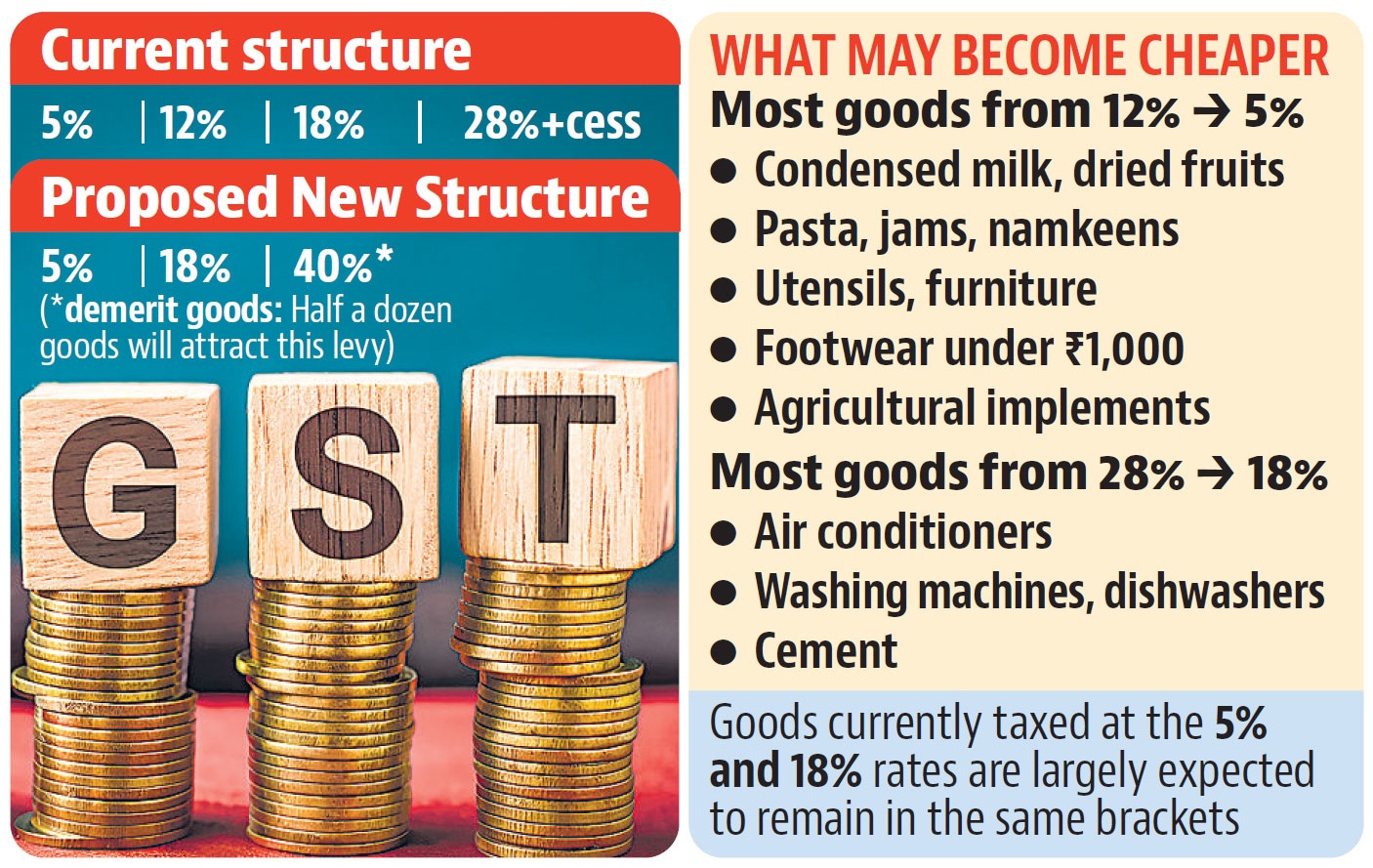
    1. Historic simplification: Earlier GST had 5%, 12%, 18%, and 28% slabs. The new 2-rate system with exemptions marks the biggest simplification since 2017.
    2. People-centric relief: Daily-use goods like soap, shampoo, bicycles, and kitchenware now taxed at 5%; essentials like milk, paneer, parathas exempt. This makes taxation citizen-friendly.
    3. Social security boost: All life and health insurance products are exempted from GST for the first time, improving affordability and raising insurance penetration.
    4. Correcting distortions: Long-pending inverted duty structures, particularly in textiles and fertilizers, have been corrected.
    5. Institutional strengthening: The announcement of GST Appellate Tribunal (GSTAT) by year-end promises faster dispute resolution.

    Impact of reforms on households and social security

    1. Cheaper essentials: Items like soap, shampoo, toothpaste, bicycles, and kitchenware moved to the 5% slab.
    2. Exemptions on food: UHT milk, paneer, chapatis, and parathas exempt, easing burden on middle and low-income families.
    3. Insurance relief: GST exemption on life and health insurance makes coverage accessible to senior citizens and low-income groups.
    4. Healthcare affordability: Cancer drugs, medicines for rare diseases, and critical devices made cheaper through exemptions and cuts.

    Benefits of GST 2.0 for farmers and rural India

    1. Lower cultivation cost: Fertilisers, sulphuric acid, and ammonia shifted from 18% to 5%.
    2. Cheaper farm equipment: Tractors and machinery brought to 5% slab, improving productivity and rural income.
    3. Structural correction: By rationalising inputs and outputs, GST 2.0 reduces price distortions and supports agricultural sustainability.

    Implications for industries and employment

    1. Labour-intensive sectors: Handicrafts, marble, granite, and leather goods get rate reductions, boosting employment.
    2. Textile competitiveness: GST on man-made fibres and yarn reduced to 5%, resolving a major inverted duty issue. This is expected to improve exports and domestic value-addition.
    3. Infrastructure multiplier: Cement rate cut from 28% to 18% to spur housing and infrastructure.
    4. Green economy boost: Cuts on renewable energy devices and auto components support sustainable growth.

    Institutional reforms under GST 2.0

    1. Operationalisation of GSTAT: To be functional by year-end, ensuring quicker dispute resolution and taxpayer confidence.
    2. Process reforms: Provisional refunds for inverted duty structures, risk-based compliance, and harmonised valuation rules reduce business uncertainty.
    3. Ease of doing business: These reforms align India’s tax system with global best practices and make compliance less cumbersome.

    Phased rollout and implementation strategy

    1. Gradual rollout: Effective from September 22, 2025, reforms are phased to balance fiscal stability and consumer benefits.
    2. Revenue neutrality: Phasing prevents sudden fiscal shocks while stimulating demand and investment.
    3. Stakeholder partnership: Council’s decisions reflect responsiveness to industry, consumers, and state governments.

    Conclusion

    GST 2.0 represents not just a fiscal reform but a societal shift. By rationalising slabs, correcting distortions, and easing compliance, it strengthens the foundation for a Viksit Bharat 2047. The reforms are inclusive, covering farmers, workers, households, and industries alike, while building institutions like GSTAT. The success of these reforms will ultimately depend on smooth implementation and sustained cooperative federalism.

    Value Addition

    Economic Reforms: GST 2.0 and Global Best Practices

    Two-rate model adoption: GST 2.0 moves from a complex four-slab structure (5%, 12%, 18%, 28%) to a simplified two-rate system (5% Merit Rate and 18% Standard Rate), with a 40% demerit rate for select goods. This mirrors global practices where most advanced economies prefer fewer slabs for simplicity.

    International parallels:

    1. Canada follows a dual rate Goods and Services Tax/Harmonized Sales Tax model, with exemptions for essentials like food and healthcare.
    2. Australia operates a uniform GST at 10% but exempts basic food, health, and education, similar in spirit to India’s exemptions on milk, paneer, chapati, and healthcare.
    3. Singapore maintains a single GST rate (currently 9%) with targeted exemptions.

    Benefits of convergence:

    1. Ease of compliance: Fewer slabs reduce classification disputes and litigation.
    2. Predictability for businesses: Encourages investment by aligning India’s tax structure with global investors’ expectations.
    3. Revenue neutrality with inclusivity: Exemptions for essentials ensure equity while maintaining fiscal stability.

    Reform trajectory: GST 2.0 represents a shift towards global standards without fully copying them, adapting the model to India’s socio-economic realities — balancing growth, inclusion, and fiscal prudence.


  • [1st September 2025] The Hindu Op-ed: India’s economic churn, the nectar of growth

    PYQ Relevance

    [UPSC 2019] Do you agree with the view that steady GDP growth and low inflation have left the Indian economy in good shape? Give reasons in support of your arguments.

    Linkage: India’s steady GDP growth of 7.8%, coupled with broad-based sectoral performance, reflects macroeconomic stability, while effective fiscal and monetary discipline underpins low inflation. The sovereign rating upgrade after 18 years validates external confidence in India’s fundamentals. These trends, along with inclusive poverty reduction, highlight that the economy is indeed in good shape.

    Mentor’s Comment

    India’s economy is once again at the centre of global attention. From being dismissed as a “dead economy” by sceptics, the latest economic data, sovereign rating upgrade, and energy security achievements have painted a powerful picture of resilience and renewal. This article unpacks the recent developments in India’s economic and energy story, their significance, and what they mean for aspirants of Viksit Bharat.

    Why is this issue in the news?

    India’s Q1 FY 2025-26 GDP figures revealed 7.8% real growth, the fastest among major economies, coupled with a historic sovereign rating upgrade by S&P Global after 18 years. Simultaneously, India has consolidated its position as the world’s third-largest energy consumer and is spearheading a green transition. These milestones are striking because they overturn the “dead economy” narrative, highlight India’s growing share in global growth, and showcase a balance between growth, reform, and welfare, all while maintaining democratic values in contrast to authoritarian models of fast-paced growth.

    Introduction

    Indian civilisation has always embraced the philosophy that turbulence precedes triumph, like the Samudra Manthan, where chaos yielded nectar. Similarly, India’s economic journey has turned crises into opportunities, from the liberalisation of 1991 to the digital surge during COVID-19. Today, India stands at another inflection point. Despite global headwinds and doubts, the country is demonstrating robust growth, deepening reforms, and a secure energy base, shaping the narrative of resilience and inclusive progress.

    Broad-based economic growth

    1. GDP expansion: Real GDP grew 7.8% in Q1 FY 2025-26, while GVA rose 7.6%, supported by manufacturing (7.7%), construction (7.6%), and services (9.3%).
    2. Global standing: India is the world’s fourth-largest economy and the fastest-growing major one, projected to overtake Germany by decade’s end.
    3. Global contribution: Independent estimates suggest India contributes 15% of incremental world growth, with ambitions to raise it to 20%.

    Why the sovereign rating upgrade matters

    1. S&P recognition: First upgrade in 18 years, citing robust growth, fiscal consolidation, and monetary credibility.
    2. Lower borrowing costs: Improves India’s access to cheaper capital and widens the investor base.
    3. Narrative shift: Counters the label of a “dead economy,” giving credibility to India’s reforms.

    Growth with inclusion

    1. Poverty reduction: 24.82 crore Indians moved out of multidimensional poverty between 2013-14 and 2022-23.
    2. Last-mile delivery: Success through bank accounts, clean cooking fuel, health cover, tap water, and direct benefit transfers (DBT).
    3. Democratic model: Built on consensus, competitive federalism, and digital rails, contrasting authoritarian growth models.

    Energy security as a growth driver

    1. Global role: India is the third-largest energy consumer, fourth-largest refiner, and fourth-largest LNG importer.
    2. Capacity expansion: Refining capacity of 5.2 mb/d with plans to cross 400 MTPA by 2030.
    3. Exploration reforms: Sedimentary basin coverage expanded to 16% in 2025 (from 8% in 2021), with 1 million sq km target by 2030.
    4. Gas reforms: New pricing linked to Indian crude basket; 20% premium for deepwater wells boosting investment.

    India’s energy transition

    1. Ethanol blending: Surged from 1.5% (2014) to 20% today, saving ₹1.25 lakh crore forex and paying ₹1 lakh crore to farmers.
    2. Green fuels: 300 compressed biogas plants under SATAT, targeting 5% blending by 2028.
    3. Hydrogen push: Oil PSUs driving the green hydrogen mission.

    Responding to global criticism on Russian oil

    1. Compliance: India operates fully within G-7/EU price cap systems; every transaction uses legal, audited channels.
    2. Global stabiliser: Purchases prevented oil shocks and stabilised prices, aligning with Vasudhaiva Kutumbakam.
    3. Export reality: India has been a top petroleum exporter for decades, not a “laundromat” for Russia.

    India’s digital-industrial revolution

    1. Semiconductors: Four new projects cleared under the India Semiconductor Mission; strengthened by Japan collaborations.
    2. Digital economy: India leads in real-time payments; UPI enhances small-business productivity and exports of solutions.
    3. Synergy: Gati Shakti logistics & digital rails reduce costs, formalise the economy, and spur consumption.

    Conclusion

    India’s recent performance is more than statistics, it is the reaffirmation of resilience, reform, and inclusion. The world’s doubters labelled it a “dead economy,” yet growth, energy security, digital leadership, and poverty reduction tell a different story. As reforms deepen, India is on track not just to become the world’s third-largest economy soon but also to build a model of democratic, inclusive, and sustainable growth. For India, Viksit Bharat is not aspiration, it is delivery in motion.

  • Simplified two-rate GST Structure

    Why in the News?

    • The Group of Ministers (GoM) on Rate Rationalisation has accepted the Centre’s proposal to simplify GST into a two-rate structure.
    • The recommendation will now be placed before the GST Council for final approval.

    https://www.thehindu.com/business/Economy/gom-on-rate-rationalisation-approves-centres-two-rate-gst-proposal/article69959558.ece 

    About Goods and Services Tax (GST):

    • Nature: Comprehensive, multi-stage, destination-based indirect tax on goods and services.
    • Introduction: Launched July 1, 2017, via the 101st Constitutional Amendment Act, 2016.
    • Replaced Taxes: Subsumed excise duty, value-added tax (VAT), service tax, etc.
    • Objectives: One Nation–One Tax, reduce cascading taxation, simplify compliance, expand tax base.
    • Structure: Five slabs – 0%, 5%, 12%, 18%, 28%, with cess on luxury/sin goods (tobacco, cars, online gaming).
    • Exemptions: Essential goods (food, medicines, education items) in 0% slab. Petroleum, alcohol, and electricity remain outside GST.

    Proposed Two-Rate GST Structure:

    • Reforms: Removal of 12% and 28% slabs; only 5% and 18% to remain.
    • Reclassification: 99% of 12% items → 5% slab; 90% of 28% items → 18% slab.
    • New Slab: 40% rate for demerit goods (tobacco, luxury cars, real-money gaming).
    • Cess: Compensation cess on 28% items to end.
    • Timeline: Implementation expected October 2025 (Diwali).

    Policy Rationale & Concerns:

    • Simplification: From four slabs to two, easing compliance and transparency.
    • Consumption Boost: Lower rates on daily goods to benefit households and Micro, Small and Medium Enterprises (MSMEs).
    • Compliance Gains: Less scope for disputes, litigation, and evasion.
    • Economic Signal: Projects confidence in domestic consumption as growth driver.
    • State Concerns: States, including Kerala, warn of revenue loss; call for compensation mechanism.
    [UPSC 2018] Consider the following items:

    1. Cereal grains hulled 2. Chicken eggs cooked 3. Fish processed and canned 4. Newspapers containing advertising material

    Which of the above items is/are exempted under GST (Goods and Services Tax)?

    Options: (a) 1 only (b) 2 and 3 only (c) 1, 2 and 4 only *(d) 1, 2, 3 and 4


  • Is the new Income Tax law more accessible? 

    Introduction

    In August 2025, Parliament passed the Income Tax Bill, 2025, a shorter and simplified legislation with 23 chapters (down from 47) and 536 sections (down from 819). The Bill aims to reduce discretion with clearer provisions, introduce taxpayer-friendly reforms like longer timelines for return updation, and curb harassment. However, it has also expanded the powers of tax officials, especially over digital information and personal data, raising concerns about privacy and misuse.

    Need for Overhauling the 1961 Income Tax Framework

    1. Obsolete framework: The Income Tax Act, 1961 had become outdated, riddled with amendments, and difficult for laypersons to interpret.
    2. Harassment potential: Excessive discretion allowed officials to harass taxpayers.
    3. Structural reform: New law cuts down chapters from 47 to 23 and sections from 819 to 536, simplifying compliance.
    4. Greater clarity: More tables (57, up from 18) and formulae (46, up from 6), along with examples to aid understanding.

    From Draft Bill to Final Law: The Legislative Journey

    1. Initial draft (Feb 2025): Introduced in Parliament but referred to a Select Committee given the Bill’s significance.
    2. Committee review: Headed by Baijayant Panda, with MPs across parties; submitted a detailed report in July 2025.
    3. Withdrawal & replacement: Government withdrew the earlier version on August 8, 2025, to incorporate committee recommendations.
    4. Final Bill (Aug 11, 2025): Introduced and passed the same day, avoiding confusion through multiple versions.

    Key Reforms and Structural Simplifications:

    1. No slab changes: Finance Minister clarified tax rates and slabs remain unchanged.
    2. Technical refinements: Clearer provisions for Minimum Alternate Tax (MAT) and Alternate Minimum Tax (AMT), separated into sub-sections.
    3. Taxpayer-friendly features: Returns can be updated up to 4 years from the end of the relevant assessment year without penalty; Assessment reopening period reduced to 5 years.

    Simplification Gains and Emerging Concerns

    1. Expanded search powers: Tax officers can now demand passwords of electronic devices, emails, and social media accounts.
    2. Override access: Officials may bypass access codes to computer systems if passwords are not shared.
    3. Privacy concerns: Unlike earlier provisions (limited to inspection and lock-breaking), the new law extends to personal digital data, raising red flags.

    Government’s Rationale for Expanding Digital Powers

    1. Rationale: Much of financial data today is exchanged via messaging apps, emails, or stored digitally.
    2. Committee stance: Though some dissent was recorded, the Select Committee accepted the government’s view that these provisions are essential for effective investigation.

    Conclusion

    The Income Tax Bill, 2025 is a watershed reform, simplifying one of India’s most complex laws. While the codification of taxpayer-friendly provisions marks a progressive step, the enhanced surveillance powers granted to tax authorities highlight the thin line between efficiency and overreach. The challenge ahead lies in ensuring that simplification does not come at the cost of citizens’ trust and constitutional rights.

    Value Addition for UPSC

    • Governance angle (GS-II): Balancing simplification of laws with citizen rights and privacy.
    • Economic reforms (GS-III): Tax rationalisation improves compliance and ease of doing business.
    • Ethics (GS-IV): Dilemma of state surveillance vs. individual liberty; Kantian duty-based ethics vs. utilitarian approach.
    • Comparative context: Similar debates exist globallye.g., U.S. IRS’s digital access powers vs. EU’s stricter GDPR protections.

    PYQ Relevance

    [UPSC 2020] Explain the rationale behind the Goods and Services Tax (Compensation to States) Act of 2017.How has COVID-19 impacted the GST compensation fund and created new federal tensions?

    Linkage: The GST Compensation Act, 2017 aimed to build Centre–State trust during the GST transition but COVID-19 strained revenues, sparking federal tensions. Similarly, the Income Tax Bill, 2025 seeks to simplify direct taxes to build citizen trust but raises concerns over state overreach in digital surveillance. Both show that taxation is ultimately about trust and legitimacy in governance.

    Practice Mains Question

    The Income Tax Bill, 2025 seeks to simplify India’s tax regime but also introduces stronger surveillance powers for officials. Discuss the balance between efficiency, transparency, and taxpayer rights. (250 words)

    Mapping Microthemes for GS Papers

    1. GS-I: Evolution of economic policies post-Independence.
    2. GS-II: Governance, legislative reforms, fundamental rights (privacy).
    3. GS-III: Fiscal reforms, tax policy, ease of doing business.
    4. GS-IV: Ethics of surveillance, transparency, accountability.
  • New Income Tax Bill, 2025

    Why in the News?

    Parliament has passed the Income-tax Bill, 2025, replacing the 1961 law with a leaner, simpler version free of redundant provisions and archaic language, effective April 1, 2026.

    About New Income Tax Bill, 2025:

    • Purpose: Replaces the Income Tax Act, 1961 after more than 60 years to simplify the law, remove redundant provisions, and modernise tax administration.
    • Effective Date: Comes into effect from April 1, 2026.
    • Structural Changes: Sections reduced from 819 to 536; chapters from 47 to 23.
    • Conciseness: Word count cut from 5.12 lakh to 2.6 lakh, with 39 tables and 40 formulas for clarity.
    • New Concept: Introduces “tax year” defined as April 1 to March 31.

    Key Features:

    • Refunds: Restores refund claims on belated returns by removing the earlier restriction.
    • Tax Collected at Source (TCS) Clarity: Nil TCS for Liberalised Remittance Scheme (LRS) remittances for education funded by financial institutions.
    • Corporate Tax: Corrects errors in inter-corporate dividend deduction for companies opting for concessional tax rates.
    • Alternate Minimum Tax (AMT) Alignment: Aligns AMT provisions for Limited Liability Partnerships (LLPs) with existing rates.
    • Nil-Tax Deducted at Source (TDS) Certificate: Permits taxpayers with no liability to obtain a nil-TDS certificate.
    • Transfer Pricing: Clarifies transfer pricing provisions, set-off of losses, and alignment with Section 79 on “beneficial owner.”
    • Non-Profit Organisation (NPO) Benefit: Expands exemption to 5% of total donations, instead of only anonymous donations.
    • House Property Income: Clarifies 30% standard deduction after municipal taxes.
    • Search Definition: Retains “virtual digital space” definition to include cloud storage, email, and social media accounts.
    • Data Handling: Standard Operating Procedure (SOP) to be issued for handling personal digital data seized in searches.
    [UPSC 2025] Consider the following statements: Statement I: In India, income from allied agricultural activities like poultry farming and wool rearing in rural areas is exempted from any tax. Statement II: In India, rural agricultural land is not considered a capital asset under the provisions of the Income-tax Act, 1961.

    Which one of the following is correct in respect of the above statements?

    (a) Both Statement I and Statement II are correct and Statement II explains Statement I

    (b) Both Statement I and Statement II are correct but Statement II does not explain Statement I*

    (c) Statement I is correct but Statement II is not correct

    (d) Statement I is not correct but Statement II is correct


  • [9th August 2025] OPED With tariffs, India’s growth rate needs a careful watch

    The recent U.S. decision to impose a 25% reciprocal tariff and an additional 25% penal levy on India’s exports marks a sharp turn in bilateral trade relations. While aimed at narrowing the U.S. trade deficit and influencing India’s crude sourcing from Russia, these measures risk slowing India’s GDP growth, widening the Current Account Deficit, and adding pressure on the rupee, making it a key test for India’s economic resilience in an era of rising protectionism.


    Context:

    The United States has imposed two major trade measures against India in August 2025:

    1. 25% Reciprocal Tariff (effective August 7) — in response to U.S. trade imbalance with India.
    2. 25% Penal Levy (effective August 29) — as a consequence of India’s continued oil imports from Russia.

    Both actions together could significantly affect India’s exports, GDP growth, and the Current Account Deficit (CAD).

    India–U.S.A Trade Snapshot:

    1. Merchandise trade surplus in 2024–25: $41.18 billion in India’s favour.
    2. The U.S. is targeting both exports and imports to narrow this gap.
    3. The penal levy also acts as a non-tariff barrier pushing India to source crude from costlier markets like the U.S. itself.

    Potential Economic Implications for India

    The combined effect of these tariffs and the penal levy could have severe consequences for India’s economic health.

    • Impact on Trade Balance and Current Account Deficit (CAD):
      1. Export Decline: The immediate and most direct impact will be a sharp decline in India’s exports to the US. Assuming a high import elasticity of -1, the article suggests that exports could fall by 25%.
      2. Widening Trade Deficit: Even with this decline, the overall trade deficit for India is estimated to widen by about 0.56% of GDP.
      3. Current Account Deficit: It is projected to increase from 0.6% to 1.15% of GDP due to the US reciprocal tariffs alone.
    • Effect on GDP Growth Rate:
      1. The decline in exports and the widening of the trade and current account deficits will have a ripple effect on the overall economy.
      2. When both the reciprocal tariffs and the penal levy are taken into account, the total reduction in the growth rate could be even more significant, exceeding 0.6 percentage points.
    • Currency and Inflationary Pressures
      1. Currency Depreciation: This can happen due to the uncertainty and trade deficit. The rupee-dollar exchange rate has already seen pressure, hovering over ₹87.5 since the tariffs were announced.
      2. Inflation: A shift away from Russian oil towards potentially more expensive crude sources, coupled with rising global oil prices, could put significant pressure on domestic inflation.

    India’s Strategic Response and Mitigating Factors:

    • Diplomatic and Trade Negotiations:
      1. Negotiating with the US: There is still room for negotiation with the US, especially since a comprehensive trade deal has not been finalized.
      2. Highlighting Unilateralism: India needs to work with other nations to draw global attention to the discriminatory and inequitable nature of the US’s actions, particularly the penal levy imposed over oil imports.
    • Domestic Policy Adjustments:
      1. Diversification of Export Markets: In the long term, reducing dependence on a single large market like the US is crucial.
      2. Review of Import Tariffs: India’s own import tariffs negatively affect its exports. A strategic review and reduction of these tariffs could boost export competitiveness by lowering input costs for Indian producers.
    • Role of Other Factors:
      1. New Trade Agreements: India’s recent Comprehensive Economic and Trade Agreement with the UK and ongoing negotiations with the European Union could help moderate the adverse impact on the CAD by opening up new markets.
      2. Exchange Rate: The depreciation of the rupee, while a sign of pressure, can also act as a natural buffer by making Indian exports cheaper and more competitive in global markets.

    To counter the economic impact of US tariffs, India’s path forward must be two-fold: proactive diplomatic engagement to challenge protectionism, and focused domestic policy reforms to boost export competitiveness. By diversifying its trade partners and refining its own tariff policies, India can fortify its economic resilience against external shocks.


    Value Addition:

    Key Economic Terms

    1. Current Account Deficit (CAD) – when a country imports more goods, services, and capital than it exports.
    2. Import elasticity with respect to tariffs – percentage change in imports in response to a percentage change in tariffs.
    3. Non-tariff barriers – policy measures other than tariffs that restrict imports/exports (e.g., quotas, licensing).
    4. Merchandise trade surplus – when export value exceeds import value for goods.
    5. Exchange rate depreciation – decline in the value of a currency relative to others.

    Mains Practice Question:

    “Unilateral trade measures by major powers pose a significant challenge to the principles of free and fair trade. In light of recent US tariffs on India, discuss the potential economic consequences for India and critically evaluate the policy options available to mitigate these risks.” (Answer in 250 words)

  • Asset Under Management (AUM)

    Why in the News?

    India’s Mutual Fund (MF) industry has witnessed exponential growth, with Assets Under Management (AUM) reaching ₹74.40 lakh crore as of June 2025, a sevenfold increase over the past decade.

    What are Assets Under Management (AUM)?

    • Definition: AUM refers to the total market value of financial assets (stocks, bonds, etc.) managed by an investment firm on behalf of clients.
    • Growth Drivers:
      • Net investor inflows and redemptions
      • Market performance
      • Dividend reinvestments
    • Importance:
      • Indicates fund size, investor confidence, and fund stability
      • Reflects fund manager performance and popularity
      • Higher AUM allows better liquidity and portfolio diversification
      • Impacts management fees and minimum investment limits

    What is a Mutual Fund?

    • Definition: A mutual fund pools money from multiple investors to invest in a diversified portfolio.
    • Management: Handled by professional fund managers to balance risk and return.
    • Unit-Based Investment: Investors purchase fund units; each unit’s value is called the Net Asset Value (NAV), which changes with market movement.

    Classification of Mutual Funds

    a. Based on Asset Class:

    1. Equity Funds: Invest in stocks; includes large-cap, mid-cap, and small-cap funds.
    2. Debt Funds: Invest in bonds and other fixed-income instruments.
    3. Hybrid Funds: Mix of equity and debt for balanced risk-return.

    b. Based on Investment Objective:

    1. Growth Funds: Focus on capital appreciation; suitable for long-term investors.
    2. Income Funds: Aim for regular income via bonds/dividends.
    3. Liquid Funds: Invest in short-term debt; low risk and high liquidity.
    4. Tax-saving Funds (Equity Linked Savings Scheme): Offer Section 80C tax benefits; equity-focused.
    5. Pension Funds: Meant for retirement; long-term return-focused.

    c. Based on Structure:

    1. Open-ended Funds: Investors can enter or exit anytime; highly liquid.
    2. Closed-ended Funds: Fixed maturity; investments only during the initial offer period.
    3. Interval Funds: Allow purchase/redemption only at specific intervals.


    [UPSC 2025] Consider the following statements:

    I. India accounts for a very large portion of all equity option contracts traded globally, thus exhibiting a great boom. II. India’s stock market has grown rapidly in the recent past, even overtaking Hong Kong’s at some point in time. III. There is no regulatory body either to warn small investors about the risks of options trading or to act on unregistered financial advisors in this regard.

    Which of the statements given above are correct?

    Options:  (a) I and II only * (b) II and III only (c) I and III only (d) I, II and III


  • IMF releases World Economic Outlook (WEO)

    Why in the News?

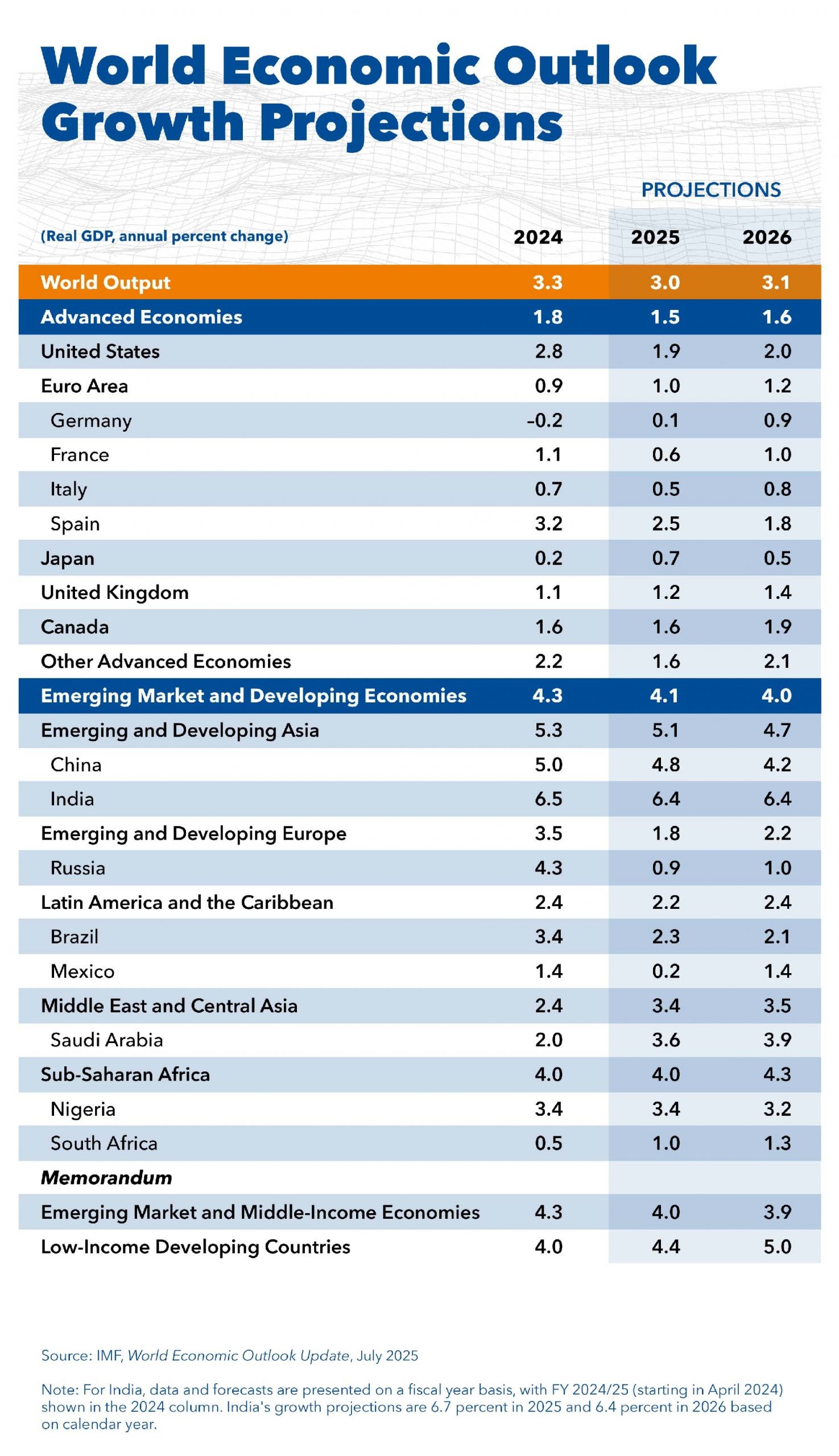
    The International Monetary Fund (IMF) has released the July 2025 update to its World Economic Outlook (WEO).

    IMF releases World Economic Outlook (WEO)

    About World Economic Outlook (WEO):

    • Published By: International Monetary Fund (IMF)
    • Frequency: Biannual (April, October) + updates in January and July
    • Purpose: Provides global forecasts on GDP, inflation, trade, and policy trends
    • Data Sources: IMF consultations with member nations and internal models
    • Audience: Governments, institutions, investors, researchers
    • July 2025 Update Title: “Global Economy: Tenuous Resilience amid Persistent Uncertainty”

    Key Highlights – July 2025 Update:

    • Global Growth Projections:
      • 2025: 3.0% (↑ from 2.8% in April)
      • 2026: 3.1% (↑ from 3.0%)
    • Despite multiple shocks—COVID-19, the Ukraine war, tariff increases—global growth continues.
      However, resilience remains fragile due to:

      • US–China tariff tensions and rising protectionism
      • Conflicts in Ukraine and the Middle East
      • High public debt in advanced economies is raising interest rates
    • Country Forecasts for 2025:  United States: 1.9%,  China: 4.8% (↑ from 4.0%),  Euro Area: 1.0%,  Germany: 0.1%,  United Kingdom: 1.2%,  Japan: 0.7%,  Russia: 0.9%,  Pakistan: 2.7%.

    India – The Bright Spot:

    • Growth Rate: 2023: 9.2%;  2024: 6.5%;  2025: 6.4% (strongest among major economies).
    • Drivers of Growth:
      • Robust domestic demand
      • Strong services and manufacturing output
      • Effective inflation and monetary policy management
    • Strategic Position:
      • Set to overtake several advanced economies in GDP size
      • Viewed globally as a “bright spot” amid persistent uncertainties
    [UPSC 2014] Which of the following organisations brings out the publication known as ‘World Economic Outlook?

    Options: (a) The International Monetary Fund * (b)The United Nations Development Programme (c) The World Economic Forum (d) The World Bank


  • [pib] Digital Payments Index (DPI)

    Why in the News?

    According to the Reserve Bank of India (RBI), digital payments registered a 12.6% year-on-year rise as of March 31, 2024, as measured by the RBI’s Digital Payments Index (DPI).

    About RBI’s Digital Payments Index (DPI):

    • Launched by: Reserve Bank of India (RBI) in January 2021
    • Purpose: Measures the extent of digital payment adoption across India
    • Base Period: March 2018 (Index value = 100)
    • Release Frequency: Semi-annually (with a 4-month lag)
    • Objective: Track usage, infrastructure, and growth in digital payments
    • Key Parameters (with Weightage): These evaluate infrastructure readiness, transaction volume, user adoption, and innovation.
      1. Payment Enablers – 25%
      2. Payment Infrastructure – Demand Side – 10%
      3. Payment Infrastructure – Supply Side – 15%
      4. Payment Performance – 45%
      5. Consumer Centricity – 5%

    Growth Highlight:

    • Growth Trends in RBI-DPI: DPI grew nearly 5 times from 100 in March 2018 to 493.22 in March 2025, reflecting India’s rapid digital payment adoption.
    • Nearly 5× increase from the base value in 7 years
    • Driven by rapid expansion of Unified Payments Interface (UPI), mobile wallets, and QR code infrastructure
    [UPSC 2024] Consider the following countries:

    I. United Arab Emirates II. France III. Germany IV. Singapore V. Bangladesh

    How many countries amongst the above are there other than India where international merchant payments are accepted under UPI?”

    Options: (a) Only two (b) Only three* (c) Only four (d) All the five

    Answer: (b) Only three (UAE, France, Singapore)