💥Join UPSC 2027,2028 Mentorship (July Batch) + XFactor Notes & Microthemes PDF

GS Paper: Indigenization Of Technology

  • [1st December 2025] The Hindu OpED: India needs research pipelines

    PYQ Relevance

    [UPSC 2024] What is the present world scenario of intellectual property rights with respect to life materials? Although India is second in the world to file patents, still only a few have been commercialized. Explain the reasons behind this less commercialization.

    Linkage: India’s weak research pipelines, unpredictable R&D funding, and poor industry-university linkages directly explain why patent filings do not translate into commercialization, making this PYQ highly relevant for GS-III themes of IPR, innovation ecosystem, GERD gaps, and research-industry translation.

    Mentor’s Comment

    India stands at a decisive moment where research capacity, funding predictability, and university-industry linkages.  It will determine whether it becomes a global knowledge leader or remains a low spender on R&D. This translates a critical national issue, India’s missing research pipelines, into a structured UPSC Mains-ready analysis.

    Introduction

    India’s ambition to innovate and lead in emerging technologies is constrained by irregular research outlays, limited campus-industry linkage, low GERD (0.65% of GDP), and absence of predictable pipelines that convert lab innovations into products, patents, and industry deployment. In sharp contrast, countries that succeeded, such as the U.S., China, and advanced economies, matched corporate R&D efforts with stable campus-strengthening investments, enabling a steady rise in innovation intensity. India now aims to transition from isolated research islands to structured, industry-driven, multi-university research pipelines.

    Why in the News? 

    India’s research ecosystem is under scrutiny because GERD remains stagnant at 0.65% of GDP, despite corporates like Tata Motors, Dr. Reddy’s, Reliance, Sun Pharma and Bharat Electronics posting strong R&D numbers in FY24. A major contrast is visible: India has global-scale labs and talent but lacks predictable, industry-linked research pipelines, unlike countries that institutionalised grant mechanisms, co-funded platforms, and competitive university partnerships. This mismatch between capability and structure is now a policy priority and a turning point for India’s innovation ambitions.

    What global benchmarks reveal about successful research ecosystems?

    1. Stable research outlays: Countries that scaled innovation kept firm-level R&D spending steady for years; they aligned CSR-type funding to predictable pipelines supporting labs and doctoral cohorts.
    2. Corporate-university integration: The U.S. NSF’s Industry-University Cooperative Research Centers and Semiconductor Research Corporation link firms with competitive research consortia.
    3. High corporate R&D leadership: Firms like Meta invested ~$44 billion in 2024; Alphabet, Amazon, Apple, IBM and Microsoft anchor multibillion-dollar R&D programmes.
    4. Translation into partnerships: U.S. universities booked ~$692 billion of domestic R&D payments; ratio of industry contracting rose sharply in 2022.

    Where does India stand in corporate R&D performance?

    1. High-intensity corporate R&D: Tata Motors posted ₹44,381 crore revenue and ₹29,398 crore R&D in FY24 (6.7% intensity).
    2. Sectoral R&D patterns: Sun Pharma invested 6.7%; Dr. Reddy’s spent ₹2,29 billion (8.2% of sales).
    3. Strategic spending: Bharat Electronics Ltd. invested 2.64% of turnover; Reliance Industries spent over ₹4,100 crore on R&D in FY24-25.
    4. Emerging partnerships: Marlabs Research Park hosts more than 200 companies near faculty labs, creating a daily flow of industry ideas.

    What structural gaps weaken India’s research pipeline?

    1. Low GERD-to-GDP ratio: GERD at 0.65% of GDP remains below advanced economies.
    2. Irregular funding cycles: HEIs face unpredictable, short-term grants; lack of multi-year financial visibility disrupts research continuity.
    3. Weak measurable outcomes: Absence of instruments like patent targets, standards contributions, and milestone-linked funding.
    4. Fragmented labs: Universities operate as isolated research islands instead of multi-university shared platforms.

    What policy directions does the article propose?

    1. Three-year R&D-to-sales norms: Electronics, pharma, defence and space firms must agree on rising year-on-year ratios supported by market-linked export expectations.
    2. Shared campus facilities: Co-funded platforms where industry uses HEI labs for multi-year projects with open data deliverables.
    3. Deadline industry-relevant KPIs: Universities must maintain structured performance indicators tied to outcomes.
    4. Credit for collaborative research: Benefit firms that hire PhDs, invest in accredited labs, or co-supervise doctoral research.
    5. Strengthening university research culture: Indian universities sit near dynamic markets; they must channel their knowledge traditions into technology breakthroughs.

    How can India build future-ready research pipelines?

    1. Predictable funding architecture: Move from ad-hoc grants to structured multiyear timelines and tendered project pipelines.
    2. National mission pipelines: Semiconductor Mission’s startup and research integration via IDEX and AIMTOP serve as replicable templates.
    3. Multi-university shared centres: These can pool equipment, modernise test instruments, and convert research into measurable outputs.
    4. Industry-ready researchers: Create dual-track PhD programmes aligned with corporate rotations, job assignments, and real field tasks.
    5. Publicise R&D metrics: Annual reporting by listed companies on R&D intensity and HEI contributions to enhance transparency.

    Conclusion

    India possesses the labs, talent and markets, yet the absence of predictable research pipelines denies it the innovation momentum achieved by global peers. With structured outlays, measurable outputs, co-funded facilities, multi-university centres, and industry-linked doctoral programmes, India can transform research from a sporadic activity into a national innovation supply chain. This shift is essential for scaling Indian R&D and creating sustained technological competitiveness.
  • Samudrayaan Mission 

     Why in the News?

    • Key tests for Samudrayaan, India’s first manned deep-ocean submersible, have been delayed due to the late procurement of syntactic foam cladding from France. The crucial 500-metre test dive is now expected by mid-2025 (around April).

    What is syntactic foam? 

    • A special composite material made of hollow micro-balloons embedded in resin. Provides high buoyancy & resistance to extreme pressure → essential for deep-sea vehicles.

    About Samudrayaan

    • Part of India’s Deep Ocean Mission (DOM) under the Ministry of Earth Sciences (MoES).
    • Developed by the National Institute of Ocean Technology (NIOT), Chennai.
    • Aim: Conduct manned exploration of deep-sea resources and collect soil & rock samples from the ocean floor.

    Features of the Manned Submersible (MATSYA-6000)

    • Capacity: 3 persons
    • Maximum Depth: 6,000 metres
    • Hull Material: Titanium sphere (final version)
    • Buoyancy: Achieved using syntactic foam
    • Purpose:
      • Deep-sea mineral exploration
      • Study of polymetallic nodules
      • Geological and biological sample collection

    Depth Significance

    • Only a few countries (USA, Russia, China, Japan, France) have undertaken comparable manned dives.
    The term ‘IndARC’, sometimes seen in the news, is the name of (2015)

    (a) an indigenously developed radar system inducted into Indian Defence 

    (b) India’s satellite to provide services to the countries of Indian Ocean Rim 

    (c) a scientific establishment set up by India in Antartic region 

    (d) India’s underwater observatory to scientifically study the Arctic region

  • MH-60R Seahawk Follow-On Support Deal

     Why in the News?

    India on 28 November 2025 signed a ₹7,995-crore follow-on support package with the United States for the Indian Navy’s fleet of 24 MH-60R Seahawk helicopters. The deal comes amid recent tensions after the U.S. imposed 50% tariffs on Indian goods.

    Key Highlights of the Deal

    • Signed under: U.S. Foreign Military Sales (FMS) programme.
    • Documents signed: Letters of Offer and Acceptance (LOAs).
    • Duration: 5 years.
    • Purpose: Long-term sustainment support for MH-60R helicopters.

    What the Sustainment Package Includes

    • Provisioning of spares, support equipment, training, technical support.
    • Repair and replenishment of components.
    • Setting up of intermediate-level component repair and periodic maintenance inspection facilities in India.
    • Improved operational availability and maintainability of the fleet.

    About MH-60R Seahawk

    • Manufacturer: Lockheed Martin.
    • Type: Maritime variant of the Black Hawk helicopter.
    • Features:
      • All-weather capability
      • Advanced avionics and sensors
      • Multi-mission: ASW, anti-surface warfare, surveillance, search & rescue, logistics.
    Consider the following statements: (2009)

    1. INS Sindhughosh is an aircraft carrier.

    2. INS Viraat is a submarine.

    Which of the statements given above is/ are correct?

    (a) 1 only (b) 2 only (c) Both 1 and 2 (d) Neither 1 nor 2

  • Entrepreneur-in-Residence (EIR) Programme & BRIC  

    Why in the news? 

    At the 3rd Annual General Meeting of the Biotechnology Research and Innovation Council (BRIC), Union Minister Dr. Jitendra Singh highlighted the growing importance of the Entrepreneur-in-Residence (EIR) Programme and India’s rising biotech innovation ecosystem.

    Entrepreneur-in-Residence (EIR) Programme

    • It is one of the programmes launched under the National Initiative for Developing and Harnessing Innovations (NIDHI).
    • A Government of India initiative to bridge the gap between research and enterprise.
    • Encourages young scientists, innovators, and researchers to become scientist-entrepreneurs.
    • Helps convert lab research → market-ready innovations.

    About BRIC

    • Established: 2023
    • Type: Pan-India umbrella network of biotechnology research institutions.
    • First major experiment in merging multiple institutes under one collaborative body.
    • Ranked as India’s top organization in biological sciences research (Nature Index India 2025).
    Which of the following statements is/are correct regarding National Innovation Foundation India (NIF)? (2015)

    (1) NIF is an autonomous body of the Department of Science and Technology under the Central Government. 

    (2) NIF is an initiative to strengthen the highly advanced scientific research in India’s premier scientific institution in collaboration with highly advanced foreign scientific institution. 

    Select the correct answer using the code given below. 

    (a) 1 only (b) 2 only (c) Both 1 and 2 (d) Neither 1 nor 2

  • IAF’s Tejas jet crashes during demo flight at Dubai Air Show, pilot killed

    Why In The News?

    An Indian Air Force Tejas fighter jet crashed during the Dubai Air Show, killing Wing Commander Namansh Syal, after spiralling out of control and igniting on impact at Al Maktoum International Airport.

    1)Tejas Mk1A: 

    • About: The Tejas Mk1A is an upgraded variant of India’s Light Combat Aircraft (LCA) Tejas, developed by Hindustan Aeronautics Limited (HAL).
    • Purpose: This version is aimed to enhance operational and combat capabilities, survivability and maintainability over the baseline Mk1.
    • Capabilities:
      • Active Electronically Scanned Array (AESA) radar integration.
      • Electronic Warfare Suite (EWS) – radar‑warning and self‑protection jamming.
      • Upgraded Flight Control Computer (DFCC Mk1A) for better maneuverability and stability.
      • Missile compatibility- Beyond Visual Range (BVR) missiles, Air-to-Air and Air-to-Ground missiles and Advanced Short Range Air-to-Air Missiles (ASRAAM).
      • Planned integration of Combined Interrogator and Transponder (CIT)Software Defined Radio (SDR) and Operating Data Link (ODL) with existing onboard avionics.

    2) LCA Tejas:

    • About: The LCA Tejas programme, initiated by the Government of India in 1984, aimed to replace the ageing MiG-21 fighter jets. The programme is managed by the Aeronautical Development Agency (ADA).
    • Features:
      • Lightest, smallest, and tailless multi-role supersonic fighter in its class.
      • Capable of carrying a variety of air-to-air, air-to-surface, and precision-guided weapons.
      • Maximum payload capacity of 4000 kg.
      • Maximum speed: Mach 1.8.
      • Range: 3,000 km.
    • Variants of Tejas:
      • Tejas Trainer: 2-seater operational conversion trainer for training air force pilots.
      • LCA Navy: Twin- and single-seat carrier-capable for the Indian Navy.
      • LCA Tejas Navy MK2: This is phase 2 of the LCA Navy variant.
      • LCA Tejas Mk-1A: This is an improvement over the LCA Tejas Mk1 with a higher thrust engine.

    3)Fifth Generation Fighter Jets:

    • About:
      • Combat Role: Designed for highly contested combat zones with advanced air and ground threats.
      • Stealth & Speed: Feature stealth technology and supercruise capability.
      • Key Advantages:
        • Multi-spectral low-observable design
        • Enhanced self-protection
        • Radar jamming capabilities
        • Fully integrated avionics systems
      • Global Operators:
        • Russia: Sukhoi Su-57
        • China: Chengdu J-20
        • United States: F-35 series
    • Need for India:
      • Squadron Strength: IAF has ~30 squadrons, below the sanctioned 42.
      • Ageing Fleet:
        • MiG-21
        • MiG-29
        • Jaguar
        • Mirage 2000
        • All to be phased out by mid-next decade.
      • Airpower Gap:
        • China: 3,304 aircraft
        • India: 2,296 aircraft
        • Pakistan: 1,434 aircraft
      • Strategic Need: Strengthen air defences against China and Pakistan and increase defence self-reliance.
      • Indigenous Development:
        • Developing AMCA
        • Five prototypes planned
        • Joint effort by ADA, HAL, and private industry
      • Strategic Positioning: 5G fighters would place India alongside the US, Russia, and China.
    [UPSC 2024] Question: Consider the following aircraft:

    1. Rafael

    2. MiG-29

    3. Tejas MK-1

    How many of the above are considered fifth generation fighter aircraft?

    Options: (a) Only one (b) Only two (c) All three (d) None*


  • India’s first overseas Defence Facility in Morocco

    Why in the News?

    Defence Minister Rajnath Singh inaugurated Tata Advanced Systems’ plant at Berrechid, Morocco—India’s first overseas and Morocco’s largest defence manufacturing facility.

    About India’s Morocco Defence Facility:

    • Developer: Established by Tata Advanced Systems Limited (TASL) – India’s first overseas defence manufacturing facility and Morocco’s largest defence plant.
    • Scale & Capacity: Spread over 20,000 sq. m. with capacity to produce ~100 armoured vehicles annually.
    • Product: Focused on the Wheeled Armoured Platform (WhAP) 8×8, jointly developed by TASL and DRDO.
    • Variants: Modular designs include Infantry Fighting Vehicle, Armoured Personnel Carrier, Reconnaissance Vehicle, Command Post, Mortar Carrier, and Ambulance.
    • Operations: First deliveries to the Royal Moroccan Army scheduled for October 2025.

    Significance:

    • Strategic Expansion: Extends India’s defence vision from Make in India to Make for the World.
    • Diplomatic Milestone: Symbolises stronger India–Morocco defence ties, marked by the first visit of an Indian Defence Minister to Morocco.
    • Economic & Employment Boost: Creates jobs in Morocco; 33% local sourcing of components (to increase to 50%).
    • Export Hub: Morocco’s location makes it a gateway to Africa and Europe, enhancing India’s defence export footprint.
    • Security Role: Enhances regional defence capacity and establishes India as a credible global supplier of armoured vehicles.
    [UPSC 2017] What is the importance of developing Chabahar Port by India?

    Options: (a) India’s trade with African countries will enormously increase.

    (b) India’s relations with oil-producing Arab countries will be strengthened.

    (c) India will not depend on Pakistan for access to Afghanistan and Central Asia. *

    (d) Pakistan will facilitate and protect the installation of a gas pipeline between Iraq and India.


  • Vikram 32-Bit Processor

    Why in the News?

    Union Minister for Electronics & IT has presented PM with a memento containing the first ‘Made in India’ Vikram 32-bit Launch Vehicle Grade Processor (VIKRAM3201).

    About Vikram 32-bit Processor (VIKRAM3201):

    • Overview: India’s first fully indigenous 32-bit space-grade microprocessor, developed by VSSC–ISRO with Semiconductor Laboratory (SCL), Chandigarh.
    • Lineage: Successor of 16-bit VIKRAM1601 (used since 2009 in ISRO launch vehicles), designed for avionics, navigation, guidance, and mission control.
    • Launch & Validation: Unveiled at Semicon India 2025 as a symbol of India’s semiconductor self-reliance. Validated in space during PSLV-C60 (2025) via POEM-4 experiments.
    • Applications: Primarily for space missions, but also suited for defence, automotive, and energy systems due to its rugged reliability.
    • Policy Support: Developed under India Semiconductor Mission and Design Linked Incentive (DLI) scheme, reflecting policy thrust on indigenous chip design and manufacturing.

    Key Technical Features:

    • Architecture: 32-bit design with support for 16/32-bit fixed-point and 64-bit floating-point (IEEE754) operations, essential for trajectory precision.
    • Registers & Memory: 32 registers (32-bit wide), capable of addressing up to 4096M words of memory.
    • Instruction Set: 152 instructions with microprogrammed control for flexibility in aerospace computations.
    • Performance: Operates at 100 MHz, single 3.3V supply, consumes <500 mW power, with <10 mA quiescent current.
    • Environmental Tolerance: Functions between –55°C to +125°C, fit for space and military conditions.
    • Interfaces: Equipped with four 32-bit timers, 256 software interrupts, and dual on-chip 1553B bus interfaces for avionics communication.
    • Software Compatibility: Optimised for Ada language (aerospace standard); C compiler support under development by ISRO.
    • Packaging & Fabrication: Built in a 181-pin ceramic PGA package, fabricated on 180 nm CMOS process at SCL, Mohali.
    [UPSC 2008] Which one of the following laser types is used in a laser printer?

    Options: (a) Dye laser  (b) Gas laser (c) Semiconductor laser  (d) Excimer laser


  • Integrated Air Defence Weapon System (IADWS) 

    Why in the News?

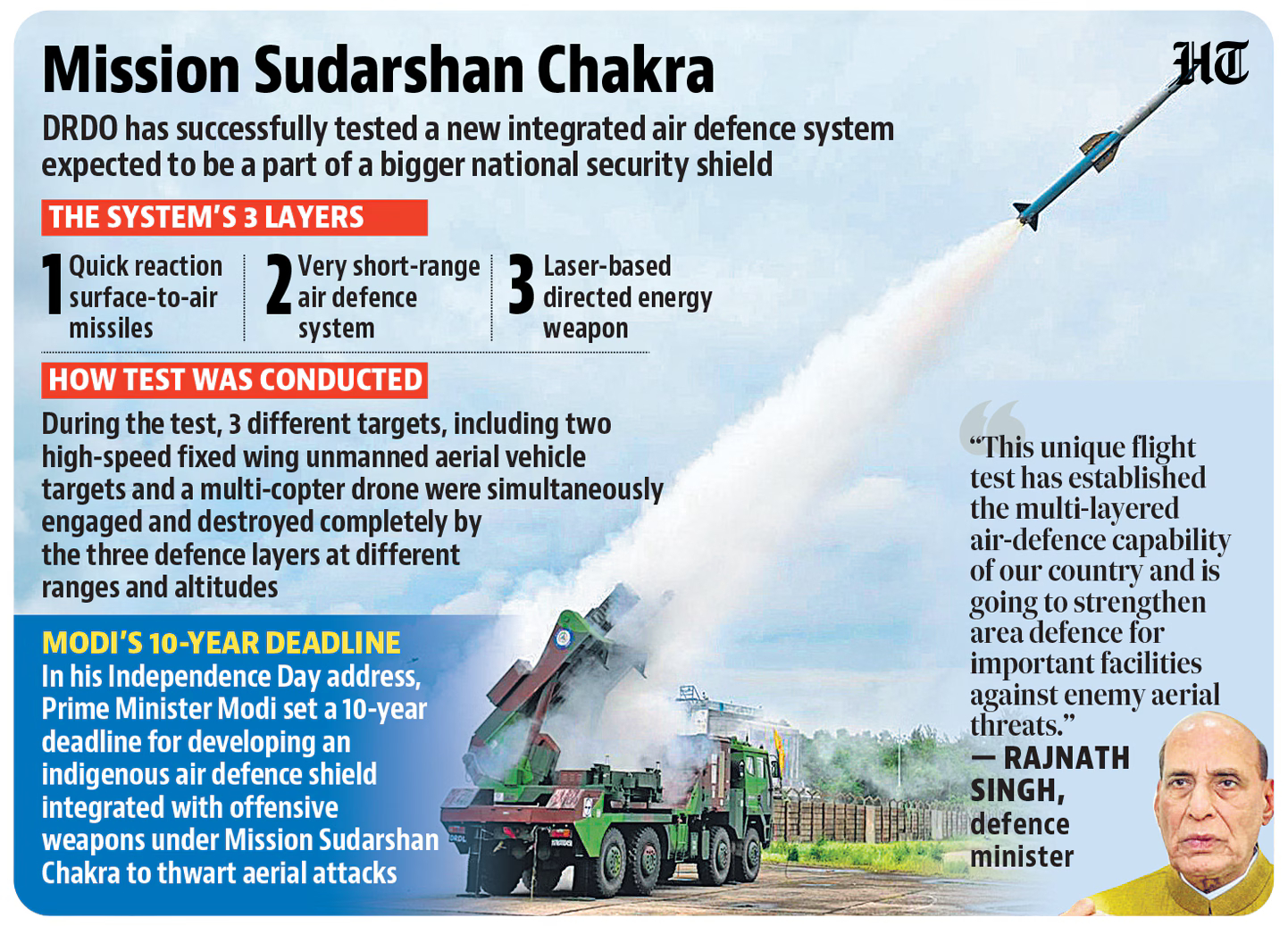
    The DRDO has successfully conducted the maiden flight-tests of the Integrated Air Defence Weapon System (IADWS) off the coast of Odisha.

    Integrated Air Defence Weapon System (IADWS) 

    About the Indigenous Air Defence Weapon System (IADWS):

    • Overview: A multi-layered indigenous system developed to neutralise a wide spectrum of aerial threats.
    • Integration: Combines 3 components viz. Quick Reaction Surface-to-Air Missiles (QRSAM), Very Short Range Air Defence System (VSHORADS), and Directed Energy Weapon (DEW).
    • Control: All systems are networked through a Command-and-Control Centre developed by the Defence Research and Development Laboratory (DRDL), Hyderabad.

    Key Components of IADWS:

    1. QRSAM:
      • Short-range missile system for protecting moving Army armoured formations.
      • Range: 3–30 km.
      • Equipped with 360° surveillance and tracking radars.
      • Fully automated, mobile, and capable of “search on move” and “track on move.”
    2. VSHORADS:
      • Fourth-generation man-portable air defence system (MANPAD).
      • Range: 300 m – 6 km.
      • Targets include drones, UAVs, and low-altitude aerial threats.
      • Deployable across Army, Navy, and Air Force.
    3. Directed Energy Weapon (DEW):
      • Vehicle-mounted laser system.
      • Range: <3 km.
      • Proven in field trials against UAVs and drone swarms.

    Strategic Significance:

    • Multi-Layer Defence: Provides aerial protection up to 30 km against threats from drones to fighter jets.
    • Self-Reliance: Enhances indigenous capability, reducing dependence on imported defence systems.
    • National Security: Strengthens preparedness for Mission Sudarshan Chakra — India’s planned national air defence shield.
    • Technological Integration: Demonstrates India’s leap in combining missile and laser-based defence on a single platform.
    • Geostrategic Importance: Seen as a milestone in India’s path to advanced, self-reliant defence systems.
    [UPSC 2018] What is “Terminal High Altitude Area Defense (THAAD)”, sometimes seen in the news?

    Options:

    (a) An Israeli radar system

    (b) India’s indigenous anti-missile programme

    (c) An American anti-missile system*

    (d) A defence collaboration between Japan and South Korea


  • Reforming the steel framework

    Introduction

    Independence Day speeches are often symbolic, but in 2025 the Prime Minister shifted focus to frontier technologies, semiconductors, clean energy, AI, quantum computing, and defence indigenisation. Unlike earlier years, this vision was paired with the acknowledgment that bureaucratic inertia and regulatory red tape remain India’s toughest hurdles. The central challenge is whether India’s governance structures can keep pace with its technological ambitions.

    Significance of the 2025 Speech by the Prime Minister 

    • Future focus: Strong emphasis on frontier areas like semiconductors, EVs, and jet engines.
    • Symbolic push: The PM asked if fighter jet engines should not be Indian-made.
    • Bold promise: India will shed dependency in two decades.
    • Data milestone: India is the largest per capita data consumer (32 GB), ahead of China and the US.

    India’s current position in technology and self-reliance

    • Strength in mid-tech: Success in fintech, data access, and digitisation
    • Emerging hubs: Bengaluru, Hyderabad, Pune, Gurugram drive high-tech growth.
    • Import dependency: India depends heavily on imports in semiconductors, defence hardware, AI hardware, and clean energy technologies.
    • Global presence: Firms like Nvidia and IBM rely on India’s talent pool, but domestic ecosystems remain thin.

    Bureaucratic Challenges that obstruct deep-tech ambition

    • Colonial bureaucratic legacy: The Westminster model prioritised control over innovation and accountability.
    • Rigid steel frame: The “steel frame” of the civil services designed to ensure subservience to colonial administrators remains rigid even a century after the Public Service Commission’s creation in 1926.
    • Unrealised reforms: The Veerappa Moily Committee (2005) suggested domain experts and ethics codes-still pending.
    • Lateral entry limits: Attempts at inducting experts face systemic resistance.

    Why are regulatory and judicial reforms critical?

    • Persistent red tape: The Deregulation Commission (2025) was set up to identify redundant compliance norms, but structural bottlenecks persist.
    • Judicial backlog: Slow dispute resolution and investment climate, affectshigh-tech sectors.
    • Comparative lessons:
      • US & China: Despite different models, both empower political leadership over bureaucracy to push national interests.
      • UK: Even Britain debates its bureaucratic model, Dominic Cummings under Boris Johnson pushed for external competition and greater ministerial control.

    How does this link to Viksit Bharat@2047?

    • Ambition vs. architecture: India’s goal of becoming a deep-tech powerhouse is contingent not just on financial investment but on restructuring governance.
    • Symbolic timing: The UPSC centenary in 2026 is a historic chance for overhaul.
    • Future-readiness: Without structural reform, Atmanirbhar Bharat may remain aspirational.

    Conclusion

    India’s ambition to lead in deep-tech must be matched with institutional reform. The PM’s 2025 speech acknowledged that Atmanirbharta is as much about fixing bureaucratic bottlenecks as building jet engines or quantum labs. The centenary of UPSC offers an opportune moment to align India’s governance with its 2047 goals.

    Value Addition
    Committees on Civil Service Reforms

    1. Santhanam Committee (1964)

    • Focus: Preventive corruption measures.
    • Key suggestion: Creation of the Central Vigilance Commission (CVC).

    2. Kothari Committee (1976)

    • Focus: Recruitment and exam structure of Civil Services.
    • Key suggestion: Recommended 3-stage exam (Prelims, Mains, Interview), which is still followed today.

    3. Satish Chandra Committee (1989)

    • Focus: Review of recruitment and selection.
    • Key suggestion: Increased emphasis on aptitude and ethics in recruitment.

    4. Hota Committee (2004)

    • Focus: Ethics, transparency, and performance.
    • Key suggestion: Right to Information, performance-linked incentives, citizen charters.

    5. Second Administrative Reforms Commission (ARC) – Veerappa Moily (2005–2009)

    Most comprehensive civil service reform report (15 volumes). Key suggestions:

    • Lateral entry of domain experts.
    • Code of Ethics & Code of Conduct.
    • Citizen-centric administration
    • Performance-based appraisal system.
    • Training in e-governance and modern management practices

    6. Punchhi Commission (2010) – on Centre-State relations

    • Relevant link: Stressed need for civil service neutrality in federal governance.

    7. Baswan Committee (2016)

    1. Focus: UPSC exam age and attempts.
    2. Key suggestion: Reduce maximum age for UPSC CSE (though not implemented).

    8. Current initiatives 

    • Lateral entry into Joint Secretary and Director-level posts.
    • Mission Karmayogi (2020): National Programme for Civil Services Capacity Building (NPCSCB) to train officers with competency-based framework.
    • Deregulation Commission (2025): Identifying and scrapping redundant compliances.

    Mapping Microthemes

    • GS Paper-II: Civil Service Reform, Regulation, Judiciary
    • GS Paper -III: Tech missions, Defence Indigenisation, Atmanirbhar Bharat
    • GS Paper -IV: Accountability, Ethics in governance

    PYQ Relevance

    [UPSC 2016] Civil Services “Traditional bureaucratic structure and culture have hampered the process of socio-economic development in India.” Comment.

    Linkage: PM Modi’s Independence Day 2025 address highlighted that despite India’s technological advances, the colonial-era bureaucratic “steel frame” continues to obstruct innovation, investment, and governance reforms. The traditional bureaucratic structure—designed for control rather than development—remains a bottleneck in achieving Atmanirbhar Bharat. Thus, the speech directly echoes the UPSC 2016 theme that outdated bureaucratic culture hampers socio-economic transformation.

  • Pralay Missile 

    Why in the News?

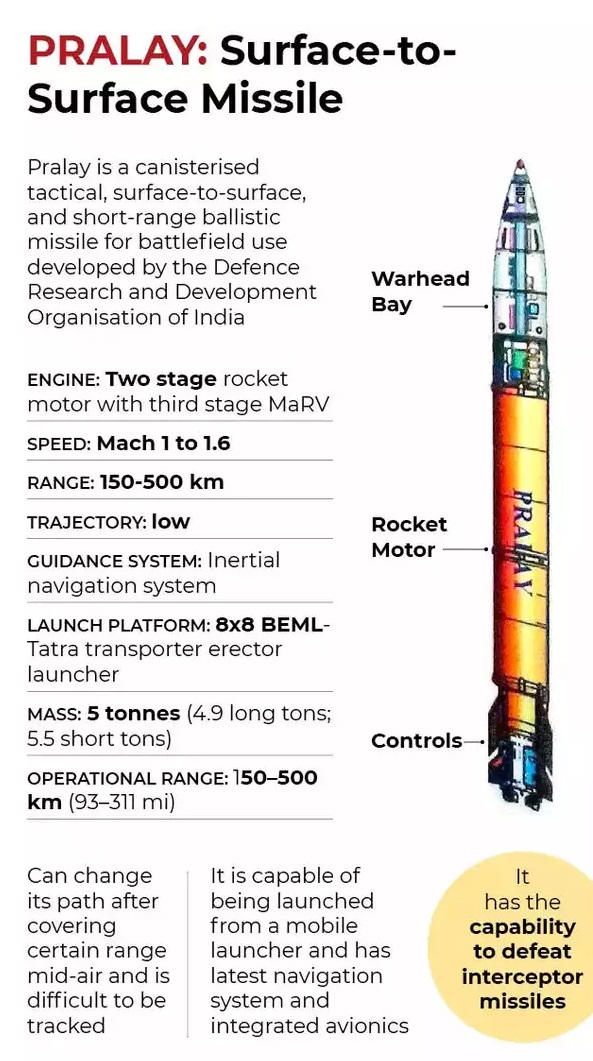
    The Defence Research and Development Organisation (DRDO) successfully conducted two consecutive test flights of the Pralay missile from the Dr. A.P.J. Abdul Kalam Island off Odisha’s coast.

    Pralay Missile 

    About Pralay Missile:

    • Developer: Defence Research and Development Organisation (DRDO), led by Research Centre Imarat (RCI) with Indian industry support.
    • Purpose: Tactical surface-to-surface missile for precision strikes along sensitive borders like the Line of Actual Control (LAC) and Line of Control (LoC).
    • Role: Enhances India’s conventional deterrence in short-range battlefield operations.
    • Targets: Designed to destroy high-value assets—radars, command centers, airstrips, and military infrastructure.

    Key Features:

    • Type: Quasi-ballistic surface-to-surface missile
    • Range: 150–500 km
    • Payload: 500–1,000 kg (conventional warheads)
    • Propulsion: Solid-propellant rocket motor
    • Launcher: Mobile platform for rapid deployment
    • Guidance: Advanced inertial navigation with <10 m Circular Error Probable (CEP)
    • Terminal Speed: Up to Mach 6.1
    • Maneuverability: Capable of mid-air trajectory changes to evade interception
    [UPSC 2023]  Consider the following statements:

    1. Ballistic missiles are jet-propelled at subsonic speeds throughout their fights, while cruise missiles are rocket-powered only in the initial phase of flight. 2. Agni-V is a medium-range supersonic cruise missile, while BrahMos is a solid-fuelled intercontinental ballistic missile.

    Which of the statements given above is/are correct?

    Options: (a) 1 only (b) 2 only (c) Both 1 and 2 (d) Neither 1 nor 2*