💥Join UPSC 2027,2028 Mentorship (July Batch) + XFactor Notes & Microthemes PDF

GS Paper: Laws, Institutions & Bodies Constituted For The Vulnerable Sections

  • How is India planning to end Child Marriage?

    child-marriage

    The steering committee of a UNFPA-UNICEF Global Programme to End Child Marriage is on a visit to India to witness state interventions that have helped reduce the prevalence of child marriage.

    Why such visit?

    • The UNFPA-UNICEF estimates that 10 million children could become child brides as a result of the pandemic globally.

    What is Child Marriage?

    • Child marriage refers to any formal marriage or informal union between a child under the age of 18 and an adult and another child.
    • The Prohibition of Child Marriage (Amendment) Bill, 2021, fixes 21 years as the marriageable age for women.

    Reasons behind its prevalence

    • Role of poverty: A large proportion of child marriages take place primarily because of poverty and the burden of the huge costs of dowry associated with delayed marriages.
    • Norms: It is because of social norms in many regions and cultures that parents begin preparations for a girl’s marriage once she has reached puberty.
    • Crisis: Conflict increases the inequalities that make girls vulnerable to child marriage – and its consequences. Families may arrange marriages for girls, believing marriage will protect their daughters from violence.

    Issues with Child Marriage

    (1) Social implications

    • Impacts girl child more: Globally, the prevalence of child marriage among boys is just one sixth that among girls.
    • Leads to deprivation: Child marriage robs girls of their childhood and threatens their lives and health.
    • Exclusion: The practice can also isolate girls from family and friends and exclude them from participating in their communities, taking a heavy toll on their physical and psychological well-being.
    • Academic loss: Girls who marry before 18 are more likely to experience domestic violence and less likely to remain in school.

    (2) Health issues

    • Life threats: Child brides often become pregnant during adolescence, when the risk of mortality during for themselves and their infants.
    • Forced pregnancy: Girls are forced into adulthood before they is physically and mentally ready. This is the main cause of global prevalence of malnutrition.

    (3) Economic impacts

    • Child marriage negatively affects the Indian economy and can lead to an intergenerational cycle of poverty.
    • It suddenly pulls out the children involved out of workforce before they grow as adult.
    • Girls and boys married as children more likely lack the skills, knowledge and job prospects needed to lift their families out of poverty and contribute to their country’s social and economic growth.

    What is the situation in the world?

    • According to data from UNICEF, the total number of girls married in childhood stands at 12 million per year.
    • It strives to end the practice by 2030 — the target set out in the Sustainable Development Goals.

    Where does India stand?

    GOOD:  Declining trend

    • There is a growing trend for a decline in the overall prevalence of child marriage.
    • In India, child marriage reduced from 47.4% in 2005-06 to 26.8% in 2015-16, registering a decline of 21% points during the decade.
    • In the last five years, it declined by 3.5% points to reach 23.3% in 2020-21, according to the latest National Family Health Survey-5 data.

    BAD: State-wise disparity is very higher

    • However, 3% is still a disturbingly high percentage in a country with a population of 141.2 crore.
    • Some states have a higher prevalence than the national average — West Bengal, Bihar and Tripura top the list with more than 40% of women aged 20-24 years married below 18 (NFHS).
    • In Kerala, women who got married before the age of 18 stood at 6.3% in 2019-20, from 7.6% in 2015-16.

    Laws and policy interventions in India

    • There are crucial laws that aim at protecting children from violation of human and other rights including the-
    1. Prohibition of Child Marriage Act, 2006 and
    2. Protection of Children from Sexual Offences Act, 2012
    • Raising the age of marriage: A parliamentary standing committee is weighing the pros and cons of raising the age of marriage for women to 21, which has been cleared by the Union Cabinet.
    • Beti Bachao Beti Padhao Scheme: It aims to address the issue of the declining child sex ratio image (CSR).
    • Kanyashree scheme: West Bengal’s scheme offers financial aid to girls wanting to pursue higher studies, though women’s activists have pointed. Bihar and other States have been implementing a cycle scheme to ensure girls reach safely to school, and UP has a scheme to encourage girls to go back to school.

    Way forward

    • Ensure education: Much of the benefits can be reaped by ensuring that women complete education at least up to 12 years.
    • Upskilling: Bangladesh shows that improving women’s education and imparting modern skills to them that increase their employability reduces child marriage and improves health and nutrition.
    • Educational attainment criteria in schemes: Schemes which ease the financial burden of marriage but the eligibility criteria of which should essentially link to educational attainment in addition to age demand attention.

    Conclusion

    • A legalistic approach to increasing the age at marriage will produce positive results only if it leads to an improvement in women’s education and skill acquisition for employability.
    • In the absence of an enhancement in women’s schooling or skills, a legalistic approach to ending child marriage might become counterproductive.
     

    Click and get your FREE Copy of CURRENT AFFAIRS Micro Notes

  • Child Welfare Police Officers a must in all police stations: Home Minister

    cwpo

    The Ministry of Home Affairs has asked the States/Union Territories to appoint a Child Welfare Police Officer (CWPO) in every police station to exclusively deal with children, either as victims or perpetrators.

    Who is a Child Welfare Police Officer (CWPO)?

    • Police play a pivotal role in the prevention and investigation of child abuse and neglect while helping to make communities safer for children and families.
    • CWPO is stipulated in advisory issued by the National Commission for Protection of Child Rights.
    • The Juvenile Justice (Care and Protection of Children) Act, 2015, also calls for designating at least one officer, not below the rank of an Assistant Sub-Inspector, as CWPO in every station.

    Functions of CWPO

    • To handle cases of both juveniles in conflict with law and children in need have care of protection
    • To function as a watch-dog for providing legal protection against all kinds of cruelty, abuse and exploitation of children and report instances of non-compliance for further legal action
    • To take serious cognizance of adult perpetrators of crimes against children
    • To ensure that the accused are apprehended immediately and booked under the appropriate provisions of the law
    • To ensure that the juvenile or child is provided with immediate medical attention, basic needs and create a child-friendly atmosphere at the time of first contact.

    Need for CWPO

    • CWPO ensure that juvenile or child is treated with decency and dignity during investigation, enquiry, search etc.
    • They help upheld right to confidentially and privacy of the juvenile/child.

    Back2Basics: National Commission for Protection of Child Rights (NCPCR)

    • The NCPCR is a statutory body established by the Commission for Protection of Child Rights (CPCR) Act, 2005.
    • The Commission works under the aegis of Ministry of Women and Child Development.
    • The Commission is mandated under section 13 of CPCR Act, 2005 to ensure that all laws and policies are in consonance with the Child Rights perspective as enshrined by the UN Convention on the Rights of the Child.
    • As defined by the commission, a child includes persons up to the age of 18 years.


    Click and get your FREE copy of Current Affairs micro notes

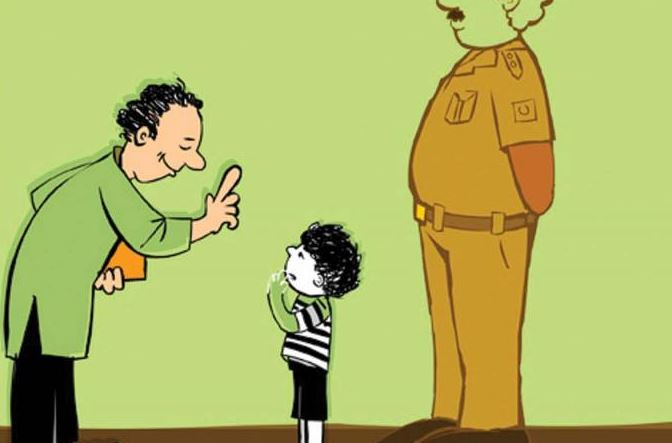
  • Two finger test: Undermining the dignity of women

    finger test

    Context

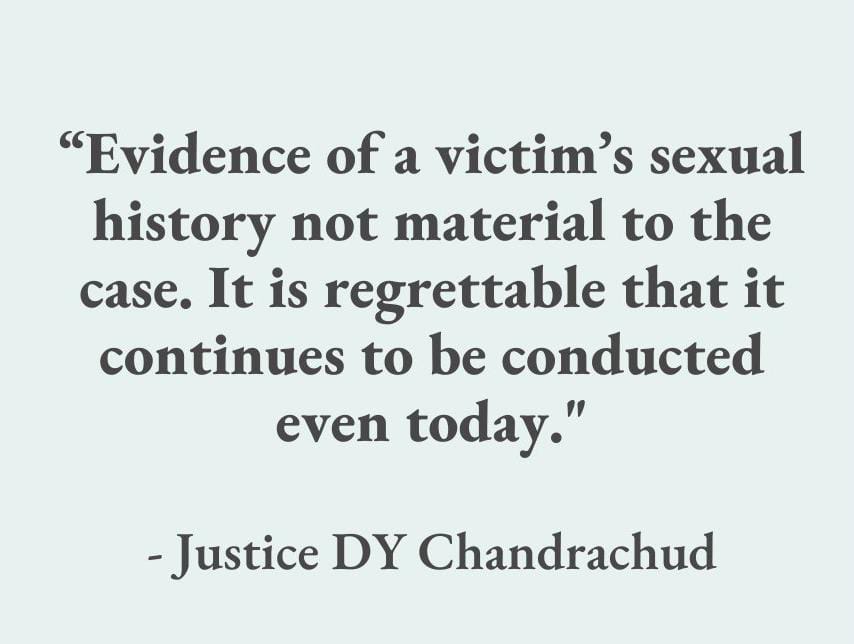
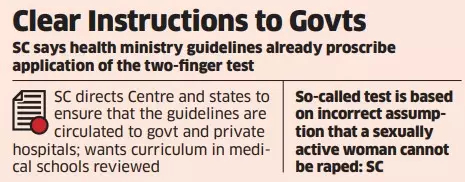
    • On October 31, a two-judge bench of the Supreme Court noted that the two-finger test is a sexist medical practice that re-victimizes and re-traumatizes rape survivors. The Court also issued directions to the Union and state governments to implement the 2014 guidelines of the Ministry of Health and Family Welfare for health providers in sexual violence cases.

    What is two finger tests?

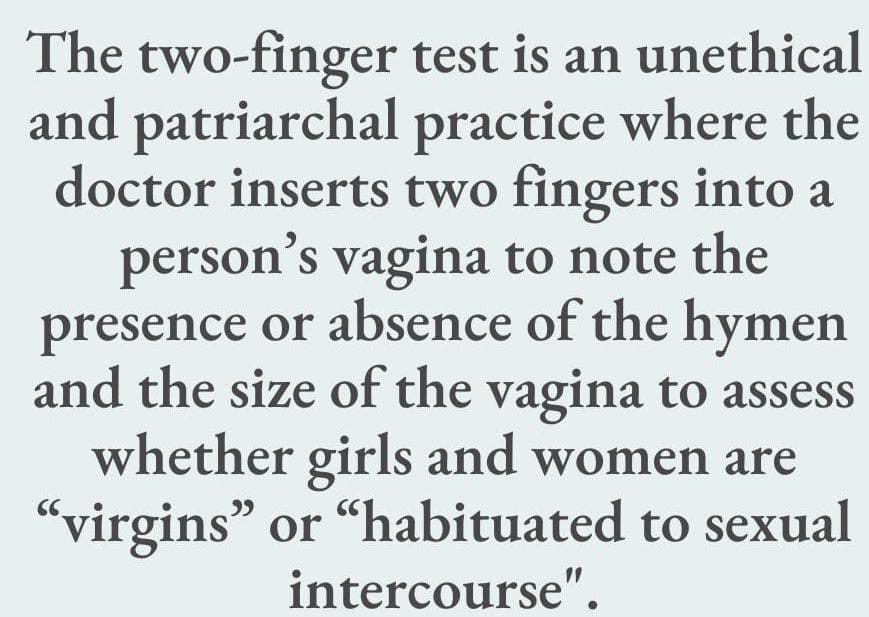
    • The two-finger test involves the medical examiner inserting their two fingers into the vagina of a survivor to note the presence or absence of the hymen and the so-called laxity of the vagina.

    finger test

    What is the expert doctor’s opinion?

    • Misogynistic belief: While a hymen can be torn and its orifice may vary in size for many reasons unrelated to sex, the origin of the two-finger test lies in the misogynistic belief that a torn hymen is an indication that the survivor is habituated to sex and therefore, cannot be raped or is more likely to make false claims about being raped.

    What is the law against such infringement of bodily privacy?

    • SC prohibited test in Rajesh v. State of Haryana 2013 case: “Medicalization of consent” where women’s bodies are given precedence over their voices. Recognizing this as an invasion of privacy and a violation of a survivor’s dignity, the Supreme Court prohibited the test in Lillu at Rajesh v. State of Haryana (2013).
    • Guidelines for medico-legal care for survivors of sexual violence: Shortly after, in March 2014, taking forward the recommendations of the Justice J S Verma Committee Report, the Ministry of Health & Family Welfare issued guidelines for medico-legal care for survivors of sexual violence. These guidelines explicitly prohibited the two-finger test and discussed the need for training medical examiners to respond to the needs of the survivors in a sensitive and non-discriminatory manner.

    Why the practice of two finger tests still persists?

    • Lack of political will: Nearly eight years since the guidelines were issued, the two-finger test still remains a reality. Its prevalence is a reflection of the complete lack of political will to address the issue.
    • No pan-India comprehensive review: While fragmented pieces of narratives and research indicate that the two-finger test continues in rape cases to date, it is incumbent upon the executive to undertake a comprehensive pan-India review to assess the nature and extent of the problem.
    • Change in format and unclarity: The changed format (introduced after the passing of the Criminal Law Amendment Act, 2013) of the medico-legal certificate used by doctors in rape cases did not require them to make a note of the finding of the two-finger test. However, according to the lawyers, this did not mean that the test was not happening anymore. Some says they it was no longer being recorded as such but was still being conducted.
    • Poor medical infrastructure: The continued existence of the two-finger test is a result of the overall poor state of forensic medicine infrastructure in India.
    • Lack of awareness: Lack of awareness amongst the medical community about the unscientific nature of the two-finger test.

    finger test

    What is the opinion of the court?

    • Government must enforce the protocol: The Court commenting on the sorry state of affairs and issuing directions to the government on enforcement of the protocol including the emphasis on workshops and the medical school curriculum is significant.
    • Holding a person, a guilty of misconduct: The Court took a step further by holding a person conducting the two-finger test on a rape survivor guilty of misconduct. It is unclear if the Court was making a reference to professional misconduct on part of the medical examiner.

    finger test

    What should be the way forward?

    • Caregiving to victim: Medical practitioners must see themselves as caregivers when handling sexual violence cases.
    • Awareness about legal system: Medical practitioners should be made to understand as their role in the criminal legal system, specifically towards rape survivors.
    • Training of medical examiners: The training in medical school must prepare medical examiners for their role in the justice system.
    • Police should play an active role: The institution of police should be sensitized on the continued use of the two-finger test in rape cases.
    • Modules on sexuality: Training and workshops designed for doctors needs to include modules on sexuality and discrimination.

    Conclusion

    • Two finger test is further traumatizing the victim of rape. Despite the directives of courts years ago and unscientific nature, two finger test continues. Women empowerment is not only about the earnings and livelihood its also about the right to privacy and dignity of life.

    Mains Question

    Q. What is two finger tests? what is the law against the two-finger test? give the reasons for continuation of two finger test?

    Click and Get your FREE copy of Current Affairs Micro notes


  • Why the SC slammed the two-finger test on rape and sexual assault victims?

    finger

    The Supreme Court has declared that any person conducting the invasive ‘two-finger’ or ‘three-finger’ vaginal test on rape or sexual assault survivors will be found guilty of misconduct.

    What is the two-finger test?

    • The test is conducted to check whether the victim has had recent sexual intercourse.
    • It includes an inspection of the hymen.
    • The hymen is inspected as it can be torn only if the woman has had any sexual intercourse.
    • This test was performed on rape or sexual assault survivors.

    What did the Verma Committee say on the two-finger test?

    • The committee under former Chief Justice JS Verma, formed soon after the 2012 Nirbhaya Gangrape case had recommended tougher laws for such cases and ban of the two-finger test.
    • This test has no bearing on a case of sexual assault.
    • On the basis of this test observations/ conclusions such as ‘habituated to sexual intercourse’ should not be made and this is forbidden by law.
    • Yet, the test continues to be conducted in India and other countries despite rape test kits are being provided by the government to all medical institutions after the committee recommendations.

    Is the two-finger test scientifically accepted?

    • Of course NOT.
    • According to medical experts, science has proved that the hymen is not a reliable source of proving vaginal penetration.
    • The hymen, which is a thin membrane in the vagina, can rupture not just during sexual activity but also during day-to-day work or any physical activity, including playing sports.

    What has the Supreme Court said previously?

    • Violation of privacy: In May 2013, the Supreme Court banned the two-finger test on rape victims on the grounds that it violated their right to privacy.
    • Alternative procedures: The court asked the government to provide better medical procedures in order to confirm sexual assault.
    • Painful for women: The test is medically unnecessary, often times painful, humiliating and a traumatic practice that must end.

    Way ahead

    • Workshops should be held for health providers to prevent the test from being conducted on rape survivors.
    • The curriculum in medical schools should be revised.
    • The court ordered copies of the judgment to be handed over to the Health Ministry, which should be circulated to the health and home departments of the States.
    • The home departments should circulate the judgment to the Director Generals of Police in the States.


    Click and Get your FREE copy of Current Affairs Micro notes

  • Online Child Sexual Abuse Material

    child

    Context

    • Last month, the Central Bureau of Investigation (CBI) conducted searches across States and Union Territories as part of a pan-India operation, “Megh Chakra”. The operation, against the online circulation and sharing of Child Sexual Abusive Material (CSAM) using cloud-based storage, was supposedly based on inputs received from Interpol’s Singapore special unit, in turn based on the information received from New Zealand.

    Current system of detecting CSAM

    • Help of foreign agencies: As the public reporting of circulation of online CSAM is very low and there is no system of automatic electronic monitoring, India’s enforcement agencies are largely dependent on foreign agencies for the requisite information.
    • Operation carbon: In November 2021, a similar exercise code-named “Operation Carbon” was launched by the CBI, with many being booked under the IT Act, 2000.

    American Model of fighting CSAM

    • Cyber tipline programme under NCMEC: The National Centre for Missing & Exploited Children (NCMEC), a non-profit organization in the United States, operates a programme called Cyber Tipline, for public and electronic service providers (ESPs) to report instances of suspected child sexual exploitation. In 2021, the Cyber Tipline received more than 29.3 million reports (99% from ESPs) of U.S. hosted and suspected CSAM.
    • Mandatory reporting for Internet service providers (ISPs): ISPs are mandated to report the identity and the location of individuals suspected of violating the law. Also, NCMEC may notify ISPs to block transmission of online CSAM.

    UK Model of fighting CSAM

    • Internet Watch Foundation (IWF) to ensure safe online environment: In the United Kingdom, the mission of the Internet Watch Foundation (IWF), a non-profit organisation established by the United Kingdom’s Internet industry to ensure a safe online environment for users with a particular focus on CSAM, includes disrupting the availability of CSAM and deleting such content hosted in the U.K.
    • ISPs may be held responsible: The IWF engages the analysts to actively search for criminal content and not just rely on reports from external sources. Though the U.K. does not explicitly mandate the reporting of suspected CSAM, ISPs may be held responsible for third party content if they host or caches such content on their servers. In 2021, the IWF assessed 3,61,062 reports, (about 70% reports had CSAM) and seven in 10 reports contained “self-generated” CSAM.

    child

    Efforts of Global community

    • Global network for secure IT infrastructure: A global network of 50 hotlines (46 member countries), provides the public with a way to anonymously report CSAM. It provides secure IT infrastructure, ICCAM (I- “See” (c)-Child-Abuse-Material) hosted by Interpol and facilitates the exchange of CSAM reports between hotlines and law enforcement agencies. ICCAM is a tool to facilitate image/video hashing/finger printing and reduce the number of duplicate investigations.
    • Removal of illegal URLs: In 2021, the number of exchanged content URLs stood at 9,28,278, of which 4,43,705 contained illegal content. About 72% of all illegal content URLs were removed from the Internet within three days of a notice and takedown order.

    child

    India’s Efforts so far

    • Internet service providers are exempted from the liability: In India, the Supreme Court of India, in Shreya Singhal (2015), read down Section 79(3)(b) of the IT Act to mean that the ISP, only upon receiving actual knowledge of the court order or on being notified by the appropriate government, shall remove or disable access to illegal contents. Thus, ISPs are exempted from the liability of any third-party information.
    • In the Kamlesh Vaswani (WP(C) 177/2013) case: The petitioner sought a complete ban on pornography. After the Court’s intervention, the advisory committee (constituted under Section 88 of the IT Act) issued orders in March 2015 to ISPs to disable nine (domain) URLs which hosted contents in violation of the morality and decency clause of Article 19(2) of the Constitution. The petition is still pending in the Supreme Court.
    • Aarambh India portal: a Mumbai-based non-governmental organization, partnered with the IWF, and launched India’s first online reporting portal in September 2016 to report images and videos of child abuse. These reports are assessed by the expert team of IWF analysts and offending URLs are added to its blocking list. Till 2018, out of 1,182 reports received at the portal, only 122 were found to contain CSAM.
    • National cybercrime reporting portal: The Ministry of Home Affairs (MHA) launched a national cybercrime reporting portal in September 2018 for filing online complaints pertaining to child pornography and rape-gang rape. This facility was developed in compliance with Supreme Court directions with regard to a public interest litigation filed by Prajwala, a Hyderabad-based NGO that rescues and rehabilitates sex trafficking survivors. As not many cases of child porn and rape were reported, the portal was later extended to all types of cybercrime.
    • National Crime Records Bureau (MHA): The National Crime Records Bureau (MHA) signed a memorandum of understanding with the NCMEC in April 2019 to receive Cyber Tipline reports to facilitate action against those who upload or share CSAM in India. The NCRB has received more than two million Cyber Tipline reports which have been forwarded to the States for legal action.
    • The ad hoc Committee of the Rajya Sabha: In its report of January 2020, made wide-ranging recommendations on ‘the alarming issue of pornography on social media and its effect on children and society as whole’.
    • Widening of the definition of child pornography’: On the legislative front, the committee not only recommended the widening of the definition of ‘child pornography’ but also proactive monitoring, mandatory reporting and taking down or blocking CSAM by ISPs.
    • Breaking of end-to-end encryption: On the technical front, the committee recommended permitting the breaking of end-to-end encryption, building partnership with industry to develop tools using artificial intelligence for dark-web investigations, tracing identity of users engaged in crypto currency transactions to purchase child pornography online and liasoning with financial service companies to prevent online payments for purchasing child pornography.

    child

    What needs to be done?

    • Mandatory reporting of CSAM by ISP, s: According to the ninth edition (2018) report of the International Centre for Missing and Exploited Children on “Child Sexual Abusive Material: Model Legislation & Global Review”, more than 30 countries now require mandatory reporting of CSAM by ISPs. Surprisingly, India also figures in this list, though, the law does not provide for such mandatory reporting.
    • Establish liability of legal persons: The Optional Protocol to the United Nations Convention on the Rights of the Child that addresses child sexual exploitation encourages state parties to establish liability of legal persons.
    • Convention on The Protection of Children against Sexual Exploitation and Sexual Abuse: The Council of Europe’s Convention on Cybercrime and Convention on The Protection of Children against Sexual Exploitation and Sexual Abuse also requires member states to address the issue of corporate liability.
    • India should join INHOPE: It is time India joins INHOPE and establishes its hotline to utilize Interpol’s secure IT infrastructure or collaborate with ISPs and financial companies by establishing an independent facility such as the IWF or NCMEC.

    Conclusion

    • India needs to explore all options and adopt an appropriate strategy to fight the production and the spread of online CSAM. Children need to be saved.

    Mains Question

    Q. How children are Vulnerable against child sexual abuse material (CSAM)? What legal remedies available in India against CSAM?

    UPSC 2023 countdown has begun! Get your personal guidance plan now! (Click here)


  • Why India Inc. needs a neurodiverse workplace ?

    neurodiverseContext

    • Discrimination in employment is a worldwide phenomenon. Gender, ethnic, racist discrimination are well known but discrimination towards neurodiverse persons are hardly debated in public forums. Despite having special abilities companies are not using their potentials.

    What is neurodiversity?

    • Harvard Health Publishing defines, neurodiversity as a notion that every person interacts and experiences their surroundings differently; there is no right way of thinking, learning, or/and behaving. These differences should not be construed as defects or disorders.

    What is a neuro-diverse workplace?

    • Neurodiversity in the workplace refers to including people with neuro-divergent conditions such as attention-deficit/hyperactivity disorder, autism spectrum disorders, dyslexia, dyspraxia, dyscalculia and Asperger’s Syndrome.

    What are those Conditions that make them different from normal humans?

    • Autism: A mental condition in which a person finds it difficult to communicate or form relationships with other people. Signs of autism include not responding to their name, avoiding eye contact, not smiling when you smile at them.
    • Dyslexia: a difficulty that some people have with reading and spelling signs include confusion over letters that look similar and putting letters the wrong way round , confusing the order of letters in words, reading slowly or making errors when reading aloud
    • Asperger’s syndrome: A developmental disorder related to autism and characterized by awkwardness in social interaction, pedantry in speech, and preoccupation with very narrow interests. Less severe symptoms than Autism syndrome.
    • Dyscalculia: A brain disorder in which a wide range of difficulties with math, including weaknesses in understanding the meaning of numbers, and difficulty applying mathematical principles to solve problems.

    neurodiverseHow they can be naturally efficient and creative?

    • More efficient: Studies have shown that teams with both neurodivergent and neurotypical members are far more efficient than teams that comprise neurotypical employees alone.
    • Ability to focus: Neurodivergent individuals possess excellent attention to detail and an uncanny ability to focus on complex and repetitive tasks over a more extended period than their neurotypical peers.
    • Ability to work at faster speed: A study by the University of Montreal found that in a test involving completing a visual pattern, people on the autism spectrum could finish their task 40% faster than those who were not on the spectrum.
    • Robust spatial reasoning: People with dyslexia can think about objects in three dimensions and analyses such objects even with limited information.
    • Out of box thinking: They have problem-solving capabilities which allow them to see multiple solutions to a problem. They are often out-of-the-box thinkers with average or above-average intelligence.

    Current Status of people living with neurodivergent conditions

    • People suffer with the Condition: According to a recent report, nearly 2 million people in India suffer from this neurological and developmental disorder and are therefore identified as autistic. Another study by Deloitte estimates that nearly 20% of the world is neurodiverse. In the U.S., it is estimated that 85% of people on the autism spectrum are unemployed compared with 4.2% of the overall population
    • Discrimination at employment: Even with all the necessary skill sets and degrees, these persons are denied a job because they may react to situations differently from non-neurodiverse persons.
    • Lack of awareness: Lack of awareness about neurodivergent conditions, and how the people with condition may react and lack of and accommodating environment. Hence, there is an urgency to create a work environment that welcomes neurodiverse individuals.

    neurodiverseCurrent work profile of companies and workplaces

    • A 2019 McKinsey study revealed that companies with gender diversity were 25% more likely to have above-average profitability while those with ethnic diversity out-rival their competitors by 36%.
    • Another report titled ‘India’s Best Workplaces in Diversity, Equity & Inclusion 2021’ states that diverse teams perform better, boost leadership integrity, heighten trust in the organization’s management and multiply revenue growth.

    neurodiverseFew Examples show that things are changing

    • Competitive environment: Organisations embracing neurodiversity enjoy a competitive edge in several areas such as efficiency, creativity, and culture.
    • Various MNC’s hiring program: Companies such as Deloitte, Microsoft, SAP, JPMorgan Chase, and E&Y have introduced neurodiversity hiring programs.
    • Indian company: Indian-origin companies Hatti Kaapi and Lemon Tree Hotels have also included a neurodiverse workforce.

    What can be done to create more inclusive workplaces?

    • Creating neurodivergent friendly offices: .Many employees with neurodiversity may find the hustle and bustle of a traditional office disturbing. Therefore, neurodivergent friendly offices catering to the employees’ diverse sensory responses can help ensure that these employees are comfortable in office spaces.
    • Openness: Creating the right environment is an ever-evolving exercise that requires openness and a will to change on the employer’s part. This flexibility can result in exceptional benefit with minimal or no additional costs.
    • Wider Inclusivity: To ensure higher profitability and be respected as a responsible employer globally, companies need to widen their definition of inclusivity by providing higher participation of a neurodiverse workforce.

    Conclusion

    • Organizations must not only remove barriers that obstruct the progress of such individuals but also create conducive conditions for them to achieve their true potential and providing proper infrastructure so that they can perform at their optimal levels.

    Mains Question

    Q. People with neurodiversity are discriminated not only socially but also economically, Comment. What measures could be taken to bridge this gap within the society?


  • Odisha offering cash incentive for PVTGs Marriages

    Keeping the rampant child marriages among the Particularly Vulnerable Tribal Groups (PVTGs) of Odisha in mind, the State government is providing an incentive of ₹20,000 to the couples marrying after the age of 18 years.

    Particularly Vulnerable Tribal Groups (PVTGs)

    • There are certain tribal communities who have declining or stagnant population, low level of literacy, pre-agricultural level of technology and are economically backward.
    • They generally inhabit remote localities having poor infrastructure and administrative support.
    • These groups are among the most vulnerable section of our society as they are few in numbers, have not attained any significant level of social and economic development.
    • 75 such groups have been identified and categorized as Particularly Vulnerable Tribal Groups (PVTGs).

    Origin of the concept

    • The Dhebar Commission (1960-1961) stated that within Scheduled Tribes there existed an inequality in the rate of development.
    • During the fourth Five Year Plan a sub-category was created within Scheduled Tribes to identify groups that considered to be at a lower level of development.
    • This was created based on the Dhebar Commission report and other studies.
    • This sub-category was named “Primitive tribal group”.

    Features of PVTGs

    • The features of such a group include a:
    1. Pre-agricultural system of existence
    2. Practice of hunting and gathering
    3. Zero or negative population growth
    4. Extremely low level of literacy in comparison with other tribal groups
    • Groups that satisfied any one of the criterion were considered as PTG.
    • In 2006 the government of India proposed to rename “Primitive tribal group” as Particularly vulnerable tribal group”.


    Try this PYQ:

    Q.Consider the following statements about Particularly Vulnerable Tribal Groups (PVTGs) in India:

    1. PVTGs reside in 18 States and one Union Territory.
    2. A stagnant or declining population is one of the criteria for determining PVTG status.
    3. There are 95 PVTGs officially notified in the country so far.
    4. Irular and Konda Reddi tribes are included in the list of PVTGs.

    Which of the statements given above are correct? (CSP 2019)

    (a) 1, 2 and 3

    (b) 2, 3 and 4

    (c) 1, 2 and 4

    (d) 1, 3 and 4


    [wpdiscuz-feedback id=”8g267rzr19″ question=”Please leave a feedback on this” opened=”0″]Post your answers here.[/wpdiscuz-feedback]


    UPSC 2023 countdown has begun! Get your personal guidance plan now! (Click here)

  • Ratan Tata, KT Thomas appointed trustees of PM CARES

    The Union government has appointed veteran industrialist Ratan Tata, former Supreme Court judge K.T. Thomas, and former Lok Sabha Deputy Speaker Kariya Munda as trustees of the PM CARES Fund.

    PM CARES Fund

    • The PM CARES Fund was created on 28 March 2020 following the COVID-19 pandemic in India.
    • The fund will be used for combat, containment and relief efforts against the coronavirus outbreak and similar pandemic like situations in the future.
    • The PM is the chairman of the trust. Members will include the defence, home and finance ministers.
    • The fund will also enable micro-donations. The minimum donation accepted is ₹10 (14¢ US).

    Some intriguing facts about PM-CARES fund

    • PM CARES has been created not by law, not by notification, but by the mere creation of a webpage, and set up last year in March to raise funds for those affected by the COVID-19 pandemic.
    • The page lists its structure, functions and duties in an arbitrary manner.
    • The official appeals for funds are made under the national emblem.
    • The most significant lie of this sworn statement is that the Government has no control over the Fund.

    The other funds

    (1) National Disaster Response Fund (NDRF)

    • The statutorily constituted NDRF was established under the Disaster Management (DM) Act of 2005.
    • The NDRF is mandated to be accountable, and answerable under the RTI Act, being a public authority, and auditable by the Comptroller and Auditor General of India.

    (2) Disaster Response Fund

    • The DM Act also provided for a Disaster Response Fund — state and district level funds (besides the national level).
    • It also collects and uses the donations at the local level, with mandatory transparency and audit provisions.

    (3) Prime Minister’s National Relief Fund

    • There is the PMNRF operative since the days of Jawaharlal Nehru. It was established with public contributions to assist displaced persons from Pakistan.
    • The resources are now utilised primarily to render immediate relief to families of those killed in natural calamities and to the victims of the major accidents and riots.
    • However, it has the President of India and the Leader of Opposition also as trustees.

    Issues over PM-CARES Fund

    • No defined purpose: It is deliberately ignored while a new, controversial, unanswerable, and ‘non-accountable vehicle is created; its character is not spelt out till today.
    • Non-accountable: The government seems to consider statutory provisions for enquiry and information seeking to be embarrassing obstacles.
    • Centralization of donations: It centralises the collection of donations and its utility, which is not only against the federal character but also practically inconvenient. The issue is seeming, the trusteeship of the fund.

    Questions and gaps

    • Law/statute: The PM CARES Fund was neither created by the Constitution of India nor by any statute.
    • Authority: If that is the case, under what authority does it use the designation of the Prime Minister, designated symbols of the nation, the tricolour and the official (gov.in) website of the PMO, and grant tax concessions through an ordinance.
    • Collection and dispensation: The amount received by the Fund does not go to the Consolidated Fund of India. If it goes to the CFI, it could have been audited by the CAG.
    • Uncontrolled: The This Trust is neither intended to be or is in fact owned, controlled or substantially financed by any instrumentality of the any govt even being chaired by the PM.

    Issue over tax benefits

    • Income tax: An ordinance was promulgated to amend Income Tax Act, 1961 and declare that the donations to the PM CARES Fund “would qualify for 80G benefits for 100% exemption”.
    • CSR Funds: It will also qualify to be counted as Corporate Social Responsibility (CSR) expenditure under the Companies Act, 2013.
    • Foreign donations: It has also got exemption under the FCRA [Foreign Contribution Regulation Act] and a separate account for receiving foreign donations has been opened.

    What can be inferred from all these?

    • The Centre now considers it as another obstacle and has created a new trust with the Prime Minister and his Ministers only.
    • The manner in which the PM CARES Fund was set up — with its acronym created to publicise the point that the PM cares for people — shows a bypassing of the statutory obligations of a public authority.

    Query and response: Again ironical

    • After initial denials, the Government has conceded it to be a public charitable trust, but still maintains that it is not a ‘public authority’.
    • The point is that the PMO operates the Fund, but says it cannot supply any information about the PM CARES Fund because it is not a public authority.

    Severe interpretations: Is it an Office of Profit?

    • If the PM CARES Fund is unconnected with the Government, then the Fund could become an office of profit.

    Conclusion

    • In order to uphold transparency, the PM CARES Fund should be declared as a Public Authority under the RTI Act, and all RTI queries answered truthfully.
    • The fund should be designated as a “public authority” under Section 2(h) of the RTI Act.


    UPSC 2023 countdown has begun! Get your personal guidance plan now! (Click here)

  • SC quota for Dalit Muslims and Christians

    The Centre is likely to soon decide on setting up a national commission to study the social, economic and educational status of Dalits who converted to religions other than Hinduism, Buddhism and Sikhism.

    What is the news?

    • Several petitions are pending before the Supreme Court seeking Scheduled Caste (SC) reservation benefits for Dalits who converted to Christianity or Islam.

    Dalit Convertees and Quota Benefits

    • The original rationale behind giving reservation to Scheduled Castes was that these sections had suffered from the social evil of untouchability, which was practised among Hindus.
    • Under Article 341 of the Constitution, the President may specify the castes, races or tribes or parts of or groups within castes, races or tribes which shall…be deemed to be Scheduled Castes.
    • The first order under this provision was issued in 1950, and covered only Hindus.
    • Following demands from the Sikh community, an order was issued in 1956, including Sikhs of Dalit origin among the beneficiaries of the SC quota.
    • In 1990, the government acceded to a similar demand from Buddhists of Dalit origin, and the order was revised to state: “No person who professes a religion different from the Hindu, the Sikh or the Buddhist religion shall be deemed to be a member of Scheduled Caste.”

    Does this religion-based bar apply to converted STs and OBCs as well?

    • It does not.
    • The Department of Personnel and Training (DoPT) website states, “The rights of a person belonging to a Scheduled Tribe are independent of his/her religious faith.”
    • Following the implementation of the Mandal Commission report, several Christian and Muslim communities have found place in the Central and state lists of OBCs.

    What efforts have been made to include Muslims and Christians of Dalit origin among SCs?

    • After 1990, a number of Private Member’s Bills were brought in Parliament for this purpose.
    • In 1996, a government Bill called The Constitution (Scheduled Castes) Orders (Amendment) Bill was drafted, but in view of a divergence of opinions, the Bill was not introduced in Parliament.
    • Then government headed by PM Manmohan Singh set up two important panels:
    1. Ranganath Misra Commission: The National Commission for Religious and Linguistic Minorities, popularly known as the Ranganath Misra Commission, in October 2004 and
    2. Sachar Committee: A seven-member high-level committee headed by former Chief Justice of Delhi High Court Rajinder Sachar to study the social, economic, and educational condition of Muslims in March 2005.

    What did they recommend?

    • The Sachar Committee Report observed that the social and economic situation of Dalit Muslims and Dalit Christians did not improve after conversion.
    • The Ranganath Misra Commission, which submitted its report in May 2007, recommended that SC status should be completely de-linked from religion and Scheduled Castes should be made fully religion-neutral like Scheduled Tribes.

    Reception to these recommendations

    • The report was tabled in Parliament in 2009, but its recommendation was not accepted in view of inadequate field data and corroboration with the actual situation on the ground.
    • Few studies, commissioned by the National Commission for Minorities, was also not considered reliable due to insufficient data.

    What lies ahead?

    • Based on the recommendations of the Ranganath Misra Commission, there are some petitions pending before the Supreme Court, seeking reservation benefits for Christians and Muslims of Dalit orgin.
    • In the last hearing, a three-judge Bench gave the Solicitor General of India three weeks’ time to present the stand of the Union government on the issue.
    • The next hearing is awaited.


    UPSC 2023 countdown has begun! Get your personal guidance plan now! (Click here)

  • Tamil Nadu’s new Breakfast Scheme in Schools

    breakfast

    Tamil Nadu CM has launched the Chief Minister’s Breakfast Scheme for students of Class I to V in government schools.

    CM’s Breakfast Scheme

    • The scheme covers around 1.14 lakh students in 1,545 schools which include 417 municipal corporation schools, 163 municipality schools and 728 taluk and village panchayat-level schools.
    • The inauguration of the scheme marks an important milestone in the State’s history of providing free meals to school students.

    How has the idea evolved?

    (a) Pre-independence

    • In November 1920, the Madras Corporation Council approved a proposal for providing tiffin to the students of a Corporation School at Thousand Lights at a cost not exceeding one anna per student per day.
    • Theagaraya Chetty, the then President of the Corporation and one of the stalwarts of the Justice Party, said the boys studying at the school were poor, which affected the strength of the institution ‘greatly’.
    • The scheme, which was extended to four more schools and facilitated higher enrollment of students.

    (b) Post-independence

    • The concept saw a Statewide application in 1956 when the then CM K. Kamaraj decided to provide free noon meal to poor children in all primary schools across the State.
    • The Budget for 1956-57 contained a provision for supplying mid-day meals to schoolchildren for 200 days a year, initially covering 65,000 students in 1,300 feeding centres.
    • In July 1982, it was left to the then CM MG Ramachandran to extend the programme to children in the 2-5 age group in Anganwadis and those in 5-9 age group in primary schools in rural areas.
    • Subsequently, the scheme now called Puratchi Thalaivar MGR Nutritious Meal Programme — was extended to urban areas as well.
    • Since September 1984, students of standards VI to X have been covered under the scheme.

    Beneficiaries of the programme

    • As of now, there are nearly 7 lakh beneficiaries spread over 43,190 nutritious meal centres.
    • This includes around 3,500 students of National Child Labour Project (NCLP) special schools.
    • Besides, as a consequence of the collaborative implementation of the Integrated Child Development Scheme (ICDS) and the nutritious meal programme, around 15.8 lakh children in the age group of 2+ to 5+ years receive nutritious meals.

    Impact on school education

    • Rise in enrolment: After the improved version of the mid-day meal scheme in 1982, the Gross Enrollment Ratio (GER) at primary level (standards I to V) went up by 10% during July-September, 1982 as compared to the corresponding period in 1981.
    • Girls’ enrolment: The rise in boys’ enrollment was 12% and in the case of girls, 7%, according to a publication brought out by the Tamil Nadu government on the occasion of the launch of the Scheme.
    • Increase in attendance: Likewise, attendance during July-September 1982 rose by 33% over the previous year’s figure.

    Focus areas programme

    • Anaemia is a major health problem in Tamil Nadu, especially among women and children, says the 2019-21 National Family Health Survey (NFHS)-5’s report.
    • From 50% during the period of the 2015-16 NFHS-4, the prevalence of anaemia in children now went up to 57%.
    • This and many other health issues can be addressed through the combined efforts of the departments of School Education, Public Health and Social Welfare and Women Empowerment.
    • Besides, a continuous and rigorous review of the progress of the scheme and nutritious meal programme should be carried out in a sustained manner.


    UPSC 2023 countdown has begun! Get your personal guidance plan now! (Click here)