💥Join UPSC 2027,2028 Mentorship (July Batch) + XFactor Notes & Microthemes PDF

GS Paper: Laws, Institutions & Bodies Constituted For The Vulnerable Sections

  • Increasing the age of marriage for girls and related issues

    The article analyses the issues with objectives of increasing the age of marriage for girls.

    Poverty of mother: Important factor

    • Raising the age of marriage is the could be the way to improve the health and nutritional status of mothers and their infants.
    • An article published in the journal The Lancet Child and Adolescent Health analyses data on stunting in children and thinness in mothers in the latest round of the National Family Health Survey 4 (2015-16).
    •  The authors examine the strength of the association between many different causal factors.
    •  As it turns out, the poverty of the mother plays the greatest role of all by far.
    • Instead of early pregnancy causing malnourishment, they may both be the consequences of poverty.
    • The best way to go about breaking such a cycle would be to pick the factors perpetuating it, it would be the poverty of the mother in this case.

    Declining fertility rate in India

    • India’s fertility rates have been declining to well below replacement levels in many States, including those with higher levels of child marriage.
    • This could be the reason for the shift from fuelling fears about booming populations to expressing concern for the undernourishment of children.
    • So, the problem of “populations explosion” is not the real problem as the demographic data suggests.

    Concern

    • The change in the marriage age will leave the vast majority of Indian women who marry before they are 21 without the legal protections.

    Conclusion

    The proposal and the objective to be achieved through raising the age of marriage needs reconsideration for the reasons cited above.

  • Right to possession to women and issues

    The Supreme Court in its latest judgement clarified that women’s right to their parents’ property is their birthright and clarified the air of confusion surrounding the issue due to previous judgements.

    What was said in the judgement

    • The judgement highlighted the patriarchal practices of the Mitakshra School of Hindu law — the guiding force of the Hindu Succession Act, 1956.
    • It settled the confusion created by two of its own antagonistic judgments.
    • In Prakash vs Phulawati (2016), it had ruled that the amendments to the Hindu Succession Act (2005) applied only to women whose parents were alive on September 9, 2005, the date of the notification of the act.
    • In Danamma @ Suman Surpur vs Amar (2018) cases, it inferred that coparcenary rights were birthrights.
    • The Supreme Court has now set forth the idea that coparcenary rights are birthrights free from limitations imposed by the dates of any legal notifications.

    Issues that need to be addressed

    1) Stree dhan issue

    • Section 14 (1) of the Hindu Succession Act 1956 provides that women can acquire property as a full owner, and it can be carried over or retained post marriage as stree dhan.
    • There are cases where the movable property may have been given to a daughter by her father as an intentionally undeclared and informal settlement between his descendants.
    • At the same time, it is quite true that stree dhan over time gave way to the unethical and illegal practices of dowry.
    • But the issue of stree dhan needs to be explained further in the light of this judgment.
    • The ruling might impact dowry transactions that continue despite stringent anti-dowry laws.

    2) Issues in claiming the right to property

    • In the rural context, where most of the property is in the form of agricultural land claiming the property may not be easy.
    • With patriarchy, it is doubtful if male heirs will share property-related documents, information.

    3) Challenge of societal change

    • On occasion, the law and courts may turn out to be progressive.
    • However, we can not expect society to readily accede to progressive reforms.
    • The challenge for economically dependent women in far-flung rural areas who are denied literacy, dignity and, sometimes, even a name and identity, in securing their rights is immense.
    • In parts of Bihar, there are areas where women are still addressed by their village names or more commonly as someone’s wife.

    Conclusion

    Women are asserting their rights, both in conjugal and property matters. However, there are significant cultural, religious, educational barriers and caste and class inequalities that require a massive overhauling of social attitudes to overcome.


    Back2Basics: Mitakshra School of Hindu law

    • In the Mitakshara School, the allocation of parental property is based on the rule of possession by birth.
    • Moreover, a man can leave his property in his will.
    • The joint family property goes to the group known as coparceners.
    • Ther are the people who belong to the next three generations.
    • Hence, the joint family property by partition can be, at any time, converted into a separate property.
    • Therefore in Mitakshara School, sons have an exclusive right by birth in the joint family property.

    Coparcener

    • Coparcenary is a term often used in matters related to the Hindu succession law, and coparcener is a term used for a person assumes a legal right in his ancestral property by birth.


  • Analysing the impact of reservation

    Provision of reservation has helped in correcting the historical injustice in some way. However, the recent decline in government jobs and policy changes could undermine the provision of reservation.

    How reservation helped SCs and OBCs: Some figures

    • In the Central Administrative Services, SCs reached 14 per cent of the Class C in 1984.
    • They reached 14.3 per cent of Class B in 2003.
    • In Class C,13.3 per cent in 2015.
    • In the Central Public Sector Enterprises (CPSEs), their proportion rose from 14.6 per cent in 2004 to 18.1 per cent in 2014.
    • In parallel, the SCs’ literacy rate jumped from 21.38 per cent in 1981 to 66.1 per cent in 2011.
    •  After the Mandal Commission report was implemented, OBCs started to benefit from it.
    • In 2013, OBCs – 52 per cent of India’s population according to the Mandal report – represented 8.37 per cent of Class A in the Central Government Services, 10.01 per cent of Class B and 17.98 per cent of Class C.
    • Their percentage in the CPSEs jumped from 16.6 per cent in 2004 to 28.5 per cent in 2014.

    Number of jobs declining

    • First, the number of vacancies has surged, from 5.5 lakh in 2006 to 7.5 lakh in 2014 so far as central government employment is concerned.
    • Second, the total number of employees has dropped between 2003 and 2012, from 32.69 lakh to 26.30 lakh in the Central Government Services.
    • The number of Dalits benefiting from reservations has been reduced by 16 per cent from 5.40 lakh to 4.55 lakh.
    • While the number of OBCs benefiting from reservations had jumped from 14.89 lakh in 2008 to 23.55 lakh in 2012, it has dropped to 23.38 lakh the year after.
    • Reservations have also been undermined by lateral entry into the bureaucracy.
    • This new procedure undermined the reservations system because the quotas did not apply.

    Judgements that affect the idea of reservation

    • In one judgment the UGC was allowed to shift the unit of provision of reservations from a university as a whole to the departmental level.
    • Such a shift has reduced the quantum of reserved seats and restricted the entry of lower castes.
    • Small departments, where vacancies are few, would be indivisible — thereby no seats would be reserved.
    • As a result, only 2.5 per cent posts were reserved for SCs, none for STs and 8 per cent for OBCs.
    • However, the impact of the ordinance and the subsequent Bill passed by the Parliament in March and July 2019, reversing the Supreme Court’s judgment, is yet to be seen.
    • In another judgement, Supreme Court ruled that reservation in job promotions was not a fundamental right.
    • This ruling undermined the effect of an amendment to the Constitution that had been introduced by the Narasimha Rao government in 1995 and that had resulted in article 16(4A).
    • Article 16(4A) had circumvented a facet of the 1992 decision of the Supreme Court to allow reservation for SCs and STs in promotions.
    • In 2001 the 85th amendment extended the benefit of reservations in favour of the SCs/STs in matters of promotion with consequential seniority.
    • This time, in 2020, the Government of India has decided not to contest the decision of the Supreme Court.

    Policy changes that affect the reservation

    • The National Commission for Backward Classes has issued a notice to the health ministry complaining that the post-Mandal 27 per cent quota was not implemented systematically.
    • The funds earmarked for Dalit education in the Indian budget were reduced by the previous government.
    • While this budget item, within the Special Component Plan is supposed to be proportional to the demographic weight of the Dalits, 16.6 per cent, it fluctuated between 9 and 6.5 per cent.

    Conclusion

    Reservations have been one of the most effective techniques of positive discrimination in India and helped in the goal of delivering social justice. So, any policy that affects it must be reconsidered.

    Original link

    https://indianexpress.com/article/opinion/columns/reservation-in-india-privatisation-push-nirmals-sitharaman-backward-castes-6494931/

  • What is Inner Line Permit (ILP) and what is its CAA context?

    The Supreme Court has declined to stay the operation of a Presidential order which petitioners claimed deprived Assam of the powers to implement the Inner Line system in its districts and limit the applicability of the Citizenship (Amendment) Act.

    Try this:

    Q. The NRC fails to resolve the illegal immigration issue in Assam. Critically Analyse.

    In light of the ongoing pandemic, the fumes of protests over NRC/CAA have somewhat vanished. However, one must not forget the fundamental linkages between the NPR/NRC/CAA/ILP etc.

    The Inner Line

    • A concept drawn by colonial rulers, the Inner Line separated the tribal-populated hill areas in the Northeast from the plains.
    • To enter and stay for any period in these areas, Indian citizens from other areas need an Inner Line Permit (ILP).
    • Arunachal Pradesh, Nagaland and Mizoram are protected by the Inner Line, and lately, Manipur was added.
    • The concept originates from the Bengal Eastern Frontier Regulation Act (BEFR), 1873.

    Its inception

    • The policy of exclusion first came about as a response to the reckless expansion of British entrepreneurs into new lands which threatened British political relations with the hill tribes.
    • The BEFR prohibits an outsider’s — “British subject or foreign citizen” — entry into the are beyond the Inner Line without a pass and his purchase of land there.
    • On the other hand, the Inner Line also protects the commercial interests of the British from the tribal communities.
    • After Independence, the Indian government replaced “British subjects” with “Citizen of India”.
    • Today, the main aim of the ILP system is to prevent settlement of other Indian nationals in the States where the ILP regime is prevalent, in order to protect the indigenous/tribal population.

    How is it connected to the Citizenship Amendment Act?

    • The CAA, which relaxes eligibility criteria for certain categories of migrants from three countries seeking Indian citizenship, exempts certain categories of areas, including those protected by the Inner Line system.
    • Amid protests against the Act, the Adaptation of Laws (Amendment) Order, 2019, issued by the President, amended the BEFR, 1873, extending it to Manipur and parts of Nagaland that were not earlier protected by ILP.

    What is the petition now?

    • The petition was against the Presidential order. It said the order took away the Assam government’s permissive power to implement the ILP.
    • This could have made the CAA inapplicable in these areas, the petition said.
    • The CAA has given fresh legs to the demand.
  • Three thresholds in Industrial Disputes Act that need revision

    Sometimes the measures we come up with end up doing exactly the opposite of what they were supposed to do. This might be the case with some provisions in the Industrial Dispute Act. This article deals with 3 such provisions in the IDA. So, what are these provisions? How the issues caused by these provisions could be resolved? Read to know more…

    How provisions of IDA could be detrimental?

    • What made so many migrants suddenly long for their village after lockdown?
    • The answer lies in our Industrial Disputes Act (IDA), the motherboard of our labour laws.
    • IDA has encouraged short-term employment, low skills and zero security.
    • It did this by setting up thresholds which disincentivised long-term commitment of workers to entrepreneurs and vice versa.
    • It also kept firms informal and unwilling to invest in human capital.
    • This is why when the lockdown happened, it turned into a migrant crisis.

    Let’s look at  3 thresholds in IDA that are causing harm

    • 1) Hire more than 99 workers, and you will have to notify the government before you can fire any one of them.
    • 2) Hire more than 20 and you open yourself up to provident fund commitments and bonus payments.
    • 3) If you want to deny workers severance pay, never keep them continuously employed for more than 240 days.

    So, how IDA ends up discouraging formalisation?

    • Given these provisions in the IDA, entrepreneurs are reluctant to hire more than 99 workers for over 240 days.
    • The employers are naturally tempted to observe these thresholds and duck under the radar.
    • This is made easier by the fact that these thresholds mesh well with the fear that the middle-class — and upwards — have of a working-class takeover.
    • As a result, these thresholds have only encouraged the informal sector, where both unregistered labour and unregistered entrepreneurs dominate.
    • It has led to the proliferation of informal enterprises and low-skill workers.
    • In the first 15 years of this century itself, over half the increase in total employment has been that of contract workers.
    • This has also led to a phenomenal rise in MSMEs as the IDA has discouraged entrepreneurs from harbouring any ambitions to grow big and formal.
    • The MSMEs have, consequently, increased in number from 3.6 crore units in 2012 to about 6 crore today.
    • Since there are constraints on both the workforce size and duration of employment, upskilling and R&D naturally become early casualties.
    • India spends only 0.7 per cent of its GDP in R&D, one of the lowest in the world, while South Korea spends 4.2 per cent.

    Contribution of MSME in GDP is not increasing

    • Over 94 per cent of MSMEs are in the Micro sector and their contribution to GDP is just not measuring up.
    • In 2012, MSMEs produced 37.54 per cent of our GDP.
    • But this number fell to 30.7 per cent in 2015, and in 2019 it decreased further to 29.7 per cent, though they are still working full throttle.
    • Yet, the lure to stay on the good side of the IDA thresholds is so compelling that even formal units are today outsourcing from the informal ones.
    • Over time, the IDA has succeeded in converting a large number of organised sector companies into strange, hybrid economic creatures, both fishy and foul.

    But, how removal of the 3 thresholds will change the situation?

    • If the 3 mentioned thresholds are removed, every worker — regardless of factory size — is entitled to the same rights.
    • Likewise, every employer, regardless of factory size, can hire and fire workers.
    • There is greater freedom on both sides, but this freedom comes with a price that does not discourage either size or skills in an enterprise.
    • The worker can now be fired without notifying the government, but must be compensated with severance wages, regardless of the size of the firm.
    • Also, unlike the IDA, all the firms must have a formal dispute resolution board.
    • Now that the enterprises have been freed of the size threshold, entrepreneurs get no advantage in dwarfing their firms.
    • Other reforms can soon follow, such as allowing for workers’ representation in a firm’s supervisory board, as it happens in Germany.
    • Measures such as these create trust between employees and employers, and also remove the threatening spectre of a working-class strike.

    Consider the question “Various provision of the Industrial Disputes Act which were enacted but with a different purpose now seems to place both the workers and employers in a disadvantageous position. In light of this statement, examine the issues with the threshold limits of the number of employees and number of employment days in the Industrial Disputes Act.”

    Conclusion

    In the ultimate analysis, the IDA does not produce winners, only losers. The workers remain skill-stunted and insecure, and the entrepreneurs, too, pull back from releasing their much-vaunted “animal spirits”. So, the IDA thresholds must go and not be merely fiddled with, as some states have done.


    Back2Basics: Industrial Disputes Act 1947

    • The main purpose of the Industrial Disputes Act, 1947 is to ensure fair terms between employers and employees, workmen and workmen as well as workmen and employers.T
    • The objective of the Industrial Disputes Act is to secure industrial peace and harmony by providing machinery and procedure for the investigation and settlement of industrial disputes by negotiations.
  • Explained: How can Inter-State workers be protected?

    Context

    • Following the novel coronavirus pandemic, the nationwide lockdown announced on March 24 at short notice has caused immense distress to migrant workers around the country.
    • Hundreds have been seen trying to walk home to Uttar Pradesh, Bihar, West Bengal and Odisha from their places of work in Rajasthan, Delhi, Maharashtra, Gujarat and so forth.

    Try a mains question on this issue:

    Inter state migrants face social, economic and cultural shocks. Discuss some steps taken by center and state governments. Also suggest further reforms.

    Inter-State workers: Where is their almighty?

    • Recently, 16 migrant labourers who were trying to return to Madhya Pradesh, their home State, on foot were killed when a goods train ran over them.
    • Questions are being raised about their welfare and the lack of legal protection for their rights.
    • Those working in the field of labour welfare have recalled a 1979 law to regulate the employment and working conditions of inter-State migrants.
    • The lack of serious implementation has led to their rights being ignored.

    What about occupational safety?

    • As part of the present regime’s efforts towards consolidating and reforming labour law, a Bill has been introduced in Parliament called the Occupational Safety, Health and Working Conditions Code, 2019.
    • The proposed code seeks to merge 13 labour laws into a single piece of legislation.
    • The Inter-State Migrant Workmen (Regulation of Employment and Conditions of Service) Act, 1979, is one of them.
    • Activists fear that specific safeguards given to migrant workers may be lost as a result of this consolidation.

    Inter-State Migrant Workmen Act, 1979: What does the law envisage?

    • The Act seeks to regulate the employment of inter-State migrants and their conditions of service.
    • It is applicable to every establishment that employs five or more migrant workmen from other States; or if it had employed five or more such workmen on any day in the preceding 12 months.
    • It is also applicable to contractors who employed a similar number of inter-State workmen.
    • The Act would apply regardless of whether the five or more workmen were in addition to others employed in the establishment or by the contractors.
    • It envisages a system of registration of such establishments. The principal employer is prohibited from employing inter-State workmen without a certificate of registration from the relevant authority.
    • The law also lays down that every contractor who recruits workmen from one State for deployment in another State should obtain a licence to do so.

    What are the beneficial provisions for inter-State migrants in it?

    • The provision for registration of establishments employing inter-State workers creates a system of accountability and acts as the first layer of formalizing the utilization of their labour.
    • It helps the government keep track of the number of workers employed and provides a legal basis for regulating their conditions of service.
    • As part of the licensing process, contractors are bound by certain conditions.
    • These include committing them to provide terms and conditions of the agreement or any other arrangement on the basis of which they recruit workers.
    • In no case, shall the wages be lower than what is prescribed under the Minimum Wages Act.

    What does the proposed Code say on migrant workers?

    • The attempt to consolidate laws relating to occupational safety, health and working conditions means that many separate laws concerning various kinds of workers and labourers will have to be repealed.
    • The proposed law seeks to repeal 13 Acts such as the Factories Act, Mines Act, Dock Workers’ Act, the Inter-State Migrant Workmen Act, and other enactments relating to those working in plantations, construction, cinema, beedi and cigarette manufacture, motor transport, and the media.

    What does the news law promise for migrant workers?

    • Regarding inter-State migrant workers, the Act includes them in the definition of ‘contract labour’.
    • At the same time, an inter-State migrant worker is also separately defined as a person recruited either by an employer or a contractor for an establishment situated in another State.
    • The Code has a chapter on ‘contract labour and inter-State migrant workers’, but the Parliamentary Standing Committee has recommended that the provisions relating to migrant workers be covered in a separate chapter.
    • The Code contains provisions similar to the 1979 Act regarding registration of establishments, licensing of contractors and the inclusion of terms and conditions on hours of work, wages and amenities.
    • Further, both the old Act and the proposed Code envisage the payment of a displacement allowance and a journey allowance to inter-State migrant workers.

    Trade Union’s response

    • Even though the Code seeks to preserve many of the protections and rights are given to inter-State workers, trade unions feel that it is always better to have a separate enactment.
    • The unprecedented distress and misery faced by migrant workers due to the current lockdown have drawn attention to beneficial legislation dedicated to their welfare.
    • The Centre of Indian Trade Unions (CITU) has highlighted the fact that both the States where they work and home States have obligations cast upon them in the existing law.
    • Despite the fact that it has been poorly implemented at all, labour unions feel that preserving the separate enactment and enforcing it well is a better option than subsuming it under a larger code.
  • Relaxation in labour laws due to COVID-19 outbreak and their impacts

    • Amid the coronavirus-induced lockdown, an increasing number of states that include Uttar Pradesh, Madhya Pradesh, Rajasthan and Gujarat have pushed through changes to their labour laws by way of amendments — ordinances or executive orders.
    • They aim to provide some sort of blanket exemption to employers from labour laws.

    Practice Question

    Q. Multiplicity of Labour laws in India has done little to address the plight of Labourers. Critically comment in context to the nationwide lockdown imposed due to the coronavirus outbreak.

    What is the move all about?

    • Most states cleared an ordinance exempting businesses from the purview of most labour law provisions for the next three years.
    • However, labour laws related to bonded labour, deployment of women and children and timely payment of salaries are not changed.

    Changes in the law

    • The changes in the labour laws will apply to both the existing businesses and the new factories being set up in the state.
    • Similarly, the Madhya Pradesh government has also suspended many labour laws for the next 1000 days.
    • Few important amendments are:
    • Employers can increase working hours in factories from 8 to 12 hours and are also allowed up to 72 hours a week in overtime, subject to the will of employees.
    • The factory registration now will be done in a day, instead of 30 days. And the licence should be renewed after 10 years, instead of a year. There is also the provision of penalty on officials not complying with the deadline.
    • Industrial Units will be exempted from majority of the provisions of the Industrial Disputes Act, 1947.
      • Organisations will be able to keep workers in service at their convenience.
      • The Labour Department or the labour court will not interfere in the action taken by industries.
      • Contractors employing less than 50 workers will be able to work without registration under the Contract Labour (Regulation and Abolition) Act, 1970.

     Major relaxations to new industrial units are:

      • Exempted from provisions on ‘right of workers’, which includes obtaining details of their health and safety at work, to get a better work environment which include drinking water, ventilation, crèches, weekly holidays and interval of rest, etc.
      • Exempted from the requirement of keeping registers and inspections and can change shifts at their convenience.
      • Employers are exempt from penalties in case of violation of labour laws.

    Rationale Behind the Changes in Labour Laws

    • States have begun easing labour laws to attract investment and encourage industrial activity.
    • To protect the existing employment, and to provide employment to workers who have migrated back to their respective states.
    • Bring about transparency in the administrative procedures and convert the challenges of a distressed economy into opportunities.
    • To increase the revenue of states which have fallen due to closure of industrial units during Covid-19 lockdown.
    • Labour reform has been a demand of Industries for a long time. The changes became necessary as investors were stuck in a web of laws and red-tapism.
    • Businesses and economic activities have slowed down due to which labour welfare has also been affected due to the national lockdown.

    What are the Indian Labour Laws?

    • Labour falls in the Concurrent List and there are many laws enacted by the Centre that a state cannot just brush aside.
    • Estimates vary but there are over 200 state laws and close to 50 central laws. And yet there is no set definition of “labour laws” in the country.

    Their types

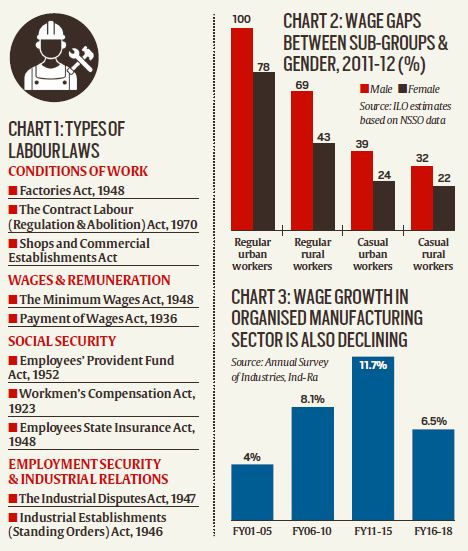
    Broadly speaking, they can be divided into four categories. Refer to the image.

    • The main objectives of the Factories Act, for instance, are to ensure safety measures on factory premises and promote the health and welfare of workers.
    • The Shops and Commercial Establishments Act, on the other hand, aims to regulate hours of work, payment, overtime, a weekly day off with pay, other holidays with pay, annual leave, employment of children and young persons, and employment of women.
    • The Minimum Wages Act covers more workers than any other labour legislation.
    • The most contentious labour law, however, is the Industrial Disputes Act, 1947 as it relates to terms of service such as layoff, retrenchment, and closure of industrial enterprises and strikes and lockouts.

    Why are labour laws often criticised?

    • Indian labour laws are often characterized as “inflexible”. Most of them are inadequate to make the sector formalized.
    • At present 90% of India’s workers are parts of the informal economy. The Chart shows, even the organised sector are increasingly employing workers without formal contracts.
    • Others have also pointed out that there are too many laws, often unnecessarily complicated, and not effectively implemented. This has laid the foundation for corruption and rent-seeking.

    Issues with the recent relaxation

    1.Exploitation

    • The state of UP has summarily suspended almost all labour laws including the Minimum Wages Act.
    • Hence this move is characterized as “creating an enabling environment for exploitation”.
    • That’s because far from being a reform, which essentially means an improvement from the status quo, the removal of all labour laws will not only strip the labour of its basic rights but also drive down wages.
    • For instance, what stops a firm from firing all existing employees and hiring them again at lower wages.
    • For one, as Chart 3 shows, even before the Covid-19 crisis, thanks to the deceleration in the economy, wage growth had been moderating.
    • Moreover, there was always a wide gap between formal and informal wage rates. For example, a woman working as a casual labourer in rural India earns just 20% of what a man earns in an urban formal setting.
    • If all labour laws are removed, most employment will effectively turn informal and bring down the wage rate sharply. And there is no way for any worker to even seek grievance redressal.

    2.Informalization

    • Moreover, far from pushing for a greater formalization of the workforce, this move will in one go turn the existing formal workers into informal workers as they would not get any social security.

    3. Will reduce demand in the economy

    • Scrapping labour laws to save on labour costs will not help start the economy but will do exactly the opposite.
    • It will reduce wages, lower earnings (particularly of low wage workers) and reduce consumer demand.

    4.Unlikely to spur economic growth?

    • Theoretically, it is possible to generate more employment in a market with fewer labour regulations.
    • However, as the experience of states that have relaxed labour laws in the past suggests, dismantling worker protection laws have failed to attract investments and increase employment.
    • It is unproven if they can cause an increase in worker exploitation or deterioration of working conditions. However, in the long run, employment will not increase, because of several reasons.

    5. Enacted without any scrutiny:

    • Usually, any change in an Act follows a rigorous process of public consultation, scrutiny by committees of Parliament, and debates in the House before being approved.
    • The changes described here have not gone through such a process.
    • However, most of these have a three-month time limit, and any extension would need to be approved by the legislature.

    What else could have been done?

    1.Allow two shifts

    • There is already too much-unused capacity. Firms are shaving off salaries up to 40% and making job cuts. The overall demand has fallen. Which firm will hire more employees right now, he asked.
    • If the intention was to ensure more people have jobs, then states should not have increased the shift duration from 8 hours to 12 hours.
    • They should have allowed two shifts of 8-hours each instead so that more people can get a job.
    • This move and the resulting fall in wages will further depress the overall demand in the economy, thus hurting the recovery process.

    2.Partnered with the industry

    • Most governments have done across the world have partnered with the industry and allocated 3% or 5% of the GDP towards sharing the wage burden and ensuring the health of the labourers.
    • Moreover, beyond labour regulations, firms face a lot of other hurdles like the shortage of skilled labour and the weak enforcement of contracts etc.
    • Time demands to secure the labour most than their employers.
  • AMMA Canteen and its success

    The Amma Canteen, a delivery system to provide urban food security in Tamil Nadu, has become an effective mechanism in reaching the needy during the lockdown.

    AMMA Canteen

    • Amma Unavagam better known as Amma Canteen is a food subsidization programme run by the Government of Tamil Nadu.
    • Under the scheme, municipal corporations of the state-run canteens serving subsidised food at low prices.
    • The dishes are offered at low prices: ₹1 for an idli, ₹5 for a plate of sambar rice, ₹5 for a plate of “Karuvapellai Satham” (Curry leaves rice) and ₹3 for a plate of curd rice.

    Feeding the stranded

    • Migrants usually benefit from this canteen scheme.  It is not uncommon to see policemen, municipal workers and people from the media having their breakfast in these canteens.
    • The system, in short, has ensured urban food security and is a boon to migrants during lockdown. There are, thus, unexpected but pleasant benefits from this scheme.

    Reasons for success

    • It is a delivery system with minimum leakages and has reached to its target group very effectively compared to the PDS system.
    • People realized the benefits of the scheme in due course of time and thus it emerged popularly.

    A lesson for all

    • Welfare schemes are started with the intention to provide benefits to vulnerable sections of society.
    • The success of any welfare scheme depends on the seriousness of the people at the helm of affairs, the efficiency of the scheme’s functionaries and the involvement of the people.
    • During the process of implementation, some deserving people get excluded from the scheme, while some of those who were undeserving manage to enjoy its benefits.
    • Welfare schemes deliver unexpected but pleasant benefits sometimes.

    Way forward

    • For such a welfare scheme to be successful, it must be launched in letter and spirit.
    • The benefits of the schemes cannot be realized at pan India level in the absence of a good delivery system.
    • These states should explore the possibility of utilising available infrastructure in existing private canteens and hotels (closed during lockdown).
    • This measure would not only help migrant workers but also provide employment to workers who remained unemployed since the lockdown came into effect.
  • Haryana’s ‘quota within SC quota

    The Haryana Assembly last week passed a Bill to split the 20% quota for Scheduled Castes (SCs) in the state’s higher educational institutions into two, creating a quota within the quota for a new group of “Deprived Scheduled Castes”.

    Deprived Scheduled Castes

    • This category has 36 communities including Valmiki, Bazigar, Sansi, Deha, Dhanak, and Sapera.

    What does the new law say?

    • Fifty per cent of the 20 per cent seats reserved for SCs for admission in any Government educational institution shall be set aside for candidates belonging to DSCs.
    • Where a seat set aside for candidate from deprived Scheduled Castes is not filled up in any academic year due to non-availability of such candidate; it shall be made available to candidate of Scheduled Castes.

    Constitutional Provisions incited

    • Article 15(5) of the Constitution authorizes the State to make special provisions for the advancement of any socially and educationally backward classes of citizens or for SCs/STs for admission to educational institutions.
    • However Article 15(5) did not mention powers to bifurcate the quota.

    Is this sub-quota a new idea?

    • The present Haryana government has replicated the initiative of the state government in 1994.
    • Then government bifurcated the Scheduled Caste quota into two categories: Block A and Block B.

    Why such move?

    • The Statement of Objects and Reasons of the Act says that the representation of the SCs now categorised as DSCs” is “only 4.7%, 4.14% and 6.27% in Group A, Group B and Group C services respectively, even though their population is about 11% of the total State population.
    • The population of other SCs in Haryana is also about 11% of the total State population but in respect of representation in Government Services their share is 11%, 11.31% and 11.8% in Group A, B and C, respectively.”
    • The reason for the poor representation of the DSCs in government jobs can be found in their educational qualifications.
    • Thus, even though the “minimum prescribed educational qualification for majority of the posts of Group A, B & C services… is Graduation, the Socio-Economic Caste Census data reveals that in terms of education.
    • Only 3.53% population of the DSCs is Graduate, 3.75% of them are Senior Secondary level and 6.63% are Matric/Secondary level. Also 46.75% of them are illiterate.
  • Skill her, skill India

    Context

    On March 8, we honour and celebrate women on the occasion of the International Women’s Day. Women in our country are making strides in social, financial and political fields.

    Women breaking the barriers

    • Women working for the development of the country: Be it the 1857 mutiny for India’s freedom or the struggle for Independence, our women have always made India proud.
      • Even today, women are performing their duties with full devotion for the development of the country and upliftment of society.
      • They are working efficiently in various fields, such as academics, literature, music and dance, sports, media, business, information technology, science and technology, politics and social development.
    • Breaking barriers in various fields: Indian women from metropolitan cities like Delhi, Mumbai, Kolkata and Chennai are breaking barriers in fields ranging from politics to the corporate sector.
    • Giving society a new direction: Women are giving society a new direction through their leadership and critical participation in panchayat elections.
      • Increasing awareness and clear intentions are the reason behind women strengthening economic, social and cultural establishments.
      • This is very important for a democratic system.

    Female participation in the corporate sector

    • IT sector participation: There is a constant evolution of female participation in the corporate sector. Female participation is constantly increasing in the Information Technology sector.
    • Presence in other areas: Along with the IT sector, the presence of women is also increasing in the banking and finance sector.
      • Last year, the Indian Space Research Organisation decided to hand over the command of Chandrayaan-2 to two women, and these women also played a key role in the mission.

    Government schemes for women empowerment

    • Our government is running many schemes for women’s empowerment such as the Pradhan Mantri Ujjwala Yojana, Beti Bachao Beti Padhao, Mahila E-haat Scheme, Sukanya Samriddhi Yojana, Sakhi Yojana, Ladli Yojana, Digital Laado and the Swachh Bharat Mission.
    • Government is also working extensively on women’s nutrition.
    • Multiple ministries working on the same: The Ministry of Skill Development and Entrepreneurship, Women and Child Empowerment, and Human Resource Development are working closely in this regard.
    • Identification of skill set: We know that every person has a unique skill-set. What is needed is a mechanism to ensure that that skill-set is identified and honed in the best possible way.
      • The government need to ensure that all women in our country from different occupations are trained in their respective skill-sets and are employable.
    • Government need to put to best use their skill-set to become self-employed entrepreneurs and progress.
    • Around 68.12 lakh women in India have been trained under the Pradhan Mantri Kaushal Vikaas Yojana 2.0.
    • Under the Jan Shikshan Sansthan Scheme, around 08 lakh women have been trained in the 2018-2020 period, while 38.72 lakh women have been trained in Industrial Training Institutes (ITI).
      • At present, there are 18 National Skill Training Institutes across the country to train women. Special batches are being conducted to provide basic, theoretical and advanced training to women.
    • Making progress in non-traditional skills: It is a matter of joy and pride that while women in India are studying electronics, fashion design, technology and business management, there are also those who hone their new-age skills in artificial intelligence, data analytics, 3D printing, etc.
      • Along with traditional skills like beauty, wellness and healthcare, women are also progressing quickly in non-traditional skills such as electronics and hardware.

    The role of various missions in strengthening women’s skill

    • The National Rural Livelihood Mission has strengthened women’s skills and prepared them for employment.
    • Training for self-employed tailors, beauty therapists, customer care executives, hairstylists, yoga trainers, etc. are being carried out in the Prime Minister Skill Centres.
    • Women playing a significant role in various missions: Very soon, one will get to see women playing significant roles in central government schemes such as the Ayushman Bharat Yojana, Swachh Bharat Mission and Smart City Mission.
      • By joining these missions, women will make a huge contribution in giving a new shape to society.
      • In fact, in the creation of a New India, women’s education and skill development are going to be critical.
    • In the last few years, the central government has rolled out various schemes that have emboldened the women of our country and taken them on the path of self-reliance and security.

    Conclusion

    The efforts of our government have created a milieu of trust in the women of our country. They are confident that the country’s government machinery is standing by them by creating an atmosphere of respect and development for women. In the past few years, our government has made massive advancements in providing education and honing skill-sets. We pledge to make sure that these efforts reach each and every Indian woman.