💥Join UPSC 2027,2028 Mentorship (July Batch) + XFactor Notes & Microthemes PDF

GS Paper: PDS, Buffer Stock & Food Security

  • Redefining essential items: why it was needed, and who it will impact

    Recently, the Rajya Sabha passed the Essential Commodities (Amendment) Bill, 2020 which is aimed at deregulating commodities such as cereals, pulses, oilseeds, edible oils, onion and potatoes.

    Try this question:

    What are the salient features of Essential Commodities (Amendment) Bill, 2020?

    Essential Commodities (Amendment) Bill, 2020

    • It amends the Essential Commodities Act, 1955, by introducing a new Subsection 1(A) in Section 3.
    • After the amendment, the supply of certain foodstuffs — including cereals, pulses, oilseeds, edible oils, potato — can be regulated only under extraordinary circumstances, which include an extraordinary price rise, war, famine, and natural calamity of a severe nature.
    • In effect, the amendment takes these items out from the purview of Section 3(1), which gives powers to the central government to “control production, supply, distribution, etc, of essential commodities”.
    • Earlier, these commodities were not mentioned under Section 3(1) and reasons for invoking the section were not specified.

    How is an ‘essential commodity’ defined?

    • There is no specific definition of essential commodities in the Essential Commodities Act, 1955. Section 2(A) states that an “essential commodity” means a commodity specified in the Schedule of the Act.
    • The Act gives powers to the central government to add or remove a commodity in the Schedule.
    • The Centre, if it is satisfied that it is necessary to do so in the public interest, can notify an item as essential, in consultation with state governments.

    Which are those commodities?

    • According to the Ministry of Consumer Affairs, Food and Public Distribution, which implements the Act, the Schedule at present contain seven commodities.
    • They are drugs; fertilizers, whether inorganic, organic or mixed; foodstuffs including edible oils; hank yarn made wholly from cotton; petroleum and petroleum products; raw jute and jute textiles; seeds of food-crops and seeds of fruits and vegetables, seeds of cattle fodder, jute seed, cottonseed.
    • By declaring a commodity as essential, the government can control the production, supply, and distribution of that commodity, and impose a stock limit.

    Under what circumstances can the government impose stock limits?

    • While the 1955 Act did not provide a clear framework to impose stock limits, the amended Act provides for a price trigger.
    • It says that agricultural foodstuffs can only be regulated under extraordinary circumstances such as war, famine, extraordinary price rise, and natural calamity.
    • However, any action on imposing stock limits will be based on the price trigger.
    • Thus, in case of horticultural produce, a 100% increase in the retail price of a commodity over the immediately preceding 12 months or over the average retail price of the last five years, whichever is lower, will be the trigger for invoking the stock limit.
    • For non-perishable agricultural foodstuffs, the price trigger will be a 50% increase in the retail price of the commodity over the immediately preceding 12 months or over the average retail price of the last five years, whichever is lower.

    Why was the need for this felt?

    • The 1955 Act was legislated at a time when the country was facing a scarcity of foodstuffs due to persistently low levels of foodgrains production.
    • The country was dependent on imports and assistance (such as wheat import from the US under PL-480) to feed the population.
    • To prevent hoarding and black marketing of foodstuffs, the Essential Commodities Act was enacted in 1955. But now the situation has changed.
    • The production of wheat has increased 10 times while the production of rice has increased more than four times since five decades.
    • The production of pulses has increased 2.5 times, from 10 million tonnes to 25 million tonnes. In fact, India has now become an exporter of several agricultural products.

    What will be the impact of the amendments?

    • The key changes seek to free agricultural markets from the limitations imposed by permits and mandis that were originally designed for an era of scarcity.
    • The move is expected to attract private investment in the value chain of commodities removed from the list of essentials, such as cereals, pulses, oilseeds, edible oils, onions and potatoes.
    • While the purpose of the Act was originally to check illegal trade practices such as hoarding, it has now become a hurdle for investment in the agriculture sector in general, and in post-harvesting activities in particular.
    • The private sector had so far hesitated about investing in cold chains and storage facilities for perishable items as most of these commodities were under the ambit of the EC Act.
    • The amendment seeks to address such concerns.

    Why is it being opposed?

    • This was one of the three ordinances/Bills that have seen protests from farmers in parts of the country.
    • The Opposition says the amendment will hurt farmers and consumers, and will only benefit hoarders.
    • They say the price triggers envisioned in the Bill are unrealistic — so high that they will hardly ever be invoked.
  • Nutrition security along with food security


    • The “State of Food Security and Nutrition in the World” was recently released.

    About the report

    • It is published by the UN Food and Agriculture Organization (FAO) and other UN agencies including the WHO.
    • The report estimated that 820 million people worldwide did not have enough to eat in 2018, up from 811 million in the previous year.
    • At the same time, the number of overweight individuals and obesity continue to increase in all regions.

    Highlights of the report

    • The number of people going hungry has risen for the third year running to more than 820 million. After decades of decline, food insecurity began to increase in 2015.
    • Africa and Asia account for more than nine out of ten of the world’s stunted children, at 39.5% and 54.9% respectively.
    • However at the same time, obesity and excess weight are both on the rise in all regions, with school-age children and adults affected particularly.

    India scenario

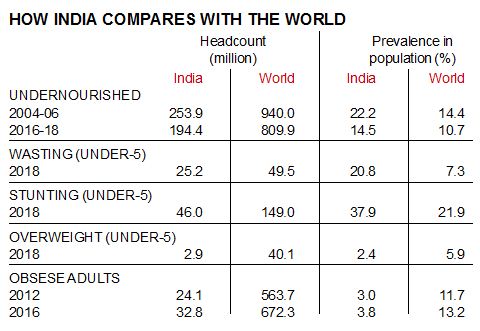
    • The number of obese adults in India has risen by a fourth in four years, from 24.1 million in 2012 to 32.8 million in 2016.
    • While India’s undernourished population has dropped by roughly the same fraction in 12 years, from 253.9 million in 2004-06 to 194.4 million in 2016-18.

    Compared with China

    • The report has a section on economic growth in China and India, and its effect on poverty.
    • Between 1990 and 2017, the two countries had an average GDP per capita growth rate of 8.6 per cent and 4.5 per cent respectively, the report said, citing World Bank.
    • In both countries, the increase in GDP per capita has been accompanied by poverty reduction.
  • Issue of Food subsidy in India

    Solutions to Problems in Food Subsidy Delivery

    The following solutions will help in addressing problems associated with PDS.

    1. Replacing Targeted Public Distribution System (TPDS) with Direct Benefit Transfer (DBT) of food subsidy. National Food Security Act (NFSA) states that the centre and states should introduce schemes for cash transfers to beneficiaries.Cash transfers seek to increase the choices available with a beneficiary, and provide financial assistance.  It has been argued that the costs of DBT may be lesser than TPDS, owing to lesser costs incurred on transport and storage.  These transfers may also be undertaken electronically. As per a report given by a high level committee of Food Corporation of India, DBT would reduce Government subsidy bills by more than Rs 30,000 crores.
    2. Automation at the Fair Price Shops is another important step taken to address the problem in PDS. Currently more than 4.3 lakh (82%) Fair Price Shops have been automated across the country. Automation involves installation of Point of Sale (PoS) devices, for authentication of beneficiaries and electronic capturing of transactions.
    3. Aadhar and introduction of Biometrics was recommended to plug leakages in PDS. Such transfers could be linked to Jan Dhan accounts, and be indexed to inflation. It  facilitates the removal of bogus ration cards, check leakages and ensure better delivery of food grains. In February 2017, the Ministry made it mandatory for beneficiaries under NFSA to use Aadhaar as proof of identification for receiving food grains.
    4. 100% ration cards had been digitised.
    5. Between 2016 and 2018, seeding of Aadhaar helped in detection of 1.5 crore fake, duplicate and bogus ration cards and these cards were deleted.
    6. Increase the procurement undertaken by states known as Decentralised Procurement (DCP), and reduce the expenditure on centralised procurement by the Food Corporation of India (FCI). This would drastically reduce the transportation cost borne by the government as states would distribute the food grains to the targeted population within their respective states. As of December 2019,17 states have adopted decentralised procurement.
    7. The Fair Price shops operate at very low margins as per findings of the Government. Hence the fair price shops should be allowed to sell even non-PDS items and make it economically viable. This will motivate them to not to resort to unfair practices in the distribution of Government subsidized food grains meant for beneficiaries of Government schemes.
    8. A greater and more active involvement of the panchayats in the PDS can significantly improve access at the village level.
    9. There is also an urgent need to set up a proper and effective grievances redressal system for both the fair price shops as well as beneficiaries
  • Universalising the PDS

    • The Public distribution system (PDS) is an Indian food Security Systemestablished under the Ministry of Consumer Affairs, Food, and Public Distribution.
    • PDS evolved as a system of management of scarcity through distribution of food grains at affordable prices.
    • PDS is operated under the joint responsibility of the Central and the State Governments.
      • The Central Government, through Food Corporation of India (FCI), has assumed the responsibility for procurement, storage, transportation and bulk allocation of food grains to the State Governments.
      • The operational responsibilities including allocation within the State, identification of eligible families, issue of Ration Cards and supervision of the functioning of Fair Price Shops (FPSs) etc., rest with the State Governments.
    • Under the PDS, presently the commodities namely wheat, rice, sugar and keroseneare being allocated to the States/UTs for distribution. Some States/UTs also distribute additional items of mass consumption through the PDS outlets such as pulses, edible oils, iodized salt, spices, etc.
  • Agri reforms and way forward

    At a time when the economy is going through the crisis, anything that could provide revenue to the government will be a real godsend. This article suggests two such areas to tap into. It also examines the effects of recently issued 3 ordinances related to agriculture.

    Rs. 1,50,000 crore: Value of excessive grain stock

    • There is one area which the government can tap to raise more than Rs 1,00,000 crore.
    • As on June 1, FCI had unprecedented grain stocks of 97 million metric tonnes (MMT) in the Central Pool (see Figure).
    • Even on July 1, when the procurement of rabi ends, FCI is likely to have grain stocks of about 91-92 MMT.
    • This will be against a buffer stock norm of 41.12 MMT that are required for the Public Distribution system (PDS), and some strategic reserves.
    • So, compared to this norm, on July 1, FCI will have “excess stocks” of at least 50 MMT.
    • Even if one takes a conservative and lower ballpark figure of Rs 30,000/tonne  as the combined economic cost of rice and wheat, the value of this “excessive stock”, beyond the buffer norm, is Rs 1,50,000 crore.
    • This is unproductive capital locked-up in the Central pool of FCI.
    • Unlock this by liquidating “excess stocks” through open market operations.
    • It will not recover its full economic cost, as they are much higher than the prevailing market prices, but by not liquidating it.
    • But FCI will keep incurring unnecessary interest costs of about Rs 8,000-10,000 crore per annum.
    • This is simply not a good food policy.

    How will amendment to ECA 1955 will help

    •  Amendment of the Essential Commodities Act, via the ordinance route, can instil confidence in the private sector for building large scale storage.
    • Now, stocking limits will not be imposed on the private sector, except under exceptional circumstances.
    • The government, however, delete the clause of “extraordinary price rise”.
    • Removing it will lead to private sector building large and modern storage facilities (silos).
    • It will propel investments in building more efficient food supply lines.
    • The only condition could be to register large storage facilities under the Warehousing Development and Regulatory Authority (WDRA) to know how much stock is there with the private sector, and where.

    How will amendment to APMC Act will help

    • The ordinance on APMC creates multiple channels for farmers to sell their produce outside the APMC mandi system.
    • It also helps towards an unrestricted all India market for agri-produce.
    • Of course, it will be resisted by many states that are taking undue advantage of the APMC mandis’ virtual monopoly power.
    • But if the central ordinance is implemented in its true spirit, it will be a game-changer.

    How will the ordinance on contract farming will help

    • It aims to encourage contract farming.
    • The basic idea behind this is that farmers’ sowing decisions should be made in view of the expected prices of those crops at the time of harvest.
    • It is forward looking and more aligned to the likely demand and supply situation.
    • The current practice, where farmers’ sowing decisions are more influenced by last year’s price, often leads to the problem of boom and bust.
    • Although honouring an assured price remains a challenge when actual market conditions differ widely at the time of the harvest.

    Relook at food subsidy is needed

    •  In the Union budget of 2020-21, a sum of Rs 1,15,570 crore has been provisioned for food subsidy.
    • This number is highly misleading as FCI has been asked to borrow from the National Small Savings Fund (NSSF).
    • As on March 31, 2020, borrowings from the NSSF were Rs 2,54,600 crore, on which FCI pays an interest rate of 8.4 to 8.8 per cent per annum.
    • So, the real food subsidy bill for 2020-21 amounts to Rs 3,70,170 crore.
    • The Economic Survey has suggested- 1) reducing the coverage under PDS; 2) linking issue price to at least half of the procurement price; 3) move gradually towards cash transfers.
    • These steps will save a minimum of Rs 50,000 crore annually.

    Consider the question “There was a mention of reforms related to agri-sector in the recently announced stimulus package. Examine the issues with segments of agri-sector which necessitated these reforms.”

    Conclusion

    Liquidating the excess grain stock and rationalising the PDS could provide the government with much needed resources at a time when it needs it the most. Also, reforms in the related to agriculture could remove the stumbling blocks in the way towards the prosperity of farmers.

  • Applying the lessons learned from GST to One Nation One Ration Card (ON-ORC)

    Never before we felt the necessity of portable benefit schemes as we did in the wake of the pandemic. Portable ration card could have mitigated the suffering of migrant workers to some extent. But it was not to be. This article examines the challenges in implementing the idea of ON-ORC and offers the solution to these challenges by drawing on the lessons learned from GST. At the same time, the shortcoming of GST can also be avoided in the ON-ORC.

    What is One Ration Card (ON-ORC)?

    • In the present system, a ration cardholder can buy foodgrains only from an Fair   Price Shop that has been assigned to her in the locality in which she lives.
    • However, this will change once the ONORC system becomes operational nationally.
    • Under the ONORC system, the beneficiary will be able to buy subsidised foodgrains from any FPS across the country.
    • The new system, based on a technological solution, will identify a beneficiary through biometric authentication on electronic Point of Sale (ePoS) devices installed at the FPSs.
    • This would enable that person to purchase the number of foodgrains to which she is entitled under the NFSA.

    Portable welfare benefit and attempts so far to achieve it

    •  The idea of portable welfare benefits means a citizen should be able to access welfare benefits irrespective of where she is in the country.
    • In the case of food rations, the idea was first mooted under the UPA government by a Nandan Nilekani-led task force in 2011.
    • The current government had committed to a national rollout of One Nation, One Ration Card (ON-ORC) by June 2020, and had initiated pilots in 12 states.

    Progress on intra-state and inter-state portability

    • While intra-state portability of benefits has seen good initial uptake, inter-state portability has lagged.
    • The finance minister has now announced the deadline of March 2021 to roll out ON-ORC.

    So, to ensure a smooth rollout, let’s review the challenges thus far

    1) The fiscal implications:

    • ON-ORC will affect how the financial burden is shared between states.

    2) The larger issues of federalism and inter-state coordination:

    • Many states are not convinced about a “one size fits all” regime because i) they have customised the PDS through higher subsidies, ii) higher entitlement limits, and iii) supply of additional items.

    3) The technology aspect:

    • ON-ORC requires a complex technology backbone that brings over 750 million beneficiaries, 5,33,000 ration shops and 54 million tonnes of food-grain annually on a single platform.

    How the lessons learned from GST can be applied to deal with the above 3 challenges?

    1. Fiscal challenge

    • Just like with ON-ORC, fiscal concerns had troubled GST from the start.
    • States like Tamil Nadu and Gujarat that are “net exporters” were concerned they would lose out on tax revenues to “net consumer” states like UP and Bihar.
    • Finally, the Centre had to step in and provide guaranteed compensation for lost tax revenues for the first five years.
    • The Centre could provide a similar assurance to “net inbound migration” states such as Maharashtra and Kerala that any additional costs on account of migrants will be covered by it for the five years.

    2. We could have a National council for ON-ORC

    • GST also saw similar challenges with broader issues of inter-state coordination.
    • In a noteworthy example of cooperative federalism, the central government created a GST council consisting of the finance ministers of the central and state governments to address these issues.
    • The government could consider a similar national council for ON-ORC.
    • To be effective, this council should meet regularly, have specific decision-making authority, and should operate in a problem-solving mode based on consensus building.

    3. Technological aspect: PDS Network

    • GST is supported by a sophisticated tech backbone, housed by the GST Network (GSTN), an entity jointly owned by the Centre and states.
    • A similar system would be needed for ON-ORC.
    • The Nilekani-led task force recommended setting up of a PDS network (PDSN).
    • PDSN would track the movement of rations, register beneficiaries, issue ration cards, handle grievances and generate analytics.
    • Since food rations are a crucial lifeline for millions, such a platform should incorporate principles such as inclusion, privacy, security, transparency, and accountability.
    • The IM-PDS portal provides a good starting point.

    Also, there are certain shortcomings in GST which we could avoid in ON-ORC

    We should learn from the shortcomings and challenges of the GST rollout. For example:

    1) Delay in GST refunds led to cash-flow issues.

    • Similar delays in receiving food rations could be catastrophic.
    • Therefore, ON-ORC should create, publish and adhere to time-bound processes.
    • The time-bound processes could be in the form of right to public services legislation that have been adopted by 15 states, and rapid grievance redress mechanisms.

    2)  Increase in compliance burden for MSMEs, especially for those who had to digitise overnight.

    • Similar challenges could arise in ON-ORC.
    • PDS dealers will need to be brought on board, and not assumed to be compliant.
    • Citizens will need to be shielded from the inevitable teething issues by keeping the system lenient at first.
    • This can be done by providing different ways of authenticating oneself and publicising a helpline widely.

    Consider the question “One Nation-One Ration Card(ON-ORC) could solve many problems faced by the beneficiaries when they move across the country. Examine the challenges the ON-ORC could face. Suggest ways to deal with these challenges.”

    Conclusion

    If done well, ON-ORC could lay the foundation of a truly national and portable benefits system that includes other welfare programmes like LPG subsidy and social pensions. It is an opportunity to provide a reliable social protection backbone to migrants, who are the backbone of our economy.

  • Taking India’s agri-marketing and PDS system on a more efficient path

    Agriculture is still the mainstay of Indian economy. There are certain problems that persist in the agri-marketing and PDS. The author suggests to use the present corona crisis to embark on the path of the reform in these areas.

     Supply lines maintained during the lockdown

    • India seems to have contained the mortality rate from Covid-19 to 3.3% which is lower than the global average of about 7 per cent.
    • On the food front too, India has done reasonably well.
    • Despite initial disruptions in supply lines, India has somehow managed to feed its large population of 1.37 billion.
    • In fact, if there is any complaint, it is from the producer’s side that the prices of perishables have collapsed in some parts of the country.
    • But, from the consumer’s point of view, even for perishables like milk and vegetables, supply lines were quickly restored and food is easily available in the markets at reasonable prices.
    • On keeping supply lines for essential food alive and running, those in the government managing the food logistics surely deserve to be complimented.

    Reforms in agri-marketing and PDS

    • Agriculture still engages India’s largest workforce.
    • And it may be the only sector that registers a respectable growth this year as almost all other major sectors may plummet into negative territory.
    • Agriculture sector is in urgent need of the reforms that can help farmers get a better price for their produce with consumers still paying a reasonable price for their food.
    • Following ways are suggested for agri-marketing:
    • While the APMC markets can keep doing their business as usual, it is time to open channels for direct buying from farmers/farmer producer organisations (FPOs).
    • Any registered large buyer, be it processors or retail groups or exporters must be encouraged by providing them with a license, that is valid all over India.
    • They should be exempted from any market fee and other cesses as they will not be using the services of the APMC market yards.
    • E-NAM can flourish if grading and dispute settlement mechanisms are put in place.
    • Private mandis with modern infrastructure need to be promoted in competition with APMCs.
    • On the PDS front, we need to move towards cash transfers that can be withdrawn from anywhere in the country.
    • Some initiative has already been taken by the Madhya Pradesh and even Uttar Pradesh is now moving along these lines.
    • But much more can be done to put India’s agri-marketing and PDS system on a more efficient path.

    Consider the question asked by the UPSC in 2014 “There is also a point of view that Agricultural Produce Marketing Committees set up under the State Acts have not only impeded the development of agriculture but also have been the cause of food inflation in India. Critically examine.”

    Conclusion

    The recovery of the economy, whether it will be V-shape or J-shape, depends upon the package that the government announces. The mega reforms need to be built in this recovery package.


    Agriculture Produce Marketing Committee Regulation (APMC) Act.

    • All wholesale markets for agricultural produce in states that have adopted the Agricultural Produce Market Regulation Act (APMRA) are termed as “regulated markets”.
    • With the exception of Kerala, J & K, and Manipur, all other states have enacted the APMC Act.
    • It mandates that the sale/purchase of agricultural commodities notified under it are to be carried out in specified market areas, yards or sub-yards. These markets are required to have the proper infrastructure for the sale of farmers’ produce.
    • Prices in them are to be determined by open auction, conducted in a transparent manner in the presence of an official of the market committee.
    • Market charges for various agencies, such as commissions for commission agents (arhtiyas); statutory charges, such as market fees and taxes; and produce-handling charges, such as for cleaning of produce, and loading and unloading, are clearly defined, and no other deduction can be made from the sale proceeds of farmers.
    • Market charges, costs, and taxes vary across states and commodities.
  • FCI to the rescue

    FCI, indeed, has remained a crucial topic from the examination viewpoint. Mostly it is highlighted for its issues, corruption and wastages in the godowns. Be it MS Swaminathan or the latest Shanta Kumar committee all focus on how to revamp this giant institution. This article, however, points to the relevance of the FCI in the times of pandemic and suggests areas where there is scope for improvement in fulfilling its role. Stay tuned to find out what are the major concerns with FCI which needs consideration by the government.

    A background check on FCI

    • The FCI was set up under the Food Corporations Act 1964.

    •  In its first decade, FCI was at the forefront of India’s quest of self-sufficiency in rice and wheat following the Green Revolution.

    • Its functions involved managing procurement and stocking grain that supported a vast Public Distribution System (PDS).

    • Over time it became a behemoth that had long outlived its purpose and Its operations were regarded as expensive and inefficient.

    • Even in the 1970s and 1980s, poor storage conditions meant a lot of grain was lost to pests, mainly rats; diversion of grain was widespread.

    What role can FCI play amid Covid-19?

    • The FCI has consistently maintained the PDS, a lifeline for vulnerable millions across the country.

    • In the middle of the COVID-19 pandemic, it can play a major role in avoiding hunger and starvation.

    • Before the lockdown, with 77 million tonnes of grains in its godowns, the FCI was facing a serious storage problem.

    • This was worrying not just because of a shortage of modern storage facilities but also because the FCI lacked a “pro-active liquidation policy” for excess stocks.

    • Post-COVID: FCI has opened up the godowns to release food stocks to those affected by the lockdown.

    • The FCI has also enabled purchases by States and non-governmental organisations directly from FCI depots, doing away with e-auctions typically conducted for the Open Market Sale Scheme (OMSS).

    • With rabi procurement underway in many States, it seems that the country will secure ample food supplies to cope with the current crisis.

    • Given the extended lockdown, the FCI is uniquely positioned to move grain across State borders where private sector players continue to face formidable challenges of transport.

    5 suggestions for the FCI to perform better

    1. Using roads along with rails:

    • The FCI is overwhelmingly reliant on rail, which has several advantages over road transport.

    • In 2019-2020 (until February) only 24% of the grain moved was by road.

    • The FCI has long recognised that road movement is often better suited for emergencies and for remote areas.

    • Containerised movement too, which is not the dominant way of transporting grain, is more cost-effective and efficient.

    • Now, more than ever, it is imperative to move grain quickly and with the least cost and effort, to areas where the need is greatest.

    2. Store grain near demand hotspot

    • The FCI already has a decentralised network of godowns.

    • In the current context, it would be useful for the State government and the FCI to maintain stocks at block headquarters or panchayats in food insecure or remote areas.

    • This would allow State governments to respond rapidly.

    •  It will also provide a sense of assurance and psychological comfort to vulnerable communities.

    • This is especially relevant for regions that are chronically underserved by markets or where markets have been severely disrupted.

    3. Release stocks over and above existing allocation

    • The central government need to look beyond the PDS and the Pradhan Mantri Garib Kalyan Yojana and release stocks over and above existing allocations.

    • This would provide flexibility to local governments to access grains for appropriate interventions at short notice and to sell grain locally at pre-specified prices until supply is restored.

    • This would allow the state government to engage in feeding programmes, free distribution to vulnerable and marginalised sections, those who are excluded from the PDS, etc.

    • In many States, there is a vibrant network of self-help groups formed under the National Rural Livelihoods Mission (NRLM) which can be tasked with last mile distribution of food aid other than the PDS.

    • Consultative committees presumably exist already in each State to coordinate with the FCI on such arrangements.

    4. Suspend FIFO principle

    • Typically, the FCI’s guidelines follow a first in, first out principle (FIFO).

    • FIFO mandates that grain that has been procured earlier needs to be distributed first to ensure that older stocks are liquidated, both across years and even within a particular year.

    • It is time for the FCI to suspend this strategy, that enables movement that costs least time, money and effort.

    5. Support the farmers trying to reach out to consumers directly

    • In many places, farmer producer organisations (FPOs) have been at the forefront of rebuilding these broken supply chains.

    • The FCI along with the National Agricultural Cooperative Marketing Federation of India Ltd. (NAFED), is well placed to rope in expertise to manage the logistics to support these efforts.

    • NAFED has already taken the initiative to procure and transport horticultural crops.

    • The FCI should similarly consider expanding its role to support FPOs and farmer groups, to move a wider range of commodities including agricultural inputs such as seeds and fertilizers, packing materials and so on.

    Major concerns regarding FCI’s role

    • Cost of food subsidy: The first is a long-term concern regarding the costs of food subsidy.

    • An analysis of FCI costs spanning 2001-16 suggests that on average about 60% of the costs of acquisition, procurement, distribution and carrying stocks are in fact transfers to farmers.

    • Not all of what is counted as subsidy therefore represents a waste of resources.

    • The government needs to address the FCI’s mounting debts — an estimated ₹2.55 lakh crore in March 2020 in the form of National Small Saving Funds Loan alone.

    • Depressing food prices: A second concern is that extended food distribution of subsidised grain is akin to dumping and depresses food prices locally.

    • The depressed prices, in turn, affect farmers.

    The Covid-19 pandemic has brought into sharp focus the relevance of the FCI. This makes PDS and Food security in prelims as well as in mains examination focus area. So, questions based on the topic are likely to be asked by the UPSC, for ex- “The FCI’s role in providing succour has been proved many times in the past and it lived up to its reputation amid Covid-19 pandemic as well. In the light of the above statement, discuss the relevance of the FCI and suggest the ways to improve its performance in the times of disasters”

    Also consider a question asked by the UPSC in 2019, “What are the reformative steps taken by the Government to make the food grain distribution system more effective?”

    Conclusion

    In 2015, the Shanta Kumar report recommended repurposing the organisation as an “agency for innovations in Food Management System” and advocated shedding its dominant role in the procurement and distribution of grain. There is no doubt that the FCI needs to overhaul its operations and modernise its storage. At the same time, the relevance of an organisation such as the FCI or of public stockholding, common to most Asian countries, has never been more strongly established than now.

  • Three dimensions of food security amid Covid-19

    The article discusses the three dimensions of food security-1)Availability 2)Acces 3) Absorption. The first two are also dependent on job security. All these are now being threatened by the pandemic. Ways to safeguard food security along with its 3 dimensions are suggested at the end of the article.

    1. Availability of food in the market

    • The first is the availability of food in the market, and this is seen as a function of production.
    • Fortunately, thanks to the Green Revolution, today we have enough food in the market and in government godowns.
    • This is a great accomplishment by Indian farmers who converted a “ship to mouth” situation to a “right to food” commitment.
    • Yet we cannot take farmers’ contributions in terms of sustaining production for granted.
    • Some special exemptions have been given to the agricultural sector, farmers are confronted at the moment with labour shortages.
    • But many of the inputs, including seeds, are expensive or unavailable, marketing arrangements including supply chains are not fully functional, pricing is not remunerative, and public procurement is also not adequate.
    • There is no room for complacency, as in the absence of demand, the lack of storage or value addition facilities, especially for perishable commodities, we do not yet know exactly what the impact of the current pandemic will be on the kharif sowing and food availability in the future.

    2. Access to food

    • The second dimension is the access to food, which is a function of purchasing power, as unless you are a farmer and grow your own food, others have to buy it.
    • Fortunately, the government, through the National Food Security Act (NFSA) and the PDS, has assured some additional food to every individual during this crisis.
    • Strengthening the food basket: This should be further strengthened and the food basket widened by including millets, pulses and oil.
    • Hidden hunger: Steps should also be taken to avoid hidden hunger caused by the deficiency of micronutrients in the diet.
    • In light of the closure of schools and anganwadi centres, and the consequent disruptions in the provision of midday meals or other nutritional inputs, it is important to pay attention to the life cycle approach advocated in the NFSA, particularly the first thousand days in a child’s life, when the cognitive abilities of the child are shaped.
    • We may otherwise see negative effects on nutritional security in the medium to longer term.

    After reading the article you’ll be able to answer the question such as this one- “In the ongoing crisis, maintaining the level of food security has become one of the most essential need. In light of the above statement, critically examine the priority areas for maintaining food security in the country. Suggest measures to make accessibility and availability of food easier for all.”

    Job security to ensure food security and access to food

    • Food security and access to nutritious, good quality food is also contingent on job security.
    • Today, a lot of people employed both on farms and in the non-farm sector are without jobs.
    • If job security is threatened, then so is food and nutrition security.
    • We have to ensure people do not lose their jobs, and one way of doing this will be to ensure value addition to primary products.
    • One example of such value addition is the Rice Biopark in Myanmar, wherein the straw, bran, and the entire biomass are utilised.
    • This would mean some attention to and investment in new technologies that can contribute to biomass utilisation.
    • The Amul model provides a good example from the dairy sector of improved incomes to milk producers through value addition.
    • Similar attention needs to be given to the horticulture sector on a priority basis.
    • Women farmers are at the forefront of horticulture and special attention needs to be given to both their technological and economic empowerment during this crisis.
    • A second pathway to livelihood security is strengthening the Mahatma Gandhi National Rural Employment Guarantee Act (MGNREGA).
    • Need to cover skilled work: Given the lack of jobs and incomes during the COVID-19 crisis, it is imperative to expand the definition of work in MGNREGA to cover skilled work related to farmers and their farming activities.
    • This is particularly important for women farmers and workers, who should not just be given tasks of carrying stones or digging mud.
    • Apart from farming, they engage in a range of essential care tasks, including caring for children, the elderly and sick people.
    • These tasks, often invisible, need to be recognised as work and supported with appropriate education, including on nutrition.

    3. Absorption of food in the body and its utilisation

    • The third dimension of food security is the absorption of food in the body or its utilisation.
    • Absorption and utilisation of food is dependent importantly on sanitation, drinking water and other non-food factors, including public health services.
    • Ensuring that these services are functional depends on the capacities of the local panchayats and their coordination with other local bodies.
    • The lack of adequate clean water, in particular, has come to the fore in both rural areas and urban slums in the context of COVID-19, where one of the key measures for stopping transmission relates to frequent hand-washing.

    Food security threatened by pandemic

    • If we can ensure food availability, food access and food absorption, then we have a fairly robust system of food and nutrition security.
    • All the above dimensions are, however, now threatened by the novel coronavirus, as discussed earlier.
    • It is very critical to highlight the linkages between agriculture, nutrition and health.
    • The inability to harvest, transport and market perishable fruits and vegetables at remunerative prices during the current crisis has deprived farmers of incomes and livelihoods.
    • It has also deprived consumers of micronutrients in their diets.
    • Farmers making losses, and agriculture moving from being job-led to jobless, raise questions about the sustainability of the production cycle.
    • At the same time, this can have long-term consequences on nutrition and health security.

    A question based on the dimension of the food security can be asked by the UPSC for ex- “Food security involved the security of food in all three dimensions, availability of food, access to food and absorption of food. How far the food security act is effective in ensuring security in all three dimensions?”

    Conclusion

    India avoided what could have been a big famine in the 1960s through the help of technology and public policy, which actively worked with and supported farmers to achieve significant increases in yield. Through a combination of farmers’ cooperation, technological upgrading and favourable public policies in procurement, pricing and distribution, we can deal with the fallouts of the pandemic.

  • Farmers are at their wits’ end

    Context

    As global trade falls and supply disruptions persist, a prolonged lockdown will adversely affect food security.

    Fears of food crisis and impact of COVID-19 on agriculture

    • The COVID-19 pandemic has led to global concerns on the state of agriculture and food security.
    • Warning of food crisis: On the one hand, the Food and Agriculture Organization (FAO) has warned of a “food crisis” if countries do not protect vulnerable people from hunger and malnourishment.
    • On the other, farmers face a stalemate as they are unable to work on their land, earn remunerative prices and gain access to markets.

    We can try to understand the impact of COVID-19 on agriculture with three questions.

    • One, does the world have enough food to feed its people?
    • Two, is food available at affordable prices?
    • Three, how are farmers coping with the lockdown?

    Food stocks and prices in the world

    • Cereal stock in the world: According to the FAO, as on April 2, 2020, the total stock of cereals in the world was about 861 million tonnes. This translates to a stocks-to-use ratio (SUR) — i.e., the proportion of consumption available as stocks — of 30.7%.
    • The FAO considers this “comfortable”. The SURs for wheat, rice and coarse grains were 35.3%, 35.1% and 26.9%, respectively.
    • Variation among nations: World stocks are different from national stocks. About 52% of the global wheat stocks is held by China, and about 20% of the global rice stocks is held by India.
    • Rice importers may suffer: If the major holders of global stocks decide to turn precautionary and stop exporting, and if the lockdown is prolonged, countries dependent on rice imports will suffer.
    • Restriction on wheat export: Kazakhstan, a major wheat exporter, has banned exports. Russia, the largest wheat exporter, is expected to restrict its exports.
    • Restriction on rice export: Vietnam, the third-largest rice exporter, has stopped its exports, which will reduce the global rice exports by 15%.
    • If India and Thailand too ban exports, the world supply of rice will sharply fall.
    • In March 2020, the Philippines and the European Union, major rice importers, had inventories of rice enough to feed their populations for about three months.
    • Others, however, had inventories to hold on for about one month only. If the lockdown continues beyond a month, these countries will face food shortages.

    Stocks with India and output projections

    • India’s foodgrain output is projected to be about 292 MMT in 2019-20.
    • Stock with FCI: On March 1, 2020, the total stock of wheat and rice with the Food Corporation of India (FCI) was 77.5 MT.
    • Buffer stock norms: The buffer norms for foodgrain stocks — i.e., operational stock plus strategic reserves — is 21.04 MT.
    • Similarly, for pulses, India had a stock of 2.25 MT in mid-March 2020.
    • In both cases, the rabi harvest is slated to arrive in April 2020, and the situation is expected to ease further.

    Price fluctuation of food in the world

    • Fall in demand and supply and price fluctuation: There is always an element of uncertainty on how prices will behave if both demand and supply fall together.
    • Prices in different markets fluctuate considerably given differences in the extent of production, stocks, arrivals and supply disruptions.
    • According to the FAO, the world food price index fell by 4.3% and world cereal price index fell by 1.9% between February and March 2020 due to the weakening demand for food and the sharp fall in maize prices owing to poor demand for biofuels.
    • Price rise in Western economies: Retail prices of rice and wheat have been rising in the Western economies in March 2020.
    • The major reasons identified are panic buying by households, export restrictions by countries and continuing supply chain disruptions.
    • Retail prices of beef and eggs have also been rising.

    Demand and price fluctuation in India

    • WPI and CPI for food in India were rising from mid-2019 onwards, reflecting a rise in vegetable prices, especially onion prices.
    • January and February 2020 saw a moderate fall in these indices, but vegetable prices have remained high.
    • If food prices rise due to the lockdown, it will be on top of an already rising price curve.
    • However, unlike in the West, food prices in India have not risen after the lockdown.
    • While supplies have declined, demand has fallen too. This is because there has been a sharp fall in the consumption of foodgrains and vegetables. Similarly, the consumption of milk has fallen by 10-12%.

    The crisis in the harvesting and marketing of the crops

    Harvesting and marketing of crops are in crisis across India, because of-

    • Disruptions in the procurement of foodgrains by government agencies.
    • Disruptions in the collection of harvests from the farms by traders.
    • Shortage of workers to harvest the rabi crops.
    • Shortage of truck drivers.
    • Blockades in the transport of commodities.
    • Limited operations of APMC mandis; and
    • Shutdowns in the retail markets.

    Conclusion

    The world and India have adequate food stocks. But as global trade shrinks and supply disruptions persist, a prolonged lockdown will adversely affect food security in many countries. Concurrently, farmers face acute labour shortages, falling farmgate prices and lack of access to input/output markets. It is unclear who is benefiting, but farmers, workers and the poor are at their wits’ end.