💥Join UPSC 2027,2028 Mentorship (July Batch) + XFactor Notes & Microthemes PDF

GS Paper: PDS, Buffer Stock & Food Security

  • How the Central and State governments procure Wheat?

    Wheat procurement is now underway in various states of the country.

    Wheat Procurement in India

    • The main purpose of procuring for the central pool is ensuring the MSP as well as the country’s food security by making food available to the weaker sections at affordable prices.
    • The Centre procures wheat by paying the minimum support price (MSP) announced for the crop.
    • The States do it under two systems:
    1. The centralised one, also called the non-decentralised procurement system (non-DCP) and
    2. The decentralised one, also called DCP

    (1) Non-DCP

    • Under this system, the Food Corporation of India (FCI) directly or through state government agencies procure wheat from the purchase centres established across the states based on various parameters like moisture, lustre, broken/shrivelled etc.
    • In Punjab and Haryana, farmers sell their crop to the central agency or state agencies through Arhtiyas (commission agents).
    • The wheat procured by the state agencies is handed over to the FCI for storage or for transportation to the consuming states.
    • The FCI, which is the central nodal agency for wheat procurement, pays the cost of procured wheat to the state agencies.

    (2) DCP

    • The decentralised system was brought in the late 1990s to promote local procurement and save the transportation cost and time.
    • The state government or its agencies procure, store and distribute wheat against the Centre’s allocation for targeted PDS and other weaker sections etc. with the state.
    • The excess stocks procured by the state and its agencies are handed over to the FCI for the central pool.
    • The expenditure incurred by the state government on the procurement, storage and distribution of stocks under the decentralised system are reimbursed by the Centre.

    Role of Arhtiyas

    • Apart from paying the MSP, the Centre also reimburses the arhtiyas’ commission, administrative charges, mandi labour charges, transportation charges, custody and maintenance charges, interest charges, the gunny bag cost and statutory taxes.
    • The cost of excess stocks handed over to the FCI is reimbursed to the state government or agencies as per the Centre’s policies.
    • Procurement agencies ensure that the stocks brought to mandis are purchased as per the specifications fixed by the government and farmers are not compelled to sell their crop below the MSP.
    • But if a farmer gets a better price from private players, he can sell to them.

    From how many states is wheat procured for the central pool?

    • There are 15 states on the procurement list for the central pool, but the contributions from seven of the states are negligible.
    • Only Punjab, Haryana, Madhya Pradesh, Uttar Pradesh and Rajasthan are the main contributors to the central pool.
    • Bihar also contributed to some extent in the last season.

    How much wheat is procured for the central pool by the FCI every year?

    • According to the records of the FCI, from 2011 to 2021, procurement for the central pool was between 25-40 per cent of the total wheat production.
    • The procurement has doubled in the past one decade as 22.5 million tonnes of wheat was procured in 2011 and 43.3 million in 2021.
    • The current season of procurement is going on.

    What is the procurement scale against the total production of wheat in India?

    • In 2011 the total production of wheat was 88 million tonnes while it was around 109 million tonnes in 2021.
    • And the government’s procurement was 26 per cent and around 40 per cent in 2011 and 2021 respectively.
    • The procured grain is used for export purposes, the public distribution system and maintaining a particular stock for an emergency period.
    • The remaining 60 per cent of the production goes to the bakery industry and other wheat-related businesses.
    • Farmers also keep some of this wheat for their self-consumption.

    What is the share of wheat contribution of various states to the central pool?

    • Barring 2020, Punjab has been the number one wheat contributor to the central pool.
    • The state has increased its contribution from 102.09 lakh tonnes in 2011 to 132. 22 lakh tonnes in 2021.
    • Haryana has also increased its contribution from 63.47 lakh tonnes to around 84.93 lakh tonnes in the same period.
    • Madhya Pradesh’s contribution was 35.38 lakh tonnes in 2011, which jumped to the highest among all states—129.42 lakh tonnes—in 2020 and was 128.16 lakh tonnes last year.
    • Uttar Pradesh’s contribution increased from 16.45 lakh tonnes to 56.41 lakh tonnes, and Rajasthan’s contribution rose from 4.76 lakh tonnes to 23.40 lakh tonnes in the same period.

    Note: Punjab (despite its small size compared to MP, UP) is also the leading wheat producer state in India.


    Back2Basics: Minimum Support Price (MSP)

    • MSP is a form of market intervention by the GoI to insure agricultural producers against any sharp fall in farm prices.
    • The MSP are announced at the beginning of the sowing season for certain crops on the basis of the recommendations of the Commission for Agricultural Costs and Prices (CACP).
    • MSP is price fixed to protect the producer – farmers – against excessive fall in price during bumper production years.
    • In case the market price for the commodity falls below the announced minimum price due to bumper production and glut in the market, govt. agencies purchase the entire quantity offered by the farmers at the announced minimum price.
    • The minimum support prices are a guarantee price for their produce from the Government.
    • The major objectives are to support the farmers from distress sales and to procure food grains for public distribution.

    Methods of calculation

    • In formulating the level of MSP and other non-price measures, the CACP takes into account a comprehensive view of the entire structure of the economy of a particular commodity or group of commodities.
    • The CACP makes use of both micro-level data and aggregates at the level of district, state and the country.
    • Other factors include cost of production, changes in input prices, input-output price parity, trends in market prices, demand and supply, inter-crop price parity, effect on industrial cost structure, effect on cost of living, effect on general price level, international price situation, parity between prices paid and prices received by the farmers and effect on issue prices and implications for subsidy.

    Procurement agencies

    • Food Corporation of India (FCI) is the designated central nodal agency for price support operations for cereals, pulses and oilseeds.
    • Cotton Corporation of India (CCI) is the central nodal agency for undertaking price support operations for Cotton.


    UPSC 2022 countdown has begun! Get your personal guidance plan now! (Click here)

  • Agri-food systems need a transformative change

    Context

    There is an urgent need for reorientation of the long-term direction of agri-food systems to not only enhance farm incomes but also ensure better access to safe and nutritious foods.

    Challenge of malnutrition in India

    • The findings from the first round of the Fifth National Family Health Survey suggest that nutrition-related indicators have worsened in most States.
    • In addition, findings from the Comprehensive National Nutrition Survey (2016-18) have highlighted the role of micro-nutrient malnutrition.
    • Pathways for nutritional security consist of improving dietary diversity, kitchen gardens, reducing post-harvest losses, making safety net programmes more nutrition-sensitive, women’s empowerment, enforcement of standards and regulations, improving Water, Sanitation and Hygiene, nutrition education, and effective use of digital technology.

    Agri-food system: Significance and challenges it faces

    • The agri-food systems are the most important part of the Indian economy.
    • India produces sufficient food, feed and fibre to sustain about 18% of the world’s population (as of 2020). Agriculture contributes about 16.5% to India’s GDP and employs 42.3% of the workforce (2019-20).
    • A sustainable agri-food system is one in which a variety of sufficient, nutritious and safe foods are made available at an affordable price to everyone, and nobody goes hungry or suffers from any form of malnutrition.
    • However, the country’s agri-food systems are facing new and unprecedented challenges, especially related to economic and ecological sustainability, nutrition and the adoption of new agricultural technologies.
    • The edifice of India’s biosecurity remains vulnerable to disasters and extreme events.

    Way forward: Reorienting agri-food systems

    • There is an urgent need for reorientation of the long-term direction of agri-food systems to not only enhance farm incomes but also ensure better access to safe and nutritious foods.
    • Additionally, the agri-food systems need to be reoriented to minimise cost on the environment and the climate.
    • This need is recognised by the theme of World Food Day 2021: ‘Our actions are our future. Better production, better nutrition, a better environment and a better life’.
    • FAO’s support for the transformation of agri-food systems is rooted in agro-ecology.
    • The more diverse an agricultural system, the greater its ability to adapt to shocks.
    • Different combinations of integrated crop-livestock-forestry-fishery systems can help farmers produce a variety of products in the same area, at the same time or in rotation.
    • In January this year, FAO in collaboration with NITI Aayog and the Ministry of Agriculture convened a National Dialogue to evolve a framework for the transition to a more sustainable agri-food systems by 2030 and identify pathways for enhancing farmers’ income and achieving nutritional security.

    Consider the question “What are the challenges facing agri-food systems in India? Suggest the pathways to transform the agri-food system to enhance farm income and ensure food and nutrition security.”

    Conclusion

    Food systems can help combat environmental degradation or climate change. Sustainable agri-food systems can deliver food security and nutrition for all, without compromising the economic, social and environmental bases.

    UPSC 2022 countdown has begun! Get your personal guidance plan now! (Click here)

  • Reimagining food systems with lessons from India

    Context

    The first and historic United Nations Food Systems Summit (UNFSS) 2021 was held in September this year.

    Significance of food system transformation

    • Global food systems are the networks that are needed to produce and transform food, and ensure it reaches consumers, or the paths that food travels from production to plate.
    • Global food systems are in a state of crisis in many countries affecting the poor and the vulnerable.
    • In terms of larger goals, the food system transformation is considered essential in achieving the sustainable development agenda 2030.
    • This makes strong sense as 11 Sustainable Development Goals (SDGs) out of 17 are directly related to the food system.

    Achievements of the Food Systems Summit

    • The summit created a mechanism for serious debates involving UN member states, civil society, non-governmental organisations, academics, researchers, individuals, and the private sector.
    • The debate and response focused on five identified action tracks namely: Ensure access to safe and nutritious food for all; Shift to sustainable consumption patterns; Boost nature-positive production; Advance equitable livelihoods, and Build resilience to vulnerabilities, shocks, and stress.
    • The Statement of Action emerging from the summit offers a concise set of ambitious, high-level principles and areas for action to support the global call to “Build back better” after the COVID-19 pandemic.

    Lessons from India’s experience with food systems

    • India’s long journey from food shortage to surplus food producer offers several lessons for other developing countries.
    • The learnings encompassed elements of nutritional health, food safety and standards, sustainability, deployment of space technology, and the like.
    • Safety nets: One of India’s greatest contributions to equity in food is its National Food Security Act 2013 that anchors the Targeted Public Distribution System (TPDS), the Mid-Day meals (MDM), and the Integrated Child Development Services (ICDS).
    • Today, India’s food safety nets collectively reach over a billion people.
    • Food safety nets and inclusion are linked with public procurement and buffer stock policy.
    • Challenge of climate change: Climate change and unsustainable use of land and water resources are the most formidable challenges food systems face today.
    • The latest Intergovernmental Panel on Climate Change (IPCC) report has set the alarm bells ringing, highlighting the urgency to act now.
    • Nutrition and food diversity: Dietary diversity, nutrition, and related health outcomes are another area of concern as a focus on rice and wheat has created nutritional challenges of its own.
    • India has taken a bold decision to fortify rice supplied through the Public Distribution System with iron.
    • Low nutrition: Despite being a net exporter and food surplus country at the aggregate level, India has a 50% higher prevalence of undernutrition compared to the world average.
    • But the proportion of the undernourished population declined from 21.6% during 2004-06 to 15.4% during 2018-20.
    • Food wastage: Reducing food wastage or loss of food is a mammoth challenge and is linked to the efficiency of the food supply chain. Food wastage in India exceeds ₹1-lakh crore.

    Need to eliminate hunger

    • The State of Food Security and Nutrition in the World’ report, estimates that around a tenth of the global population was undernourished last year.
    • Hunger and food insecurity are key drivers of conflict and instability across the world.
    • The Nobel Peace Prize 2020 conferred on the United Nations WFP highlighted the importance of addressing hunger to prevent conflicts and create stability.

    Way forward

    • Collaboration: We must collaborate to invest, innovate, and create lasting solutions in sustainable agriculture contribution to equitable livelihood, food security, and nutrition.
    • Lessons from India: India has so much to offer from its successes, and learning also, to prepare itself for the next 20 to 30 years.
    • There is a need to reimagining the food system towards the goal of balancing growth and sustainability, mitigating climate change, ensuring healthy, safe, quality, and affordable food, maintaining biodiversity, improving resilience, and offering an attractive income and work environment to smallholders and youth.

    Conclusion

    We are on the cusp of a transformation to make the world free of hunger by 2030 and deliver promises for SDGs, with strong cooperation and partnership between governments, citizens, civil society organisations, and the private sector.

  • MSP is not the way to increase farmers’ income

    Context

    The recently released data for 2018-19 Situation Assessment Survey (SAS) of agricultural households paints a bleak picture for doubling farmers’ income.

    Background

    • Prime Minister Narendra Modi set out an ambitious target to double farmers’ incomes by 2022-23.
    • The Ashok Dalwai Committee made it clear that the target of doubling farmers’ incomes was in real terms.
    •  Required rate: The committee clearly stated that a growth rate of 10.4 per cent per annum would be required to double farmers’ real income by 2022-23.
    • The goal was to be achieved over seven years with the base year of 2015-16.
    • According to an estimate of farmers’ income for 2015-16 by NABARD in 2016-17, the average monthly income of farmers for 2015-16 was Rs 8,931.
    • However, unless a similar survey is conducted in 2022-23, we won’t really know what happened to the target of doubling farmers’ real income.

    Determining the growth rate of farmers income

    • As per Situation Assessment Survey (SAS) of agricultural households for 2018-19, an average agricultural household earned a monthly income of Rs 10,218 in 2018-19 (July-June) in nominal terms.
    • We have a similar SAS for 2012-13, when the nominal income was Rs 6,426.
    • In nominal terms, the compound annual growth rate (CAGR) turns out to be 8 per cent between 2012-13 to 2018-19.
    • Choice of deflator: If one deflates nominal incomes by using CPI-AL (consumer price index for agricultural labour), which should be the logical choice, then the CAGR turns out to be just 3 per cent.
    • If one uses WPI (wholesale price index of all commodities), the CAGR in real incomes turns out to be 6.1 per cent.
    • This vast difference is just due to the choice of deflator.
    •  However, there is another SAS that the NSO conducted for 2002-03.
    • When one compares CAGR in farmers’ real income (deflated by CPI-AL) over 2002-03 to 2018-19, it turns out to be 3.4 per cent (and 5.3 per cent if deflated by WPI).
    • A better method would have been to look at average annual growth rates (AAGR), if yearly data was available.
    • The AAGR for agri-GDP is available and at an all-India level, between 2002-03 to 2018-19, it turns out to be 3.3 per cent.

    Policy message about farmers income from SASs

    • One, the share of income from rearing animals (this includes fish) has gone up dramatically from 4.3 per cent in 2002-03 to 15.7 per cent.
    • Two, the share of income from the cultivation of crops has decreased from 45.8 per cent to 37.7 per cent.
    • Three, the share of wages and salaries has gone up from 38.7 per cent to 40.3 per cent.
    • Four, the share of income coming from non-farm business has come down from 11.2 per cent to 6.4 per cent.

    Way forward

    • Survey results indicates that the scope for augmenting farmers’ incomes is going to be more and from rearing animals (including fisheries).
    • There is no minimum support price (MSP) for products of animal husbandry or fisheries and no procurement by the government.
    •  It is demand-driven, and much of its marketing takes place outside APMC mandis.
    • This is the trend that will get reinforced in the years to come as incomes rise and diets diversify.
    • Those who advocate raising the MSP of grains and government procurement, irrespective of increasing grain stocks to more than double the buffer stocking norms, are living in the past — and advocating a very expensive food system.
    • That will fail sooner or later.
    • Wisdom lies in investing more in animal husbandry (including fisheries) and fruits and vegetables, which are more nutritious.
    • The best way to invest is to incentivise the private sector to build efficient value chains based on a cluster approach.

    Consider the question “Why the role of MSP in increasing the farmers’ income has been repeatedly questioned? What are the alternatives to achieve the doubling of farmers’ income?”

    Conclusion

    Too much focus on increasing MSP to increase farmers’ income is not helping the cause. What we need is an investment in animal husbandry (including fisheries) and fruits and vegetables.

    UPSC 2022 countdown has begun! Get your personal guidance plan now! (Click here)
  • How India’s food systems must respond to the climate crisis

    Context

    This month, the UN Secretary-General will convene the Food Systems Summit. There is a proposal to have an International Panel on Food and Nutritional Security (IPFN) — an “IPCC for food,” similar to the panel on climate change.

    Issues with India’s agriculture?

    • What is a food system? According to the Food and Agriculture Organisation (FAO), food systems encompass the entire range of actors involved in the production, aggregation, processing, distribution, consumption and disposal of food products.
    • Effects of Green Revolution: The Green Revolution succeeded in making India food sufficient, however, it also led to water-logging, soil erosion, groundwater depletion and the unsustainability of agriculture.
    • Deficit mindset: Current policies are still based on the “deficit” mindset of the 1960s.
    • Biased policies: The procurement, subsidies and water policies are biased towards rice and wheat.
    • Three crops (rice, wheat and sugarcane) corner 75 to 80 per cent of irrigated water.
    • Lack of diversification: Diversification of cropping patterns towards millets, pulses, oilseeds, horticulture is needed for more equal distribution of water, sustainable and climate-resilient agriculture.

    Issues with various elements of India’s food system

    1) Changes needed in India’s agriculture

    • The narrative of Indian agriculture has to be changed towards more diversified high-value production, better remunerative prices and farm incomes.
    • Inclusive: It must be inclusive in terms of women and small farmers.
    • Similarly, women’s empowerment is important particularly for raising incomes and nutrition.
    • Women’s cooperatives and groups like Kudumbashree in Kerala would be helpful.
    • Small farmers require special support, public goods and links to input and output markets.
    • Better remunerative prices: Farmer producer organisations help get better prices for inputs and outputs for small-holders.
    • The ITC’s E-Choupal is an example of technology benefiting small farmers.
    • Innovation: One of the successful examples of a value chain that helped small-holders, women and consumers is Amul (Anand Milk Union Ltd) created by Verghese Kurien.
    • Such innovations are needed in other activities of food systems.

    2) Hunger and malnutrition in India

    • The NFHS-5 shows that under-nutrition has not declined in many states even in 2019-20. Similarly, obesity is also rising.
    • A food systems approach should focus more on the issues of undernutrition and obesity.
    • Safe and healthy diversified diets are needed for sustainable food systems.
    • The EAT-Lancet diet, which recommends a healthy and sustainable diet, is not affordable for the majority of the population in India.
    • Animal-sourced foods are still needed for countries like India. For instance, per capita consumption of meat is still below 10 kg in India as compared to 60 to 70 kg in the US and Europe.

    3) Ensuring sustainability of food system

    • Estimates show that the food sector emits around 30 per cent of the world’s greenhouse gases.
    • Sustainability has to be achieved in production, value chains and consumption.
    • How to achieve sustainability? Climate-resilient cropping patterns have to be promoted.
    • Instead of giving input subsidies, cash transfers can be given to farmers for sustainable agriculture.

    4) Health and social protection

    • Food systems also need health infrastructure.
    • The Covid-19 pandemic has exposed the weak health infrastructure in countries like India.
    • Inclusive food systems need strong social protection programmes.
    • India has long experience in these programmes. Strengthening India’s National Rural Employment Guarantee Act, public distribution system (PDS), nutrition programmes like ICDS, mid-day meal programmes, can improve income, livelihoods and nutrition for the poor and vulnerable groups.

    5) Role of non-agriculture

    • Some economists like T N Srinivasan argued that the solution for problems in agriculture was in non-agriculture.
    • Reduce pressure on agriculture: Therefore, labour-intensive manufacturing and services can reduce pressure on agriculture.
    • Income from agriculture is not sufficient for smallholders and informal workers.
    • Strengthening rural MSMEs and food processing is part of the solution.

    Conclusion

    India should also aim for a food systems transformation, which can be inclusive and sustainable, ensure growing farm incomes and nutrition security.

    UPSC 2022 countdown has begun! Get your personal guidance plan now! (Click here)

  • Biofortified food can lead India from food security to nutrition security

    Context

    On August 15, Prime Minister Narendra Modi announced that, by 2024, rice provided to the poor under any government scheme — PDS, mid-day-meal, anganwadi — will be fortified.

    Need for nutrition security in India

    • 15.3 per cent of the country’s population is undernourished.
    • India has the highest proportion of “stunted” (30 per cent) and “wasted” children (17.3 per cent) below five years of age, as per the FAO’s recent publication, ‘The State of Food Security and Nutrition in the World, 2021’.
    • These figures indicate that India is at a critical juncture with respect to nutritional security.
    • Other factors: Other factors like poor access to safe drinking water and sanitation, low levels of immunization and education, especially of women, contribute equally to this dismal situation.

    India’s journey towards nutrition security

    • As per the ICAR website, they had developed 21 varieties of biofortified staples including wheat, rice, maize, millets, mustard, groundnut by 2019-20.
    • These varieties are not genetically modified.
    • These biofortified crops have 1.5 to 3 times higher levels of protein, vitamins, minerals, and amino acids compared to the traditional varieties.
    • A research team at the National Agri-Food Biotechnology Institute in Mohali has also developed biofortified colored wheat (black, blue, purple) that is rich in zinc and anthocyanins.
    • The HarvestPlus program of the Consultative Group for International Agricultural Research (CGIAR) has been working closely with ICAR, to improve the access of the poor in India to iron-rich pearl millet and zinc-rich wheat.
    • Globally, more than 40 countries have released biofortified crops, benefitting over 48 million people.
    • Leveraging science to attack the complex challenge of malnutrition, particularly for low-income and vulnerable sections of society, can be a good intervention.

    Challenges in securing nutrition security

    • Access to nutritious food is only one of the determinants of nutrition.
    • Other factors like poor access to safe drinking water and sanitation, low levels of immunization and education, especially of women, contribute equally to this dismal situation.
    • Need for a multi-pronged approach: In the long run, India needs a multi-pronged approach to eliminate the root cause of this complex problem.

    Way forward: Multi-pronged approach

    1) Focus on mother’s education

    • There is a direct correlation between a mother’s education and the well-being of children.
    • Targeted programs for improving the educational status of girls and reducing school dropout rates need to be promoted.
    • The Global Nutrition Report (2014) estimates that every dollar invested in a proven nutrition program offers benefits worth 16 dollars.

    2) Scale-up innovation in biofortified food by supporting policies

    • Innovations in biofortified food can alleviate malnutrition only when they are scaled up with supporting policies.
    • This would require increasing expenditure on agri-R&D and incentivizing farmers by linking their produce to lucrative markets through sustainable value chains and distribution channels.
    • The government can also rope in the private sector to create a market segment for premium-quality biofortified foods.
    •  For instance, trusts run by the TATA group are supporting different states to initiate fortification of milk with Vitamin A and D. 

    3) National awareness drive

    • A national awareness drive on the lines of the “Salt Iodisation Programme” launched by the government in 1962 can play an important role at the individual and community levels to achieve the desired goals of poshan for all. 
    • Branding, awareness campaigns, social and behavioral change initiatives, can promote the consumption of locally available, nutrient-dense affordable foods among the poor and children.

    Consider the question” Access to nutritious food is only one of the determinants of nutrition, and fortified food can play important role in this direction. Suggest the other measures to ensure nutrition safety in India.” 

    Conclusion

    Biofortified food is a step in the right direction, however, other factors should also be given equal attention in securing national security in India.

    UPSC 2022 countdown has begun! Get your personal guidance plan now! (Click here)
  • Mandatory rice fortification policy should be re-examined

    Context

    To deal with the high prevalence of anaemia, the government has been pursuing the policy of food fortification with iron. This policy needs a rethink.

    Rice-fortification policy

    • There are high levels of anaemia in India, affecting women and children equally.
    • This is despite the corrective measures like mandatory supplementation of iron tablets through Anaemia Mukt Bharat programme of pharmaceutical iron supplementation.
    • To deal with the issue, the government has decided on compulsory rice fortification in safety-net feeding programmes like the ICDS, PDS and school mid-day meals.
    • This was announced by the Prime Minister in his recent Independence Day address to the nation.
    • The mandatory rice fortification programme is being piloted in some districts already.
    • Food fortification is considered attractive as it requires no behavioural modification by the beneficiary.

    Why iron fortification policy needs re-examination?

    1) Over-estimation of anaemia burden

    • High WHO cutoff for Hg levels: WHO haemoglobin cut-offs are used to diagnose anaemia in India.
    • There is a growing global consensus that these may be too high.
    • A recent Lancet paper suggested a lower haemoglobin cut-off level to diagnose anaemia in Indian children.
    • Using this will actually reduce the anaemia burden by two-thirds.
    • Capillary Vs venous blood sample: Haemoglobin level can be falsely low when a capillary blood sample (taken by finger-prick) is used for measurement, instead of the more reliable venous blood sample (taken with a syringe from an arm vein). The anaemia burden in India is estimated from capillary blood, which inflates the anaemia burden substantially.
    • If the recommended venous blood sample is used, it would halve this burden.
    • There is, thus, a significant overestimation of anaemia burden.

    2) Other nutrients and protein intake

    • A MoHFW national survey (Comprehensive National Nutrition Survey) of Indian children showed that iron deficiency was related to less than half the anaemia cases.
    • Many other nutrients and adequate protein intake are also important, for which a good diverse diet is required.

    3) Iron requirement over-estimated

    • The idea for iron fortification comes from the premise that a normal Indian diet cannot possibly meet an individual’s daily iron requirement.
    • This is wrong thinking, and is based on older iron requirements (as per National Institute of Nutrition [NIN] 2010), which were much too high.
    • The latest corrected iron requirements (NIN 2020) are 30-40 per cent lower.
    • The iron density of the Indian vegetarian diet, about 9 mg/1000 kCal, can thus meet most requirements.

    4) Challenges in rice fortification

    • Rice fortification is very complex.
    • It requires a fortified rice “kernel” or grain that is composed of rice flour paste, along with the required concentration of micronutrients and binders, extruded into a grain that exactly matches the shape of the rice it is intended to fortify.
    • The problem lies in making “matching” kernels for each rice cultivar that is distributed in the food safety-net programmes from year to year and state to state.
    • If it does not match, the instinct of a home cook will be to pick out and discard the odd grains, thereby defeating the purpose of fortification.

    Risks involved

    • Ingesting fortified salt (two teaspoons, 10 g/day) or rice (quarter kilo/day) will deliver an additional 10 mg iron/day each to the diet.
    • When the iron intake exceeds 40 mg/day, the risk of toxicity goes up.
    • The unabsorbed iron that remains in the gut can wreak havoc among the beneficial bacteria in the large intestine.
    • Iron causes oxidative stress, and more seriously, is implicated in diabetes and cancer risk. Men will also be more at risk.

    Way forward

    • We just need to absorb the existing dietary iron better and complement this with all the other nutrients that are required, by eating a diverse diet (with fruits and vegetables, for example), and improving our environment.
    • Indeed, it is well-known that the benefits derived from the nutrients in whole foods are greater than the sum of their parts.

     Conclusion

    We need to rethink our reductionist strategies if we are to deliver food and nutrition security to our people.

    UPSC 2022 countdown has begun! Get your personal guidance plan now! (Click here)
  • How to exit farming risk trap

    Context

    The farmers’ protest against farm laws brings into focus the factors afflicting agriculture in India.

    Issues of Indian agriculture

    • Some 50 years after the Green Revolution, an all-India agricultural landscape is characterized by relatively low productivity levels that co-exist with high levels of variation in crop yields across our farming districts.
    • Excessive control: Various government agencies have a say on all aspects of the farmer’s livelihood — the latest count includes 13 central and countless state ministries and agencies.
    • These agencies oversee rural property rights, land use, and land ceilings; commodity prices, input subsidies, and taxes, infrastructure, production, credit, marketing and procurement, public distribution, research, education, trade policy, etc.
    • Poor policies: The result has been a mix of arbitrary and conflicting policy interventions by both the central and state government agencies.
    • Poor provision of basic public goods: This, combined with poor and varying levels of provision of basic public goods, including irrigation explains the poor state of Indian agriculture.

    Risk-to-return in agriculture

    • The following figures indicate the median (typical) district-level yield (in tonnes-per-hectare) for four major crops — rice, wheat, maize, and cotton — along with the geographic variability of this yield (risk) across all reporting districts for each year from 1966 to 2018.
    • Combining these two values — median district yield and its geographic variability across all farming districts — provides us a measure of the all-India level of risk-to-return, in percentage terms.

    Lessons from risk-to-return profile

    • One, the large gap in rice and wheat yields that opened up between Punjab and Haryana and the farm districts in the rest of the country remains far from being closed.
    • Limited mobility of ideas: There is severe unevenness in the provision of common goods across districts — irrigation, roads, power, etc.
    • There is also the absence of well-functioning markets for agricultural land, crops, and inputs, the slow labour reform, and the poor quality of education.
    • These two factors have worked to reduce overall resource mobility within and across our farming districts.
    • Most importantly, they have limited the mobility of ideas and technology needed to increase productivity and reduce the variation of yield across districts.
    • Decentralization failed: As a result of lack of mobility, the real promise of a decentralized system — of experimentation, of learning from each other, and the adoption of best practices and policies — has failed to materialize.
    • Distortion due to subsidies: Various input subsidies and minimum price guarantee procurement schemes provided by the state have worked to worsen the overall levels of productivity and the risk in agriculture, generating adverse effects for all of us, through the degradation of our water resources, soil, health, and climate.
    • At the same time, these policies have tightened the trap our farm households find themselves in.
    • Thus, as is evident in the next chart, outside of rice and wheat, the risk-to-return levels are even higher in the case of maize and cotton, including for Punjab.
    • As a result, the farm households of Punjab and Haryana fear both, the loss of state support for rice and wheat and the higher risks implied by a switch to other crops.

    Way forward

    • Minimize risk: The guiding principle for three farm laws must be to create conditions that allow farm households to maximize their income while minimizing the overall level of risk in Indian agriculture.
    • Freedom of choice: Farmers must be made free to determine the best mix of resources, land, inputs, technology, and organizational forms for their farms.
    • More freedom: Farmers, just as entrepreneurs in the non-farm sector, must be allowed to enter and exit agriculture, on their own terms and contract with whomever they wish.
    • Allow entry of corporates: Entry of the large or small private corporates in the Indian agricultural stream will help the Indian farmer, along with the rest of us, move to a low-risk, high-return path of progress.

    Conclusion

    The more we delay the needed reforms, the more difficult it will prove to be for all of us to extract ourselves out of these risk-laden currents of agriculture.

  • How green are India’s agri-exports?

    The article highlights the unsustainability of agri-exports owing to their water-intensive nature and subsidies provided in their production.

    India’s agri-exports

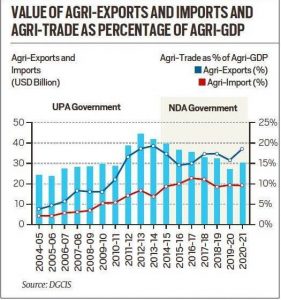
    • Agri-exports touched $41.8 billion in FY 2020-21, registering a growth of 18 per cent over the previous year.
    • Amongst the various agri-commodity exports, rice ranks first with 17.7 million tonnes valued at $8.8 billion, roughly 21 per cent of the total value of agri-exports.
    • It is followed by marine products ($6 billion), spices ($4 billion), bovine (buffalo) meat ($3.2 billion) and sugar ($2.8 billion).

    Trend analysis of agri-exports

    • During the last seven years, agri-exports have remained lower than the level reached in FY2013-14 ($43.3 billion).
    • That was when the highest agri-trade surplus (exports minus imports) was generated ($27.8 billion).
    • That was also when Indian agriculture was most globally integrated, with agri-trade (exports plus imports) touching 20 per cent of the agri-GDP.
    • It has slid to 13.5 per cent by FY2020-21, indicating India is becoming less globally competitive in exports and more protectionist in imports, presumably in the name of Atmanirbhar Bharat.
    • It is high time to review current agri-trade policies and accompanying tariff structures.

    Why sustainability of agri-exports is a concern?

    • From a strategic point of view, however, one must ask whether this growth rate can be sustained over a longer period, and the implications it has for Indian agriculture.
    • Water consumption: India is a water-stressed country with per capita water availability of 1,544 cubic metres in 2011, down from 5,178 cubic metres in 1951.
    • It is well known that a kg of sugar has a virtual water intake of about 2,000 litres.
    • In 2020-21, India exported 7.5 million tonnes of sugar, implying that at least 15 billion cubic metres of water was exported through sugar alone.
    • Rice, needs around 3,000 to 5,000 litres of water for irrigating a kg, depending upon topography.
    • Also, rice cultivation contributes to more than 18 per cent of the GHG emission generated from agriculture.
    • Subsidies: Power and fertiliser subsidies account for about 15 per cent of its value in states like Punjab and Haryana.
    • If these subsidies are withdrawn, rice will not be as preferred a crop with farmers as it is today.

    Way forward

    •  Farming practices such as alternate wetting drying (AWD), direct-seeded rice (DSR) and micro-irrigation will have to be taken up on a war footing.
    • Farmers may be incentivised and rewarded to save water, switch from paddy and sugar to other less water guzzler crops, and reduce the carbon footprint.
    • It is high time that policymakers revisit the entire gamut of rice and sugar systems from their MSP/FRP to their production in an environmentally sustainable manner.
    • At least in the case of rice, procurement will have to be limited to the needs of PDS, and within PDS, it is high time to introduce the option of direct cash transfers.

    Consider the question “Rice and sugar forms the part of India’s agri-basket. However, there are concerns over their sustainability. What are the reasons for concerns and suggest the measure to deal with these concerns” 

    Conclusion

    To maintain the sustainability of the agri-exports, crops must be produced efficiently and with minimal subsidies. The government needs to take steps to ensure that with rice and sugar.

  • India ranks 87th in global energy transition index

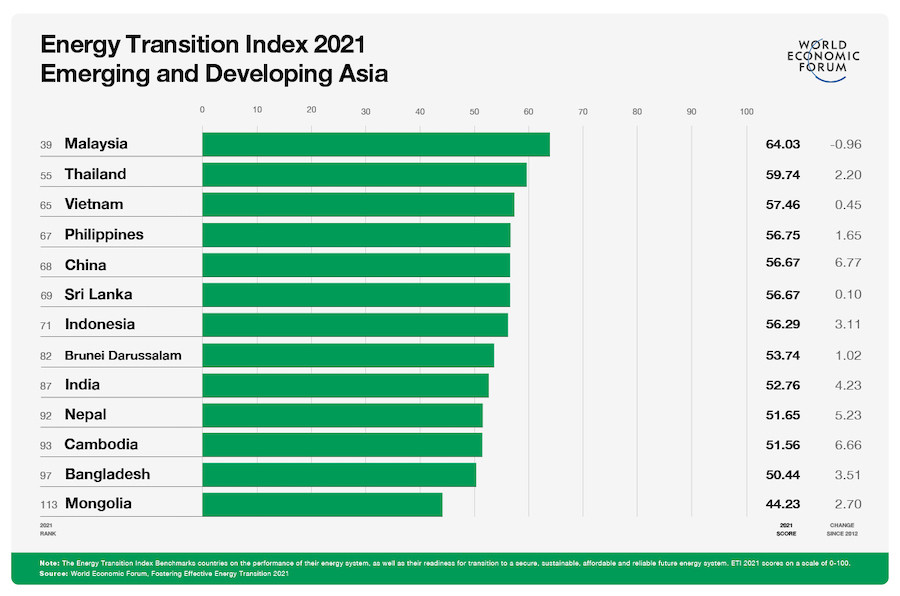
    India has been ranked at the 87th position among 115 countries in the Energy Transition Index (ETI).

    • The latest report is based on a revised ETI methodology that takes into account recent changes in the global energy landscape and the increasing urgency of climate change action.
    • 92 out of 115 countries tracked on the ETI increased their aggregate score over the past 10 years, which affirms the positive direction and steady momentum of the global energy transition

    Highlights of the report:

    • The top 10 countries in the index are Western and Northern European countries.
    • Sweden is in the first position followed by Norway (2nd) and Denmark (3rd).
    • Other countries in the top 10 are Switzerland (4), Austria (5), Finland (6), the United Kingdom (7), New Zealand (8), France (9) and Iceland (10).
    • China (68) and India (87), which collectively account for a third of global energy demand, have both made strong improvements over the past decade, despite coal continuing to play a significant role in their energy mix.
      • “China”s improvements primarily result from reducing the energy intensity of the economy, gains in decarbonising the energy mixthrough the expansion of renewables and strengthening the enabling environment through investments and infrastructure.
    • Zimbabwe is the last ranked country.

    India specific highlights:

    • India has been ranked at the 87th position among 115 countries.
    • India has targeted improvements through subsidy reforms and rapidly scaling energy access, with a strong political commitment and regulatory environment for the energy transition.

    About the Energy Transition Index (ETI):

    • ETI is a report from World Economic Forum (WEF).
    • It is an annual ranking.
    • The index tracks nations on the current performance of their energy systems across various aspects.
    • The index benchmarks 115 countries on the current performance of their energy systems across three dimensions :
      1. Economic development and growth
      2. Environmental sustainability
      3. Energy security and access indicators — and their readiness to transition to secure, sustainable, affordable, and inclusive energy systems.