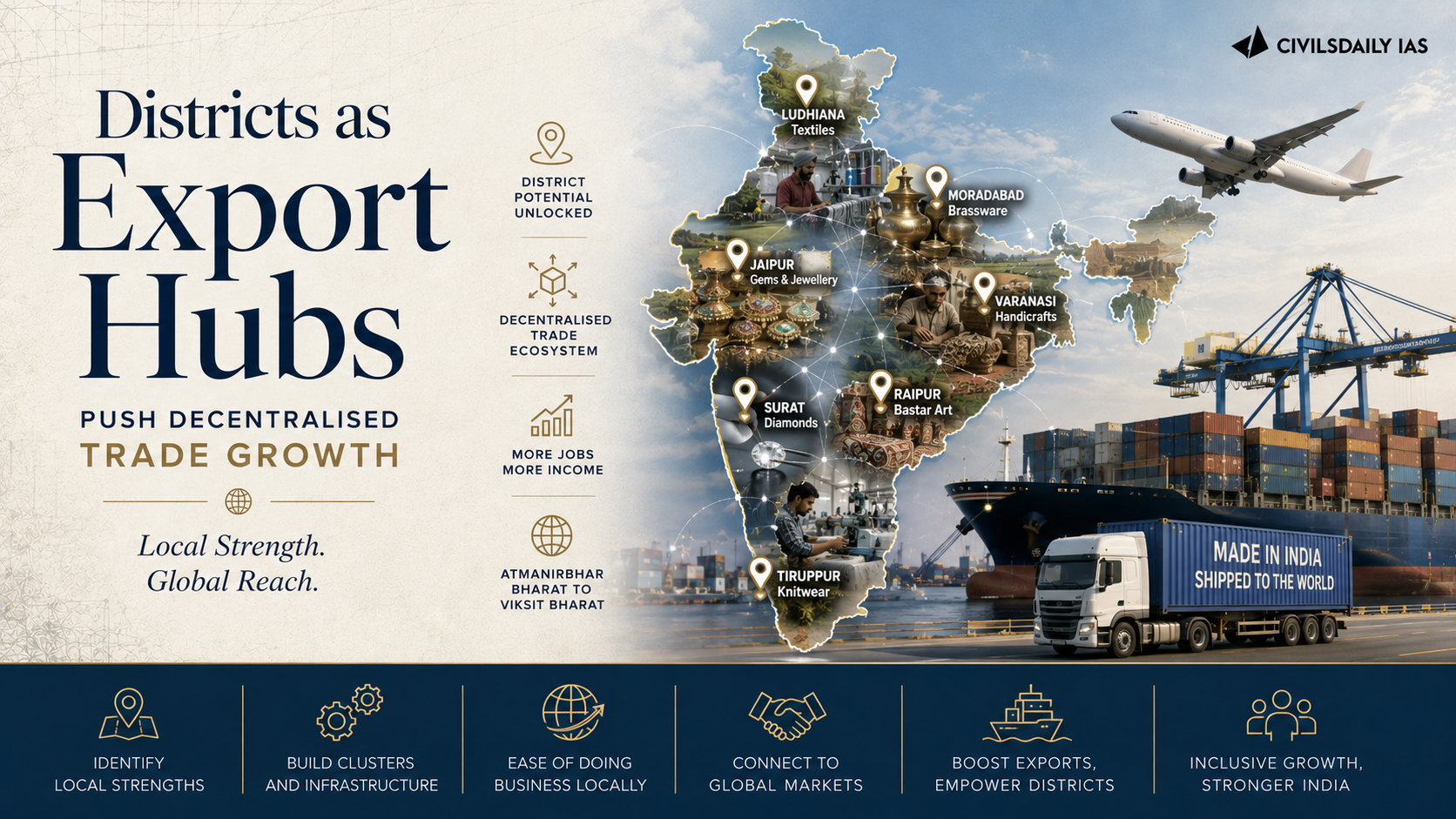
Why in the News
The Districts as Export Hubs (DEH) initiative was profiled as a route to raise India’s export base from the district level.
Core Facts
- Objective: The DEH initiative treats every district as an export hub. It identifies products and services in each district with export potential.
- Institutional design: A State Export Promotion Committee (SEPC) operates at the state level. A District Export Promotion Committee (DEPC) operates at the district level.
- Planning tool: Each district prepares a District Export Action Plan (DEAP). The plan maps products, gaps and support needed.
- Nodal body: The Directorate General of Foreign Trade (DGFT), the agency under the Ministry of Commerce and Industry that regulates India’s exports and imports, coordinates the initiative.
- Convergence: The initiative aligns with the One District One Product (ODOP) programme.
Static Context
- Policy anchor: The Foreign Trade Policy, 2023 institutionalised districts as export hubs as a core strategy.
- Governing agency: DGFT issues the Foreign Trade Policy and administers export promotion schemes.
- ODOP link: ODOP selects one flagship product per district for branding and market access.
Prelims Angle
- Nodal agency for DEH is the DGFT under the Ministry of Commerce and Industry.
- The two tier structure is SEPC and DEPC.
- The policy anchor is the Foreign Trade Policy, 2023, and ODOP convergence is a likely factual hook.
Mains Angle
- GS3, Indian economy and mobilisation of resources: A question can ask how decentralised export promotion raises India’s share in global trade.
- The constraint side: It can probe constraints of logistics, credit and quality certification at the district level.
