Why in the News
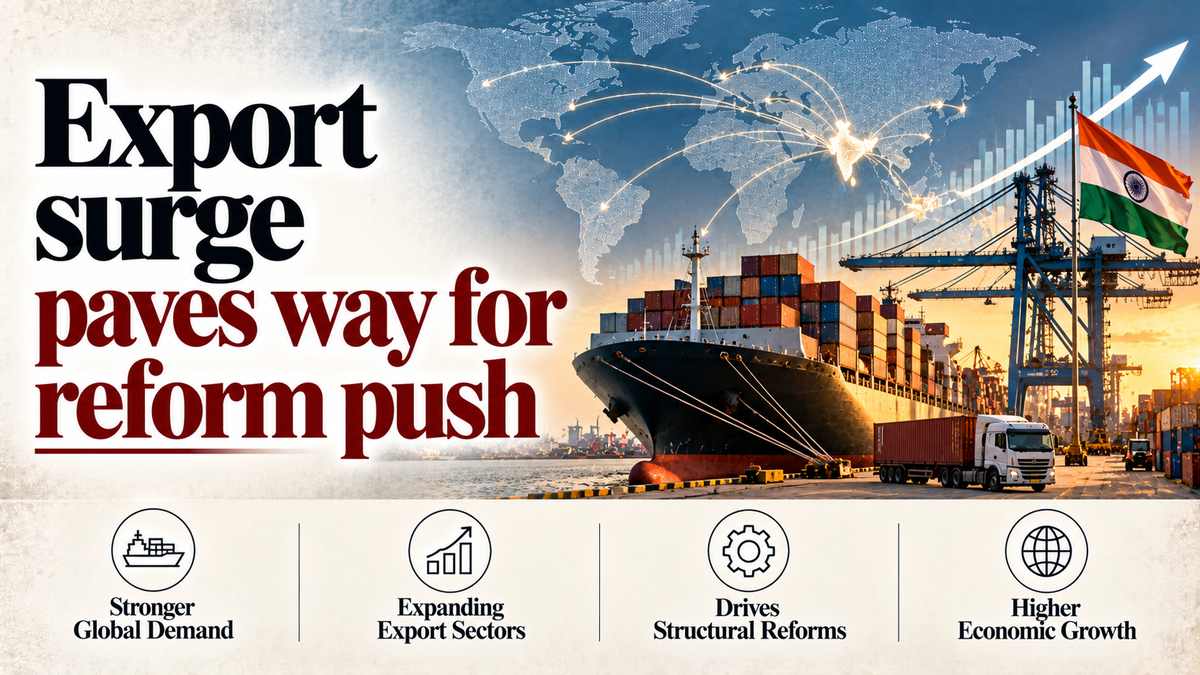
India’s merchandise exports rose 23% to $44.4 billion in September, extending a run of strong months after several sluggish years. The surge is led by engineering and electronics goods and helped by a weaker rupee, even as the trade deficit with China keeps widening.
What are merchandise exports, and why does this surge stand out?
- What it is: Merchandise exports are physical goods a country sells abroad, as distinct from services such as software. Like a shop’s sales counter, they show how much the world buys from Indian factories and farms.
- Why it is tracked: Export earnings pay for imports. When imports exceed exports, the gap is the trade deficit, which India must finance with money from abroad.
- Sluggish record: After a jump in the Covid period, exports barely grew, rising less than 5% in the four years to March 2026.
- The takeaway: Exports are growing fast for the first time in years, so India earns more of the foreign currency it needs to pay for imports.
What is driving the surge?
- Engineering and electronics: Exports of these two segments have crossed $100 billion in the financial year so far, up 26% on the same period last year.
- Share of non-oil exports: The two sectors now make up almost half of all non-oil exports, meaning exports other than petroleum products.
- United States market: The US remains India’s largest export market. Exports to it rose 48% in September, though the tariff terms Washington will apply are still unclear.
- China market: Exports to China are up 36% in the year so far.
- Gulf weakness: Shipments to the Middle East, including the United Arab Emirates (UAE) and Saudi Arabia, remain depressed.
Why does the import side still worry?
- China trade deficit: China holds the largest share of India’s imports. India’s trade deficit with China widened to $68.9 billion in April to September, from $54.4 billion a year earlier.
- Current account deficit: The current account deficit (CAD) is the amount by which India’s payments abroad for goods, services and income exceed its receipts.
- ICRA forecast: Rating agency ICRA expects the CAD to rise to $13 to 15 billion in the July to September quarter.
- Causes of the wider CAD: ICRA expects a modest rise in the merchandise trade deficit. It also expects lower invisible earnings, the receipts from services, remittances and investment income.
Should the RBI let a weaker rupee help exporters?
- Rupee and competitiveness: A weaker rupee makes Indian goods cheaper abroad, so the currency’s decline has helped exporters compete.
- RBI intervention: The Reserve Bank of India (RBI) has announced several measures and intervened in the foreign exchange market to slow the rupee’s fall.
- Stated policy: The RBI says it intervenes only to contain excess volatility, meaning sharp swings in the exchange rate, not to hold a set rate.
- No rupee target: Holding the rupee at a fixed rupee-dollar level would cancel the price advantage exporters now enjoy, so the RBI should avoid targeting one.
Challenges
- Tariff exposure in the US: India’s largest market is also its most uncertain, so a tariff change can quickly reverse gains. Eg. US tariffs of up to 50% on Indian goods (2025).
- Import-heavy electronics: Electronics exports rely on imported components, many of them from China, so higher exports also raise imports.
- Currency-led gains: Competitiveness that comes from a falling rupee fades once the rupee recovers, and a weak rupee raises the cost of imported oil.
Way Forward
- Contentious trade deals: The Ministry of Commerce and Industry should move ahead on the more contentious free trade agreements (FTAs), beyond the several already signed.
- Manufacturing and investment: The government should boost manufacturing and attract more foreign investment to widen the export base.
- Component manufacturing: Expand domestic electronics component production under the Electronics Component Manufacturing Scheme to cut reliance on Chinese inputs.
- Gulf markets: Use the India-UAE Comprehensive Economic Partnership Agreement (2022) to revive shipments to West Asia.
Conclusion
India’s exports are growing again on two strong sectors and a weaker rupee, but the widening deficit with China shows the gains rest partly on imported inputs. Whether exports hold up once the rupee steadies and US tariff terms settle will show if the surge is lasting.
Key numbers
- Exports, April to September: $259 billion in the first half of this financial year.
- Annual exports: $422 billion (2021-22) to $441 billion (2025-26).
Matching Previous Year Question
“[2020] With reference to the international trade of India at present, which of the following statements is/are correct? 1. India’s merchandise exports are less than its merchandise imports. 2. India’s imports of iron and steel, chemicals, fertilisers and machinery have decreased in recent years. 3. India’s exports of services are more than its imports of services. 4. India suffers from an overall trade/current account deficit. Select the correct answer using the code given below: (a) 1 and 2 only (b) 2 and 4 only (c) 3 only (d) 1, 3 and 4 only ANSWER: (d)”
