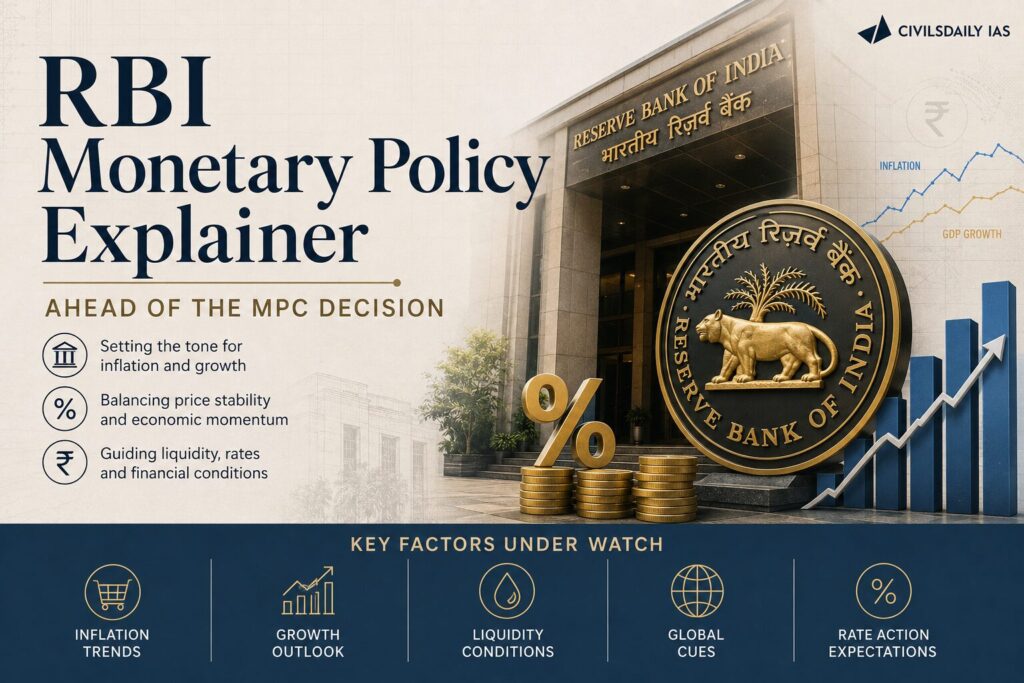
Why in the News
The Monetary Policy Committee (MPC) of the Reserve Bank of India (RBI) is set to announce its bi-monthly monetary policy. Most analysts expect it to keep the repo rate unchanged amid global economic uncertainty.
What is the Monetary Policy Committee (MPC)?
- The MPC decides the policy repo rate to maintain price stability while supporting economic growth.
- Constituted under: Reserve Bank of India Act, 1934 (amended in 2016).
- It meets every two months to review inflation and growth.
Repo Rate & Inflation Target
- Repo Rate: The interest rate at which the RBI lends short-term funds to commercial banks.
- Inflation Target: 4%, with a tolerance band of 2%-6% under the Flexible Inflation Targeting (FIT) framework.
Factors Considered by MPC
- Rising crude oil prices.
- US-Iran geopolitical tensions.
- Weak monsoon and El Niño increasing food inflation.
- Mixed domestic growth indicators.
- Policy stance of major central banks (US Fed, ECB, BoJ, BoE).
Challenges
- Time lag in monetary policy transmission.
- Supply-side inflation (food and fuel) beyond RBI’s control.
- Balancing inflation with economic growth.
- External risks affecting capital flows and the rupee.
- Uncertain global and domestic economic conditions.
Value Addition
- Flexible Inflation Targeting (FIT): Adopted in 2016 to maintain inflation at 4% ± 2%.
- Monetary Policy Tools: Repo Rate, Standing Deposit Facility (SDF), Cash Reserve Ratio (CRR), Statutory Liquidity Ratio (SLR), and Open Market Operations (OMOs).
“[2017] Which of the following statements is/are correct regarding the Monetary Policy Committee (MPC)?
1. It decides the RBI’s benchmark interest rates.
2. It is a 12-member body including the Governor of RBI and is reconstituted every year.
3. It functions under the chairmanship of the Union Finance Minister.
(a) 1 only
(b) 1 and 2 only
(c) 3 only
(d) 2 and 3 only