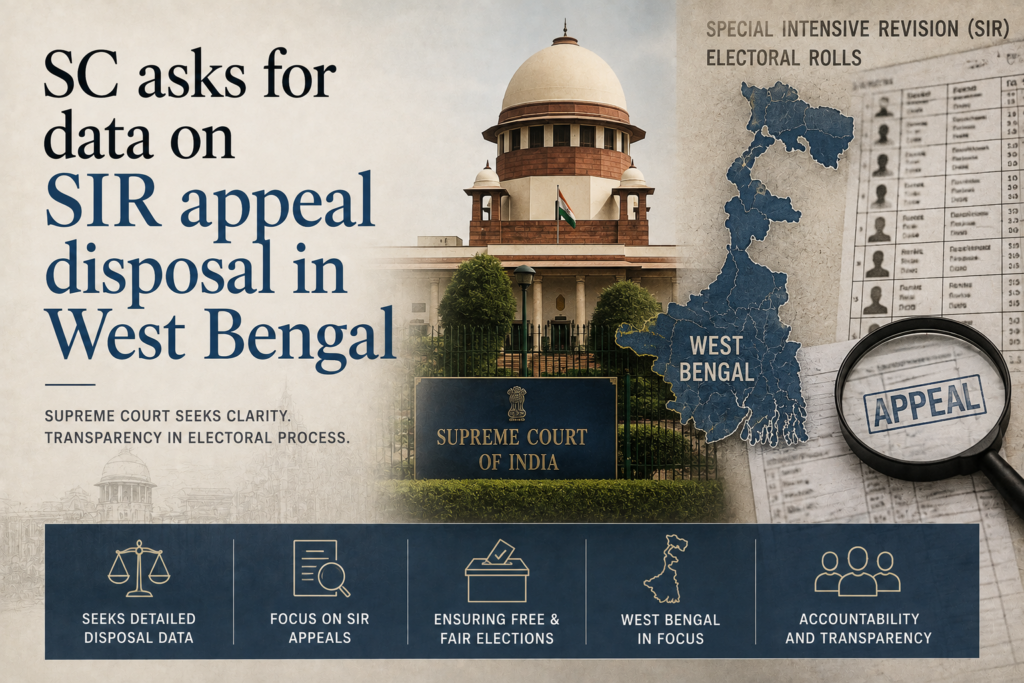
Why in the News
The Supreme Court asked the Election Commission of India to furnish data on the disposal rate of appeals filed by persons excluded from the West Bengal electoral roll during the Special Intensive Revision. The court declined to fix a timeline for the appellate tribunals but signalled it would restructure the disposal architecture if performance is found wanting, exposing the tension between the right to an effective remedy and the slow pace of appeal disposal linked to welfare access.
What is the Special Intensive Revision (SIR) of electoral rolls?
- Definition: The Special Intensive Revision (SIR) is an intensive, house to house verification of electoral rolls conducted by the Election Commission of India to add eligible voters and remove ineligible entries.
- Object: Its stated aim is that no eligible voter is excluded and no ineligible person is included in the draft electoral roll.
- Process: Booth Level Officers collect enumeration forms from households, after which the draft roll is published and objections are heard.
- Appeal route: Persons whose names are excluded may appeal before designated appellate tribunals set up following Supreme Court orders.
What did the Supreme Court direct?
- Data on disposal: The court asked the Election Commission of India to furnish details on the quantum of appeals disposed by the appellate tribunals.
- No fixed timeline: It declined to bind the tribunals to a specific timeline for deciding appeals.
- Focus on quantum: The court clarified it is concerned with the volume and speed of disposal, not the outcome of individual appeals.
- Restructuring option: It indicated it may revisit and restructure the disposal architecture, including online access for the deciding officer, if performance appears wanting.
- Next hearing: The matter was listed for 25 August.
Why does appeal disposal matter beyond the roll?
- Under one percent decided: The petitioner submitted that the tribunals had not decided even one percent of the appeals.
- Welfare linkage: Counsel argued that the State was denying ration and other benefits to those deleted from the rolls whose appeals were pending.
- Access barrier: People from distant areas found it difficult to physically reach the tribunals, prompting the court to examine logistical issues.
- Remedy must be effective: The court observed that merely filing an appeal may not satisfy a litigant if the due process does not yield an outcome.
- Separate cause of action: On the welfare denial, the court advised the petitioner to approach the Calcutta High Court as it involved a different cause of action.
Where does the genuine tension lie?
- Judicial restraint versus effective remedy: The court will not fix a decision timeline for the tribunals, yet insists that an appeal must lead to a real outcome.
- Roll purity versus disenfranchisement: Intensive revision seeks accurate rolls, while slow appeal disposal risks keeping eligible voters excluded.
- Electoral right versus welfare access: Exclusion from the roll is linked to denial of ration and welfare, widening the stakes beyond voting.
- Creator’s duty: As the creator of the tribunals, the court accepts responsibility to ensure the due process it designed actually functions.
About Electoral Roll Management in India
- Definition: The electoral roll is the list of eligible voters for a constituency, maintained and periodically revised by the Election Commission of India.
- Legal basis: Roll preparation and revision are governed by the Representation of the People Act, 1950, and the Registration of Electors Rules, 1960.
- Eligibility: A person may be enrolled only in the constituency where they are ordinarily resident and whose name appears on the roll may contest and vote.
- Revision types: Rolls are updated through summary revision and, where needed, intensive or special intensive revision.
Statutory Framework Governing Electoral Rolls
- Article 324: Vests superintendence, direction, and control of elections and roll preparation in the Election Commission of India.
- Article 326: Provides for adult suffrage as the basis of elections to the Lok Sabha and State Assemblies.
- Representation of the People Act, 1950: Governs allocation of seats and preparation of electoral rolls.
- Representation of the People Act, 1951: Governs the conduct of elections, qualifications, and disqualifications of candidates.
- Registration of Electors Rules, 1960: Prescribes the procedure for enrolment, revision, appeals, and correction of rolls.
Back2Basics: Election Commission of India (ECI)
- Constitutional basis: Established under Article 324 as an independent constitutional body.
- Composition: A Chief Election Commissioner and such number of Election Commissioners as the President fixes.
- Jurisdiction: Conducts elections to Parliament, State legislatures, and the offices of President and Vice President, and maintains electoral rolls.
- Tenure and removal: The Chief Election Commissioner can be removed only through the process applicable to a Supreme Court judge.
- Function in focus: Preparation and revision of electoral rolls, including intensive revision exercises.
“[2017] For election to the Lok Sabha, a nomination paper can be filed by
(a) Anyone residing in India.
(b) A resident of the constituency from which the election is to be contested.
(c) Any citizen of India whose name appears in the electoral roll of a constituency.
(d) any citizen of India.
